





Key Takeaways
- To develop an app like Yassir, businesses must focus on a multi-service super app architecture that combines ride-hailing, food delivery, and digital payments into a single seamless platform with real-time tracking and AI-powered matching.
- The cost to build an app like Yassir typically ranges from $8,000 to $26,000+, depending on feature complexity, number of service modules, platform selection, and third-party integrations.
- The global super app market is projected to grow from $121.10 billion in 2025 to $968.77 billion by 2033 (30.1% CAGR), making super app development a high-growth opportunity, especially in emerging markets.
- A successful Yassir-like app depends on key features such as a unified booking engine, in-app wallet, real-time GPS tracking, push notifications, ratings & reviews, and scalable microservices-based backend architecture.
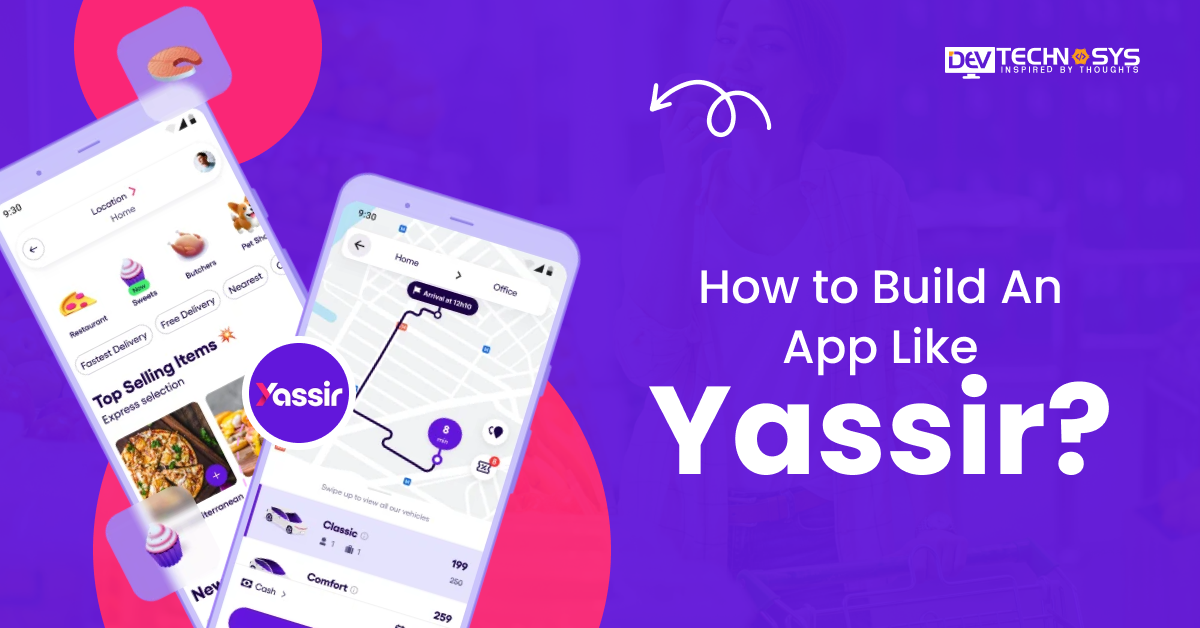
The rise of super apps has transformed how users access everyday services from ride-hailing and food delivery to payments and logistics, all within a single platform. One standout example is Yassir, which has rapidly expanded across multiple regions by offering a seamless multi-service experience. As demand for convenience-driven platforms grows, many businesses are looking to build an app like Yassir to capture this evolving market.
Whether you aim to develop an app like Yassir for transportation, delivery, or a full-scale ecosystem, understanding the right features, technologies, and cost factors is essential. In this guide, we’ll break down everything you need to create an app like Yassir, from development steps to monetization strategies and scalability considerations.
What is Yassir?
Yassir is a leading on-demand super app that offers a wide range of services, including ride-hailing, food delivery, and digital payments, all on a single platform. Originally launched in Algeria, it has expanded across the Middle East and Africa, becoming a strong regional competitor to global platforms.
The app connects users with drivers, merchants, and service providers through a seamless interface, enabling real-time bookings and transactions. Its multi-service model makes it a popular Yassir alternative for businesses aiming to build a super app like Yassir and deliver convenience, scalability, and an integrated digital ecosystem.
How Does Yassir Work?
Yassir operates as a unified super app that connects users, service providers, and merchants on a single platform. The working model is straightforward: users open the app, select a service, and get it delivered to their doorstep or destination in real time.
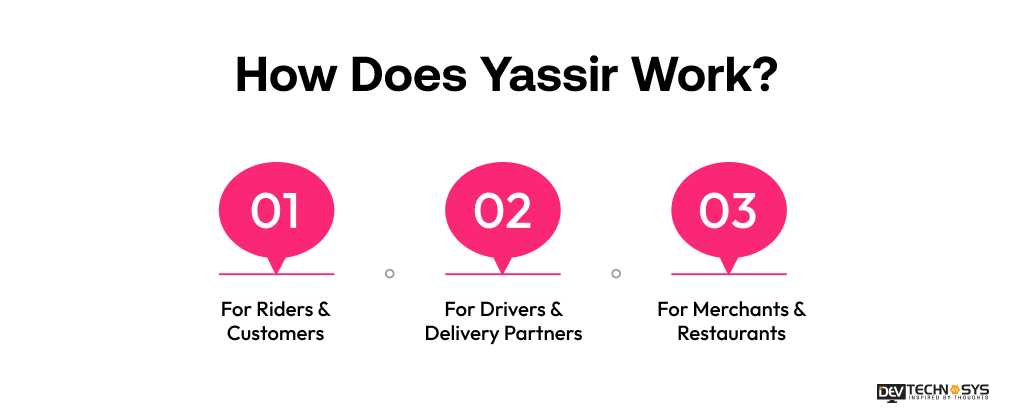
1. For Riders & Customers
Users sign up, enter their location, and instantly book a ride, order food, or request a delivery. The app matches them with the nearest available driver or merchant and provides live tracking throughout.
2. For Drivers & Delivery Partners
Drivers register on the platform, complete verification, and go online to start accepting ride or delivery requests. They receive real-time job alerts, navigate using in-app maps, and get paid directly through the platform.
3. For Merchants & Restaurants
Restaurants and stores list their products or menus on the app. When an order is placed, they receive an instant notification, prepare the order, and hand it off to a Yassir delivery partner for last-mile fulfillment.
What is the Market Size for a Super App Like Yassir?
According to Grand View Research, here are the market stats for supper apps like Yassir:
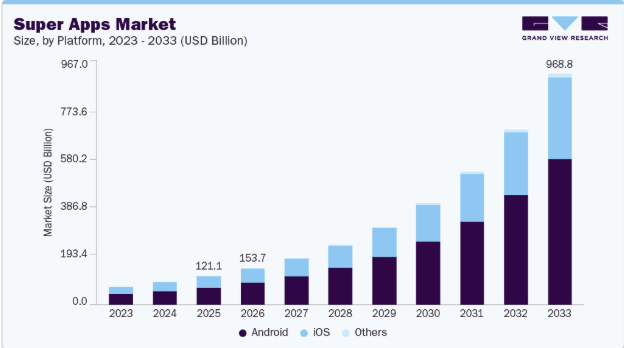
- The global super apps market was valued at $121.10 billion in 2025 and is projected to reach $968.77 billion by 2033, growing at a CAGR of 30.1%.
- Asia Pacific held the largest revenue share of over 48% in 2025, with China leading the region.
- The Android platform dominated with over 60% market share, while smartphones accounted for over 76% of device usage across super app platforms.
- The consumer segment is expected to grow at the fastest CAGR of 30%+ between 2026 and 2033, driven by demand for convenience and seamless digital experiences.
- Rising smartphone adoption, mobile internet expansion in emerging markets, and AI-driven personalization are the key forces accelerating super app growth globally.
Why Do Entrepreneurs Invest in Building a Yassir Clone App?
The super app model is one of the most lucrative business opportunities in today’s digital economy. Instead of building a single-service app, entrepreneurs who invest in a Yassis alternative gain access to multiple revenue streams, a larger user base, and stronger retention all within one platform.
Markets across Africa, the Middle East, and Southeast Asia remain largely underserved by global tech giants, leaving enormous white space for regional super apps to dominate. With rising smartphone penetration and a mobile-first population, the timing and conditions have never been more favorable for entrepreneurs to develop a super app like Yassir.
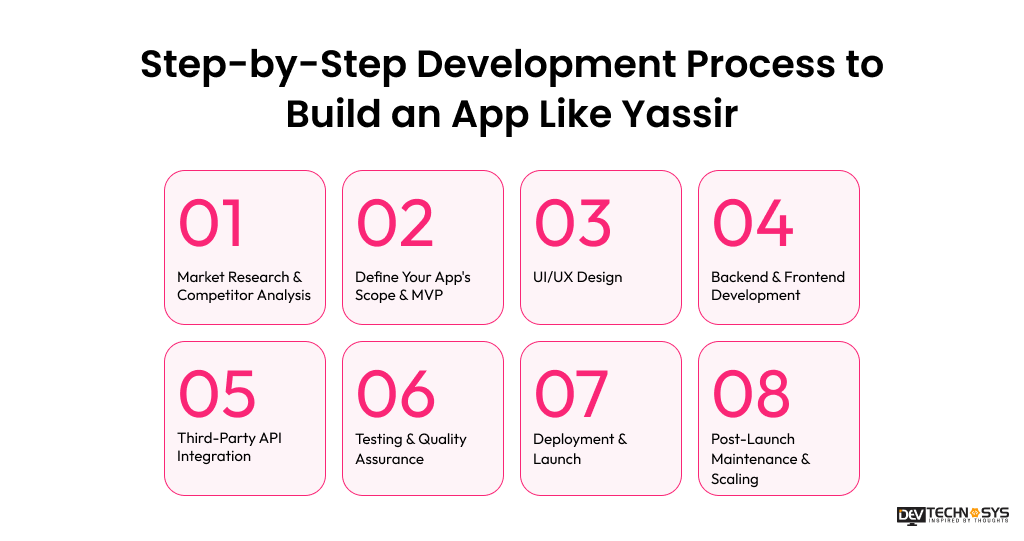
Step-by-Step Development Process to Build an App Like Yassir
Building a Yassir clove is not a single task;k it is a structured journey that requires careful planning, the right technology choices, and an experienced development team. Here is a step-by-step breakdown of how the development process works, from initial research to post-launch growth.
1. Market Research & Competitor Analysis
Before writing a single line of code, study your target market deeply. Identify your geography, analyze competitors like Yassir, Careem, and InDrive, understand local user behavior, and map out regulatory requirements. This step defines the foundation of every decision that follows from features to monetization.
2. Define Your App’s Scope & MVP
Avoid building everything at once. Define which service vertical you will launch first: ride-hailing, food delivery, or fintech. A focused MVP reduces time-to-market, controls initial costs, and allows you to validate product-market fit before expanding into a full multi-service super app.
3. UI/UX Design
Design is your first impression. Create user personas, map out user flows, and build wireframes for all four interfaces: user, driver, merchant, and admin. Prioritize localization, RTL language support, and a unified design language that feels consistent across every service vertical within the app.
4. Backend & Frontend Development
This is where your app comes to life. Hire dedicated developers to build the core architecture using microservices, set up APIs, and create all client-facing interfaces. The backend handles matching algorithms, real-time data synchronization, payment logic, and database management that power every interaction on the platform.
5. Third-Party API Integration
No super app is built in isolation. Integrate essential third-party services, including Google Maps for geolocation, payment gateways for transactions, Twilio or Africa’s Talking for SMS, and Firebase for push notifications. These API integrations for super apps dramatically reduce development time while adding proven, reliable functionality to your platform.
6. Testing & Quality Assurance
Rigorous testing is non-negotiable for a super app. Run unit tests, integration tests, performance load tests, and security audits across all modules. Testing on real devices across varying network conditions is especially important for emerging markets where connectivity can be inconsistent, and device specs vary widely.
7. Deployment & Launch
Deploy your app on AWS or Google Cloud, submit to the App Store and Google Play, and execute a soft launch in one city before scaling. A controlled launch lets you monitor real-world performance, gather early user feedback, and fix critical issues before a full-scale market rollout.
8. Post-Launch Maintenance & Scaling
Launch is just the beginning. Monitor crash reports, track KPIs, and release regular updates based on user feedback. As your user base grows, scale your infrastructure, add new service verticals, and continuously optimize performance. Budget 15–20% of your build cost annually for ongoing mobile app maintenance costs and improvements.
7 Key Features of a Yassir-Like Super App in 2026
Building a competitive super app requires more than just combining multiple services under one roof. The features you build define the user experience, retention, and ultimately your revenue. Here are the 8 most critical features your Yassir-like app must have.
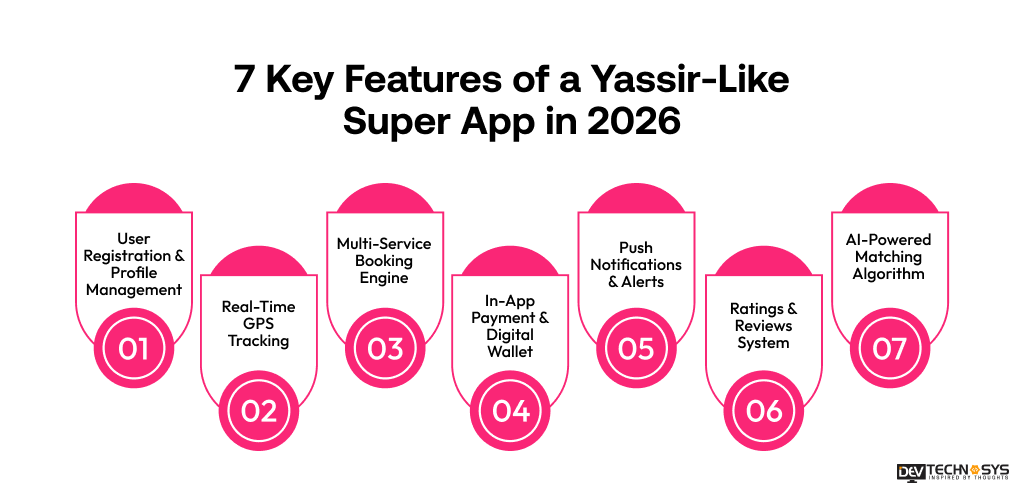
1. User Registration & Profile Management
A smooth onboarding experience sets the tone for everything that follows. Users should be able to sign up via phone number, email, or social login, complete their profile, and access all services instantly without repetitive verification steps across different modules within the app.
2. Real-Time GPS Tracking
Live tracking is the backbone of any on-demand super app. Users expect to see their driver, delivery partner, or order status updating in real time on a map. Accurate, low-latency GPS tracking builds trust, reduces support queries, and significantly improves the overall user experience.
3. Multi-Service Booking Engine
A unified booking engine allows users to switch between ride-hailing, food delivery, and grocery ordering without leaving the app. This single-interface approach is what separates a super app from a collection of standalone apps and is central to driving cross-service engagement and retention.
4. In-App Payment & Digital Wallet
Seamless payments are non-negotiable. Users should be able to pay via card, cash, or an in-app wallet and switch between them effortlessly. A built-in digital wallet also opens doors to fintech revenue streams like peer-to-peer transfers, bill payments, and micro-lending down the line.
5. Push Notifications & Alerts
From order confirmations and driver arrivals to promotional offers and loyalty rewards, a well-executed push notification system directly impacts user retention, repeat usage, and overall lifetime value of each customer on the platform.
6. Ratings & Reviews System
Trust is the currency of on-demand platforms. A transparent ratings and reviews system allows users to rate drivers and merchants after every interaction, helping maintain service quality across the platform. It also gives service providers constructive feedback and motivates consistently high performance.
7. AI-Powered Matching Algorithm
AI in a super app has become essential today. AI-powered matching connects users with the nearest, highest-rated, and most available driver or merchant in seconds. It factors in location, traffic, demand patterns, and historical data to optimize every match, reducing wait times and improving service efficiency.

Tech Stack Used to Build a Super App Like Yassir
Choosing the right technology stack is one of the most critical decisions in super app development. Below is a comprehensive breakdown of the technologies used across every layer of a Yassir-like platform.
Category |
Technology |
Description |
| Frontend (Mobile) | React Native, Flutter | Cross-platform frameworks for building iOS and Android apps from a single codebase, reducing development time and cost significantly |
| Frontend (Web) | React.js, Next.js | Modern JavaScript frameworks for building fast, SEO-friendly web interfaces, including the admin panel and merchant dashboard |
| Backend | Node.js, Python (FastAPI), Go | Scalable server-side technologies that handle API requests, business logic, and microservices architecture across all service verticals |
| Maps & Geolocation | Google Maps API, Mapbox | Powers location search, route optimization, distance calculation, and real-time driver tracking across the ride-hailing and delivery modules |
| Payment Gateway | Stripe, Paymob, Orange Money | Secure payment processing integrations supporting cards, digital wallets, and local payment methods across MENA and African markets |
| Push Notifications | Firebase (FCM), OneSignal | Delivers real-time push notifications to users and drivers for order updates, promotions, and ride alerts across iOS and Android devices |
| Cloud Infrastructure | AWS, Google Cloud Platform | Scalable cloud platforms for hosting, storage, and computing resources that support high availability and global deployment |
| DevOps & CI/CD | Docker, Kubernetes, GitHub Actions | Containerization and orchestration tools that automate the deployment, scaling, and management of microservices in production environments |
How Much Does It Cost to Build an App Like Yassir?
The average cost to build an app like Yassir can range between $8,000 and $26,000. A basic version with essential features like user registration, booking, and simple payments falls on the lower end, while a fully scalable super app with multi-service modules, advanced APIs, and real-time synchronization reaches the higher range.
App Complexity |
Features Included |
Estimated Cost |
| Basic MVP App | User login, ride booking, simple UI, basic payment integration | $8,000 – $12,000 |
| Mid-Level App | Real-time tracking, multiple services (ride + delivery), push notifications, chat | $12,000 – $18,000 |
| Advanced Super App | Multi-service ecosystem, wallet, AI features, analytics dashboard, scalable architecture | $18,000 – $26,000 |
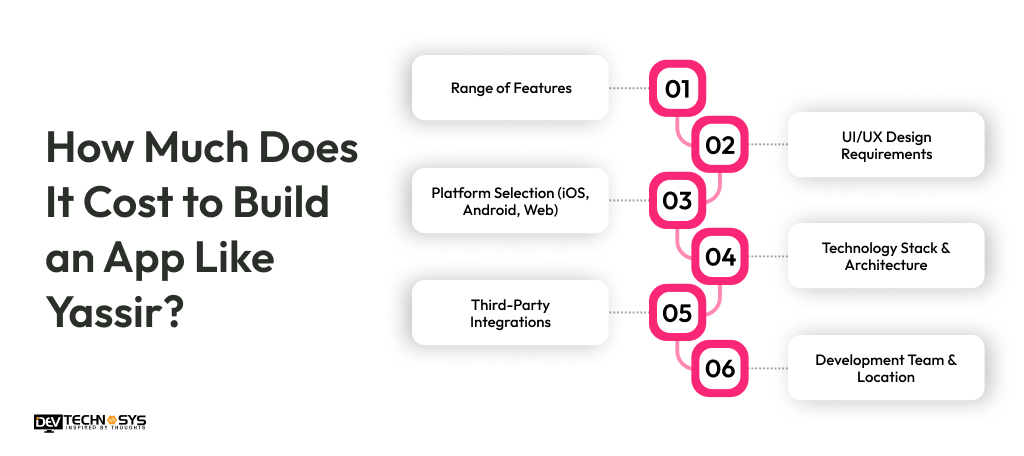
Several factors influence the overall cost to develop an app like Yassir, including design complexity, technology choices, and integrations. Below are the factors that affect the super app development cost.
1. Range of Features
The number of features directly impacts development cost because each additional module,e such as ride booking, delivery, wallet, and tracking, increases backend complexity, API calls, testing time, and overall system architecture requirements for a scalable super app.
Feature Tier |
Features Included |
Affected Cost (USD) |
| Basic | Login, simple ride booking, basic UI | $500 – $1,000 |
| Mid-Level | Ride + delivery, tracking, notifications, chat | $1,000 – $1,800 |
| Advanced | Full super app, wallet, analytics, real-time sync | $1,800 – $2,500 |
2. UI/UX Design Requirements
UI/UX design affects cost because creating a seamless and intuitive interface requires extensive wireframing, prototyping, animations, and user flow optimization. More complex designs increase design hours and testing cycles for better user engagement and retention.
Feature Tier |
Features Included |
Affected Cost (USD) |
| Basic | Standard templates, minimal UI | $800 – $1,500 |
| Mid-Level | Custom UI, better user flow | $1,500 – $2,400 |
| Advanced | Premium UI, animations, advanced UX | $2,400 – $3,500 |
3. Platform Selection (iOS, Android, Web)
Platform selection impacts cost because building separate Android app development, iOS, and web requires additional development, testing, and optimization efforts. Each platform increases workload for maintaining consistent performance and user experience across devices.
Feature Tier |
Features Included |
Affected Cost (USD) |
| Basic | Single platform (Android or iOS) | $2,000 – $3,000 |
| Mid-Level | Cross-platform development | $2,000 – $3,000 |
| Advanced | Android + iOS + Web app | $3,000 – $5,000 |
4. Technology Stack & Architecture
Technology stack affects cost because advanced architectures like microservices and cloud infrastructure require higher engineering effort, deployment complexity, and scalability planning to support large-scale super app operations with real-time performance and reliability.
Feature Tier |
Features Included |
Affected Cost (USD) |
| Basic | Monolithic backend | $600 – $1,200 |
| Mid-Level | Cloud backend, scalable APIs | $1,200 – $2,000 |
| Advanced | Microservices, high scalability systems | $2,000 – $3,000 |

5. Third-Party Integrations
Third-party integrations increase cost because connecting external services like payments, maps, SMS, and real-time tracking requires secure configuration, testing, and continuous maintenance to ensure smooth and reliable communication between systems.
Feature Tier |
Features Included |
Affected Cost (USD) |
| Basic | Basic APIs (login, notifications) | +$0 – $2,000 |
| Mid-Level | Payment + chat + booking APIs | +$2,000 – $5,000 |
| Advanced | Real-time tracking, advanced APIs | +$5,000 – $7,000 |
6. Development Team & Location
Development team location affects cost because hourly rates, expertise level, and communication efficiency vary across regions. Offshore teams are more affordable, while onshore teams increase cost due to higher expertise and better project management quality.
Feature Tier |
Features Included |
Affected Cost (USD) |
| Basic | Small offshore team | $1,000 – $2,000 |
| Mid-Level | Experienced hybrid team | $2,000 – $5,000 |
| Advanced | Expert onshore team | $5,000 – $8,000 |
Top Apps Like Yassir You Should Know
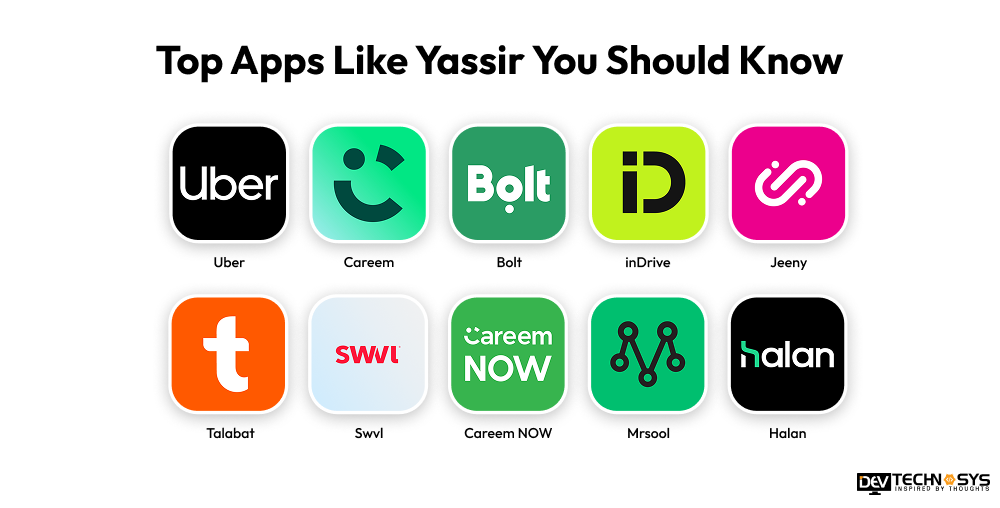
If you plan to make an app like Yassir, analyzing competitors is essential to understand positioning, features, and scalability. Here are five top super apps in the Middle East and mobility ecosystem across the MENA region and beyond.
App |
Market |
Model |
Key USP |
Category |
| Careem | UAE + MENA | Super App | Ride-hailing + delivery + payments | Mobility |
| Uber | Global | Ride-hailing | Global brand, AI-based pricing | Mobility |
| Bolt | Europe + Africa | Ride-hailing | Low-cost rides, fast expansion | Mobility |
| inDrive | Global | P2P Ride-hailing | User-set pricing model | Mobility |
| Jeeny | Saudi + Jordan | Ride-hailing | Localized pricing strategy | Mobility |
| Swvl | Egypt + GCC | Mass Transit | Fixed-route shared rides | Transport |
| Talabat | MENA | Food Delivery | Strong logistics + brand presence | Delivery |
| Careem NOW | MENA | Delivery | Integrated within the Careem super app | Delivery |
| Mrsool | Saudi Arabia | On-demand Delivery | Anything delivery model | Hyperlocal |
| Halan | Egypt | Super App | Ride + fintech integration | Mobility |
1. Uber
Uber is a global leader in mobility services, known for its advanced pricing algorithms and seamless user experience. Businesses aiming to develop an app like Yassir can learn from its scalable architecture and partner with expert super app development services providers.
2. Careem
Careem is a leading super app across the Middle East, offering ride-hailing, food delivery, and payments in one platform. It is a great benchmark if you want to build an app like Yassir, especially when working with a reliable super app development company.
3. inDrive
inDrive introduces a unique peer-to-peer pricing model where users negotiate fares directly with drivers. This flexible approach is ideal if you want to create an app like Yassir using an innovative super app development solution that differentiates your platform.
4. Bolt
Bolt focuses on affordability and fast expansion across emerging markets. Its cost-efficient model is useful for startups planning to make an app like Yassir while carefully evaluating mobile app development costs and market entry strategies.
5. Halan
Halan combines ride-hailing with fintech services, offering payments and lending within the same ecosystem. It is a strong example for entrepreneurs looking to build a super app like Yassir and develop a multi-service super app targeting diverse user needs.
Monetization Models for a Yassir Alternative in 2026
Building a super app is not just about features; it is about creating sustainable revenue streams. If you plan to build an app like Yassir, choosing the right monetization strategy ensures long-term profitability while keeping the user experience seamless and scalable.
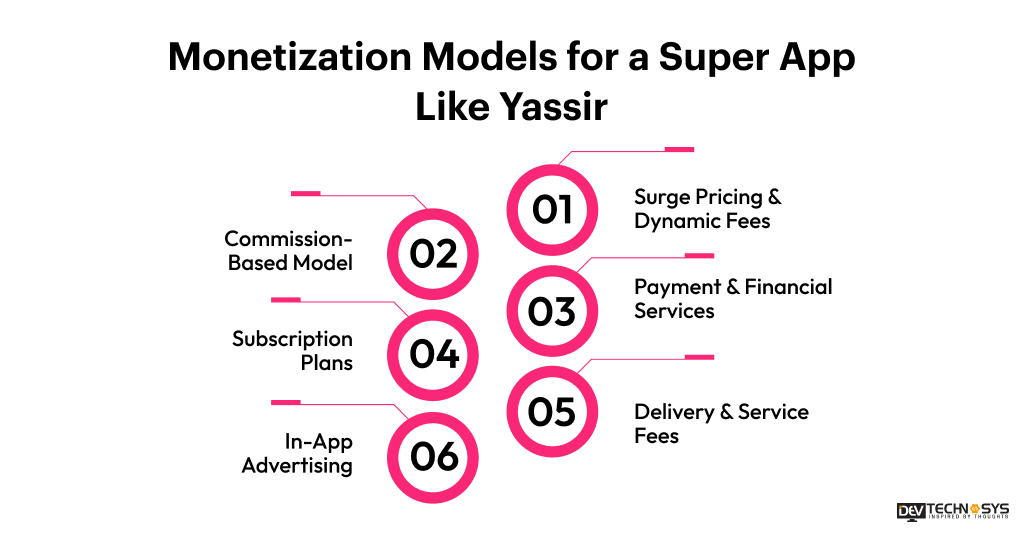
1. Commission-Based Model
One of the most common revenue streams is charging a commission on every transaction. Whether it is ride-hailing, food delivery, or e-commerce, taking a percentage from service providers helps generate consistent income as your platform scales.
2. Subscription Plans
Offering premium memberships for users or service providers can create recurring revenue. Features like priority bookings, discounted services, or enhanced visibility for vendors make subscription models highly attractive in a competitive super app ecosystem.
3. In-App Advertising
Super apps attract massive user traffic, making them ideal for targeted advertising. Businesses can pay to promote their services within the app, while you benefit from high-margin ad revenue without disrupting core functionalities.
4. Surge Pricing & Dynamic Fees
Implementing dynamic pricing during peak hours or high demand allows platforms to maximize earnings. This model is widely used in ride-hailing apps and ensures service availability while increasing revenue during busy periods.
5. Payment & Financial Services
Integrating digital wallets, bill payments, or lending services opens additional revenue streams. Transaction fees and financial service commissions can significantly boost profitability while enhancing user convenience within the app.
6. Delivery & Service Fees
Charging delivery or service fees for logistics-based offerings is another reliable income source. Transparent pricing combined with efficient service builds trust and encourages repeat usage. A well-balanced combination of these monetization models can help you scale your super app efficiently while maintaining user satisfaction and competitive advantage.
Why Partner with a Super App Development Company?
Building a Yassir clone demands far more than just coding ability; it requires domain expertise, proven architecture experience, and a team that has navigated the real challenges of multi-service platform development.
Dev Technosys is a leading super app development company with 15+ years of experience delivering complex, scalable on-demand platforms across the Middle East, Africa, and beyond.
Whether you want to launch an MVP quickly or build a full-scale multi-service ecosystem, Dev Technosys offers end-to-end development, dedicated engagement models, transparent pricing, and long-term post-launch support, making it the partner you can trust to bring your super app vision to life.

Conclusion
The success of Yassir proves that the super app model is not exclusive to Asia; it is a global opportunity waiting to be seized in the right markets. Africa, the Middle East, and other emerging economies are ripe for a well-built, localized multi-service platform that solves real everyday problems.
If you are ready to build an app like Yassir, the roadmap is clear: start with a focused MVP, choose the right tech stack, and partner with an experienced team that knows how to scale. Dev Technosys, with 15+ years of experience as a mobile app development company, is equipped to turn your super app vision into a market-ready reality.
FAQs
Q1. How much does it cost to build an app like Yassir?
The cost to build a super app like Yassir typically ranges between $8,000 and $26,000+, depending on the number of service verticals, features, platform (iOS/Android), and the development team’s location. Starting with an MVP for a single service vertical is the most cost-effective approach before scaling into a full super app.
Q2. How long does it take to develop a super app like Yassir?
A focused MVP with one core service vertical takes approximately 1–2 months to develop. A full-scale super app covering ride-hailing, food delivery, fintech, and e-commerce can take anywhere between 4–6+ months. Timeline depends heavily on team size, feature complexity, third-party integrations, and the number of platforms being targeted simultaneously.
Q3. What is the difference between a super app and a regular on-demand app?
A regular on-demand app delivers a single service: rides, food, or groceries. A super app like Yassir clone consolidates multiple services, payments, and user accounts into one unified platform. This creates stronger user retention, higher lifetime value, cross-service revenue opportunities, and a significant competitive moat that single-service apps simply cannot replicate.
Q4. Do I need separate apps for users, drivers, and merchants?
Yes. A fully functional Yassir-like super app requires four distinct interfaces: a user app, a driver/delivery partner app, a merchant/restaurant app, and a web-based admin panel. Each interface is tailored to the specific workflows, permissions, and real-time data needs of that particular user type within the platform ecosystem.
Q5. Which markets are best suited for launching a super app like Yassir?
Africa, the Middle East, and Southeast Asia are the most promising markets for super app launches today. These regions have large mobile-first populations, rapidly growing smartphone penetration, underpenetrated digital payment infrastructure, and limited competition from global platforms. This creates the ideal conditions for a well-localized super app to gain rapid traction and scale.