





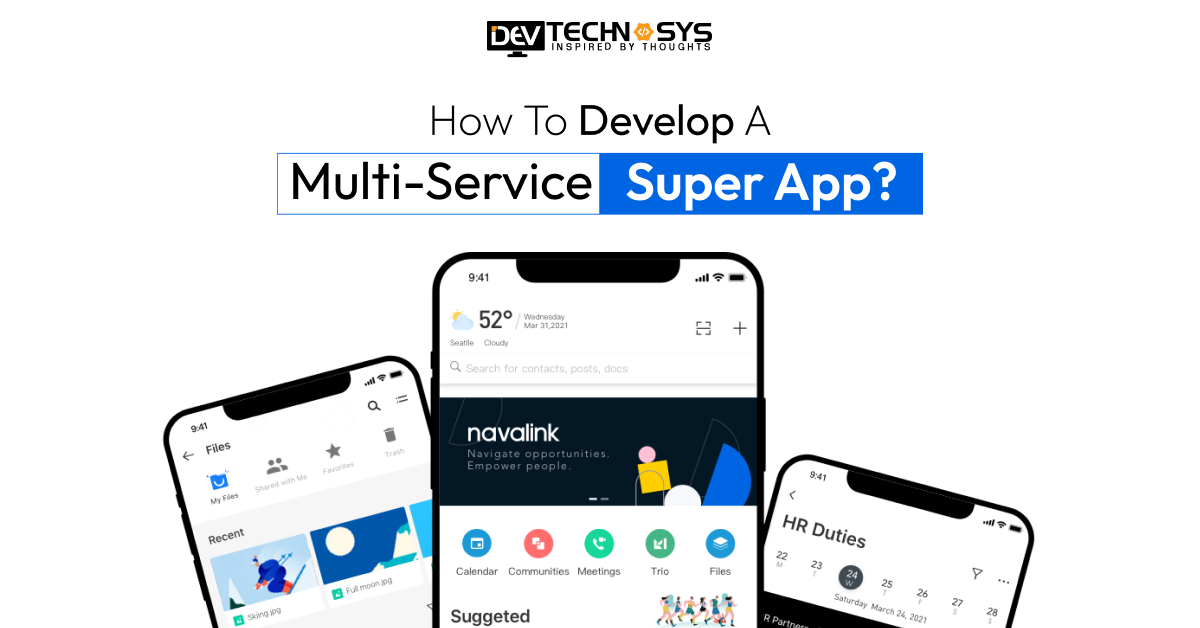
Why fill your phone’s storage with several apps when you can get all services in one? Yes, you heard it right! With a cross-platform multi-service app, you can find various services in a single platform, from ride booking to paying bills. Now, there must be a lot of questions in your mind: what is a multi-service app? Why is it gaining popularity?
Or, if you are a business looking to enter the competitive Middle East market with your own super app, you may have a lot of queries. How to develop a multi-service super app? How much does it cost to build a multi-service super app? Which development company to turn to?
Well, worry not! In this helpful guide, we will answer all of these queries regarding multi-service super app development. From feature to development process to cost requirements, we will address every factor one by one. So stay tuned in!
Multi-Service App Market
- Super applications market size stood at USD 125 Billion in 2024 and is forecast to achieve USD 300 Billion by 2033, registering a 5% CAGR from 2026 to 2033..
- North America contributed the largest share, accounting for approximately 35% of the total Multi-service Platforms market revenue.
- The cloud services market worldwide is expected to make $832 billion by It reveals a clear tuning between technological progress and the expansion of integrated service offerings.
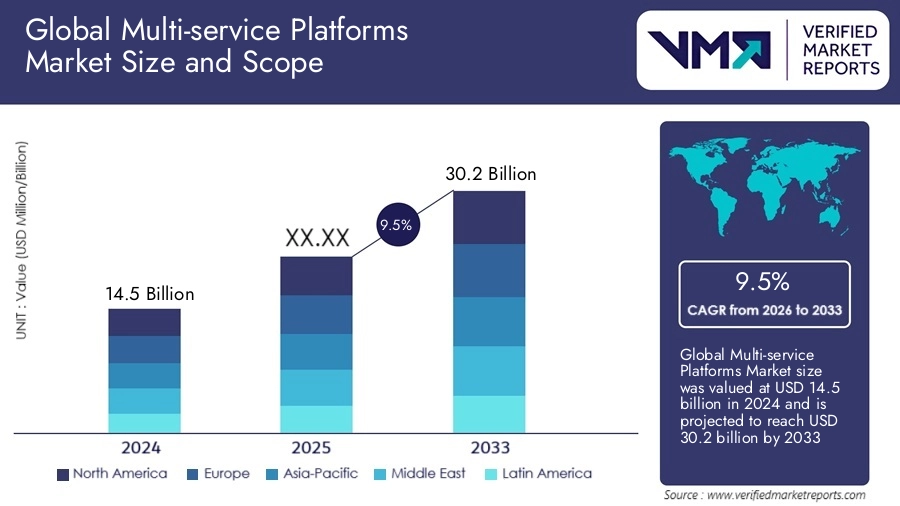
- The Asia Pacific region is projected to experience the highest CAGR during the prediction period, driven by the adoption of AI in super app and other advanced technologies across emerging economies.
- Research indicates that companies and businesses that adopt AI and machine learning can see a 20–25% increase in customer satisfaction, positioning them favorably within the competitive landscape.
What is a Multi-service Super App?
A super-app, also known as an everything app, is a mobile or web app that provides multiple services. A multi-service super app integrates numerous services ranging from food ordering to financial services and lifestyle utilities in a single app interface.
These “all-in-one” applications aim to provide convenience for users by consolidating various tasks and transactions into a single platform. Examples of multi-service super apps include: WeChat, Alipay, Grab, and Gojek.
Why Should Businesses Invest in Multiservice App Development?
Businesses should invest in multi-service super app development to reach a broader audience, generate diverse revenue streams, boost customer loyalty, and gain a competitive edge. Let’s learn about the benefits of multi-service super apps in detail:
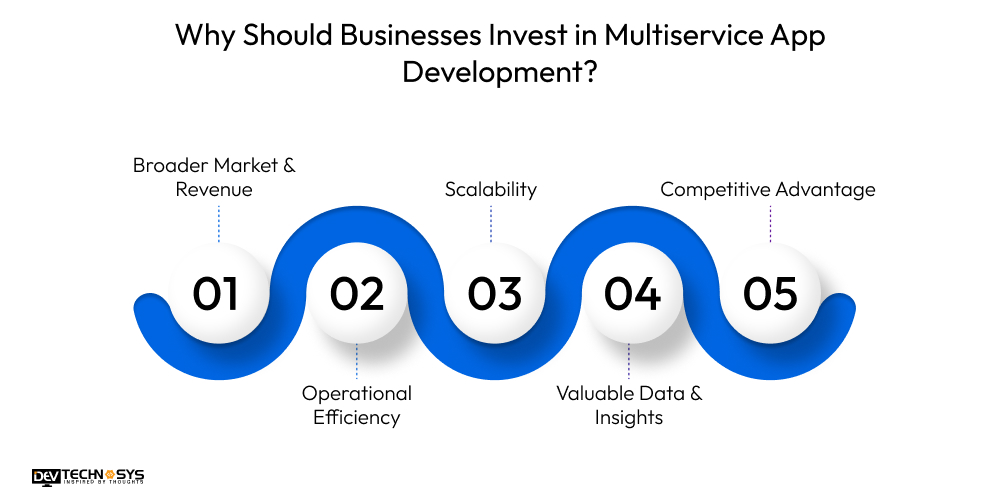
1. Broader Market & Revenue
Wider market reach is a big reason to develop a multi-service super app. It helps companies to reach border markets and attract a large consumer base. It also enables them to generate multiple revenue streams from various services.
2. Operational Efficiency
Deciding to build a multi-service super app is beneficial for businesses, as it reduces the complexities and costs related to management, leading to increased efficiency and lower overheads.
3. Scalability
Operational efficiency is another reason why businesses should invest in multi-service super app. It can easily scale by adding new services to the existing platform, allowing the app to grow and adapt to the latest trends.
4. Valuable Data & Insights
By investing to make a multi-service super app, businesses can collect rich user data on service preferences and behaviors. It offers valuable insights to tailor services, optimize marketing strategies, and inform business decisions.
5. Competitive Advantage
Businesses can build multi-service digital ecosystem app that offers advanced features and a customer experience, thereby setting themselves apart from their competitors.
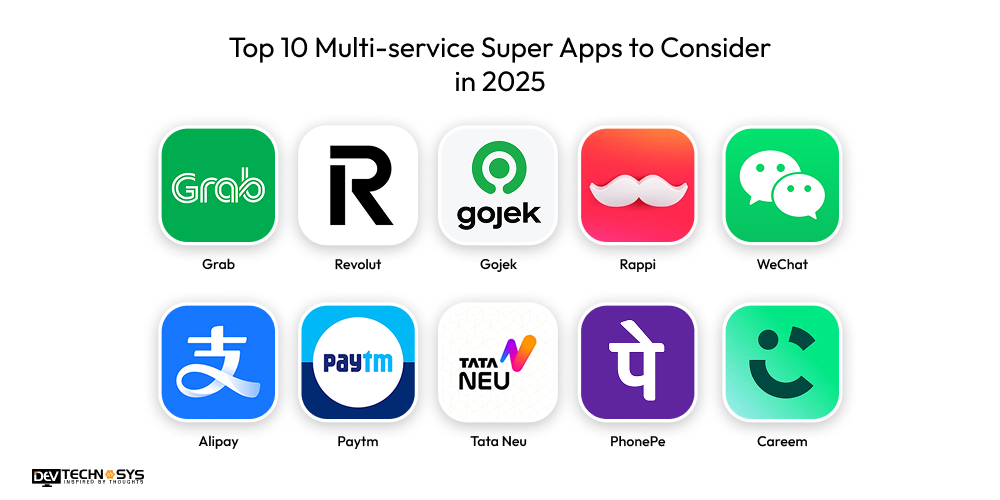
Top 10 Multi-service Super Apps to Consider in 2025
Here are some of the top super apps in the Middle East that you can explore in 2025.
App |
Launch Year |
Ratings |
Downloads |
Platforms |
| Grab | 2012 | 4.8★ | 100M+ | Android, iOS |
| Revolut | 2015 | 4.5★ | 50M+ | Android, iOS, Web |
| Gojek | 2010 | 4.7★ | 100M+ | Android, iOS |
| Rappi | 2015 | 4.5★ | 50M+ | Android, iOS |
| 2011 | 4.3★ | 1B+ | Android, iOS | |
| Alipay | 2004 | 4.4★ | 500M+ | Android, iOS |
| Paytm | 2010 | 4.6★ | 100M+ | Android, iOS |
| Tata Neu | 2022 | 4.2★ | 90M+ | Android, iOS, Web |
| PhonePe | 2015 | 4.5★ | 500M+ | Android, iOS |
| Careem | 2012 | 4.6★ | 50M+ | Android, iOS |
What are the Steps to Develop A Multi-service Super App?
Although constructing a multi-service app with mini-programs seems like a complex task, it’s not as daunting as it may seem. Now, let us guide you through the stages of multi-service super app development:
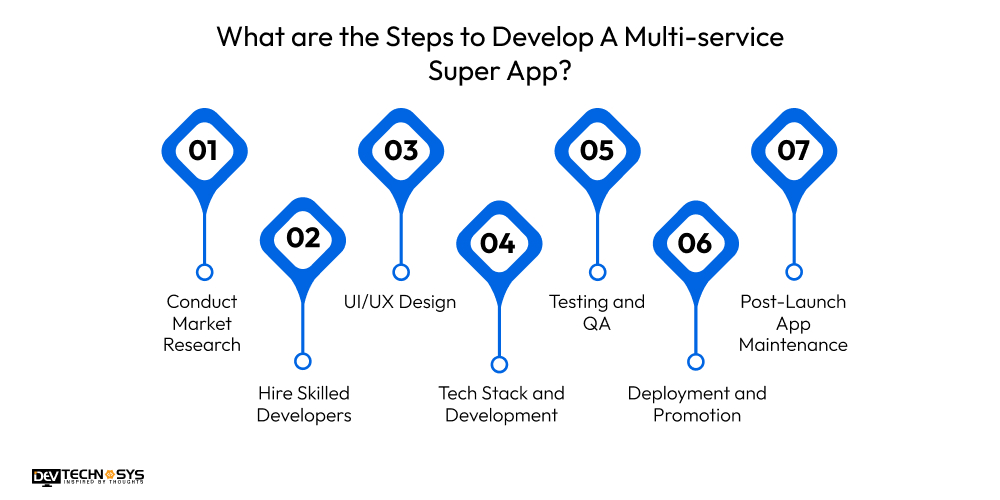
Step 1. Conduct Market Research
As an aspiring entrepreneur, you must conduct extensive market research. Research about user demands, market trends, and competitors. Through market research, you can thoroughly understand what is happening in the market and the loopholes in the services provided by your competitors. This research will help you build a multi-service super app that leads the market.
Step 2. Hire Skilled Developers
The next step is to hire an Android and iOS app development company for the development of your multi-purpose super app. The company you select to develop a multi-service super app must have proven expertise in cross-platform development (E.g., Flutter, React Native), API integration, cloud infrastructure, and secure payment systems.
Step 3. UI/UX Design
If you want to create a multi-service super app that engages users, put more emphasis on user interface design. To put it simply, a well-designed interface with creative designs, animations, wireframes, and layouts can capture the focus of a large user base for your app. It helps you stay ahead of the competitive curve.
Step 4. Tech Stack and Development
Choose a reliable multi-service super app tech stack, such as Flutter or React Native, for cross-platform development. For the backend, consider using Node.js or Python. Additionally, opt for AWS or Firebase for hosting. To get a clear picture, take a look at the table below:
Category |
Technologies |
Purpose |
| Frontend | Flutter, React Native | Cross-platform app development |
| Backend | Node.js, Python | Server-side logic and APIs |
| Database | MongoDB, MySQL | Secure data storage |
| Hosting | AWS, Firebase | Cloud hosting and scalability |
| Payment Gateway | Stripe, Razorpay | Secure in-app payments |
| Real-Time Features | WebRTC, Socket.io | Chat, notifications, tracking |
| Push Notifications | FCM, OneSignal | Alerts and updates |
| Analytics | Google Analytics | Track app performance |
| Security | SSL, OAuth 2.0 | Data protection and authentication |
Once the tech stack and features are finalized, your developer who provides super app development service will integrate all components, tech stack, UI/UX design, features, and secure payment gateway.
To develop a robust MVP (Minimum Viable Product) that showcases your app’s core functionality. A multi-service app with payment gateway and security features can enhance the performance and impression of your super app.
Step 5. Testing and QA
Testing is the next step to create a multi-service super app and one of the most crucial ones as well. Your testing team must conduct thorough testing and quality assurance (QA) to ensure your multi-service super app runs smoothly. This includes:
- Functional Testing: Verify all features work as intended.
- Performance Testing: Check app speed, load handling, and responsiveness.
- Security Testing: Ensure user data is safe and protected.
- Compatibility Testing: Test across devices, screen sizes, and OS versions.
- Usability Testing: Confirm the interface is intuitive and user-friendly.
- Bug Fixing: Identify and resolve errors before launch to ensure a seamless experience.
Step 6: Deployment and Promotion
Once the testing procedure is complete, your super app development provider will deploy your multi-service super app to platforms like Google Play Store, Apple App Store, and the web. Launch marketing campaigns using social media, email, influencers, and ads to attract users and increase downloads. Proper promotion ensures visibility and initial adoption.
Step 7: Post-Launch App Maintenance
After launch, continuously monitor app performance, fix bugs, release updates, and add new features based on user feedback. Regular maintenance ensures smooth functionality, security, and scalability, keeping users engaged and satisfied.
Essential Features of a Multi-Service App
Do you want to build a super app like Lazzoo or Gojek? If so, then you must be aware of the features that make these apps so great. Here are some essential features to incorporate in a multi-service app:
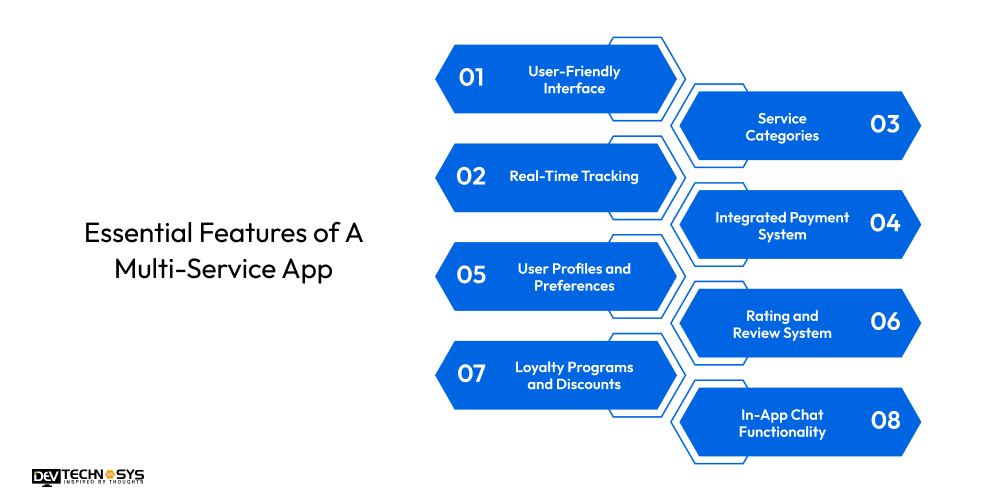
1. User-Friendly Interface:
An intuitive and easy-to-navigate interface ensures users can find services quickly and complete tasks smoothly. Having a clear and attractive interface can lead curious users to your app, thus increasing user engagement.
2. Service Categories:
Organize offerings into clear categories for faster search and selection. Categories can include anything from home services to food delivery to repairs. This feature saves users time and effort by leading them directly to what they want.
3. Real-Time Tracking:
If you want to develop an app like Tawasal, then adding a real-time tracking feature is crucial. Enable users to track service providers, deliveries, or bookings in real time for transparency and reliability.
4. Integrated Payment System:
Security is a crucial factor for any app. So, adding Secure in-app payments, including cards, wallets, and UPI, is highly vital. It simplifies transactions and enhances convenience.
5. User Profiles and Preferences:
Enable users to create profiles, save preferences, and manage bookings, offering a personalized and seamless experience tailored to their needs.
6. Rating and Review System:
It is an important feature that allows users to rate and review services, helping improve quality, transparency, and trust while encouraging service providers to maintain high performance standards.

7. Loyalty Programs and Discounts:
Offer points, rewards, or discounts to retain customers and encourage repeated usage. Hire a developer from a top mobile app development company to incorporate a loyalty program feature in your app.
8. In-App Chat Functionality:
Facilitate direct communication between users and service providers for coordination and queries. If you want to build a multi-service app, then adding a chat feature is essential.
What is the Cost to Build a Multi-service Super App?
The multi-service super app development cost ranges between $8,000 to $25,000, depending on factors like platform choice, features, UI/UX design, development, and maintenance. The cost to develop a super app with basic features and functionalities can be around $8,000 to $15,000.
However, if you want advanced features like live location tracking and an integrated payment system, then the cost to build a multi-service super app may exceed $25,000. The table below highlights the cost to develop a multi-service super app with a development timeline:
App Type |
Estimated Cost |
Development Timeframe |
| Basic MVP | $8,000 – $12,000 | 2–3 months |
| Standard App | $13,000 – $19,000 | 3–4.5 months |
| Feature-Rich App | $20,000 – $25,000 | 5–7 months |
What Factors Can Affect the Cost to Develop a Multi-Service App?
There are various factors that can affect the cost to develop a multi-service super app, including features, platform, UI/UX design, and more. Let’s learn about these factors affecting the mobile app development cost in detail:
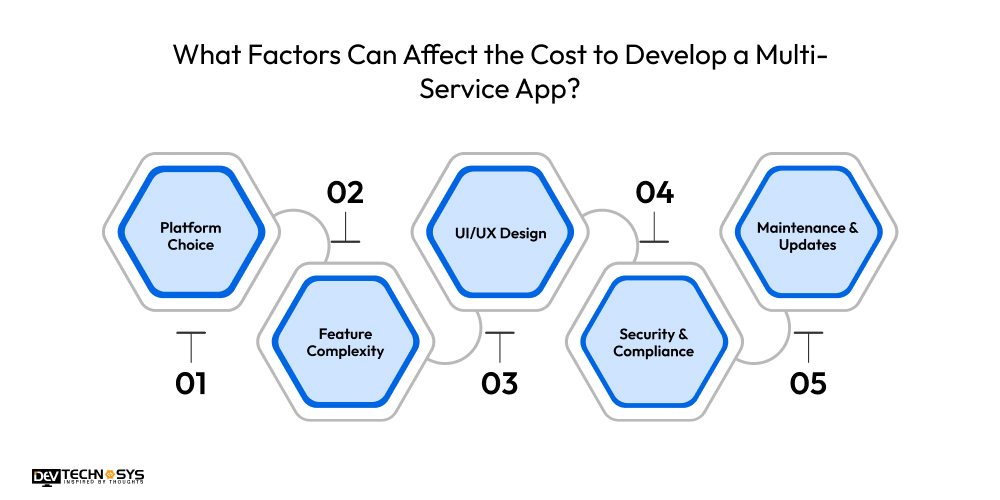
1. Platform Choice
Platform choice can highly impact the cost to create a multi-service super app. Developing for iOS, Android, or both affects cost. Cross-platform frameworks like Flutter or React Native reduce expenses. The table given below highlights the cost to develop a multi-service super app according to platform choice.
Level |
Estimated Cost (USD) |
Development Timeline |
| Single platform (iOS or Android) | $8,000 ‒ $12,000 | 2 ‒ 3 months |
| Cross-platform (both Android & iOS) | $13,000 ‒ $18,000 | 3 ‒ 4 months |
| Web + Mobile inclusion | $18,000 ‒ $25,000 | 4 ‒ 5 months |
2. Feature Complexity
Another factor that impacts the super app development cost is the complexity of features. Adding advanced features like real-time tracking, multiple payment options, and loyalty programs can increase the timeline and cost to make a multi-service super app.
Complexity Level |
Estimated Cost (USD) |
Development Timeline |
| Basic features only | $8,000 ‒ $11,000 | 2 months |
| Moderate features | $12,000 ‒ $18,000 | 3 ‒ 4 months |
| Higher complexity | $19,000 ‒ $25,000 | 4 ‒ 5 months |
3. UI/UX Design
The cost to create a multi-service super app differs depending on the user interface designs. The custom, interactive, and intuitive user interfaces may cost more than templates, but they significantly enhance user engagement and retention. Here’s the table showcasing the Multi-service super app development cost based on user interface design:
Design Level |
Estimated Cost (USD) |
Development Timeline |
| Simple templates / standard UI components | $2,000 ‒ $4,000 | 2 months |
| Custom UI / animated transitions / more screens | $5,000 ‒ $7,000 | 3 ‒ 4 months |
| High polish UI / branding/high-fidelity design | $8,000 ‒ $10,000 | 4 ‒ 5 months |
4. Security & Compliance
The cost to make a multi-service super app varies depending on the security features. Secure payment gateways, encryption, and regulatory compliance increase development cost and ensure safe, trusted app usage.
Type |
Cost (USD) |
Timeline |
| Basic | $2,000–$3,500 | 2 months |
| Moderate | $4,000–$7,000 | 3–4 months |
| High | $6,000–$9,000 | 4–5 months |
5. Maintenance & Updates
The cost to create a multi-service super app also depends on maintenance services. Ongoing updates, bug fixes, and server hosting incur recurring expenses to maintain the app’s reliability and scalability. Learn more about the cost to make a multi-service super app in the table below:
Maintenance Level |
Estimated Annual Cost (USD) |
Update Cycle / Frequency |
| Basic maintenance | $1,500 ‒ $3,000 | 1-2 weeks per update |
| Moderate maintenance | $4,000 ‒ $8,000 | 2-4 weeks per cycle |
| Extensive support & updates | $9,000 ‒ $12,000 | 4-6 weeks per major release |
How Do Multi-Service Apps Make Money?
Here are some of the top monetization strategies that businesses can use to make money from multi-service apps:
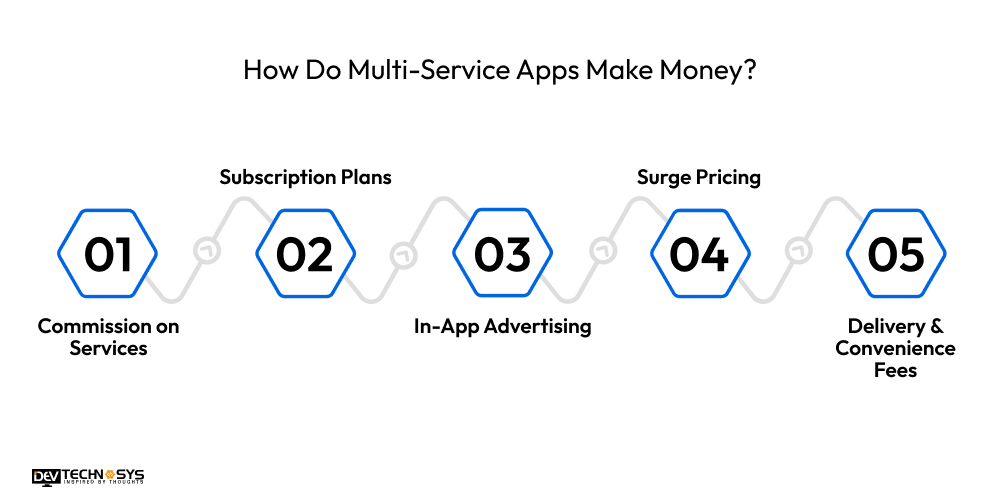
1. Commission on Services:
The app earns revenue by taking a small percentage from each completed service, including rides, deliveries, and home repair bookings.
2. Subscription Plans:
Service providers or customers pay monthly or annual fees to access premium tools, better visibility, faster services, and exclusive app benefits.
3. In-App Advertising:
Local businesses and brands pay to display targeted ads or featured listings within the app, boosting visibility and increasing conversions.
4. Surge Pricing:
During high-demand hours, the app increases service prices to maximize revenue while ensuring an adequate supply and maintaining service availability.
5. Delivery & Convenience Fees:
Users pay extra fees for faster deliveries or doorstep services, providing the platform with a consistent and scalable income source.

Conclusion
The details and information provided above discuss how to develop a multi-service super app. Building such an app can help businesses offer multiple services under one platform, attract a wider audience, and boost revenue through convenience and innovation.
If you want a multi-service super app developed from scratch, turn to Dev Technosys, a top super app development company in the Middle East. Stay tuned for more updates.
FAQs
Q1. How Much Does It Cost to Build a Super App?
Development costs for a multi-service super app range from $8,000 to $25,000, depending on features, platform choice, and design complexity for an MVP.
Q2. What Features Are Essential in a Super App?
Essential features include user profiles, service categories, real-time tracking, integrated payments, ratings, reviews, in-app chat, loyalty programs, and analytics dashboards for users.
Q3. Which Tech Stack Is Best for Multi-Service Apps?
Use Flutter or React Native for cross-platform frontend, Node.js or Python for backend, and AWS or Firebase for hosting, storage, and real-time integrations.
Q4. How Do Super Apps Make Money?
Revenue comes from commissions on services, subscriptions, in-app ads, surge pricing, delivery or convenience fees, partnerships, and transaction fees through integrated payment gateways.
Q5. What Services Can You Get in a Multi-Service App?
Services provided by a multi-service app include:
- Ride Services: Book taxis, bikes, or rentals for quick, hassle-free travel.
- Household Services: Get cleaning, plumbing, or salon services on demand.
- Delivery Services: Receive groceries, food, or parcels instantly delivered to your home.
- Medicine Delivery: Order medicines and health products with fast delivery.
- Mechanic Services: Request quick car or bike repair anytime.