





Key Takeaways:
-
- To build an app like ToYou, businesses must focus on strong market research, hyperlocal architecture, and GCC-specific features like Arabic RTL support, escrow payments, and real-time order tracking.
- The cost to build an app like ToYou typically ranges from $10,000 to $28,000, depending on feature complexity, platform choice, and third-party API integrations.
- The hyperlocal delivery app market is growing at a CAGR of 25% in 2025, making hyperlocal delivery app solution development one of the most profitable opportunities in MENA right now.
- A successful ToYou clone app depends on in-app chat, AI-powered listing management, a robust order management system, and an efficient delivery partner panel.
- Monetization models including commissions, subscriptions, delivery fees, and in-app advertising, turn ToYou app clone development into a long-term, multi-stream revenue opportunity.
The on-demand industry is booming across the Middle East, and hyperlocal marketplace apps are sitting right at the center of it. Saudi Arabia alone processed over $10 billion in e-commerce transactions in 2025, with mobile-first platforms leading the charge. ToYou has emerged as one of the region’s most powerful C2C and B2C marketplace apps, seamlessly connecting buyers, sellers, and delivery partners under one roof.
If you’re an entrepreneur, startup founder, or investor eyeing the MENA market, the opportunity to build an app like ToYou has never been more compelling. From classified listings to real-time doorstep delivery, the platform proves that hyperlocal commerce, when built right, is both scalable and highly profitable.
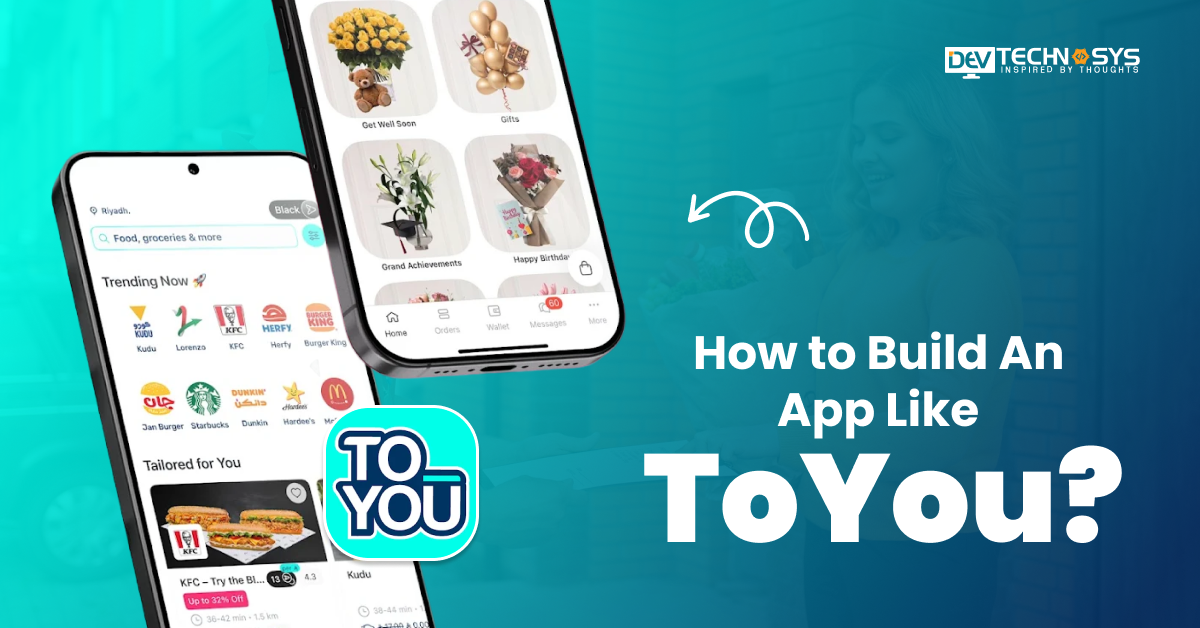
If you are wondering how to develop an app like ToYou, you have reached the right place. This blog will provide a streamlined process for the ToYou Clone app development. It will also explore key features required for business success and the costs involved.
What is ToYou?
ToYou is a Saudi Arabia-based hyperlocal delivery app solution that bridges the gap between classified listings and last-mile logistics. Launched to serve the growing demand for fast, reliable C2C and B2C commerce in the GCC region, this ToYou alternative-inspiring platform allows users to buy and sell pre-owned or new items while arranging same-day doorstep delivery all within a single app.
Unlike traditional classified platforms, where the transaction ends at a message, ToYou closes the full loop: list, negotiate, pay, and deliver. What sets ToYou apart from similar apps like ToYou is its hyperlocal engine, matching buyers with nearby sellers to enable faster fulfillment, lower delivery costs, and a stronger community trust layer.
How Does ToYou Work?
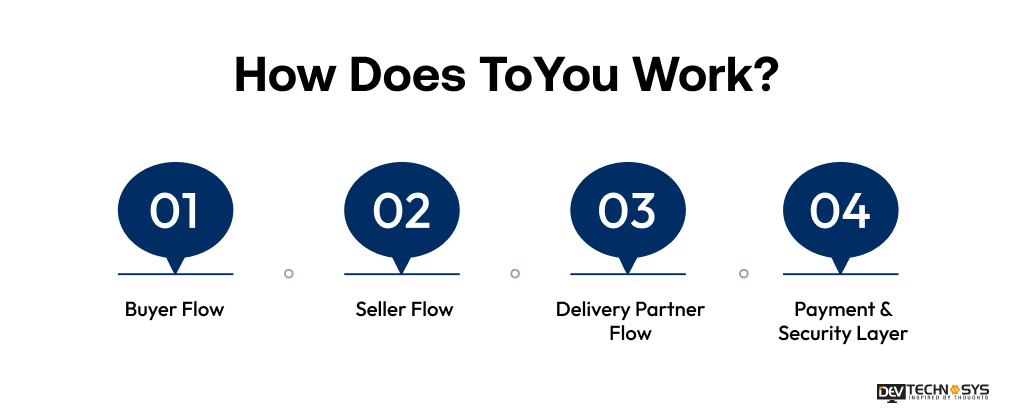
ToYou operates across three interconnected user roles: buyers, sellers, and delivery partners, each with a streamlined, purpose-built flow.
1. Buyer Flow
A buyer opens the app, browses listings, and filters results by location, category, or price. Once they find the right item, they connect with the seller through in-app chat and notifications, place the order, and monitor every step via the real-time order tracking feature until the item arrives at their door.
2. Seller Flow
A seller registers, verifies their account, and creates a listing with photos and pricing. The moment a buyer places an order, the seller receives an instant alert through the order management system, confirms the sale, and hands off the item to the assigned delivery partner.
3. Delivery Partner Flow
A delivery partner receives a nearby job request, reviews the route, and accepts it. They then navigate to the pickup point, collect the item, complete the delivery, and watch their earnings update instantly in their in-app wallet.
4. Payment & Security Layer
Payments are processed through a secure gateway with an escrow hold. Funds are released to the seller only after confirmed delivery with a built-in dispute resolution system protecting all parties. This end-to-end flow is exactly what our on-demand app development services are designed to replicate.
Market Stats for Hyperlocal Delivery Apps like ToYou
The numbers don’t lie. If you’ve been waiting for the right moment to make an app like ToYou, that moment is right now. Here’s what the data tells us, according to Research and Markets:
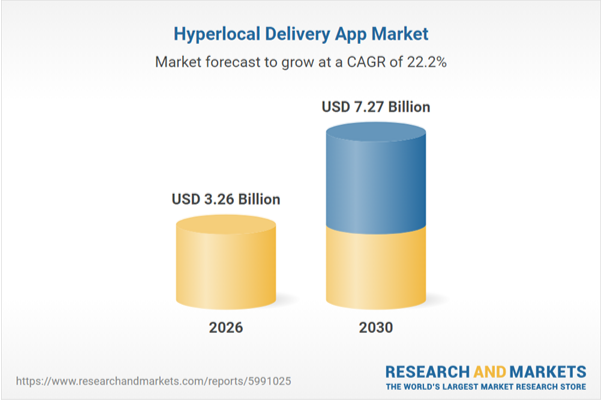
- The global hyperlocal delivery app market is valued at $2.61 billion in 2025, growing at a CAGR of 25%
- By 2030, the market is projected to reach $7.27 billion at a CAGR of 22.2%
- Growing digital payment integration and AI-based order matching are making marketplace app development more investor-attractive than ever.
- Retail e-commerce sales hit $289.2 billion in Q1 2024 alone, a 2.1% quarter-on-quarter increase.
- Route optimization, real-time tracking, and last-mile delivery tech are now baseline expectations, not premium features.
Why Are Entrepreneurs Investing in Apps Like ToYou?
The business case to create an app like ToYou is stronger than it looks on the surface. Here’s why smart entrepreneurs are moving fast:
- Built-In Trust = Lower Returns: The C2C model, combined with delivery accountability, dramatically reduces return rates, a pain point that plagues traditional ecommerce web development service models.
- Untapped Market Potential: Tier-2 and Tier-3 MENA cities remain severely underserved, as no reliable local delivery layer exists, making ToYou app clone development an almost competition-free entry in dozens of cities.
- Multiple Revenue Streams from Day One: Commission per transaction, promoted listings, and delivery fees mean your app earns from multiple angles simultaneously.
- Vision 2030 Tailwind: Saudi Arabia’s government digitization agenda is actively accelerating consumer adoption of platforms like ToYou across retail app development verticals.
- Effortless Scalability: One core codebase can be rolled out across multiple cities and countries, making it easy to develop a marketplace app like ToYou at a regional scale without rebuilding from scratch.
Step-by-Step Development Process to Create an App Like ToYou
Building a successful hyperlocal marketplace isn’t just about great features; it’s about executing the right development process in the right order. Here is exactly how to develop an app like ToYou from a blank canvas to a live product.
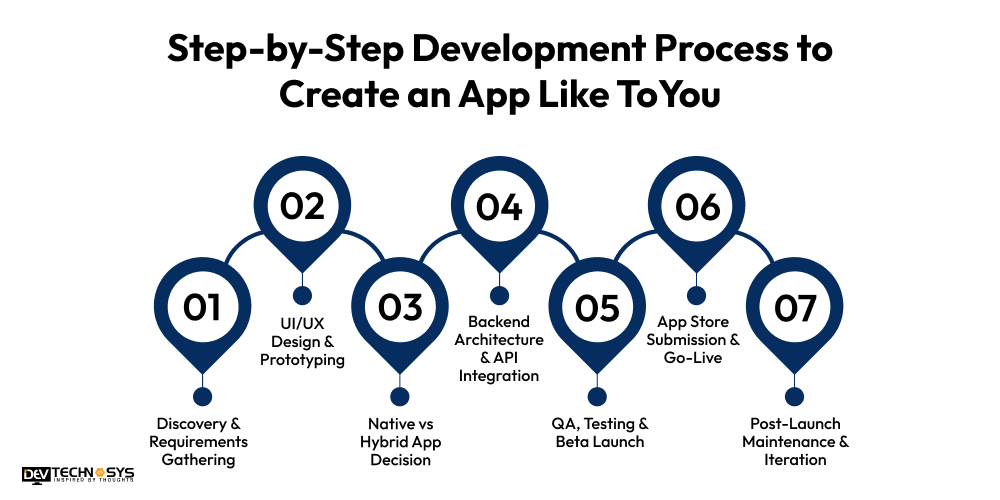
1. Discovery & Requirements Gathering
Every successful build starts with brutal clarity. This phase covers deep market research, competitor auditing, user persona definition, and feature prioritization. You map out the full scope of your platform, what panels are needed, what user flows matter most, and what integrations are required from day one. You decide what goes initially and schedule what goes later. This distinction saves months of wasted development time and thousands of dollars before a single line of code is written.
2. UI/UX Design & Prototyping
This is where your app gets its personality. Designers create wireframes, interactive prototypes, and a complete visual system with special attention to Arabic RTL support, which is absolutely non-negotiable for any GCC-facing platform. Color systems, typography, navigation patterns, and micro-interactions are all defined here. Real user testing happens at the prototype stage, allowing you to catch usability problems and fix them before development begins.
3. Native vs Hybrid App Decision
Native vs hybrid app development comes down to budget, timeline, and performance expectations. React Native or Flutter gives you a single codebase for both iOS and Android, faster to build and more affordable to maintain. Swift for iOS and Kotlin for Android deliver superior performance but at significantly higher cost and longer timelines. Your hybrid app development services partner should guide this decision carefully based on your target audience, expected traffic volume, and long-term scale goals.
4. Backend Architecture & API Integration
The longest and most technically demanding phase of the entire project. This covers microservices architecture setup, database schema design, server configuration, and all critical third-party API integration for delivery apps, including Google Maps for routing, payment gateways for secure transactions, Firebase for real-time notifications, and Elasticsearch for fast listing search.
5. QA, Testing & Beta Launch
This phase includes device testing across multiple screen sizes and operating system versions, load testing under simulated peak traffic conditions, and security vulnerability scanning. Every bug, performance bottleneck, and UX friction point caught here costs a fraction of what it would cost to fix after your app goes live to thousands of users.
6. App Store Submission & Go-Live
With testing complete, your app goes through Google Play and Apple App Store submission, including compliance reviews, metadata optimization, screenshot preparation, and app description copywriting. A staged rollout strategy is recommended for it. Release first to a limited geography or user group to monitor real-world performance before opening the floodgates to your full target market across the GCC region.
7. Post-Launch Maintenance & Iteration
The real work begins once real users are inside your platform, generating real feedback. Ongoing mobile app maintenance cost planning covers routine bug fixes, iOS and Android OS update compatibility, and iterative feature releases driven by actual user behavior data. Allocating 15–20% of your initial development budget annually for maintenance is the industry standard.
8 Must-Have Features to Build an App Like ToYou
Choosing the right features is the single most important decision when you build an app like ToYou. Build too little, and you lose users on day one. Build too much, and you blow your budget before launch. Here are the 8 non-negotiable features your platform must have to compete in the hyperlocal marketplace space.
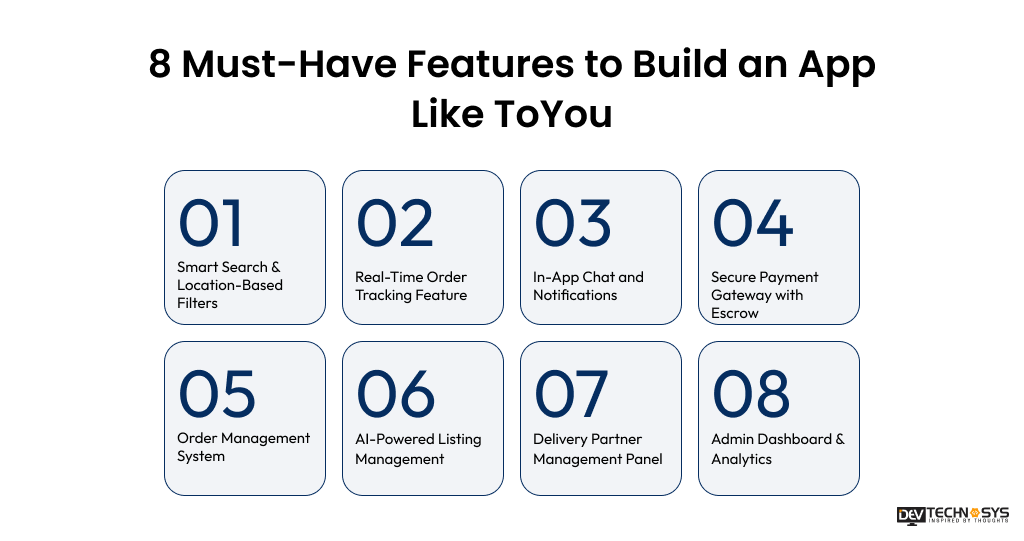
1. Smart Search & Location-Based Filters
Users can search listings by category, price range, item condition, and most critically, proximity to their current location. Hyperlocal relevance is the entire value proposition of a ToYou-like platform, so this filter engine must be fast, accurate, and deeply intuitive.
2. Real-Time Order Tracking Feature
Every buyer expects live GPS visibility from the moment their order is picked up to the moment it lands at their door. The real-time order tracking feature with live map updates, status milestones, and accurate ETA notifications is completely non-negotiable in 2025.
3. In-App Chat and Notifications
Buyers and sellers need to negotiate, clarify, and confirm all without leaving the app. Robust in-app chat and notifications with media sharing, read receipts, and instant push alerts keep every conversation locked inside your ecosystem. This reduces drop-offs and builds transactional confidence between strangers.
4. Secure Payment Gateway with Escrow
Support for credit cards, digital wallets, cash on delivery, and GCC-native BNPL options like Tamara and Tabby, paired with an escrow hold that only releases funds to the seller upon confirmed delivery. This single feature is what separates a trusted marketplace from a glorified WhatsApp group.
5. Order Management System
Sellers need a clean, intuitive dashboard to accept orders, track fulfillment status, manage active listings, and review earnings history at a glance. A powerful order management system directly impacts seller satisfaction and retention, and a platform with unhappy sellers quickly runs out of inventory for buyers.
6. AI-Powered Listing Management
Automated image quality checks, duplicate listing detection, prohibited item flagging, and smart category tagging ensure your marketplace stays clean and trustworthy without requiring an army of human moderators. This feature pays for itself almost immediately at scale.
7. Delivery Partner Management Panel
A dedicated interface for delivery partners to accept or decline job requests, preview routes before committing, navigate turn-by-turn, update delivery status in real time, and manage their earnings wallet. Keeping your delivery partners happy and efficient is what keeps your last-mile operation running smoothly as you scale across cities.
8. Admin Dashboard & Analytics
Your command center for user moderation, commission configuration, fraud detection alerts, and platform-wide performance analytics covering GMV, active users, churn rate, and delivery success rates. Everything a professional mobile app development company would architect from day one to give you full visibility and control over your growing marketplace.
Which Tech Stack is Used to Build an App Like ToYou?
Choosing the right delivery app tech stack is what determines whether your platform scales smoothly or collapses under pressure. Here is the complete technology breakdown powering a production-grade API integration for delivery apps like ToYou:
| Layer | Technology | Why It’s Used |
| Frontend (Mobile) | React Native / Flutter | Cross-platform, faster time-to-market, single codebase for iOS & Android |
| Frontend (Web Admin) | React.js | Component-based architecture, fast and responsive dashboard rendering |
| Backend | Node.js + Express / Django | Scalable REST APIs, async handling for real-time events |
| Database | PostgreSQL + MongoDB + Redis | Relational for users/orders, NoSQL for listings, Redis for caching |
| Real-Time Engine | Socket.io / Firebase | Live chat, live tracking, and instant push notifications |
| Maps & Navigation | Google Maps API / HERE Maps | Geocoding, routing, and accurate ETA calculation |
| Payments | Stripe / PayTabs / HyperPay | GCC-native payment support, fully PCI-DSS compliant |
| Search | Elasticsearch | Fast, fuzzy, and location-aware listing search |
| Cloud & DevOps | AWS / GCP + Docker + Kubernetes | Auto-scaling, CI/CD pipelines, zero-downtime deployments |
| AI / ML | TensorFlow / AWS Rekognition | Image moderation, fraud detection, smart recommendations |
| Notifications | Firebase Cloud Messaging + Twilio | Push and SMS alerts across all platforms |
What is the Average Cost to Build an App Like ToYou?
The cost to develop an app Like ToYou depends on the complexity of features, third-party integrations, and platform coverage. The cost to build an app like ToYou can vary based on whether you start with a lean MVP or a fully loaded hyperlocal marketplace.
With a budget of $10,000 to $28,000, businesses can start smart and scale features over time by working with experts who understand real mobile app development cost structures inside out.
| Level | Estimated Cost (USD) | Features Included |
| Basic | $10,000 – $15,000 | Listings, buyer-seller chat, basic order tracking, single platform |
| Mid-Level | $15,000 – $22,000 | 2 platforms, admin panel, payment gateway, delivery partner app |
| Advanced | $22,000 – $28,000+ | AI moderation, real-time tracking, full integrations, Arabic RTL, all panels |
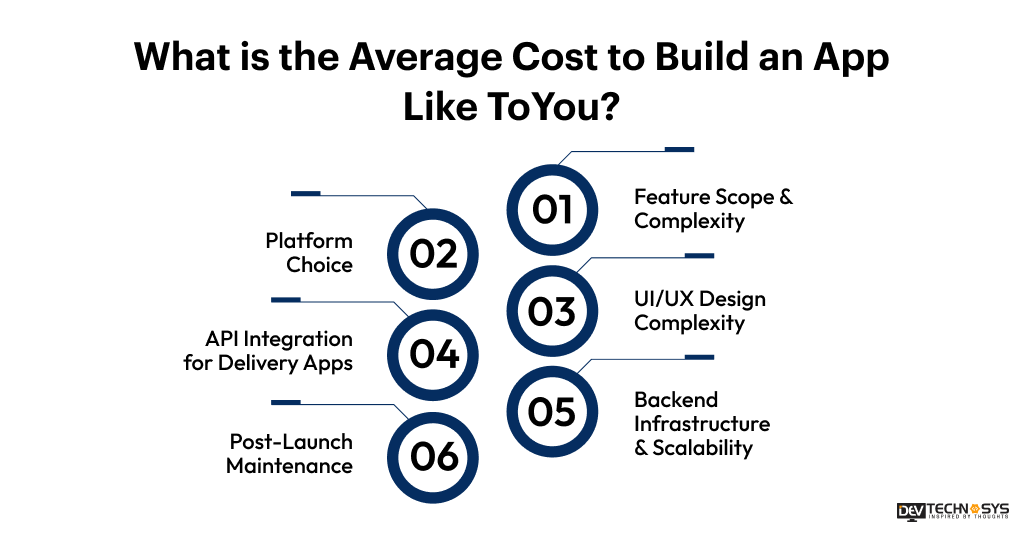
Below are the key factors that affect your marketplace app development cost:
1. Feature Scope & Complexity
The number and depth of features are the single biggest cost driver in cost to build an app like ToYou. A basic listing and chat feature costs far less than building an AI-powered moderation, real-time order tracking feature, and an escrow payment system. Partnering with an experienced on-demand app development company helps you prioritize the right features for your budget from day one.
| Level | Features | Affected Cost |
| Basic | Listings, search, buyer-seller chat | $2,000 – $5,000 |
| Standard | Order tracking, payment gateway, notifications | $5,000 – $7,000 |
| Advanced | AI moderation, escrow, route optimization, analytics | $7,000 – $8,500 |
2. Platform Choice
Choosing between native and hybrid app development significantly impacts your ToYou app development cost. Native iOS and Android apps deliver superior performance but require two separate codebases, doubling frontend development effort and cost.
A dedicated Android app development team or iOS specialist can help you weigh the trade-offs between performance and budget and recommend the most cost-effective path based on your target GCC audience and launch timeline.
| Level | Features | Affected Cost |
| Basic | Single platform (Android or iOS only) | $1,500 – $3,000 |
| Standard | Cross-platform (React Native / Flutter) | $3,000 – $5,000 |
| Advanced | Native iOS + Native Android (separate builds) | $5,000 – $8,000 |
3. UI/UX Design Complexity
For GCC-facing platforms, Arabic RTL support, bilingual interfaces, and culturally appropriate design patterns add meaningful complexity, which leads to marketplace app development costs. Understanding true mobile app development cost means factoring in design iterations, user testing rounds, and prototype revisions, all of which are essential for building a marketplace that users actually enjoy using every single day.
| Level | Features | Affected Cost |
| Basic | Simple layout, minimal design, standard components | $1,000 – $2,500 |
| Standard | Clean modern UI, responsive design, RTL support | $2,500 – $4,000 |
| Advanced | Premium UI/UX, animations, bilingual Arabic-English | $4,000 – $6,000 |

4. API Integration for Delivery Apps
Third-party API integration for delivery apps, including maps and payments, adds both licensing fees and development hours to your total ToYou app development cost. When you hire dedicated developers with prior marketplace integration experience, you avoid costly trial-and-error with third-party services and get production-ready integrations built right the first time.
| Level | Features | Affected Cost |
| Basic | 1–2 APIs (maps + basic payment) | $1,000 – $2,500 |
| Standard | Maps + payment gateway + push notifications | $2,500 – $4,500 |
| Advanced | Full stack: maps, payments, Elasticsearch, Firebase, Twilio | $4,500 – $7,000 |
5. Backend Infrastructure & Scalability
Backend infrastructure covering servers, databases, cloud hosting, and real-time processing directly determines how well your hyperlocal delivery app solution handles growth. The smartest move here is to hire developers who specialize in scalable microservices architecture, and who have already solved the exact infrastructure challenges your platform will face at 10x your launch-day traffic.
| Level | Features | Affected Cost |
| Basic | Simple backend, low traffic capacity | $2,000 – $3,500 |
| Standard | Cloud backend, moderate scaling, database optimization | $3,500 – $6,000 |
| Advanced | Microservices, Kubernetes, CI/CD, high-availability setup | $6,000 – $10,000 |
6. Post-Launch Maintenance
Launching your ToYou clone app is only the beginning. Ongoing mobile app maintenance cost planning covering bug fixes, OS compatibility updates, API version upgrades, and performance monitoring is a recurring investment that must be budgeted from day one.
Industry standard practice is allocating 15–20% of your total cost to develop an App Like ToYou annually for maintenance. Skipping this step is one of the most common reasons promising marketplace app development projects fail within their first year.
| Level | Features | Affected Cost |
| Basic | Bug fixes, minor updates | $1,500 – $2,000/year |
| Standard | OS updates, API maintenance, performance monitoring | $2,000 – $2,500/year |
| Advanced | Full support, feature iterations, server scaling | $2,500 – $3,000/year |
Top 10 Apps Like ToYou You Should Know
If you are planning to build a marketplace app like ToYou, studying the competitive landscape is not optional; it is essential. Here is a comprehensive look at the top ToYou alternative platforms dominating the MENA region and beyond.
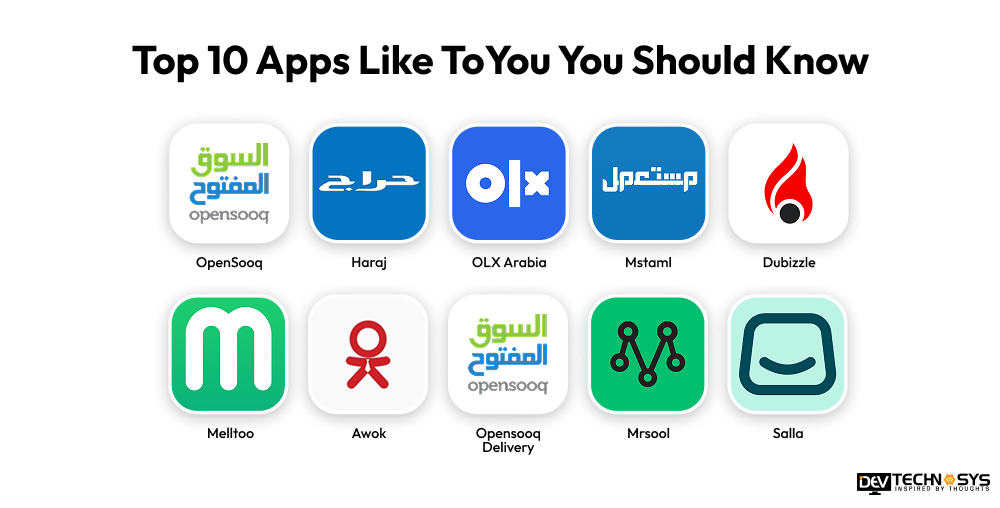
| App | Market | Model | Key USP | Category |
| Haraj | Saudi Arabia | C2C Classifieds | Arabic-first, massive local user base | Buy/Sell |
| OpenSooq | Pan-Arab | Classifieds + Ads | 13-country reach, ad-boost system | Classifieds |
| OLX Arabia | GCC + MENA | Classifieds | Global brand, strong local trust | Buy/Sell |
| Mstaml | Egypt | Second-hand Goods | High-frequency, budget-category listings | Re-commerce |
| Dubizzle | UAE | Property + Goods | Premium positioning, real estate + items | Multi-vertical |
| Awok | UAE | B2C E-commerce | Flash deals, fast GCC delivery | E-commerce |
| Melltoo | UAE | C2C Marketplace | In-app chat-first buying experience | Buy/Sell |
| Opensooq Delivery | Jordan | C2C + Delivery | Classified + integrated last-mile | Hyperlocal |
| Zid | Saudi Arabia | B2C SaaS Commerce | Merchant storefronts + delivery | D2C Platform |
| Salla | Saudi Arabia | B2C E-commerce | Arabic-native merchant platform | E-commerce |
1. Haraj
Haraj is Saudi Arabia’s most-used C2C classified app with an Arabic-first UX that resonates deeply with local buyers and sellers. Its massive user base and community trust make it the closest similar app to ToYou in the Saudi market. If this model excites you, you can develop an app like Haraj with a team that understands the GCC market inside out.
2. OLX Arabia
OLX Arabia leverages global Prosus Group infrastructure to deliver a trusted classifieds experience across GCC and MENA. Millions already know the OLX name, giving it an enormous acquisition advantage over newer ToYou alternative platforms. If you want to build something equally dominant, partnering with an experienced on-demand app development company is the smartest first step.
3. Mstaml
Mstaml is Egypt’s leading second-hand marketplace built for high-frequency, budget-category transactions where speed beats premium features. It is a strong reference point for anyone looking to make an app like ToYou targeting North African markets. Our ecommerce web development services can help you replicate and improve this model for your target region.
4. OpenSooq
OpenSooq spans 13 MENA countries with a sophisticated ad-boost monetization system generating strong recurring seller revenue. Its multi-country infrastructure makes it one of the most studied ToYou app clone development references for regional-scale entrepreneurs. If regional scale is your goal, you can develop an app like OpenSooq with the right technical partner by your side.
5. Dubizzle
Dubizzle combines real estate, vehicles, and everyday goods in one polished UAE ecosystem with premium market positioning. It is a compelling model for entrepreneurs who want to develop a marketplace app like ToYou targeting higher-income GCC demographics. Working with a reliable mobile app development company ensures you build a platform with the same level of polish and trust from day one.
Which Monetization Models Can Work for Your ToYou Clone App?
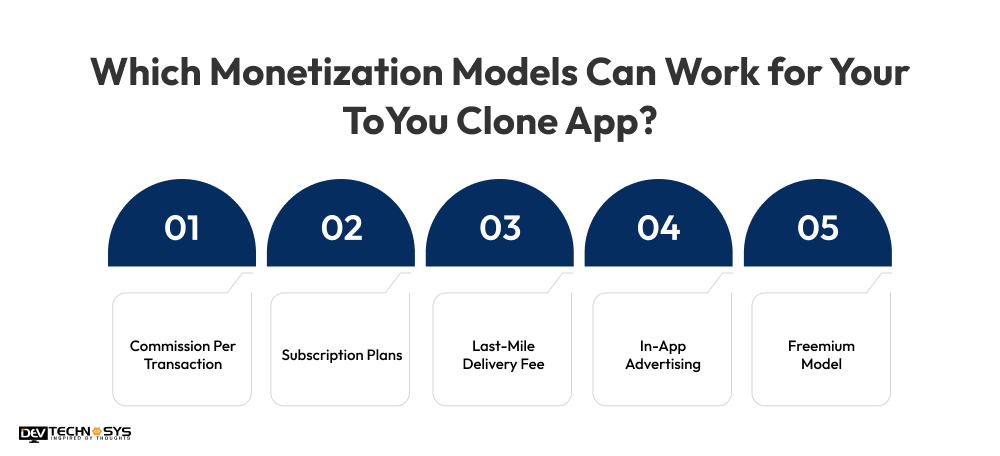
One of the strongest reasons entrepreneurs choose to build a marketplace app like ToYou is its ability to generate revenue from multiple streams simultaneously from day one. Here are the five most powerful monetization models to build into your ToYou app clone development:
1. Commission Per Transaction
Charge a configurable 2–15% commission on every completed deal across the platform. This is the most reliable and scalable revenue stream for any hyperlocal delivery app solution. The more transactions your platform processes, the more you earn without adding operational complexity.
2. Subscription Plans
Offer sellers premium tiers, unlocking verified badges, advanced listing analytics, priority customer support, and boosted search visibility. Recurring subscription revenue stabilizes your marketplace app development income beyond transaction-dependent earnings.
3. Last-Mile Delivery Fee
Charge a fixed or distance-based delivery fee on every order and split it between your platform and the courier partner. This turns your logistics layer into a direct, high-margin revenue channel that scales naturally as your delivery volume grows.
4. In-App Advertising
Sell banner placements and native ad slots to brands targeting your marketplace audience. As your user base grows, this becomes a significant passive revenue stream requiring zero additional infrastructure investment on your end.
5. Freemium Model
White-label your ToYou alternative platform for regional businesses and SMEs who want their own branded marketplace. This enterprise tier commands premium pricing and opens an entirely new B2B revenue channel well beyond your core consumer marketplace app development model.

What Will Make Your Marketplace App Beat ToYou?
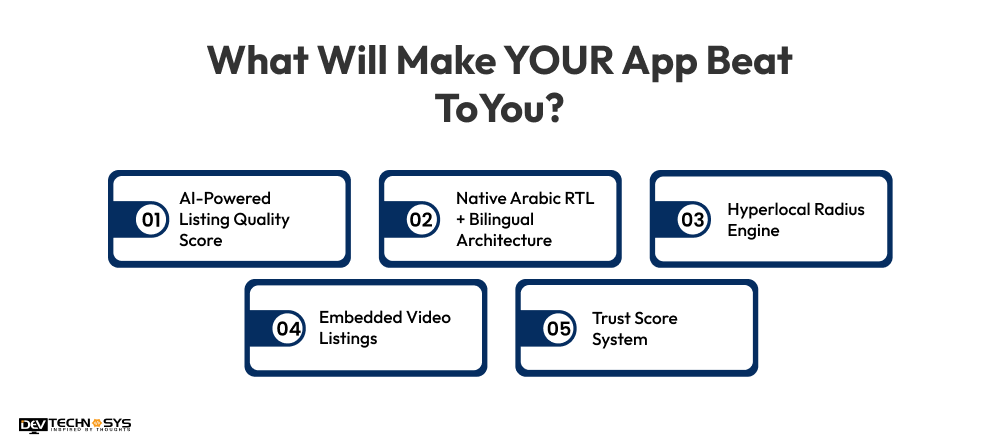
Building a ToYou alternative is not just about replicating what already exists; it is about building something meaningfully better. Hire mobile app developers in the Dubai who have already solved these exact engineering challenges across live hyperlocal marketplace products.
1. AI-Powered Listing Quality Score
Automatically flag blurry photos, incomplete descriptions, and suspected duplicate listings before they ever go live. This keeps your marketplace clean, trustworthy, and conversion-optimized without requiring a large manual moderation team and scaling costs.
2. Native Arabic RTL + Bilingual Architecture
Most platforms bolt on Arabic support as an afterthought, and users feel it. Building RTL and bilingual Arabic-English architecture at the core level from day one delivers a dramatically smoother, more intuitive experience for GCC users that competitors simply cannot match overnight.
3. Hyperlocal Radius Engine
Street-level delivery zone targeting in 500-meter increments enables ultra-fast same-hour delivery that broad-radius platforms cannot offer. This precision targeting is what transforms a generic marketplace app development project into a true hyperlocal delivery app solution that dominates neighborhood-level commerce.
4. Embedded Video Listings
30-second product demo videos outperform static photos by 3x in conversion rates. Giving sellers the ability to showcase items in motion, condition, size, and functionality builds buyer confidence and dramatically reduces post-delivery disputes on your ToYou app clone development platform.
5. Trust Score System
Replace basic star ratings with a blockchain-stamped transaction history for every seller on your platform. Immutable, tamper-proof reputation data builds a level of marketplace trust that no similar app like ToYou currently offers, making your platform the default choice for high-value transactions.
Conclusion
The success of ToYou proves one thing clearly: hyperlocal C2C commerce combined with integrated last-mile delivery is not just a trend. It is a scalable, highly profitable business model built for the way MENA consumers shop today and tomorrow.
Every month you wait is a month your competitor spends building user trust, seller inventory, and delivery network density that takes years to overcome.
Dev Technosys has years of experience delivering on-demand and marketplace apps for clients across the GCC, Middle East, and globally, from initial discovery to live product and beyond. If you are ready to develop an app like ToYou, our team is ready to make it happen. Connect with our iOS app development company today and turn your marketplace idea into a market-leading reality.
FAQs
Q1. How Long Does It Take to Build an App Like ToYou from Scratch?
The ToYou app development timeline typically ranges from 1 to 6 months, depending on scope. A basic MVP takes 1–2 months, a mid-range platform with two panels takes 2–3 months, and a full-scale hyperlocal delivery app solution with AI and all integrations takes 3–6+ months.
Q2. Can I Launch a ToYou-Like Marketplace in Saudi Arabia Without a Local Business Entity?
Technically, you can soft-launch, but processing payments and listing on Saudi app stores legally requires a registered local entity or an authorized local partner. Most international entrepreneurs entering the GCC market establish a Saudi LLC or partner with a licensed local business before their official public launch.
Q3. What Payment Gateways Should I Integrate for a GCC-Based Marketplace App?
For GCC audiences, the strongest API integration for delivery apps includes PayTabs, HyperPay, and Moyasar for local card processing, plus Tamara and Tabby for BNPL options that GCC shoppers actively prefer. Stripe works well for international coverage alongside these region-native gateway options.
Q4. How Do I Prevent Fake Listings and Fraud on My ToYou Clone App?
Combine AI-powered image moderation, duplicate listing detection, and phone number verification at registration with a robust order management system that flags suspicious patterns automatically. Escrow-based payments add another fraud prevention layer; funds are only released after confirmed delivery, eliminating the most common marketplace scam scenarios entirely.
Q5. Is It Better to Build a Native iOS/Android App or Go Hybrid for a ToYou-Like Platform?
For most startups, native vs hybrid app development favors hybrid; React Native or Flutter delivers 80% of native performance at 60% of the cost and timeline. Go fully native only when your platform demands complex real-time animations or device-level hardware features that cross-platform frameworks cannot handle efficiently.