





Key Takeaways:
-
- Smart toll platforms like Smart Salik use RFID + mobile apps to enable fully automated, cashless toll collection without stopping vehicles.
- Core system includes user app, RFID detection, payment gateway, admin dashboard, and real-time transaction tracking for smooth operations.
- Development typically costs around $30,000 to $150,000+, depending on features like AI analytics, scalability, and integrations.
- The global electronic toll collection market is expected to reach $16.9B in 2026 and grow to $46.3B by 2036 (CAGR ~10.6%).
- Future-ready systems focus on AI traffic prediction, dynamic pricing, and smart city integration to improve mobility and revenue efficiency.
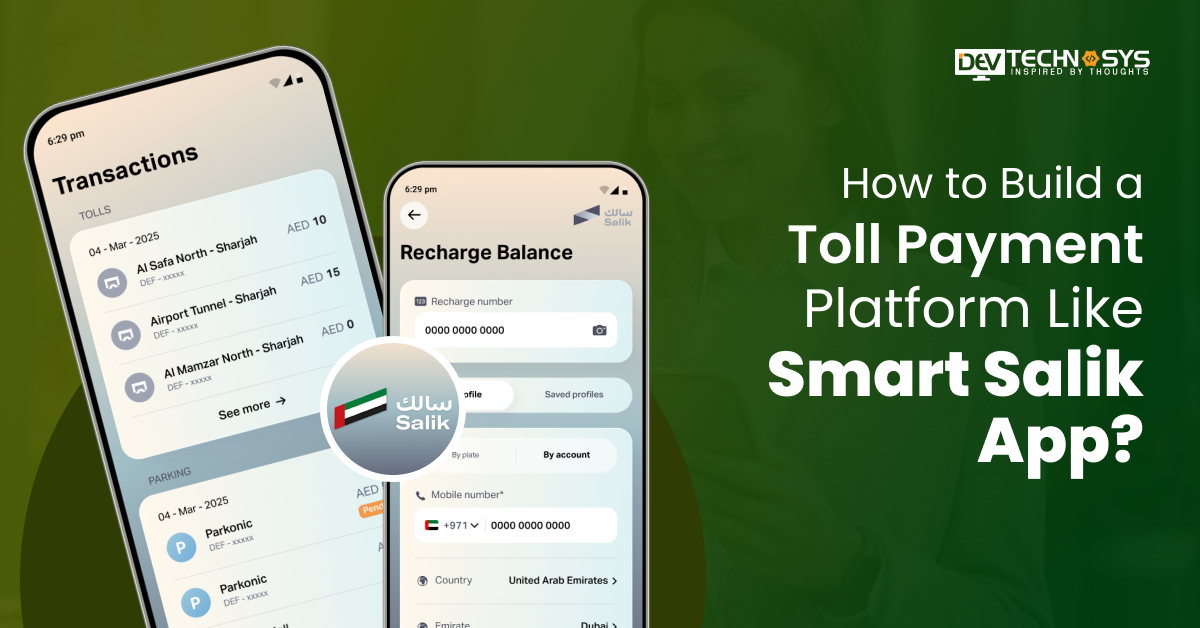
Traffic congestion and manual toll booths slow down daily travel across busy cities, pushing transportation authorities toward faster, automated solutions. Many businesses now want to build a n app like Smart Salik app to modernize cashless toll collection using RFID technology and reduce delays on busy roads.
Smart Salik has become a leading example in the UAE’s smart mobility ecosystem, proving how a reliable toll management system can simplify commutes for millions of drivers. Government bodies and private enterprises across the region are now adopting similar digital payment solutions to strengthen their digital transportation infrastructure.
This guide walks you through everything needed to develop an app like Smart Salik app, covering the complete development process, must-have features, the right technology stack, real cost factors, proven monetization models, and the future trends shaping the UAE’s smart transportation landscape.
What is a Toll Payment Platform Like Smart Salik App?
A toll payment platform is a digital system that automates toll collection using vehicle identification technology instead of cash or manual booths. Smart Salik works as a complete smart toll collection system, linking RFID tags, payment processing, and real-time tracking. Traditional toll booths are quickly becoming obsolete as UAE roads shift toward automation.
1. Key Components of an Electronic Toll Collection App
An electronic toll collection app depends on several core components working together. The mobile application allows drivers to register vehicles, top up balances, and view transaction history. RFID technology mounted on vehicles communicates with toll plaza sensors to identify vehicles instantly without stopping. A secure payment gateway processes deductions in real time, while user account management keeps personal and vehicle details organized.
Behind the scenes, a toll transaction engine calculates charges based on distance, vehicle type, or zone, and an admin dashboard gives operators visibility into traffic patterns, revenue, and system performance. Businesses planning advanced transportation solutions often partner with a mobile app development company to build scalable toll ecosystems.
2. Why Smart Toll Systems Are Transforming Transportation
Smart toll systems reduce congestion, speed up vehicle movement, and strengthen smart city integration, which is why many organizations want to create a toll payment platform like Smart Salik app. Understanding the platform is only the first step; the next question is how tolls are identified and charged automatically.
How Does a Toll Payment Platform Like Smart Salik App Work?
Every toll transaction follows a clear, automated sequence behind the scenes. From the moment a vehicle is registered to the instant a payment is deducted, each step is designed to keep traffic moving without manual intervention.
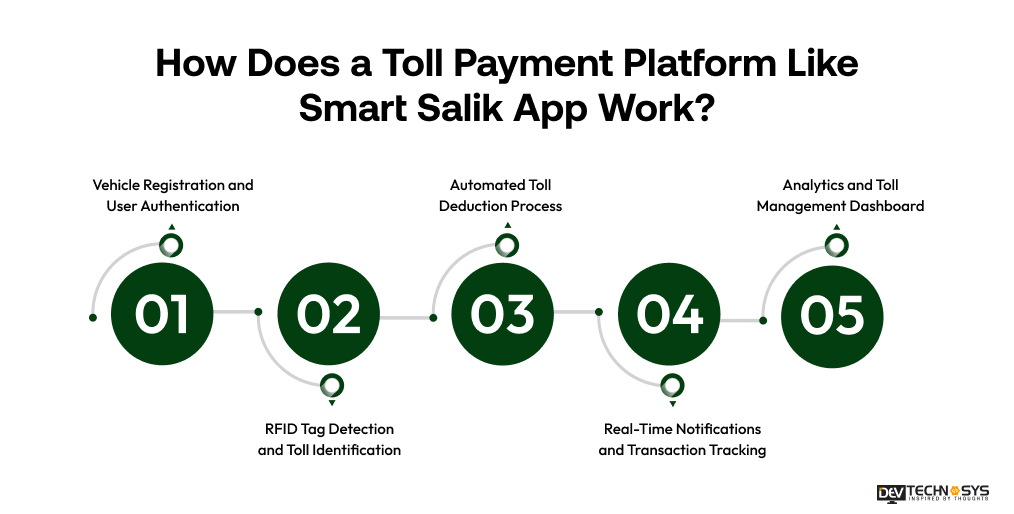
1. Vehicle Registration and User Authentication
To begin using a toll payment platform, users create an account through the mobile app and add their vehicle details, including plate number and vehicle type. They link a preferred payment method, such as a card or digital wallet, and complete a quick verification step. This ensures only authenticated users and vehicles are linked to active toll accounts.
2. RFID Tag Detection and Toll Identification
Once registered, each vehicle is fitted with an RFID tag that communicates with sensors installed at toll gates. As the vehicle approaches, the reader scans the tag and instantly identifies the vehicle without requiring it to stop or slow down. This RFID-based detection keeps traffic flowing smoothly while ensuring accurate toll identification for every passing vehicle.
3. Automated Toll Deduction Process
As soon as the vehicle is identified, the system calculates the toll fee automatically based on vehicle type or route. The amount is deducted instantly from the linked wallet or card, completing the transaction within seconds. This automated toll payment solution removes the need for manual fee collection, making travel faster and more efficient for every driver.
4. Real-Time Notifications and Transaction Tracking
After each deduction, users receive instant payment confirmation through app notifications. Every transaction is logged in their account, allowing them to view detailed toll receipts and transaction history anytime. This level of transparency builds trust and gives drivers complete visibility into their toll spending.
5. Analytics and Toll Management Dashboard
On the backend, an admin dashboard gives operators real-time visibility into traffic flow, revenue, and user activity. Reporting tools help authorities monitor performance across toll plazas. Many platforms rely on enterprise app development to manage this scale efficiently, which is why many authorities want to build an app like Smart Salik app for their own networks.
UAE Toll Collection Market Statistics and Industry Trends in 2026
Electronic toll collection is expanding rapidly worldwide as governments shift away from manual booths toward automated, software-driven systems. This growth is fueling demand for mobile-based tolling applications, with many authorities now turning to a mobile app development company in Kuwait and across the region to build region-specific tolling solutions.
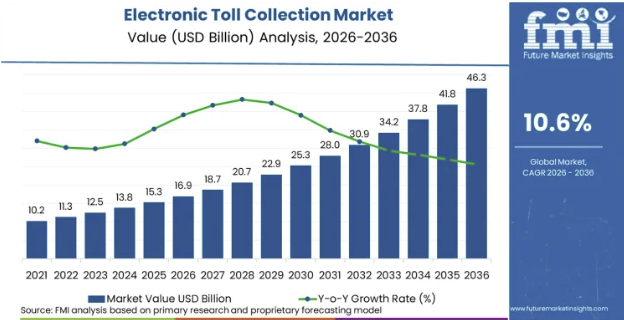
- The global electronic toll collection market is expected to reach USD 16.9 billion in 2026.
- The market is projected to reach USD 46.3 billion by 2036.
- Expected CAGR of 10.6% from 2026 to 2036.
- Growing adoption of AI-powered tolling systems worldwide.
- Rising investment in IoT-based toll management and smart transportation solutions.
This strong market growth is one of the key reasons why businesses and transportation authorities are increasingly investing in toll payment platform development.
Quote
According to Mattar Al Tayer (Chairman, Roads and Transport Authority, Dubai), “The Smart City concept envisions high priority to the welfare and convenience of residents, and the delivery of state-of-the-art services, including smart mobility, a key pillar of smart cities.”
Why Entrepreneurs and Governments Invest in Toll Payment Platform Development
Smart mobility initiatives and the shift toward cashless tolling are driving global investment in transportation technology, prompting many businesses to hire dedicated developers for toll payment platform development.
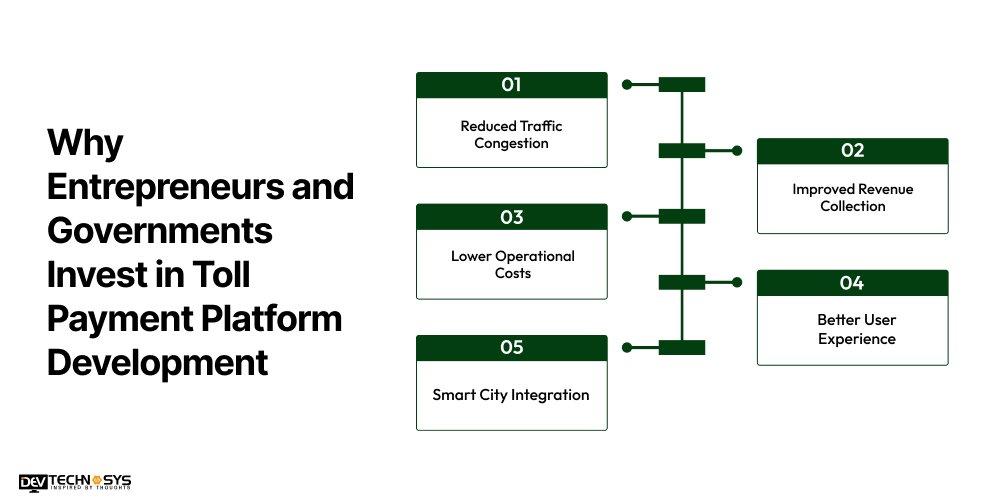
1. Reduced Traffic Congestion
Automated toll collection helps vehicles move faster and reduces waiting times at toll checkpoints.
2. Improved Revenue Collection
Digital toll systems minimize leakage and improve transaction accuracy across every checkpoint.
3. Lower Operational Costs
Automation reduces manpower requirements and ongoing toll booth expenses for operators.
4. Better User Experience
Drivers benefit from seamless, cashless toll payments through a reliable toll payment app development approach.
5. Smart City Integration
Modern toll systems support connected transportation and broader urban mobility initiatives.
Essential Features Required to Build a Toll Payment Platform Like Smart Salik App
A successful electronic toll collection app depends on user-friendly features, efficient administration tools, and advanced technologies that work together to support seamless toll collection and traffic management. Similar to modern Android app development projects, toll payment platforms require intuitive interfaces and real-time transaction capabilities.
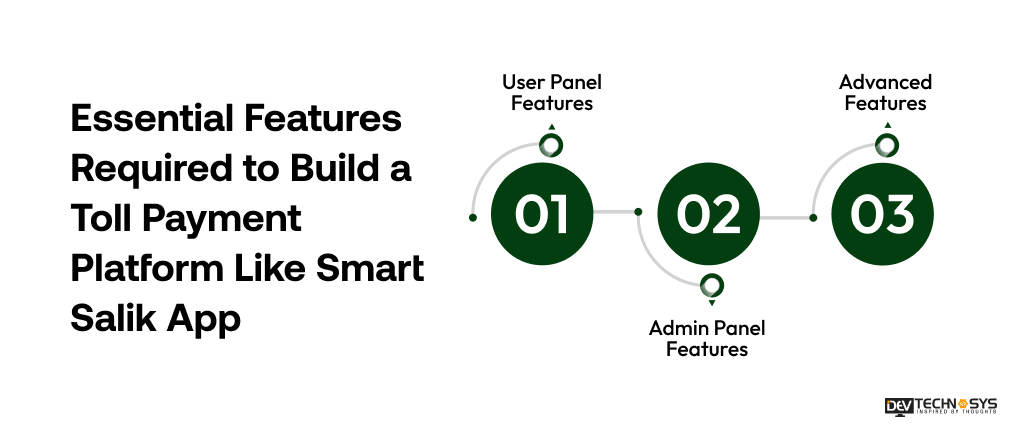
User Panel Features
User-side features focus on convenience, payment management, and real-time access to toll-related information, keeping the everyday experience simple for drivers.
- User Registration & Login: Secure registration enables users to create accounts, verify identities, and access personalized toll payment services from a single dashboard.
- Vehicle Management: Users can add, edit, and manage multiple vehicles, making the platform suitable for individuals and fleet operators alike.
- RFID Tag Management: Allows users to link RFID tags with vehicles for accurate identification and automatic toll deduction at every checkpoint.
- Wallet Integration: Provides a centralized wallet for storing funds and completing toll payments without manual transactions or cash handling.
- Auto Recharge: Automatically replenishes wallet balances when funds fall below a predefined threshold, preventing payment interruptions during travel.
- Toll History: Stores detailed transaction records, enabling users to review toll expenses and travel activities anytime they need to.
- Real-Time Notifications: Instant alerts notify users about toll deductions, wallet updates, and successful payment confirmations as they happen.
Admin Panel Features
Administrative features help operators manage users, toll infrastructure, revenue collection, and overall platform performance efficiently through reliable toll management software.
- User Management: Administrators can monitor registrations, verify accounts, and manage user-related activities through a centralized dashboard.
- Toll Rate Management: Allows operators to update toll charges based on routes, vehicle categories, and government regulations as needed.
- Transaction Monitoring: Provides visibility into payment activities, helping administrators identify failed transactions and unusual patterns quickly.
- Revenue Analytics: Generates reports on toll collections, revenue trends, and operational performance to support better decision-making.
- RFID Monitoring: Tracks RFID tag activity to ensure accurate vehicle identification and uninterrupted toll collection processes across all gates.
- Security & Access Control: Protects sensitive data by assigning role-based permissions and monitoring system access activities at every level.
Advanced Features
Advanced capabilities help businesses develop a modern platform like Smart Salik app that supports future-ready transportation ecosystems and rising traffic demands.
- AI Traffic Analytics: Analyzes traffic patterns and congestion trends to improve transportation planning and operational efficiency over time.
- Dynamic Toll Pricing: Adjusts toll charges based on traffic volume, peak hours, and route demand to balance congestion fairly.
- GPS-Based Vehicle Tracking: Improves route visibility and helps users monitor travel activities across toll-enabled road networks in real time.
- Multi-Vehicle Account Support: Allows businesses and fleet operators to manage several vehicles under a single, organized account.
- Smart City Integration: Connects toll infrastructure with broader urban mobility and transportation management systems for citywide coordination.
- Fraud Detection System: Identifies suspicious transactions and enhances payment security through automated monitoring mechanisms around the clock.
Selecting the right combination of user, admin, and advanced features is essential to build a toll payment platform like Smart Salik app capable of delivering secure, scalable, and efficient toll collection services for modern road networks. After identifying the required features, the next step is understanding the development process needed to turn the concept into a fully operational toll payment platform.
Step-by-Step Process to Develop an App Like Smart Salik App
Turning the idea into a working product involves several distinct stages, each building on the one before it. Here is how the process typically unfolds from planning to launch.
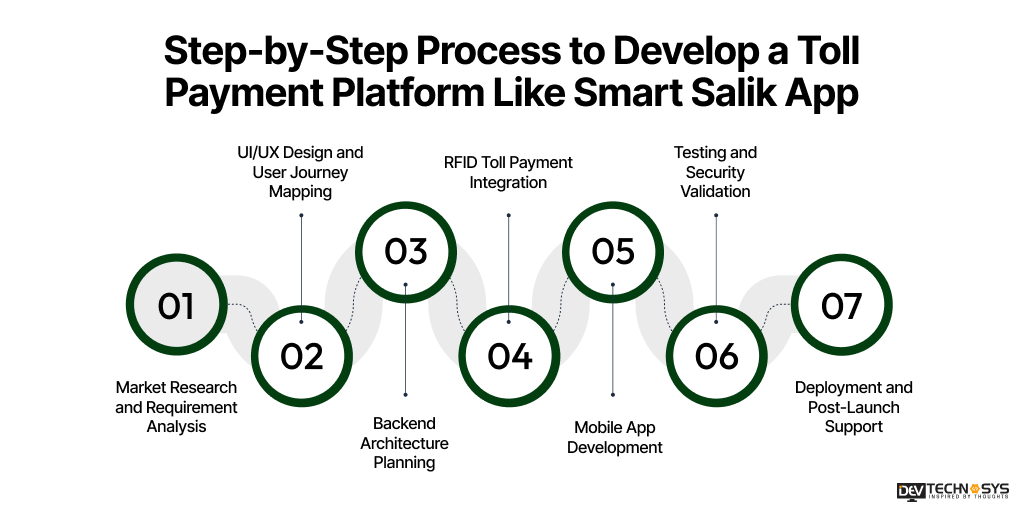
1. Market Research and Requirement Analysis
Every successful project starts with defining business goals, identifying target users, and analyzing competitors already operating in the space. Teams also study transportation regulations and finalize the platform scope. This planning stage ensures the foundation is solid before any development work begins.
2. UI/UX Design and User Journey Mapping
Designers create wireframes and map user flows for both drivers and administrators, focusing on a mobile-first approach. Dashboard layouts are refined for clarity and speed. Many businesses collaborate with an experienced iOS app development company to ensure seamless performance across Apple devices throughout this stage.
3. Backend Architecture Planning
A strong backend forms the backbone of any toll platform. This stage covers database architecture, API design, cloud infrastructure setup, and scalability planning. Security frameworks are also established early to protect sensitive payment and vehicle data as the platform grows over time.
4. RFID Toll Payment Integration
This stage connects RFID readers installed at toll gates with the platform’s backend systems. Vehicle detection, toll identification, and real-time data synchronization are configured to ensure every transaction is processed accurately. RFID toll payment integration is one of the most technically demanding stages, since accuracy directly affects revenue and user trust.
5. Mobile App Development
Parallel development of Android and iOS apps brings wallet functionality, vehicle management, and payment processing to life for end users. This toll payment app development stage focuses on speed, stability, and a smooth checkout experience so drivers can manage everything from a single app.
6. Testing and Security Validation
Before launch, the platform undergoes functional testing, security testing, payment validation, and performance testing under real-world conditions. Bug fixing happens continuously during this stage. Reliability and compliance remain the top priorities, since any failure here directly affects toll revenue and user confidence.
7. Deployment and Post-Launch Support
Once validated, the app is deployed to app stores and hosted on a scalable cloud infrastructure, with continuous monitoring in place. Teams that develop an App like Smart Salik app must also plan for regular updates and maintenance, since those who create a toll payment platform like Smart Salik app know that ongoing optimization is what keeps the system reliable long after launch.
Building such a system takes more than coding; it requires proper planning, secure infrastructure, and continuous refinement at every stage. Businesses that build a toll payment platform like Smart Salik app succeed when they treat toll payment platform like Smart Salik app development as an ongoing process rather than a one-time project. The technologies selected during development play a major role in determining the platform’s performance, security, and scalability.
Industry Insight
According to Global Market Insights, “Governments worldwide are prioritizing electronic toll systems to reduce congestion, improve toll efficiency, and support smart transportation ecosystems.”
Technology Stack Used for Toll Payment Platform Development
Choosing the right technology stack directly impacts how the platform performs, scales, and stays secure as user traffic grows. The right combination of tools also makes future expansion and feature upgrades far easier to manage down the line.
Layer |
Technologies |
Purpose |
| Frontend | Flutter, React Native | Cross-platform mobile apps |
| Backend | Node.js, .NET, Java | Business logic and APIs |
| Database | PostgreSQL, MongoDB | Data storage |
| Cloud | AWS, Azure, Google Cloud | Scalability and hosting |
| Payment Gateway | Stripe, PayTabs, Checkout.com | Payment processing |
| RFID Layer | RFID Readers, RFID APIs | Vehicle identification |
| Analytics | Power BI, Tableau | Reporting and insights |
| Security | OAuth 2.0, JWT, SSL | Data protection |
Businesses seeking cross-platform mobility applications often leverage Flutter app development services to accelerate development and maintain a consistent user experience across devices. A modern tech stack ensures smooth toll transactions, secure payment processing, cloud infrastructure that scales with demand, and successful RFID toll payment integration across every checkpoint.
Selecting the right technologies is just as crucial for long-term toll payment app development as it is for the toll management software running behind the scenes, since both rely on the same foundation to function reliably.
How Much Does It Cost to Build a Toll Payment Platform Like Smart Salik App?
The cost to build a toll payment platform like Smart Salik app typically ranges between $30,000 and $150,000+. Pricing depends on complexity, feature requirements, third-party integrations, and scalability needs. RFID hardware integration and payment gateway setup also influence the final budget, since both require specialized development work and ongoing maintenance support.
Development Level |
Key Features |
Estimated Cost |
| Basic Toll Payment Platform | User registration, wallet, RFID linking, toll history | $30,000 – $50,000 |
| Mid-Level Toll Payment Platform | Basic features + admin dashboard, auto recharge, real-time alerts | $50,000 – $80,000 |
| Advanced Toll Payment Platform | Mid-level features + AI traffic analytics, dynamic pricing, fraud detection | $80,000 – $120,000 |
| Enterprise Toll Payment Platform | Advanced features + smart city integration, multi-vehicle support, predictive reporting | $120,000 – $150,000+ |
Factors Affecting Toll Payment Platform Like Smart Salik App Development Cost
Similar to any mobile app development cost estimation, toll platform pricing depends on complexity, integrations, infrastructure, and long-term scalability requirements. The toll payment platform like Smart Salik app development cost, can vary significantly depending on which factors apply to a specific project.
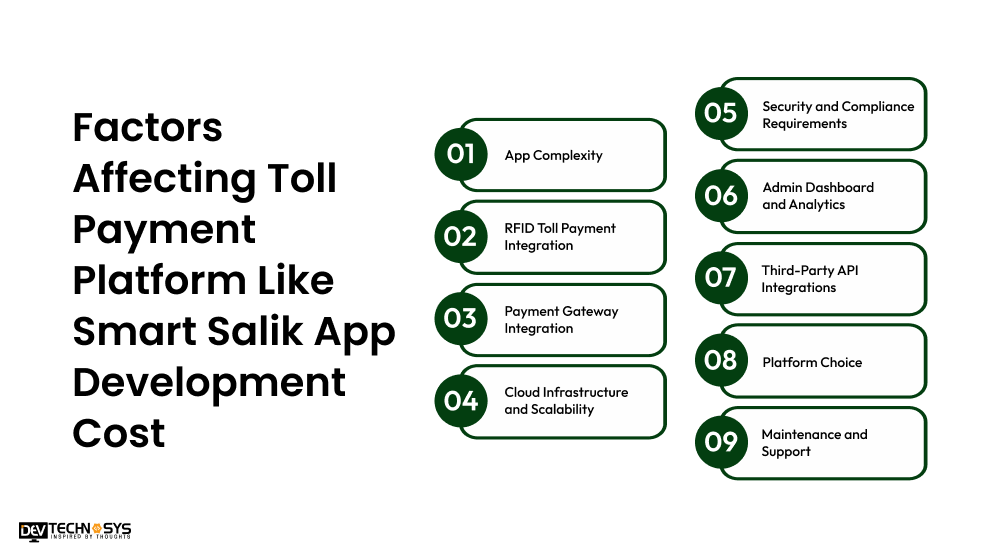
1. App Complexity
A basic platform with registration, payments, and transaction tracking requires fewer development hours. However, advanced modules such as AI analytics, fleet management, and dynamic pricing significantly increase development effort and overall project cost.
2. RFID Toll Payment Integration
RFID infrastructure requires seamless communication between readers, toll stations, and mobile applications. The complexity of integrating, testing, and maintaining real-time vehicle identification directly impacts development timelines and budget requirements.
3. Payment Gateway Integration
Supporting multiple payment methods, digital wallets, recurring payments, and secure transaction processing adds development complexity. Compliance requirements and regional payment provider integrations also contribute to increased implementation costs.
4. Cloud Infrastructure and Scalability
Platforms handling thousands of daily transactions require scalable cloud environments. Advanced hosting architecture, database optimization, backup systems, and load balancing increase infrastructure investment and long-term operational expenses.
5. Security and Compliance Requirements
Strong security frameworks, encryption mechanisms, access controls, and payment compliance standards demand additional development and testing efforts. These measures are essential for protecting sensitive user and financial data.
6. Admin Dashboard and Analytics
Comprehensive dashboards with traffic monitoring, revenue reporting, predictive analytics, and operational insights require additional backend development, reporting tools, and data visualization capabilities, increasing overall project complexity.
7. Third-Party API Integrations
Connecting GPS services, notification systems, mapping solutions, payment providers, and transportation databases requires custom API development, testing, and ongoing maintenance, which affects both initial and future costs.
8. Platform Choice
Developing separate Android, iOS, and web applications requires additional resources compared to a single-platform solution. Multi-platform development increases design, testing, deployment, and maintenance efforts.
9. Maintenance and Support
Regular updates, bug fixes, security patches, infrastructure monitoring, and performance improvements are ongoing requirements. Long-term support costs should be considered when planning to build a toll payment platform like Smart Salik app.
Cost Factor |
Impact on Budget |
Estimated Cost Contribution |
| App Complexity | High | $10,000 – $35,000 |
| RFID Integration | High | $8,000 – $20,000 |
| Payment Gateway Integration | Medium | $3,000 – $10,000 |
| Cloud Infrastructure | Medium-High | $5,000 – $15,000 |
| Security & Compliance | Medium-High | $5,000 – $12,000 |
| Admin Dashboard & Analytics | Medium | $4,000 – $10,000 |
| Third-Party APIs | Medium | $3,000 – $8,000 |
| Platform Choice | High | $8,000 – $20,000 |
| Maintenance & Support | Ongoing | 15% to 20% Annually |
Understanding these cost factors helps businesses estimate budgets more accurately and compare their platform requirements with existing toll payment solutions in the market.
Top 10 Toll Payment Platforms Like Smart Salik App in 2026
Analyzing successful toll payment platforms helps businesses understand industry standards, popular features, and opportunities when developing a platform like Smart Salik app, especially when working with a hybrid app development company.
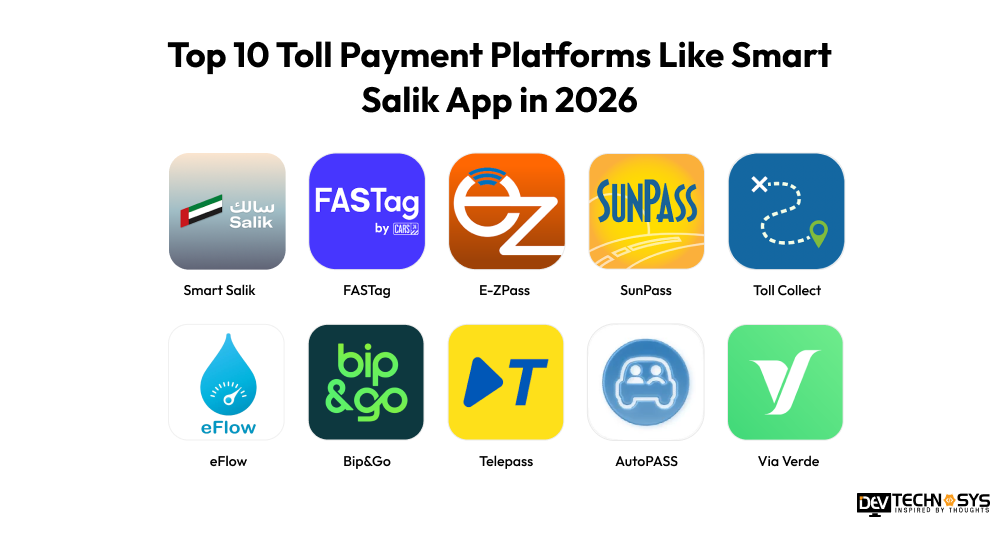
Platform |
Toll Technology |
Key Features |
Best For |
| Smart Salik | RFID | Auto Toll Payments, Wallet, Notifications | Urban Toll Collection |
| FASTag | RFID | Nationwide Toll Payments, Recharge, Vehicle Tracking | Highway Networks |
| E-ZPass | RFID | Multi-State Toll Access, Account Management | Regional Tolling |
| SunPass | RFID | Express Lanes, Toll Payments, Mobile App | Florida Roads |
| Toll Collect | GPS + RFID | Truck Tolling, Fleet Monitoring | Commercial Transport |
| eFlow | RFID | Barrier-Free Tolling, Auto Payments | Urban Mobility |
| Bip&Go | RFID | Cross-Border Tolling, Travel Services | European Drivers |
| Telepass | RFID | Parking, Fuel Payments, Tolling | Smart Mobility |
| AutoPASS | RFID | Nationwide Toll Coverage, Digital Payments | National Transport |
| Via Verde | RFID | Tolling, Parking, EV Charging Payments | Connected Mobility |
1. Smart Salik
Smart Salik plays a central role in Dubai’s smart transportation ecosystem. Its RFID-based toll collection, automatic payments, and seamless vehicle identification have made it one of the most successful tolling platforms globally, setting a strong benchmark for cities planning similar systems.
2. FASTag
FASTag transformed toll collection across India through nationwide RFID deployment, reducing congestion and supporting cashless payments at thousands of toll plazas. Its widespread adoption proves how a unified tolling network can scale across an entire country’s highway infrastructure.
3. E-ZPass
E-ZPass offers extensive coverage across multiple U.S. states, and its centralized toll account management improves convenience for frequent travelers crossing state lines. The platform’s interoperability between regions remains one of its strongest selling points for daily commuters and businesses.
4. Telepass
Telepass extends beyond toll payments by integrating parking, fuel purchases, and other mobility services into a single connected digital ecosystem for drivers. This broader approach to mobility shows how toll platforms can evolve into all-in-one transportation companion apps over time.
5. Toll Collect
Toll Collect focuses on commercial transportation, using GPS-enabled tolling and fleet management capabilities designed specifically for heavy vehicle operators across Germany. Its hybrid GPS and RFID model demonstrates how toll systems can adapt to serve large-scale logistics and freight networks.
Industry Insight
According to IMARC Group, “The ETC market is growing due to rising demand for efficient traffic management and the increasing adoption of smart transportation solutions worldwide.”
Revenue Models for a Toll Payment Platform Like Smart Salik App
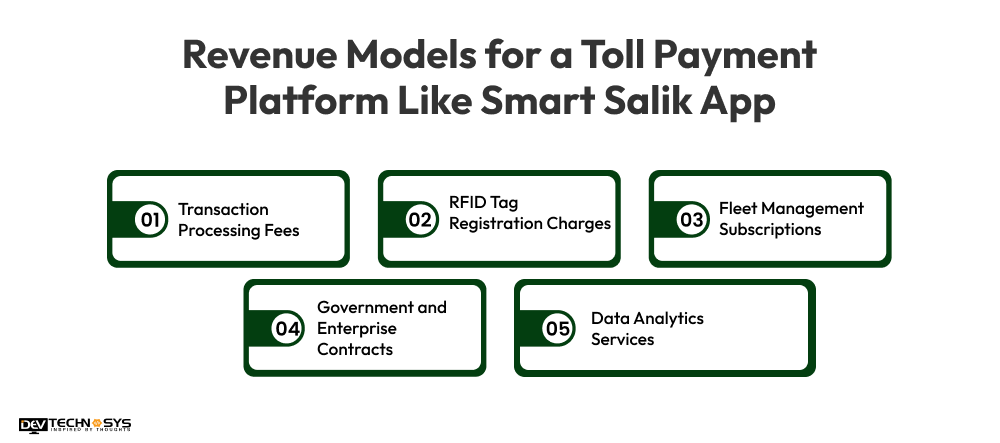
Businesses planning to create a toll payment platform like Smart Salik app should establish sustainable revenue streams to ensure long-term profitability, especially when working with the best payment gateway in UAE for processing.
1. Transaction Processing Fees
Charging a small fee on every toll transaction processed through the platform creates a steady, recurring revenue stream as overall platform usage grows.
2. RFID Tag Registration Charges
Revenue can also come from charging users for RFID tag issuance, activation, replacement, and account setup services throughout their time on the platform.
3. Fleet Management Subscriptions
Offering premium dashboards, reporting tools, and vehicle management features to logistics companies through monthly or annual subscription plans adds a dependable B2B income stream.
4. Government and Enterprise Contracts
Partnering with transportation authorities, municipalities, and highway operators to provide toll collection infrastructure and management services opens up large-scale, long-term contracts.
5. Data Analytics Services
Providing traffic insights, toll usage trends, and mobility analytics to organizations seeking data-driven transportation planning turns an automated toll payment solution into a valuable data asset beyond its core function.
Combining multiple monetization models helps maximize profitability while supporting future platform expansion and innovation. Beyond revenue generation, businesses must also identify unique differentiators that help their platform stand out in a competitive mobility market.
Unique Strategies to Differentiate Your Toll Payment Platform Like Smart Salik App
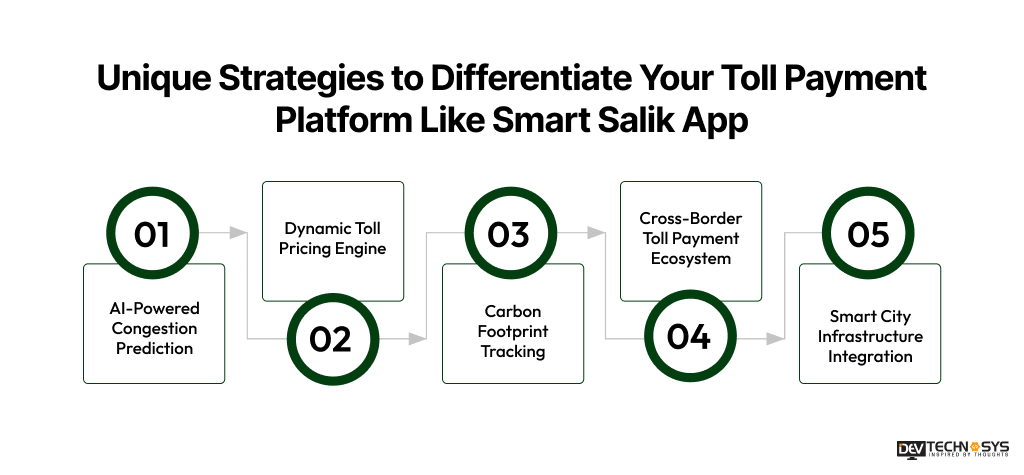
Simply replicating existing toll platforms is no longer enough in a rapidly evolving mobility landscape. Businesses that build a toll payment platform like Smart Salik app should focus on innovation, user convenience, and future mobility trends, much like the evolution seen in a smart payment app like Touch ‘n Go eWallet.
1. AI-Powered Congestion Prediction
Using artificial intelligence to analyze traffic patterns helps predict congestion before it occurs. This allows drivers to choose efficient routes and gives transportation authorities better tools for long-term planning.
2. Dynamic Toll Pricing Engine
Automatically adjusting toll charges based on traffic volume, road demand, and peak usage periods helps optimize traffic flow while maximizing operational efficiency for toll operators managing busy routes.
3. Carbon Footprint Tracking
Allowing users to monitor estimated carbon emissions generated during trips encourages environmentally conscious driving behavior through sustainability-focused insights built directly into the app experience.
4. Cross-Border Toll Payment Ecosystem
Enabling users to access toll roads across multiple regions using a single account creates a seamless travel experience and significantly reduces payment complexity for frequent travelers.
5. Smart City Infrastructure Integration
Integrating toll operations with parking systems, public transportation, EV charging stations, and other smart transportation solutions creates a genuinely connected mobility ecosystem for urban commuters.

Conclusion
The demand for digital toll collection continues to rise as cities prioritize automation, RFID technology, and smart mobility solutions. Businesses and transportation authorities that build a platform like Smart Salik app can reduce congestion, simplify revenue collection, and deliver a smoother travel experience for drivers across modern, scalable platforms.
From essential features and the right technology stack to a clear development process and realistic cost expectations, businesses now have a complete roadmap to develop a platform like Smart Salik app. Partnering with the right hybrid app development services ensures secure payment systems and long-term mobility innovation as digital tolling continues to expand.
FAQs
Q1. How Long Does It Take to Build a Platform Like Smart Salik App?
Development typically takes four to eight months, depending on feature complexity, RFID integration, and payment gateway requirements. Basic platforms launch faster, while advanced systems with AI analytics, fleet management, and smart city integration require additional testing time before a stable, secure launch.
Q2. Can an Existing Toll Platform Be Integrated With Government RFID Systems?
Yes, most modern toll payment platforms support integration with existing government RFID infrastructure through standardized APIs. This allows new platforms to sync with national tolling databases, vehicle registries, and existing toll gates without replacing established hardware, which helps reduce overall rollout costs.
Q3. What Ongoing Maintenance Does a Toll Payment Platform Require After Launch?
Post-launch maintenance includes regular security patches, server monitoring, RFID hardware checks, and payment gateway updates. Businesses should also budget for periodic feature upgrades, compliance updates, and customer support to keep the platform reliable as transaction volumes and user expectations grow over time.
Q4. How Scalable is a Toll Payment Platform for Handling High Traffic Volumes?
Cloud-based architecture allows toll payment platforms to scale efficiently during peak traffic periods. Using load balancing, distributed databases, and auto-scaling infrastructure, platforms can handle sudden spikes in transactions without downtime, ensuring smooth toll collection even during holidays or major traffic events.
Q5. Should Businesses Build a Toll Payment App or Partner With an Existing Toll Network?
Building a custom platform offers full control over features, branding, and revenue, making it ideal for governments and large operators. Partnering with existing toll networks suits smaller businesses seeking faster market entry without investing in dedicated RFID infrastructure or independent backend systems.