





Key takeaways:
-
- To build an app like Grammarly, businesses must focus on strong market research, AI integration, and scalable architecture to deliver a high-performing AI writing assistant app that meets modern user needs.
- The cost to develop an app like Grammarly typically ranges from $10,000 to $26,000, depending on features, AI complexity, platform choice, and overall grammar check app development requirements.
- The success of a Grammarly-like app depends on advanced NLP, real-time suggestions, cloud computing, and must-have features like tone detection, plagiarism checking, and AI-based text correction systems.
- Successful monetization models include subscriptions, API licensing, and enterprise solutions, helping businesses turn Grammarly app development into a long-term revenue-generating opportunity.
There is no turning back in how we write now, and AI is the trendsetter. Grammarly has proved that. With over 30 million daily active users, it is one of the best AI writing assistant apps ever created. Many entrepreneurs around the world aspire to build an app like Grammarly due to the rapidly growing popularity of such solutions.
The demand for AI grammar checker software is soaring thanks to the ongoing rise in telecommuting, the growth of content-based businesses, and non-native English-speaking users across the globe.
But what do you really need to develop an app like Grammarly in 2026? Which features, technologies, and resources should you account for?
In this comprehensive guide, we will outline all aspects of developing a Grammarly-like app, from the technology stack and required features to cost estimation and ways to earn from it.
Let’s get rolling!
What is Grammarly?
Grammarly is an app that uses AI to evaluate your writing for grammar, spelling, punctuation, tone, and style in real time. It works on all types of browsers, desktop programs, and mobile devices, so people can write properly and with confidence in any situation.
Launched in 2009, it uses advanced NLP and machine learning to go far beyond basic spell-check, making it the world’s most widely used AI writing assistant app today.
How Does a Grammarly-Like App Work?
A Grammarly-like app operates through a combination of Natural Language Processing (NLP), machine learning, and cloud computing to analyze and improve text in real time. Here’s a simplified breakdown of how the entire system works:
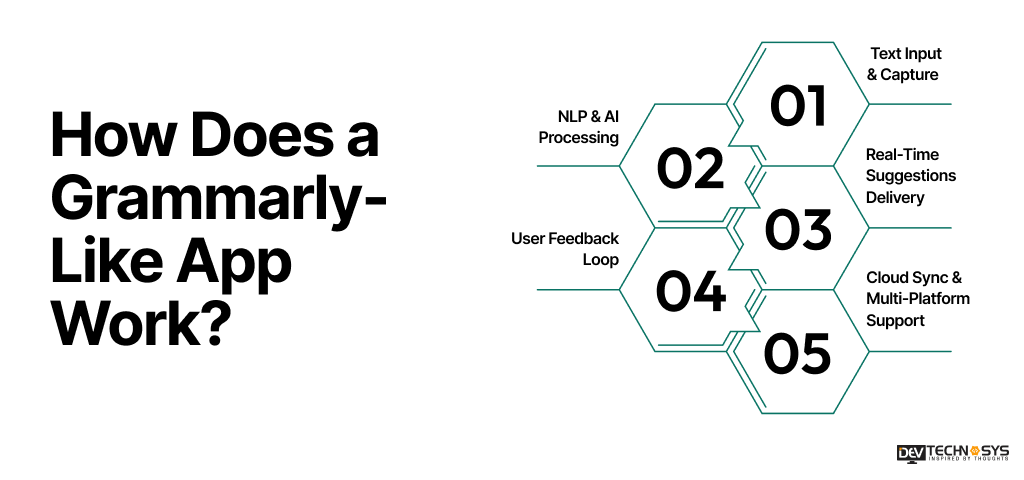
1. Text Input & Capture
The user types or pastes text into the app, whether through a browser extension, mobile keyboard, or desktop editor. The input is instantly captured and sent to the backend for processing. It also supports multiple languages and input formats to accommodate diverse user needs.
2. NLP & AI Processing
This is the brain of the system. The AI-based text correction system runs the text through multiple NLP models that detect grammatical errors, punctuation mistakes, tone inconsistencies, and structural issues simultaneously. Advanced contextual understanding ensures suggestions are relevant to the user’s intent and writing style.
3. Real-Time Suggestions Delivery
Once processed, corrections and suggestions are pushed back to the user interface within milliseconds, highlighting errors and offering context-aware fixes, tone adjustments, and vocabulary enhancements. The interface is designed to be non-intrusive while still providing clear and actionable recommendations.
4. User Feedback Loop
When users accept or reject suggestions, that data feeds back into the ML model, continuously improving accuracy and personalization over time. This adaptive learning mechanism helps tailor the system to individual user preferences and writing habits.

5. Cloud Sync & Multi-Platform Support
All user data, preferences, and writing history are stored and synced via cloud computing, ensuring a seamless experience across devices, i.e., web, mobile, and desktop. Robust security and encryption protocols are implemented to protect user data and privacy.
Market Stats & Opportunities for Grammar Check App Development
According to Business Research Insights, below are the market stats for the AI writing assistant app;
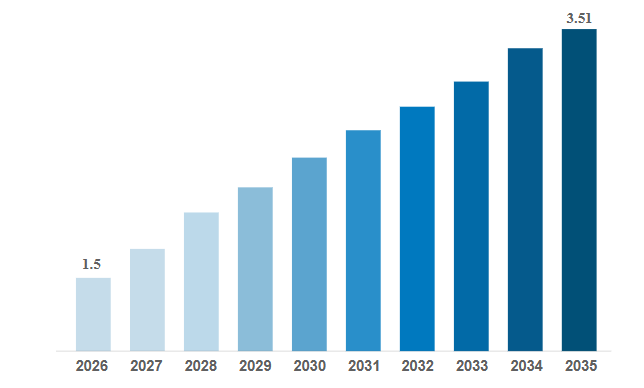
- The online grammar checker market is projected to grow from $1.5 billion in 2026 to $3.51 billion in 2035 at a 5% CAGR, showing strong long-term expansion.
- Growth is driven by increasing demand for error-free digital communication, content creation, and remote work environments.
- Grammarly leads the market with a comprehensive platform including grammar checks, style suggestions, and plagiarism detection.
- Key competitors like ProWritingAid, Ginger Software, WhiteSmoke, and Hemingway Editor focus on specialized features such as readability, translation, and in-depth writing analysis.
- The competitive landscape is shaped by AI innovation, multilingual support, integrations, and advanced writing insights, rather than basic grammar checking alone.
Industry Insight
Emergen Research, content creation and grammar checking together account for a major share of usage, with over 40%+ adoption in AI writing tools, showing strong demand for AI-powered text correction systems in digital communication.
How to Build An App Like Grammarly? Step-by-Step Development Process
To build a grammar check app like Grammarly requires careful planning, the right technology, and a structured approach. Here is a step-by-step breakdown to help you build an app like Grammarly from scratch.
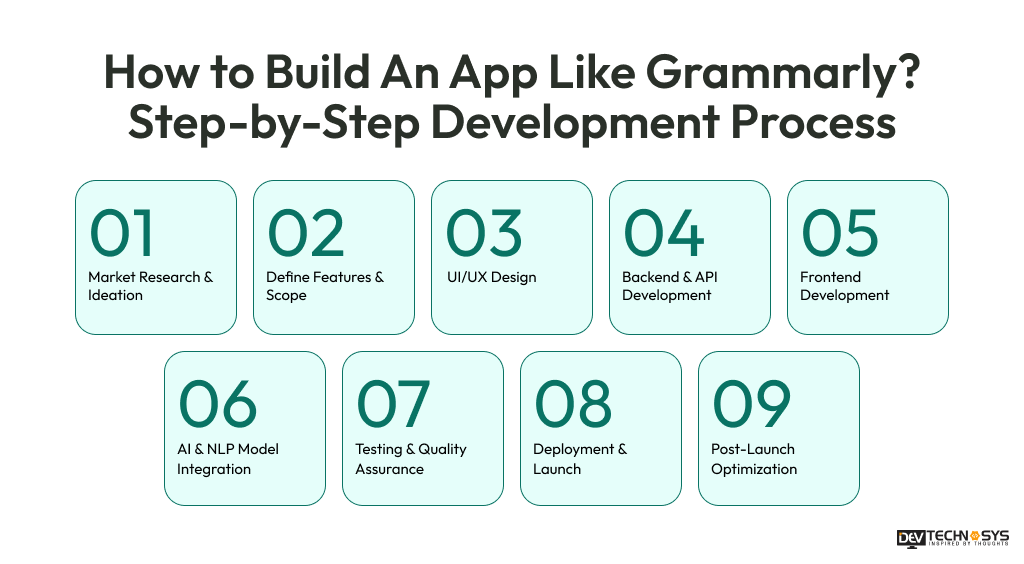
1. Market Research & Ideation
Define your target audience, niche, and value proposition. Study competitors, identify gaps, and decide what makes your app unique. Partnering with an experienced mobile app development company at this stage ensures your scope is technically realistic and commercially viable.
2. Define Features & Scope
List core MVP features like grammar check, spell correction, and tone detection. Prioritize what goes into your first release and plan advanced features for later phases. A clear scope prevents costly revisions and keeps your Grammarly app development timeline on track.
3. UI/UX Design
Design a clean, distraction-free interface that works seamlessly across browser extensions, mobile, and desktop. For Android users, Android app development best practices should guide layout and interaction design, ensuring smooth, platform-native experiences from day one.
4. Backend & API Development
Build your NLP engine, integrate AI models, and develop the Grammarly-like API that powers real-time text analysis. Your backend must handle thousands of simultaneous requests without latency; scalability is non-negotiable at this stage of development.
5. Frontend Development
Build user-facing interfaces for web, iOS, and Android. Aligning with a reliable iOS app development company ensures seamless writing-assistant feature integration across Apple devices. Keep performance, speed, and cross-platform consistency as your top frontend priorities throughout.
6. AI & NLP Model Integration
Integrate NLP libraries like spaCy, OpenAI GPT, or Google NLP into your backend pipeline. Train models on large grammar datasets and fine-tune them for accuracy, context awareness, and tone detection to deliver intelligent, reliable suggestions every time.
7. Testing & Quality Assurance
Run extensive testing across devices, browsers, and operating systems. Check grammatical accuracy, response speed, and UI consistency. Any lag or false suggestion damages user trust; thorough QA is what separates a polished AI writing assistant app from a frustrating one.
8. Deployment & Launch
Deploy on cloud infrastructure for scalability and reliability. Many businesses use hybrid app development services to launch on both iOS and Android simultaneously, reducing time-to-market and overall development costs without compromising on quality or performance.
9. Post-Launch Optimization
Collect user feedback, monitor performance, and push regular updates. Use real-world data to retrain AI models and improve suggestion quality continuously. This ongoing process is what keeps your Grammarly-like app competitive and relevant in a fast-evolving market.

Tech Stack Required to Build An App Like Grammarly
Building a robust Grammarly-like app demands a carefully chosen technology stack that supports real-time AI processing, cross-platform compatibility, and scalable cloud infrastructure. Below is a comprehensive tech stack table to guide your Grammarly app development decisions:
Category |
Technology / Tool |
Description |
| Frontend | React.js, Angular, React Native, Flutter | Fast, component-based frameworks for building responsive web interfaces |
| Backend | Node.js, Python (Django/FastAPI) | Scalable server-side frameworks are ideal for handling real-time API requests |
| NLP Engine | spaCy, NLTK, OpenAI GPT | Core libraries for grammar detection, text analysis, and language understanding |
| Machine Learning | TensorFlow, PyTorch | Frameworks for training and fine-tuning custom AI proofreading models |
| Database | PostgreSQL, MongoDB | Relational and NoSQL databases for storing user data and writing history |
| API Development | REST API, GraphQL | For building APIs that connect the frontend with the AI backend |
| Authentication | OAuth 2.0, JWT | Secure user authentication and session management across all platforms |
| DevOps & CI/CD | Docker, Kubernetes, GitHub Actions | Containerization and automated deployment pipelines for smooth releases |
| Security | SSL/TLS, AES Encryption | Ensures data privacy and secure transmission of user content |
7 Must-Have Features of a Grammarly-Like App in 2026
The success of any Grammarly-like app depends heavily on its feature set. To create an app like Grammarly that users trust and return to daily, you need to deliver accuracy, speed, and intelligence across every interaction. Here are the 8 must-have features for your content editing app development.
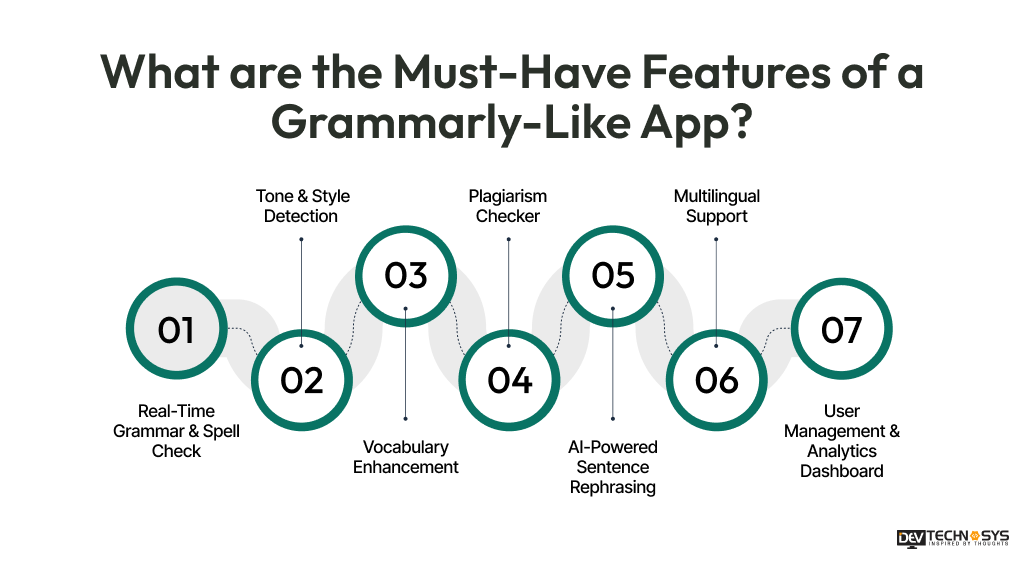
1. Real-Time Grammar & Spell Check
The foundation of any AI proofreading app, instantly detecting and correcting grammatical errors, spelling mistakes, and punctuation issues as the user types, without any manual trigger required. It ensures a smooth and uninterrupted writing experience with minimal latency.
2. Tone & Style Detection
Analyzes the overall tone of content, formal, casual, confident, or aggressive, and suggests adjustments to match the user’s intended communication style and target audience. This helps maintain consistency and professionalism across different types of communication.
3. Vocabulary Enhancement
Suggests stronger, more precise word choices to improve clarity and impact. This feature is what elevates a basic spell-checker into a true AI writing assistant app that users genuinely rely on. It also helps users expand their vocabulary and writing skills over time.
4. Plagiarism Checker
Scans content against billions of web pages to detect duplicate content, a critical feature for students, writers, and professionals who need originality assurance before publishing. Detailed reports highlight matched sources and similarity percentages for transparency.
5. AI-Powered Sentence Rephrasing
Goes beyond correction; it rewrites entire sentences for better clarity, conciseness, or tone. Understanding the mobile app development cost tied to this AI feature helps prioritize it wisely in your MVP. Multiple rewrite options give users flexibility to choose the best version.
6. Multilingual Support
Supports grammar checking across multiple languages, significantly expanding your app’s reach to a global audience of non-native English speakers and international professionals. Language detection automatically adapts suggestions based on the selected or detected language.
7. User Management & Analytics Dashboard
Allows admins to monitor active users, track usage patterns, manage subscriptions, and measure AI model performance, keeping your Grammarly app development data-driven and growth-focused. Real-time insights enable better decision-making and continuous product improvement.
Why Do Businesses Invest in Grammarly-Like App Development?
The demand for smart writing tools is growing faster than ever. Here is why businesses are actively looking to develop an app like Grammarly in 2026.
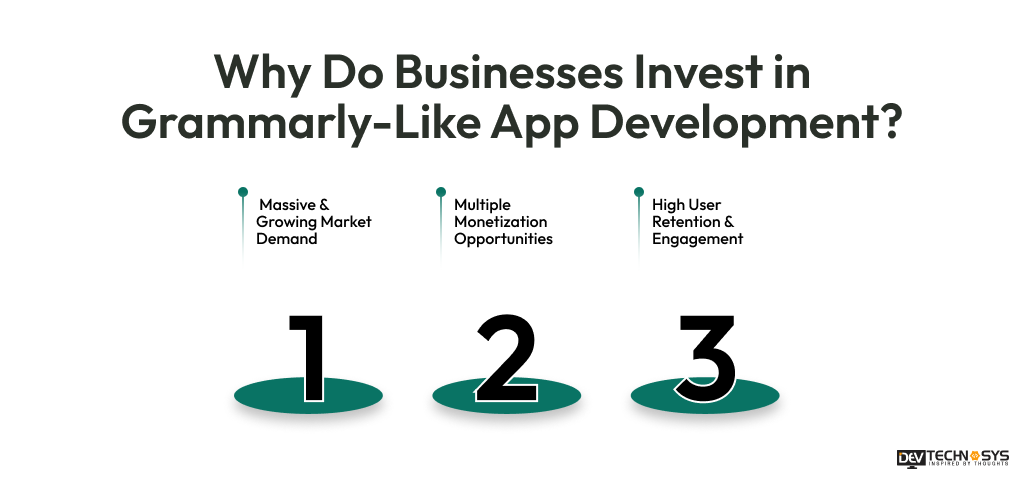
1. Massive & Growing Market Demand
The global AI writing assistant market is projected to reach billions in the coming years. Businesses recognize this opportunity early, just like companies rushed to invest in on-demand app development solutions when that wave hit. The timing to enter this space has never been better.
2. Multiple Monetization Opportunities
From premium subscriptions and API licensing to enterprise plans and white-label solutions, a Grammarly-like app offers diverse, scalable revenue streams that generate consistent long-term income without high ongoing operational costs.
3. High User Retention & Engagement
Writing tools become daily habits. Once users integrate your app into their workflow, churn rates drop significantly. Businesses looking to make an app like Grammarly benefit from exceptionally strong retention metrics compared to most other app categories.
Industry Insight
According to Market.us, cloud-based deployment dominates the industry with over 66% market share, as businesses prefer scalable, real-time grammar check app development using AI and NLP technologies for seamless performance across platforms.
What is the Cost to Build An App Like Grammarly?
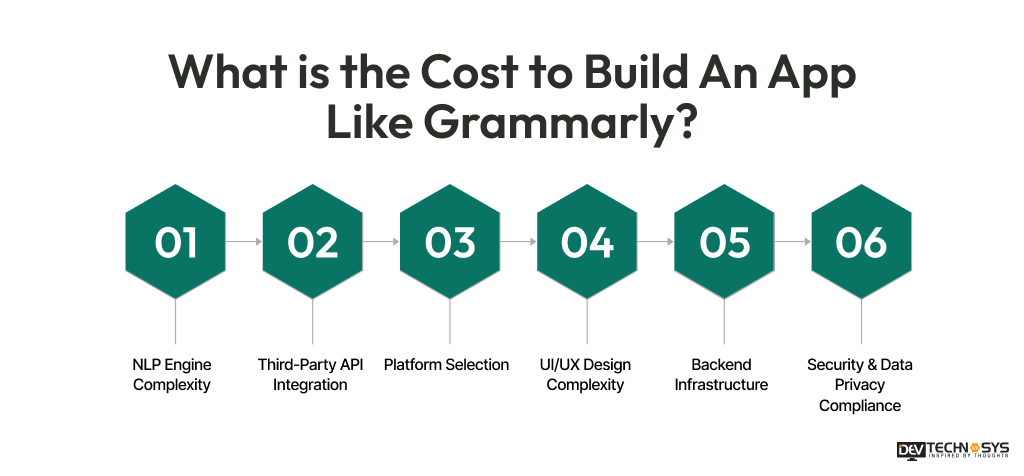
The Grammarly app development cost depends on the complexity of features, AI integration, and platform coverage. The cost to develop an app like Grammarly can vary based on whether you build a basic MVP or a fully advanced AI-powered writing assistant. With a budget of $10,000 to $26,000, businesses can start small and gradually scale features over time.
Level |
Estimated Cost (USD) |
Features Included |
| Basic | $10,000 – $14,000 | Grammar check, spell check, simple UI, basic editor |
| Mid-Level | $14,000 – $20,000 | Advanced grammar suggestions, readability analysis, user accounts, API integration |
| Advanced | $20,000 – $26,000 | AI-powered writing assistant, NLP integration, plagiarism detection, web + mobile support |
Below are the factors that affect the grammar check app development cost
NLP Engine Complexity
The complexity of the NLP engine significantly impacts the grammar check app development cost. Advanced models require training, fine-tuning, and continuous updates. More sophisticated language processing increases accuracy but also demands higher computational resources and skilled AI engineers.
Level |
Features |
Affected Cost |
| Basic | Rule-based grammar checks, fixed error patterns | $1,500 – $2,500 |
| Standard | NLP-based suggestions, contextual corrections | $2,500 – $4,000 |
| Advanced | AI/LLM-based grammar correction, deep context understanding | $4,000 – $6,000 |
Third-Party API Integration
Third-party API integration affects cost when using services like Grammarly-like APIs, OpenAI models, or language toolkits. Licensing fees, usage-based pricing, and integration complexity can significantly increase overall development and maintenance expenses over time.
Level |
Features |
Affected Cost |
| Basic | Minimal API usage, limited external dependency | $500 – $1,500 |
| Standard | Integration with 1–2 AI/NLP APIs | $1,500 – $3,000 |
| Advanced | Multiple APIs + smart routing + usage optimization | $3,000 – $4,000 |
Platform Selection
Choosing between web, mobile, or cross-platform development affects cost. Native mobile apps require separate builds for Android and iOS, while cross-platform frameworks reduce effort but may limit performance optimization and advanced feature flexibility.
Level |
Features |
Affected Cost |
| Basic | Web-only application | $1,000 – $2,500 |
| Standard | Web + single mobile platform (Android or iOS) | $2,500 – $5,000 |
| Advanced | Cross-platform (Web + Android + iOS) | $5,000 – $8,000 |
UI/UX Design Complexity
UI/UX design quality directly impacts user engagement and development cost. Custom animations, accessibility features, and intuitive interfaces require additional design effort, prototyping, and iterative testing, increasing overall project budget and timelines.
Level |
Features |
Affected Cost |
| Basic | Simple interface, minimal design, basic layout | $800 – $2,000 |
| Standard | Clean modern UI, responsive design, better usability | $2,000 – $3,000 |
| Advanced | Premium UI/UX, animations, interactive editing experience | $3,000 – $5,000 |
Backend Infrastructure
Backend infrastructure, including servers, databases, and cloud services, affects scalability and performance. High traffic handling, real-time grammar suggestions, and data storage needs increase hosting costs and system architecture complexity over time.
Level |
Features |
Affected Cost |
| Basic | Simple backend, low traffic handling | $1,500 – $3,000 |
| Standard | Cloud backend, moderate scaling, database optimization | $3,000 – $5,000 |
| Advanced | High-scale architecture, real-time processing, distributed systems | $5,000 – $7,,000 |
Security & Data Privacy Compliance
Security and data privacy compliance increase development complexity. Grammar check apps often process sensitive text data, requiring encryption, secure APIs, GDPR-like compliance, and regular audits, which adds to both development and maintenance costs.
Level |
Features |
Affected Cost |
| Basic | Basic HTTPS encryption, simple authentication | $500 – $1,500 |
| Standard | Secure login, encrypted storage, role-based access | $1,500 – $3,000 |
| Advanced | GDPR-level compliance, audit logs, advanced encryption | $3,000 – $6,000 |
What are the Top 10 Apps Like Grammarly?
Grammarly is one of the most popular AI writing assistants, but many alternatives now offer better pricing, privacy, multilingual support, or advanced rewriting features. If you’re building or comparing tools, you can also explore related AI writing ecosystems and even tools used for content evaluation like top AI detectors to use for checking AI-generated text quality.
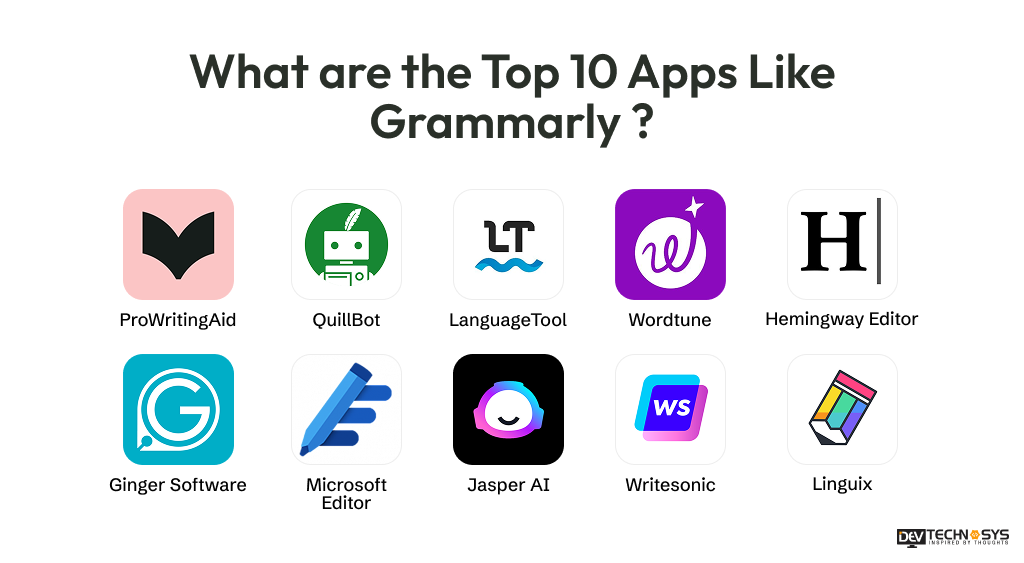
App Name |
Key Features |
Platform |
Pricing Model |
| ProWritingAid | Deep grammar analysis, readability reports, style improvement, long-form writing tools | Web, Desktop, Browser Extension | Freemium + Paid |
| QuillBot | Paraphrasing modes, grammar checker, summarizer, citation tool | Web, Browser Extension | Freemium + Paid |
| LanguageTool | Multilingual grammar checking, privacy-focused editing, style suggestions | Web, Desktop, Browser Extension | Freemium + Paid |
| Wordtune | AI rewriting, tone adjustment, sentence rephrasing | Web, Browser Extension | Freemium + Paid |
| Hemingway Editor | Readability scoring, sentence simplification, clarity improvement | Web, Desktop App | Free + Paid |
| Ginger Software | Grammar correction, translation, sentence rephrasing, text-to-speech | Web, Desktop, Mobile | Freemium + Paid |
| Microsoft Editor | Grammar & spelling inside Microsoft Office, browser-based writing help | Web, MS Office, Edge Extension | Free + Subscription (M365) |
| Jasper AI | AI content generation, marketing copywriting, and blog writing tools | Web | Paid Subscription |
| Writesonic | AI writing generator, SEO blogs, and content creation tools | Web | Freemium + Paid |
| Linguix | Grammar correction, writing suggestions, browser-based assistant | Web, Browser Extension | Freemium + Paid |
1. ProWritingAid
ProWritingAid is a powerful grammar and style improvement tool offering deep reports, readability analysis, and long-form writing support. It is widely used by authors and editors for improving structure and clarity in professional content creation workflows. Many teams also combine it with hire mobile app developers in Middle East to build custom writing or editing platforms.
2. Wordtune
Wordtune uses AI to rewrite and refine sentences in different tones, like formal, casual, or concise. It improves clarity, flow, and expression in real time, helping users write better emails, blogs, and content. It’s widely used for fast, context-aware sentence improvement in everyday writing tasks.
3. QuillBot
QuillBot is an AI-powered writing assistant known for paraphrasing, grammar checking, and summarization. It helps users rewrite sentences in multiple styles while improving clarity and tone, making it popular among students, bloggers, and researchers who focus on Android app development projects involving AI-based writing tools.
4. Hemingway Editor
Hemingway Editor focuses on readability by highlighting complex sentences, passive voice, and unnecessary adverbs. It helps writers simplify content and improve clarity, making it especially useful for bloggers and content creators.
5. LanguageTool
LanguageTool is a multilingual grammar checker that supports over 20 languages with privacy-focused editing. It provides spelling, style, and grammar suggestions, making it a strong alternative for global users. Its workflow is often studied in the context of the mobile app development lifecycle for SaaS-based productivity apps.
What are the best Monetization Models for Your Grammarly-Like App
Monetization models for a Grammarly-like app include subscriptions, freemium upgrades, API licensing, and enterprise solutions. These strategies are essential when planning Grammarly app development cost and building scalable AI writing assistant app solutions.
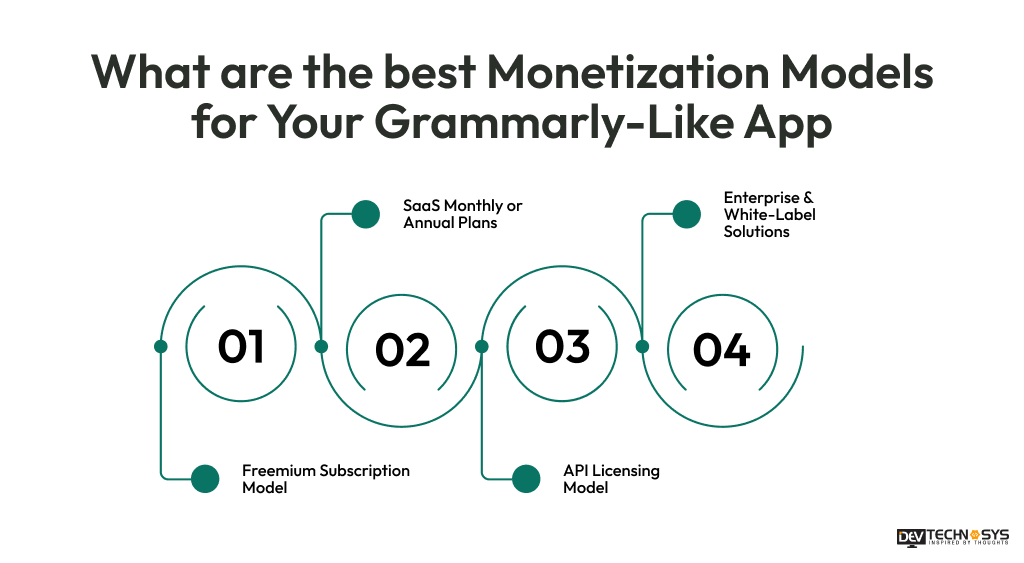
1. Freemium Subscription Model
Freemium is widely used when you build a grammar check app like Grammarly, offering basic features for free and advanced tools in paid plans. It supports AI proofreading app growth and helps reduce Grammarly app development cost through early user acquisition.
2. SaaS Monthly or Annual Plans
SaaS subscriptions are key in Grammarly app development, allowing users to pay monthly or yearly. This model works well when you developAn App Like Grammarly with a premium AI-based text correction system and scalable cloud computing infrastructure.
3. API Licensing Model
API licensing is useful when you create an App Like Grammarly or build Grammarly-like API development services. Businesses pay to access your grammar check app development system, making it ideal for enterprise-level AI writing assistant app integration.
4. Enterprise & White-Label Solutions
Enterprise monetization works when you develop an App Like Grammarly for companies needing branded tools. Many firms prefer white-label AI proofreading app solutions built by a business app development company with dedicated developers and scalable content editing app development systems.
Quote
Satya Nadella, through Microsoft AI vision, said, “AI is the defining technology of our times. It’s augmenting human ingenuity and helping us solve some of society’s most pressing challenges.”
What Makes a Grammarly-Like App Successful in 2026?
A successful Grammarly-like app in 2026 depends on AI accuracy, user experience, scalability, and smart personalization. Strong AI writing assistant app capabilities and efficient Grammarly app development cost planning also play a key role in long-term adoption and growth.
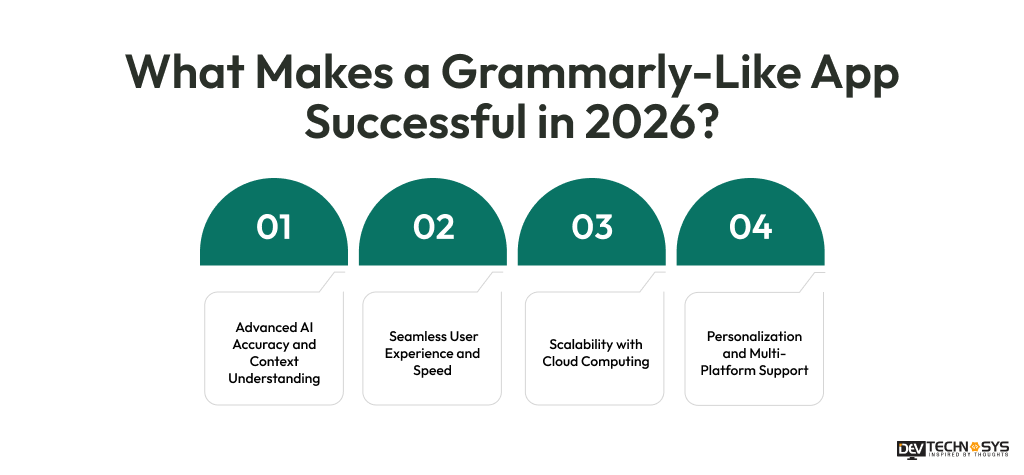
1. Advanced AI Accuracy and Context Understanding
A successful Grammarly-like app must use an AI-based text correction system that understands context, tone, and intent. Unlike basic tools, modern grammar check app development focuses on deep learning models that improve writing quality, not just fix spelling or grammar errors.
2. Seamless User Experience and Speed
User experience is critical in Grammarly app development, requiring fast suggestions, a clean UI, and real-time corrections. A smooth AI proofreading app keeps users engaged and reduces friction, making it easier to build a grammar check app like Grammarly that people rely on daily.
3. Scalability with Cloud Computing
Cloud computing ensures a Grammarly-like app can handle millions of users without performance issues. Scalable architecture is essential for AI writing assistant app platforms, supporting real-time processing, API requests, and enterprise-level growth while optimizing grammar check app development cost.
4. Personalization and Multi-Platform Support
Modern users expect personalized suggestions across web, mobile, and desktop. A strong content editing app development strategy includes adaptive AI, multilingual support, and cross-platform syncing. This improves retention and is key when you create An App Like Grammarly for global users.
How Can Dev Technosys Help You Build an App Like Grammarly?
Dev Technosys helps you build an app like Grammarly with end-to-end development, including AI integration, UI/UX design, and scalable architecture. Their expertise in Grammarly-like app development ensures strong performance and modern features. You can also hire dedicated developers to reduce timelines and optimize costs while building a powerful AI writing assistant app.
Conclusion
Developing a successful AI writing assistant app requires careful planning, strong technical execution, and the right feature set, such as grammar correction, tone detection, and AI-powered suggestions. Businesses aiming to build an app like Grammarly must focus on scalability, user experience, and long-term performance.
With proper strategy and expert support, you can bring a reliable Grammarly-like solution to market faster and more efficiently. Partnering with a trusted mobile application development company helps ensure smooth development, better quality, and faster delivery of your product while keeping costs under control.
FAQs
Q1. What Features Should a Grammarly-like App Have?
A Grammarly-like app should include grammar and spell checking, tone detection, AI rewriting, readability analysis, and contextual suggestions. Advanced versions may offer plagiarism detection, multilingual support, and real-time collaboration tools. These features help users create clearer, more professional, and error-free content across different writing scenarios.
Q2. How Much Does Grammarly App Development Cost?
Grammarly app development cost ranges from $10,000 to $26,000, depending on complexity, features, AI capabilities, and platform choice. A basic version may cost less, while advanced AI writing assistant apps with cloud computing, APIs, and scalability require a higher investment. Costs also increase with mobile support, enterprise features, and continuous AI model improvements.
Q3. Can I Build a Grammarly-like App for Mobile?
Yes, a Grammarly-like app can be built for mobile platforms using Android and iOS development tools or cross-platform frameworks. Mobile apps require optimized AI models for fast suggestions, smooth UI, and offline capabilities. Proper architecture ensures real-time grammar correction and seamless user experience on smartphones and tablets.
Q4. How Long Does It Take to Develop a Grammarly-like App?
The development timeline depends on features, design complexity, and AI integration. A basic app may take 2-3 months, while a full-scale AI writing assistant app can take 4 to 6 months. Additional time is needed for testing, optimization, and ensuring accurate real-time grammar and writing suggestions.
Q5. What Are the Challenges in Grammarly-like App Development?
Challenges include training accurate AI models, ensuring real-time performance, handling large datasets, and maintaining scalability. Developers also face issues like language complexity, data privacy, and continuous model updates. Balancing speed, accuracy, and cost is essential for building a reliable and competitive grammar checking solution.