





Key Takeaways
Quick Summary:
Transportation software development costs typically range from $8,000 to $30,000+, depending on complexity, features, and scalability. Basic MVP solutions may cost $8,000 to $15,000, mid-level systems range from $15,000 to $22,000, while advanced, enterprise-grade platforms can exceed $22,000 to $30,000+. The cost to create a transportation software is mainly influenced by features, integrations, and infrastructure requirements.
Cost Breakdown by Development Complexity
- Basic/MVP ($8,000 to $15,000):Includes core features like user registration, booking/dispatch system, basic tracking, and a simple admin dashboard.
- Mid-Level ($15,000 to $22,000):Adds real-time GPS tracking, payment integration, push notifications, analytics dashboard, and third-party API integrations.
- Advanced ($22,000 to $30,000+):Custom enterprise software development includes AI-based route optimization, predictive analytics, IoT integration, multi-user roles, and scalable cloud infrastructure.
Key Cost Drivers
- App/Software Type: Creating a fleet management system (FMS) is more affordable compared to large-scale logistics platforms or multi-service transportation ecosystems.
- Features & Integrations: Real-time tracking, AI-based optimization, and multiple integrations significantly increase transport management software development costs.
- Platform Choice: Cross-platform development reduces the cost to create a transportation software, while native or multi-platform systems increase investment due to separate builds.
Cost Based on Countries (Hourly Rates)
- United States: $50 – $100 per hour
- United Kingdom & Western Europe: $40 – $80 per hour
- Eastern Europe: $45 – $70 per hour
- Asia (India, Southeast Asia): $15 – $25+ per hour
- Australia: $35 – $70 per hour
Development Timeline
- MVP Software: 1 to 2+ months
- Mid-Level Software: 2 to 4+ months
- Marketing & ASO: App promotion, ASO, and digital marketing are essential for visibility and user acquisition.
- Advanced Software: 4 to 6+ months or more
In this fast-moving digital economy, transportation software has become the backbone of modern mobility solutions, from ride-hailing and logistics platforms to fleet management. Businesses are increasingly investing in smart, scalable applications to streamline operations, reduce costs, and enhance customer experiences. Whether you’re planning to build a solution similar to Uber or a custom logistics platform tailored to your business needs, understanding the development cost is a critical first step.
The cost to build a transportation software in 2026 can vary widely depending on features, technology stack, and project complexity. In this guide, we’ll explore key factors such as the features involved, the required tech stack, and more. Read the complete post to know the crucial components clearly.
What is the Average Transportation Software Development Cost in 2026?
The average transportation software development cost 2026 largely depends on the app’s complexity, features, and scalability requirements. Businesses can choose from different development tiers based on their goals, target audience, and budget.
For a basic MVP (Minimum Viable Product) with core features like user registration, booking, and simple tracking, the cost typically ranges between $8,000 to $15,000. This is ideal for startups looking to validate their idea quickly.
A mid-level transportation software with enhanced features such as real-time GPS tracking, payment integration, and an admin dashboard usually costs around $15,000 to $22,000.
An advanced transportation software development solution that includes AI-based route optimization, analytics, IoT integration, and high-end security. Advanced features exceed the cost to build a transportation software, reaching $30,000+ depending on customization and scalability needs.
| Development Type | Estimated Cost (2026) | Development Timeline |
| Basic MVP Development | $8,000 – $15,000 | 1 – 2 months |
| Mid-Level Software | $15,000 – $22,000 | 2 – 4 months |
| Advanced Software | $22,000 – $30,000+ | 4 – 6+ months |
Industry Insights: According to Grand View Research, the global transportation management system market was valued at $18.56 billion in 2025 and is projected to reach $68.36 billion by 2033, growing at a CAGR of 17.8%.
What are the Factors Affecting the Cost to Build a Transportation Software?
The cost of building transportation software in 2026 depends on multiple technical, operational, and business-related factors. From feature complexity to technology choices, each element plays a crucial role in determining the overall development budget.
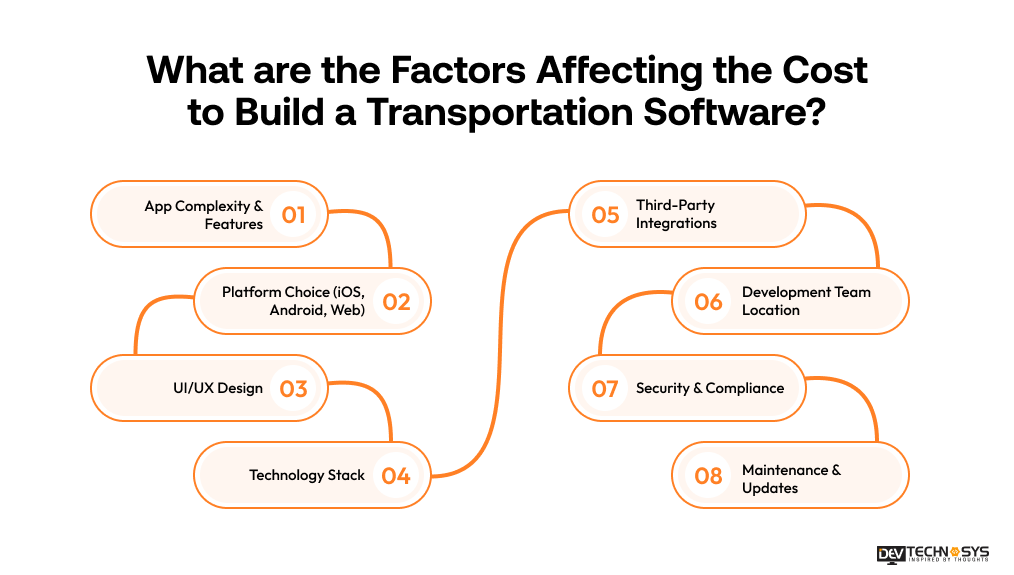
1. App Complexity & Features
The overall cost of transportation software MVP development largely depends on its complexity and feature set. The cost to build a transportation software for basic apps with limited functionality falls on the lower side.
Advanced platforms include AI-based route optimization, role-based access control (RBAC), real-time analytics, AI-based demand forecasting, and multi-user roles. Adding all these features demands more development time, significantly increasing the cost to build a transportation software and technical effort.
| Complexity Level | Estimated Cost Impact | Features Included |
| Basic Transportation software | $3,000 to $6,000 | Booking, user login, simple tracking |
| Medium Transportation Software | $6,000 to $8,000 | Real-time tracking, payments, and a dashboard |
| Advanced Transportation Software | $8,000 to $10,000+ | AI, analytics, automation, multi-user roles |
2. Platform Choice (iOS, Android, Web)
Choosing the right platform significantly impacts development costs. Native development (Swift, Kotlin) is more affordable, while multi-platform solutions for iOS, Android, and web increase expenses.
Cross-platform development (Flutter, React Native) can reduce the cost to develop transport management system, but native apps often deliver better performance, scalability, and user experience, which may justify higher investment.
| Platform Type | Estimated Cost Impact | Description |
| Single Platform | $8,000 – $12,000 | iOS or Android only |
| Cross-Platform | $12,000 – $18,000 | Flutter, React Native solutions |
| Multi-Platform | $18,000 – $25,000+ | iOS, Android, and Web apps |
3. UI/UX Design
UI/UX design plays a critical role in user engagement and the overall ride-sharing application and software’s success. Basic interfaces are cost-effective, but custom designs with interactive elements, animations, and intuitive navigation require additional time and expertise.
A well-designed interface improves user retention but also increases the cost to develop a transportation software.
| Design Level | Estimated Cost Impact | Features Included |
| Basic UI | $2,000 – $4,000 | Simple layout, minimal design |
| Custom UI | $4,000 – $7,000 | Interactive elements, better UX |
| Advanced UI/UX | $7,000 – $10,000+ | Animations, personalization, premium design |
4. Technology Stack
The selection of technologies influences both development cost and long-term performance. Using modern frameworks, scalable backend systems, Database Management Systems (PostgreSQL, MongoDB, MySQL), and cloud computing infrastructure (AWS, Azure, Google Cloud), may require a higher initial investment.
However, a robust technology stack delivers better performance, greater flexibility, and future scalability, reducing technical debt and maintenance challenges over time.
| Tech Stack Type | Estimated Cost Impact | Description |
| Basic Stack | Low | Standard frontend & backend |
| Modern Stack | Moderate | Cloud, RESTful APIs / GraphQL APIs, scalable backend |
| Advanced Stack | High | Microservices Architecture, AI/ML integration |
5. Third-Party Integrations
Transportation software often relies on third-party services such as payment gateway integration, GPS tracking, maps, and APIs. These integrations enhance functionality but come with licensing, subscription, or usage-based pricing models.
The more integrations required, the higher the development and operational expenses, especially for real-time and data-intensive features. Here’s the cost to develop a transportation software based on integration level
Industry Insights: Based on a report by Future Market Research, the logistics software market is expected to reach $15.80 billion by 2032, driven by integration-heavy solutions.
| Integration Level | Estimated Cost | Examples |
| Minimal | $600 – $1,500 | Basic APIs |
| Moderate | $1,500 – $2,500 | Payments, maps, notifications |
| Extensive | $2,500 – $3,500 | AI tools, analytics, multiple APIs |
6. Development Team Location
The geographical location of your development team significantly affects the overall budget. Hiring developers in regions like North America or Western Europe increases the cost of transportation software development services compared to countries like India.
Additionally, experienced teams may charge higher rates but deliver better quality, efficiency, and faster project completion. Here’s the table transportation software development cost by region.
| Region | Estimated Cost | Hourly Rate (Approx.) |
| Asia (India, etc.) | Low | $15 – $25+/hr |
| Eastern Europe | Moderate | $40 – $80/hr |
| North America/UK | High | $80 – $100+/hr |
7. Security & Compliance
Security is a critical factor, especially for transportation software handling sensitive user and payment data. Implementing encryption, secure authentication, and compliance with regulations like GDPR increases the cost to build transportation management system (TMS). However, strong security measures protect against data breaches and legal risks, making them a necessary investment.
| Security Level | Estimated Cost | Features Included |
| Basic Security | $2,000 – $4,000 | Basic authentication |
| Standard Security | $4,000 – $7,000 | Encryption, secure APIs |
| Advanced Security | $7,000 – $10,000 | GDPR compliance, multi-layer security |

8. Maintenance & Updates
Post-launch maintenance is an ongoing expense that includes bug fixes, performance optimization, feature updates, and server monitoring. Regular updates ensure the software remains secure, functional, and competitive. Typically, maintenance costs account for 12% to 20% of the initial development cost annually.
Industry Insights: According to Globe Newswire, ongoing maintenance is crucial, as logistics costs reached $2.58 trillion in the U.S. in 2025, underscoring the need for efficient, up-to-date systems.
| Maintenance Level | Estimated Cost | Description |
| Basic Maintenance | $900 – $2,000 | Bug fixes |
| Ongoing Support | $2,000 – $3,500 | Updates, monitoring |
| Full Maintenance | $3,500 – $5,000 | Continuous upgrades, scaling |
5 Hidden Factors Impacting the Cost to Build a Tranportation App?
Here are 5 hidden factors impacting the cost to build a transportation app, often overlooked during planning:
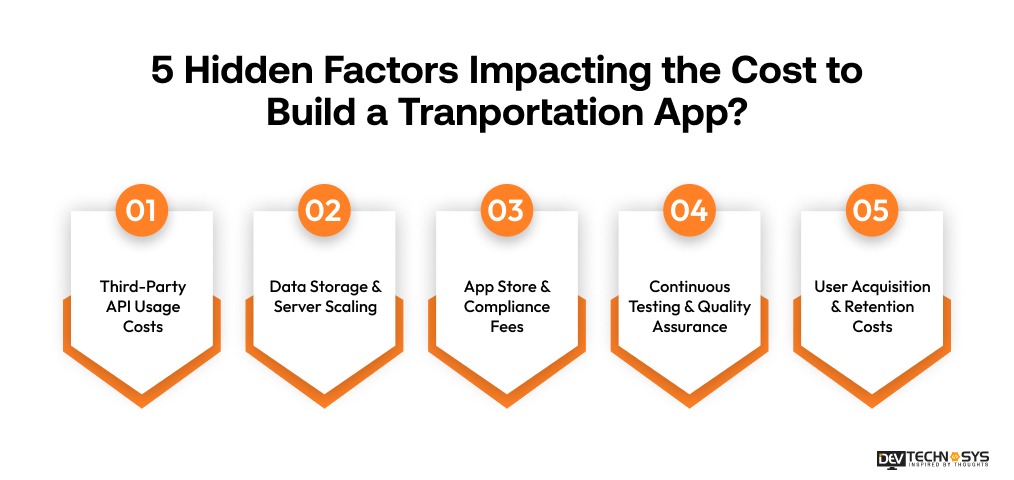
1. Third-Party API Usage Costs
Many transportation apps rely on APIs for maps, payments, SMS, and notifications. While integration may seem straightforward, ongoing usage fees (per request or transaction) can significantly increase long-term software development cost, especially as your user base and data consumption grow over time.
2. Data Storage & Server Scaling
As your app grows, it generates massive amounts of data like user activity, trip history, and real-time tracking logs. Managing this requires scalable cloud storage and servers, which increases the cost to build a transportation software over time, particularly during high traffic and peak usage periods.
3. App Store & Compliance Fees
Publishing apps on platforms like the Apple App Store or Google Play Store involves registration fees and compliance requirements. Additionally, adhering to regional regulations, data protection laws, and transport policies can add unexpected legal and operational expenses.
4. Continuous Testing & Quality Assurance
Beyond initial development, transportation apps require ongoing testing for performance, security, and usability. Frequent updates, bug fixes, and compatibility checks across devices and OS versions increase QA costs, especially for apps with real-time features and large user bases.
5. User Acquisition & Retention Costs
Building the app is only part of the investment. Marketing, promotions, referral programs, and onboarding strategies to attract and retain users can significantly impact overall delivery management software cost. Without proper budgeting, these post-launch expenses can exceed initial cost to build a transportation software in competitive markets.
Why Businesses Must Invest in Transportation Management Platform Development?
Investing in transportation management platform development is essential for businesses looking to improve efficiency and stay competitive in a rapidly evolving market. It streamlines operations through automation, enhances real-time visibility and tracking, reduces costs with optimized routing, and improves customer experience with accurate updates.
For driving long-term growth and operational excellence, a well-built transportation software:
- Enables data-driven decision-making
- Supports business scalability
- Integrates advanced technologies like AI
- Enhances security and regulatory compliance
- Real-time GPS tracking & geolocation APIs
- Provides machine learning for route prediction
- IoT-enabled vehicle tracking
Why Budgeting for Your Transportation Software Project is Crucial?
According to a top Android app development company, budgeting for your transportation software project is essential to ensure smooth execution, financial stability, and long-term success. A well-planned budget helps businesses stay prepared and make informed decisions throughout the development lifecycle.
- Helps control overall logistics software development pricing while preventing unexpected expenses and financial overruns during the project lifecycle.
- Allows businesses to prioritize core features and functionalities based on goals, ensuring efficient use of available resources.
- Ensures proper allocation of resources, including a custom software developer or development team, tools, and infrastructure, for better productivity and outcomes.
- Reduces the risk of delays and project disruptions by planning finances in advance and avoiding last-minute constraints.
- Supports smarter decisions when choosing the right technology stack, third-party integrations, and development team.
- Accounts for post-launch expenses such as maintenance, updates, security, and scaling requirements.
- Enables long-term planning by preparing the software for future upgrades, expansion, and increasing user demand
Types of Transportation Softwares with Their Development Cost
Transportation software comes in various types, each designed to solve specific logistics, mobility, and operational challenges. The development cost varies depending on the software type, features, and level of complexity required.
1. SAP Transportation Management
A robust enterprise-grade solution designed for end-to-end logistics and freight management. It offers route optimization, real-time tracking, and analytics. Developing similar software requires advanced backend architecture, SAP integration capabilities, and scalable cloud infrastructure, with costs typically ranging from $10,000 to $30,000+, depending on customization and enterprise requirements.
| Development Level | Estimated Cost | Key Inclusions |
| Basic Version | $10,000 – $18,000 | Core logistics, basic tracking, simple dashboard |
| Mid-Level System | $18,000 – $25,000 | Route optimization, cloud analytics, SAP integrations |
| Advanced System | $25,000 – $30,000+ | Real-time tracking, cloud scalability, enterprise features |
2. Oracle Transportation Management
This platform enables efficient transportation planning, execution, and freight payment processes. It supports global logistics operations with high scalability. According to experts who provide artificial Intelligence development services, building similar software involves various factors.
It involves complex database management, AI-driven planning features, and secure cloud systems, with development costs estimated between $10,000 to $28,000+ based on integrations and enterprise-grade functionalities.
| Development Level | Estimated Cost | Key Inclusions |
| Basic Version | $10,000 – $16,000 | Transportation planning, basic UI, reporting |
| Mid-Level System | $16,000 – $22,000 | Freight management, integrations, dashboards |
| Advanced System | $22,000 – $28,000+ | AI planning, cloud infrastructure, global scalability |
3. Manhattan TMS
A comprehensive transportation management solution focused on supply chain optimization and warehouse integration. It enhances visibility and operational control. Developing similar software requires a microservices architecture, real-time data processing, and strong API integrations, with estimated costs ranging from $18,000 to $33,000+, depending on system complexity.
| Development Level | Estimated Cost | Key Inclusions |
| Basic Version | $18,000 – $24,000 | Shipment tracking, warehouse integration basics |
| Mid-Level System | $24,000 – $29,000 | Real-time data processing, API integrations |
| Advanced System | $29,000 – $33,000+ | Microservices architecture, advanced analytics |
4. Blue Yonder TMS
An AI-powered transportation platform offering predictive analytics, demand forecasting, and route optimization. It helps businesses improve logistics efficiency. Creating similar software demands machine learning capabilities, big data analytics, and cloud-native development. Adding them increases the logistics software development cost from $11,000 to $29,000+, depending on advanced AI integrations.
| Development Level | Estimated Cost | Key Inclusions |
| Basic Version | $11,000 – $18,000 | Basic logistics features, tracking, and dashboards |
| Mid-Level System | $18,000 – $24,000 | Predictive analytics, route optimization |
| Advanced System | $24,000 – $29,000+ | AI/ML integration, big data analytics, automation |

5. MercuryGate TMS
A cloud-based transportation management system that provides shipment planning, execution, and visibility across supply chains. It supports multi-modal logistics operations. Developing such software requires scalable SaaS architecture, API integrations, and real-time tracking systems, with estimated costs ranging from $12,000 to $30,000+ based on feature depth.
| Development Level | Estimated Cost | Key Inclusions |
| Basic Version | $12,000 – $18,000 | Shipment planning, basic SaaS features |
| Mid-Level System | $18,000 – $24,000 | API integrations, real-time tracking |
| Advanced System | $24,000 – $30,000+ | Multi-modal logistics, scalable cloud architecture |
Transportation Software Development Timeline Explained
The transportation software development timeline in 2026 typically ranges from a few weeks to several months, depending on the complexity, features, and level of customization required. A basic solution can be developed quickly for testing ideas, while advanced systems with AI, real-time tracking, and scalable infrastructure require more time for planning, development, and deployment.
| Development Phase | Estimated Timeline |
| Requirement Analysis | 1 – 2 weeks |
| UI/UX Design | 2 – 3 weeks |
| Frontend & Backend Development | 4 – 10 weeks |
| Third-Party Integrations | 1 – 3 weeks |
| Testing & QA | 2 – 4 weeks |
| Deployment & Launch | 1 – 2 weeks |
Overall, a basic transportation software may take 1 to 2 months, a mid-level solution 2 to 4 months, and a fully advanced platform 4 to 6+ months for complete development and deployment.
How to Reduce the Cost to Build a Transportation Software?
According to top developers who provide transportation software development services, there are various ways to save money on logistics app development. The best ways to save money on logistics apps are defining precise requirements, using cross-platform development, starting with an MVP, hiring offshore teams, and more. Let’s learn about them in detail:
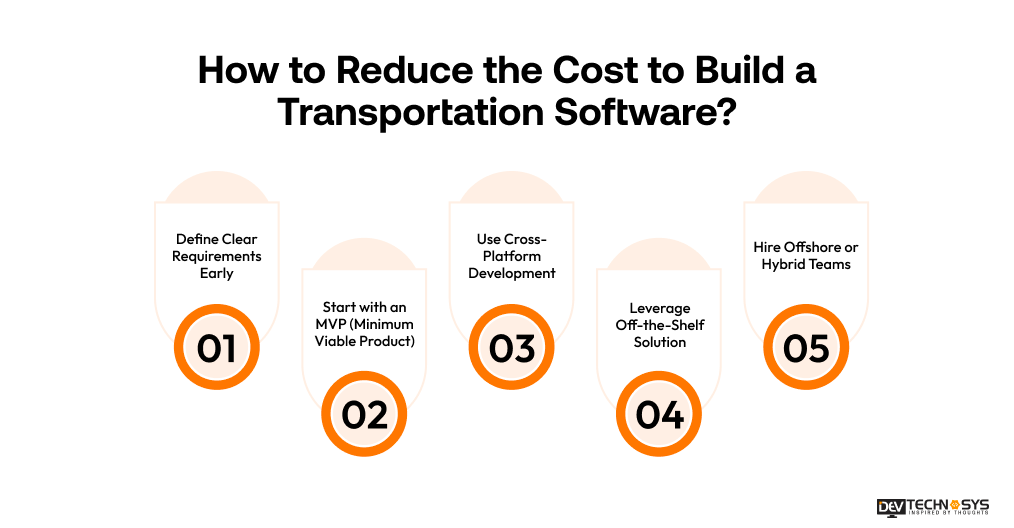
1. Define Clear Requirements Early
Avoid scope creep by clearly defining your goals, features, and technical needs from the outset. The more precise your plan, the less time and money you will spend on revisions. Development providers should also state the mobile transportation software development in UAE charges clearly beforehand.
2. Start with an MVP (Minimum Viable Product)
It is better to start with MVP app development. Focus on essential features first, such as route tracking, shipment status, and notifications. You can scale later based on user feedback. Stating your requirements clearly from the start can help businesses save on cost to create a transportation management system.
3. Use Cross-Platform Development
According to developers who provide transportation software development services in Qatar, tools like Flutter or React Native let you build for both Android and iOS using a single codebase, reducing the time and cost to make a logistics and transportation software .
4. Leverage Off-the-Shelf Solution:
The cost to launch a logistics and transportation software can be reduced by leveraging third-party solutions. Use pre-built APIs or modules for maps, geolocation, chat, and payment instead of building everything from scratch.
5. Hire Offshore or Hybrid Teams
One way to save money on logistics software is by hiring offshore development teams that offer top-notch transportation software development services in Qatar. Development rates vary globally, so working with experienced teams from regions such as Eastern Europe or India can significantly reduce ride-hailing app development cost.
Also, read our logistics software development guide to explore key features, cost factors, development process, and strategies for building scalable and efficient logistics solutions
White-Label vs Custom Transportation Software Development Cost
When choosing between white-label and custom transportation software, cost and flexibility are the key deciding factors. White-label solutions are pre-built platforms that can be quickly customized with your branding, making them faster and more affordable to launch.
In contrast, custom software is developed from scratch, offering complete control over features, scalability, and integrations, but at a higher cost and longer development timeline.
Businesses with limited budgets often prefer white-label options, while enterprises aiming for unique functionality and long-term scalability typically invest in custom software development services.
| Aspect | White-Label Software | Custom Software |
| Estimated Cost | $8,000 – $18,000 | $15,000 – $30,000+ |
| Development Time | 2 – 4 weeks | 2 – 6+ months |
| Customization Level | Limited | Fully customizable |
| Scalability | Moderate | High |
| Ownership | Partial (license-based) | Full ownership |
| Best For | Startups, quick launch | Enterprises, long-term growth |

What are the Monetization Models For Transportation Software?
Car rental apps have transformed the mobility industry by offering convenient, on-demand vehicle access and seamless booking experiences. Understanding the development cost of popular car rental apps helps businesses estimate budgets and plan scalable, feature-rich solutions effectively.
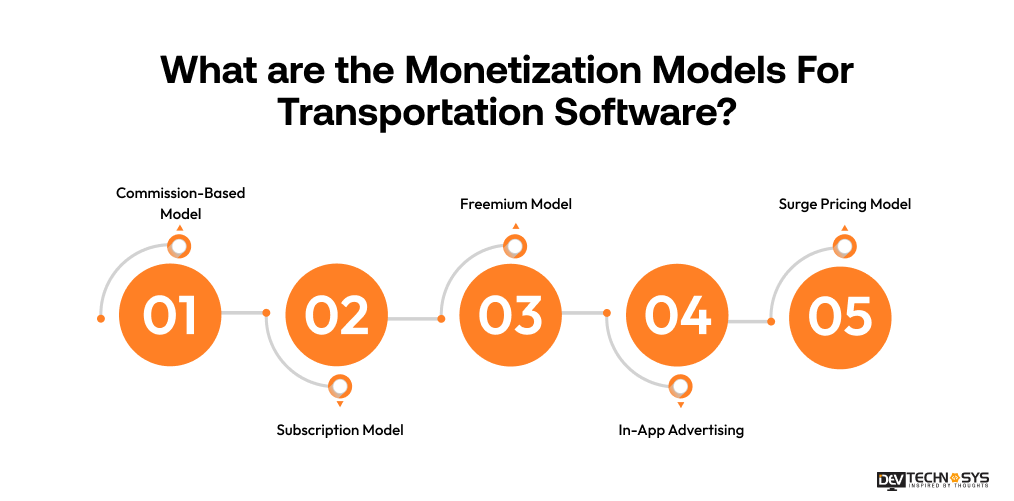
1. Commission-Based Model
The commission-based model generates revenue by charging a percentage on every transaction completed through the platform. It includes ride bookings, deliveries, or logistics services. As user activity increases, revenue scales automatically, making it one of the most popular and sustainable monetization strategies for transportation software businesses.
2. Subscription Model
In this model, users, drivers, or businesses pay a recurring fee, monthly or annually, to access the platform or premium features. It ensures a steady and predictable revenue stream while offering advanced functionalities like analytics, priority support, or exclusive services that enhance user experience and platform value.
3. Freemium Model
The freemium model provides basic features for free while charging for advanced functionalities. This approach helps attract a large user base initially and gradually converts free users into paying customers by offering premium benefits such as enhanced tracking, priority bookings, or detailed analytics.
4. In-App Advertising
Transportation software can generate revenue by displaying advertisements within the platform. This includes banner ads, sponsored listings, and partnerships with relevant businesses. It works best for apps with high user traffic, allowing companies to earn consistent income without directly charging users for services.
5. Surge Pricing Model
This model adjusts pricing dynamically based on demand and supply conditions. During peak hours or high-demand situations, prices increase, maximizing revenue opportunities. It not only boosts profitability but also helps balance demand by encouraging more drivers or service providers to participate during busy periods.
Closing Thoughts
The cost of building transportation software in Middle East varies significantly based on factors such as features, complexity, technology stack, and development approach. The right investment depends on your business goals, target audience, and long-term vision.
If you are a business looking to understand the exact cost or planning to build a scalable transportation solution, it’s essential to partner with a reliable transportation software development company such as Dev Technosys. With 10+ years of experience building cost-efficient transportation solutions, we turn your raw idea into software that delivers a strong ROI.
FAQs
Q1. How Much Does it Cost to Build Transportation Software Per Feature?
Feature-wise, fleet management software development cost varies depending on complexity. Basic features like user login and booking can cost between $8,000 to $15,000. The advanced features such as real-time GPS tracking, route optimization, and AI analytics, significantly increase development costs to over $30,000. The cost difference is due to higher technical requirements and integrations.
Q2. What is the Cost Of Building a Transportation App Like Uber?
Developing an app similar to Uber can cost between $12,000 and $30,000+, depending on features like real-time tracking, payment systems, driver management, and scalability. Advanced functionalities and multi-region support can further increase the overall development budget.
Q3. What is the Difference Between Transportation Software and a Transportation App Cost?
Transportation apps (user-facing) are generally less expensive, while transportation software (enterprise systems like TMS) costs more due to backend complexity, integrations, and scalability requirements. Enterprise-grade solutions require higher investment compared to standard mobile applications.
Q4. How Much Does it Cost to Integrate GPS Tracking in Transportation Software?
GPS integration costs can range from $1,000 to $5,000+, depending on the provider, real-time tracking features, and API usage. Ongoing costs may also apply based on the number of requests and data usage.
Q5. What is the Cost of Developing a Logistics or Fleet Management System?
A logistics or fleet management system typically costs between $12,000 and $30,000+, depending on features like fleet tracking, route optimization, reporting dashboards, and third-party integrations for automation and analytics.