





Key Takeaways
- Entrepreneurs can tap into the rapidly growing Middle East fashion eCommerce market and generate sustainable revenue by building an app like 6thStreet with the right development partner.
- The global eCommerce app market is projected to grow from USD 3.19 trillion in 2025 to USD 5.07 trillion by 2031 at a CAGR of 7.82%.
- A 6thStreet clone app delivers seamless multi-brand shopping, AI-powered personalization, real-time order tracking, and frictionless returns, creating a retail experience that keeps shoppers coming back consistently.
- The cost to build an app like 6thStreet ranges from $8,000 to $26,000, depending on complexity, features, platform choice, and the engagement model of your development team.
eCommerce has become a new standard in the retail industry. It has altered the way people buy and sell, helping new businesses to pave the way into the market. The growing popularity of similar apps like 6thStreet has become a trend setter.
6thStreet is one of the most successful e-commerce platforms in the UAE, which gives businesses a push to build an app like 6thSreet. But the question in the mind arises, “How to build an app like 6thStreet?” Today, businesses aiming to develop an app like 6thStreet are focusing on delivering intuitive UI/UX, real-time inventory management, and secure payment systems to stay competitive.
In this guide, we will break down everything you need to know to make an app like 6thStreet, including its working model, must-have features, development process, technology stack, and cost factors.
What is the 6thStreet App?
The 6thStreet app is a popular fashion eCommerce platform offering clothing, footwear, accessories, and beauty products from global brands. Operated by the Apparel Group, it delivers a seamless mobile shopping experience with easy navigation, personalized recommendations, and secure checkout.
For businesses planning to build an app like 6thStreet, it serves as a strong reference point. Its model highlights how efficient design, smooth navigation, and integrated vendor systems can enhance user engagement while supporting scalable growth in modern digital commerce platforms.
How Does an App Like 6thStreet Work?
6thStreet operates as a multi-brand fashion marketplace that seamlessly connects shoppers, brands, and logistics partners through a single, intelligent platform. Here’s a breakdown of how each layer functions:
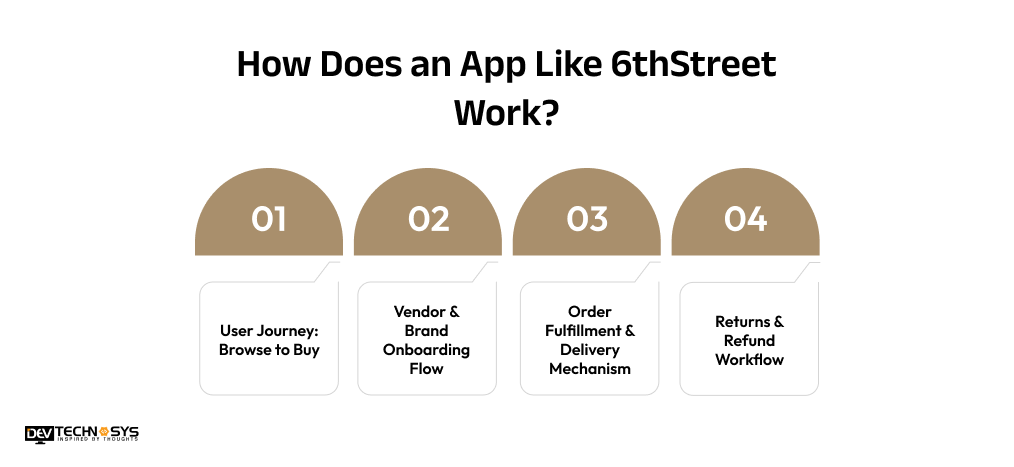
1. User Journey: Browse to Buy
Shoppers land on the app, browse curated collections, filter by brand or category, and complete purchases through a secure, one-tap checkout, all within minutes.
2. Vendor & Brand Onboarding Flow
Brands register via a dedicated portal, submit catalogs, set pricing, and go live after admin verification, creating a scalable, self-managed storefront ecosystem.
3. Order Fulfillment & Delivery Mechanism
Once an order is placed, the system auto-routes it to the respective brand or warehouse. Integrated logistics partners handle pick-up, packing, and last-mile delivery with real-time tracking.
4. Returns & Refund Workflow
Customers initiate returns through the app. A reverse logistics partner collects the item, and refunds are automatically processed to the original payment method after quality inspection.
What are the Market Stats for Fashion eCommerce Apps Like 6thStreet?
According to Mordor Intelligence, here are the market stats for fashion eCommerce apps like 6thStreet:
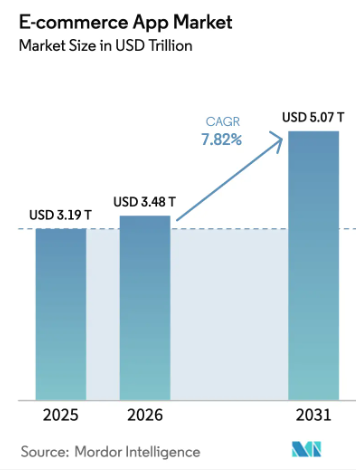
- The global eCommerce app market was valued at USD 3.19 trillion in 2025 and is projected to reach USD 5.07 trillion by 2031, growing at a CAGR of 7.82% from 2026 to 2031.
- Fashion and apparel commanded the largest product category share at 28.66% in 2025, making it the most dominant vertical in the global eCommerce app ecosystem.
- Android held a commanding 72.67% of the eCommerce app market share in 2025, while super-app mini-programs are posting the highest projected CAGR at 8.24% through 2031.
- Business-to-consumer marketplaces accounted for 55.71% of the market in 2025, with peer-to-peer resale advancing at an 8.41% CAGR through 2031, validating the multi-brand marketplace model that 6thStreet is built upon.
Why Should Entrepreneurs Invest in a Fashion Shopping App Like 6thStreet?
The Middle East’s fashion eCommerce sector is no longer emerging. It is accelerating. With smartphone penetration crossing 90% across GCC nations and consumer appetite for premium, multi-brand online shopping at an all-time high, the timing for entrepreneurs to build a shopping app like 6thStreet has never been more strategic. From Dubai to Riyadh, digitally native shoppers are abandoning malls in favor of curated app experiences that deliver convenience, variety, and instant delivery.
1. Booming Regional Market Demand
The GCC fashion eCommerce market is expanding at an unprecedented pace. Rising disposable incomes, a young digitally fluent population, and aggressive smartphone adoption are collectively creating an addressable market that global investors are actively racing to capture before saturation sets in.
2. High Average Order Values
Middle Eastern fashion consumers consistently demonstrate some of the highest average order values globally. Premium brand affinity, gifting culture, and seasonal shopping festivals like Ramadan and Eid create predictable, high-volume revenue spikes that make fashion marketplaces exceptionally profitable throughout the year.
3. Underserved Niche Opportunities
Despite the presence of established players, significant gaps remain in modest fashion, sustainable clothing, and hyper-local designer brands — giving new entrants clearly defined niches to own without competing head-to-head against dominant platforms.
4. Scalable Business Model
Multi-vendor marketplaces scale without proportional cost increases. As vendor count and transaction volume grow, revenue compounds while operational overhead remains relatively stable — making it one of the most capital-efficient business models available to entrepreneurs today.
Industry Insight
According to Alibaba Insights, “AI-driven fit prediction systems can achieve over 90% first-try fit success, significantly improving conversion and reducing returns.”
Development Process to Build an App Like 6thStreet
To develop a fashion eCommerce app like 6thStreet is not just about writing code. It is about engineering a seamless online retail app solution that serves shoppers, brands, and administrators simultaneously. Here is a step-by-step breakdown of how the development journey unfolds:
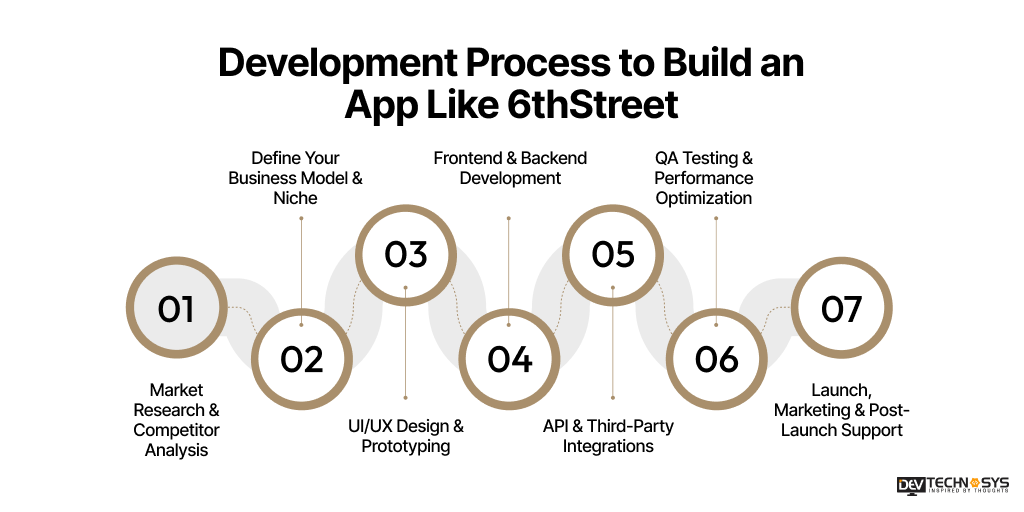
1. Market Research & Competitor Analysis
This phase involves studying competitors like OUNASS, Namshi, and Noon, identifying market gaps, understanding your target audience’s shopping behavior, and mapping out regional demand patterns across the GCC. The insights gathered here directly shape every decision that follows.
2. Define Your Business Model & Niche
This step defines your revenue model, commission-based, subscription, or advertising, and establishes the operational framework. Entrepreneurs who want to develop a shopping app like OUNASS often carve out a premium niche, while others opt for a mass-market multi-brand approach similar to 6thStreet’s core positioning.
3. UI/UX Design & Prototyping
This phase covers wireframing, user flow mapping, and interactive prototyping. The goal is to create an app like 6thStreet that feels intuitive, visually premium, and conversion-optimized, one that transforms first-time visitors into repeat buyers through frictionless navigation and aesthetically compelling layouts.
4. Frontend & Backend Development
Frontend development focuses on delivering a pixel-perfect, responsive user interface across iOS and Android. Backend development powers the logic behind product listings, user authentication, order management, and vendor operations. Choosing the right mobile app development company at this stage determines the scalability and performance of your entire platform.
5. API & Third-Party Integrations
A fashion eCommerce app requires a robust integration layer, including payment gateways, logistics APIs, CRM tools, push notification services, and social login systems, all of which need to connect seamlessly. This step ensures your platform communicates efficiently with every external service it depends on.
6. QA Testing & Performance Optimization
Before launch, every user flow, payment path, and vendor interaction is rigorously tested across devices and network conditions. Load testing, security audits, and bug fixing happen here to ensure your app performs flawlessly under real-world traffic.
7. Launch, Marketing & Post-Launch Support
App store optimization, influencer campaigns, paid acquisition, and post-launch performance monitoring all determine whether your platform gains traction or fades into obscurity. Ongoing shopping app development services and maintenance keep the platform evolving with user expectations and market demands.
8 Must-Have Features of an App Like 6thStreet
Building a competitive fashion eCommerce app demands more than a product listing page and a checkout button. Here are the eight core features that define platforms like 6thStreet:
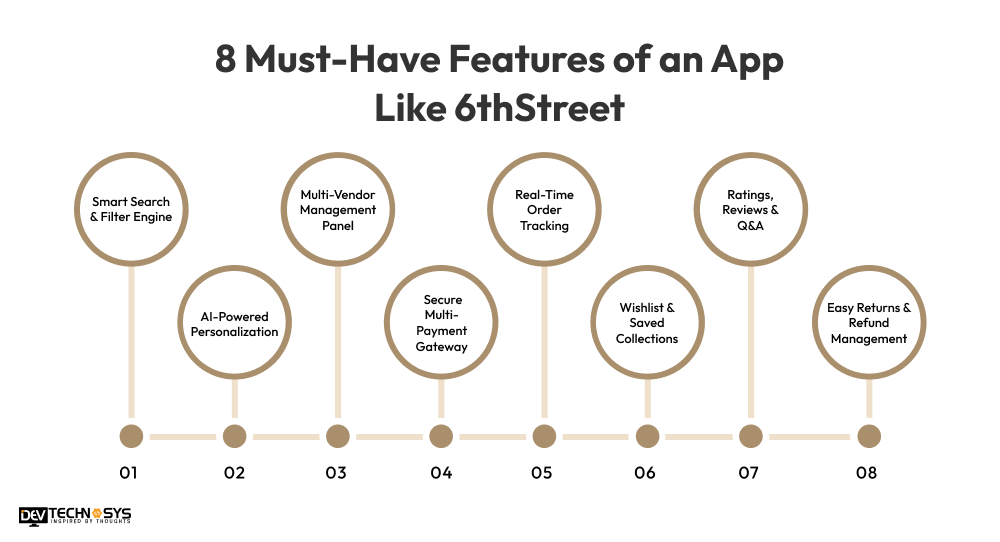
1. Smart Search & Filter Engine
Users can search by brand, category, size, color, and price range, delivering hyper-relevant results instantly and eliminating the frustration of endless, unfiltered product browsing across thousands of listings.
2. AI-Powered Personalization
The app studies individual shopping behavior, purchase history, and wish lists to serve curated product feeds, making every session feel uniquely tailored and significantly increasing average order value.
3. Multi-Vendor Management Panel
Brands independently manage their storefronts, inventory, pricing, and promotions through a dedicated self-service dashboard, enabling scalable onboarding without placing operational burden on the platform’s central admin team.
4. Secure Multi-Payment Gateway
From credit cards to digital wallets and buy-now-pay-later options, seamless in-app payment integration reduces checkout drop-offs and accommodates the diverse payment preferences of shoppers.
5. Real-Time Order Tracking
Customers monitor every delivery stage from warehouse dispatch to doorstep arrival directly inside the app, reducing support queries and building post-purchase confidence that encourages repeat shopping behavior.
6. Wishlist & Saved Collections
Users save favorite products and receive instant price drops, or low-stock alerts, as a subtle but powerful retention mechanism that pulls shoppers back into the app repeatedly without aggressive remarketing spend.
7. Ratings, Reviews & Q&A
Authentic user-generated content across every product listing builds social proof and reduces purchase hesitation. It directly influences conversion rates, making it one of the most underrated yet high-impact features on the platform.

8. Easy Returns & Refund Management
A one-tap return initiation system paired with automated refund processing eliminates post-purchase anxiety, turning what is typically a friction-heavy experience into a trust-building moment that drives long-term customer loyalty.
Industry Insight
According to Genlook, “The future of fashion eCommerce lies in ‘agentic commerce,’ where AI proactively recommends and executes purchases based on user intent.”
What is the Tech Stack for Building an App Like 6thStreet?
The tech stack determines your app’s speed, scalability, and long-term maintainability. Below is the comprehensive tech stack used by a leading shopping app development company:
Category |
Technology |
Description |
| Frontend (Mobile) | React Native / Flutter | Cross-platform development for iOS & Android from a single codebase |
| Frontend (Web) | React.js / Next.js | Fast, SEO-friendly web storefront with server-side rendering |
| Backend | Node.js / Python (Django) | Scalable server-side logic handling millions of concurrent requests |
| Database | PostgreSQL / MongoDB | Relational and NoSQL databases for structured and unstructured product data |
| Cloud Infrastructure | AWS / Google Cloud | Reliable hosting, auto-scaling, and global content delivery |
| AI & ML | TensorFlow / Python | Powers personalization engines, demand forecasting, and recommendation systems |
| Payment Gateway | Stripe / PayTabs / Telr | Secure, multi-currency payment processing tailored for MENA markets |
| Push Notifications | Firebase (FCM) | Real-time alerts for orders, offers, and price drops |
| Search Engine | Elasticsearch | Lightning-fast product search and intelligent filtering at scale |
| DevOps & CI/CD | Docker / Kubernetes / Jenkins | Automated deployment, container management, and continuous delivery pipelines |
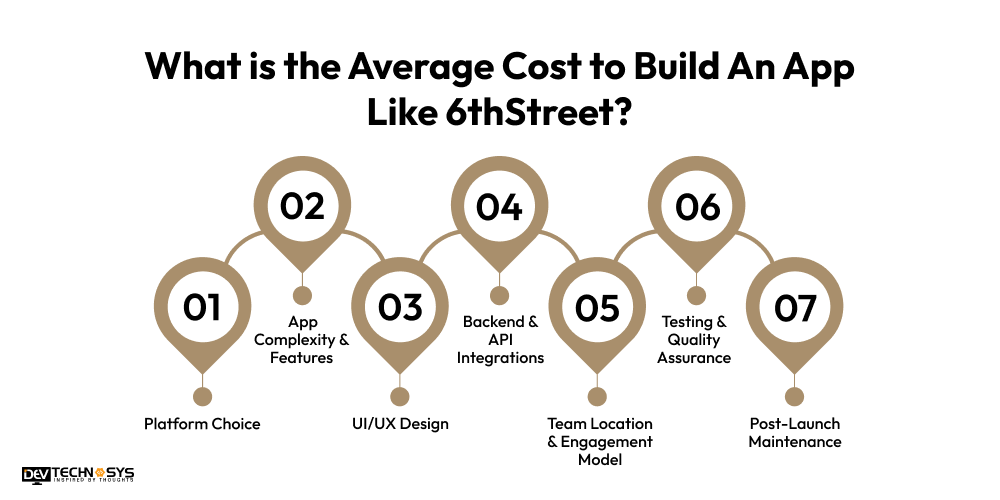
What is the Average Cost to Build An App Like 6thStreet?
Partnering with the right hybrid app development company significantly impacts your final budget. The average cost to build a shopping app like 6thStreet typically ranges from $8,000 to $26,000, depending on complexity, features, and team location.
App Type |
Features Included |
Estimated Cost |
Timeline |
| Basic MVP | Core shopping, single vendor, basic UI, payment gateway | $8,000 – $12,000 | 1 – 2 months |
| Mid-Level App | Multi-vendor, AI recommendations, real-time tracking, analytics dashboard | $12,000 – $18,000 | 2 – 3 months |
| Advanced App | Full-scale marketplace, AR try-on, advanced AI, custom integrations, admin panel | $18,000 – $26,000 | 3 – 6 months |
1. Platform Choice
Platform selection directly determines your overall mobile app development cost. Choosing iOS alone demands stricter App Store guidelines and device-specific optimization, whereas Android requires broader testing across hundreds of device variants. Building for both platforms simultaneously multiplies development effort and timeline. The choice of platform is a major driving force in influencing the 6thStreet app development cost.
Platform Option |
Cost Contribution |
Impact |
| Single Platform | $800 – $1,500 | Faster development, limited reach |
| Cross-Platform | $2,000 – $3,500 | Moderate cost, wider audience |
| Native (iOS + Android) | $3,500 – $5,000 | Best performance, higher cost |
2. App Complexity & Features
More features mean longer development cycles. Basic apps need fewer resources. Advanced AI, AR, and multi-vendor systems demand specialized expertise. Every added feature multiplies testing requirements. Knowing the cost to develop an online shopping app upfront helps entrepreneurs prioritize features smartly without overshooting their initial budget allocation. This affects the 6thStreet app development cost in the long run.
Complexity Level |
Cost Contribution |
Impact |
| Basic Features | $1,500 – $2,500 | Core functionality, limited engagement |
| Mid-Level Features | $2,500 – $4,000 | Balanced UX, moderate development effort |
| Advanced Features | $4,000 – $6,000 | High engagement, longer development cycle |
3. UI/UX Design
Premium, conversion-optimized design requires skilled designers who understand fashion eCommerce user behavior deeply. Multiple revision cycles and interactive prototyping consume significant development hours before a single line of code is written. User testing across demographics adds additional time and cost. Complex animations and micro-interactions further increase design effort.
Design Type |
Cost Contribution |
Impact |
| Basic UI | $500 – $1,000 | Functional but generic appearance |
| Custom UI/UX | $1,000 – $2,500 | Branded, conversion-focused experience |
| Premium Design System | $2,500 – $4,000 | World-class aesthetics, higher retention |
4. Backend & API Integrations
Every third-party integration adds considerable development time and budget. Payment gateways require strict security compliance and thorough testing. Logistics APIs demand real-time synchronization with fulfillment partners. The more integrations your platform requires, the higher your development costs climb, making backend architecture one of the most significant cost contributors in the entire project.
Integration Level |
Cost Contribution |
Impact |
| Basic Integrations | $800 – $1,500 | Limited third-party connectivity |
| Standard Integrations | $1,500 – $2,500 | Payments, logistics, notifications |
| Advanced Integrations | $2,500 – $4,000 | Full ecosystem connectivity |
5. Team Location & Engagement Model
Hourly development rates vary dramatically depending on your team’s geographical location. North American and European developers command premium rates that significantly inflate budgets. Choosing to hire on-demand app developers from South Asia delivers substantial cost savings without sacrificing technical quality or delivery timelines. Your engagement model, fixed price, hourly, or dedicated team, also meaningfully influences your total shopping app development cost.
Team Location |
Cost Contribution |
Impact |
| North America / Europe | $5,000 – $8,000 | Highest rates, premium market familiarity |
| Middle East / Australia | $3,500 – $5,500 | Mid-range cost, regional expertise |
| India / South Asia | $1,200 – $3,000 | Cost-effective, high-quality output |
6. Testing & Quality Assurance
Rigorous QA is absolutely non-negotiable around any multi-vendor marketplace features. Each device variation has to be tested against different OS versions. Regional network characteristics give rise to distinct performance variables that need specific attention. Bugs found after release are a much more severe blow to consumer trust than any pre-launch QA spend; thorough testing is one of the finest budget decisions you can make.
QA Level |
Cost Contribution |
Impact |
| Basic Testing | $300 – $600 | Functional checks only |
| Standard QA | $600 – $1,200 | Device & performance testing |
| Full QA & Security Audit | $1,200 – $2,000 | End-to-end coverage, launch-ready |
7. Post-Launch Maintenance
Apps require constant upgrades, server upkeep, and bug patches long after launch day. Knowing the cost to maintain an app allows entrepreneurs to create a realistic financial plan for the long run. Industry guidelines recommend budgeting 15% to 20% of the original development investment per year for continuing maintenance and platform innovation.
Maintenance Plan |
Cost |
Includes |
| Basic Maintenance | $300 – $600/month | Bug fixes, security patches, minor updates |
| Standard Support | $600 – $1,200/month | Feature enhancements, performance monitoring, and monthly reports |
| Full Managed Support | $1,200 – $2,000/month | 24/7 monitoring, proactive optimization, priority support, scaling assistance |
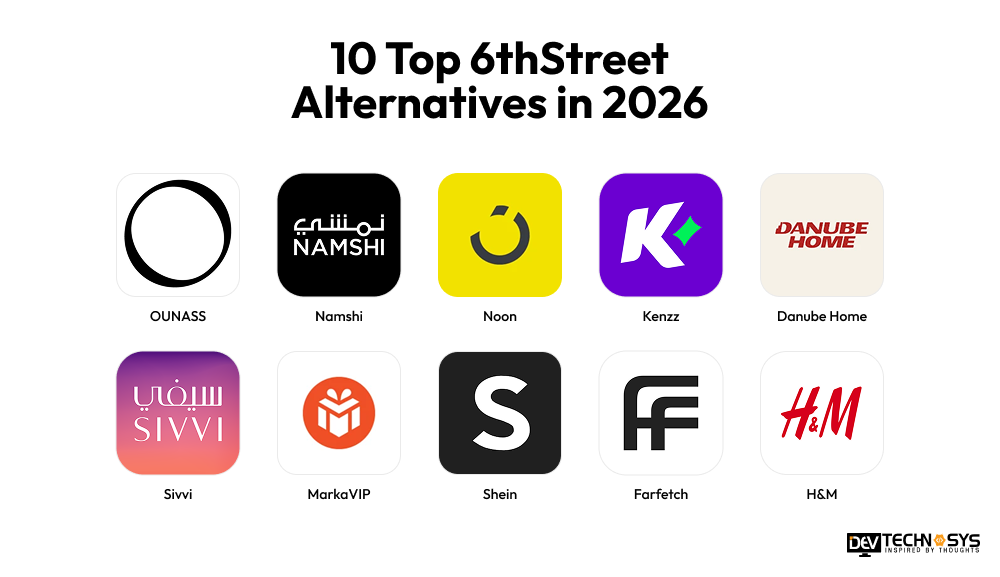
What Are the 10 Top 6thStreet Alternatives in 2026?
The Middle East’s fashion eCommerce landscape is fiercely competitive. Here is a comprehensive comparison of the top 10 6thStreet alternatives and competitors:
App |
Founded |
Region |
Category |
USP |
Downloads |
| OUNASS | 2016 | UAE | Luxury Fashion | Same-day delivery for luxury brands | 1M+ |
| Namshi | 2011 | UAE | Fashion & Lifestyle | Largest online fashion retailer in MENA | 5M+ |
| Noon | 2017 | UAE | Multi-Category | Arab-owned eCommerce giant | 10M+ |
| Kenzz | 2021 | Egypt | Fashion & Lifestyle | Leading Egyptian social commerce platform | 2M+ |
| Danube Home | 2018 | UAE | Home & Fashion | Premium home furnishing & lifestyle | 500K+ |
| Sivvi | 2015 | UAE | Fashion | Trend-focused multi-brand fashion | 1M+ |
| MarkaVIP | 2010 | Jordan | Fashion & Lifestyle | Flash sales on premium brands | 3M+ |
| Shein | 2008 | Global | Fast Fashion | Ultra-affordable global fast fashion | 50M+ |
| Farfetch | 2007 | Global | Luxury Fashion | Global luxury boutique marketplace | 10M+ |
| H&M | 1947 | Global | Fashion | Affordable Scandinavian fashion retail | 20M+ |
1. OUNASS
OUNASS is the ultimate luxury fashion destination in the Middle East, delivering same-day delivery on thousands of brand labels. For entrepreneurs aiming to build an OUNASS-like shopping app, quality UX, tailored brand relationships, and white-glove customer service are the fundamental differentiators.
2. Kenzz
Kenzz is Egypt’s fastest-growing social commerce fashion platform, blending community-driven discovery with seamless checkout. Those aiming to develop an Egyptian shopping app like Kenzz focus on influencer-led marketing, localized payment options, and a deeply engaging, mobile-first social shopping experience.
3. Namshi
Namshi dominates the MENA fashion eCommerce industry with a massive portfolio of apparel, footwear, and beauty. Its easy return policy and aggressive discount approach have established one of the region’s most loyal and fast-growing communities of online shoppers.
4. Noon
Noon is the Arab world’s homegrown eCommerce giant, competing directly with Amazon across fashion, electronics, and groceries. Its deep regional trust, Arabic-first experience, and rapid delivery network make it a formidable multi-category marketplace across the GCC.
5. Danube Home
Danube Home bridges premium home furnishing and lifestyle fashion in one unified platform. Entrepreneurs inspired to develop a shopping app like Danube Home invest heavily in high-resolution visual merchandising, room visualization tools, and a curated catalog that speaks to aspirational homeowners across the UAE.
Monetization Models for a Fashion eCommerce App Like 6thStreet
To create an app like 6thStreet, you need a significant investment, but the right monetization strategy transforms that investment into a sustainable, high-margin business. Here are the five most powerful revenue models powering platforms like 6thStreet:
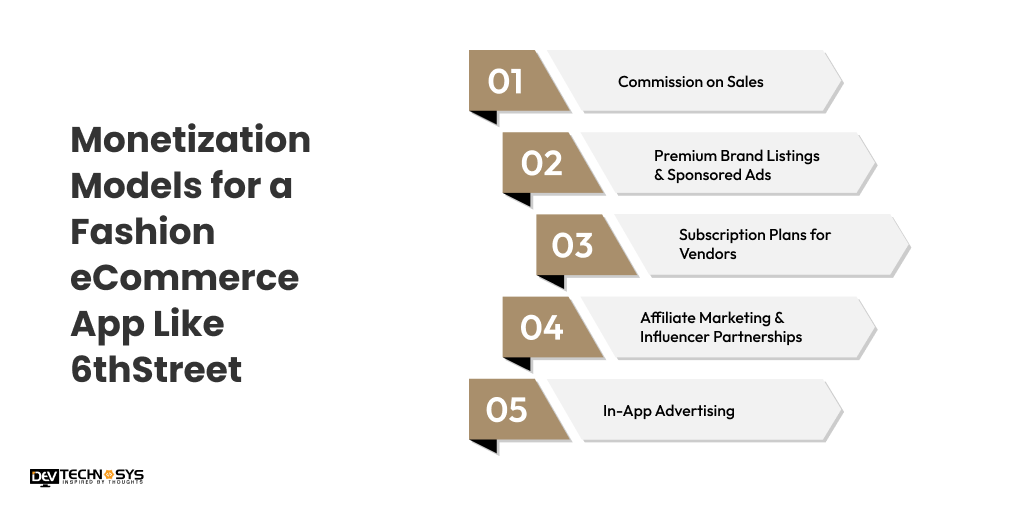
1. Commission on Sales
Every time a brand completes a sale through your platform, you earn a percentage, typically ranging from 8% to 25%, depending on the product category. As your vendor base and transaction volume grow, this model scales effortlessly without proportional cost increases, making it the financial backbone of platforms like 6thStreet.
2. Premium Brand Listings & Sponsored Ads
Brands pay a premium to have their products featured at the top of search results, category pages, and homepage banners. This pay-to-promote model generates significant ad revenue while simultaneously helping vendors drive higher visibility.
3. Subscription Plans for Vendors
Offer tiered monthly or annual subscription packages to brands, each unlocking progressively advanced tools like enhanced analytics, unlimited product listings, and promotional slots. This model creates predictable, recurring revenue that shields your platform from seasonal sales fluctuations and cyclical spending dips common in fashion retail.
4. Affiliate Marketing & Influencer Partnerships
Partnering with influencers and affiliate marketers who earn commissions on referred purchases creates a performance-based acquisition engine. This model dramatically reduces your paid advertising spend while building authentic brand awareness through the trusted voices of your target audience.
5. In-App Advertising
Beyond sponsored listings, dedicated ad placements, including banner ads, interstitials, and video ads from fashion and lifestyle brands, generate substantial passive revenue. As your mobile app development solutions scale and daily active users grow, your advertising inventory becomes increasingly valuable to brands competing for consumer attention inside your platform.
Quote
Jack Ma (Co-founder of Alibaba Group), through a speech at the World Economic Forum, said, “If your business is not on the internet, then your business will be out of business.”
How AI is Revolutionizing Fashion eCommerce Apps Like 6thStreet
Artificial Intelligence is the core engine driving personalization, profitability, and customer retention at scale. Understanding the role of artificial intelligence in mobile app development is now a prerequisite for any entrepreneur serious about building a competitive fashion marketplace in 2026:
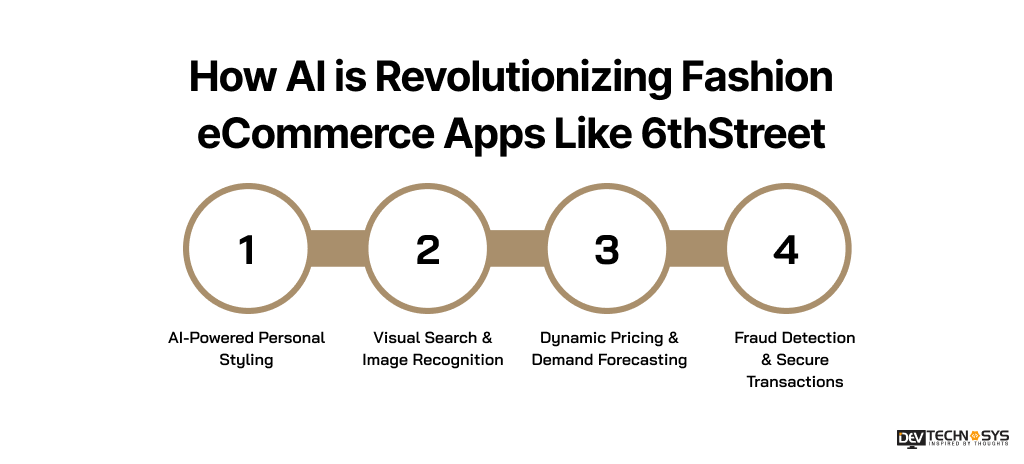
1. AI-Powered Personal Styling
Modern fashion apps use machine learning algorithms to analyze browsing patterns, purchase history, and size preferences. This hyper-personalization dramatically increases average order value and reduces the likelihood of returns, directly impacting platform profitability.
2. Visual Search & Image Recognition
Shoppers can now photograph an outfit they love and instantly find identical or similar products within the app. This computer vision capability collapses the gap between inspiration and purchase, making discovery faster and more intuitive than any keyword-based search system ever could.
3. Dynamic Pricing & Demand Forecasting
AI monitors competitor pricing, seasonal demand patterns, and inventory levels in real time, automatically adjusting prices to maximize both vendor revenue and platform commissions simultaneously. Entrepreneurs ready to build an artificial intelligence app for fashion eCommerce are not just building a shopping platform; they are building an intelligent retail ecosystem.
4. Fraud Detection & Secure Transactions
Machine learning models identify suspicious transaction patterns and flag fraudulent activity before it impacts the platform. It protects both shoppers and vendors with invisible but powerful security layers.

Conclusion
The fashion eCommerce revolution across the Middle East is not slowing down. It is compounding. From AI-powered personalization to seamless multi-vendor management and real-time delivery tracking, to build an app like 6thStreet, you need to have the most lucrative digital investments available to entrepreneurs in the GCC region today.
From tech stack selection to monetization strategy, it demands precision, experience, and a development partner who understands both the technology and the market. With over a decade of experience delivering world-class shopping app development solutions, Dev Technosys has helped businesses across the globe transform bold ideas into market-leading digital products. With 15+ years of experience, they can help you build a successful app like 6th 6thStreet.
Your vision deserves more than average execution. Let’s build something the Middle East has never seen before.
FAQs
Q1. How Long Does it Take To Develop An App Like 6thStreet?
The development timeline depends on your app’s complexity and feature set. A basic MVP typically takes 1 to 2 months, a mid-level app requires 2 to 3 months, and a full-scale advanced platform like 6thStreet can take 3 to 6 months from discovery to launch.
Q2. Can I Build a 6thStreet Clone App With a Limited Budget?
Absolutely. Starting with a lean MVP that covers core shopping functionalities, product listings, payment gateway, and order tracking. The cost to build an app like 6thStreet is $8,000 to $12,000. As your user base grows, you can incrementally add advanced features without overhauling the entire platform architecture.
Q3. What is the Difference Between a Multi-Vendor Marketplace And a Single-Brand Shopping App?
A single-brand app sells products exclusively from one retailer, while a multi-vendor marketplace like 6thStreet hosts multiple independent brands under one unified platform. Multi-vendor models are significantly more scalable, generate higher transaction volumes, and offer shoppers far greater variety.
Q4. Which Platform Should I Choose to Build My Fashion App – iOS, Android, or Both?
For the GCC and MENA region, launching on both platforms simultaneously is strongly recommended. Android commands over 72% of the regional market share, but iOS users consistently demonstrate higher average order values. A fashion eCommerce app development company can deliver both from a single codebase, significantly reducing your time-to-market and overall development budget.
Q5: How Does AI Improve the User Experience in a Shopping App Like 6thStreet?
AI enhances the shopping experience across multiple touchpoints, from personalized product recommendations and visual search to dynamic pricing and fraud detection. It studies individual user behavior to serve hyper-relevant content, reduces return rates through smart size suggestions, and keeps shoppers engaged longer, directly improving conversion rates and overall platform revenue.