



 Tarun Nagar
 Key Takeaways:
-
- Food delivery app solutions are built to connect customers, restaurants, and delivery partners in real-time ecosystems.
- The food delivery app development cost typically ranges between $30,000 and $150,000, depending on complexity.
- Market growth of food delivery platforms is driven by mobile adoption and on-demand service expectations. The market is expected to reach USD 728.83 billion by 2032.
- Monetization strategies that help PedidosYa app development generate revenue include commissions, delivery fees, subscriptions, and an in-app payment gateway.
Food delivery apps have transformed how people order meals, making convenience the core of modern dining experiences. Similar apps like PedidosYa have become dominant in UAE by offering fast delivery, real-time tracking, and seamless restaurant discovery in one unified ecosystem.
Today, businesses are actively investing in food delivery app development to replicate this success. These platforms combine customer apps, restaurant panels, delivery partner apps, and admin dashboards into a scalable system.
However, to build a food delivery app like PedidosYa, more than just basic ordering functionality is required. It demands strong architecture, advanced features, secure payment systems, and intelligent logistics management.
This guide explains everything in detail related to on-demand food delivery app development. It includes features, workflows, cost, monetization strategies, AI integration, and development steps. By the end, you will understand how to build a food delivery app like PedidosYa from scratch.
What Is PedidosYa and Why Is It So Popular in UAE?
PedidosYa is the leading food ordering app development in Latin America. It connects users with restaurants and delivery partners through a seamless mobile and web-based system. Its success comes from strong logistics, regional adaptation, and user-friendly design.
- PedidosYa operates as a multi-sided marketplace connecting customers, restaurants, and delivery riders efficiently.
- It provides real-time order tracking, ensuring transparency from order placement to final delivery.
- The platform supports multiple payment methods, including cash, cards, and digital wallets.
- Its strong presence in Latin America comes from localized restaurant partnerships and regional expansion strategies.
- Fast delivery times are achieved through optimized route planning and smart dispatch systems.
Food Delivery App Market Size, Growth Statistics, and Industry Trends for 2026
The food delivery industry is experiencing rapid global expansion driven by digital transformation and lifestyle changes. Fortune Business Insights highlights strong growth potential across all regions, especially in urban markets.
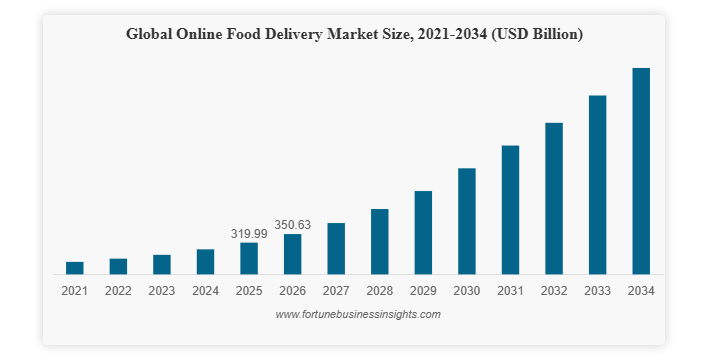
- The global online food delivery market was valued at USD 319.99 billion in 2025 globally.
- Market projected to reach USD 728.83 billion by 2034 from 2026 USD 350.63 billion levels.
- The market is expected to grow at a CAGR of 9.58% during the forecast period globally.
- Platform-to-consumer channels hold 58% share of the global online food delivery market segment dominance observed.
- Strong growth and a dominant platform-to-consumer share highlight the rapid expansion of the online food delivery industry globally.
Understanding the End-to-End Workflow of a Food Delivery App
A similar app like PedidosYa operates through a structured workflow connecting customers, restaurants, and delivery partners in real time. Each step to create an app like PedidosYa ensures smooth order processing, tracking, and delivery execution.
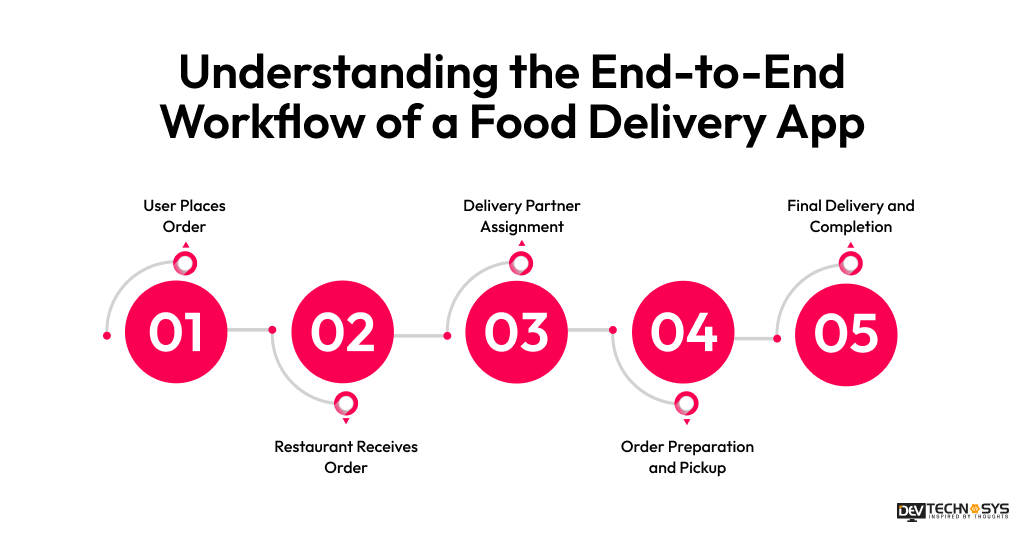
Step 1: User Places Order
Customers browse restaurants, select food items, and place orders through the app. The system confirms availability and calculates total pricing instantly.
Step 2: Restaurant Receives Order
The restaurant receives order details through its dashboard and confirms preparation time. Kitchen operations begin immediately after acceptance.
Step 3: Delivery Partner Assignment
The system automatically assigns a nearby delivery partner based on location, availability, and estimated delivery time optimization.
Step 4: Order Preparation and Pickup
The restaurant prepares the food while the delivery partner reaches the pickup location. Real-time status updates keep users informed.
Step 5: Final Delivery and Completion
The delivery partner delivers the order to the customer’s location. Payment is processed, and feedback is collected for service improvement.
Food Delivery App Business Model Explained with Examples
Food delivery apps operate using different business models depending on ownership, logistics, and fulfillment strategies. Each model offers unique advantages to build a food delivery app like PedidosYa with scalability, revenue generation, and operational control.
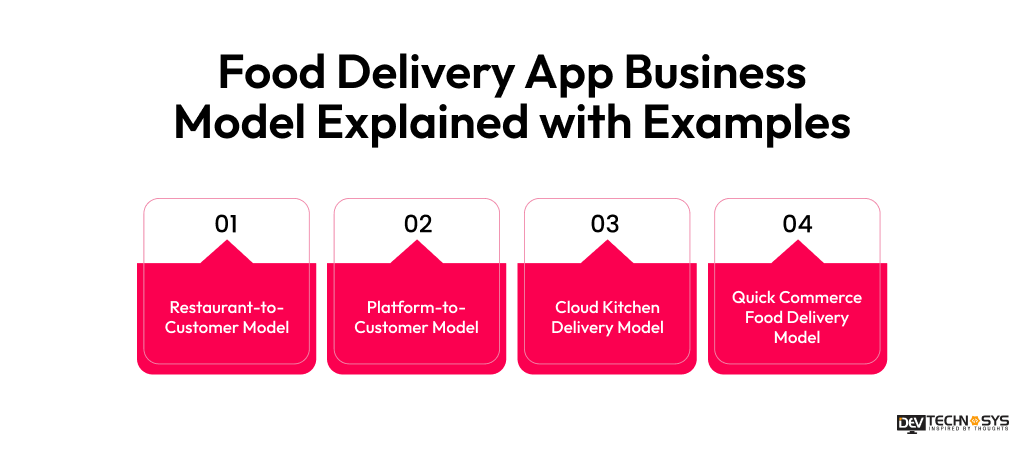
1. Restaurant-to-Customer Model
This model allows restaurants to manage their own delivery operations while using the platform for order acquisition. The app acts mainly as a discovery and ordering interface. It is cost-effective for platforms but offers limited control over delivery quality and timing.
Real Examples:
- Domino’s Pizza (uses its own delivery fleet in most regions)
- Pizza Hut (self-managed delivery in many countries)
- Papa John’s (direct restaurant-controlled delivery system)
These brands use their own drivers, delivery routes, and customer service. The app or website only acts as an ordering interface, not a logistics controller.
2. Platform-to-Customer Model
In this model, the platform manages everything, including order processing, delivery logistics, and customer service. It ensures better control over user experience and delivery speed. PedidosYa clone app uses this model to maintain consistency and scalability across regions.
Real Examples:
- Uber Eats
- DoorDash
- PedidosYa
- Just Eat Takeaway
The platform assigns delivery riders, tracks orders in real time, and manages customer experience end-to-end. Restaurants only focus on food preparation.

3. Cloud Kitchen Delivery Model
Cloud kitchens operate without physical dine-in spaces and rely entirely on delivery orders. The platform manages order aggregation and delivery logistics. This model reduces operational costs and allows businesses to scale multiple food brands from a single kitchen infrastructure.
Real Examples:
- Rebel Foods (Faasos, Behrouz Biryani brands)
- Kitopi
- CloudKitchens
Multiple food brands operate from one kitchen. Orders come via apps like Uber Eats or DoorDash, reducing dine-in costs and increasing scalability.
4. Quick Commerce Food Delivery Model
This model focuses on ultra-fast deliveries, often within 10–30 minutes. It uses micro-warehouses and optimized routing systems. Quick commerce is growing rapidly due to high demand for instant food and grocery delivery in urban markets.
Real Examples:
- Blinkit
- Gorillas
- Zepto
- Getir
These platforms store fast-moving items in local warehouses and use optimized delivery routes to ensure extremely fast fulfillment.
Essential Food Delivery App Features That Drive User Engagement
To build a food delivery app like PedidosYa, developers must heavily work on feature design and user experience. Well-structured features improve engagement, retention, and order frequency. A successful platform must balance customer convenience, restaurant efficiency, delivery speed, and admin control across all modules. Have a look at the top-class features of a food delivery app like PedidosYa.
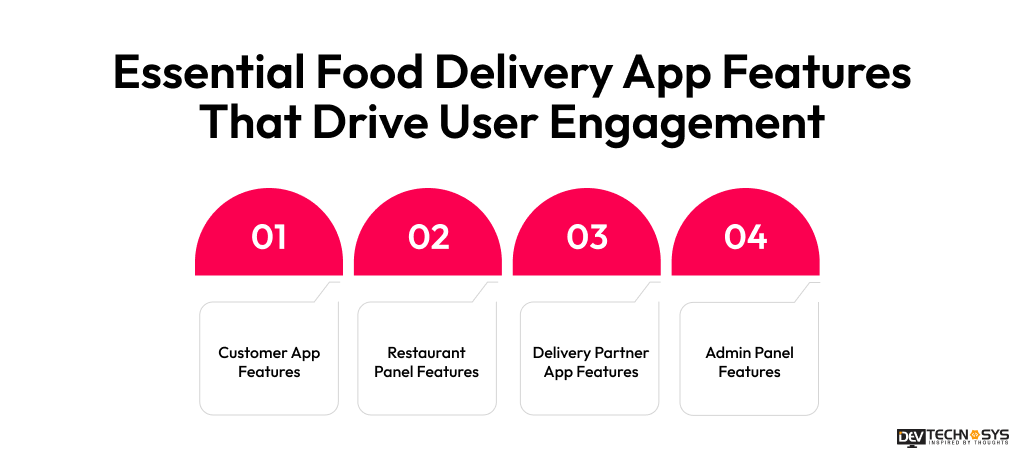
1. Customer App Features
Customer app features define the core user experience in a food delivery platform. They ensure seamless ordering, personalization, real-time tracking, secure payments, and engagement, driving higher retention and satisfaction.
| Feature | Description |
| Order Management Dashboard | Manage and track customer orders in real time |
| Menu Management System | Add, update, and manage restaurant menu items easily |
| Order Status Updates | Provide live updates on order preparation and delivery |
| Sales and Analytics Reports | View sales data and performance insights for improvement |
| Promotional Tools | Create discounts, offers, and promotional marketing campaigns |
| Inventory Management System | Track stock levels and prevent item unavailability issues |
| Multi-Branch Management | Manage multiple restaurant outlets from single dashboard system |
| User Profile Management | Store addresses, preferences, and order history securely |
| Payment Options Integration | Enable multiple secure payment methods for customers |
| Reorder & Favorites | Quickly reorder previous meals and favorite restaurants |
2. Restaurant Panel Features
Restaurant panel features help food vendors manage orders, menus, pricing, and performance efficiently. These tools streamline operations, improve order accuracy, and enable data-driven decisions for better profitability and service.
| Feature | Description |
| Order Management Dashboard | Accept, reject, and manage incoming customer orders efficiently |
| Menu Management System | Easily update menu items, pricing, and availability details |
| Order Status Updates | Update order progress from preparation to completion stages |
| Sales and Analytics Reports | Analyze revenue trends, orders, and performance metrics effectively |
| Promotional Tools | Run discounts, offers, and restaurant promotional campaigns easily |
| Inventory Management System | Monitor stock levels and avoid item shortages efficiently |
| Multi-Branch Management | Control and manage multiple restaurant branches centrally |
| Restaurant Profile Management | Manage restaurant details, timings, and visibility settings |
| Customer Feedback System | View and respond to customer ratings and reviews |
| Earnings & Commission Reports | Track revenue, payouts, and commission deductions clearly |
3. Delivery Partner App Features
Delivery partner features focus on efficient logistics, navigation, earnings, and order fulfillment. They ensure faster deliveries, better coordination, transparency, and improved productivity for drivers operating within the platform ecosystem.
| Feature | Description |
| Driver Registration & Verification | Register drivers securely with an identity verification and approval system |
| Order Assignment System | Automatically assign nearby delivery orders to available drivers |
| GPS Navigation Integration | Provide optimized routes for faster and more efficient deliveries |
| Real-Time Order Updates | Send live updates about pickup and delivery status |
| Earnings Dashboard | Track daily, weekly, and monthly earnings transparently in-app |
| Delivery History Logs | Maintain a complete record of all completed deliveries |
| In-App Communication | Enable direct communication between drivers, customers, and restaurants |
| Availability Toggle | Allow drivers to go online or offline anytime easily |
| Delivery Proof System | Capture OTP or photo proof for completed deliveries |
| Incentive & Bonus System | Reward drivers for peak-time and high-performance deliveries |
4. Admin Panel Features
Admin panel features provide complete platform control over users, restaurants, deliveries, payments, and analytics. They ensure smooth operations, security management, performance monitoring, and scalable business growth across the system.
| Feature | Description |
| User Management System | Manage customers, restaurants, and delivery partners from one dashboard |
| Order Monitoring Dashboard | Track all active, completed, and canceled orders in real-time |
| Commission Management | Set and manage platform commissions for restaurants and drivers |
| Analytics & Reports | Access detailed business performance and user behavior insights |
| CMS | Manage banners, offers, and app content updates easily |
| Payment Management System | Track payments, refunds, and financial transactions securely |
| Customer Support Management | Handle customer complaints and support tickets efficiently |
| Fraud Detection System | Detect suspicious transactions and prevent fraudulent activities |
| Location & Zone Management | Define delivery areas and optimize service coverage regions |
| Notification Management System | Control push notifications, alerts, and promotional messages |
Next-Generation Food Delivery App Features Powered by AI
AI-powered food delivery app features transform into intelligent systems. They enhance personalization, automate operations, optimize logistics, and improve decision-making. When businesses make a food delivery app like PedidosYa with AI features, it significantly increases efficiency, engagement, and revenue across the platform.
1. AI-Based Food Recommendations
AI analyzes user preferences, behavior, and order history to suggest personalized food options. This improves engagement, increases conversion rates, and boosts overall order value across the platform.
2. Predictive Demand Forecasting
AI predicts future food demand using time, weather, and user trends. This helps restaurants prepare efficiently, reduce delays, and optimize inventory management across peak and off-peak hours.
3. Smart Delivery Route Optimization
Machine learning calculates the fastest and most efficient delivery routes. This reduces delivery time, lowers fuel costs, and improves overall logistics efficiency and customer satisfaction significantly.
4. Dynamic Pricing System
AI adjusts prices based on demand, availability, and peak hours. This maximizes revenue, balances supply and demand, and improves profitability during high-traffic periods across the platform.
5. AI Chatbots for Customer Support
Automated chatbots handle customer queries instantly and efficiently. This reduces support workload, improves response time, and enhances overall user experience through 24/7 assistance availability.
6. Image-Based Food Recognition
Users can upload food images to discover similar dishes. This enhances search functionality, improves discovery experience, and makes ordering more intuitive and engaging for users.
7. Voice-Based Ordering System
Voice-enabled systems allow users to place orders hands-free. This improves accessibility, convenience, and user experience, especially for multitasking or differently-abled customers using the platform.
8. Smart Fraud Detection System
AI identifies suspicious transactions and fraudulent activities in real time. This improves platform security, protects users, and ensures safe and trustworthy financial operations across the ecosystem.
How to Build a Food Delivery App Like PedidosYa: Step-by-Step Development Process?
A structured restaurant delivery app development approach ensures scalability, performance, and long-term success. Each stage plays a critical role in building a stable, user-friendly, and revenue-driven food delivery platform like PedidosYa.
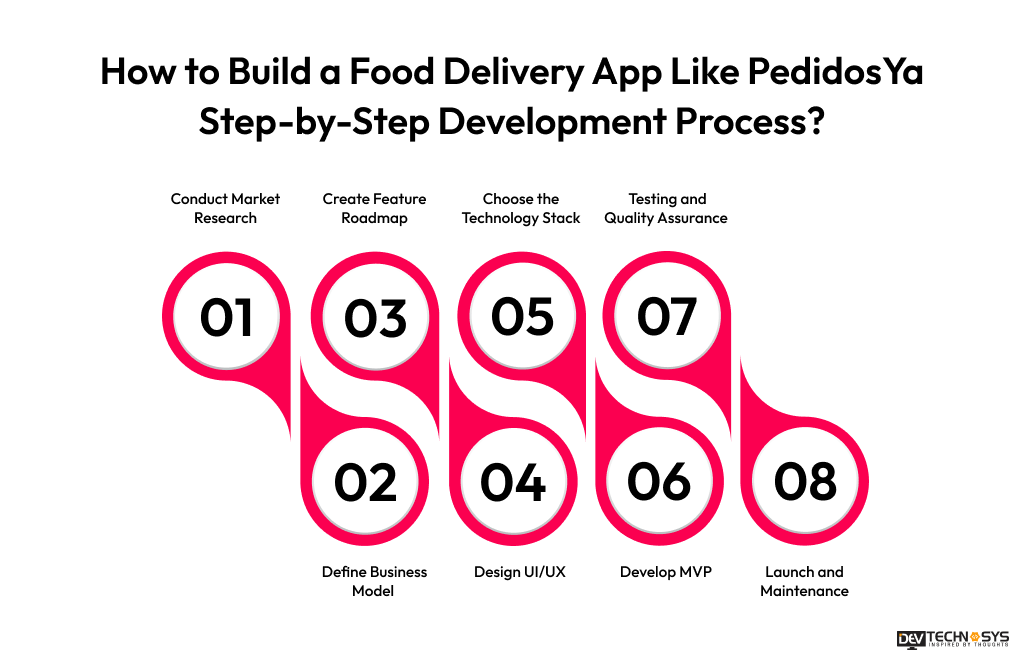
Step 1: Conduct Market Research
Market research identifies user expectations, competitor strategies, and regional demand patterns to build a food delivery app like Bolt Food. It helps businesses understand customer behavior, pricing models, and feature gaps. This stage ensures the app solves real problems, targets the right audience, and aligns with market demand for better adoption and long-term scalability.
Step 2: Define Business Model
Defining the business model establishes how the food delivery platform will generate revenue. Common models include commission-based, subscription, delivery fee, and hybrid approaches. This step ensures financial clarity, operational structure, and long-term sustainability while aligning platform goals with restaurant partners, delivery agents, and customer expectations effectively.
Step 3: Create Feature Roadmap
To develop a food delivery app like Keeta, the feature roadmap prioritizes essential and advanced functionalities. They are based on business goals and user needs. It separates MVP features from future enhancements, ensuring faster time-to-market. This planning stage reduces development complexity, avoids feature overload, and helps build a scalable product that evolves with user demand and technological advancements.
Step 4: Design UI/UX
UI/UX design focuses on creating an intuitive, visually appealing, and easy-to-navigate interface for all user types. It improves user engagement, reduces friction during ordering, and enhances overall experience. A well-designed interface increases conversion rates, ensures smooth navigation, and builds trust among customers, restaurants, and delivery partners across the platform.
Step 5: Choose the Technology Stack
Selecting the right technology stack is a really important step to create a food delivery app like Talabat. It ensures scalability, security, and high performance of the food delivery application. It includes frontend, backend, database, and cloud infrastructure decisions. The right stack supports real-time tracking, seamless integrations, and faster development cycles while ensuring long-term maintainability and system stability under high user traffic conditions.
Step 6: Develop MVP
MVP development focuses on building a minimum viable product with core features like ordering, payments, and delivery tracking. It allows businesses to validate their idea in real market conditions. This approach reduces initial investment risk, accelerates launch timelines, and provides valuable user feedback for future feature improvements and scaling decisions.
Step 7: Testing and Quality Assurance
Testing and quality assurance ensure the application is free from bugs, performance issues, and security vulnerabilities. It includes functional testing, load testing, usability testing, and cross-device compatibility checks. This stage guarantees smooth performance under heavy traffic, enhances reliability, and ensures a seamless user experience before final deployment and launch.
Step 8: Launch and Maintenance
The launch and maintenance phase involves deploying the application on app stores and monitoring performance in real time. After that, businesses invest in the mobile app maintenance cost for post-launch support. It includes bug fixes, updates, feature enhancements, and performance optimization. Continuous monitoring ensures stability, improves user satisfaction, and helps the platform scale efficiently based on user feedback and market demand.
Choosing the Right Tech Stack to Build a Scalable Food Delivery App
A strong tech stack is essential for a high-performance food delivery iOS and Android app development. It ensures scalability, speed, and long-term maintainability across mobile, web, and backend systems.
| Layer | Technology | Purpose |
| Frontend (Mobile) | Flutter / React Native | Cross-platform app development |
| Frontend (Web) | React.js | Web dashboard and admin panel |
| Backend | Node.js / Python (Django) | API development and business logic |
| Database | PostgreSQL / MongoDB | Structured and unstructured data storage |
| Real-Time Tracking | WebSockets / Firebase | Live order and delivery tracking |
| Cloud Hosting | AWS / Google Cloud | Scalable infrastructure management |
| Payment Gateway | Stripe / Razorpay | Secure payment processing |
| Maps & Navigation | Google Maps API | Route optimization and tracking |
| Notifications | Firebase Cloud Messaging | Push notification system |
| Analytics | Google Analytics / Mixpanel | User behavior tracking |
Understanding the Technical Architecture of Food Delivery Applications
The scalable food delivery architecture is designed to manage real-time interactions between customers, restaurants, delivery partners, and administrators. It ensures fast communication, scalability, and fault tolerance across the system.
| Layer | Component | Function |
| Presentation Layer | Mobile Apps & Web | User interaction interface |
| API Gateway Layer | Request Router | Handles all API requests |
| Authentication Layer | User Auth Service | Login and security validation |
| Business Logic Layer | Core Services | Order, payment, and delivery logic |
| Real-Time Layer | WebSockets / Firebase | Live tracking updates |
| Database Layer | SQL / NoSQL DB | Data storage and retrieval |
| External Services | Payment, Maps, SMS APIs | Third-party integrations |
| Admin Layer | Admin Dashboard | Platform control and monitoring |
Complete Cost Estimation for Developing a Food Delivery App Like PedidosYa
The total cost to build a food delivery app like PedidosYa typically ranges between $30,000 and $150,000. A basic MVP sits at the lower end, while a fully scalable enterprise-level platform with AI reaches the higher range.
To develop a food delivery app like PedidosYa, careful budgeting across design, development, integrations, and maintenance is needed. PedidosYa alternatives’ costs vary based on features, platform complexity, and scalability requirements.
A well-planned PedidosYa app development cost ensures long-term profitability, smooth performance, and competitive market positioning.
5 Key Factors That Influence Food Delivery App Development Costs
Each factor directly impacts the overall food delivery app development cost. These elements determine scalability, performance, and feature depth. Understanding them helps businesses allocate resources efficiently and avoid unexpected development expenses during product scaling and post-launch optimization phases.
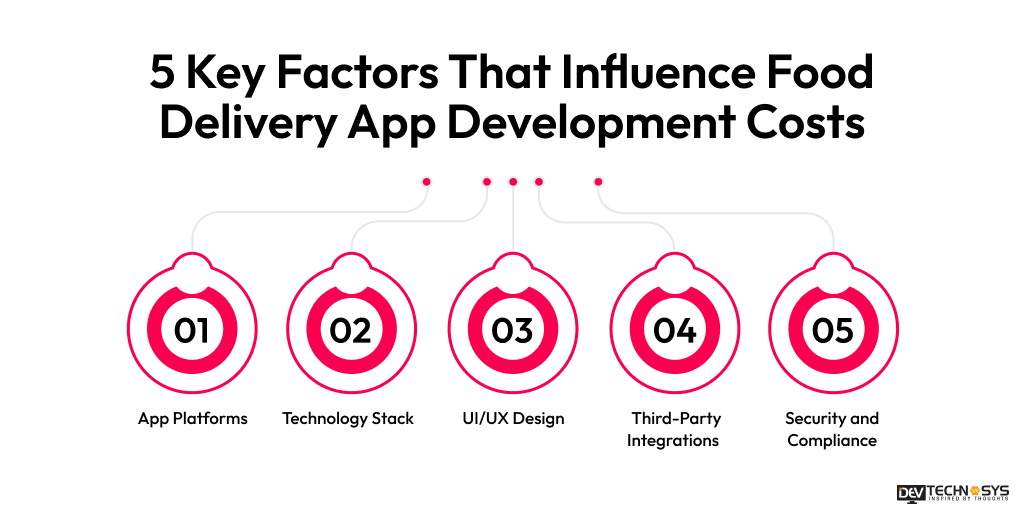
1. App Platforms
Developing for Android, iOS, or both platforms significantly impacts cost. Cross-platform frameworks like Flutter reduce expenses, while native development increases quality but requires separate codebases. Supporting multiple platforms improves reach but increases development time, testing effort, and long-term maintenance complexity for the application ecosystem.
| Type | Cost |
| Android App | $10,000 – $15,000 |
| iOS App | $12,000 – $18,000 |
| Cross-Platform | $15,000 – $30,000 |
2. Technology Stack
The chosen technology stack affects performance, scalability, and mobile app development cost. Advanced stacks with microservices, real-time tracking, and cloud infrastructure increase expenses but ensure long-term efficiency. Simpler stacks reduce initial costs but may limit scalability, flexibility, and system performance during high user traffic situations.
| Component | Cost |
| Backend Development | $3,000 – $8,000 |
| Database Setup | $1,000 – $4,000 |
| DevOps & Cloud | $1,000 – $3,000 |
| Architecture Planning | $500 – $1,000 |

3. UI/UX Design
UI/UX design plays a crucial role in user engagement and retention. High-quality custom design increases development cost but improves usability and conversion rates. Poor design reduces user satisfaction and retention. Investing in intuitive, responsive, and visually appealing interfaces ensures better long-term platform success.
| Component | Cost |
| Wireframing | $1,000 – $3,000 |
| UI Design | $2,000 – $8,000 |
| UX Research | $1,000 – $5,000 |
| Prototyping | $1,000 – $4,000 |
4. Third-Party Integrations
Integrating payment gateways, GPS systems, SMS services, and analytics tools adds to the cost of food delivery app development services. These integrations are essential for functionality, real-time tracking, and communication. While they reduce internal development effort, premium APIs and enterprise-level services increase overall project expenses significantly.
| Component | Cost |
| Payment Gateway | $1,500 – $5,000 |
| Maps API | $1,000 – $3,000 |
| SMS & Email | $500 – $2,000 |
| Analytics Tools | $1,000 – $2,000 |
5. Security and Compliance
Security implementation, including encryption, authentication, and compliance with standards like PCI DSS and GDPR, increases development cost. However, it is essential for protecting sensitive user data and financial transactions. Strong security systems prevent fraud, build trust, and ensure regulatory compliance across regions.
| Component | Cost |
| Data Encryption | $1,000 – $5,000 |
| Authentication System | $1,000 – $4,000 |
| Compliance Setup | $2,000 – $7,000 |
| Security Testing | $1,000 – $4,000 |
How Food Delivery Apps Make Money: Proven Monetization Strategies?
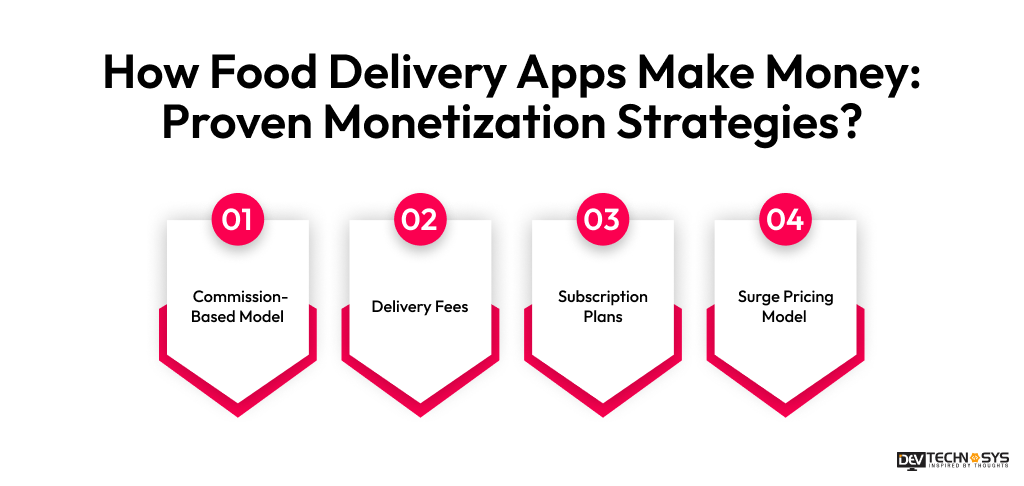
Food delivery platforms use multiple revenue streams to ensure profitability and long-term sustainability. A diversified monetization model helps balance operational costs, attract restaurant partners, and maximize earnings. It helps in maintaining competitive pricing for end users across different regions and market segments.
1. Commission-Based Model
Platforms charge restaurants a commission on every order placed through the app. This is the primary revenue source. It ensures scalability as earnings grow with order volume, making it a stable and performance-driven monetization strategy for food delivery businesses.
2. Delivery Fees
Customers are charged delivery fees based on distance, demand, and order size. This model helps cover logistics costs, incentivizes efficient routing, and increases platform profitability during peak hours or high-demand regions with optimized pricing strategies.
3. Subscription Plans
Users subscribe to premium plans offering free delivery, discounts, and exclusive deals. Subscription models generate recurring revenue and improve customer loyalty. They also increase order frequency, making them highly effective for long-term revenue stability and engagement.
4. Surge Pricing Model
Prices increase during peak demand periods, weather disruptions, or limited driver availability. Surge pricing balances supply and demand while maximizing revenue. It also encourages better delivery partner availability during high-demand time windows across the platform.
Security and Compliance Requirements for Food Delivery App Development
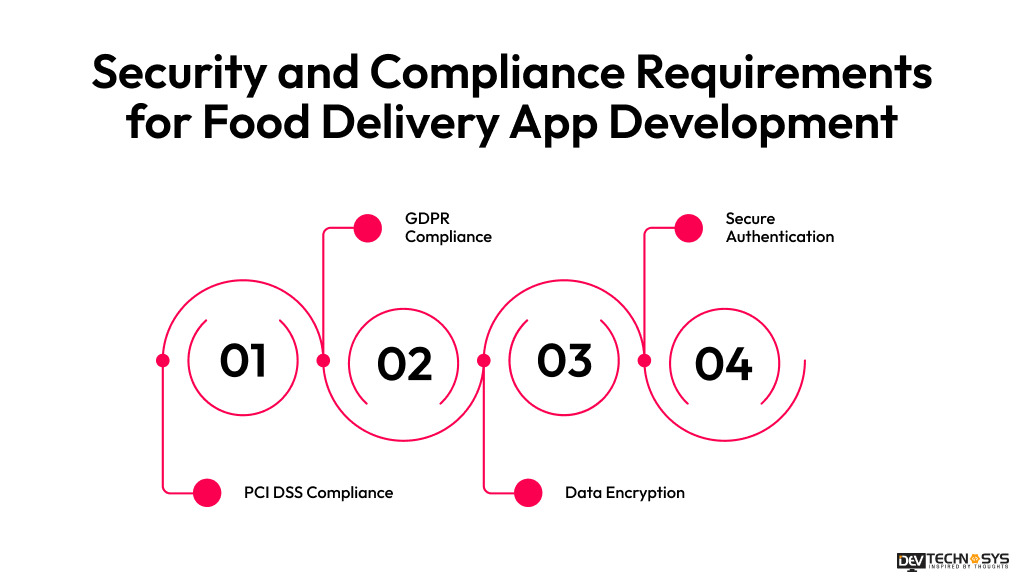
Security and compliance are critical for protecting sensitive user data, ensuring safe transactions, and maintaining trust. Food delivery apps handle financial information, personal addresses, and order history, making robust security architecture essential for regulatory compliance and platform reliability.
1. PCI DSS Compliance
PCI DSS ensures secure handling of credit card information during online transactions. It includes encryption, secure storage, and strict access controls. Compliance prevents financial fraud, protects customer payment data, and builds trust in digital payment systems.
2. GDPR Compliance
GDPR ensures user data privacy and protection, especially for European users. It regulates how personal data is collected, stored, and processed. Compliance ensures transparency, user control, and legal protection, reducing risks of data misuse or regulatory penalties.
3. Data Encryption
Data encryption protects sensitive information such as passwords, payment details, and personal data. It ensures that data remains unreadable during transmission and storage. This prevents unauthorized access and strengthens overall platform security against cyber threats.
4. Secure Authentication
Secure authentication uses multi-factor verification, OTPs, and biometric systems to verify users. It prevents unauthorized access and enhances account protection. Strong authentication systems reduce fraud risks and improve trust across customers, restaurants, and delivery partners.
Major Food Delivery App Development Challenges and How to Overcome Them
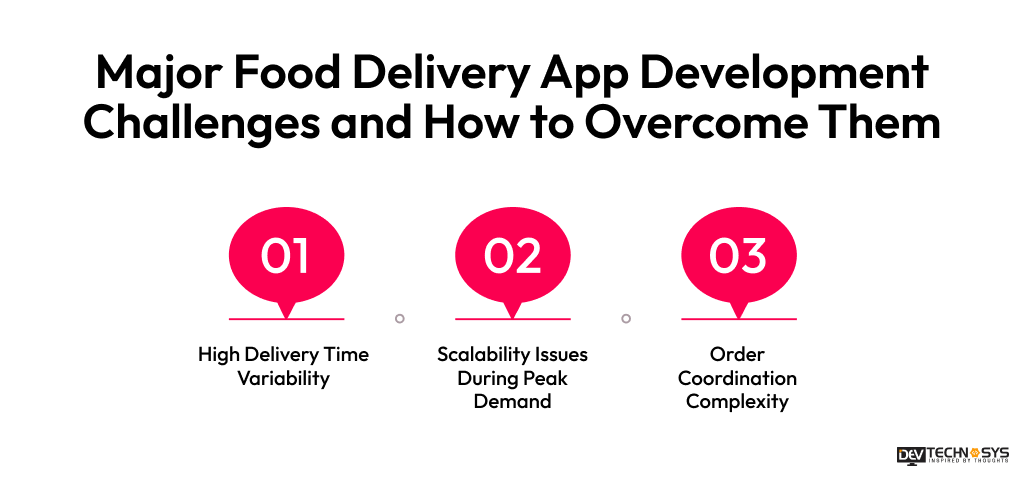
Building a food delivery app involves complex technical, operational, and logistical challenges. These challenges directly impact user experience, delivery speed, and platform scalability. Addressing them early ensures smoother operations, better system performance, and higher customer satisfaction across all stakeholders, including customers, restaurants, and delivery partners.
1. High Delivery Time Variability
Delivery times often fluctuate due to traffic conditions, restaurant preparation delays, and driver availability issues. This inconsistency affects customer satisfaction and retention rates, making it one of the most critical challenges in food delivery app performance optimization.
Solutions:
- AI-based route optimization for faster delivery paths
- Real-time GPS tracking for accurate ETA updates
- Smart driver allocation based on proximity and availability
- Predictive traffic analysis to avoid delays
2. Scalability Issues During Peak Demand
Food delivery apps often face system overload during weekends, festivals, and peak meal hours. This leads to slow app performance, order failures, and poor user experience, especially when traffic spikes unexpectedly without proper infrastructure scaling.
Solutions:
- Cloud-based microservices architecture for flexible scaling
- Auto-scaling servers using AWS or Google Cloud
- Load balancing to distribute traffic efficiently
- Database optimization for high-volume transactions
3. Order Coordination Complexity
Managing coordination between customers, restaurants, and delivery partners is highly complex. Delays in communication, mismanagement of orders, and inaccurate status updates can create inefficiencies and negatively impact overall delivery experience across the platform ecosystem.
Solutions:
- Automated dispatch system using AI-based matching
- Real-time status synchronization across all users
- Centralized order management dashboard
- Push notification system for instant updates
How AI Is Transforming Food Delivery Apps in 2026-2027?
Artificial Intelligence is transforming food delivery apps by making them smarter, faster, and more efficient. AI enables predictive analytics that forecast customer demand and optimize inventory planning for restaurants.
Personalized recommendation engines improve user engagement by suggesting relevant meals based on past behavior. Smart logistics systems reduce delivery time by optimizing routes in real time. AI-powered chatbots provide instant customer support, reducing operational workload.
Fraud detection systems identify suspicious transactions and enhance platform security. In addition, AI improves pricing strategies through dynamic pricing models based on demand and availability. Overall, AI is making food delivery platforms more efficient, scalable, and user-centric across global markets.

Why Invest in a Food Delivery App Like PedidosYa in 2026-2027?
Investing in a food delivery app like PedidosYa offers strong growth potential due to rising smartphone usage and increasing demand for convenience-based services. The global food delivery market continues to expand rapidly, driven by urbanization and digital transformation.
Every food delivery app development solution offers multiple revenue streams, including commissions, delivery fees, subscriptions, and advertising models. Scalable architecture allows businesses to expand across regions efficiently. Additionally, advancements in AI, automation, and logistics optimization are improving profitability and operational efficiency.
With changing consumer behavior and preference for on-demand services, food delivery apps represent a high-return investment opportunity in the global digital economy over the coming years.
Conclusion
Building a food delivery app like PedidosYa requires strategic planning, advanced technology, and a strong understanding of user behavior. From defining business models to implementing AI-powered features, every stage contributes to long-term platform success.
A well-designed system ensures seamless interaction between customers, restaurants, and delivery partners. With proper architecture, scalable infrastructure, and secure payment systems, businesses can achieve sustainable growth in the competitive on-demand delivery market.
As digital food ordering continues to expand globally, investing in such platforms presents a strong opportunity. A reliable food delivery app development company focus on innovation, user experience, and operational efficiency will lead the future of food delivery ecosystems.
FAQs
Q1. How Much Does It Cost To Develop A Food Delivery App Like Pedidosya?
The cost of developing a food delivery app like PedidosYa typically ranges between $30,000 and $150,000. Pricing depends on features, UI/UX complexity, technology stack, third-party integrations, security requirements, scalability needs, and whether the app is built for MVP or enterprise-level deployment.
Q2. How Long Does It Take To Develop A Food Delivery App?
Developing a food delivery app usually takes 4 to 7+ months, depending on project complexity. Timeline varies based on design requirements, feature depth, backend architecture, integration needs, testing cycles, and development team size, expertise, and workflow efficiency across different stages.
Q3. What Technologies Are Used In Food Delivery Apps?
Food delivery apps use technologies like Flutter, React Native, Node.js, Python, PostgreSQL, Firebase, AWS, and Google Maps API. These technologies support real-time tracking, scalable backend systems, cross-platform mobile development, secure payments, and efficient data management across multiple users.
Q4. How Do Food Delivery Apps Make Money?
Food delivery apps generate revenue through commissions on orders, delivery charges, subscription plans, in-app advertisements, and surge pricing during peak demand. These diversified monetization strategies ensure consistent revenue streams while maintaining platform scalability and profitability across all user segments.
Q5. Is AI Important In Food Delivery Apps?
AI is essential in food delivery apps because it enhances personalization, improves delivery route optimization, enables demand forecasting, strengthens fraud detection, and automates customer support. These capabilities increase efficiency, reduce costs, and significantly improve overall user experience and platform performance.