



 Tarun Nagar
 Key Takeaways
Automobile app development costs in the Middle East generally range from $8,000 to $30,000+, depending on app complexity, features, and integrations. Saudi Arabia vehicle app pricing starts at $8,000 to $12,000 for basic features and functionality; mid-level apps range from $12,000 to $22,000; and advanced apps with AI, IoT, or connected-car features can exceed $22,000 to $30,000+. Key cost drivers include features, platform choice, integrations, and development team location.
Cost Breakdown by Development Complexity
- Basic/MVP ($8,000 – $12,000): Core features like user login, vehicle listing, basic tracking, and simple payment integration.
- Medium ($12,000 – $22,000): Adds real-time vehicle tracking, notifications, advanced UI/UX, multiple payment options, and third-party service integrations.
- Complex ($22,000 – $30,000+): Includes AI-based recommendations, multi-vendor management, IoT integrations, advanced analytics, and scalable cloud infrastructure.
Key Cost Drivers
- App Type: Single-feature apps like vehicle tracking are cheaper than multi-feature platforms with marketplaces, rentals, or connected-car functionality.
- Features & Integrations: Real-time tracking, Real-Time data processing, IoT, AI recommendations, and multiple payment gateways significantly increase costs.
- Platform: Native iOS and Android apps cost more than cross-platform solutions like Flutter or React Native.
- Development Team Location: Hourly rates vary across regions, affecting overall Automotive app development budget.
Cost Based on Countries (Hourly Rates)
- UAE & Saudi Arabia: $25 – $55/hr
- United States: $40 – 90/hr
- Eastern Europe: $40 – $70/hr
- Southeast Asia: $15 – $25/hr
Development Timeline
- MVP App: 2 – 4 months
- Mid-Level App: 4 – 7 months
- Advanced App: 8 – 12+ months
Additional Costs
- Maintenance: 12 – 18% of total development cost annually
- Marketing & Launch: User acquisition, branding, and promotion
- Third-Party Services: Payment gateways, GPS APIs, IoT/cloud services, notifications
From booking a ride in seconds to tracking vehicle maintenance with a tap, automobile apps are transforming how people interact with transportation across the Middle East. As smart cities rise in places like Dubai and Riyadh, demand for digital automotive solutions is accelerating rapidly. Whether you’re planning to build a car rental app, a vehicle marketplace, or a fleet management platform, understanding the vehicle app development cost is crucial.
The region’s growing tech ecosystem, combined with increasing smartphone penetration and government-led digital initiatives, makes it an exciting space for innovation. However, app costs can vary widely depending on features, integrations, and scalability needs. Let’s explore what it really takes to build a powerful automobile app in the Middle East.
What is an Automobile App?
An automobile app is a software application designed to interact with vehicles, assist drivers, or manage automotive-related tasks. These apps can either be installed directly on a vehicle’s infotainment system (in-vehicle apps) or used on a smartphone to connect with the car. These applications allow users to manage their vehicles remotely or access services including car sharing & ride-hailing, maintenance & management, marketplaces, and electric vehicle (EV) support.
What is the Average Automobile App Development Cost?
The automobile app development cost may range from $8,000 to $30,000+, depending on various factors. The basic automobile app development cost in Dubai will be $8,000 to $12,000, making it ideal for startups looking to launch quickly with an MVP approach. For mid-level and advanced automotive apps, the investment can range from $12,000 to $20,000. The Advanced backend development cost for automotive apps
will cost around $20,000 to $30,000+
| App Type | Estimated Cost (USD) |
| Basic Automobile App | $8,000 – $12,000 |
| Mid-Level Automobile App | $13,000 – $20,000 |
| Advanced Automobile App | $21,000 – $30,000 |
The automobile mobile app development cost can also be influenced by factors such as UI/UX design, third-party API integrations, security measures, and compliance with regional regulations in tech-driven cities like Dubai and Riyadh.
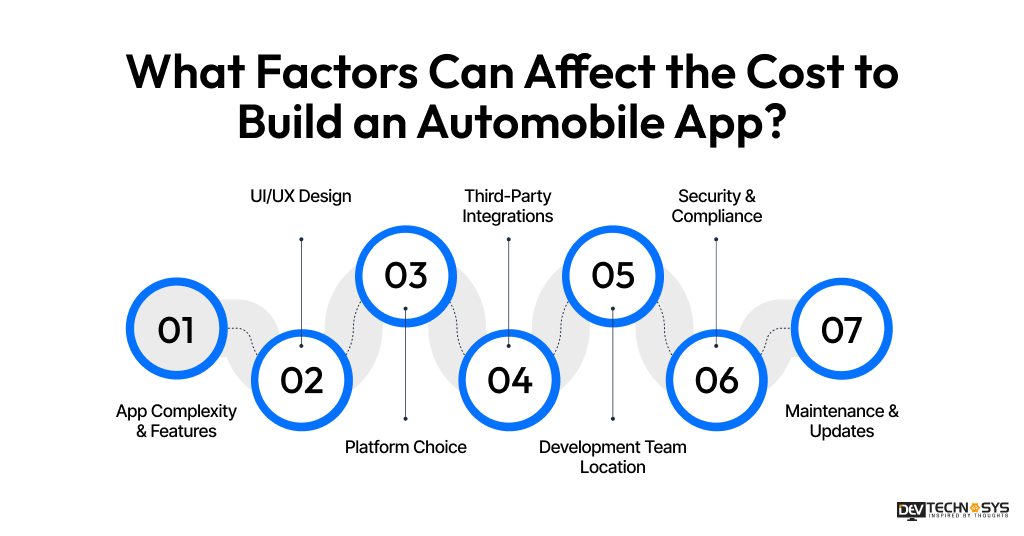
What Factors Can Affect the Cost to Build an Automobile App?
The cost to build an automobile app is influenced by multiple factors, including technical complexity and design and development choices. Each decision, whether related to features, platforms, or integrations, can significantly impact the overall Android app development budget.
1. App Complexity & Features
The complexity of your automobile app plays a major role in determining cost. Basic apps with simple features like login and listings are cheaper, while advanced apps with AI, IoT, real-time tracking, and analytics require more development time, increasing the overall cost to build an automobile app significantly.
| Complexity Level | Estimated Cost Impact |
| Basic (MVP) | $2,000 – $3,000 |
| Mid-Level | $3,000 – $6,500 |
| Advanced | $6,500 – $8,000+ |
2. UI/UX Design
A well-designed user interface improves user engagement but also adds to the total cost to develop an automobile app. Custom layouts, animations, and seamless navigation require more design effort and testing. Investing in intuitive UI/UX improves retention, but it also increases design and front-end development costs.
Industry Insights: According to Trango Tech, this decision typically influences development cost differences of 10% to 60% or more based on performance and UX needs.
| Design Level | Estimated Cost Impact |
| Basic Design | $3,000 – $5,000 |
| Custom UI/UX | $3,500 – $6,000 |
| Advanced Design | $6,000 – 8,000+ |
3. Platform Choice
Choosing between Android, iOS, or both platforms impacts the cost to develop an automobile app. Developing a single-platform app costs less, while building for both platforms requires more resources. Cross-platform frameworks can reduce the cost to develop an automobile app, but may limit performance compared to fully native application development approaches.
| Platform Type | Estimated Cost Impact |
| Single Platform | $3,000 – $6,000 |
| Cross-Platform | $4,500 – $7,000 |
| Native (Both) | $7,000 – $10,000+ |
4. Third-Party Integrations
AI-powered automotive apps often rely on third-party services like payments, maps, and notifications. Integrating tools such as Google Maps or payment gateways increases functionality but also adds to the custom automotive app development cost due to API usage, licensing fees, and integration complexity. Here’s the table explaining the third-party API cost in automotive apps.
| Integration Type | Estimated Cost Impact |
| Basic APIs | $1,000 – $3,000 |
| Standard Integrations | $4,000 – $7,000 |
| Advanced Integrations | $7,000 – $12,000 |

5. Development Team Location
The cost of hiring developers varies by region. Teams in the Middle East or Western countries typically charge higher hourly rates, while developers in regions like India offer a more cost-effective automobile app development solution. Choosing the right team can significantly influence the overall cost to create an automobile app.
| Region | Hourly Rate |
| India / Asia | $15 – $25/hr |
| Middle East (UAE/GCC) | $40 – $60/hr |
| USA / Europe | $50 – $90/hr+ |
6. Security & Compliance
Automobile apps must ensure data protection, especially when handling payments and user information. Implementing strong security measures like encryption, authentication, and compliance with regional regulations increases development complexity, requiring additional resources and ultimately raising the total cost to create an automobile app.
| Security Level | Cost Range |
| Basic Security | $2,000 – $4,000 |
| Standard Security | $4,000 – $6,000 |
| Advanced Security + Audit | $6,000 – $8,000 |
7. Maintenance & Updates
Post-launch maintenance is an ongoing expense that includes bug fixes, updates, and performance improvements. Regular updates are necessary to keep the app secure and competitive. Typically, the cost to maintain an app account for 15% to 20% of the initial development cost each year.
| Maintenance Level | Estimated Cost |
| Basic | $1,000 – $2,500/year |
| Standard | $2,500 – $4,000/year |
| Advanced / Enterprise | $4,000 – $6,000+/year |
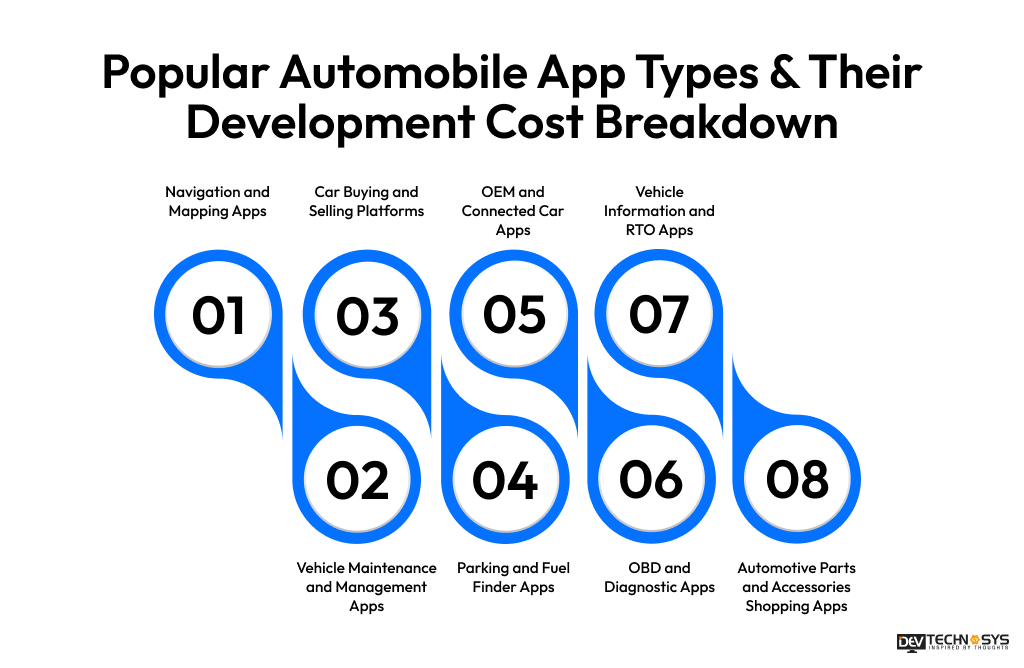
Popular Automobile App Types & Their Development Cost Breakdown
Each automobile app category comes with its own set of features, complexity, and development costs. Understanding these variations helps businesses choose the right solution and plan budgets effectively for building scalable and competitive automotive applications.
1. Navigation and Mapping Apps
Navigation and mapping apps provide real-time traffic updates, route optimization, and turn-by-turn directions, making them essential for daily commuting. Apps like Google Maps and Waze rely heavily on GPS and live data. The cost to create an automobile app ranges from $8,000 to $21,000+ due to complex integrations.
Industry Insights: Business of Apps states that global navigation app market was valued at $21 billion in 2024 and continues growing, driven by widespread smartphone use and GPS services
| Component | Details |
| Core Features | GPS tracking, real-time traffic, route optimization |
| APIs Required | Maps, location services, traffic data |
| Complexity Level | High |
| Estimated Cost | $8,000 – $21,000+ |
2. Vehicle Maintenance and Management Apps
Vehicle maintenance apps help users track fuel consumption, service history, mileage, and expenses efficiently. Popular apps like Fuelio and Drivvo include dashboards and analytics and GPS & mapping APIs. Development typically costs between $10,000 and $25,000, depending on features and reporting capabilities.
| Component | Details |
| Core Features | Fuel tracking, service logs, expense analytics |
| APIs Required | Analytics, cloud storage |
| Complexity Level | Medium |
| Estimated Cost | $10,000 – $25,000 |
3. Car Buying and Selling Platforms
According to an automobile app development company in Dubai, car marketplace apps allow users to browse, compare, and purchase vehicles with ease. Platforms like CarDekho and CarWale offer listings, filters, and dealer connections. These apps usually cost $12,000 to $30,000+ due to database and API integrations.
| Component | Details |
| Core Features | Listings, filters, dealer integration, reviews |
| APIs Required | Payment, CRM, database APIs |
| Complexity Level | Medium to High |
| Estimated Cost | $12,000 – $30,000+ |
4. Parking and Fuel Finder Apps
Parking and fuel finder apps help users locate nearby parking spaces or fuel stations with pricing and availability details. Apps like GasBuddy and SpotHero use location-based services. On demand app development costs range from $9,000 to $23,000, depending on real-time features.
| Component | Details |
| Core Features | Location tracking, availability, price comparison |
| APIs Required | Maps, geolocation, pricing data |
| Complexity Level | Medium |
| Estimated Cost | $9,000 – $23,000 |
5. OEM and Connected Car Apps
OEM and connected car app Middle East allow users to remotely control vehicle functions such as locking, unlocking, and monitoring fuel or battery levels. Apps like HondaLink integrate IoT systems. The cost for automobile app development services, especially for connected car apps, is higher, around $8,000 to $22,000+, due to hardware connectivity.
Industry Insights: According to zionmarketresearch.com, the connected car apps market is expanding rapidly, with a global market size of $66 billion in 2023 and projected to reach $370 billion by 2032, at a CAGR of ~18.5%.
| Component | Details |
| Core Features | Remote control, vehicle status, alerts |
| APIs Required | IoT, vehicle hardware integration |
| Complexity Level | High |
| Estimated Cost | $8,000 – $22,000+ |
6. OBD and Diagnostic Apps
OBD diagnostic apps connect to a vehicle’s onboard system to monitor engine health and detect faults in real time. Apps like RepairSolutions2 require hardware integration, vehicle diagnostics & OBD-II integration, and data processing. Development timeline and cost estimation generally range between $10,000 and $25,000.
| Component | Details |
| Core Features | Engine diagnostics, error codes, and real-time monitoring |
| APIs Required | OBD-II integration, analytics |
| Complexity Level | Medium to High |
| Estimated Cost | $10,000 – $25,000 |
7. Vehicle Information and RTO Apps
Vehicle information apps provide details such as registration status, owner information, insurance validity, and traffic fines. Apps like Vehicleinfo rely on database and API integrations. Development costs typically range from $8,000 to $28,000, depending on data access. Hire on-demand app developers if you want to build an next-gen RTO apps.
| Component | Details |
| Core Features | RC details, insurance status, fines tracking |
| APIs Required | Government database APIs |
| Complexity Level | Medium |
| Estimated Cost | $8,000 – $28,000 |
8. Automotive Parts and Accessories Shopping Apps
Automotive eCommerce apps allow users to browse, compare, and purchase spare parts and accessories. These apps include features like product catalogs, carts, and payment gateways. Car app development cost UAE usually ranges from $12,000 to $29,000+, depending on inventory management and platform complexity.
| Component | Details |
| Core Features | Product catalog, cart, payments, inventory |
| APIs Required | Payment gateway, inventory management |
| Complexity Level | Medium to High |
| Estimated Cost | $12,000 – $29,000+ |

What are the 5 Most Popular Automobile Apps to Consider in 2026?
Automobile apps are rapidly evolving, offering smarter ways to navigate, manage vehicles, and buy or sell cars with ease. In 2026, these apps are expected to play a crucial role in enhancing driving experiences and simplifying automotive services.
1. Waze
Waze is a community-driven navigation app that provides real-time traffic updates, accident alerts, and route optimization. This digital vehicle inspection app relies on user-generated data to deliver accurate insights, helping drivers avoid congestion. Its Fleet Management Tools (Vehicle Tracking, Driver Monitoring), social features, and live updates make it a top choice for smart and efficient commuting in 2026.
| Component | Details |
| Core Features | Real-time traffic updates, user reports, route optimization |
| APIs Required | GPS, maps, live traffic data |
| Complexity Level | High |
| Estimated Cost | $10,000 – $25,000+ |
2. Google Maps
Google Maps remains a dominant navigation app, offering precise directions, live traffic updates, and location discovery features. With integrations like business listings, reviews, and street views, it goes beyond navigation. Its AI-driven recommendations and global coverage make it indispensable for users and businesses alike in 2026.
| Component | Details |
| Core Features | Navigation, street view, business listings, live tracking |
| APIs Required | Maps, geolocation, AI-based recommendations |
| Complexity Level | High |
| Estimated Cost | $12,000 – $30,000+ |
3. Fuelio
Fuelio is a powerful vehicle management app that helps users efficiently track fuel consumption, mileage, and expenses. It offers detailed analytics and logs to optimize vehicle performance and costs. Its simplicity and data-driven insights make it a popular choice for personal and professional vehicle management. Wish to create a similar app to Fuelio? Contact a top provider of full stack development services.
Industry Insights: According to Google Play, Fuelio, a leading fuel and mileage tracking app, has 5 million+ downloads on Android and maintains strong user reviews, demonstrating real consumer demand for vehicle expense management tools.
| Component | Details |
| Core Features | Fuel tracking, expense logs, mileage analytics |
| APIs Required | Cloud storage, analytics tools |
| Complexity Level | Medium |
| Estimated Cost | $8,000 – $20,000 |
4. Vehicleinfo
Vehicleinfo allows users to access key vehicle details, including registration status, ownership information, insurance validity, and traffic fines. It is widely used for quick verification and transparency. Its integration with official databases makes it a reliable tool for vehicle-related information and compliance checks.
| Component | Details |
| Core Features | Vehicle registration details, insurance info, and fines tracking |
| APIs Required | Government database APIs |
| Complexity Level | Medium |
| Estimated Cost | $8,000 – $22,000 |
5. Autotrader
Autotrader is a leading car buying and selling platform that connects buyers with dealers and private sellers. It offers detailed listings, price comparisons, reviews, and financing options. Its user-friendly interface and extensive inventory make it a preferred choice for automotive transactions in 2026.
| Component | Details |
| Core Features | Car listings, filters, dealer connections, reviews |
| APIs Required | Payment gateways, CRM, database APIs |
| Complexity Level | Medium to High |
| Estimated Cost | $12,000 – $30,000+ |
What are the Ways to Monetize an Automobile App?
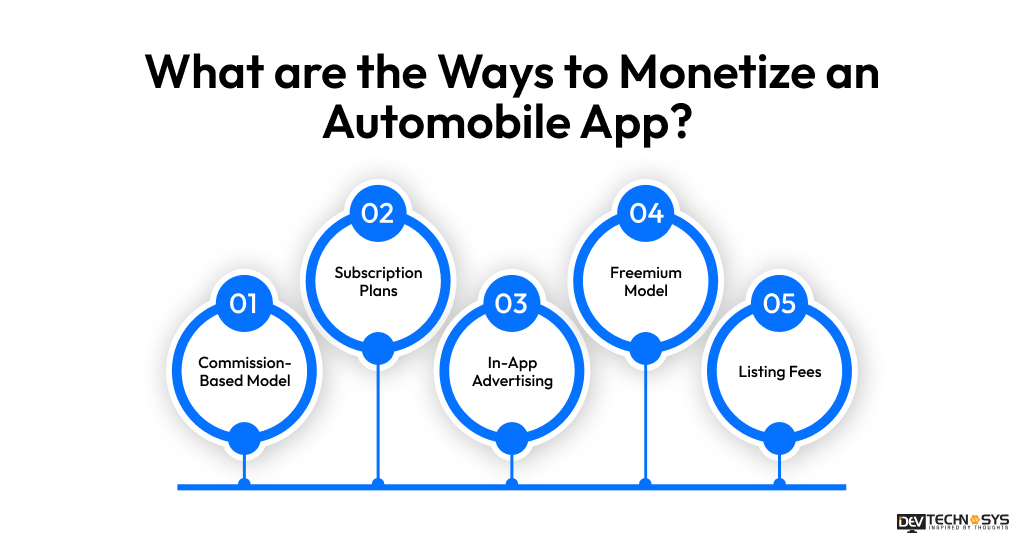
Monetizing an automobile app is essential for turning your digital product into a sustainable and profitable business. With the right strategy, you can generate revenue while delivering value to users. Choosing the right mix depends on your app type, target audience, and long-term business goals.
1. Commission-Based Model
This model generates revenue by charging a percentage on every transaction made through the app. It works best for car marketplaces, rentals, or service bookings, ensuring consistent earnings as user activity and transactions increase over time.
2. Subscription Plans
Subscription models offer premium features through monthly or yearly payments. Users can access benefits like advanced analytics, ad-free experiences, priority listings, or enhanced tracking, making it a reliable and recurring revenue stream for automobile apps.
3. In-App Advertising
Apps with high traffic can earn through advertisements such as banners, videos, or sponsored listings. Generally,the mobile app development company will use this method for navigation or marketplace apps, where consistent user engagement ensures steady ad impressions and higher revenue potential.
4. Freemium Model
The freemium model provides basic features for free while charging for advanced functionalities. This approach attracts a large user base initially and gradually converts free users into paying customers by offering valuable premium upgrades and features.
5. Listing Fees
Charging listing fees allows businesses or individuals to showcase vehicles, services, or products on the platform. This model is widely used in car marketplace apps and ensures revenue generation regardless of whether a transaction is completed.

What are the Measures to Reduce the Cost of Automobile App Development?
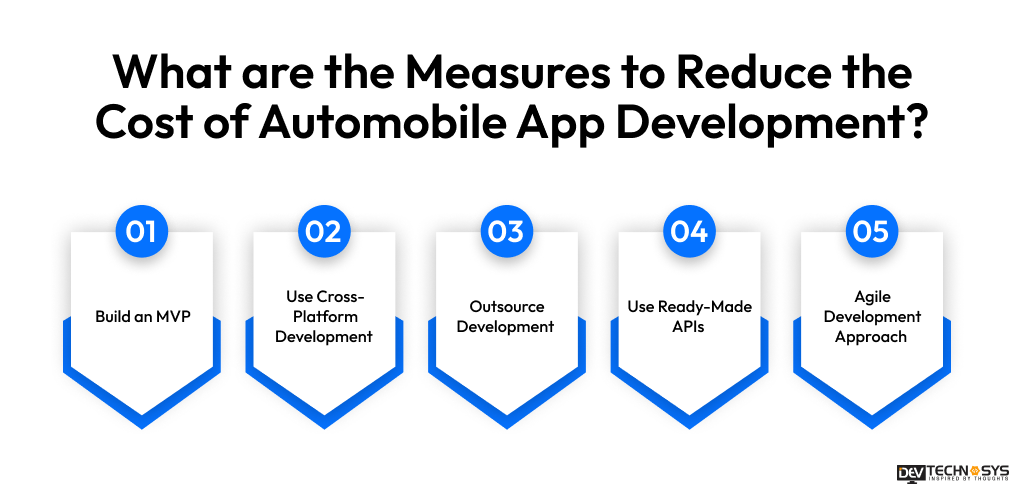
According to the best automotive app development company, reducing the cost of automobile app development is essential for startups and businesses looking to enter the market efficiently. Implementing smart strategies ensures high-quality apps while keeping investments manageable and maximizing return on development efforts.
1. Build an MVP
Developing a Minimum Viable Product with only core features allows you to test the app concept quickly. It minimizes upfront investment, gathers user feedback early, and helps prioritize features for future development, reducing wasted time and cost.
2. Use Cross-Platform Development
Leveraging frameworks like Flutter or React Native lets you build a single app for both iOS and Android. This approach saves development time, reduces the Automobile app development cost in UAE compared to separate native apps, and maintains consistent performance across multiple platforms.
3. Outsource Development
Partnering with experienced developers from cost-effective regions lowers overhead costs while accessing skilled talent. Outsourcing enables faster project delivery, flexibility in team scaling, and efficient resource management, making it an ideal approach for startups or businesses with tight budgets.
4. Use Ready-Made APIs
Integrating pre-built APIs for features like GPS, payments, notifications, and analytics reduces development time and complexity. This ensures reliability, allows faster deployment, and prevents unnecessary expenses associated with building every component from scratch.
5. Agile Development Approach
Using agile methodology breaks the project into small phases, allowing continuous testing, iteration, and feedback incorporation. This reduces costly errors, optimizes resource allocation, and ensures timely delivery, ultimately lowering the Automobile app development cost in Middle East while maintaining app quality and performance.
Conclusion
Automobile app development in the Middle East is a growing opportunity, driven by rapid digital transformation and smart mobility initiatives in cities like Dubai and Riyadh. By starting with an MVP, leveraging cross-platform technologies, and using ready-made APIs, businesses can significantly reduce costs while ensuring scalability.
With the right strategy, investing in an automobile app can deliver long-term value, improved customer experience, and strong market competitiveness. If you want to develop an automobile app for your business, discuss your project plan with a top automobile app development company in Middle East.
FAQs
Q1.What is the Average Cost to Build an Automobile App?
The average Automobile app development cost ranges between $8,000 and $30,000+ for basic to moderately complex apps. However, advanced applications with AI, IoT, Payment Gateway Integration, and real-time tracking features can exceed $30,000 or more, depending on customization and scalability requirements.
Q2. How Long Does it Take to Develop an Automobile App?
Development time typically ranges from 2 to 6 months. A basic MVP can be built within a few months, while complex apps with advanced features, integrations, and testing may take longer to ensure quality and performance.
Q3. What Factors Affect Automobile App Development Cost?
Key factors include app complexity, UI/UX design, platform choice, third-party integrations, and development team location. Real-time features like GPS tracking and advanced technologies such as AI or IoT also significantly increase development costs.
Q4. Which Technologies Are Commonly Used in Automobile Apps?
The technology stack that is commonly used to build an automobile app includes:
- Cross-Platform Frameworks: Flutter, React Native
- Cloud Services: AWS, Google Cloud
- GPS & Mapping APIs: Google Maps API
- Payment Gateways: Stripe, PayPal
- IoT Integration: Connected vehicle features
- Backend: Node.js, Python, Django
Q5. How Can I Reduce The Cost of Developing an Automobile App?
You can reduce costs by building an MVP, using cross-platform development, outsourcing to cost-effective regions, and integrating ready-made APIs. Adopting an agile development approach also helps minimize errors and optimize resources efficiently.