






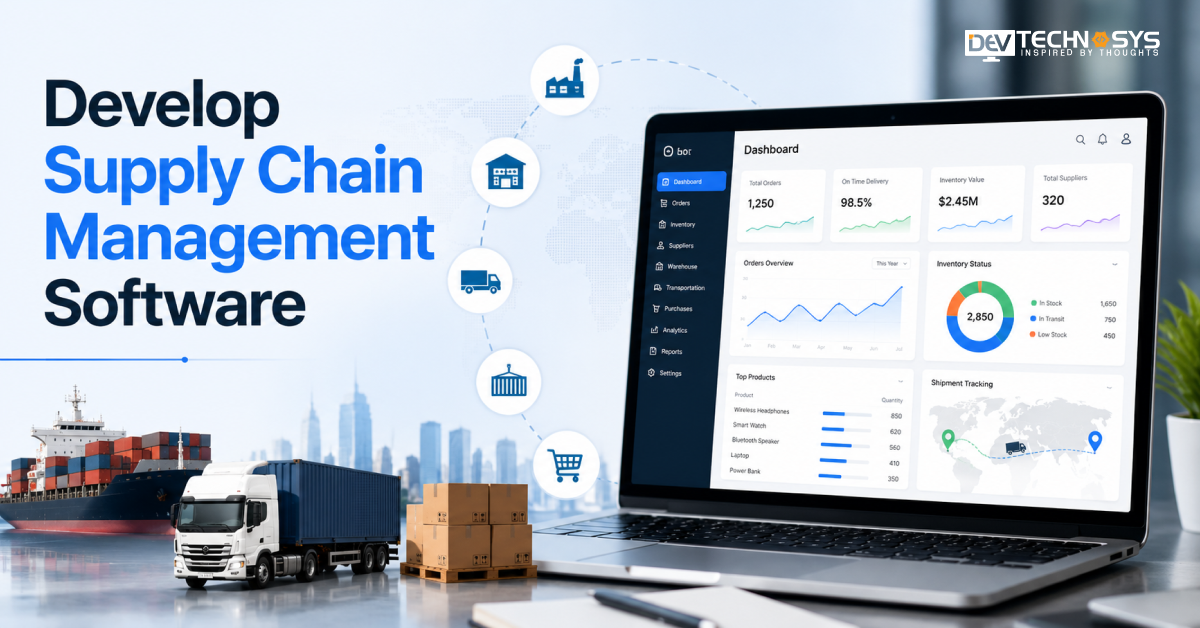
The Middle Eastern region is rapidly becoming a worldwide logistics and trading center, acting as a link between Asia, Europe, and Africa via important seaports, trade zones, highways, and global air cargo networks.
However, managing these complicated supply chains poses several obstacles, such as shipments and customs, inventory visibility, supplier coordination, etc.
These features can be achieved with the help of supply chain management software, which is able to assemble all components of supply chains through real-time tracking, automatic processes, foresight, and centralized storage of information.
Yet, bringing SCM to life for companies in the Middle East involves much more than applying the most common warehousing and logistics functions.
The software needs to have the functions of complying with local laws, working in different currencies, supporting different languages and taxes, and being adaptable to different countries. The introduction to SCM is divided into several sections covering the functionality, the procedure, the choice of technologies, security issues, costs and money, terms of realization, and the functions to develop supply chain management software.
What is Supply Chain Management Software?
Supply chain management software is a digital platform that helps businesses manage and optimize the flow of products, information, and resources from suppliers to customers. It combines procurement, inventory, warehousing, transportation, order processing, and analytics into a single system.
For Middle Eastern companies, SCM software can offer cross-border visibility, process automation, real-time shipment tracking, operational cost reduction, and quicker, data-led supply chain choices.
Industry Insights:
“According to PwC, 56% of transport and logistics CEOs reported extensive AI use in demand fulfillment, including supply-chain and logistics operations, nearly twice the regional average.”
Market Analysis of UAE Supply Chain Management Software Market
- The UAE Supply Chain Management market was estimated at USD 288.8 Million in 2026 and is projected to reach USD 644.3 Million by 2030.
- The UAE market is estimated to develop at a CAGR of 14.2% during 2026-2030.
- Solution was the highest revenue-producing component in 2026 on a segment basis.
- The Most Lucrative Component Segment is Services, Registering the Fastest Growth During the Forecast Period.
Answer a few quick questions and our experts will share a tailored project estimate.
Why Do UAE Businesses Want to Invest in Supply Chain Management Software Development?
UAE businesses are investing in supply chain management software to manage increasingly complicated logistics, increase real-time visibility, and streamline operations among suppliers, warehouses, and transportation networks.
These benefits of supply chain management software also help to lower operating costs, simplify repetitive operations, improve decision-making, enable regional expansion, and build more resilient, data-driven supply chains.
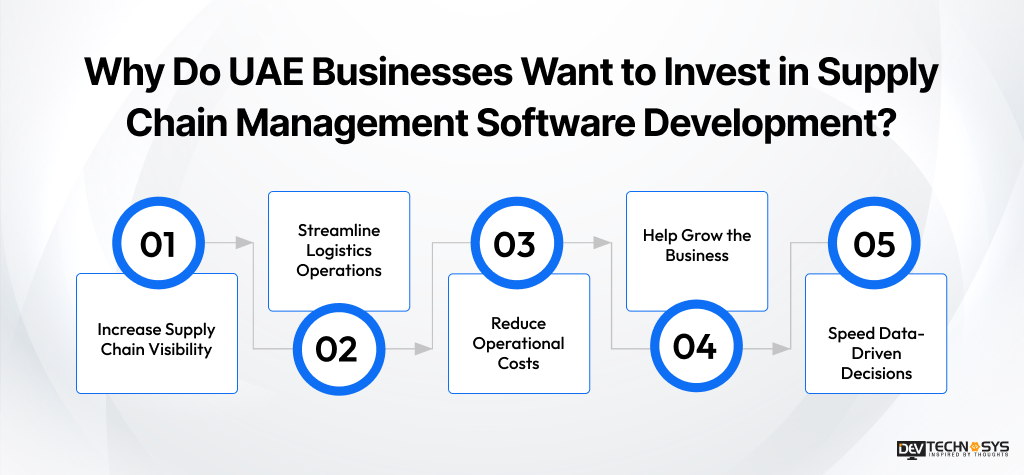
1. Increase Supply Chain Visibility
UAE enterprises usually have complicated networks of suppliers, warehouses, transportation, and distribution channels in local and foreign markets. Real-time visibility of inventory, orders, shipments, and deliveries is provided via custom SCM software. This single view helps firms detect bottlenecks faster, coordinate activities more efficiently, and make informed decisions based on correct data.
2. Streamline Logistics Operations
The UAE is a key regional logistics and trade hub, and businesses need effective management of transportation and delivery. SCM software can automate the planning of routes, tracking of shipments, coordination of fleets, and scheduling of deliveries. This helps avoid unnecessary delays, optimize resources, increase delivery performance, and establish smoother logistical operations across various sites.
3. Reduce Operational Costs
Manual processes, poor inventory records, delayed shipments, and disconnected systems can increase operating costs. UAE companies can implement tailor-made SCM software to eliminate tedious tasks, manage inventory levels, improve procurement planning, and minimize errors. Ultimately, better usage of resources allows firms to manage costs while still achieving effective supply chain performance.
4. Help grow the business
More and more UAE enterprises have consumers across the GCC and internationally, which results in more complicated supply chain requirements. Scalable SCM software may add more warehouses, suppliers, users, goods, and geographical locations without affecting the current operations. Such flexibility allows companies to grow efficiently while maintaining control over the supply chain operations centrally.
5. Speed Data-Driven Decisions
Modern supply chains produce huge volumes of operational data from orders, inventory, suppliers, warehouses, and transportation networks. SCM software converts this data into dashboards, reports, forecasts, and useful insights.
These capabilities can be leveraged by UAE enterprises to spot demand trends, predict interruptions, optimize inventory, and make faster strategic decisions.
Market Insights:
“As per the Reuters, UAE exports to CEPA partner countries increased 42.3% year over year in 2025, demonstrating expanding international trade connectivity and supply-chain activity.”
How to Build Supply Chain Management Software?
Develop supply chain management software entails a lot more than just connecting logistics operations. It includes defining business objectives, mapping workflows, customizing the primary modules, linking the regional systems, enhancing security, and testing the performance.
Together, these form a good and scalable platform that significantly contributes to better visibility, automation, efficiency, and decision-making processes in Middle Eastern chains.
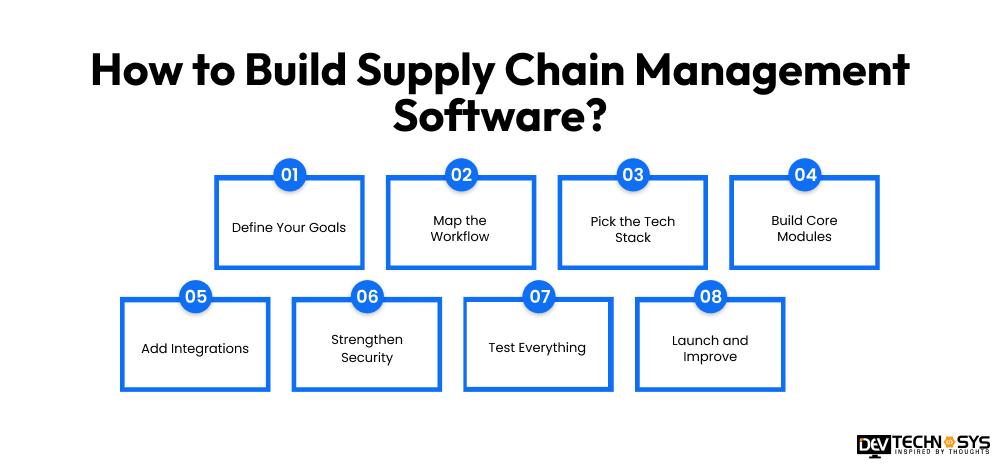
1. Define Your Goals
Figure out the supply chain challenges that need to be solved by your software, including delays in procurement, gaps in inventory, visibility of shipments, and inefficiencies in the delivery process.
Hire an ERP software development company to identify the users, workflows, KPIs, and business outcomes before you start developing the software. When developing for the Middle Eastern markets, you have to think of cross-border transactions, several currencies, support in the Arabic language, customs processes, taxation, and laws prevailing in each country.
2. Map the Workflow
Devise an effective diagram showing the relationship among the processes in the supply chain, including Supplier – Procurement – Inventory – Warehouse – Transport – Delivery – Analytics.
Take note of the business approvals, dependencies, data movements, and user roles in every stage of the process. This should help the development team to build modules that work in an interconnected manner, thus enhancing operational efficiency.
3. Pick the Tech Stack
Decide on technology solutions based on scalability, security, integration requirements, and predicted volumes of transactions. Reliable application programming interfaces (APIs), scalable databases, strong security features for user authentication, and service modules are essential to support the company’s growth.
Hire an experienced AI development services provider to ensure that your stack contains the necessary software tools: front-end, back-end, database, and infrastructure technology to support the expansion and integration of the company.
4. Build Core Modules
Design your modules according to your company’s specific supply chain requirements without developing unnecessary features. The main components should be: supplier management, purchasing, inventory, warehouse management, order fulfillment, logistics, shipment tracking, demand forecasting, and reporting.
Make sure to organize these components in a centralized way so that all users have access to the same data in order to build a unified decision-making chain.
5. Add Integrations
Link your platform with ERP, CRM, WMS, TMS, accounting systems, GPS, IoT devices, mapping APIs, carriers, and supplier platforms. API-based ERP integrations allow data to be synchronized in real-time across various business systems.
Also consider using customs platforms, logistics providers, payment systems, and other government services in order to build a connected digital supply-chain ecosystem in the Middle East region.
6. Strengthen Security
Utilize technologies such as encryption, RBAC, MFA, API security, audit trails, monitoring, and secure backups to protect business, financial, supplier, and customer data.
Integrate security measures at all levels of development to ensure that security is built in. Be sure to assess any privacy and other regulations in the countries of the Middle East where your software will perform certain functions.
7. Test Everything
Evaluate the software using various functional scenarios as well as compliance with the requirement documentation and performance. Create situations with high-volume transactions, delayed shipments, wrong information in inventories, and failure of the API or connectivity.
Compare reports and dashboards created with the already available tools with the actual business process. Test different roles and regions to find the weaknesses prior to software installation and avoid unnecessary expenses later.
8. Launch and Improve
Implement the platform in phases to ensure its effective use prior to extending it to other warehouses, suppliers, and area locations. Monitor performance, integrations, users, inventory, and operational KPIs post-implementation.
Hire a software development company to gather feedback and use it to continuously improve automations, predictions, dashboards, and workflows. Regular updates ensure that the platform has what it needs to adapt to changing business requirements and local market conditions.

Essential Features of SCM Software
Procurement, inventory, warehousing, transportation, and analytics are all integrated into a single platform by modern SCM software. Supply chain visibility is enhanced, workflows are automated, operational expenses are decreased, decision-making is strengthened, and more responsive business operations are made possible with the correct feature set. Let’s take a look at the various supply chain software features:
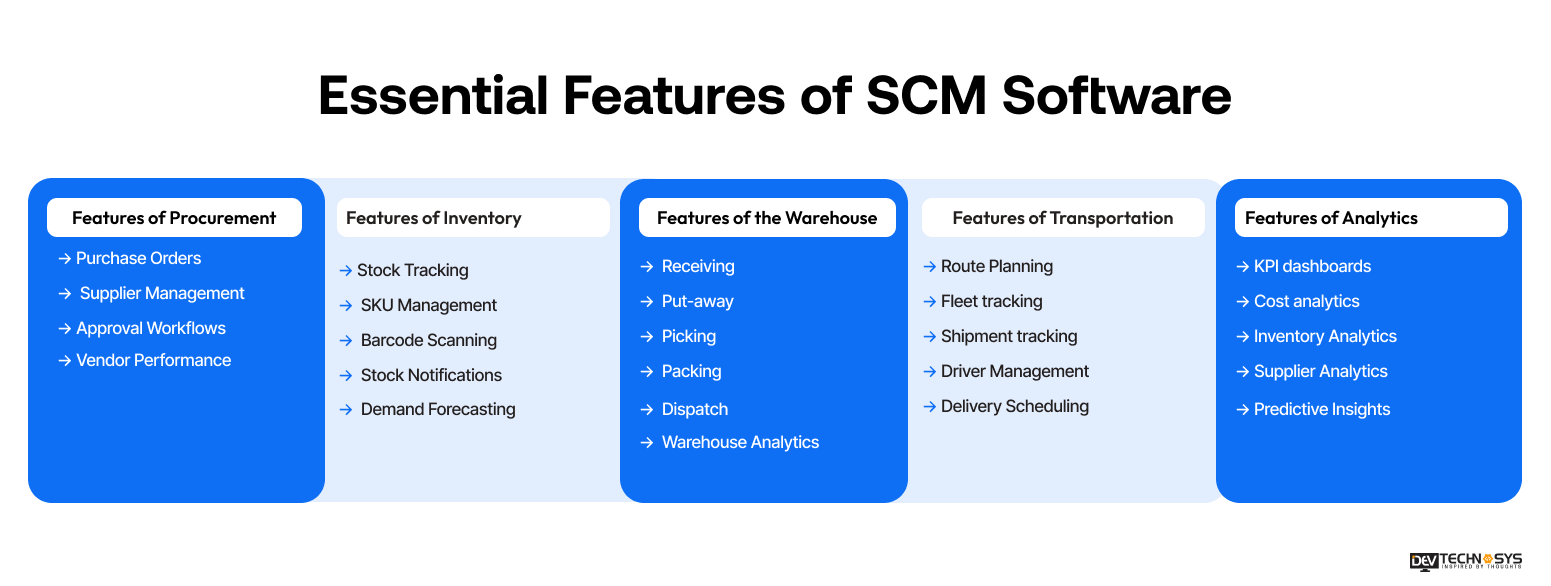
1. Features of Procurement
-
Purchase Orders
Establish, authorize, monitor, and oversee purchase orders while minimizing human error and upholding precise purchasing documentation among procurement teams and suppliers.
- Supplier Management
To streamline vendor relationships and facilitate well-informed procurement decisions, centralize supplier profiles, contracts, certifications, pricing, communication, and performance data.
-
Approval Workflows
To speed up procurement while upholding financial controls, automate buy approvals utilizing configurable rules, role-based permissions, expenditure caps, and escalation pathways.
-
Vendor Performance
Using performance measures that assist companies in identifying risks and fortifying supplier relationships, keep an eye on supplier quality, delivery schedules, price, compliance, and dependability.
2. Features of Inventory
-
Stock Tracking
To maintain precise stock visibility across warehouses, retail locations, and distribution centers, track inventory numbers, movements, locations, and status in real time.
-
SKU Management
Utilize a centralized inventory database to manage SKU specifics, product variations, categories, pricing, quantities, suppliers, and storage data.
-
Barcode Scanning
Utilize barcode scanning to reduce manual data-entry errors while receiving and dispatch, identify products, update inventory movements, and speed up warehouse operations.
-
Stock Notifications
Set up automated notifications for low, excess, reserved, or expiring inventory to assist teams in quickly restocking and preventing expensive shortages.
-
Demand Forecasting
To forecast demand and provide more informed purchasing and replenishment choices, examine past sales, seasonal patterns, market trends, and inventory data.
3. Features of the Warehouse
-
Receiving
When products reach warehouse facilities, inventory records are automatically updated, inbound shipments are tracked, quantities are confirmed, and goods are inspected.
-
Put-away
To maximize space usage and retrieval efficiency, optimize storage locations based on product attributes, availability, warehouse capacity, and operational guidelines.
-
Picking
To cut down on errors and fulfillment delays, create optimized picking lists, allocate warehouse responsibilities, and mentor employees through effective product collecting.
-
Packing
Oversee packing procedures, check merchandise, create shipping labels, and make sure packages are properly packaged before they leave the warehouse.
-
Dispatch
Assign shipments, manage order dispatch, update inventory, and give real-time progress updates from warehouse departure to final delivery.
-
Warehouse Analytics
Use actionable analytics to monitor warehouse efficiency, order accuracy, storage utilization, picking performance, processing delays, and operational bottlenecks.
4. Features of Transportation
-
Route Planning
To save transportation costs and increase delivery efficiency, optimize delivery routes based on distance, traffic, delivery windows, vehicle capacity, and shipment priority.
-
Fleet tracking
For better fleet visibility and control, track vehicle locations, movements, utilization, fuel consumption, and operational status in real time.
-
Shipment tracking
Throughout the transportation lifecycle, offer real-time shipment visibility via tracking events, GPS, carrier integrations, and automated notifications.
-
Driver Management
To enhance labor utilization and transportation coordination, manage driver profiles, timetables, assignments, compliance records, performance, and availability.
-
Delivery Scheduling
To minimize delays and missed appointments, schedule deliveries based on client preferences, vehicle availability, route capacity, priorities, and delivery windows.

5. Features of Analytics
-
KPI dashboards
Supply chain KPIs, operational metrics, fulfillment performance, inventory levels, transportation efficiency, and procurement outcomes should all be shown on centralized dashboards.
-
Cost analytics
To find cost drivers, inefficiencies, and chances for operational savings, examine procurement, inventory, warehousing, transportation, and fulfillment expenditures.
-
Inventory Analytics
To enhance working capital and inventory planning, assess stock turnover, carrying costs, shortages, excess inventory, aging products, and demand trends.
-
Supplier Analytics
To find high-performing suppliers and manage supply risks, compare supplier pricing, quality, delivery performance, compliance, and dependability.
-
Predictive Insights
To foresee shifts in demand, interruptions, delays, shortages, and new operational hazards, use both historical and current supply chain data with predictive analytics.
UAE-Specific Requirements for SCM Software
The SCM software for the UAE should incorporate regional business practices, logistical network, and regulatory considerations. But requirements vary with firm size, industry, supply chain complexity, and markets served. Capabilities should be prioritized based on the operating model, trading jurisdictions, client base, and cross-border activities of the business.
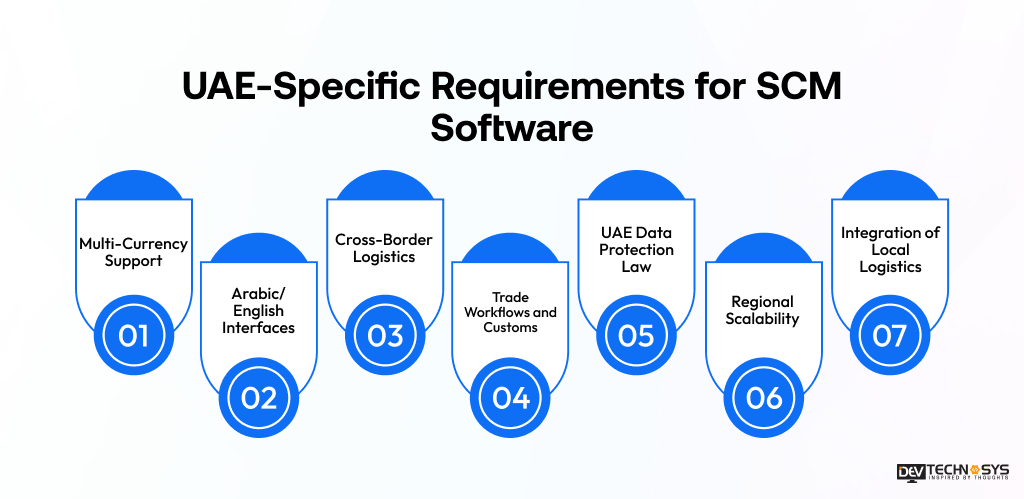
1. Multi-Currency Support
With multi-currency capability, UAE companies may manage procurement, supplier invoicing, transportation expenses, and foreign transactions in AED, USD, EUR, GBP, and other currencies.
It can perform currency conversions, exchange rate computations, pricing, and financial reporting. The specific currencies needed will vary depending on supplier locations, client markets, and the company’s international trading activity.
2. Arabic/English Interfaces
Arabic and English interfaces can improve accessibility for UAE-based supply chain teams, suppliers, warehouse staff, and business users. Localizing navigation, notifications, reports, and documentation could be of use to organizations functioning with multilingual staff. Not all organizations need Arabic support, particularly if the organization’s internal operations and users are strictly English-speaking.
3. Cross-Border Logistics
International shipping companies may require SCM functions for cross-border shipments, carrier coordination, cargo documentation, customs information, and delivery tracking.
These routines help organizations manage the complexities of foreign supply chains and increase shipment visibility. Requirements should be based on nations served, means of transport, trade routes, and applicable import or export processes.
4. Trade Workflows and Customs
If you import and export products, you might need workflows for customs documentation, shipping declaration, duties, tariffs, approvals, and trade compliance.
Embedding these procedures into SCM software can eliminate the need for human coordination and increase visibility into shipments. But the needed capability varies by product categories, trading countries, customs procedures, and the specific import-export model of the company.
5. UAE Data Protection Law
Where personal or corporate data is processed by SCM systems, UAE data protection standards and adequate security procedures should be considered.
Capabilities may include encryption, control of access, audit logs, retention policies and secure data handling depending on the business and processing activities. The legal and compliance requirements have to be evaluated depending on the relevant UAE jurisdiction and business type.
6. Regional Scalability
Regional scalability helps enterprises to grow their supply chain activities across the UAE and nearby regions without redeveloping their IT infrastructure.
For many entities, adjustable workflows, multiple currencies, localization, centralized reporting, and flexible integrations facilitate expansion. The required architecture is dependent on the anticipated markets, operating entities, warehouses, and logistics network of the organization.
7. Integration of local logistics
The integration of SCM software with the right regional logistics providers, carriers, fleet platforms, mapping services, marketplaces, ERP systems, and shipping platforms can lead to better operational visibility.
Businesses should choose integrations based on their current technology environment and logistical partners, instead of assuming all UAE organizations need the same third-party connections.
How Much Does SCM Software Development Cost?
The cost to develop supply chain management software in UAE normally falls between AED 110,000 and AED 550,000+, depending on features, integrations, customization, security, and scalability.
While a simple solution can be less expensive, enterprise-grade platforms with AI forecasting, real-time tracking, IoT connectivity, advanced analytics, and multi-entity support will demand a greater investment. Other factors affecting the ultimate cost include development team location, technology stack, project complexity, testing, maintenance, and compliance needs.
SCM Software Type |
Estimated Cost (AED) |
Description |
| Basic SCM Software | AED 110,000–180,000 | Core procurement, inventory, and reporting. |
| Mid-Level SCM Platform | AED 180,000–320,000 | Adds warehouse, transportation, and integrations. |
| Advanced SCM Software | AED 320,000–450,000 | Includes automation, forecasting, and advanced analytics. |
| Enterprise SCM Platform | AED 450,000–550,000+ | Supports AI, IoT, scalability, and complex operations. |
What Types of Factors Affect the SCM Software Development Cost?
The cost to build supply chain management software depends on business requirements, platform complexity, customization, integration, security, and scalability.
By being aware of these aspects, UAE enterprises may realistically forecast budgets, focus on the critical functionality, and minimize unplanned expenses related to development, deployment, and maintenance.
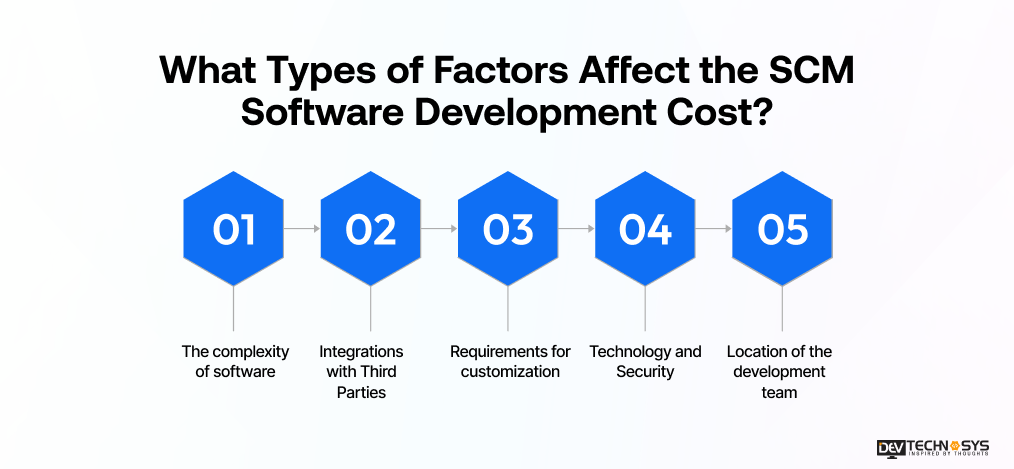
1. The complexity of software
The more modules, workflows, user roles, and automation required, the higher the cost to develop supply chain management software. A simple SCM platform takes fewer resources, while enterprise ones with procurement, inventory, warehouse, transportation, analytics, and AI features take way more development effort.
2. Integrations with Third Parties
Integrations with ERP, WMS, CRM, accounting systems, GPS, IoT devices, payment gateways, carriers, and logistics platforms can drive up supply chain software development costs.
Additional development and testing requirements depend on the number, complexity, quality of documentation, and customization needs of these integrations.
3. Requirements for customization
Highly customized workflows, dashboards, approval processes, business rules, reports, and user experiences take additional development time. Firms with specialized supply chain activities may require more customized capabilities than firms using typical SCM workflows and processes.
4. Technology and Security
Technology choices, cloud infrastructure, supply chain software architecture, data storage, encryption, authentication, control of access, monitoring, and compliance needs all impact overall cost to build a custom ERP solution.
Advanced security designs and scalable cloud environments often require more development, testing, infrastructure setup, and ongoing maintenance resources.
5. Location of Development Team
The location, skills, and engagement model of the development team can have a big impact on the expenses of the project. Teams in various regions are billed at different hourly rates.
You may pay more for skilled engineers with knowledge of SCM, cloud, AI, integration, and enterprise software, but you will get better quality delivery.
Cost Factor |
Cost Impact |
Description |
| Software Complexity | 25–30% | Number of modules, workflows, users, and automation requirements. |
| Third-Party Integrations | 20–25% | ERP, WMS, CRM, GPS, IoT, carrier, and logistics integrations. |
| Customization Requirements | 15–20% | Custom workflows, dashboards, reports, and business rules. |
| Technology and Security | 15–20% | Cloud infrastructure, architecture, encryption, access controls, and compliance. |
| Development Team Location | 10–15% | Developer expertise, location, hourly rates, and engagement model. |

How Is AI Transforming Supply Chain Software in the Middle East?
AI is enabling Middle Eastern firms to become more predictive, responsive, and data-driven with their supply chains. By evaluating operational, market, and logistics data, AI-powered SCM platforms may enhance forecasts, manage resources, spot hazards earlier, and help speed decisions across increasingly complex regional supply networks.
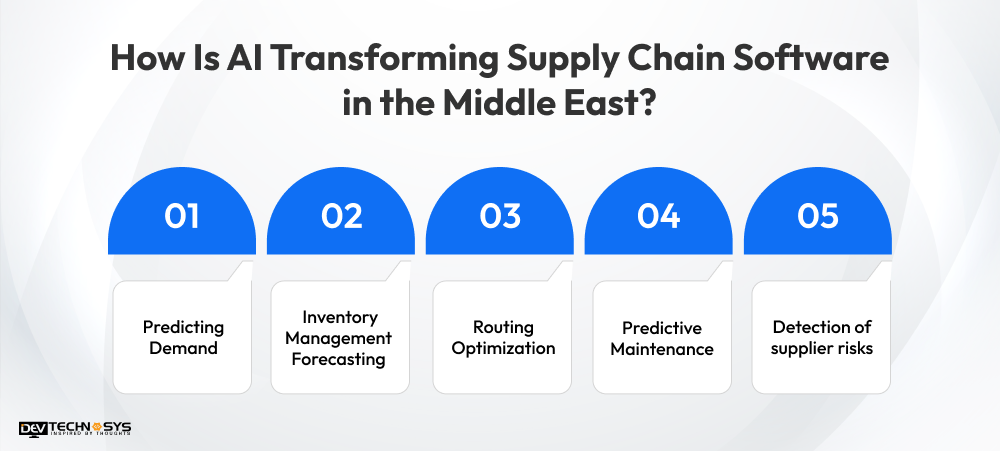
1. Predicting Demand
AI evaluates previous sales, seasonality, consumer behavior, market trends, and external signals in an effort to increase the forecast accuracy of future demand.
Such information can help Middle Eastern organizations in planning for sourcing, production, and distribution, while helping to reduce stockouts, overstocking, and expensive demand swings across multiple markets.
2. Inventory Management Forecasting
AI-powered inventory systems continuously assess stock levels, demand trends, lead times, and purchase data to make replenishment decisions. This allows organizations to maintain ideal stock levels, reduce carrying costs, minimize stock-outs, and be more responsive to changing client demand and regional market conditions.
3. Routing optimization
AI in manufacturing analyzes traffic, delivery locations, vehicle capacity, weather, fuel usage, and delivery windows to suggest transportation routes for efficiency.
Intelligent route optimization for logistics operations in the Middle East can decrease travel time, fuel costs, delivery delays, and wasteful vehicle use across complicated distribution networks.
4. Predictive Maintenance
The AI looks at vehicle, equipment, IoT sensor, and operating data and finds patterns that might be a future problem. Supply chain firms can schedule maintenance before problems occur.
This leads to better asset availability, less unplanned downtime, longer equipment life, and more reliable warehousing and transportation operations.
5. Detection of supplier risks
AI may examine supplier performance, delivery history, pricing fluctuations, quality issues, geopolitical signals, and external market data to identify potential threats. Early warnings of disruptions allow businesses to pre-emptively modify suppliers, inventory levels, sourcing strategy, or transportation arrangements.
Fact: UAE real GDP grew 6.2% in 2025, while non-oil GDP increased 6.8%, supporting continued diversification-driven logistics demand.
Security and Compliance for SCM Software
When SCM software is used to manage supplier, inventory, financial, logistics and operational data, security and compliance are of the utmost importance.
To manage risks and enable trustworthy supply chain operations, a secure platform must include encryption, role-based access, MFA, secure APIs, audit trails, monitoring, backups, and proper compliance controls.
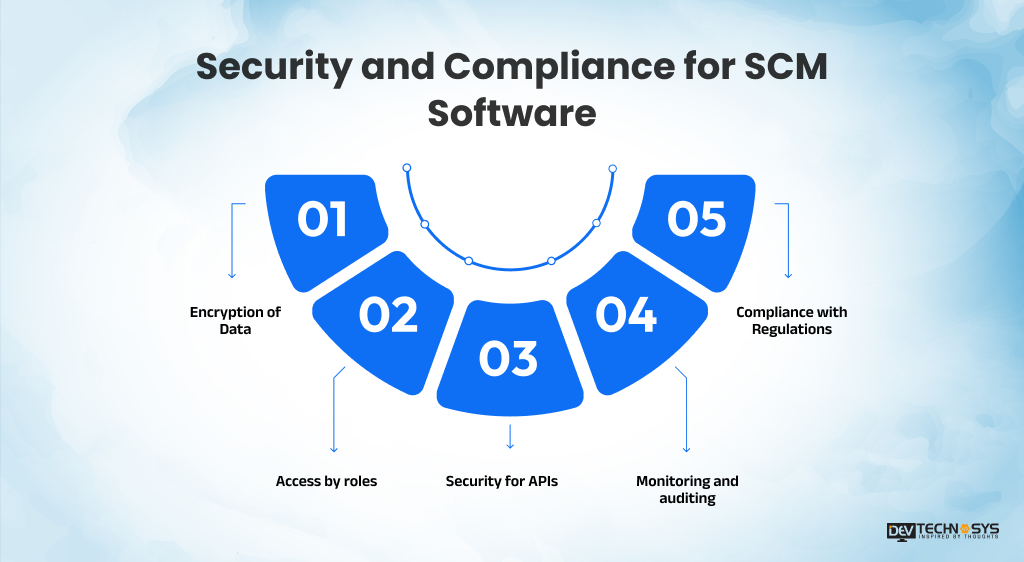
1. Encryption of Data
Encrypt sensitive data in your supply chain (supplier records, financial data, customer details, inventory, shipment info, etc.) at rest and in transit. Robust encryption techniques are used to protect cloud environments and integrated systems from illegal access, data interception, and exposure.
2. Access by roles
Implement role-based access control and multi-factor authentication so employees, suppliers, warehouse teams, supervisors, and administrators only see what they need to. Granular permissions mitigate internal security concerns and provide more control over sensitive operational and business data.
3. Security for APIs
Implement secure interaction with ERP, WMS, TMS, GPS, IoT devices, Logistics platforms, and third-party services utilizing authentication, authorization, encryption, validation, and rate restriction. Good API security helps you avoid illegal requests, data tampering, abuse of your service, and weaknesses in your integrations.
4. Monitoring and auditing
Maintain complete audit logs for all user logins, transactions, approvals, inventory adjustments, shipping status changes, and administrative functions.
Regular monitoring can detect abnormal behavior, failed authentication attempts, and potential threats, enabling firms to investigate occurrences and respond to security issues as they occur.
5. Compliance with Regulations
Review UAE and regional data protection requirements applicable to the organization’s operations, data, and countries. Businesses creating and running supply chain management platforms may also need to address standards such as ISO 27001, SOC 2, GDPR, and PCI DSS.
What are the Supply Chain Software Development Challenges?
Developing supply chain software is more than simply writing functional modules. Businesses need to solve the complexity of integration, accuracy of data, changing workflows, supplier uptake, and cybersecurity needs.
Early recognition of these issues allows organizations to select the appropriate architecture, mitigate implementation risks, and enhance system dependability. Businesses must know about supply chain software implementation challenges:
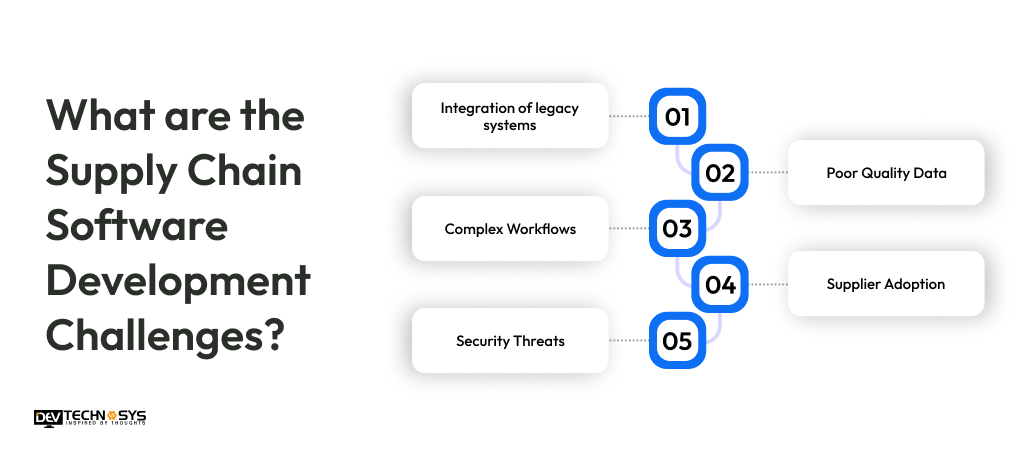
1. Integration of legacy systems
Integrating new SCM software with legacy ERP, warehouse, accounting, and logistics systems can be a challenging task. Older platforms may contain old technology, inconsistent APIs, and fragmented databases that need specialized connectors, middleware, data mapping, and significant testing to ensure accurate information flow.
2. Poor Quality Data
Inaccurate, duplicated, incomplete, or obsolete supply chain data can affect software dependability and reporting accuracy. Businesses might need to cleanse, standardize, validate, deduplicate, and regulate their data before using it to make sure AI models, dashboards, forecasting tools, and workflows are reliable.
3. Complex Workflows
Supply chains consist of related procurement, inventory, warehouse, transportation, supplier, and fulfillment procedures. When workflows differ from one place to another, or by product, department, or jurisdiction, these business rules might be difficult to translate into software. Flexibility in configurations is vital to enabling operational complexity without introducing undue system rigidity.
4. Suppliers Adoption
When suppliers are utilizing digital workflows, SCM software becomes more valuable. But suppliers might have different systems, methods, or technical skills. Intuitive interfaces, APIs, onboarding support, clear permissions, and training can all help with uptake, reduce resistance, and ensure consistent data communication.
5. Security Threats
The SCM solutions manage commercially sensitive information, supplier data, inventory records, financial details and operational information. Vulnerabilities can be created by weak authentication, excessive access privileges, insecure integrations, or poor monitoring. We use strong encryption, RBAC, MFA, secure APIs, audit logging, and continuous security testing to reduce these threats.
Why Choose Dev Technosys for SCM Software Development?
Dev Technosys has 16+ years of expertise, 2,500+ successful projects, and has served 75+ countries, providing custom SCM solutions for the changing demands of supply chains.
Our services include custom SCM, logistics, inventory and transportation management, ERP connections, AI-powered analytics, cloud development and security, and continuous maintenance.
We specialize in scalable structures and company-specific workflows to assist firms in upgrading their supply chain operations with integrations, security, and future expansion in mind.
Conclusion
Creating supply chain software is useful for Middle Eastern organizations in becoming more visible, automating processes, reducing idle time, and making better decisions on complicated logistics chains.
The complete SCM software development process includes careful planning, from determining needs and designing workflow to integrating systems, keeping data safe, and constantly improving performance.
A scalable solution must also conform to local legislation, different border operations, and customer needs. An experienced supply chain software development company can assist in turning those requirements into a trustworthy solution for the future and for long-term revenues.
Frequently Asked Questions
1. What Is The Cost to Develop Supply Chain Management Software in UAE?
In the UAE, supply chain management software development costs between AED 110,000 and AED 550,000 or more. Features, customization, integrations, security, AI capabilities, cloud infrastructure, development team location, and overall system complexity all affect the ultimate budget.
2. How Much Time Does It Take To Create Supply Chain Management Software?
Depending on the size of the project, create supply chain management software usually takes 3 to 6 months or longer. While complex systems requiring AI, various connectors, transportation management, analytics, and business workflows require longer development cycles, basic platforms take less time.
3. Is SCM Software Suitable for UAE Businesses?
Indeed, SCM software may help UAE companies by enhancing supply chain visibility, transportation, inventory, warehousing, and procurement. Business size, sector, operational complexity, trade countries, and particular workflow requirements all affect how appropriate it is.
4. How Secure Should Supply Chain Management Software Be?
To safeguard operational, financial, supplier, and customer data, SCM software should have robust security features including encryption, role-based access control, MFA, secure APIs, audit logging, backups, monitoring, and frequent security testing.
5. Can Arabic And English Be Supported by SCM Software?
It is possible for SCM software to provide multilingual navigation, reports, notifications, and documentation in both Arabic and English. However, the organization’s personnel, client needs, operational areas, and particular business procedures should all be taken into consideration when determining bilingual functionality.