





Key takeaways:
-
- Construction CRM integration connects your CRM with project management, accounting, procurement, and field operations, creating one centralized system instead of scattered, disconnected tools.
- 74% of large construction firms had already adopted CRM-integrated systems by 2025, driven by the need for workflow automation and accurate bid management.
- Integration costs range from $15,000 to $120,000+, depending on the number of systems, customization needs, legacy compatibility, and security requirements.
- Businesses with multiple projects and specialized workflows benefit more from a custom CRM, while smaller organizations with simple operations can succeed with standard platforms.
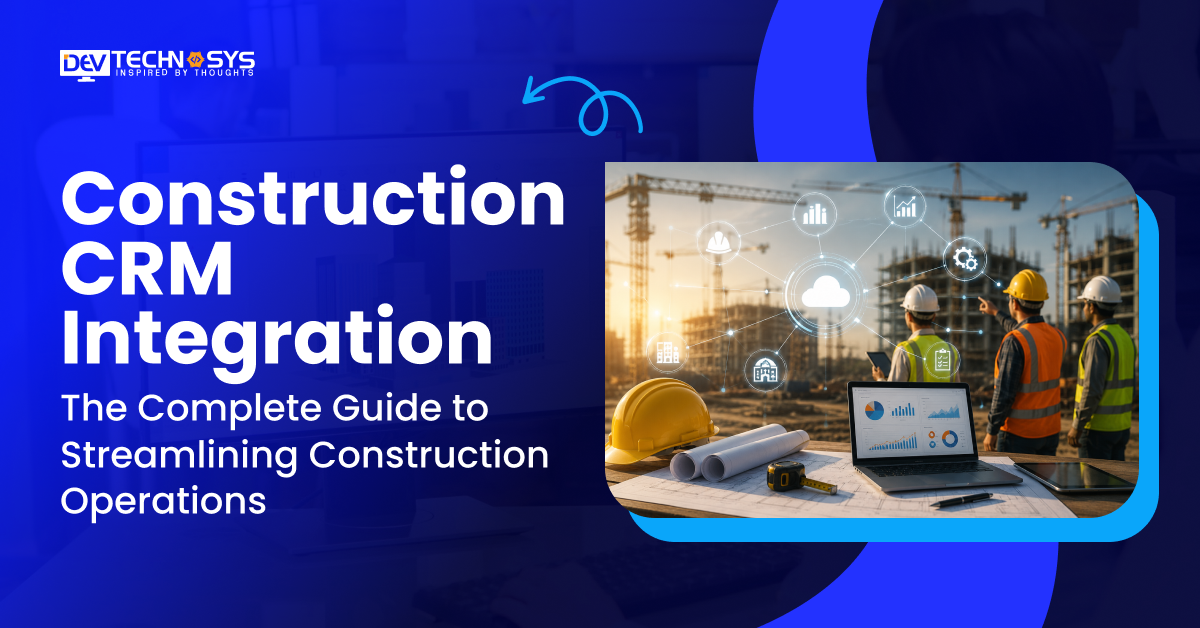
Construction projects are not just about managing schedules and budgets; contractors, developers, and project managers need to handle customer inquiries, project planning, procurement, finance, and field operations. When it is not done properly, teams can face several issues such as duplicate data entry, delayed decisions, and limited visibility across the project lifecycle. This can be easily addressed by construction CRM integration.
According to Business Research Insights, around 74% of large construction firms have already shifted towards CRM-integrated systems in 2025 for construction workflow automation to handle customer communication and bid management accuracy.
But before just going and investing in construction management software, we have to understand what construction CRM integration is. It connects your CRM with every other system that is used by your teams, creating one centralized ecosystem that can store project data, customer information, and operational workflows and keep them in sync.
This guide will help you understand what construction CRM integration is, how much you can integrate, how integrations work, and much more. At the end of the blog, you will be ready to invest in construction customer relationship management software.
Let’s dive into it!
What is Construction CRM Integration?
For construction companies, CRM integration implies connecting the customer relationship management platform with all the other systems that are running in your business. That includes project management, estimating, procurement, accounting, field operations, and document management. Instead of having a single platform for each service, real estate construction CRM helps businesses move the information automatically between different systems.
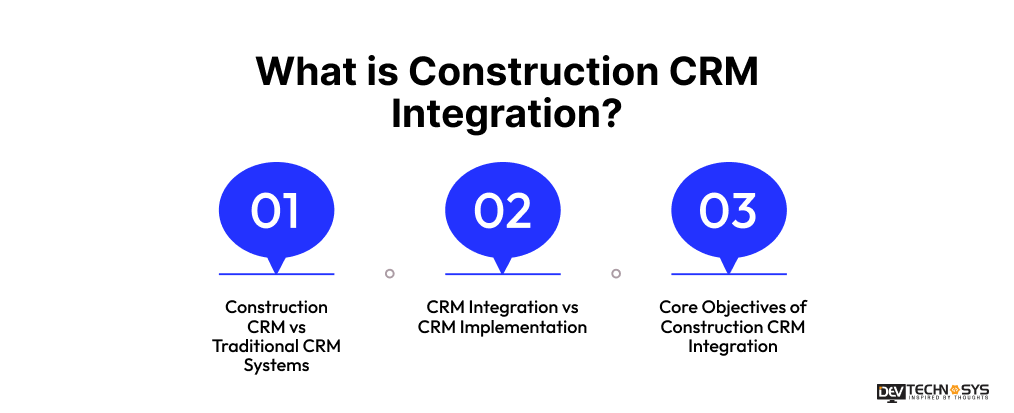
Construction CRM vs Traditional CRM Systems
A traditional CRM for construction companies is built around sales, marketing, and customer support. A construction CRM goes beyond the completion of construction. It operates bid management, lead management, project lifecycle management, contracts, site coordination, client relationship management, and ongoing customer communication throughout the life of a project.
Basis of comparison |
Traditional CRM |
Construction CRM |
| Core focus | Sales pipeline | Project lifecycle |
| What it tracks | Contact records | Projects, contracts, RFIs |
| Primary function | Marketing | Construction workflow automation |
| Team involvement | Customer support | Multi-team collaboration |
CRM Integration vs CRM Implementation
Both of these terms are often used interchangeably, but fundamentally they are different. CRM implementation is the process of installing and configuring the CRM software into your system. CRM integration is the process occurring after implementation. It connects the CRM to your other business systems so that it can automate the construction workflow rather than doing it manually.
Core Objectives of Construction CRM Integration
A builder CRM solution aims to achieve a centralized ecosystem for customer information, project data, automated workflows, real-time collaboration, enhanced project visibility, and smarter decision- making. It takes a customer inquiry, creates a lead, estimates the quotation, and the project team then picks up the approved details from the client, while doing financial and management tasks from a single platform.
Why Construction Companies Need CRM Integration in 2026?
When you run a construction company in 2026, that means you are juggling far more than just schedule and budget. Your sales team, project managers, procurement managers, site engineers, finance teams, and clients all need access to information in real time. And when the information is tangled, it becomes the biggest obstacle in the business.
1. Disconnected Systems Create Operational Bottlenecks
Most construction projects run on a number of individual tools: a CRM, estimation software, accounting, procurement, scheduling, project management, and document management. When there is no communication between these, often teams end up working on different versions of the same information.
2. Manual Processes Slow Down Construction Projects
Let’s take a situation: a lead is approved, and sales updates the CRM; then the estimator manually copies the details into estimation software. Same with the project manager, who re-enters the exact information in PMS, and finance creates another record for billing; this increases the manual labor manyfold while increasing human error and eating away at productivity.
3. Poor Customer Communication and Limited Project Visibility
All of these disconnected systems and communications affect the client also. The client will be receiving inconsistent updates depending upon the last time they had a conversation. Site engineers and project managers are often kept in the dark with the latest project information since it’s sitting in someone else’s spreadsheet.
4. Before vs After Construction CRM Integration
Basis of comparison |
Without CRM integration |
With construction CRM integration |
| Data updates | Manual updates | Automated workflows |
| Information storage | Multiple databases | Centralized information |
| Client communication | Delayed communication | Real-time collaboration |
| Record keeping | Duplicate records | Single source of truth |
| Reporting | Limited reporting | Live dashboards |
| Decision-making | Reactive decisions | Data-driven planning |
Industry Insight
According to McKinsey & Company, AI and automation can transform construction workflows, but success depends on connected, high-quality data across engineering, project management, procurement, and field operations.
What Can You Integrate With a Construction CRM?
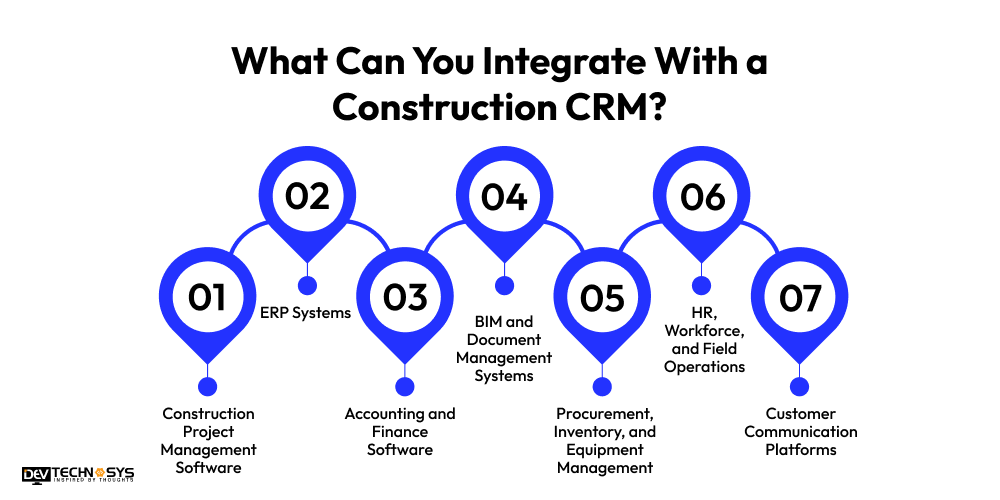
A contractor crm software becomes genuinely useful once it’s connected to the other systems your teams already rely on. Here’s what that typically looks like in practice.
1. Construction Project Management Software
When you integrate project management software with your CRM to synchronize schedules, milestones, job assignments, project status, and resource allocation with customer and sales information. The result? Everyone from sales to site teams is working off the same current project data, rather than exporting old data.
2. ERP Systems
The integration of a CRM with an ERP creates an instant exchange of budgets, procurement data, vendor records, purchase orders, and financial information between departments. This gives the business one source of financial truth, rather than having disparate numbers living in various systems.
3. Accounting and Finance Software
When you link accounting software, invoices, payments, customer billing, expenditure monitoring, and tax information transfer automatically from the CRM. Finance teams don’t need to recreate client records that already exist elsewhere in the company from scratch.
4. BIM and Document Management Systems
BIM integration combines client information with drawings, revisions, RFIs, contracts, and engineering documents. That means project teams are all working from the same version of every document, rather than chasing the latest file over email.
5. Procurement, Inventory, and Equipment Management
By combining procurement and inventory systems, suppliers, buy requests, and equipment availability are automatically updated as projects progress, so procurement teams work with current project information instead of obsolete demands.
6. HR, Workforce, and Field Operations
Linking HR and workforce systems connects workforce scheduling, attendance, subcontractor records, and field team data back to the CRM. Here, a cloud CRM helps to better coordinate office staff and mobile field teams working on site.
7. Customer Communication Platforms
Email, SMS, alerts, and customer portals automate customer updates when project milestones are reached so you don’t have to manually follow up, and customers are kept in the loop.
Most of these interfaces rely on REST API integration, secure CRM APIs, and webhooks for real-time data sync, which we’ll explore in the next section.
8. Construction CRM Ecosystem
For companies with very specific workflows, these integrations often beat off-the-shelf plugins. Partnering with a construction software development company to build custom integrations between the CRM and operational systems helps bridge the gaps that off-the-shelf connectors do not address.
How Does Construction CRM Integration Work?
So you know which systems should be joined together; the next question is: how do they actually talk to each other behind the scenes? The good news is that none of this requires your team to understand coding, just to comprehend the moving elements well enough to make informed judgments.
1. APIs: The Foundation of Modern CRM Integration
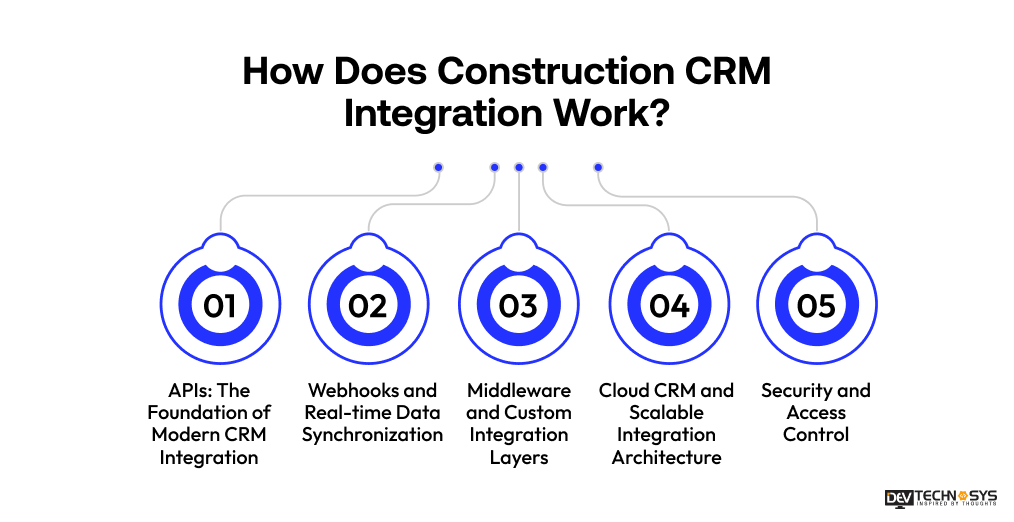
A CRM API is a secure communication bridge that allows the CRM to talk to other business applications. With REST API connectivity, customer details, project information, invoices, and schedules seamlessly flow between platforms as changes happen, rather than exporting spreadsheets manually or changing several systems by hand.
2. Webhooks and Real-time Data Synchronization
Webhooks send alerts to connected systems immediately after a major event occurs instead of waiting for a scheduled export. A lead is accepted, a project gets launched, procurement gets notified of new material requirements, finance gets updated for billing, the customer gets confirmation all through real-time data sync instead of someone manually passing the update along.
3. Middleware and Custom Integration Layers
There are a lot of construction companies with software that just doesn’t talk to each other directly. Middleware is a translation layer between the two, allowing a CRM to send data to an ERP, accounting platform, BIM system, or HR software even if those systems were not initially designed to connect. Sometimes an ETL pipeline is used to transfer data in batches where live sync isn’t possible for legacy systems.
4. Cloud CRM and Scalable Integration Architecture
This kind of connectivity is much easier with a cloud CRM, as it is not tied to any one office location. Field engineers, site supervisors, finance teams, and management all have synced information available wherever they work, on-site or off-site.
5. Security and Access Control
None of this works if the wrong people view the incorrect data. A project manager should not see payroll. A subcontractor should not be able to see the financial reports. A customer should only see project updates that are relevant to them. This is achieved by identity and access management (IAM), multi-factor authentication (MFA), and role-based permissions and is supported by data encryption and, ideally, end-to-end encryption.
Construction software development solutions can produce the bespoke middleware and API layers to connect systems that off-the-shelf integrations can’t manage for construction businesses whose operations don’t fit standard connectors.
Step-By-Step Construction CRM Integration Process in 2026
A successful construction CRM integration depends far more on planning than on the technical build itself. Here’s what that process typically looks like from discovery through deployment.
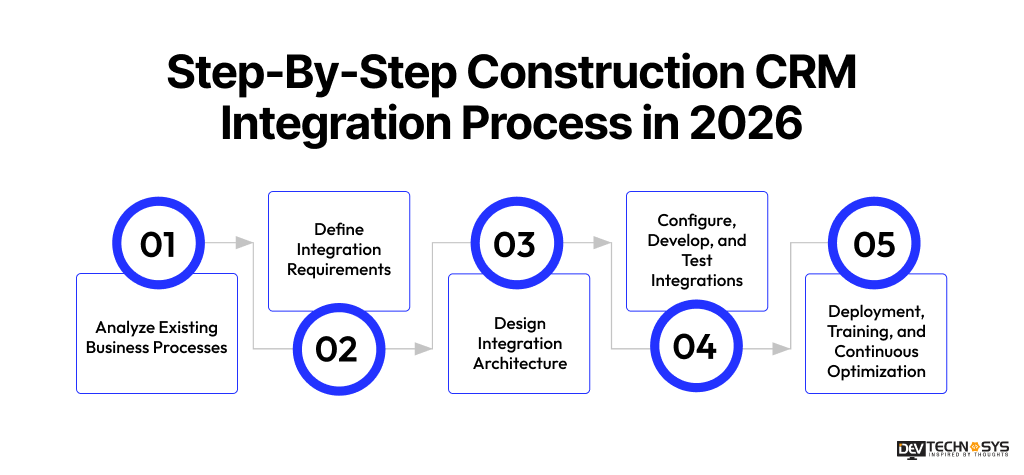
Step 1: Analyze Existing Business Processes
Before any development can begin, it’s crucial to understand how the business works now: existing procedures, current software, how departments interact, where data lives, and what the organization is aiming to achieve. Integration strategy should be aligned with genuine business processes and not pressure the organization into a standard workflow, because every construction company works in a different way.
Step 2: Define Integration Requirements
Teams then determine which systems need to connect, what data needs to transfer between them, whose departments are involved, and where automation may realistically help. This is often in the form of a flow: CRM, ERP, accounting, project management, procurement, and document management, each sharing particular pieces of information with the others. Here we are still in the planning phase, not the technicalities of how systems will really talk to each other.
Step 3: Design Integration Architecture
Once the requirements are identified, the architects will specify the required CRM APIs, integration methods, middleware, security measures, and scalability for the strategy. A good design here means less effort later on to maintain the integration and offers the firm room to develop without having to rebuild the integration.
Step 4: Configure, Develop, and Test Integrations
This phase goes through configuration, custom development, testing, user acceptance testing (UAT), and performance validation. Testing usually verifies data correctness, verifies workflows, examines authorization settings, and assesses system performance in real-life situations, identifying problems before they affect daily operations. In cases when legacy systems are involved, an ETL pipeline may also be utilized to move data into the new integrated environment.
Step 5: Deployment, Training, and Continuous Optimization
Deployment is just the beginning. Organizations need to train users, track uptake, analyze results, tweak workflows, add new integrations over time, and optimize dashboards as real usage indicates what is and isn’t working. This continuous phase is frequently more important than the technical development. It is what differentiates integrations that give permanent construction process automation and construction business intelligence from those that silently fade away.
Across every step, this kind of digital transformation in construction depends as much on stakeholder involvement, data quality, and user adoption as it does on the technology itself. Understanding the broader construction management software benefits also helps organizations prioritize integrations that deliver measurable operational improvements.
Industry Insight
According to Deloitte’s 2026 Workflow Automation Outlook, modern CRM platforms create the most value when they connect sales, customer service, and operational data in real time, enabling automated workflows and faster decision-making.
UAE Compliance Considerations for Construction CRM Integration
CRM integration for construction companies in UAE is not just about the systems integration but also about working with the realities of the region’s regulations and operations. A lot of construction businesses operating in Dubai have CRM procedures in place to record approvals, milestone records, and project paperwork in a consolidated system.
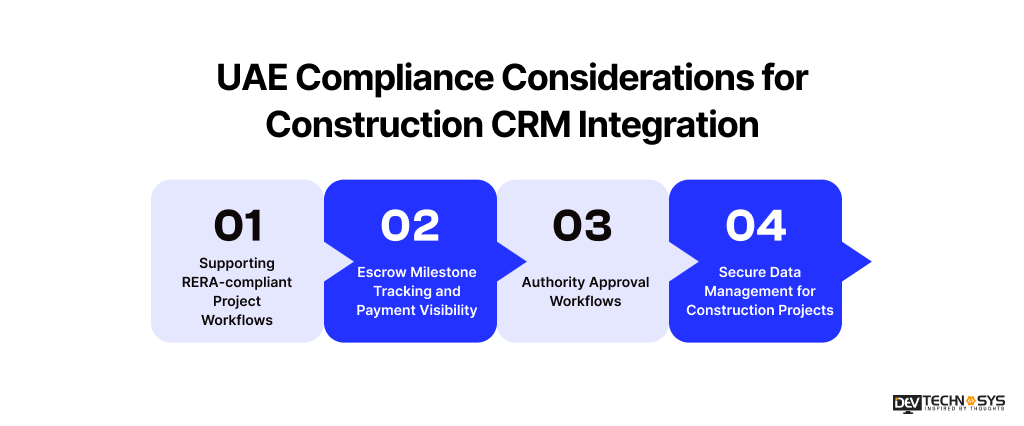
1. Supporting RERA-compliant Project Workflows
Many Dubai real estate and construction projects are RERA-related activities. A construction CRM can assist companies in organizing project information systematically to enable operational processes relevant to RERA, such as customer records, contracts, project milestones, approval history, and document tracking, all in one place instead of being distributed across teams.
2. Escrow Milestone Tracking and Payment Visibility
Construction payments are often made on a milestone basis. By integrating the CRM with accounting, ERP, and project management systems, everyone has real-time visibility into milestone completion, payment status, and approval workflows, in contrast to waiting for manual updates from other departments.
3. Authority Approval Workflows
Projects require approvals from many authorities, including Dubai Municipality, Trakhees, or Abu Dhabi DMT. By integrating with your CRM, inspection requests, approval records, permit papers, and relevant communication history can be organized so that nothing is lost between departments throughout the approval process.
4. Secure Data Management for Construction Projects
Construction projects contain sensitive contracts, financials, drawings, and customer data, so CRM integration should facilitate data encryption, end-to-end encryption, identity and access management (IAM), and multi-factor authentication (MFA). Organizations that service global clients may also be striving to meet other standards such as GDPR compliance and CCPA compliance. Enterprise implementations often strive for ISO 27001 or SOC 2 compliance as part of a larger data governance plan.
Many UAE organizations adopt construction management software development to customize CRM workflows around regional approval processes, documentation requirements, and multi-party project coordination.
What is the Cost of Construction CRM Integration?
Construction CRM integration costs vary widely depending on scope and complexity. The average cost to build a construction CRM integration typically ranges from $15,000 to $120,000. The figures below are illustrative estimates only; actual custom software development costs depend on your specific systems, customization needs, and project requirements.
Integration complexity |
Estimated cost (USD) |
Typical timeline |
| Basic CRM integration (2-3 systems) | $15,000-$40,000 | 4-8 weeks |
| Mid-level integration (ERP, CRM, accounting, PM) | $40,000-$80,000 | 2-4 months |
| Enterprise CRM ecosystem | $80,000-$120,000+ | 4-8 months |
Factors that influence integration costs.
1. Number of Systems to Integrate
Each additional platform, whether it’s an ERP, accounting tool, or document management system, brings its own data structures and workflows that need to be mapped and connected, so cost scales with how many systems are involved.
2. Legacy Software Compatibility
Older systems without modern API availability often can’t connect directly, requiring custom middleware to bridge the gap. This adds development time and cost compared to integrating with modern, API-ready platforms.
3. Workflow Customization
How closely the integration needs to match your specific business processes, rather than a generic template, has a direct impact on cost. Highly tailored workflows take more time to design and build than standard configurations.
4. Data Migration Complexity
Moving years of historical records, contracts, and project data into a newly integrated environment adds effort, particularly when that data is inconsistent or spread across multiple legacy systems.
5. Security and Compliance Requirements
Implementing data encryption, access controls, and alignment with standards such as ISO 27001 or GDPR compliance adds engineering effort, especially for enterprises handling sensitive financial or client data.
6. Third-Party Licensing
Some integrations depend on paid APIs or third-party platform licenses, which factor into the overall project cost beyond development time alone.
7. Reporting and Analytics
Building custom dashboards and business intelligence reporting on top of integrated data adds scope, particularly when stakeholders need different views for finance, operations, and management.
Quote
“AI is poised to rewire the architecture, engineering, and construction sector. Firms that move quickly to reimagine workflows, improve data use, and automate work sites will thrive.” — McKinsey & Company
Construction Project Lifecycle With a Custom Integrated CRM
The real value of construction CRM integration becomes clear when you follow a single project from first contact to final handover. Here’s how a connected CRM supports each stage along the way.
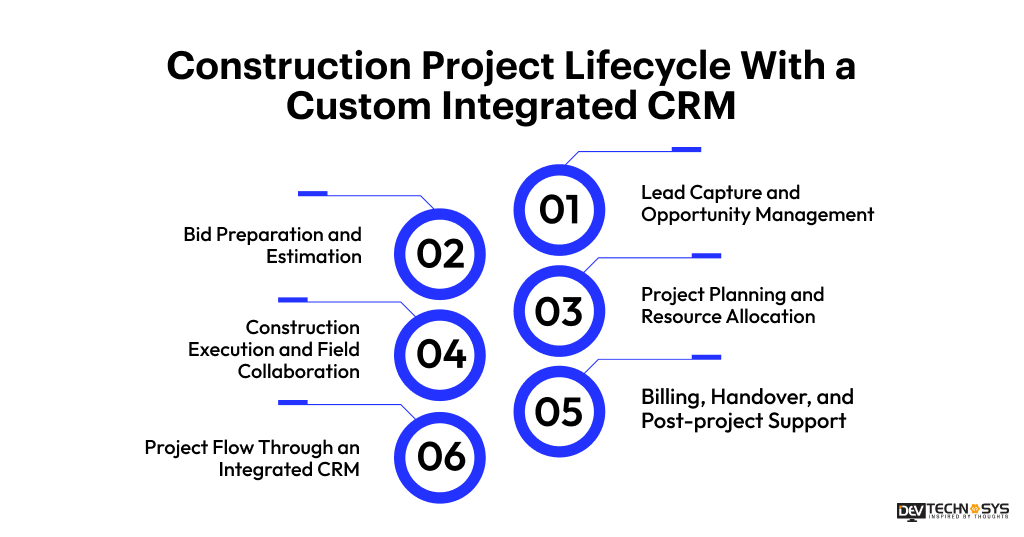
1. Lead Capture and Opportunity Management
A customer query comes into the CRM, and sales constructs an opportunity around that. Lead management is immediate, and client information is accessible to any relevant team from this point forward, instead of remaining in someone’s email.
2. Bid Preparation and Estimation
The estimators get the specifics of the lead captured in the CRM without requesting sales to resend them. They then work out the technical needs and financial estimations and build and transmit a proposal using bid management software. With integration, you don’t have to enter all this data twice.
3. Project Planning and Resource Allocation
The CRM will start the project creation if the proposal is approved. Project managers go into scheduling, team assignments, procurement planning, and resource allocation, all working from the same construction project management data that started with the original lead.
4. Construction Execution and Field Collaboration
As construction begins, site engineers send progress updates, daily reports, material requests, and issue tracking directly into the system. Real-time data sync keeps office staff and field teams synchronized, so a delay or material shortfall on site is apparent to procurement and management as soon as it’s reported.
5. Billing, Handover, and Post-project Support
Finance deals with milestone billing as milestones are achieved. The project advances to final documentation, warranty records, and handover. From this point, customer assistance and long-term client relationship management continue, and the CRM carries the project profitability history and client details ahead into future maintenance work and repeat business opportunities.
6. Project Flow Through an Integrated CRM

For construction companies with highly specialized workflows, construction software development services can customize how these lifecycle stages connect, tailoring the CRM ecosystem to project-specific requirements rather than a generic template.
While an integrated CRM streamlines the entire project lifecycle, construction companies operating in the UAE must also ensure their systems support local regulatory and operational requirements.
Conclusion
Construction CRM integration links the CRM to project management, finance, procurement, and field operations. It offers construction organizations greater insight, fewer manual processes, enhanced customer communication, and quicker and better decision-making across all projects.
Every construction business runs differently, so the right integration strategy needs to be scalable, secure, and flexible enough to support future expansion and ongoing digital transformation in construction, rather than a fixed setup that gets outgrown within a few years.
Businesses looking to do this kind of integration have the advantage of a development partner that understands construction procedures and unique integrations. Partnering with a real estate app development company can assist construction businesses that are entering the property development space in building integrated digital ecosystems across construction and real estate activities. Dev Technosys offers safe, scalable, and unique CRM integration solutions geared to how every business really functions.
FAQs
1. What is Construction CRM Integration?
Integration of construction CRMs involves connecting a construction customer relationship management platform to other business systems, such as project management, accounting, procurement and document management, so that information flows seamlessly and doesn’t live in disparate, disconnected tools.
2. Which Software Can Be Integrated With a Construction CRM?
Most construction CRMs are able to integrate with ERP systems, accounting software, BIM platforms, project management tools, procurement systems, and document management solutions, providing a unified environment for project and customer data to be kept aligned across departments.
3. How Long Does Construction CRM Integration Take?
Timelines are based on the number of systems, extent of customization, data transfer needs, and legacy program compatibility. Small projects can be done in 1 to 2 months while enterprise-level integrations can take 4 to 8 months to complete.
4. How Much Does Construction CRM Integration Cost?
Pricing is based on the complexity of integration, the level of customization needed, how many systems need to be connected, and security needs. Basic integrations cost in the low hundreds, but large ecosystems that combine a number of platforms are much more costly.
5. Can a Construction CRM Integrate With Legacy Software?
Yes, generally. Legacy systems can typically be integrated via APIs, middleware, or ETL processes, but the optimal approach will rely on the support for data sharing and automation in the existing software.
6. Is Construction CRM Integration Secure?
Security is the heart of any integration project. Trusted solutions secure contracts, financial records, and client data through data encryption, identity and access management (IAM), multi-factor authentication (MFA), and role-based access controls.
7. Why is CRM Integration Important for Construction Companies?
Integrating a CRM with other business tools allows construction organizations more visibility into projects, faster contact with customers, less manual data entry, better collaboration across teams, and more informed, data-driven decision-making throughout the project lifecycle.