





Key Takeaways
Overall Cost Range
Smart contract development charges in 2026-2027 typically range from $30,000 to $1,50,000+, based on complexity, features, and security needs.
Cost by Complexity:
- Basic: $30,000 – $50,000
- Mid-Level: $50,000 – $90,000
- Advanced: $90,000 – $1,50,000+
Key Cost Drivers
Features, blockchain choice, security audits, integrations, compliance, and developer expertise.
Key Cost Drivers
Typically 4 weeks to 7+ months, depending on project complexity.
Blockchain Impact on Cost
Ethereum is the most expensive, while Polygon and BNB Chain are more cost-efficient.
Additional Costs
Audits, maintenance, infrastructure, and upgrades can add 15–25% yearly ongoing costs.
Smart contracts are transforming the way businesses execute agreements, automate transactions, and build decentralized applications. From DeFi platforms and NFT marketplaces to enterprise automation systems, organizations are increasingly leveraging blockchain-powered smart contracts to improve efficiency, security, and transparency.
As adoption continues to grow, one of the most common questions businesses ask is: How much does smart contract development cost in 2026-2027? The cost of smart contract development typically ranges from $30,000 to $1,50,000+, depending on project complexity, blockchain platform, features, security requirements, and audit needs.
Whether you’re planning a basic token contract or a large-scale decentralized ecosystem, understanding the cost structure is essential for making informed investment decisions. In this guide, we break down everything you need to know about smart contract development expenses in 2026, helping you plan your budget, avoid unexpected expenses, and build a secure, scalable blockchain solution.
What Is Smart Contract Development and How Does It Work?
Smart contract development refers to the process of designing, coding, and deploying self-executing digital agreements on blockchain networks. These contracts automatically enforce rules when predefined conditions are met, eliminating intermediaries. They are widely used in DeFi, NFTs, and enterprise automation, ensuring transparency, security, and efficiency across decentralized ecosystems while reducing operational costs and manual intervention in traditional business processes.
Have a look at the Smart Contract Workflow:
- Define business logic and contract requirements based on use case and blockchain ecosystem
- Select an appropriate blockchain platform, such as Ethereum, Solana, Polygon, or an enterprise-grade network
- Write smart contract code using languages like Solidity, Rust, or Vyper
- Conduct internal testing to ensure logic accuracy and eliminate functional or security issues
- Perform third-party security audits to identify vulnerabilities and ensure production readiness
- Deploy the smart contract on the blockchain network after final verification and optimization steps
- Monitor performance continuously and implement upgrades or patches if required
How Much Does it Cost to Build a Smart Contract in 2026-2027?
Smart contract development cost estimate in 2026-2027 typically ranges from $30,000 to $1,50,000, depending on project complexity, blockchain selection, and security requirements. Basic contracts are more affordable than advanced decentralized systems like DeFi protocols or multi-chain applications. They require higher investment due to complex architecture, auditing needs, integrations, and long-term scalability considerations.
We will explain the cost structure through a dedicated smart contract development cost breakdown table:
| Complexity Level | Description | Estimated Cost |
| Basic Smart Contracts | Token creation, escrow, simple automation | $30,000 – $50,000 |
| Mid-Level Smart Contracts | NFTs, staking, DAO governance, integrations | $50,000 – $90,000 |
| Advanced Smart Contracts | DeFi systems, multi-chain apps, and high security | $90,000 – $1,50,000+ |
Why Feature Selection Has the Biggest Impact on Development Cost?
Feature selection significantly impacts the cost to develop a smart contract. It is because each feature adds complexity, coding effort, security risks, and testing requirements. Advanced functionalities like staking, DAO governance, or cross-chain support require deeper architecture design, increasing both development time and audit complexity. It can directly influence the average cost of smart contract development.
Core Features
| Feature | Purpose | Estimated Cost Range |
| Token Creation (ERC20 / ERC721) | Enables creation and management of digital assets or utility tokens | $2,500 – $6,500 |
| Wallet Integration | Allows secure user authentication and blockchain transactions | $3,000 – $7,500 |
| Escrow Mechanism | Ensures conditional and secure fund transfers between parties | $3,500 – $7,800 |
| Payment Distribution Logic | Automates rule-based payouts across users or stakeholders | $2,800 – $6,200 |
| Voting System (Basic DAO) | Enables decentralized governance participation and decision-making | $3,200 – $7,000 |
| User Authentication Module | Provides blockchain-based identity verification and access control | $2,500 – $6,000 |
| Transaction Logging System | Ensures transparent and immutable on-chain activity records | $2,000 – $5,500 |
| Reward Distribution System | Automates staking rewards or loyalty incentive distribution | $3,000 – $7,200 |
| Admin Control Panel Logic | Enables contract configuration and monitoring functionality | $3,500 – $8,000 |
| API Integration Layer | Connects smart contracts with external applications and services | $3,800 – $8,000 |
Advanced Features
| Specific Feature | Purpose | Estimated Cost Range |
| NFT Marketplace System | Enables minting, listing, trading, and auctioning NFTs | $6,000 – $13,500 |
| Staking Mechanism | Manages liquidity staking and automated reward distribution | $5,500 – $12,500 |
| DAO Governance Framework | Fully decentralized voting and proposal management system | $7,000 – $14,000 |
| Cross-Chain Interoperability | Enables interaction between multiple blockchain networks | $8,000 – $14,000 |
| Oracle Integration | Connects real-world data to smart contract execution logic | $6,500 – $13,000 |
| DeFi Lending & Borrowing Protocol | Manages collateral, loans, and automated interest systems | $9,000 – $14,000 |
| Upgradeable Contract Architecture | Allows post-deployment contract upgrades and version control | $7,500 – $14,000 |
| Layer-2 Scaling Integration | Reduces gas fees and improves transaction throughput | $6,000 – $12,800 |
| Multi-Signature Wallet System | Enhances security with multi-approval fund access control | $5,000 – $11,500 |
| Yield Farming Automation | Optimizes liquidity rewards and DeFi yield strategies | $7,000 – $14,000 |
How Blockchain Technology Choices Affect the Cost to Build a Smart Contract?
Blockchain selection plays a critical role in determining smart contract development pricing due to differences in programming languages, transaction fees, scalability, and ecosystem maturity. Public blockchains like Ethereum are more expensive due to high demand. While alternative chains offer cost advantages depending on project requirements and technical complexity.
| Blockchain / Tech | Cost Range | Key Advantage |
| Ethereum | $10,000 – $15,000 | High security, strong ecosystem |
| Solana | $8,000 – $13,000 | High speed, low transaction fees |
| Polygon | $7,000 – $12,000 | Low cost, Ethereum compatibility |
| BNB Chain | $6,000 – $11,000 | Affordable, scalable infrastructure |
| Avalanche | $8,000 – $13,000 | Fast finality, enterprise adoption |
| Hyperledger Fabric | $9,000 – $14,000 | Private enterprise blockchain |
| Polkadot | $9,000 – $15,000 | Cross-chain interoperability |
| Cardano | $7,000 – $12,000 | Research-driven security model |
| Tron | $6,000 – $10,000 | Low-cost transactions |
| Cosmos | $8,000 – $13,000 | Modular blockchain ecosystem |
Industry Insight: OpenZeppelin, a leading security company, emphasizes the importance of using audited libraries and frameworks. Reusing proven components can reduce development and audit costs by 15–30% while improving overall contract security.
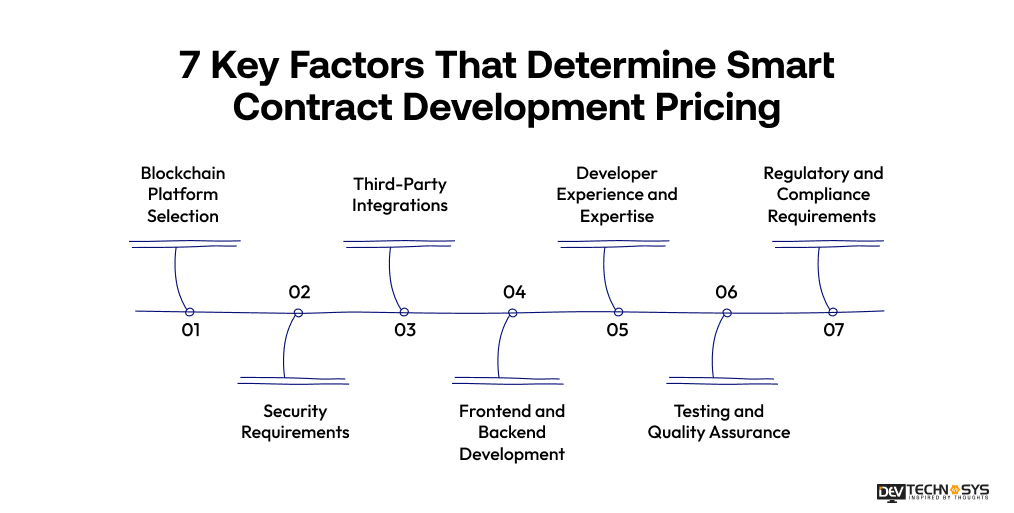
7 Key Factors That Determine Smart Contract Development Pricing
Smart contract development budget is influenced by multiple technical, security, and operational factors that directly impact project complexity and cost structure. Smart contract development cost factors add a unique development effort, testing needs, and infrastructure demands. It is essential for businesses to understand these cost factors in smart contract development.
1. Blockchain Platform Selection
Blockchain platform selection determines programming language, scalability, transaction cost, and overall system architecture. Ethereum projects are generally more expensive due to gas optimization requirements and network congestion. While the alternative blockchain development cost is less, it can introduce limitations in ecosystem maturity, developer availability, and security tooling.
| Platform Type | Estimated Cost |
| Basic Blockchain Implementation (Polygon, Tron) | $10,000 – $15,000 |
| Mid-Tier Blockchain Implementation (BNB Chain, Avalanche, Cardano) | $15,000 – $22,000 |
| Enterprise-Grade Blockchain Implementation (Ethereum, Hyperledger, Polkadot) | $22,000 – $30,000 |

2. Security Requirements
Higher security requirements significantly increase the smart contract development cost estimate. It is due to advanced encryption techniques, penetration testing, and multi-layer security audits. Financial applications, DeFi protocols, and enterprise systems require rigorous vulnerability checks, formal verification, and continuous monitoring, all of which increase development timelines, audit expenses, and overall engineering effort required for safe deployment.
| Security Level | Estimated Cost |
| Basic Security Testing & Code Review | $5,000 – $8,000 |
| Advanced Security Assessment & Penetration Testing | $8,000 – $15,000 |
| Enterprise Security Audit & Threat Modeling | $15,000 – $20,000 |
3. Third-Party Integrations
Third-party integrations with APIs, wallets, or blockchain oracles increase system complexity and the cost to create a Smart Contract. It is due to dependency management and additional testing requirements. Each integration introduces external risks, synchronization challenges, and compatibility validation needs, requiring developers to spend extra time on debugging, secure data handling, and ensuring seamless communication between systems.
| Integration Type | Estimated Cost |
| Wallet & Payment Gateway Integrations | $4,000 – $6,000 |
| Oracle & Data Feed Integrations | $6,000 – $9,000 |
| Multi-Service & Cross-Platform Integrations | $9,000 – $12,000 |
4. Frontend and Backend Development
Smart contract development services often require supporting frontend dashboards and backend infrastructure to enable user interaction and system management. Building APIs, admin panels, and data visualization layers adds significant development effort, as full-stack expertise is required alongside blockchain engineering, increasing both project scope and overall cost to develop a Smart Contract.
| Development Scope | Estimated Cost |
| Basic User Interface & Backend APIs | $15,000 – $20,000 |
| Interactive Dashboard & Advanced Backend Logic | $20,000 – $25,000 |
| Enterprise-Grade Full-Stack Development | $25,000 – $30,000 |
5. Developer Experience and Expertise
Developer experience plays a major role in determining the cost to make a smart contract. Senior blockchain developers charge higher rates but reduce risks, bugs, and rework. If you hire blockchain developer with less experience, it may lower initial costs. However, it often leads to inefficiencies, security vulnerabilities, and higher long-term maintenance and audit expenses.
| Developer Level | Estimated Cost |
| Junior Blockchain Developers | $10,000 – $14,000 |
| Mid-Level Blockchain Specialists | $14,000 – $18,000 |
| Senior Blockchain Architects & Experts | $18,000 – $22,000 |
6. Testing and Quality Assurance
Comprehensive testing and quality assurance are essential for ensuring smart contracts function correctly under all conditions. This includes unit testing, integration testing, stress testing, and simulation of attack scenarios. These processes increase the cost to create a smart contract but are critical to preventing financial losses, vulnerabilities, and post-deployment failures.
| Testing Scope | Estimated Cost |
| Functional Testing & Bug Fixing | $4,000 – $7,000 |
| Performance & Security Testing | $7,000 – $11,000 |
| Comprehensive QA & Audit Preparation | $11,000 – $15,000 |
7. Regulatory and Compliance Requirements
Regulatory and compliance requirements significantly influence the cost to create a smart contract. It is especially for financial and enterprise applications. Compliance with frameworks such as KYC, AML, and regional blockchain laws requires legal consultation, system modifications, and continuous updates, increasing both development complexity and long-term operational expenses for globally deployed applications.
| Compliance Requirement | Estimated Cost |
| Basic Regulatory Assessment | $5,000 – $8,000 |
| KYC, AML & Data Protection Compliance | $8,000 – $12,000 |
| Enterprise Compliance & Legal Integration | $12,000 – $15,000 |

Ethereum vs Solana vs Polygon: Smart Contract Development Cost Comparison
Smart contract development solution cost varies significantly across blockchain platforms due to differences in architecture, programming language, scalability, and ecosystem maturity. Ethereum remains the most widely adopted but also the most expensive due to high gas fees and complex optimization requirements.
Solana offers high-speed and low-cost transactions but requires Rust-based development expertise, which can increase initial development effort. Polygon provides a cost-effective alternative with Ethereum compatibility, making it popular for scalable applications.
Understanding these differences is crucial for businesses because platform selection directly impacts both upfront development cost and long-term operational expenses.
| Blockchain | Development Cost | Speed | Scalability | Best Use Case |
| Ethereum | $10,000 – $15,000 | Medium | High | DeFi, NFTs |
| Solana | $8,000 – $13,000 | Very High | High | High-frequency apps |
| Polygon | $7,000 – $12,000 | High | High | Scalable dApps |
How Much Does a Smart Contract Security Audit Cost?
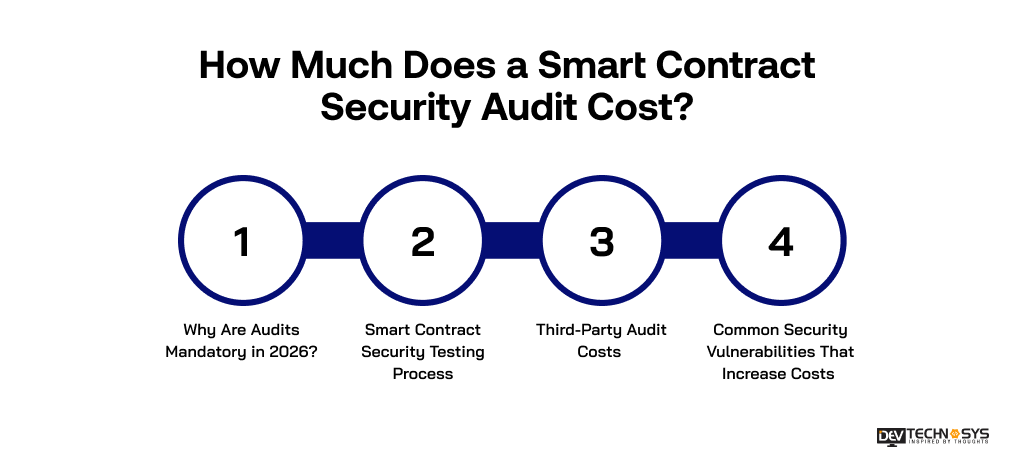
Smart contract security audits are essential in 2026-2027 and cost somewhere between $5,000 and $30,000. Such blockchain applications handle high-value digital assets and irreversible transactions. A security audit identifies vulnerabilities, logic errors, and attack vectors before deployment. Costs vary depending on contract complexity, code volume, and audit depth, making it a critical component of the overall smart contract development budget.
1. Why Audits Are Mandatory in 2026?
Smart contracts are immutable once deployed, meaning vulnerabilities cannot be patched easily. In 2026, increasing DeFi hacks and regulatory pressure make audits mandatory to ensure financial security, prevent exploit risks, and maintain user trust across blockchain ecosystems.
2. Smart Contract Security Testing Process
The security testing process involves multiple stages, including code review, automated vulnerability scanning, manual penetration testing, and simulation of attack scenarios. Auditors analyze logic flaws, reentrancy risks, and gas optimization issues to ensure the contract performs securely under real-world blockchain conditions.
3. Third-Party Audit Costs
Third-party audit firms charge based on contract complexity, code size, and turnaround time. Premium audit firms with strong reputations charge higher fees but provide deeper analysis and insurance-level trust. Costs increase significantly for DeFi protocols and cross-chain applications due to higher security risks.
4. Common Security Vulnerabilities That Increase Costs
Common vulnerabilities include reentrancy attacks, integer overflow, unauthorized access, oracle manipulation, and gas limit issues. Each vulnerability increases remediation time and audit complexity, leading to higher development and post-audit correction costs, especially in financial or DeFi-based smart contract systems.
Smart Contract Development Timeline and Cost Estimation
Smart contract development timelines in 2026-2027 typically depend on complexity, security requirements, and blockchain selection. Costs increase with extended timelines due to deeper testing, multiple audit cycles, and integration requirements, especially for enterprise-grade decentralized applications.
| Development Phase | Development Process | Estimated Timeline |
| Project Discovery | Requirement gathering, use-case analysis, and blockchain selection | 1–2 Weeks |
| Architecture Design | Smart contract structure planning, system design, and tech stack finalization | 2–3 Weeks |
| Smart Contract Development | Coding of core logic using Solidity, Rust, or other blockchain languages | 3–8 Weeks |
| API & System Integrations | Wallets, oracles, DeFi protocols, and third-party blockchain integrations | 2–4 Weeks |
| Security & Audit Preparation | Internal testing, vulnerability checks, and audit readiness setup | 2–4 Weeks |
| Testing & Quality Assurance | Functional testing, gas optimization, stress testing, and bug fixing | 2–4 Weeks |
| Deployment & Post-Launch Support | Mainnet deployment, monitoring, and upgrade management | 1 Week |
Industry Insight: We have worked on over 45 projects of blockchain and smart contract development. We have analyzed that it takes 4 to 7+ months for smart contract development.
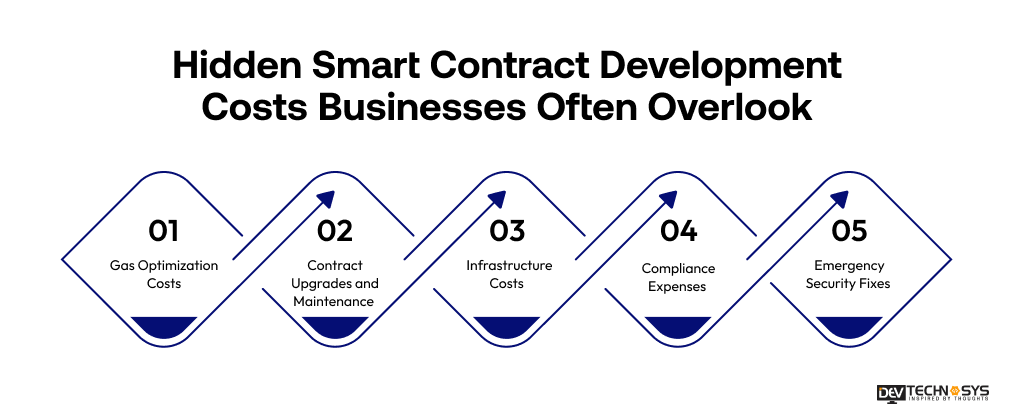
Hidden Smart Contract Development Costs Businesses Often Overlook
Hidden costs in smart contract development often appear after deployment and significantly impact the total budget. These expenses are usually underestimated during planning but include operational, compliance, infrastructure, and security-related costs. Ignoring them can increase overall project expenditure by 15–45%, depending on system complexity and usage scale.
1. Gas Optimization Costs
Gas optimization costs arise because inefficient smart contracts consume more blockchain computation resources. Poor optimization can increase long-term operational expenses by 10–25%, especially on Ethereum-based networks. Developers must invest additional time in efficient coding, testing execution paths, and minimizing redundant logic to reduce transaction fees and improve scalability.
2. Contract Upgrades and Maintenance
Even though smart contracts are immutable, businesses often require upgrades using proxy patterns or redeployment strategies. Ongoing maintenance increases long-term project costs by 15–20% annually, covering bug fixes, feature enhancements, performance improvements, and monitoring support required for evolving blockchain applications.
3. Infrastructure Costs
Infrastructure costs include blockchain node hosting, APIs, cloud storage, and off-chain systems. As user traffic grows, scaling requirements increase operational expenses by 10–18%, depending on data load and transaction volume. These costs are essential for ensuring uptime, performance stability, and smooth blockchain application execution.
4. Compliance Expenses
Compliance expenses include legal requirements such as KYC, AML, GDPR, and regional blockchain regulations. Integrating compliance systems and legal frameworks increases development costs by 12–22%, particularly in financial and enterprise-grade applications where regulatory adherence is mandatory for deployment and market operations.
5. Emergency Security Fixes
Emergency security fixes are required when vulnerabilities are discovered after deployment. Because smart contracts are difficult to modify, urgent patches or migrations are often needed. These incidents can increase total project costs by 20–30%, due to emergency development, audits, downtime risks, and potential financial exposure.
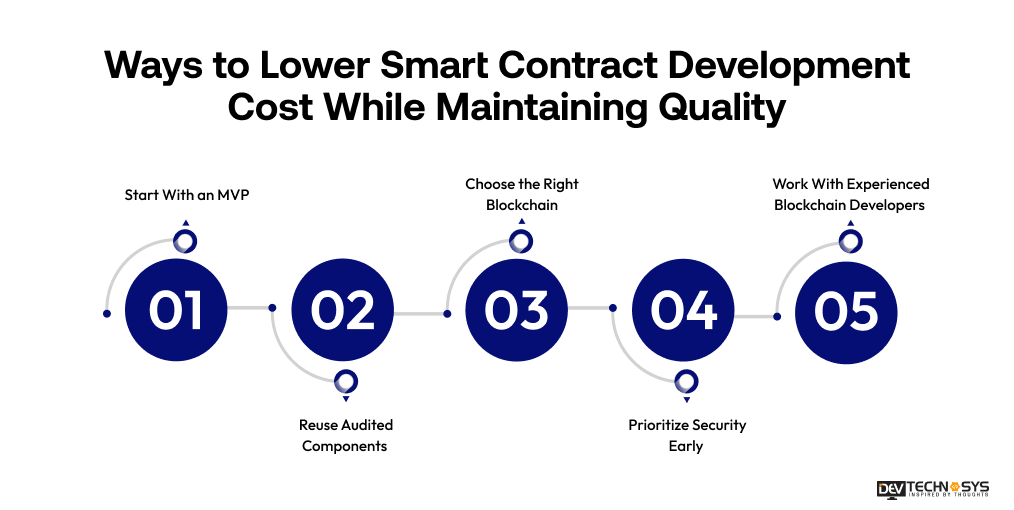
Ways to Lower Smart Contract Development Cost While Maintaining Quality
Reducing smart contract deployment cost requires strategic planning while maintaining strong security and performance standards. By optimizing architecture, reusing components, and selecting efficient blockchain networks, businesses can lower expenses significantly. Proper execution of these strategies can reduce total development costs by 20–50%, depending on project complexity.
1. Start With an MVP
Starting with a Minimum Viable Product reduces initial development scope and helps validate ideas early. This approach minimizes unnecessary features and can lower overall development costs by 25–40%, while allowing iterative scaling based on real user feedback and market demand.
2. Reuse Audited Components
Using pre-audited smart contract libraries significantly reduces development effort and security risks. These components are already tested for vulnerabilities, reducing audit and development costs by 15–30%, while improving reliability and speeding up time-to-market for blockchain applications.
3. Choose the Right Blockchain
Selecting the correct blockchain platform directly affects development and operational costs. Networks with lower gas fees and better scalability can reduce total expenses by 20–35%, while inefficient choices may lead to higher long-term maintenance and transaction optimization costs.
4. Prioritize Security Early
Integrating security from the beginning of development helps avoid costly vulnerabilities later. Early detection and prevention reduce rework and audit expenses by 10–25%, while ensuring stronger architecture design and minimizing risks of post-deployment financial losses.
5. Work With Experienced Blockchain Developers
Experienced blockchain developers improve efficiency, reduce debugging time, and minimize security risks. Although their hourly rates are higher, they reduce total project costs by 15–30%, due to fewer errors, faster delivery, and lower long-term maintenance requirements.
How Smart Contracts Deliver Cost Savings and Operational Efficiency?
Smart contracts deliver significant ROI by automating business processes, eliminating intermediaries, and reducing operational inefficiencies. They enhance transparency, reduce fraud risks, and streamline transactions, making them a cost-effective solution for enterprises adopting blockchain-based automation systems.
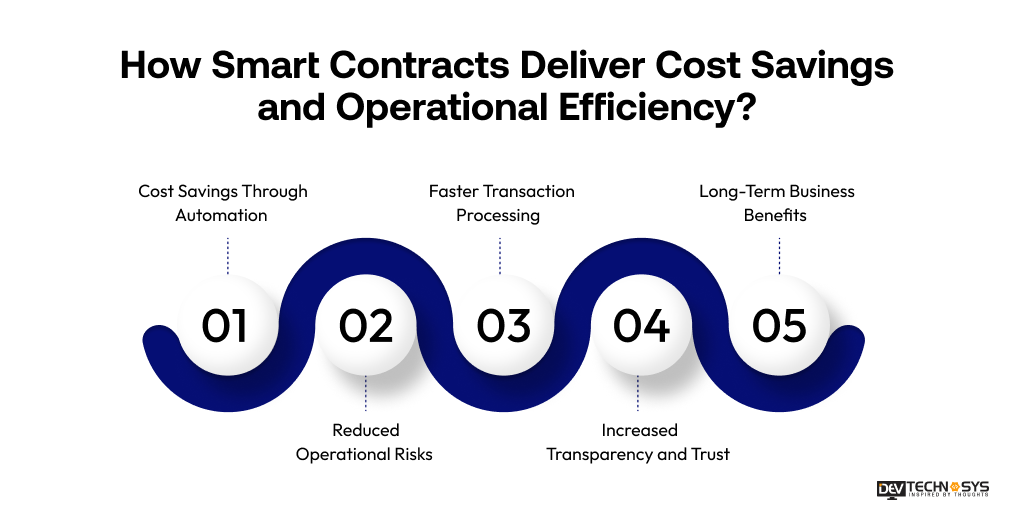
We will now explain the benefits of ROI:
1. Cost Savings Through Automation
Smart contracts eliminate manual intervention by automating agreements and payments. This reduces administrative overhead, operational delays, and human error costs, resulting in significant long-term savings across financial and enterprise systems.
2. Reduced Operational Risks
By executing predefined rules automatically, smart contracts reduce fraud, manipulation, and error risks. This minimizes financial losses and compliance issues, leading to improved operational stability and reduced risk management costs.
3. Faster Transaction Processing
Blockchain-based execution ensures near-instant transaction processing without intermediaries. This increases business efficiency, reduces settlement delays, and lowers operational friction costs across global financial systems and decentralized applications.
4. Increased Transparency and Trust
All transactions are recorded on immutable ledgers, ensuring full transparency. This reduces audit costs, improves stakeholder trust, and minimizes disputes, leading to lower reconciliation and verification expenses.

5. Long-Term Business Benefits
Over time, smart contracts reduce dependency on intermediaries, optimize workflows, and scale operations efficiently. This leads to sustained cost reduction, improved profitability, and stronger digital transformation outcomes for enterprises.
| Benefit Area | Impact on Cost |
| Automation | 20–40% savings |
| Risk Reduction | 15–30% savings |
| Transaction Speed | 10–25% efficiency gain |
| Transparency | 10–20% audit savings |
| Long-Term Efficiency | 25–50% ROI improvement |
Latest Trends Shaping the Smart Contract Development Expenses in 2026-2027
Reducing smart contract development budgets requires strategic planning while maintaining strong security and performance standards. By optimizing architecture, reusing components, and selecting efficient blockchain networks, businesses can lower expenses significantly. Proper execution of these strategies can reduce total development costs by 20–50%, depending on project complexity.
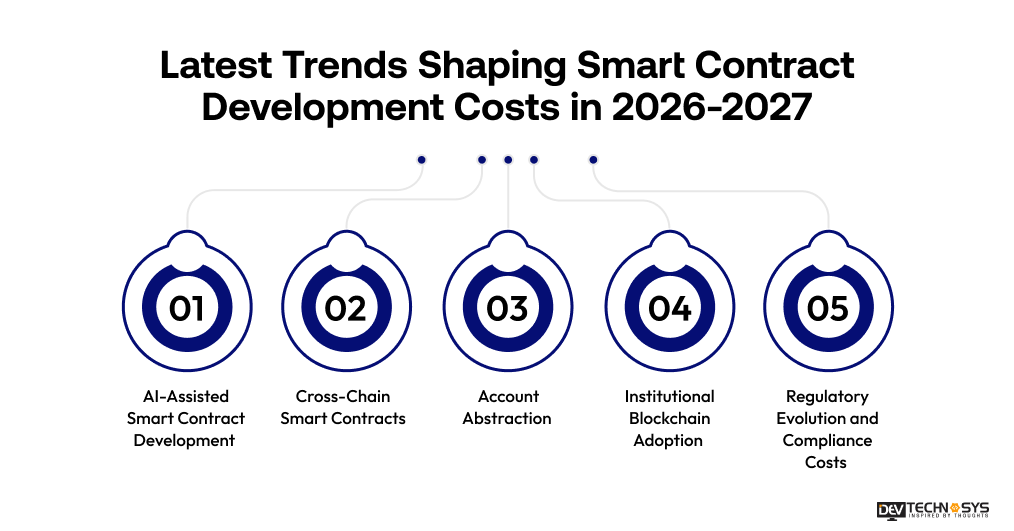
1. AI-Assisted Smart Contract Development
AI-assisted smart contract development uses machine learning tools to automate coding, debugging, and optimization tasks. These tools can reduce development effort and cost by 15–30% by improving efficiency and minimizing manual errors. However, additional validation layers are still required to ensure code security, correctness, and compliance with blockchain execution standards.
2. Cross-Chain Smart Contracts
Cross-chain smart contracts enable communication and interaction between multiple blockchain networks, improving scalability and flexibility. However, this interoperability increases development complexity and cost by 20–40%, due to advanced architecture design, bridge protocols, and extensive testing requirements needed to ensure secure and reliable cross-network execution.
3. Account Abstraction
Account abstraction improves user experience by simplifying wallet interactions and transaction handling on blockchain networks. While it enhances usability, it increases development effort and cost by 10–25%, because developers must implement smart wallet logic, custom authentication systems, and additional security validation layers for secure execution.
4. Institutional Blockchain Adoption
Institutional blockchain adoption is driving demand for enterprise-grade smart contracts with high scalability, compliance, and security standards. This increases development costs by 25–45%, as financial institutions require robust architecture, regulatory alignment, advanced audits, and large-scale system integration to meet enterprise-level expectations.
5. Regulatory Evolution and Compliance Costs
Evolving global blockchain regulations are expected to increase smart contract development pricing by 15–35%, especially in financial, healthcare, and cross-border applications. Compliance requirements such as KYC, AML, and data protection laws add additional development, legal integration, and audit overhead.
Case Study: Metacade
At Dev Technosys UAE, we developed Metacade, a Web3 gaming and crypto ecosystem that combines blockchain gaming, tokenization, staking, governance, and community engagement within a decentralized platform. The project involved developing the MCADE token, ICO infrastructure, staking mechanisms, governance smart contracts, wallet integrations, real-time analytics, and multi-network support. Due to its advanced smart contract architecture and enterprise-grade security requirements, the project falls within the advanced smart contract development category, with a development cost of $90,000.
Challenge Faced: The primary challenge was building a secure ICO architecture while ensuring transparent token allocation, sustainable staking rewards, multi-chain interoperability, and smart contract security through audits and penetration testing. Maintaining transaction performance during peak user activity also required significant optimization efforts.
Project Highlights
- Project Name: Metacade
- About Client: Alex Thompson
- Industry: Web3 Gaming & Blockchain
- Client Location: United Kingdom
- Development Cost: $90,000
- Development Timeline: 32 Weeks
- Team Size: 12 Blockchain Experts
- Platform Type: Decentralized Gaming & Token Ecosystem
Conclusion
As blockchain adoption accelerates across industries, smart contracts have become a powerful tool for automating processes, reducing operational costs, and building trustless digital ecosystems. Whether you’re developing a DeFi platform, NFT marketplace, DAO, or enterprise blockchain solution, understanding the factors that influence development costs is critical to project success.
This guide provides a comprehensive overview of the smart contract development cost in 2026-2027. It includes feature-based pricing and blockchain selection to audits, hidden expenses, and long-term ROI. With project costs ranging from $30,000 to $1,50,000+, proper planning can help businesses maximize value while minimizing risks.
Partnering with an experienced smart contract development company ensures secure architecture, efficient development, and audit-ready smart contracts. These are built to scale in an increasingly competitive Web3 landscape.
FAQs
Q1. How Much Does it Cost to Build a Smart Contract in 2026?
Smart contract development in 2026 typically costs between $30,000 and $1,50,000+, depending on complexity, blockchain platform, and feature requirements. Basic token or escrow contracts are cheaper, while DeFi protocols, NFT marketplaces, and enterprise-grade systems require higher investment due to advanced logic, integrations, and security audits.
Q2. What Factors Influence the Cost To Make a Smart Contract the Most?
The main cost drivers include blockchain selection, feature complexity, security requirements, third-party integrations, and developer expertise. Additional factors like compliance needs, testing depth, and audit requirements also significantly impact pricing. More complex architectures and high-security systems naturally increase both development time and overall project cost.
Q3. How Much Does A Smart Contract Audit Cost?
A smart contract audit typically costs between $5,000 and $30,000+, depending on code complexity and risk level. Simple contracts are cheaper to audit, while DeFi and multi-chain systems require extensive manual review, automated testing, and vulnerability analysis, making audits a major part of the overall development budget.
Q4. Which Blockchain Is The Cheapest For Smart Contract Development?
Blockchains like Polygon, BNB Chain, and Tron are generally more cost-effective for smart contract development due to lower gas fees and simpler deployment structures. In contrast, Ethereum is more expensive because of higher transaction costs and optimization requirements, although it offers stronger ecosystem support and security.
Q5. How Long Does It Take To Build A Smart Contract?
Smart contract development typically takes 4 weeks to 7+ months, depending on complexity. Basic contracts can be completed quickly, while advanced systems involving DeFi, NFTs, or cross-chain functionality require longer timelines due to development, testing, security audits, and deployment stages.