





In the last decade, grocery shopping has undergone a massive transformation from traditional stores to highly personalized, digitally-powered experiences. It is primarily due to the COVID-19 pandemic that acted as a catalyst, accelerating e-commerce grocery adoption worldwide.
However, it was technology, especially Artificial Intelligence (AI), that transformed these digital grocery platforms into intuitive, intelligent, and scalable ecosystems. Today, AI is no longer an option, but it is the structural backbone of modern grocery apps.
Artificial intelligence in grocery app development enables personalization, operational optimization, dynamic pricing, smart logistics, fraud detection, voice search capabilities, and much more. It is true to say that the role of AI in grocery app development is reshaping the future of grocery shopping.
This article explores the current market landscape of the role of AI in grocery app development more elaborately. It presents real examples of grocery apps using AI in 2026, the technologies involved, business motivations, challenges, and more.
What Are The Market Stats Of The Grocery App?
The rapid growth of grocery apps reflects changing consumer habits and increased smartphone adoption. It also explains that the role of AI in grocery app development, in personalization, automation, and logistics optimization, can be achieved across global markets. Let’s have a clear concept of this through the market predictions.
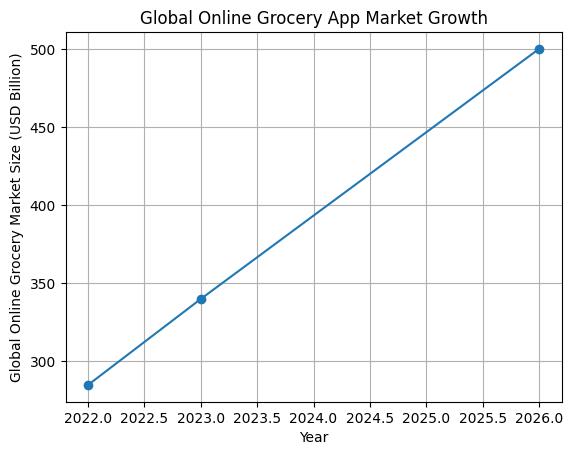
- In 2022, the global online grocery market was valued at approximately USD 285 billion, driven by pandemic-led digital adoption and increasing demand for doorstep delivery and convenience-based shopping.
- By 2023, global online grocery revenues will have surpassed USD 340 billion, reflecting a year-on-year growth of over 19%, fueled by AI-based recommendations, subscription models, and mobile-first experiences.
- In 2024, over 65% of online grocery purchases were made via mobile apps, with AI-powered search, voice ordering, and personalized offers significantly increasing user retention and repeat purchases.
- By 2025, grocery retailers globally invested more than USD 25 billion in AI technologies, focusing on demand forecasting, dynamic pricing, automated warehouses, and intelligent customer engagement tools.
- In 2026, the global online grocery app market is projected to exceed USD 500 billion, with AI-driven platforms accounting for more than 70% of total digital grocery transactions worldwide.
What Is The Role of AI in Grocery App Development?
Artificial intelligence in grocery app development plays a significant, transformative role. It enables intelligent decision-making, enhances customer experiences, improves operational efficiency, and creates data-driven, scalable, and future-ready digital grocery ecosystems. Here, we will discuss the importance of AI in grocery app development.
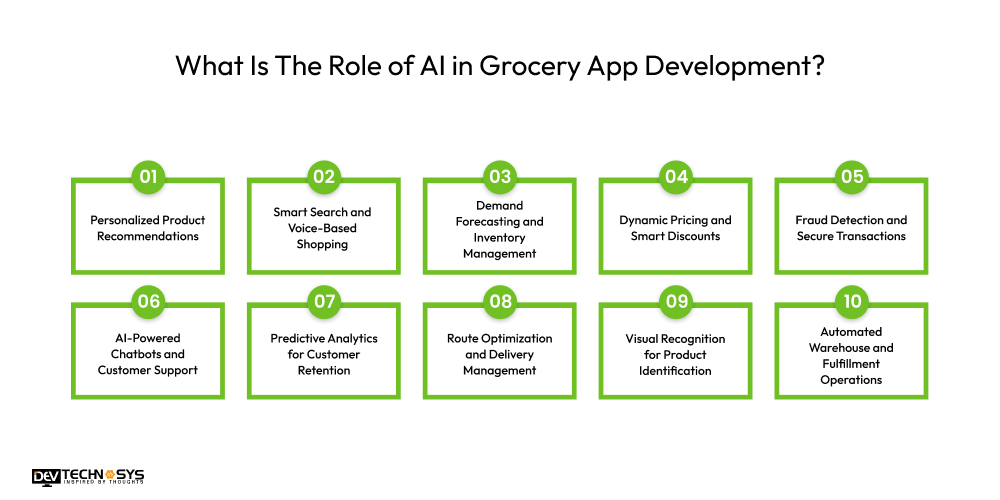
1. Personalized Product Recommendations
AI-powered grocery app development analyzes user behavior, purchase history, preferences, and browsing patterns to deliver highly personalized product recommendations. This improves user engagement, increases average order value, and helps customers quickly find relevant items without extensive searching or manual filtering. The grocery delivery app development services strengthen customer loyalty by making every shopping session feel uniquely tailored to individual needs.
2. Smart Search and Voice-Based Shopping
AI-powered search engines understand natural language queries, misspellings, and user intent, while voice assistants enable hands-free grocery shopping. These capabilities reduce friction, improve accessibility, and make product discovery faster and more intuitive for diverse user groups. It enhances inclusivity by enabling effortless shopping for users with different languages, abilities, or technical comfort levels.
3. Demand Forecasting and Inventory Management
To build an Artificial Intelligence app, machine learning algorithms are really necessary. It analyzes historical sales, seasonal trends, local demand, and external factors to predict product demand accurately.
This helps grocery apps maintain optimal inventory levels, minimize stockouts, reduce waste, and improve supply chain efficiency. Accurate forecasting supports better supplier coordination and prevents revenue loss caused by overstocking or shortages.
4. Dynamic Pricing and Smart Discounts
The grocery app development using AI enables real-time pricing adjustments based on demand, competitor pricing, stock availability, and customer behavior. Grocery apps can offer personalized discounts, optimize profit margins, and run targeted promotions without manual intervention or static pricing strategies. Real-time pricing intelligence allows businesses to stay competitive while maximizing revenue opportunities.
5. Fraud Detection and Secure Transactions
The artificial intelligence development in grocery systems monitors transactions, user activity, and payment patterns to detect suspicious behavior or fraud in real time. This enhances payment security, protects customer data, reduces chargebacks, and builds trust in digital grocery platforms. Advanced monitoring systems proactively safeguard platforms against financial losses and reputational damage.
6. AI-Powered Chatbots and Customer Support
The AI-based grocery app solutions also integrate intelligent chatbots to handle order queries, delivery tracking, refunds, and FAQs instantly. By providing 24/7 support, the role of AI in grocery app development is to reduce human workload.
It also improves response times and ensures consistent, accurate customer service across multiple communication channels. Always-available virtual assistance improves service consistency across peak hours and high-demand seasons.
7.Predictive Analytics for Customer Retention
An iOS and Android app development of grocery apps with AI predicts customer churn by analyzing engagement levels, order frequency, and feedback. Grocery apps can proactively retain users through personalized offers, reminders, loyalty rewards, and targeted communication strategies driven by predictive insights. Data-driven retention strategies help convert occasional buyers into long-term, high-value customers.
8. Route Optimization and Delivery Management
Artificial intelligence in grocery app development optimizes delivery routes by analyzing traffic conditions, delivery windows, weather, and driver availability. This reduces delivery times, lowers fuel costs, improves on-time deliveries, and enhances overall customer satisfaction in last-mile logistics. Efficient routing contributes to faster deliveries while supporting sustainability through reduced fuel consumption.
9. Visual Recognition for Product Identification
Computer vision allows users to scan products or barcodes using smartphone cameras. Grocery delivery app development solution with AI instantly identifies items, checks availability, compares prices, and simplifies reordering, creating a faster and more engaging shopping experience. Image-based interactions create a more interactive and engaging shopping experience for modern mobile users.
10. Automated Warehouse and Fulfillment Operations
AI-driven automation streamlines picking, packing, and sorting operations in warehouses. Smart robots and predictive systems improve order accuracy, speed fulfillment, reduce labor costs, and support scalable grocery app operations during peak demand periods. The smart grocery app development with automation enables grocery businesses to scale fulfillment operations without compromising speed or accuracy.
Comparison Between Grocery Apps With and Without Integrating AI
Before understanding the full-stack development services of an AI-powered grocery app, knowing the difference between AI-powered and traditional grocery apps is necessary. It helps businesses evaluate technology-driven competitive advantages. This comparison highlights the role of AI in grocery app development in efficiency and overall user experience.
| Basis of Comparison | Grocery Apps With AI Integration | Grocery Apps Without AI Integration |
| Product Recommendations | AI analyzes user behavior and purchase history to deliver personalized product suggestions | The same product lists are shown to all users without personalization |
| Search Experience | Intelligent search understands intent, voice commands, and misspellings | Basic keyword search with limited accuracy |
| Inventory Management | Predictive models forecast demand and automatically adjust stock levels | Manual stock tracking often leads to overstocking or shortages |
| Pricing Strategy | Real-time dynamic pricing and personalized offers based on demand | Fixed pricing and manually scheduled discounts |
| Customer Support | AI chatbots provide instant, 24/7 assistance for common queries | Support is limited to working hours and human agents |
| Delivery Optimization | AI optimizes routes using traffic, location, and delivery windows | Predefined routes with minimal efficiency improvements |
| Fraud Detection | Continuous monitoring detects suspicious activity in real time | Basic security checks with delayed issue identification |
| Customer Retention | Predictive insights enable targeted loyalty and re-engagement campaigns | Generic marketing messages sent to all users |
| Operational Efficiency | Automated processes reduce manual work and operational errors | High dependency on manual operations |
| Scalability | Systems scale smoothly during peak demand and festive seasons | Performance issues during high user traffic |
Which Grocery Apps Are Using AI In 2026?
Leading grocery apps are actively leveraging AI to improve personalization, logistics, pricing, and customer engagement. This signifies the role of Artificial Intelligence in mobile app development. They are setting new benchmarks for digital grocery experiences in competitive global markets. In this section, we will learn about the grocery apps integrating AI in 2026.
1. Amazon Fresh
Amazon Fresh is an AI-driven grocery app development that examines customer behavior, purchase history, and real-time demand. Its AI-powered systems enable hyper-personalized recommendations, cashier-less checkout through computer vision, predictive inventory planning, and highly optimized delivery routes for faster fulfillment.
2. Walmart Grocery
Walmart Grocery uses AI to streamline large-scale operations through intelligent inventory forecasting, dynamic pricing strategies, and automated fulfillment centers. AI-driven customer support and data analytics help Walmart improve order accuracy, reduce costs, and deliver consistent omnichannel shopping experiences.
3.Tesco Groceries
The AI integration in grocery applications like Tesco Groceries enhances demand forecasting, optimizes pricing strategies, and personalizes loyalty rewards. By analyzing regional purchasing patterns and customer data, AI helps Tesco reduce food waste, improve stock availability, and deliver tailored promotions across markets.
4. Kroger
The role of AI in grocery app development like Kroger, is to gain deep customer insights, predict demand, and manage inventory efficiently. Its AI-powered digital coupons, personalized offers, and automated warehouse robotics improve fulfillment speed, enhance customer engagement, and support scalable grocery operations.
5. Instamart
Instamart applies AI to personalize product suggestions, accurately estimate delivery times, and optimize shopper routes in real time. Its AI-powered substitution includes an Android or iOS app development services engine that intelligently replaces out-of-stock items based on customer preferences. It also ensures satisfaction and minimizes order cancellations.
6. BigBasket
BigBasket employs AI-driven analytics to personalize recommendations, enable smart product search, and optimize last-mile delivery routes. Predictive models help anticipate customer demand, reduce delivery delays, and improve operational efficiency while delivering a seamless grocery shopping experience.
What AI-Powered Technologies Are Used In Grocery App Development?
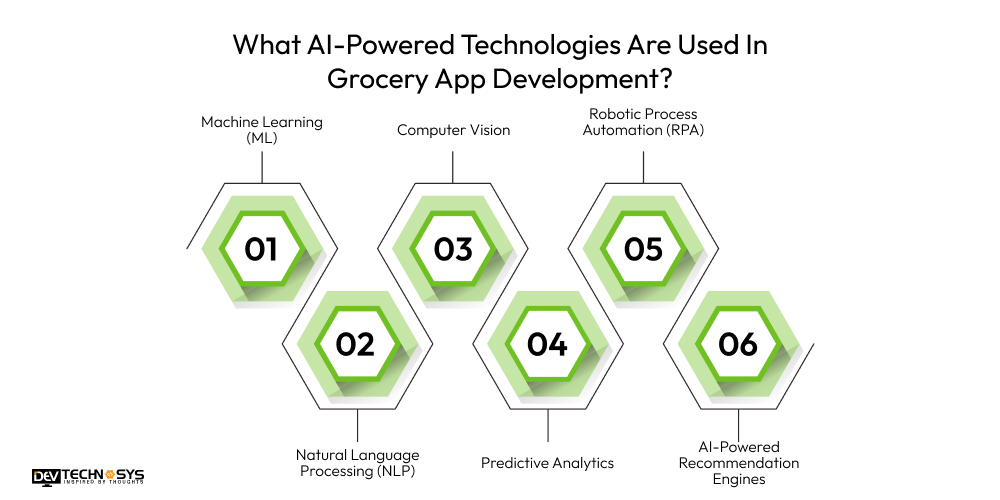
Modern grocery apps rely on a combination of advanced AI technologies that enable intelligent automation and data-driven decision-making. It also offers seamless user experiences across the entire shopping journey. To build a grocery delivery app like an Instashop, here are some AI-powered technologies widely used in grocery app development.
1. Machine Learning (ML)
Machine learning algorithms process vast amounts of user behavior, sales history, and operational data to identify patterns in advanced AI grocery app development. These insights continuously refine product recommendations, improve demand forecasting accuracy, and enable personalized shopping experiences that evolve with customer preferences.
2. Natural Language Processing (NLP)
Natural language processing allows apps to understand spoken or written user queries. It powers voice search, conversational chatbots, and intent-based product discovery. It enables users to interact naturally with apps while receiving faster, more accurate, and context-aware responses. To integrate NLP in a grocery app, you must hire on-demand app developers.
Read more: How to Build An App Like Yassir?
3. Computer Vision
Computer vision technology enables grocery apps to recognize products through images or barcodes. It supports image-based search, automated quality inspections, and cashier-less checkout systems in a cross-platform AI grocery app development. This also reduces manual effort while enhancing shopping convenience and accuracy for both customers and retailers.

4. Predictive Analytics
The role of artificial intelligence in grocery app development can be seen through predictive analytics. It uses historical and real-time data to forecast customer demand, purchasing behavior, inventory levels, and delivery schedules. This proactive approach helps grocery businesses reduce stockouts, minimize waste, optimize logistics, and make informed, data-driven decisions.
5. Robotic Process Automation (RPA)
To build a grocery delivery app like Hungerstation, robotic process automation is really mandatory. It automates repetitive backend operations such as order processing, refunds, invoicing, and inventory updates. By reducing human intervention, RPA improves operational efficiency, accuracy, and processing speed, and allows teams to focus on higher-value tasks.
6. AI-Powered Recommendation Engines
AI-powered recommendation engines combine machine learning models, behavioral data, and contextual insights to suggest relevant products. These engines personalize promotions, increase cross-selling opportunities, boost average order value, and enhance customer engagement through tailored shopping experiences.
Why Are Businesses Integrating AI In Grocery App Development?
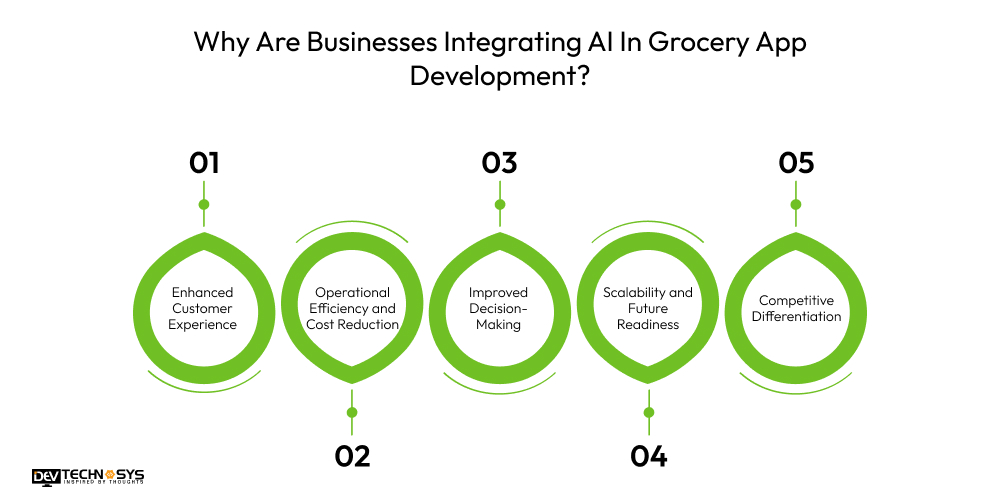
Businesses are integrating AI grocery app development for iOS, Android, or both to remain competitive, meet rising consumer expectations, and optimize operations. It unlocks data-driven growth opportunities in a fast-evolving digital marketplace. Some of these reasons are explained below:
1. Enhanced Customer Experience
A mobile app development company adds AI in grocery app development to enhance customer experience by delivering personalized product recommendations. It fosters intelligent search results and tailored promotions.
By understanding individual preferences and shopping behavior, grocery apps create seamless, relevant, and engaging journeys that increase satisfaction, build trust, and encourage long-term customer loyalty.
2. Operational Efficiency and Cost Reduction
AI-driven automation and predictive analytics streamline grocery operations by reducing manual tasks, optimizing inventory levels, and minimizing food waste. These intelligent systems improve supply chain efficiency, lower operational costs, reduce errors, and enable faster order fulfillment across warehouses and delivery networks.
3. Improved Decision-Making
AI converts large volumes of structured and unstructured data into actionable insights. Businesses can make informed decisions regarding pricing strategies, promotional campaigns, demand forecasting, inventory planning, and market expansion. It reduces risks while improving the profitability and strategic agility of grocery mobile app development solutions.
4. Scalability and Future Readiness
AI grocery app development for Android, iOS, or both scales effortlessly during high-demand periods such as holidays or flash sales. Intelligent systems adapt to increased traffic, order volumes, and operational complexity, ensuring consistent performance while preparing businesses for future growth and evolving digital commerce trends.
5. Competitive Differentiation
An AI chatbot for grocery apps is used to stand out through advanced features like smart search, voice-based ordering, personalized pricing, and predictive delivery. These innovations enhance convenience, speed, and accuracy, helping businesses attract users, retain customers, and remain competitive in crowded digital grocery markets.
What Are The Significant Challenges Of Integrating AI Grocery App Development?
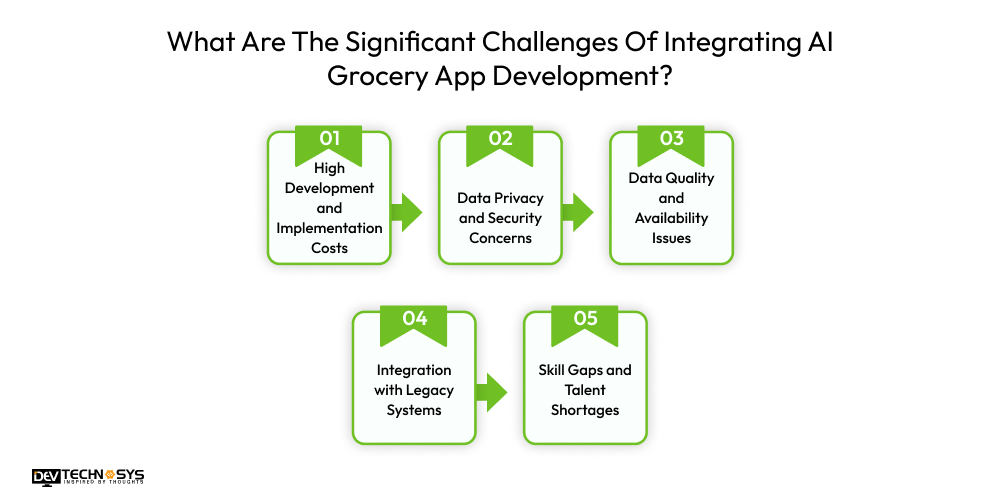
Despite its advantages, custom AI grocery app development presents technical, financial, and ethical challenges. These drawbacks a business must address to ensure successful implementation. Now, we will understand the challenges faced in the incorporation of AI in grocery app development.
1. High Development and Implementation Costs
The cost to develop a grocery delivery app like Gourmet Egypt is higher due to the advanced data infrastructure, cloud services, skilled AI professionals, and continuous model training. These costs can be challenging for small and mid-sized businesses, limiting their ability to adopt and scale intelligent technologies effectively. Ongoing expenses related to system upgrades, model retraining, and infrastructure scaling further increase long-term financial commitments.
2. Data Privacy and Security Concerns
AI-driven grocery apps process sensitive customer information such as payment details, addresses, and purchasing behavior. Ensuring compliance with data protection regulations, preventing breaches, and maintaining secure data storage and processing frameworks remain critical challenges for businesses adopting AI technologies. Any failure in data governance can damage customer trust and negatively impact brand reputation. To avoid this, you can reach out to a hybrid app development company.
3. Data Quality and Availability Issues
AI models depend heavily on large volumes of accurate, consistent, and relevant data. Incomplete datasets, data silos, or inconsistent historical records can negatively impact model performance, reduce prediction accuracy, and limit the effectiveness of AI-driven decision-making systems. Maintaining data consistency across multiple vendors, regions, and platforms becomes increasingly difficult as operations scale.
4. Integration with Legacy Systems
Many grocery businesses rely on legacy software and fragmented systems that were not designed for AI integration. Connecting these outdated platforms with modern AI solutions can be complex, time-consuming, and disruptive to ongoing operations if not managed carefully. Poor integration planning can lead to workflow disruptions and reduced system reliability during transition phases.
5. Skill Gaps and Talent Shortages
The grocery delivery app maintenance services require expertise in data science, machine learning, cloud platforms, and system integration. The limited availability of skilled professionals increases hiring costs and creates challenges for businesses aiming to build and sustain AI-driven grocery applications. Organizations often face longer development timelines due to dependency on external consultants or training programs.
Conclusion
Artificial intelligence is redefining grocery app development by transforming traditional shopping into intelligent, personalized, and highly efficient digital experiences. From smart recommendations to automated fulfillment and secure transactions, AI empowers grocery businesses to meet modern consumer expectations while optimizing operations.
As the online grocery market continues to expand rapidly, AI will no longer be a differentiator but a necessity. Businesses that invest early in AI-driven grocery app development will gain a competitive advantage. It even improves customer loyalty and builds scalable, future-ready platforms capable of thriving in an increasingly digital-first world.
If you are also interested in building a grocery app, you can reach out to a grocery delivery app development company.
FAQs
1.How Does AI Improve User Experience In Grocery Apps?
AI enhances user experience by analyzing shopping behavior, preferences, and purchase history to deliver personalized recommendations, smart search results, and predictive suggestions. These features simplify navigation, reduce shopping time, and create more relevant, engaging, and convenient grocery shopping experiences.
2. Is AI Suitable For Small Grocery Businesses?
AI is suitable for small grocery businesses because scalable cloud-based platforms and modular AI solutions enable cost-effective adoption. Features such as chatbots, recommendation engines, and demand forecasting can be implemented gradually, helping smaller retailers improve efficiency without large upfront investments.
3. Can AI Reduce Grocery Delivery Times?
AI reduces grocery delivery times by optimizing delivery routes, predicting traffic patterns, managing driver availability, and prioritizing orders intelligently. These capabilities improve last-mile logistics efficiency, minimize delays, lower transportation costs, and ensure faster, more reliable deliveries for customers.
4. Are AI-Powered Grocery Apps Secure?
AI-powered grocery apps are secure when built with strong encryption, secure authentication, and compliance with data protection regulations. AI also enhances security through real-time fraud detection, anomaly monitoring, and risk assessment, helping prevent unauthorized access and protect sensitive customer information.
5. What Is The Future Of AI In Grocery App Development?
The future of AI in grocery app development includes hyper-personalized shopping experiences, autonomous delivery systems, cashier-less stores, AI-driven sustainability initiatives, and deeper integration with smart home devices. These advancements will redefine convenience, efficiency, and innovation in digital grocery ecosystems.