





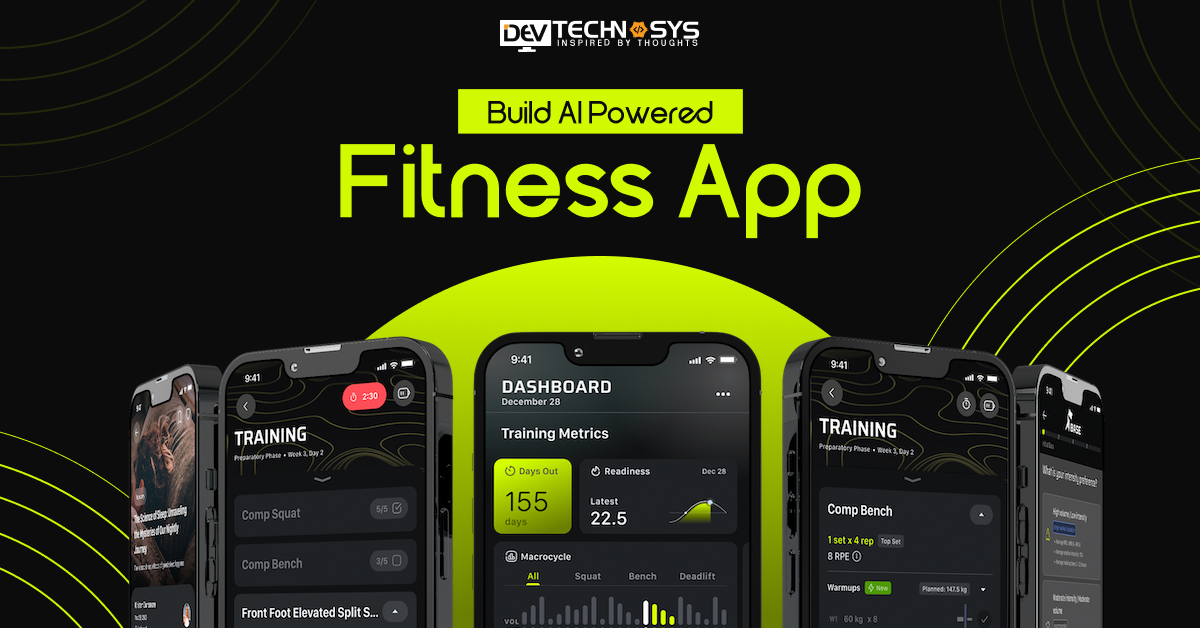
After the pandemic, more and more people have been prioritizing their health and fitness over anything else. With that concept in mind, many businesses in the UAE are focusing on developing AI-powered fitness apps. AI-based fitness app solution have completely redefined the health industry. From custom workout plans to diet schedules, people are embracing artificial intelligence in fitness app development.
So if you’re thinking to build an AI-powered fitness app, let’s dive into it. This guide will help with the AI fitness app development process, core features, cost to build AI fitness app, and the factors affecting it. The most innovative startups are partnering with top development companies in the UAE to go from idea to market-ready AI-Powered fitness application.
Middle East Digital Fitness & Wellness Apps Market Report
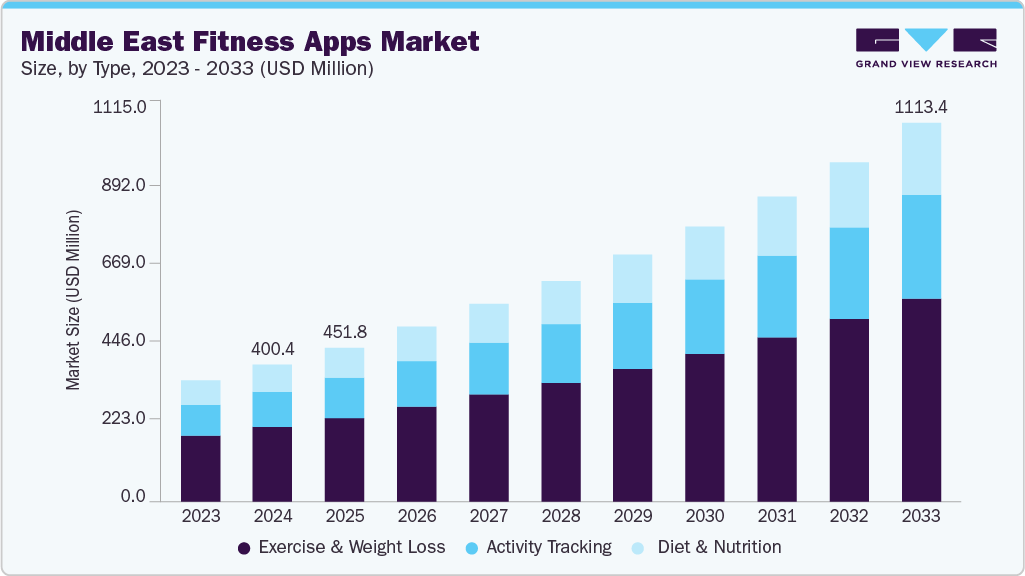
- In 2024, the Middle East fitness app market was estimated at USD 39 million.
- By 2033, it is expected to reach USD 1,113.36 million.
- From 2025 to 2033, the market is expected to grow at a CAGR of 93%.
- In 2025, Abu Dhabi launched a prototype of the “gym of the future.”
- In 2024, the exercise and weight-loss sector dominated the market with a 38% revenue share.
What is An AI-Powered Fitness App?
Personalized exercises, dietary advice, and progress tracking are all provided via an AI-powered fitness app. Fitness app development services enable real-time plan adjustments and examine user data such as goals, activities, biometrics, and preferences.
Predictive insights, smart coaching, and reminder-based incentives are all made possible by an AI-based fitness app solution. It enhances performance, lowers the risk of injury, and provides scalable, data-driven fitness experiences.
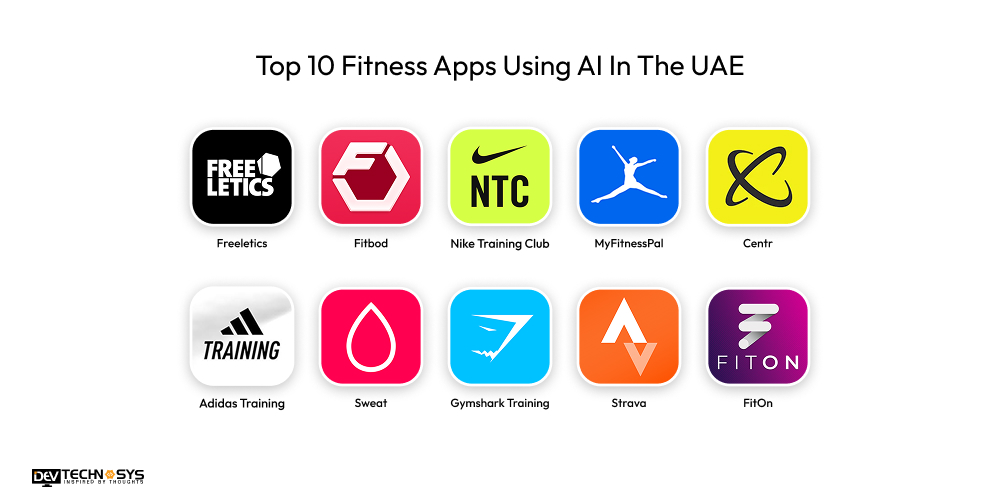
Top 10 Fitness Apps Using AI In The UAE
Due to the UAE’s high smartphone penetration, hectic urban lifestyles, and rising health consciousness, AI-powered fitness app development is becoming increasingly popular. These apps use AI to provide data-driven wellness insights, smart coaching, habit tracking, and customized workouts. The following is a carefully curated collection of well-known AI-enabled fitness apps.
App |
Launch |
Downloads |
Rating |
Platforms |
Key AI Feature |
| Freeletics | 2013 | 50M+ | 4.6 | iOS, Android | Adaptive AI workout coaching |
| Fitbod | 2015 | 5M+ | 4.7 | iOS, Android | Smart strength training plans |
| Nike Training Club | 2016 | 100M+ | 4.5 | iOS, Android | AI-curated performance workouts |
| MyFitnessPal | 2005 | 200M+ | 4.6 | iOS, Android | AI nutrition & calorie insights |
| Centr | 2018 | 5M+ | 4.4 | iOS, Android | AI-powered holistic wellness |
| Adidas Training | 2016 | 50M+ | 4.5 | iOS, Android | Personalized AI workout guidance |
| Sweat | 2015 | 10M+ | 4.3 | iOS, Android | AI fitness programs for women |
| Gymshark Training | 2020 | 1M+ | 4.4 | iOS, Android | Behavior-based workout AI |
| Strava | 2009 | 100M+ | 4.5 | iOS, Android | AI activity & performance analysis |
| FitOn | 2018 | 10M+ | 4.6 | iOS, Android | AI goal-based workout planning |
Why Should You Invest In AI Fitness App Development?
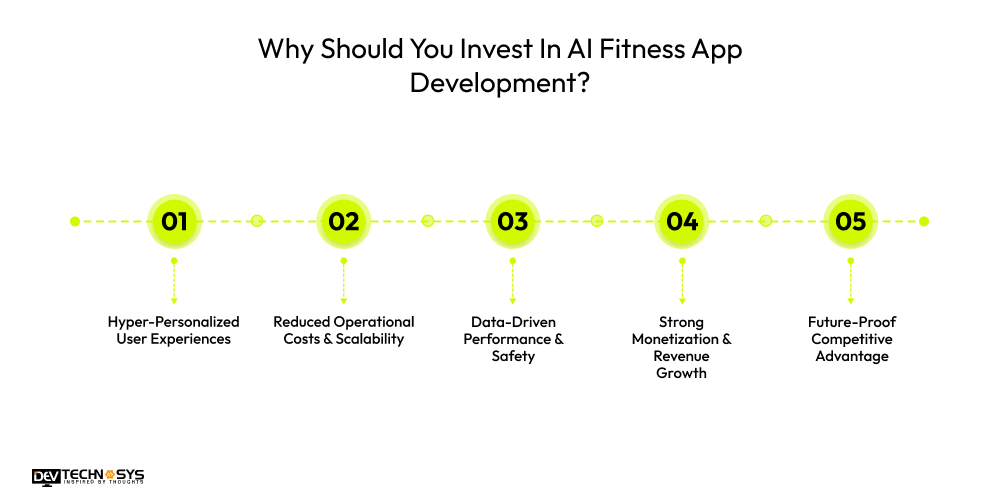
Artificial intelligence in fitness app development is revolutionizing the digital health sector by fusing data analytics, automation, and personalization. Investing in a fitness app development company enables businesses to deliver better user experiences, scale effectively, and maintain competitiveness in a global fitness market.
1. Hyper-Personalized User Experiences
When you build AI powered fitness app, it analyzes user objectives, habits, biometrics, and progress in real time to provide highly customized experiences. In a crowded fitness industry driven by convenience, relevance, and quantifiable results for contemporary digital-first health platforms, this personalization boosts engagement, retention, and results, helping businesses develop devoted customers while setting their product apart.
2. Reduced Operational Costs & Scalability
By replacing manual coaching, support, and planning procedures, Fitness app development using AI reduces long-term operating costs. In rapidly expanding digital fitness ecosystems, smart algorithms manage recommendations, progress tracking, and feedback at scale, allowing startups and businesses to effectively serve thousands of users without corresponding increases in staffing, infrastructure, or ongoing human resource expenses.
3. Data-Driven Performance & Safety
When you develop AI powered fitness app, it offers real-time data insights to boost user motivation, performance, and safety. Features such as adaptive intensity, injury risk prediction, and form correction produce smarter exercises.
Fitness app development solution enhances results, builds confidence, and positions the app as a reliable, results-driven health solution for contemporary consumers seeking quantifiable wellness.
4. Strong Monetization & Revenue Growth
Opting to create AI-powered fitness app opens up a variety of revenue streams, including corporate wellness initiatives, premium customisation, subscriptions, and data-driven partnerships. To maximize lifetime value and support scalable revenue growth across regional and international fitness markets with high investor appeal and sustainability, artificial intelligence (AI) enables dynamic pricing and upselling based on user behavior.
5. Future-Proof Competitive Advantage
Smart fitness app development aligns with the growing need for preventive care, digital health, and lifestyle optimization. AI-driven platforms become increasingly relevant over time as consumers place greater value on convenience and customization.
In the dynamic global fitness economy, fueled by data, innovation, scalability, and growth, early investment enables companies to maintain competitiveness, embrace cutting-edge technologies, and develop future-proof products.
Build AI Powered Fitness App: Step-By-Step Guide
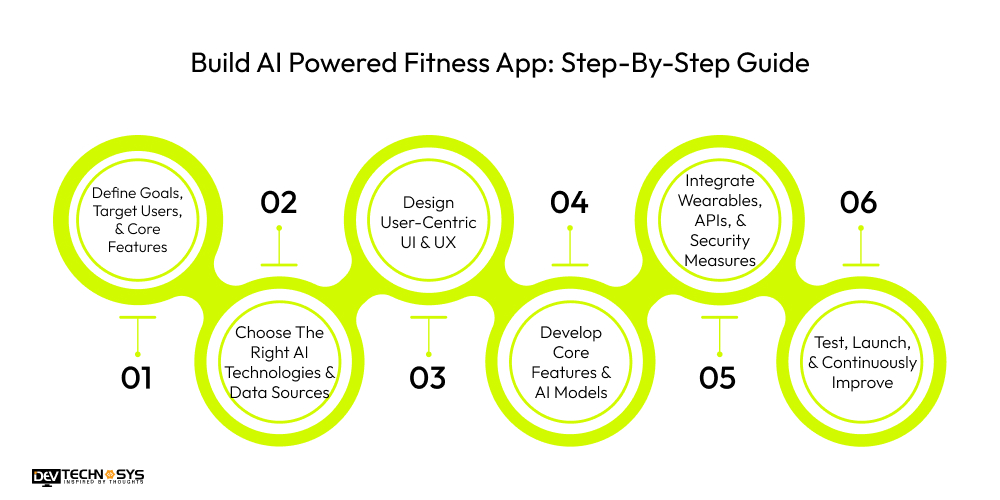
A structured approach combining intelligent technologies, scalable architecture, and user-centric design is needed to build AI powered fitness app. Every stage, from setting goals to implementing artificial intelligence development, guarantees that when you make AI powered fitness app, it meets performance, security, and commercial objectives.
1. Define Goals, Target Users, & Core Features
Determine your target audience, fitness results, and specific business objectives first for AI-driven fitness app development. Indicate if the app’s main focus is on coaching, nutrition, fitness, or overall wellness. Examine user preferences, fitness levels, and pain spots. Describe essential features such as tracking, AI coaching, personalization, and integrations to match development to user expectations and quantifiable success measures.
2. Choose The Right AI Technologies & Data Sources
Depending on the app’s needs, choose AI technologies such as computer vision, machine learning, and predictive analytics. Determine trustworthy data sources, such as wearables, sensors, user inputs, and third-party APIs. Assure scalability, privacy compliance, and data quality. Accurate customisation, astute suggestions, and ongoing learning are necessary to build an artificial intelligence app.
3. Design User-Centric UI & UX
Make an appealing user interface (UI) that makes complex fitness data easy to understand. In the custom AI fitness app development process, prioritize easy onboarding, understandable dashboards, and easily accessible exercise instructions.
Customize content distribution, reminders, and layouts with AI insights. Throughout their fitness journey, customers can trust and comprehend AI-driven advice thanks to a well-designed user experience (UX), which also improves usability, motivation, and retention.
4. Develop Core Features & AI Models
Create essential features for an AI fitness app development for Android, like AI coaching, nutrition advice, progress tracking, and exercise creation. To guarantee accuracy and inclusion, train AI models with a variety of datasets. Put feedback loops in place for ongoing education. Make sure workouts are flexible enough to adapt in real time to user goals, fitness levels, fatigue, and performance.
5. Integrate Wearables, APIs, & Security Measures
To build an app like WalkFit, gather real-time health data by integrating wearables, fitness equipment, and third-party APIs. Put in place robust security measures, encryption, and adherence to local data laws. Reliability and trust are increased through secure data management.
Smooth integrations facilitate scalability across platforms, devices, and upcoming technological advancements while improving personalization, accuracy, and the overall user experience.
6. Test, Launch, & Continuously Improve
When you build AI powered fitness app, you must perform thorough testing across multiple devices to ensure accuracy, usability, and performance. Utilize beta input to improve AI features and models. Following launch, keep an eye on user involvement, behavior, and results.
To be relevant, competitive, and successful over the long run in the ever-changing fitness technology market, constantly update algorithms, add features, and improve performance.
What Are The Essentials Features To Create AI Powered Fitness App?
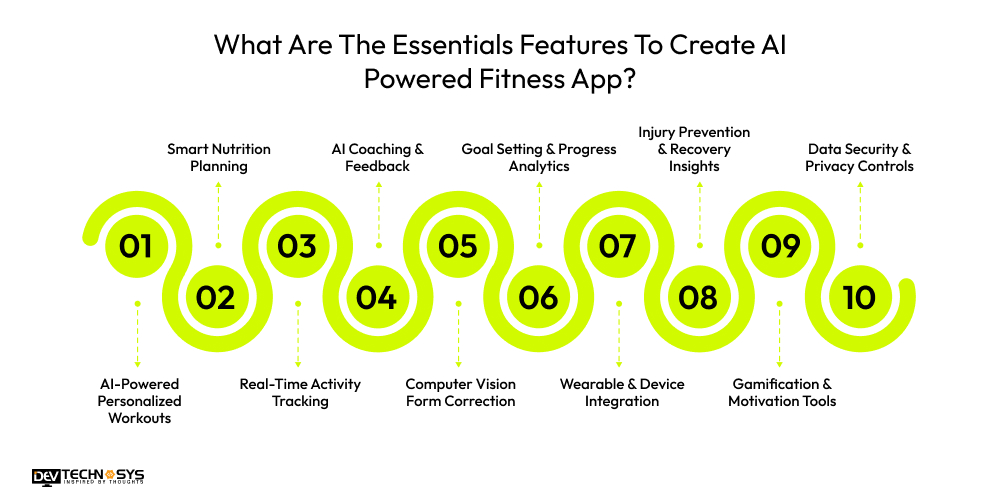
In a competitive digital health ecosystem, the proper key features to build a medical fitness app like DHA enable quantifiable fitness outcomes and long-term user retention while ensuring accurate guidance, user motivation, safety, and scalability.
1. AI-Powered Personalized Workouts
Incorporates goals, fitness level, performance history, and real-time feedback to create adaptive training plans that continuously optimize training duration, intensity, and progression.
2. Smart Nutrition Planning
For balanced nutrition management, it offers AI-powered meal suggestions, calorie tracking, and nutritional insights based on activity levels, preferences, and health goals.
3. Real-Time Activity Tracking
For precise, ongoing fitness performance assessment and insights, real-time activity monitoring uses sensors, wearables, and APIs to track workouts, steps, calories, heart rate, sleep, and sessions.
4. AI Coaching & Feedback
During workouts, AI coaching and feedback offer intelligent direction through text, voice, or images, providing performance insights, inspiration, corrections, and encouragement to increase consistency and results.
5. Computer Vision Form Correction
To reduce injury risk, improve accuracy, and enhance the safety, efficacy, and efficiency of workouts, computer vision form correction uses cameras to analyze posture, movement, and exercise technique.
6. Goal Setting & Progress Analytics
Using AI-driven insights, dashboards, and trends, goal-setting and progress analytics monitor both short- and long-term targets to gauge progress, sustain motivation, and inform wiser choices.
7. Wearable & Device Integration
Smartwatches, fitness bands, and health devices can be seamlessly connected through wearable integration and increase the cost to develop AI powered fitness app. It collects biometric, activity, and performance data in real time.
8. Injury Prevention & Recovery Insights
To identify dangers, recommend rest, improve training, and promote safer fitness, injury prevention, and recovery insights, use artificial intelligence (AI) to assess movement, fatigue, and workload.
9. Gamification & Motivation Tools
AI-driven challenges, awards, streaks, leaderboards, and reminders are used in gamification to make AI powered fitness app. The motivation tools to boost engagement, consistency, adherence, enjoyment, and long-term commitment to healthier lives.
10. Data Security & Privacy Controls
Through encryption, secure authentication, access control, and regulatory compliance, data security and privacy controls safeguard user information, guaranteeing safety, transparency, and trust.

What Is The Cost To Build AI Powered Fitness App?
The cost to build AI powered fitness app ranges from $10,000 to $35,000, depending on features, complexity, and the chosen technology. Advanced systems with computer vision, wearable integration, and real-time analytics are more expensive than basic apps with AI workout recommendations and tracking. Overall fitness app development cost are greatly influenced by multiple elements.
App Type |
Estimated Cost Range |
Development Timeline |
| Basic AI Fitness App | $10,000 – $15,000 | 2 – 3 months |
| Mid-Level AI Fitness App | $15,000 – $22,000 | 3 – 4 months |
| Advanced AI Fitness App | $22,000 – $30,000 | 4 – 6 months |
| AI Fitness App with Wearables | $25,000 – $35,000 | 5 – 7 months |
What Are The Factors That Affect The Cost To Develop AI Powered Fitness App?
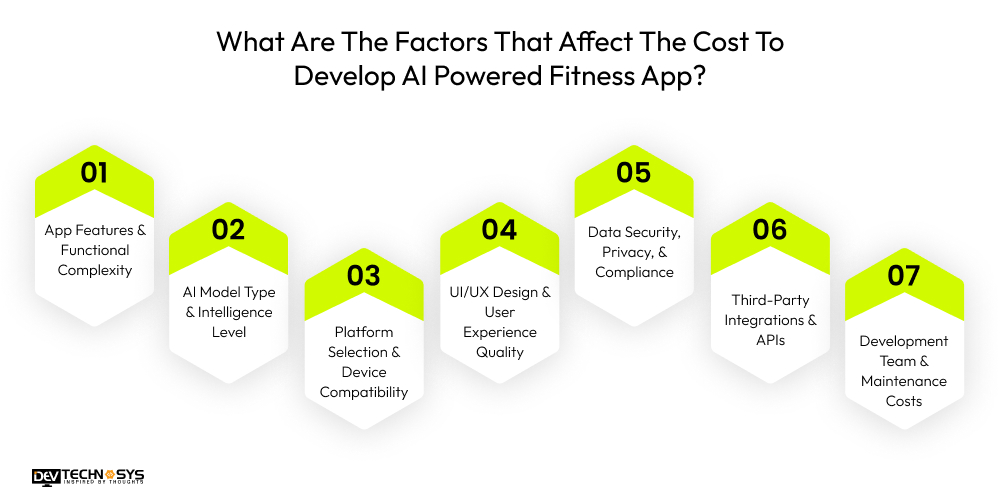
Technical challenges, feature depth, and commercial needs all affect the cost to build an app like Sworkit. AI-Powered fitness app development cost is influenced by several factors, including security requirements and the complexity of AI models. Businesses can create scalable, high-performing, user-centric AI fitness apps by considering these key factors.
1. App Features & Functional Complexity
The cost to build AI powered fitness app is heavily influenced by the number and complexity of features. While more sophisticated features like wearable integration, computer vision form correction, real-time AI coaching, and predictive analytics raise costs, basic exercise recommendations are less expensive.
Every new feature requires additional design, development, testing, and maintenance work, which significantly impacts project costs, schedules, and resources.
Feature Level |
Example Features |
Cost Range |
| Basic | Simple workouts, user registration, and logging | $2,000– $3,500 |
| Intermediate | Progress tracking, adaptive routines | $3,500 – $4,500 |
| Advanced | Real-time feedback, dynamic personalization | $4,500 – $7000 |
2. AI Model Type & Intelligence Level
The choice of AI models influences the cost to build AI powered fitness app. Deep learning or sophisticated machine learning models are more expensive than simple rule-based customisation. Artificial intelligence in fitness app development ensures dependable performance.
Features such as posture detection, predictive injury analysis, and adaptive training require substantial data, training, validation, and optimization. This significantly increases development expenses and long-term maintenance requirements.
AI Level |
Description |
Cost Range |
| Standard | Basic recommendation engine | $13,500 – $16,500 |
| Enhanced | Customized AI model training | $16,500 – $19,500 |
| Advanced | Predictive analytics & behavior modeling | $19,500 – $22000 |
3. Platform Selection & Device Compatibility
Costs are impacted by the decision between cross-platform, iOS, and Android development. It takes more work to support various platforms, devices, and screen sizes. Because of testing, optimization, performance tuning, and platform-specific integrations across many operating systems, the need for further compatibility with tablets, wearables, smart TVs, and IoT fitness equipment drives up expenses even further.
Platform Scope |
Description |
Cost Range |
| Single Platform | iOS or Android only | $10,000– $15,000 |
| Dual Platform | iOS and Android | $15,000 – $22,000 |
| Multi-Device | Adds tablet/wearable support | $22,000 – $30,000 |
4. UI/UX Design & User Experience Quality
The cost to maintain an app and user engagement are directly impacted by well-designed UI/UX. Skilled designers and iterative testing are necessary for custom animations, user-friendly dashboards, customized layouts, and accessibility features. An important cost-influencing factor in AI fitness apps is user-centric design, which raises upfront costs but enhances retention, usability, and brand value.
Design Level |
Focus Areas |
Cost Range |
| Standard | Clean basic design | $3,000 – $4,500 |
| Premium | Custom visuals/wireframes | $5,000 – $7,000 |
| High-End | Immersive UI, motion effects | $7,000– $10,000 |
5. Data Security, Privacy, & Compliance
Sensitive user data is handled by AI fitness apps, raising security and compliance expenses. Specialized knowledge is needed to implement encryption, secure authentication, access controls, and compliance with local data regulations. To ensure user confidence and legal compliance, the AI-Powered fitness app development cost is further increased by regular audits, secure cloud infrastructure, and continuous updates.
Security Tier |
Includes |
Cost Range |
| Essential | Basic encryption, secure login | $900– $2,000 |
| Enhanced | Advanced encryption, secure cloud | $2,000 – $3,000 |
| Compliance Focused | GDPR/HIPAA readiness | $3,000 – $6,000 |
6. Third-Party Integrations & APIs
Development complexity is increased when third-party services such as wearable technology, payment gateways, health platforms, analytics tools, and cloud AI services are integrated. Configuration, testing, and upkeep are necessary for every integration.
The total cost of the project is also influenced by licensing fees, API usage charges, and dependency management, particularly as the app grows and acquires new features.
Integration Level |
Examples |
Cost Range |
| Basic | Payment gateways | $800– $1,500 |
| Moderate | Fitness trackers | $1,500– $2,500 |
| Complex | Multiple API ecosystems + real-time sync | $2,500 – $3,500 |
7. Development Team & Maintenance Costs
The development team’s location, size, and level of experience all affect total expenses. When you hire on-demand app developers, AI engineers, and data scientists, the project costs increase. Long-term planning is crucial for the development of sustainable AI-powered fitness apps, as post-launch maintenance, updates, bug fixes, AI model enhancements, and infrastructure scalability add to ongoing costs.
Team Scope |
Components |
Cost Range |
| Core Dev Only | Frontend + backend | $15,000 – $20,500 |
| Team + QA | Adds quality testing | $21,500 – $25,000 |
| Full Support | Dev + QA + PM + Maintenance | $25,000 – $28,000 |
What Are The Monetization Methods For AI-Powered Fitness App Development?
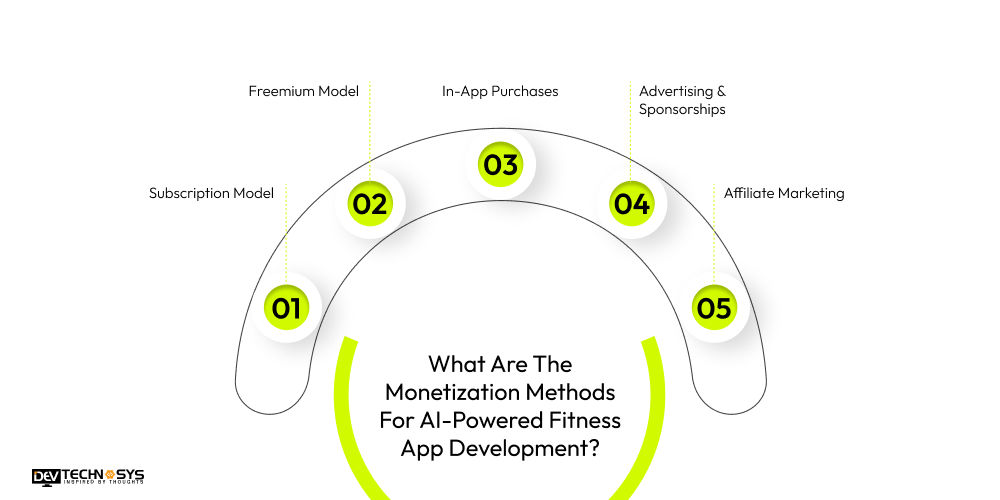
Fitness app development using AI can generate revenue in several ways. Selecting the appropriate approach strikes a balance between user satisfaction and profitability. When you plan to develop AI powered fitness app, audience, engagement, and app features all affect the revenue model. Below are five efficient ways to make money from AI-driven fitness iOS app development services.
1. Subscription Model
To access premium AI-driven features, such as customized workouts, diet programs, and progress tracking, users must pay recurring monthly or annual fees. Subscriptions with tiers accommodate varying degrees of fitness. This guarantees a steady income while promoting ongoing engagement and long-term user retention for those seeking regular, supervised exercise sessions.
2. Freemium Model
Basic program features are free, but in-app purchases are required to access more advanced AI features. A large number of people are drawn to this model because it lets them experiment with exercises and routines before making a financial commitment. Personalized coaching, comprehensive analytics, or premium content are examples of upgrades that can increase engagement and drive revenue from loyal customers.
3. In-App Purchases
Customized exercise regimens, diet plans, AI coaching sessions, or unique challenges are examples of features or content that users purchase. A mobile app development company uses this adaptable model, where consumers can only pay for the content they want while still having access to essential services. It adjusts income based on user demand without limiting access or overall app usage.
4. Advertising & Sponsorships
Displaying tailored ads or working with fitness companies, equipment manufacturers, or health services generates revenue. AI increases relevance without being obtrusive by tailoring advertisements depending on user behavior. Partnerships and sponsored content make money while maintaining the app’s affordability or free-ness, benefiting consumers, sponsors, and app developers alike.
5. Affiliate Marketing
The app generates commissions on sales through suggestions and advertises fitness goods, supplements, and services from third parties. Fitness app development using AI increases conversion rates by tailoring recommendations based on user behavior and preferences.
This approach is a successful value-driven monetization strategy because it generates revenue while providing consumers with relevant products that enhance their fitness journey.
Conclusion
That’s a wrap on how to create AI powered fitness app, and hope all your doubts and confusions are clear. To build an artificial intelligence app in the health and fitness sector could prove highly beneficial to the UAE’s targeted audiences and increase your revenue in the long run.
If you need help with AI-first fitness app development, reach out to DevTechnosys right away. The winner understands the importance of artificial intelligence in fitness app development and pairs it with a sharp strategy and flawless execution.
Frequently Asked Questions
1. What Are The Initial Steps To Build An AI-Powered Fitness App?
Conduct market research, identify the target audience, enumerate features, select AI features, and select platforms. The groundwork for effective development and future scalability is laid by choosing the appropriate tech stack, producing wireframes, and developing a clear roadmap.
2. What Is The Estimated Cost To Develop An AI-Powered Fitness App?
App complexity, AI intelligence, platforms, and design all affect costs. Depending on features, team, and technology options. On average, the cost to make an AI-powered fitness app in the UAE ranges from $10,000 to $35,000.
3. How Long Does It Take To Develop An AI Fitness App?
The features, level of AI sophistication, and platform choice all affect development schedules. Sophisticated AI-powered apps with multi-platform compatibility, real-time analytics, and tailored suggestions can take up to 3-7 months.
4. What Makes A Successful AI Fitness App In The UAE?
Elements that make an AI fitness app successful are:
- Real-Time Feedback
- Gamification & Community Engagement
- Data-Driven Insights & Progress Tracking
- Highly Personalized AI Coaching
- Wearable Integration.
5. What Are The Factors Affecting The Cost To Develop An AI-Powered Fitness App?
Factors affecting the cost to develop an AI-powered fitness app are:
- AI Model Type
- Platform Selection
- Features & Functionality
- Design & Data Security