





Key Takeaways:
-
- The global smart parking market is projected to surpass $16 Billion by 2030, driven largely by AI and IoT adoption.
- AI-powered parking apps integrate machine learning, computer vision, and IoT sensors to deliver real-time availability, predictive analytics, and seamless user experiences.
- Development costs vary depending on AI complexity, IoT integration, and security, typically ranging from $10,000 to $30,000+ for a full-scale solution.
- AI reduces parking search time, optimizes space utilization, and enhances traffic flow, leading to smarter, greener, and more efficient urban mobility.
“Experience the power of AI to transform old parking systems for modern-day users.”
If you are a business investor in the automotive industry looking for an online presence, then modern technologies are waiting for you. The use of AI in parking app development has increased rapidly in the past few years. This is because it reduces time consumption, saves money, and provides efficiency with highly productive features.
Entrepreneurs are not only using AI for automation, but also for personalization, recommendation, and predictive forecasting. In modern parking systems, use of AI is must due to its capability to automate services for users and reduce errors.
So, everything that you should know about AI in making parking applications is discussed here. Let’s not waste much time and explore more, understand more.
Market Stats on AI-Based Vehicle Assistance Apps
Roadside assistance is becoming popular as investment in automobile app development has increased. It is important for an entrepreneur to understand the market growth, revenue, and scope before starting the development:
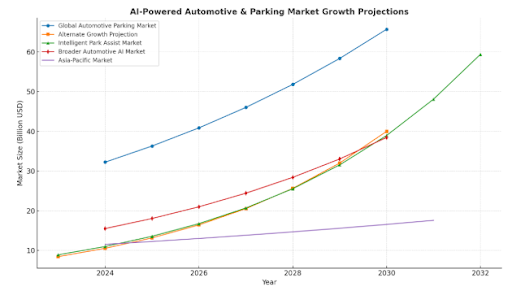
- Global Market Size: The global Automotive Parking market was estimated at $32.24 Billion in 2024, projected to grow at 12.6% CAGR rate, reaching $65.72 Billion by 2030.
- Alternate Growth Projection: Another report says the market was $8.43 Billion in 2023, with a forecast of 24.9% CAGR rate, aiming towards $40 Billion by 2030.
- Intelligent Park Assist Market: This segment is estimated at $8.9 Billion in 2023, with rising to $59.4 Billion by 2032, registering a 23.5% CAGR rate.
- Broader Automotive AI Market: The overall Automotive AI market was valued at $15.51 Billion in 2024 and is forecast to reach $38.45 Billion by 2030, exhibiting a 15.3% CAGR rate.
- Asia-Pacific Market Snapshot: In the Asia-Pacific region, the market was $11.54 Billion in 2024, contributing around 23% ($2.65 Billion), and is expected to grow at a 6.2% CAGR rate between 2024 and 2031.
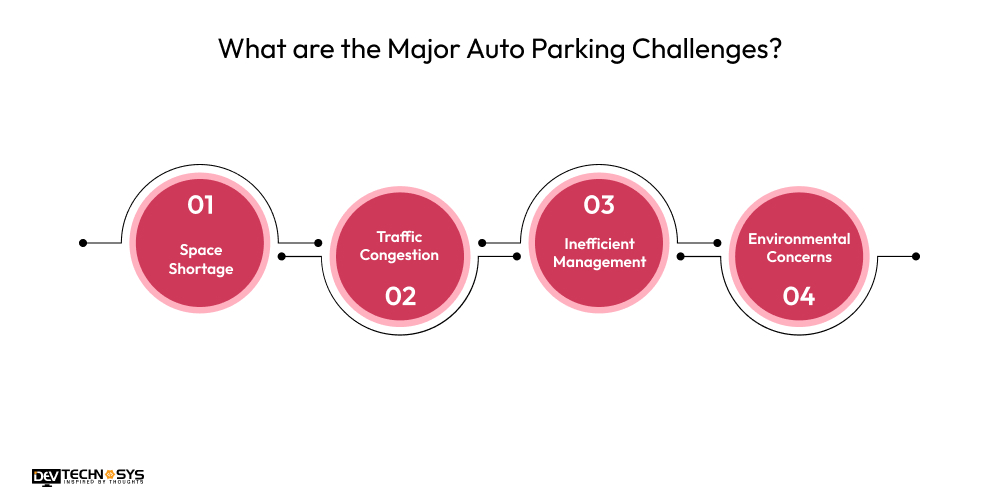
What are the Major Auto Parking Challenges?
As a driver or car owner, you may have faced multiple challenges in parking your vehicles at the right location. There are other challenges as well that we will study in this section deeply:
-
Space Shortage
The rapid rise in the number of cars has outpaced the growth of parking facilities. Cities typically have trouble finding parking spaces, especially during busy times. An AI-based parking space detection system makes city planning more effective.
-
Traffic Congestion
A lot of the traffic in cities is caused by vehicles who are looking for parking spaces by driving around. This not only wastes time on the way to work, but it also makes busy streets even busier. This means that all commuters will have to spend more time on the road and the roads will be less efficient.
-
Inefficient Management
Old-fashioned ticketing and manual monitoring are big parts of traditional parking systems. You must know the cost to maintain an app, to prevent misuse of venues and weak enforcement. This reduces both drivers and operators having operational problems.
-
Environmental Concerns
Long periods of searching for parking burn too much gas and release too much carbon. This makes the air, noise, and energy waste worse. Over time, it makes cities less sustainable and makes life worse for people who live there.

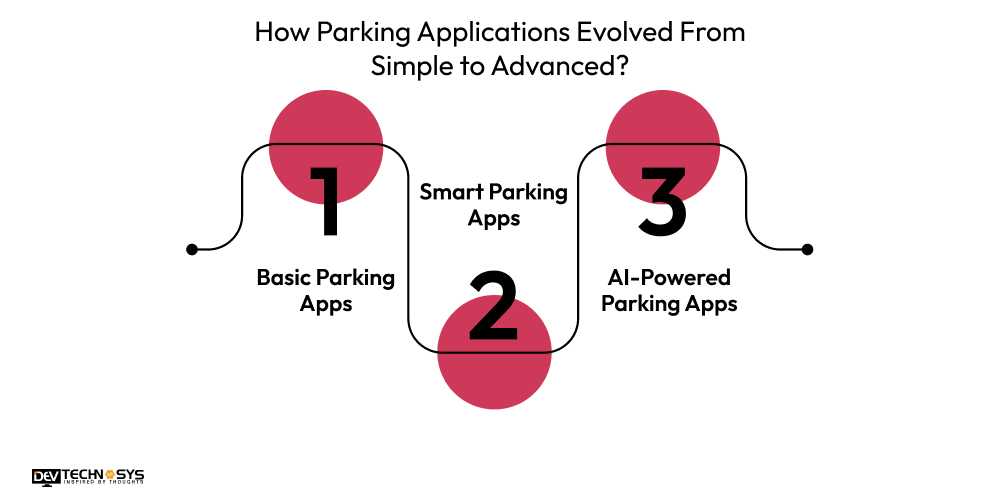
How Parking Applications Evolved From Simple to Advanced?
The evolution of parking apps is quite interesting to know for both businesses and users. So, we have brought this section that will give you the complete journey of roadside assistant apps:
-
Basic Parking Apps
Early parking apps could only show parking lots near you with fixed information. They had to enter data by hand and didn’t get changes in real time. Users had to guess, which often made things frustrating and less efficient.
-
Smart Parking Apps
Parking apps became more engaging as they added GPS, IoT sensors, and digital payments. They began to offer real-time information on parking spots, reservations, and payments without cash. Investment in parking app development made parking easier and decreased manual monitoring.
-
AI-Powered Parking Apps
Various smart parking app solutions with AI improved car parking with predictive analytics and automation. They can predict parking needs, make personalized suggestions, and find the best routes. They also let you change prices on the fly, find fraud, and connect to smart cities without any problems.
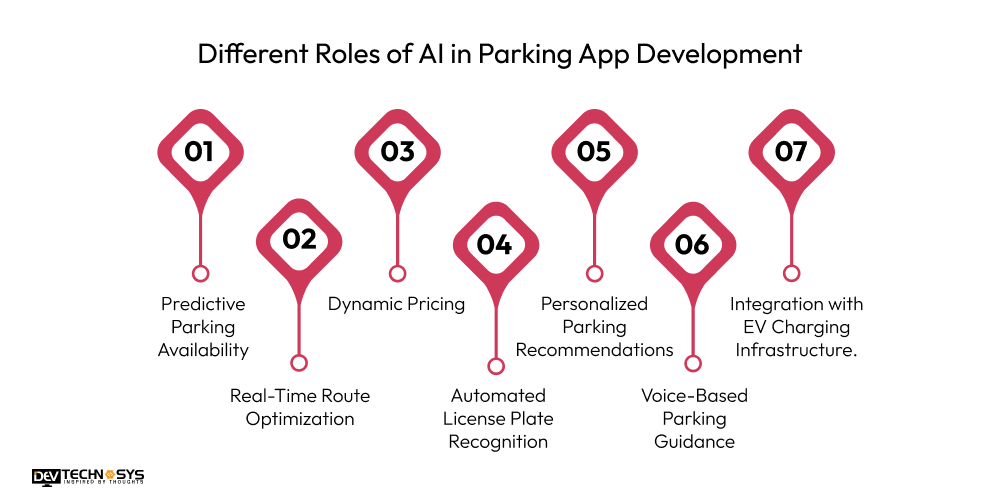
Different Roles of AI in Parking App Development
There are multiple roles of AI in parking app development such as personalization, automation, and forecasting. Let’s study these roles with detailed information in this section:
-
Predictive Parking Availability
Forecasting of parking spaces at different locations like airports, movie theaters, supermarkets, and schools or hospitals has become important nowadays. This encouraged businesses to invest in AI parking assistance app development and launch a solution that resolves all parking related issues.
Predictive algorithms are used to automatically detect vacant spaces or slots in different parking zones. This helps drivers to easily find a suitable location without any difficulty.
-
Real-Time Route Optimization
This AI model is used for multi-storey or long parking zones that helps people to easily find their vehicles. Integrated maps are used to identify a dedicated path which allows users to easily track location of cars and other automotives.
Businesses should contact an Artificial Intelligence development company who has experience in developing such applications with smart and integrated solutions.
-
Dynamic Pricing
Mortgage calculators with AI and other latest technologies help users to easily adjust pricing. This is based on parking locations, vehicle type, and duration. There is a facility for drivers to become a member and take advantage of low-cost parking.
Additionally, they can choose an amount considering different parameters. It helps them to make better parking choices and get extra benefits such as discounts or offers.
-
Automated License Plate Recognition
AI-powered smart vehicle assistance mobile applications enable parking zone owners to identify information of a particular vehicle through number plates. This feature helps in recognizing the vehicles that are lost or stolen and finds the owner of unidentified cars or bikes.
It helps investigators to easily catch criminals and prevent other activities in the region. Additionally, through series parking, you can improve efficiency and save time.
-
Personalized Parking Recommendations
Several options for vehicle parking are provided to drivers which help them in searching the right place for their cars or motorcycles. Additionally, with AI users can easily watch their vehicles in parking areas to prevent them from theft and damage.
There are choices available for users providing a varied range of parking zones. People can book for valet parking services that charge a minimal amount but place the car at suitable locations.
-
Voice-Based Parking Guidance
AI is also used to implement voice recognition modules in different vehicles that allow drivers to get control easily. Businesses can level up their services by implementing facial recognition methods and biometrics. This enhances overall user experiences and ensures proper safety.
These implementations can affect the total cost to develop an app for parking vehicles. So, you must ensure budget flexibility, resource planning, and asset management.
-
Integration with EV Charging Infrastructure
Modern vehicles are being transformed from traditional fuel-based to eco-friendly electric automotives. Here, AI acts as a bridging tool between smart EV innovations and mechanized vehicles. The technology helps to automatically determine the charging level at parking zones.
Additionally, people can schedule the charging of vehicles based on the requirements. This reduces energy loss and helps in managing the car efficiency.
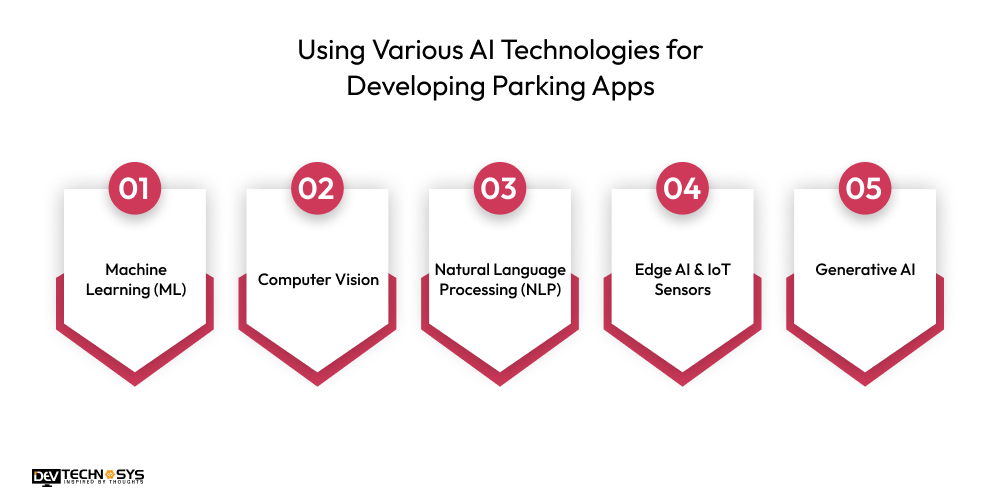
Using Various AI Technologies for Developing Parking Apps
AI includes multiple technologies that help businesses to easily create smart and responsive parking applications. Top AI-enabled technologies like ML and NLP are discussed deeply in this section:
-
Machine Learning (ML)
In order to forecast parking availability and demand trends, machine learning algorithms use both historical and current data. In order to offer tailored parking recommendations, they learn user behavior. Parking app development with Machine Learning increases accuracy over time.
-
Computer Vision
Automatic Number Plate Recognition (ANPR), vehicle detection, and occupancy monitoring are possible by AI-powered cameras. Computer Vision in parking apps prevents fraud, detects violations, and automates entry and exit. This increases enforcement accuracy while lowering manual intervention.
-
Natural Language Processing (NLP)
For smooth communication, NLP underpins voice assistants and chatbots in parking apps. Drivers can use natural voice commands to reserve parking spaces or inquire about availability. You must use iOS app development services in UAE to improve customer service and increase user accessibility to apps.
-
Edge AI & IoT Sensors
To reduce latency, Edge AI and IoT in parking app development processes parking data directly at IoT sensors and gateways. Real-time space occupancy detection using sensors provides users with immediate information. This guarantees quicker decisions without putting too much strain on cloud systems.
-
Generative AI
Generative AI aids in the planning of optimal urban space layouts and the simulation of future parking demands. It can estimate usage, model traffic patterns, and develop flexible parking plans. This helps operators and city planners with long-term planning.

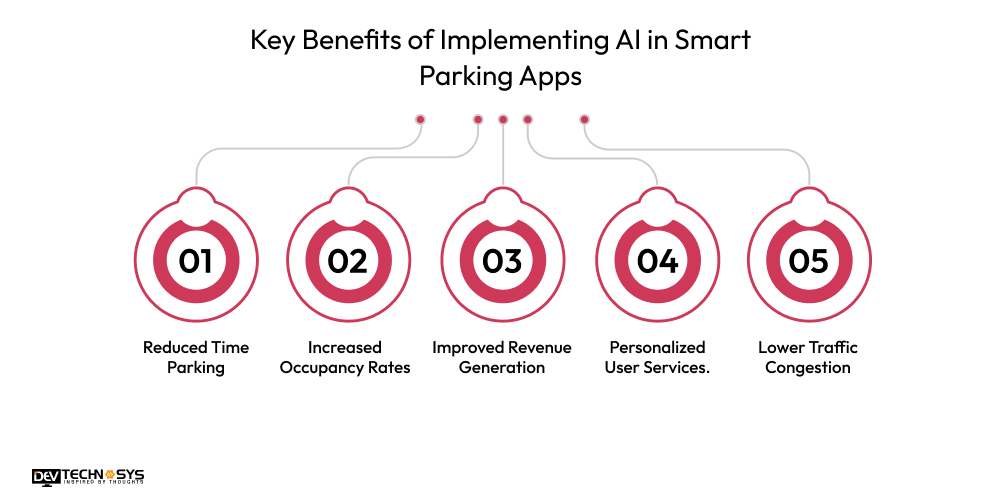
Key Benefits of Implementing AI in Smart Parking Apps
As a business investor, it is your right to know the benefits of AI in parking app development. So, you can easily implement different AI-powered components with the existing and new parking apps:
-
Reduced Time Parking
AI makes it possible for predictive analytics to provide drivers the closest open parking in real time. This cuts down on the time spent looking for parking by driving around in circles. Because of this, drivers have faster, less stressful parking experiences.
-
Increased Occupancy Rates
AI keeps an eye on how parking spaces are used so that they are used to their fullest potential. Investment in AI-powered parking app development balances demand among various locations. This means that operators have more people staying in their buildings and that they can do their jobs more efficiently.
-
Improved Revenue Generation
Dynamic pricing models that use AI change prices based on demand, geography, and time. This keeps costs low during off-peak times and makes the most money during peak times. So, you must avail parking app development services to cut down risks and increase profits.
-
Personalized User Services
AI looks at how drivers act to make personalized suggestions for things like EV charging stations, shaded parking, or premium spaces. Customized suggestions make customers happier and more loyal. It also makes it possible to offer rewards for loyalty and subscription-based models.
-
Lower Traffic Congestion
AI cuts down on unnecessary road traffic by directing drivers straight to open spots. The use of AI-driven parking app development services helps to cut down on traffic jams in busy city areas. In general, this makes traffic run more smoothly and puts less stress on city infrastructure.
Top Case Studies & Real World Examples
Various AI-powered car parking applications are available in different Middle East countries. They assist users in automated vehicle parking through voice-enabled car control and IoT integrated sensors:
-
Mawqef
The Mawqef system from Sharjah Municipality employs AI and ANPR to keep track of more than 90,000 parking spaces. It lets you keep an eye on things in real time, pay with your phone, and sign up for flexible subscriptions to make parking more efficient.
-
RTA Dubai
The Roads and Transport Authority (RTA) in Dubai has put in place smart parking inspection systems that use AI. These use cameras and analytics for regulations, which cuts down on manual inspections. AI in smart city parking solutions are being used extensively in the Middle East.
-
UAE Parking Emirates
Parking Emirates is among the top parking apps in Middle East that combines smart technology with AI-based payment systems. It helps operators make more money by making parking management easier and helping drivers find spots quickly.
-
Parkin
Parkin runs Dubai’s public parking system, using AI and automation to make things run more smoothly. It brings cashless payments, changing prices, and easy access for everyone in the city.
-
EasyPark
EasyPark is an Intelligent parking management system that uses AI to manage parking in the UAE. The software shows you open places in real time, lets you pay with your phone, and helps you find your way there.
Future Trends in AI-Powered Parking Systems
Modern parking applications are automated and smart due to various latest technologies which enhance overall user experiences. In future, these systems will get transformed with the help of new-age tools:
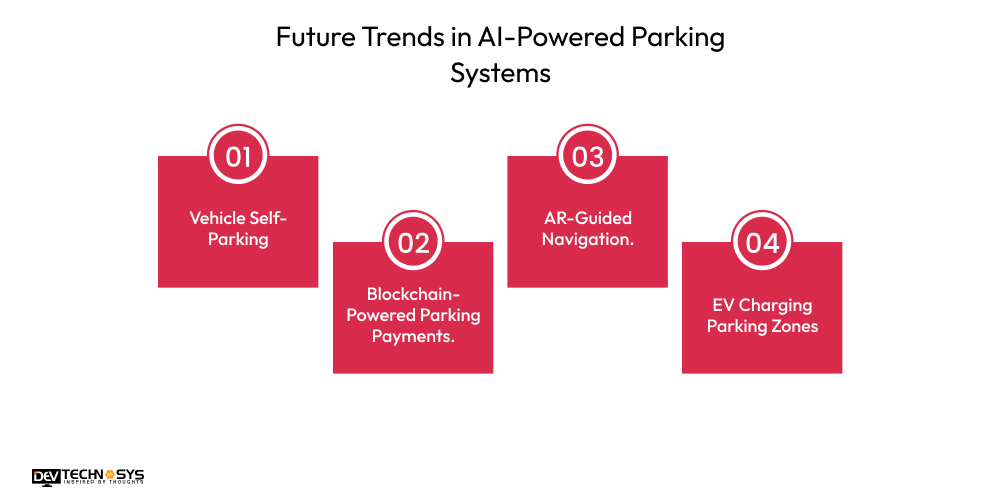
-
Vehicle Self-Parking
AI and self-driving car technology let cars park themselves without any help from the driver. Self-parking systems use sensors, cameras, and real-time navigation to move about accurately. A custom AI parking app development company helps to reduce mistakes and saves time.
-
Blockchain-Powered Parking Payments
Blockchain makes parking transactions clear, safe, and impossible to change. Smart contracts take care of bookings, payments, and refunds on their own, cutting out the need for middlemen. This makes the system more reliable, which increases user trust and operator responsibility.
-
AR-Guided Navigation
Augmented Reality and AI work together to assist drivers see where available parking places are. Overlays on smartphone screens or automobile dashboards show users how to get to their destination step by step. The use of Android app development services makes it easier in busy parking lots.
-
EV Charging Parking Zones
AI-powered EV parking zones make the most use of space and make sure there are enough charging stations. Systems can accurately estimate demand, reserve charging sites, and handle energy distribution in an effective way. This backs the growing trend toward electric cars and green transportation.
How to Implement AI in Parking App Development?
Businesses can use AI in parking app development by first understanding the process of implementation. Here, we will focus on the generally used stages to create user-friendly parking apps with AI:
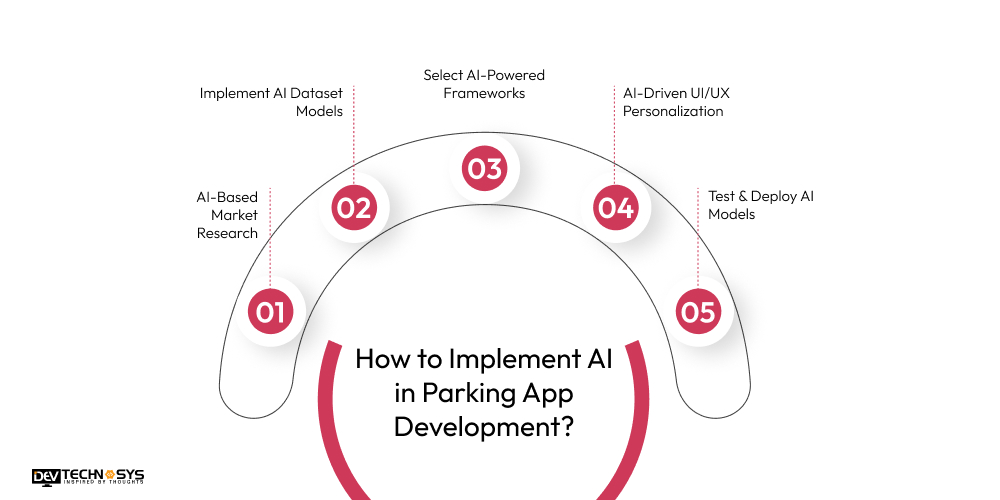
-
AI-Based Market Research
The approach to implement Artificial Intelligence in parking management starts with market research. Trends like high-demand locations and peak parking hours are detected by predictive analytics. This aids in the creation of a development roadmap supported by data. AI makes sure the app’s design takes into account actual parking difficulties.
-
Implement AI Dataset Models
Gather and train datasets from cameras, parking sensors, and usage logs. AI models are developed to identify vehicles, forecast available space, and maximize pricing. You must hire AI app developers for parking apps to ensure accuracy. The system remains adaptable to shifting circumstances through constant retraining.
-
Select AI-Powered Frameworks
Robust model performance is ensured by selecting the appropriate AI frameworks, such as TensorFlow, PyTorch, or OpenCV. Predictive analytics, image recognition, and natural language comprehension are among the features that these frameworks enable. So, you must develop a parking app to guarantee future-ready and reasonably priced app development.
-
AI-Driven UI/UX Personalization
By recommending the closest parking spaces and preferred payment options, AI personalizes the user experience. Navigation and notifications can be customized with the use of behavioral data. Chatbots and voice assistants make user engagement easier. Higher levels of client pleasure and loyalty result from this.
-
Test & Deploy AI Models
Thorough testing guarantees that AI models function correctly in practical settings. Predictions on parking availability, cost, and occupancy are verified using simulations. Models are sent to production with real-time monitoring after verification. Long-term dependability and effectiveness are guaranteed via ongoing feedback loops.
What is the Cost of Making AI-Based Car Parking Apps?
There are several factors that influence the cost of implementing AI in parking app development. The average rate is between $10,000 to $30,000 which may exceed due to these factors. Let’s study them deeply with their respective cost tables in this section:
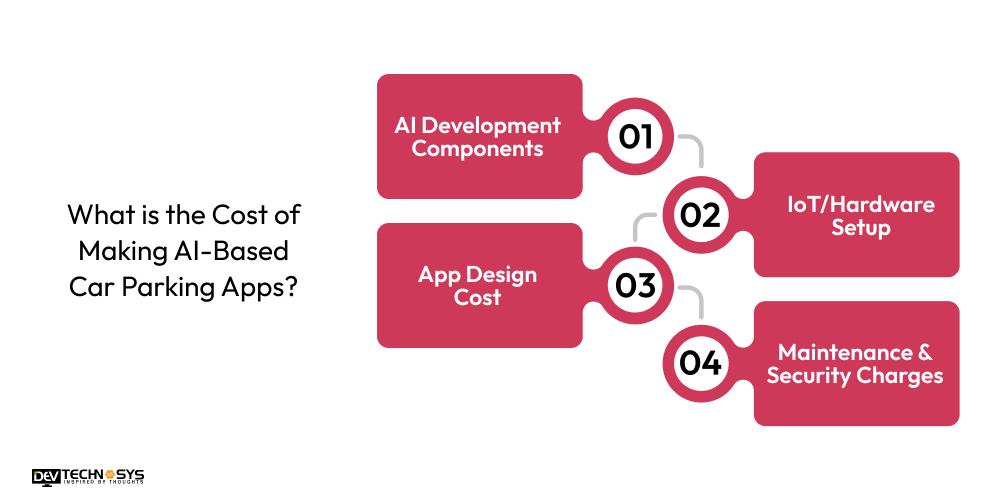
1. AI Development Components
The total parking app development cost is highly dependent on different AI components. Use of Machine Learning and Computer Vision is cheaper than highly advanced NLP systems. Additionally, Edge Computing is also expensive but provides advanced services and features.
Component |
Estimated Cost Range (USD) |
| Predictive Analytics Models | $8,000 – $15,000 |
| Computer Vision (ANPR) | $10,000 – $18,000 |
| Dynamic Pricing Algorithms | $6,000 – $12,000 |
| AI Chatbots & NLP Integration | $5,000 – $10,000 |
| Cloud AI Integration (AWS/Azure/Google AI) | $7,000 – $14,000 |
2. IoT/Hardware Setup
The cost to build a vehicle parking application is affected by the inclusion of IoT and robotics. Various hardware modules are liable to affect the overall development rate because of complexity and time consumption. Multiple sensors are used with AI algorithms to ensure safe and secure parking.
Component |
Estimated Cost Range (USD) |
| Smart Parking Sensors | $20 – $50 |
| AI-Powered Cameras | $300 – $800 |
| Edge Devices/Gateways | $1,500 – $3,000 |
| Networking & Connectivity | $5,000 – $10,000 |
3. App Design Cost
The cost to develop a parking app is highly influenced by the design of a vehicle parking application. Manual designing with languages like HTML, CSS, and JavaScript takes time and requires a high investment. But, frameworks such as React.Js reduce the overall amount of time and money.
Component |
Estimated Cost Range (USD) |
| UI/UX Design | $4,000 – $8,000 |
| Mobile Platform Development | $10,000 – $20,000 |
| Payment Gateway Integration | $3,000 – $7,000 |
4. Maintenance & Security Charges
A mobile app should be maintained and secured regularly to prevent unauthorized access. There are multiple small and medium tasks involved like bug fixes, authentication, and encryption which affects the cost. So, you must list all processes before using mobile app maintenance services.
Component |
Estimated Annual Cost (USD) |
| Regular AI Model Training | $5,000 – $12,000 |
| App Updates & Bug Fixes | $4,000 – $8,000 |
| Cloud Hosting & Storage | $3,000 – $6,000 |
| Cybersecurity Measures | $5,000 – $10,000 |
| Customer Support & Monitoring | $4,000 – $9,000 |

In a Nutshell!!
Now, you have gained enough knowledge on AI and its technologies that are used for making smart parking systems. So, it’s time to approach a mobile app development company like Dev Technosys who caters to user preferences and provide:
- Insights on various business models that use AI in parking app development.
- Affordable services from consulting to maintenance for making automated parking solutions with AI.
- Budget planning to easily manage the development and deployment cost.
- Tips for revenue generation and how to make profit with new parking systems.
With this, you can easily establish a leading brand that can offer user-friendly features with the help of AI. Additionally, user engagement and retention will also increase in return.
FAQs
1. What is the Average Cost of Making AI-Powered Parking Apps?
The average cost breakdown is discussed below:
- For personalization, the cost ranges from $10,000 to $20,000.
- The rate is between $20,000 to $25,000, for automation features.
- It may exceed more than $30,000 due to predictive analytics.
2. Why Implement AI in Parking App Development?
Using AI for developing parking apps is beneficial because:
- It provides voice commands for smart parking.
- Includes suggestions based on past experiences.
- Helps to manage accidents with automated IoT sensors.
3. How to Hire Expert AI Developers?
To hire skilled and smart AI developers, you must:
- Prepare a document listing budget requirements.
- Analyze their work and conduct technical interviews.
- Consult your AI goals and start development.
4. Which AI Components are Used for Developing Parking Apps?
Three major AI components are used for making parking apps:
- Voice Assistant – It helps drivers to control vehicles with voice commands.
- Predictive Forecasting – Enables people to judge parking locations easily.
- Personalized Vision – This provides user-specific parking options and payments.
5. How AI Ensures User Data Security?
AI provides user data security by following measures:
- Uses fraud detection to prevent unauthorized parking.
- AI-powered security algorithms ensure safety of user data.
- Predictive maintenance helps in identifying and removing errors.