





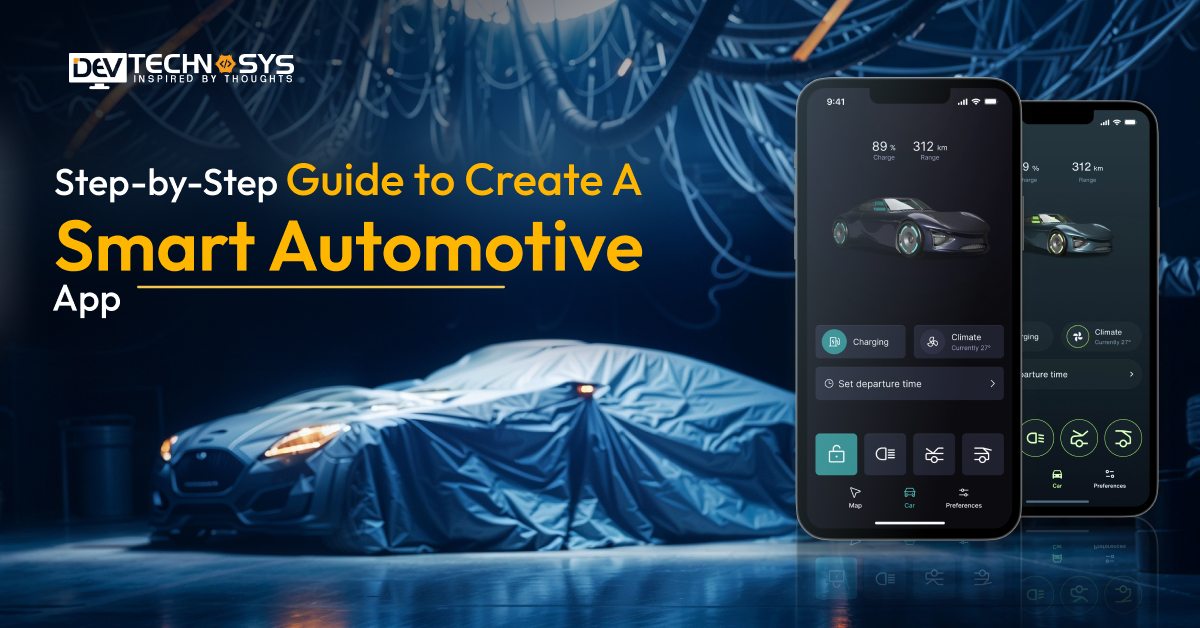
The automotive sector is well on its way to converting to a digitally transformed system, with innovative automotive applications leading the way. As connected vehicles and driver-friendly technologies continue to enter the mainstream, it is forecast that the global automotive software market will reach $80 billion by 2030, growing at a compound annual growth rate (CAGR) of more than 14%.
Smart apps enable vehicle owners and fleet operators to access on-demand diagnostics, remote vehicle vetting, predictive maintenance, navigation, and more directly from their smartphone or smart device.
Whether you are an automotive startup, a fleet operator, or a tech-focused entrepreneur, building of a smart automotive app can leverage this growing ecosystem. In this blog, we will walk you through a step-by-step process of how to create a smart automotive app, from preliminary planning to engagement and implementation.
What is a Smart Automotive App?
A Smart Automotive App is a mobile and web-based application that utilizes the approaches discussed in this blog to enhance the user and buyer driving experience, vehicle performance, safety, and convenience. User-friendly features are typically powered by the assessment of data through external or internal connections to vehicles and vehicle systems.
Smart automobile technology not only designs user-friendly equipment but also proposes smart features that offer greater capabilities beyond navigation or entertainment control.
5 Top Smart Automobile Applications 2025
If you want to create a smart automotive app, you must know about these five amazing applications in the market.
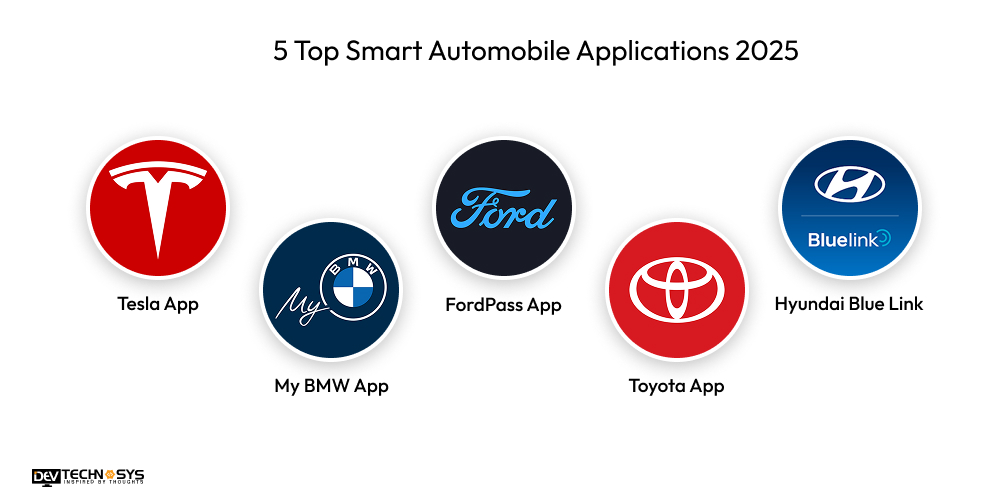
Tesla App
(Launched: 2014 | 10M+ Downloads)
The Tesla app lets owners turn on the car, check the battery, and set up charging, all from their pocket. It also pushes software updates and feeds real-time route info, making every trip feel a little fresher.
My BMW App
(Launched: 2020 | 5M+ Downloads)
My BMW tells drivers whether the door is locked, the cabin air is cool, or the battery needs juice. Also, it sets service dates with one tap. It slots neatly into the brand’s larger cloud and feeds EV perks such as station maps and pre-warming.
FordPass App
(Launched: 2016 | 5M+ Downloads)
FordPass links users to their Ford for remote start, lock/unlock, vehicle health alerts, and live traffic updates. The automobile app development incorporates parking finders, fuel maps, and Ford services, transforming a phone into a quick co-pilot.
Toyota App
(Launched: 2019 | 5M+ Downloads)
Toyota’s official app sparks the engine, tracks upkeep, finds lost cars, and books dealer time, all with a finger. It works on both gas and hybrid models, providing families with extra peace of mind and precise control.
Hyundai Blue Link
(Launched: 2012 | 1M+ Downloads)
Bluelink by Hyundai packs remote start, climate push, health checks, and emergency calls into a single dashboard. Parents can set geofences and speed caps, so a sweet ride stays a safe ride.

5 Reasons Why Entrepreneurs Want to Create a Smart Automotive App
Before we dive into the section to build a smart automotive app, you must know about its benefits. In this section, we have covered automobile industry trends that raise the demand for building it among entrepreneurs.
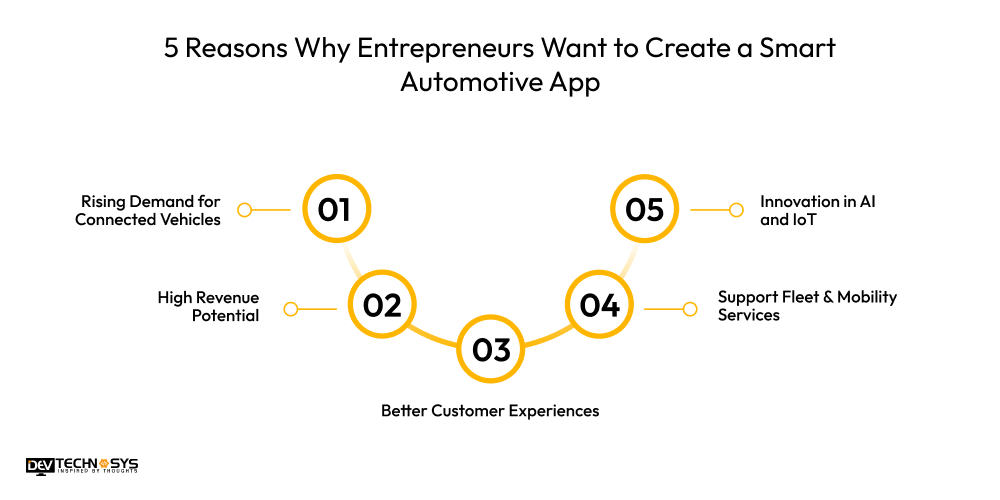
Rising Demand for Connected Vehicles
As car buyers lean toward tech-laden machines, savvy startups are chasing the wide-open space left by apps that offer remote control, smart diagnostics, and driver-assist tools.
High Revenue Potential
Smart automotive apps can generate revenue streams through subscriptions, in-app purchases, partnerships, and the sale of data insights, making them compelling, scalable, and attractive business models with multiple revenue streams.
Better Customer Experiences
Automobile data analytics provide customers with real-time information, service reminders, and personalized insights about driving, which help entrepreneurs foster deeper, long-term engagement with users and enhance customer loyalty.
Support Fleet & Mobility Services
The founders of logistics or ride-share companies utilize smart automotive apps to oversee their fleets, focusing on daily vehicle health and driver safety. Responding to data leads to efficiency gains, cost reduction, and productivity increases.
Innovation in AI and IoT
Given the advancements in AI and IoT technologies, it is now a reality for entrepreneurs to develop innovative automotive apps that address and improve transportation problems, creating a competitive advantage.
5 Categories of Smart Automotive Applications
Let’s dive into the types of smart automotive applications to know more about them. If you want to create a smart automotive app, knowing about these types will help you a lot in making the application successful.
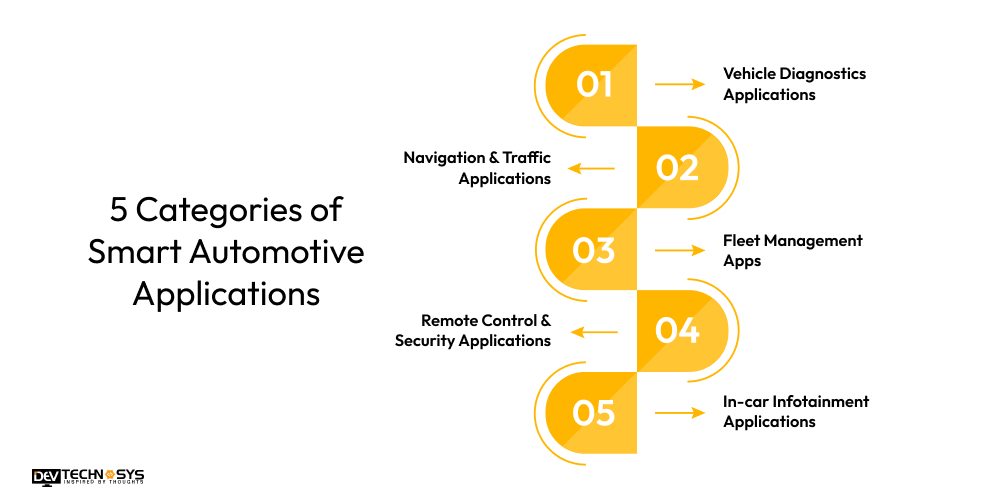
Vehicle Diagnostics Applications
These types of applications connect with the car’s onboard system to evaluate engine health, fuel levels & possible error codes. Users can receive real-time alerts and suggested maintenance to produce better vehicle performance and safety.
Navigation & Traffic Applications
Smart Navigation applications are based on real-time mapping, traffic data, artificial intelligence, and GPS, providing road or traffic alerts, estimated time of arrival, and even route planning to avoid traffic and save time.
Fleet Management Apps
These applications are utilized by transportation and logistics companies to track the locations of their vehicles, fuel consumption, driver behavior, and route effectiveness, thereby enhancing operational control and reducing costs.
Remote Control & Security Applications
These applications enable users to lock and unlock doors, start engines, adjust climate controls, and receive notifications of theft. These features will enhance vehicle security and convenience.
In-car Infotainment Applications
These applications enable music, podcasts, navigation, hands-free calls, and voice control, providing entertainment and connectivity to drivers. The development of these applications will make the time spent in the vehicle enjoyable while limiting distractions from driving.
6 Steps to Develop Smart Automotive Apps
Developing a smart automotive app requires a strategic and methodological approach. Automobile app development companies possess the resources to create innovative, functional mobility automotive apps that cater to user needs. Here are the six key steps:
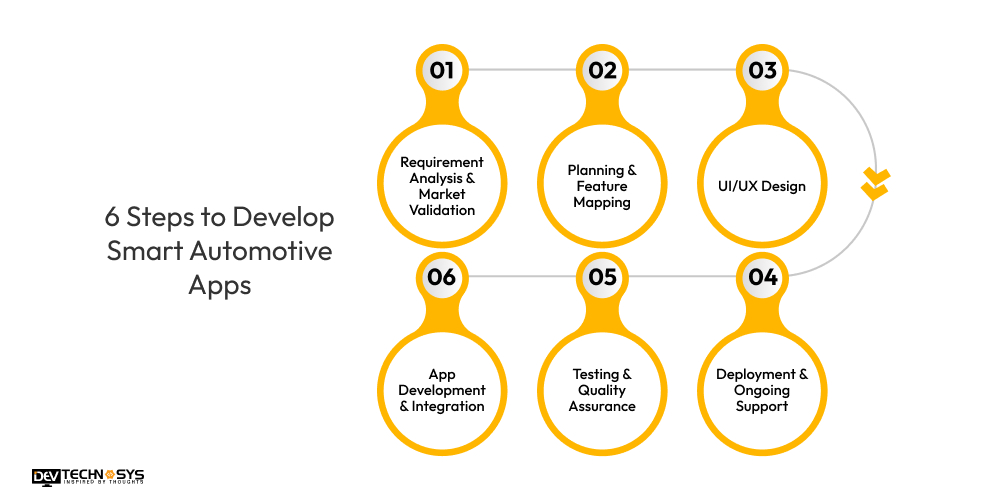
1. Requirement Analysis & Market Validation
This is the first step to defining the app’s objective, target audience, and application features. A development company will conduct in-depth market validation and competitor analysis, working with you to define user expectations and identify pain points. This process helps establish a reliable initial foundation for developing your application.
2. Planning & Feature Mapping
Once the requirements have been established, the development team creates a roadmap and develops a tech stack (AI, IoT, GPS, etc.) for your automotive app. They will map out core features, including live diagnostics, remote vehicle control, navigation, predictive maintenance, and user dashboards.
3. UI/UX Design
This is the third stage in developing a smart automotive app, where ease of use is a key part of a successful smart automotive app. Designers focus on the best layout, usability journeys, and responsive frameworks. The goal is to provide users with a seamless experience whether they’re driving, parked, or accessing the vehicle data remotely.
4. App Development & Integration
Development occurs in this section through both backend and frontend development, database configuration, and the integration of smart technologies. Developers must also create secure APIs that help the app interact with vehicle systems or third-party platforms.
It is here that functionality for real-time features such as GPS tracking, IoT connectivity, and cloud sync will be implemented.
5. Testing & Quality Assurance
Before the application launch, the app undergoes rigorous testing of various aspects, including performance, usability, security, and compatibility. The development company also simulates real-world driving scenarios to ensure the app functions as intended across various scenarios and devices.
6. Deployment & Ongoing Support
Upon successful testing, the application is deployed to various app stores or connected vehicle platforms. The automobile app development company in Dubai continues to support the app post-launch for issues such as bug fixes, repairs, regular updates, performance monitoring, and any enhancements to features added as a result of user feedback.
The hired automotive developers will offer you the affordable cost to maintain an app if you get their yearly support.
Features of Smart Automotive App
Here is the list of features of the smart automotive apps that you just need to pin down in your notes to include while building the app.
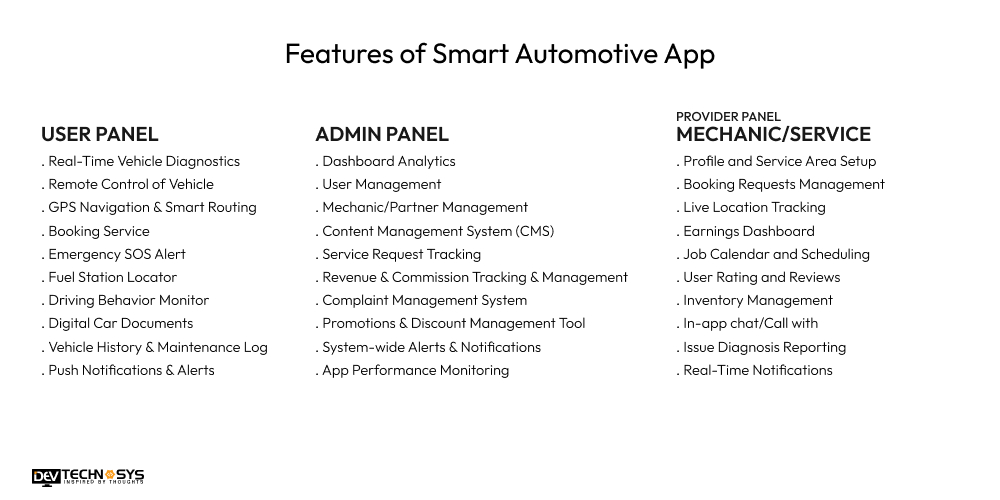
1. User Panel
Real-Time Vehicle Diagnostics
Monitor engine diagnostics, battery charge levels, tire pressure,, and fuel levels through sensors in connected vehicles and OBD II connectivity for reminders and alerts on maintenance needs or safety concerns.
Remote Control of Vehicle
Remotely operate features of the vehicle like engine start/stop, door lock/unlock, and even climate settings via a smartphone for comfort and safety.
GPS Navigation & Smart Routing
Provides live traffic updates with route recommendations and voice navigation using artificial intelligence (AI) and GPS for ease and smoothness of travel.
Booking Service
Book your vehicle servicing, repairs, or checkups through the app, selecting the date and time of your choice, and choose your preferred workshop for added convenience.
Emergency SOS Alert
Automatically send your location and vehicle condition to emergency contacts and nearby service providers in the event of an accident or breakdown.
Fuel Station Locator
Locate nearby fuel or EV charging stations with real-time availability and pricing information, enabling more efficient stops while on long drives.
Driving Behavior Monitor
Track speed, braking, acceleration,, and cornering while providing safe driving scores and driving insights to improve driving behavior.
Digital Car Documents
Upload and store your RC, Insurance, Driving License, and Pollution Certificate digitally for easy access while stopped by traffic services or in emergencies.
Vehicle History & Maintenance Log
Keep track of past services, repairs, and maintenance for transparency, so you can manage future checkups and resales with more documentation.
Push Notifications & Alerts
Receive service reminders, software updates, low fuel notifications, and updates on vehicle concerns to be fully informed no matter which service you use.
2. Admin Panel
Dashboard Analytics
Have a clear understanding of how your app is being used, active users at any given time, types of vehicles booked, service requests submitted, and revenue data to help with business decisions.
User Management
Manage the user’s account, user permissions, and verification statuses. Manage support issues or tickets and provide support to help users easily use the app, ensuring good customer service.
Mechanic/Partner Management
Onboard new service partners or mechanics, review their service ratings, manage their payout requests, and verify compliance documentation to throttle abuse and protect your business.
Content Management System (CMS)
Change and manage FAQs, terms, banter advertisements, service categories, blog content, etc. With our easy-to-use interface, you can make changes to your content in real-time.
Service Request Tracking
Track all service requests, bookings, cancellations, and the status, closes at fulfillment, and for your operations department to function efficiently.
Revenue & Commission Tracking & Management
Track all service fees, commission fees, tax, and scheduling payouts automatically for easy bookkeeping and to ensure your business is on solid financial ground and avoids issues from a financial standpoint.
Complaint Management System
View, assign, or respond to user or mechanic complaints to help keep your customers satisfied and their trust in your service.
Promotions & Discount Management Tool
Create and manage coupons, loyalty rewards, and promotional offers to better engage users and increase the use of services.
System-wide Alerts & Notifications
You can mass alert, update a message, or broadcast an emergency message to all users and partners.
App Performance Monitoring
Measure iOS app development in the UAE for the automotive industry. It helps loading time, crash reports, and usage metrics to identify and resolve technical issues proactively.

3. Mechanic/Service Provider Panel
Profile and Service Area Setup
With automobile app development, create a service profile that details specialties, operating hours, and a geographical radius to highlight the types of local bookings available.
Booking Requests Management
View new service requests, accept/reject jobs, and update status (in progress, completed, canceled) in real time.
Live Location Tracking
Option to share GPS location with users to assist users’ directions while traveling to the workshop or when mobile mechanics are on the way to the user.
Earnings Dashboard
Review daily, weekly, and monthly earnings, bonuses, and payout from completed jobs to gain visibility of your financial situation.
Job Calendar and Scheduling
View appointments and check availability to prevent overbookings and ensure timely service and delivery.
User Rating and Reviews
Access to user feedback will help you improve your services and maintain high service quality and reliability for your profile and customers.
Inventory Management
Track available parts and tool stock levels to reduce delays caused by low inventory and improve service turnaround times.
In-app chat/Call with
With automobile app development, users can communicate with each other regarding service requirements or job updates to mitigate confusion and delays.
Issue Diagnosis Reporting
Allowing mechanics and service providers to capture detailed reports of what issues were found on the car, parts needed to remedy the issues, and estimates for repair costs before emailing them to users for approval.
Real-Time Notifications
Receive instant notifications for new job requests, user cancellations, or payments being processed to keep mechanics up-to-date.
How Much Does It Cost to Create a Smart Automotive App?
The cost to create a smart automotive app typically falls within the range of $8,000 to $25,000 or more, depending on the app’s complexity, functionality, and the type of development process.
A more rudimentary app and one with limited functionality is likely to be on the lower end of that range, whereas an app with extensive functionality using AI, IoT, and real-time vehicle data will significantly surpass that.
Let’s take a closer look at seven key factors that will influence the overall cost of creating a smart automobile app:
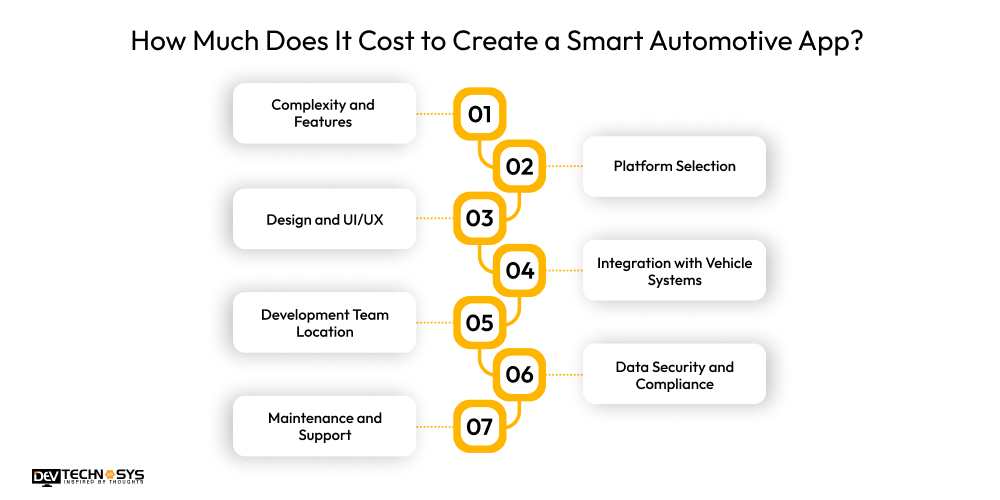
1. Complexity and Features
The more complex or functional you want the app to be, such as remote vehicle control, predictive vehicle maintenance, voice commands, augmented reality/virtual reality integration, or data analytics capabilities powered by AI, the cost to create a smart automotive app will increase.
Features like navigation or service reminders are cheap compared to new real-time vehicle diagnostics systems or advanced fleet management systems.
Feature Type |
Estimated Cost Range |
| Basic Features | $1,500 – $4,000 |
| Intermediate Features | $4,000 – $8,000 |
| Advanced Smart Features | $8,000 – $15,000+ |
| Premium Integrations (AR/VR, AI/ML) | $12,000 – $20,000+ |
2. Platform Selection
When developing for either Android or iOS, the costs are less than when developing for both platforms. Additionally, utilizing integrated libraries like Flutter or React Native, which are cross-platform, can help reduce the cost of creating a smart automotive app. Native development typically incurs higher costs, but in many cases, it delivers better performance than other methods.
Platform Type |
Estimated Cost Range |
| Single Platform | $6,000 – $12,000 |
| Dual Platform | $12,000 – $20,000 |
| Cross-Platform | $8,000 – $16,000 |
3. Design and UI/UX
Design is any custom UI/UX design the app may require beyond standard user experiences, such as app-specific interfaces, driver-friendly interfaces, and smart navigation, which can increase the overall cost of creating a smart automotive app.
Regardless, the way to maximize the odds of success of the app is to create an app with a memorable user experience, and some of that experience should be friendly and reliable.
Design Scope |
Estimated Cost Range |
| Standard Design | $1,000 – $2,500 |
| Custom UI for Drivers | $2,500 – $5,000 |
| Premium User Experience | $5,000 – $8,000+ |
4. Integration with Vehicle Systems
Linking the application to in-vehicle systems through APIs, CAN bus, or OBD-II devices requires specialized technical expertise and adds time and cost to creating a smart automotive app. Building a real-time sync and integrity with vehicle hardware adds complexity, and there’s more variability from car to car or across brands.
Integration Level |
Estimated Cost Range |
| Basic Integration | $2,000 – $4,000 |
| Medium Integration | $4,000 – $8,000 |
| Advanced Integration (Real-time) | $8,000 – $15,000+ |
5. Development Team Location
Where your automobile app development services provider is located has a big influence on the cost of building a smart automobile app. In the US and Europe, you’ll pay $80–$150/hour for good developers. On the other end of the scale, you can get good developers in India or Eastern Europe for $25–$60/hour.
Region |
Total App Cost Estimate (Avg.) |
| USA / Canada | $25,000 – $45,000+ |
| Western Europe | $20,000 – $35,000 |
| Eastern Europe | $10,000 – $20,000 |
| India / Asia | $8,000 – $15,000 |
6. Data Security and Compliance
Automobile app development typically involves monitoring sensitive data, which means implementing adequate security protocols, encrypting data, and complying with regulations such as GDPR or ISO standards. This. This adds to the cost to develop a smart automobile app but is vital to earn trust and ensure legal safety.
Security Level |
Estimated Cost Range |
| Basic Security | $1,500 – $3,000 |
| Standard Compliance | $3,000 – $6,000 |
| Enterprise-Level Security | $6,000 – $10,000+ |
7. Maintenance and Support
Ongoing updates, performance monitoring, bug fixes, and customer support are paramount to the long-term success of the cost of develop a mobile app. Typical maintenance costs range from 15-20% of the initial build costs per annum.
Maintenance Category |
Annual Cost Estimate |
| Basic Support | 10–15% of build cost |
| Full Maintenance | 15–20% of build cost |
| Enterprise Support | 20–25% of build cos |
Creating a smart automotive app is a strategic investment. Knowing about the factors of cost to develop a smart automobile app enables you to build an effective budget while selecting the right mobile app development company allows you to create a solid, scalable, and future-proof solution that meets your automotive business needs.
How AI Impacts Smart Automotive Apps?
Artificial Intelligence (AI) is playing a transformative role in improving the capabilities of Smart Automotive Apps. Here is how AI in automobile apps provides a HUGE benefit:

-
Predictive Maintenance
AI provides a predictive maintenance function by analyzing real-time and historical data of a vehicle to predict a failure before it happens—allowing an operator to “forecast” repairs and schedule service before a breakdown occurs. This will significantly reduce repair costs and associated downtime.
-
Driver Behavior Analysis
AI tracks and assesses driving habits, including speed, braking, and acceleration. These data can improve vehicle safety, reduce fuel costs, and can even be input into user insurance programs for a custom premium price.
-
Smart Navigation & Traffic Insights
AI Android app development solutions can suggest the best routes through smart navigation by looking at traffic trends, weather, and road closures to help users get to their destinations more safely and efficiently.
-
Voice Assistants & Automation
AI enables users to invoke automated systems and communicate via voice commands without needing to take their hands off the wheel. Using voice-enabled controls for climate, navigation, or music allows for a distraction-free driving environment, creating convenience and a safer driving experience.
-
Real-Time Vehicle Diagnostics
AI analyzes incoming data from different sensors for irregularities in engine performance, battery health, or tire pressure. Users receive instant alerts or scored scores of the analysis.
5 Monetization Situations of a Smart Automotive App
Monetizing a smart automotive app properly will ensure long-term sustainability and revenue. Using the car wash app development capabilities, features, and user data, there are multiple streams of income that businesses can develop. Here are five monetizing methods that are being used by organizations to develop these streams:
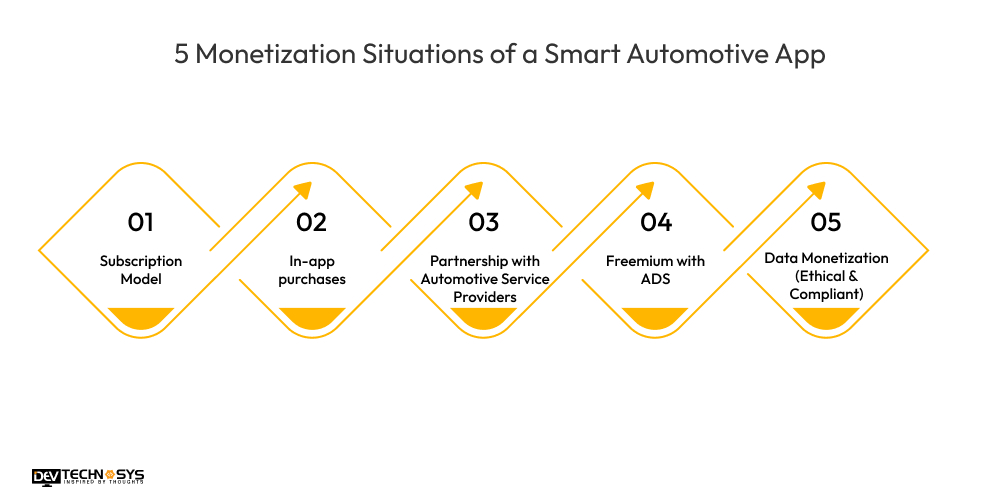
1. Subscription Model
Maximize advanced features by providing monthly or yearly subscriptions. Users could have access to premium features, including real-time diagnostics, remote controls, predictive maintenance notifications, and navigation tools for smart routes (taken for taxi vehicles). This will provide a baseline monthly or yearly income while suggesting continuous enhancements of features.
2. In-app purchases
You can offer users additional services in-app, like a custom report of their vehicle, service reminders, or even AR virtual try-ons for car accessories. In-app purchases are an excellent way to upsell valuable tools without having to force the user to additionally subscribe.
3. Partnership with Automotive Service Providers
You could partner with vehicle repair shops, insurance companies, fuel stations, or automotive accessory brands to provide user services through their platforms. You could earn a commission from every user action performed through the automobile app development if they book a service, purchase an additional warranty, etc.

4. Freemium with ADS
You could provide free access to basic features and display non-intrusive ads from automotive brands, GPS services, or local dealerships (provide business opportunities for partners). As the app grows in user base, your impressions and clicks will continue to provide a revenue base. You can also charge for a free ad service.
5. Data Monetization (Ethical & Compliant)
If the user consents to this and proper data privacy procedures are followed, anonymized data (driving patterns, vehicle performance, maintenance trends, etc) can be shared with research agencies, insurance companies, or car manufacturers to extract insights. This allows the industry to continue offering better services while providing your app with passive income.
Conclusion!
Designing a smart automotive app requires planning and the right technology stack, and you need to do things correctly. When developing a smart automotive app, from idea and feature planning through to development, testing, and product launch are all part of building an effective experience for the user of your automotive solution.
Connected mobility will create momentum and increase customer engagement, meaning it makes sense to invest and develop a smart automotive app now.
How Can Dev Technosys Help?
As a digital product agency and an automotive app development company, Dev Technosys can support you end-to-end to design and develop scalable, secure, and innovative smart automotive apps. Our automobile app developers provide solutions that align with your business vision.
FAQ
1. What Is The Best Technology Stack For Build A Smart Automobile App?
Your smart automotive tech stack should ideally include Flutter or React Native for the app (front), Node.js or Python for the back end, AWS or Azure for the cloud, and MQTT or HTTP for IoT communication.
2. How Do I Ensure Data Security In A Smart Automotive App?
Use end-to-end encryption, secure application programming interfaces (APIs), regular security audits, and compliance with automotive security standards, including ISO/SAE 21434, to protect user and vehicle data.
3. Do I Need Automotive Compliance Certifications?
Yes, there are regulations you must comply with, such as ISO 26262, GDPR, and local transport regulations on data (if any), in order to legally, safely, and reliably use your app across regions.
4. Can I Integrate Third-Party APIs into My App?
You can integrate maps, payment gateways, weather, insurance, and vehicle data platform APIs. Enhancing functionality and user experience can be accomplished via integrated third-party APIs.
5. What Team Do I Need To Develop A Smart Automotive App?
You will need mobile and backend developers, UI/UX designers, quality assurance (QA) testers, IoT engineers, and a project manager to oversee necessary technical and operational aspects of development.