





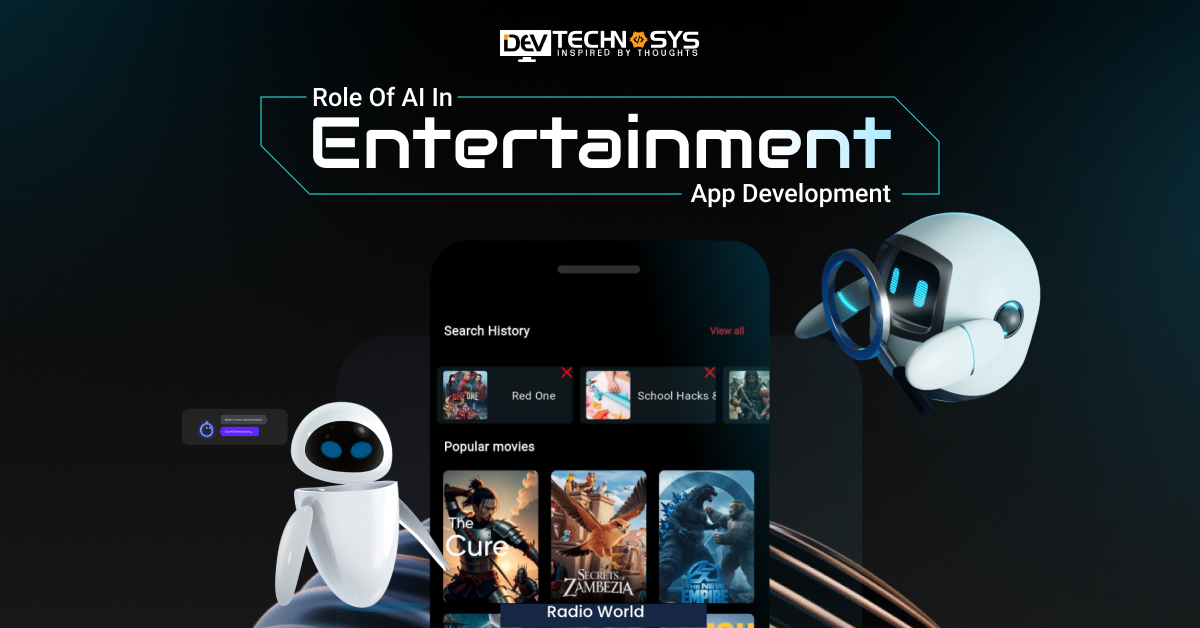
In this digital world, technology is advancing at lightning speed with AI, Artificial Intelligence. Whether it is the e-commerce, on-demand, or healthcare industry, no industry is operating without the influence of AI. So, how could AI in entertainment app development be left behind?
The role of AI in entertainment app development has transformed the way users create, distribute, and consume content. With this, people can have access to a large spectrum of content, be it movies, TV shows, web series, and whatnot.
This has also leveled up the expectations of the users and demand for personalized recommendations, intelligent search, real-time content moderation, and immersive experiences. From music and video streaming platforms to gaming and social media apps, Artificial intelligence in entertainment app development has set new standards for digital experiences.
So, in this blog, we will understand the role of AI in entertainment app development, covering everything you need to know.
What Are The Market Stats Of The Entertainment App?
Knowing the market stats gives us a clear vision of the current growth, user demand, and future potential of any industry. Here, we will know the statistical data of entertainment apps analyzed by Business Research Insights.
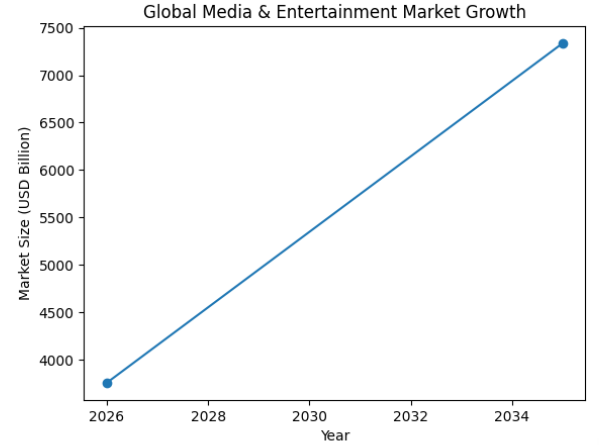
- In 2026, the market size of media and entertainment is estimated to be globally priced at approximately USD 3757.14 billion.
- These numbers are expected to reach USD 7336.96 billion by 2035, with a growing CAGR of 6.79% from 2026 to 2035.
- The consumption of digital content surged as 78% users prefer online media, and a 52% increase is seen in subscription-based streaming usage.
- In digital entertainment penetration, North America holds 38% market share, while Asia-Pacific shows 41% fastest expansion.
What is the Role of AI in Entertainment App Development?
Artificial Intelligence in entertainment app development plays a vital role in function by enabling personalization, automation, and intelligent decision-making that improve content delivery, user engagement, and overall digital entertainment experiences.
By choosing the right entertainment app development solution, businesses can build smarter platforms that adapt to user behavior, automate content workflows, and deliver immersive experiences efficiently, setting a new benchmark for the role of AI in entertainment app development.
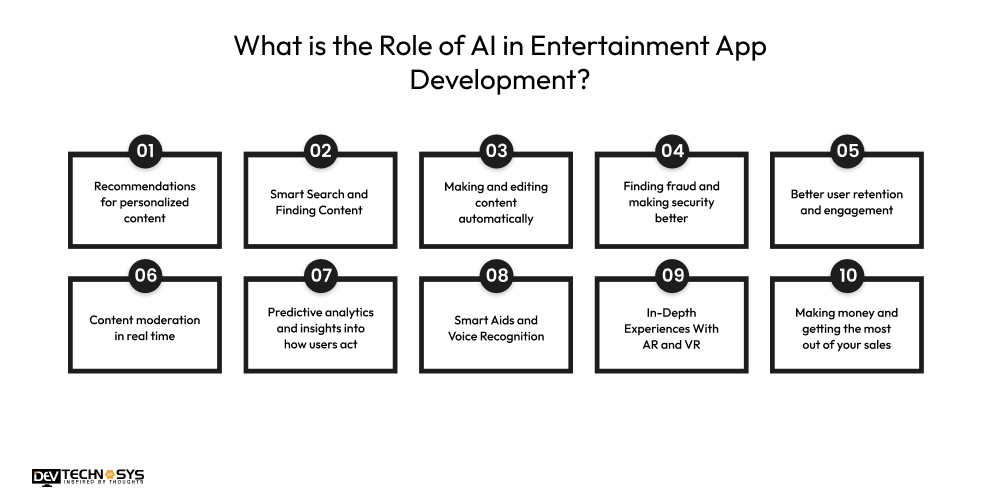
1. Recommendations for personalized content
AI looks at a person’s viewing history, tastes, actions, and behavior to make personalized content suggestions. Machine learning algorithms are used by entertainment apps to find pictures, songs, games, and videos that people will like.
This personalization makes users more interested, keeps them watching longer, and makes them happier overall by making it easier for them to find material. Android app development with modern AI music recommendation is a prime example of this capability, enhancing the music streaming experience significantly.
2. Smart Search and Finding Content
Natural language processing (NLP) helps search engines driven by Artificial intelligence in entertainment app development to figure out what users are trying to do. AI makes it possible for semantic search, voice search, and predictive ideas to work instead of exact keyword matching.
This lets users find relevant material faster, even if their search terms aren’t clear or are missing parts. This makes all entertainment platforms more accessible and easier to use, a feature common in AI-driven entertainment app development like video streaming app development solutions.
3. Making and Editing Content Automatically
AI tools help with making content, editing videos, writing songs, and making subtitles. AI is used in entertainment apps to do boring jobs automatically, like making trailers, clipping highlights, or improving sound quality.
This cuts down on production costs, speeds up the delivery of content, and frees up artists to focus on their art instead of doing tedious work by hand. Leading AI-powered video streaming apps utilize these features to optimize efficiency and scale.
4. Finding Fraud and Making Security Better
AI helps find fishy things like fake accounts, payment scams, and getting in without permission. AI improves app security and protects user data by watching trends in behavior. This builds trust among users and makes sure that data protection standards are met. Leading mobile app development companies incorporate these security measures into AI-powered apps.
5. Better User Retention and Engagement
Chatbots, interactive stories, gaming stages that change based on the player, and personalized notifications are all AI-powered features that help keep users interested. By learning what users like over time, the role of AI in entertainment app development is to ensure that content and changes are delivered on time and are relevant.
Companies that provide artificial intelligence development with chatbots in entertainment apps gain significant advantages in user support and engagement.
6. Content Moderation in Real Time
AI helps entertainment platforms watch and remove material that is offensive, illegal, or protected by intellectual property laws. AI makes sure that community rules are followed by using picture recognition, text analysis, and video scanning.
This makes the internet safer while cutting down on the need for large human monitoring teams. A mobile app development company offering AI-based entertainment app solutions benefits from the automation of content moderation.
7. Predictive Analytics and Insights Into How Users Act
AI looks at huge amounts of data to guess how people will act, what interests them, and how they will interact with material. These tools help entertainment companies figure out which styles are popular, when people are most likely to use them, and how likely it is that customers will leave.
Companies can improve their content strategies and make smart business choices with AI integration in entertainment applications.
8. Smart Aids and Voice Recognition
Voice-enabled Artificial intelligence in entertainment app development lets people use leisure apps without using their hands. Voice recognition makes things easier to get to and more accessible, whether you’re looking for a movie, changing songs, or changing settings.
Smart TVs, portable tech, and home entertainment systems that are connected will benefit the most from this feature. Many AI-driven live streaming apps leverage this functionality for seamless interaction.
9. In-Depth Experiences With AR and VR
Augmented reality (AR) and virtual reality (VR) experiences are better with AI because it lets you map your surroundings in real time, track your movements, and interact with things in new ways. Entertainment apps use AR/VR driven by AI to give users immersive gaming, virtual concerts, and interactive story experiences that keep them interested. This approach aligns with advanced AI solutions for entertainment apps, enhancing user immersion.
10. Making Money and Getting the Most Out of Your Sales
The role of AI in entertainment app development is to offer dynamic pricing, targeted ads, and make the best use of subscriptions. By tracking what users like and how much they spend, entertainment apps can show them relevant ads and deals, which can boost conversion rates without bothering users. Businesses build video streaming apps like Jio Cinema and benefit from AI-driven monetization strategies.
How Does AI-Powered Entertainment App Development Differ From Non-AI Development?
The entertainment app development services, with or without the integration of AI, present differences in functionality, user experience, scalability, and overall performance. Now, we will see how both are different from each other through the comparison table.
| Basis | AI-Powered Entertainment Apps | Non-AI Entertainment Apps |
| Content Recommendations | Delivers highly personalized recommendations by analyzing user behavior, preferences, and interaction history. | Offers generic suggestions or manually curated playlists that are the same for all users. |
| User Experience | Provides an adaptive and intelligent experience that evolves based on user actions and preferences. | Delivers a static experience with fixed features and limited personalization. |
| Search Functionality | Supports voice search and intent-based queries using natural language understanding. | Relies only on keyword-based searches with limited accuracy. |
| Content Moderation | Automatically detects and filters inappropriate or copyrighted content in real time. | Requires manual monitoring and review, which is time-consuming. |
| User Engagement | Keeps users highly engaged through personalized content and smart notifications. | Shows lower engagement due to repetitive and non-customized content. |
| Scalability | Easily scales as user data grows, improving performance and recommendations over time. | Faces limitations when handling large user bases and growing content libraries. |
| Gaming Experience | Features intelligent NPCs, adaptive difficulty levels, and dynamic gameplay experiences. | Offers fixed gameplay patterns with predictable behavior. |
| Data Analysis | Provides predictive, real-time insights to understand user trends and preferences. | Offers basic analytics with limited actionable insights. |
| Monetization | Enables AI-driven ads, dynamic pricing, and personalized subscription plans. | Uses fixed pricing models and standard advertisements. |
| Maintenance | Continuously learns and optimizes performance with minimal manual intervention. | Requires frequent manual updates and maintenance efforts. |
Which Entertainment Apps Are Using AI In 2025?
The role of artificial intelligence in mobile app development in 2026 is to personalize content, optimize user experiences, and improve engagement through smart recommendations, predictive analytics, and automated processes across various entertainment platforms.
1. Netflix
Netflix uses AI algorithms to analyze viewing habits, ratings, and watch history. Its recommendation engine suggests popular shows, personalized content, and custom thumbnails. AI also optimizes streaming quality and predicts demand, a key feature of AI in gaming app development and streaming.
2. YouTube
YouTube uses AI to suggest videos, put them into categories, add captions automatically, and moderate material. It uses AI algorithms to look at past watch history and user activity to find related videos to recommend. AI also helps content creators get the most out of their work and make money through targeted ads.
3. Spotify
An entertainment app development company integrates AI and machine learning, which is widely used by Spotify to make personalized mixes like Release Radar and Discover Weekly. Spotify makes very specific song suggestions by looking at how people listen, their moods, and how they interact with the app. AI also helps improve the quality of sound and find new podcasts.
4. TikTok
The AI-powered recommendation engine behind TikTok is what makes it so popular. The platform looks at how users engage with it, like how many times they like, share, or watch a video, to send them highly personalized short videos. AI keeps people interested by quickly changing content feeds based on what users want.
5. Amazon Prime Video
Amazon Prime Video uses AI to make personalized suggestions, find new material, and make predictions. AI looks at how people use the internet to suggest TV shows and movies and improve viewing speeds. It also helps Amazon figure out what viewers want, so it can invest the cost to maintain an app with more material in the future.
What AI-Powered Technologies Are Used In Entertainment Apps?
Entertainment apps rely on various AI-powered technologies, including machine learning, natural language processing, computer vision, recommendation engines, and speech recognition, to create smarter and more interactive experiences. These technologies are fundamental to AI-powered entertainment app development.
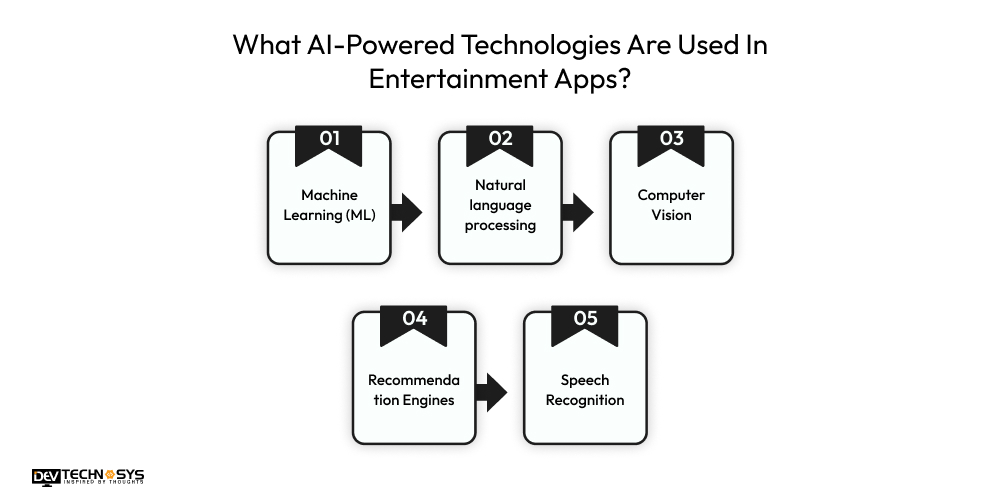
1. Machine Learning (ML)
When you build a video streaming app like Aha, ML algorithms analyze user data to provide personalized recommendations, predictive analytics, and engagement strategies. ML enables entertainment app development using AI to learn continuously and improve content suggestions.
2. Natural language processing
Voice search, chatbots, mood analysis, and text-based conversations are all made possible by NLP. NLP is used by entertainment apps to understand what users are asking, make subtitles, read reviews, and improve customer service with AI-powered chatbots.
3. Computer Vision
Computer vision lets apps look at pictures and movies to check for inappropriate content, find faces, and add visual effects. This technology is used by entertainment platforms to do things like automatically tag videos, make thumbnails, add AR effects, and improve video editing tools. Build an Artificial Intelligence App using computer vision for dynamic and interactive experiences.
4. Recommendation Engines
AI-powered recommendation engines use machine learning, behavioral analytics, and user profiling to find material that is relevant to the user. Streaming apps depend on these engines to make sure that each user has a unique experience that increases watch time, retention, and customer happiness.
5. Speech Recognition
Voice instructions, audio transcription, and real-time translation are all possible with speech recognition technology. This AI technology is used in entertainment apps to make them easier for everyone to use and to let people connect with them without using their hands on a variety of devices. AI integration in entertainment applications relies heavily on speech recognition.
Why Are Businesses Integrating AI In Entertainment App Development?
Businesses are integrating AI into entertainment app development to enhance user experience, improve retention, and automate operations. AI-driven entertainment app development empowers platforms to deliver smarter, data-informed, and immersive experiences for users.
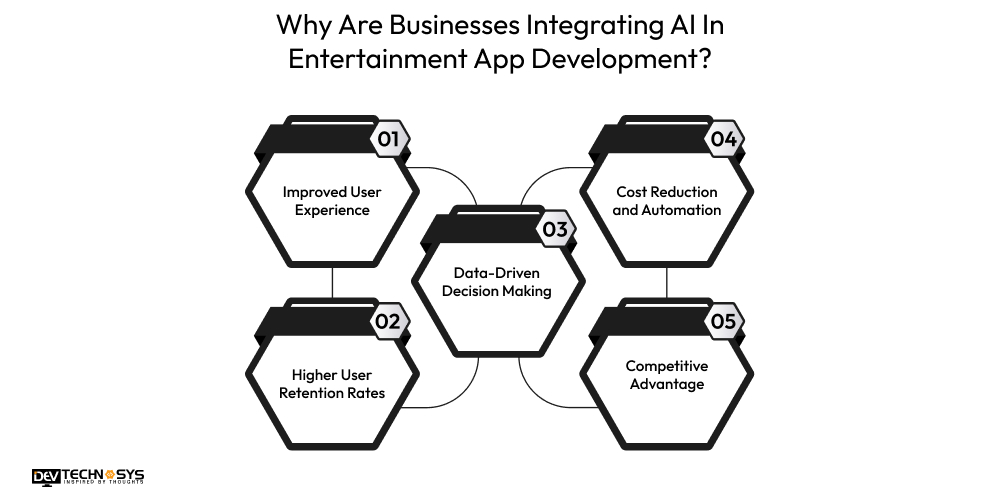
1. Improved User Experience
By looking at a user’s history, preferences, and interaction patterns, AI lets entertainment apps give them very personalized and interactive experiences. This guarantees relevant content suggestions, smarter search results, and easier navigation.
It helps businesses meet users’ rising standards and make fun entertainment platforms that focus on them. Businesses adopt strategies to build an app like MetroZone to meet rising expectations and create user-focused platforms.
2. Higher User Retention Rates
AI helps deliver timely suggestions, alerts, and personalized messages by constantly watching how users interact with and behave in the system. These features keep users involved for longer, keep them from leaving the app, and make customers more loyal.
This is why AI is so important for long-term growth and consistent user retention. Timely suggestions, alerts, and notifications keep users engaged, reduce churn, and increase loyalty, highlighting the benefits of AI in entertainment app development.

3. Data-Driven Decision Making
AI analyzes huge amounts of user data to find useful information about how content performs, what audiences like, and new trends. Businesses use these findings to improve their marketing, content strategies, and feature creation to meet user needs, which maximizes their return on investment.
Insights from AI help optimize marketing, content strategies, and feature creation. Mobile app analytics ensure better ROI for mobile app development solutions.
4. Cost Reduction and Automation
AI automates jobs that are done over and over again, like monitoring content, helping customers through chatbots, and analyzing performance. This cuts down on the need for physical work, lowers costs, lowers the chance of mistakes, and lets companies grow their entertainment apps without having to pay more for workers.
Automating repetitive tasks like moderation and customer support reduces costs and errors. Companies offering mobile app development services can scale efficiently using AI.
5. Competitive Advantage
Adding AI to entertainment apps helps them offer better features, more immersive experiences, and new ideas more quickly. Businesses that use AI can quickly respond to changes in the market, do better than their rivals, and give users personalized value, which boosts their brand’s visibility in the entertainment app ecosystem, which is very competitive.
AI-powered apps offer innovative features and immersive experiences, giving companies an edge. AI-based entertainment app solutions help brands outperform competitors while delivering superior value.
What Are The Significant Challenges Of Integrating AI In Entertainment Apps?
While AI offers many benefits, integrating it into entertainment apps presents challenges such as high development costs, data privacy concerns, technical complexity, algorithm accuracy issues, and dependence on quality data for optimal performance. These challenges can lead mobile app development companies to address these to succeed.
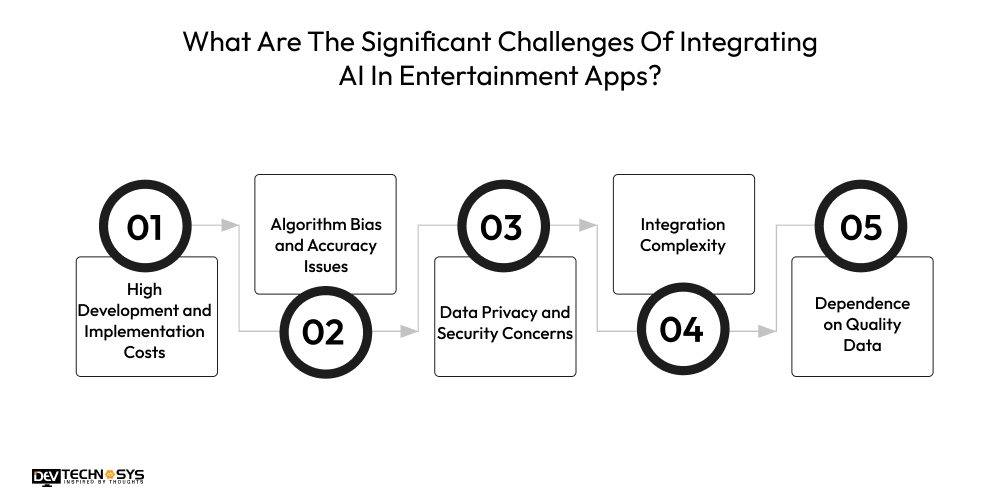
1. High Development and Implementation Costs
Implementing AI requires substantial investment in advanced technologies, skilled professionals, data infrastructure, and ongoing maintenance. For startups and mid-sized companies, these costs can be challenging to manage, making careful budgeting and phased AI adoption essential for successful implementation.
AI requires investment in technology, skilled developers, and infrastructure. Startups must plan budgets carefully for full-stack development services.
2. Algorithm Bias and Accuracy Issues
AI systems can produce biased or inaccurate outputs if trained on limited, unbalanced, or poor-quality data. This may result in irrelevant recommendations or unfair content filtering, negatively affecting user experience and trust, making continuous monitoring and model improvement necessary.
Poor-quality data can lead to inaccurate results, impacting user trust. AI in gaming app development requires continual monitoring for fairness.
3. Data Privacy and Security Concerns
AI-driven entertainment apps rely heavily on user data, increasing the risk of data breaches and privacy violations. Compliance is essential for hybrid app development company strategies.
Developers must implement strong security measures, comply with data protection regulations, and maintain transparent data usage policies to protect user trust and avoid legal complications. Heavy reliance on user data increases privacy risks.
4. Integration Complexity
Integrating AI into existing entertainment app architectures can be technically challenging. Developers must ensure compatibility with legacy systems, maintain performance stability, and manage scalability issues, all while delivering seamless user experiences without disrupting current app functionality.
Merging AI with legacy systems is challenging. iOS app development services benefit from expert implementation of AI modules.
5. Dependence on Quality Data
AI performance is directly linked to the quality and volume of data it receives. Inaccurate, incomplete, or inconsistent data can limit AI effectiveness, which can lead to poor personalization and insights. Therefore, maintaining clean, structured, and reliable data is very important for successful AI integration.
AI needs clean, structured, and reliable data. Hire on-demand app developers to manage data pipelines for effective AI models.

Conclusion
As a result, the role of AI in entertainment app development changes the way an OTT app development company makes apps and how people interact with digital material. AI improves every part of entertainment platforms, from smart search and personalized suggestions to engaging AR/VR experiences and predictive analytics.
With advanced AI solutions for entertainment apps, AI-driven platforms set new standards for innovation, creativity, and user-centric experiences. But if AI is to be widely used, problems like data protection, development costs, and algorithm accuracy need to be fixed.
As technology keeps getting better, entertainment apps that use AI will set new standards for creativity, innovation, and user-centered experiences. Collaborating with a skilled mobile app development company ensures the successful implementation of AI-powered entertainment app development solutions for modern audiences.
FAQs
Q1. How Does AI Improve User Experience In Entertainment Apps?
AI improves user experience by offering personalized content recommendations, intelligent search, voice commands, and interactive features. It helps users discover relevant content faster and enjoy seamless, engaging experiences tailored to their preferences.
Q2. Are AI-Powered Entertainment Apps Expensive To Develop?
Yes, AI-powered apps generally have higher development costs due to advanced technologies and skilled resources. However, the long-term benefits like automation, scalability, and increased user retention often justify the investment.
Q3. Is User Data Safe In AI-Driven Entertainment Apps?
Most AI-driven apps implement strong security measures and comply with data protection regulations. However, developers must ensure transparent data policies and robust security frameworks to maintain user trust and privacy.
Q4. Can Small Businesses Integrate AI Into Entertainment Apps?
Yes, small businesses can integrate AI using cloud-based AI services and APIs. These solutions reduce infrastructure costs and allow gradual AI adoption based on business needs and budget.
Q5. What Is The Future Of AI In Entertainment App Development?
The future includes hyper-personalization, immersive AR/VR experiences, AI-generated content, and smarter analytics. AI will continue to redefine entertainment apps by delivering more interactive, adaptive, and engaging digital experiences.