





In today’s digital world, everything is going online, even our money!
Have you ever paid for something using your phone or sent money with just a few taps?
That’s the power of fintech apps.
These apps help people manage their money, make payments, invest, and even save smarter. But have you ever wondered how much it actually costs to build one of these apps in 2025?
It’s not as easy, or cheap, as it might look.
Key Takeaways:
-
- The cost to develop a fintech app is around $8,000 to $25,000, or based on the specific project requirements.
- The overall fintech app development cost is affected by several factors such as features, functions, size, complexity, development team, and more.
- The size of the global fintech market is projected to rise from USD 234.6 billion in 2024 to USD 1,382 billion by 2034.
- Fintech app development solutions offer secure, fast, and user-friendly financial solutions for smarter money management.
From adding strong security to designing user-friendly features, a lot goes into making a successful fintech app.
The fintech app cost in Qatar can vary depending on how simple or advanced the app is.
In this blog, let’s explore what affects the cost to develop a fintech app in 2025 and other related information.
Global Market Projections of Fintech Applications
- Along with USD1 billion in sales, North America led the FinTech business in 2024, with more than 39.7% of the market share.
- More than 2% of the FinTech market was made up of Fraud Monitoring in 2024, making it the largest category.
- In terms of market share within the FinTech business, payments dominated in 2025, accounting for almost 6% of the total.
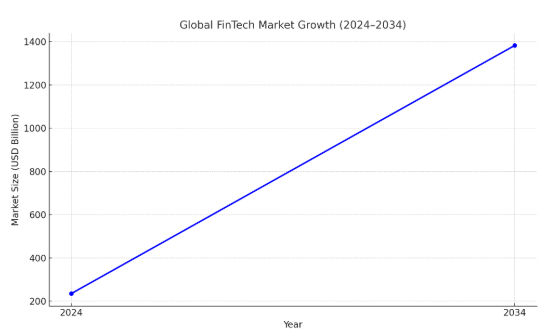
- The Global FinTech Industry Market is predicted to increase at a rate of 40% per year from 2025 to 2034, reaching USD 1,382 Billion by 2034. It was worth USD 234.6 Billion in 2024.
- Blockchain was also quite important in 2024, taking up more than 6% of the FinTech market.
What is the Cost to Develop a Fintech App?
The cost to develop a fintech app typically ranges from $8,000 to $25,000 or more, depending on the app’s complexity, features, platform (iOS, Android, or both), and development location. A simple app with basic functionalities like payments or budgeting tools may cost around $10,000 to $15,000.
More advanced apps with AI, blockchain integration, multi-currency support, and high-level security can exceed $25,000. Costs also include UI/UX design, backend development, compliance with financial regulations, and ongoing maintenance. Hiring a top-tier FinTech development company can further impact the overall budget.
App Type |
Estimated Cost (USD) |
Development Time |
| Basic (MVP) | $8,000 – $12,000 | 2 – 4 months |
| Mid-Level | $12,000 – $18,000 | 4 – 6 months |
| Advanced | $18,000 – $25,000+ | 6 – 8+ months |
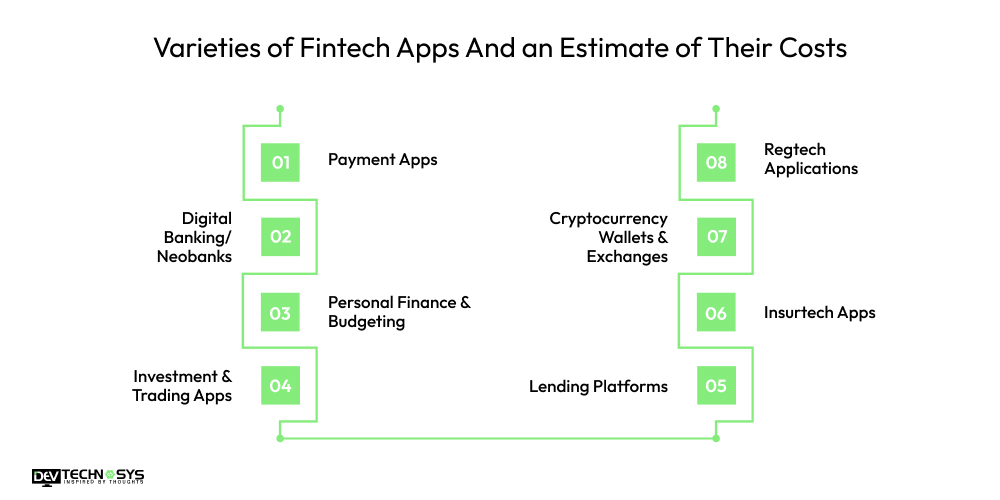
Varieties of Fintech Apps And an Estimate of Their Costs
Explore the varieties of fintech apps, from payment solutions to digital banking and crypto wallets, each with unique features and development requirements. Understand their estimated Bahrain fintech app development cost to plan your investment effectively and build a successful fintech application in 2026.
Type of Fintech App |
Estimated Development Cost (USD) |
| Payment Apps | $15,000 – $22,000 |
| Digital Banking / Neobanks | $18,000 – $24,000 |
| Personal Finance & Budgeting | $10,000 – $15,000 |
| Investment & Trading Apps | $18,000 – $25,000 |
| Lending Platforms | $12,000 – $18,000 |
| Insurtech Apps | $8,000 – $14,000 |
| Cryptocurrency Wallets & Exchanges | $17,000 – $25,000 |
| Regtech Applications | $12,000 – $20,000 |
1. Payment Apps
Payment apps enable instant peer-to-peer transfers, bill payments, and digital wallet management by linking bank accounts or cards. They simplify daily transactions with secure, fast payment options. Examples include Venmo and PayPal, making financial exchanges easy and accessible for users worldwide.
Estimated Cost: $15,000 – $22,000
2. Digital Banking/Neobanks
Neobanks provide full banking services online without physical branches. Users can open accounts, transfer money, and access loans or savings digitally. These apps emphasize lower fees and intuitive UI, offering modern banking solutions to customers who prefer mobile-first financial services.
Estimated Cost: $18,000 – $24,000

3. Personal Finance & Budgeting
These apps help users monitor income, expenses, and savings goals. By syncing bank accounts, they offer budgeting tools, financial insights, and alerts to improve money management. Apps like Mint and YNAB empower users to plan finances effectively and gain control over their spending.
Estimated Cost: $10,000 – $15,000
4. Investment & Trading Apps
Investment apps provide platforms for buying and selling stocks, bonds, cryptocurrencies, and ETFs. Many use robo-advisors to automate portfolio management, making investing accessible to beginners and experts alike. Real-time market data and educational tools support better financial decisions.
Estimated Cost: $18,000 – $25,000
5. Lending Platforms
Lending apps connect borrowers with lenders for peer-to-peer or microloans. They automate loan applications, credit scoring, and repayments, offering faster funding and competitive rates compared to traditional banks. These apps support personal and small business financing with streamlined processes.
Estimated Cost: $12,000 – $18,000
6. Insurtech Apps
Insurtech apps digitize insurance processes like quoting, purchasing policies, and claim filing. Using AI and analytics, they personalize coverage options and speed approvals. This enhances transparency, simplifies user experience, and modernizes insurance services in an efficient, tech-driven way.
Estimated Cost: $8,000 – $14,000
7. Cryptocurrency Wallets & Exchanges
Crypto wallets secure users’ digital currency keys, while exchanges facilitate buying, selling, and trading cryptocurrencies. Features include portfolio tracking and real-time price updates. Security measures like two-factor authentication ensure safe transactions in the rapidly evolving crypto market.
Estimated Cost: $17,000 – $25,000+
8. Regtech Applications
Regtech apps automate compliance tasks such as KYC, AML, and fraud detection using AI and machine learning. They help financial institutions efficiently meet regulatory requirements by monitoring transactions, analyzing data, and generating compliance reports, reducing risk and operational costs.
Estimated Cost: $12,000 – $20,000
What Are the Factors That Affect the Fintech App Development Cost?
Several key factors impact fintech business app development costs, including app complexity, feature set, platform choice, UI/UX design, backend infrastructure, security requirements, third-party integrations, team location, maintenance needs, and quality assurance efforts.
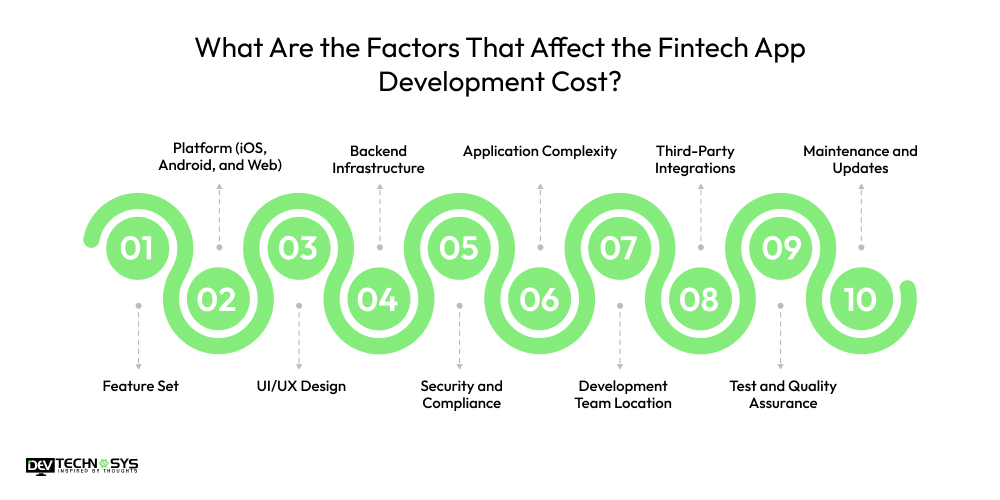
1. Feature Set
Each new feature, such as budgeting tools, real-time notifications, or investment tracking, increases cost to make a fintech app. Core functions, like as payments and identification, are required, whereas sophisticated services such as robo-advisors or loan calculators increase the overall cost to create a fintech app.
Feature Type |
Estimated Cost (USD) |
| Basic Features (Login, Payments) | $4,000 – $7,000 |
| Intermediate Features (Budgeting, Reports) | $8,000 – $10,000 |
| Advanced Features (AI, Crypto, Robo-Advisor) | $10,000 – $13,000 |
2. Platform (iOS, Android, and Web)
Developing for one platform is less expensive than designing for numerous platforms. Native apps (iOS/Android) provide superior performance but are more expensive than cross-platform or online apps. The more platforms you target, the greater the overall cost to develop an app.
Platform |
Estimated Cost (USD) |
| Single Platform (iOS or Android) | $6,000 – $10,000 |
| Cross-Platform (Flutter, React Native) | $10,000 – $13,000 |
| Native iOS + Android + Web | $13,000 – $18,000 |
3. UI/UX Design
Skilled designers are required to create a well-designed user interface that allows for easy navigation and a positive user experience. Custom animations, branding, and adaptable designs increase cost to make a fintech app, but they are critical for user engagement in banking applications.
Design Type |
Estimated Cost (USD) |
| Basic UI/UX | $5,000 – $7,000 |
| Custom UI with Prototyping | $8,000 – $12,000 |
| Advanced UX + Branding | $12,000 – $18,000 |
4. Backend Infrastructure
Fintech apps require strong backend systems for data processing, security, user administration, and third-party integration. Scalable and secure infrastructure (such as AWS and Firebase) might increase ewallet app development expenses, but it is critical for long-term stability and compliance.
Infrastructure Type |
Estimated Cost (USD) |
| Basic (Firebase, AWS light) | $5,000 – $7,000 |
| Scalable + Secure Backend | $8,000 – $12,000 |
| Enterprise-Grade Backend | $15,000 – $19,000 |
5. Security and Compliance
Fintech apps must adhere to standards such as GDPR, PCI-DSS, and local banking legislation. Implementing data encryption, secure APIs, and regulatory compliance increases cost to develop a fintech app, but it is critical for establishing user trust and legal operations.
Security Level |
Estimated Cost (USD) |
| Basic Security + SSL | $2,000 – $4,000 |
| PCI-DSS, GDPR, Data Encryption | $4,000 – $7,000 |
| Advanced Compliance (HIPAA, SOC2) | $8,000 – $10,000 |
6. Application Complexity
The more complicated the software (for example, advanced analytics, blockchain, multi-layered dashboards), the more time and skill are required, which raises cost to develop ewallet apps. Simple apps with simple functionalities are substantially cheaper than apps with extensive transaction processes, automation, or AI-driven insights.
Complexity Level |
Estimated Cost (USD) |
| Basic (MVP) | $8,000 – $11,000 |
| Medium | $13,000 – $20,000 |
| Advanced | $20,000 – $25,000 |
7. Development Team Location
The cost to develop a fintech app vary widely by country, with developers in North America and Western Europe charging more than those in Eastern Europe and Asia. Choosing an offshore workforce can save money, but it may need more monitoring and effective project management.
Region |
Hourly Rate (USD) |
Avg. Total Project Cost |
| North America | $40 – $70/hr | $40,000 – $60,000 |
| Western Europe | $35 – $60/hr | $35,000 – $50,000 |
| Eastern Europe | $30 – $50/hr | $30,000 – $45,000 |
| Asia (India, etc.) | $15 – $25/hr | $8,000 – $25,000 |
8. Third-Party Integrations
Integrations with banking APIs, payment gateways (e.g., Stripe or Plaid), KYC providers, and credit bureaus increase cost to build a fintech app like Pyypl. Each integration involves setup, testing, and security validation, and some services have recurring costs that affect budget.
Integration Type |
Estimated Cost (USD) |
| Payment Gateway (Stripe, PayPal) | $2,000 – $3,500 |
| KYC/AML (Jumio, Onfido) | $4,000 – $6,000 |
| Banking APIs (Plaid, Yodlee) | $6,000 – $8,000 |
9. Test and Quality Assurance
Fintech requires rigorous testing to assure accuracy, dependability, and security. Manual and automated testing for edge cases, security vulnerabilities, and performance concerns raises initial cost to create a fintech app while preventing costly failures or data breaches after launch.
QA Level |
Estimated Cost (USD) |
| Basic Manual Testing | $1,500 – $3,000 |
| Manual + Automated Testing | $3,500 – $5,000 |
| Enterprise QA & Security | $5,000 – $7,000 |

10. Maintenance and Updates
Bug patches, server maintenance, new feature rollouts, and OS compatibility upgrades are all included in the post-launch charges. Ongoing support is required for fintech apps because to frequent regulatory changes and changing user demands, which contribute to long-term cost to maintain an app.
Maintenance Type |
Annual Cost (USD) |
| Basic Support & Fixes | $2,000 – $4,000 |
| Regular Updates & Scaling | $4,000 – $6,000 |
| Full Maintenance Package | $6,000 – $8,000+ |
How to Reduce the Fintech App Development Cost?
To reduce fintech app development cost in Saudi Arabia, focus on building an MVP, use cross-platform frameworks, prioritize essential features, choose an experienced offshore team, leverage open-source tools, and plan thoroughly to avoid scope creep and rework.
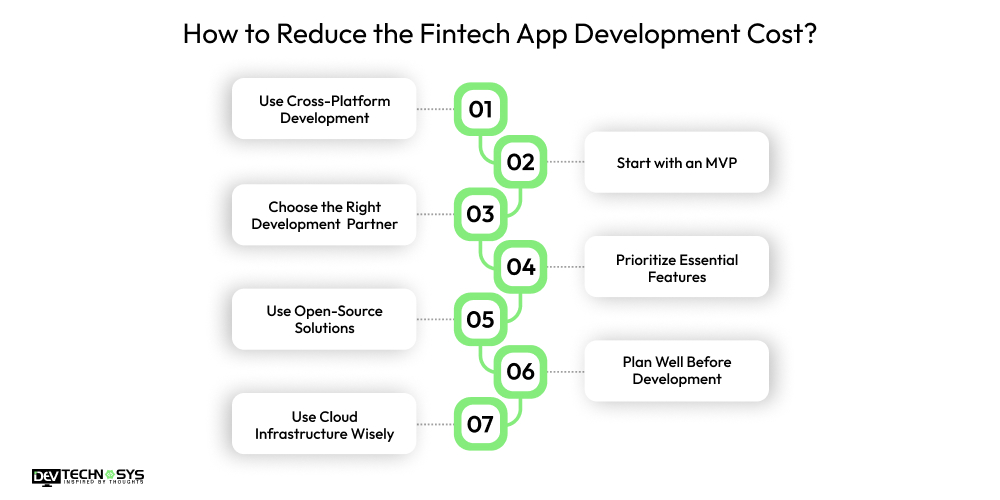
1. Use Cross-Platform Development
Rather than developing separate apps for iOS and Android, utilize frameworks such as Flutter or React Native to create a single codebase for both. This drastically reduces fintech app development services time and expense while retaining near-native performance, making it suitable for finance businesses that want to expand effectively without losing user experience.
Factor |
Description |
| Strategy | Use frameworks like Flutter or React Native for both iOS and Android. |
| How It Saves | One codebase reduces developer workload and maintenance costs. |
| Estimated Savings | $5,000 – $8,000 |
2. Start with an MVP
Create a Minimum Viable Product (MVP) to get started quickly with basic functionality. This technique lowers upfront expenses, shortens development time, and enables for early customer input. You may verify your idea before committing to full-scale production, avoiding superfluous features that may not appeal to people.
Factor |
Description |
| Strategy | Launch a Minimum Viable Product with only essential features. |
| How It Saves | Reduces development time and avoids building unnecessary features. |
| Estimated Savings | $8,000 – $10,000 |
3. Choose the Right Development Partner
Outsourcing to competent developers in cost-effective locations such as Eastern Europe or South Asia might result in considerable savings. However, quality should not be sacrificed, hire dedicated developers in UAE with proven fintech experience, good communication skills, and a well-defined development process to minimize costly mistakes or rework.
Factor |
Description |
| Strategy | Hire offshore developers from Asia or Eastern Europe. |
| How It Saves | Lower hourly rates without sacrificing quality if well-managed. |
| Estimated Savings | $5,000 – $7,000 |
4. Prioritize Essential Features
Only include high-impact, must-have features in the first release. Avoid cluttering the app with unnecessary tools. Prioritizing key user functions such as registration, account management, and basic transactions improves cost-effectiveness while addressing core user requirements. Later phases may have more features.
Factor |
Description |
| Strategy | Focus only on features critical to user and business goals. |
| How It Saves | Prevents wasted time on low-value or unused features. |
| Estimated Savings | $4,000 – $6,000 |
5. Use Open-Source Solutions
Use open-source tools and APIs for common tasks like authentication, charting, and analytics. This removes the need to start from scratch, which speeds up mobile app development services costs. Simply confirm that the tools are safe, well-supported, and meet your app’s compliance standards.
Factor |
Description |
| Strategy | Leverage free, secure, and proven libraries or APIs. |
| How It Saves | Cuts licensing fees and avoids building components from scratch. |
| Estimated Savings | $2,000 – $5,000 |
6. Plan Well Before Development
Lack of preparation causes costly scope modifications and delays. Invest time on developing thorough specifications, user journeys, and wireframes. A well-defined strategy reduces misunderstandings, development modifications, and timetable extensions, eventually saving money and producing a product that meets company objectives.
Factor |
Description |
| Strategy | Create clear documentation, wireframes, and user journeys before starting. |
| How It Saves | Minimizes revisions, reduces miscommunication, and avoids costly rework. |
| Estimated Savings | $3,000 – $7,000 |
7. Use Cloud Infrastructure Wisely
Avoid overprovisioning your servers and services. Choose scalable cloud platforms like as AWS or Google Cloud that provide pay-as-you-go pricing. Automating deployment and monitoring saves operational overhead.
According to the mobile app development firm in UAE, this assures great performance without incurring significant upfront infrastructure expenditures, particularly in the early phases of app growth.
Factor |
Description |
| Strategy | Use cloud services like AWS/GCP with auto-scaling and pay-as-you-go pricing. |
| How It Saves | Avoids overprovisioning and unnecessary upfront infrastructure costs. |
| Estimated Savings | $4,000 – $8,000 |
Tech Stacks Are Required to Develop a Fintech App
Layer |
Technologies/Tools |
Purpose |
| Frontend | React Native, Flutter, Swift (iOS), Kotlin (Android), Angular, Vue.js | User interface and experience across platforms |
| Backend | Node.js, Python (Django, Flask), Java, Ruby on Rails, .NET | Server logic, APIs, and business rules |
| Database | PostgreSQL, MySQL, MongoDB, Cassandra | Data storage and management |
| Cloud Infrastructure | AWS, Google Cloud Platform, Microsoft Azure | Hosting, scaling, and cloud services |
| Security | OAuth 2.0, JWT, SSL/TLS, AES Encryption | Authentication, data protection, secure communication |
| APIs & Integrations | Plaid, Stripe, Twilio, Yodlee, Jumio | Payment processing, banking data, identity verification |
| DevOps & CI/CD | Jenkins, Docker, Kubernetes, GitHub Actions | Automated deployment, containerization, scalability |
| Analytics & Monitoring | Google Analytics, Mixpanel, Sentry, New Relic | User behavior analysis, app performance monitoring |
| AI/ML Tools | TensorFlow, PyTorch, IBM Watson, Azure ML | Predictive analytics, chatbots, fraud detection |
5 Monetization Techniques of Fintech Applications
Fintech apps can generate revenue through subscriptions, transaction fees, interchange fees, lending interest, and affiliate marketing. These monetization models offer scalable income streams while enhancing user engagement and aligning with the app’s financial services.
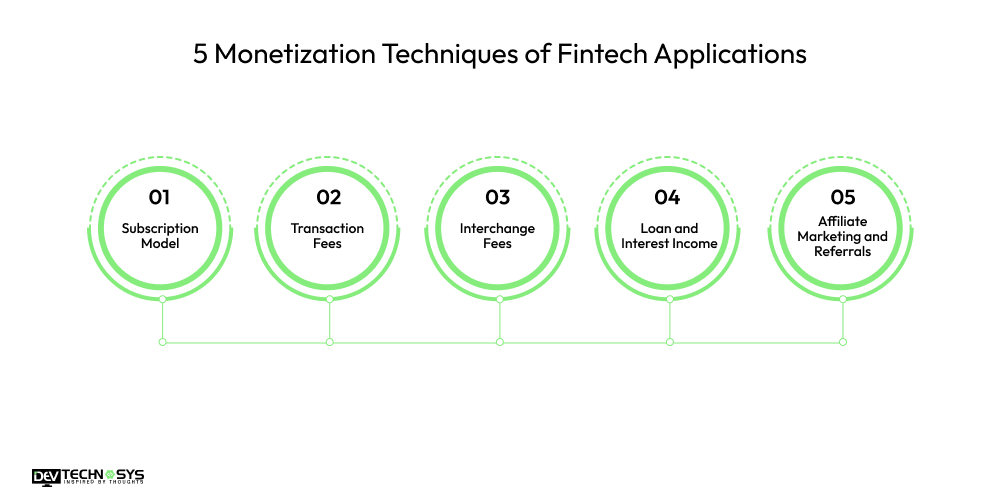
1. Subscription Model
Many financial applications are subscription-based, with users paying a recurring cost (monthly or annually) for premium capabilities. This might include enhanced budgeting tools, customized financial insights, investment guidance, or prioritization assistance. This strategy generates predictable revenue while encouraging long-term user involvement.
2. Transaction Fees
Payment or money transfer applications typically charge consumers a modest fee per transaction. Fintechs like as PayPal and Venmo charge transaction fees for specific services (e.g., quick transfers or currency exchange). This architecture grows effectively with increased usage and performs best for apps that handle frequent financial transactions.
3. Interchange Fees
When a fintech app issues its own debit or credit card, it gets an interchange fee, which is typically 1-2% of each transaction performed through such cards. This is a significant revenue source for neobanks like Chime and Revolut, and it necessitates collaboration with banks or card networks (such as Visa or Mastercard).
4. Loan and Interest Income
Top fintech apps in Middle East that provide microloans, buy-now-pay-later services, or savings accounts can generate revenue by charging interest on loans or lending pooled user deposits. Platforms such as SoFi and Cash App use this technique to generate consistent revenue from financial goods sold directly within the app.
5. Affiliate Marketing and Referrals
Fintech applications frequently sell financial items such as credit cards, insurance, and investing platforms, earning a reward for each successful referral. This works effectively for apps that provide financial comparisons or educational resources. Examples are NerdWallet and Credit Karma.

How Dev Technosys Will Help You?
The cost to create a fintech app anywhere from $8,000 to over $25,000 in 2025, depending on its features, complexity, and location. The budget is greatly impacted by elements like integrations, security, and platform selection. A significant benefit is working with a seasoned fintech app development company in UAE to guarantee affordable, scalable, and compliance solutions.
UAE-based companies are perfect for developing high-performing fintech apps that are suited to both global and Middle Eastern markets since they provide regional financial knowledge, creativity, and regulatory awareness.
Frequently Asked Questions
Q1. How Much Does It Cost To Develop a Fintech App?
The cost to build a fintech app in 2025 typically ranges between $8,000 and $25,000+, depending on complexity, features, platform, security, and integrations, with higher costs associated with advanced functionalities and compliance requirements.
Q2. How Much Does It Cost to Hire Fintech App Developers?
The cost of hiring fintech developers in the Middle East varies by region, ranging from $15 to $25+ per hour, with rates influenced by expertise, location, project complexity, and developer experience level.
Q3. How Much Does It Cost to Maintain a Fintech App?
The cost of keeping a financial app up to date, safe, and compliant is usually between $2,000 to $5,000 per year. This includes updates, security patches, server fees, compliance adjustments, and continuing maintenance.
Q4. How Long Does Fintech App Development Typically Take?
Fintech app development typically takes between 3 to 6 months, depending on app complexity, feature set, platform choice, team size, and regulatory compliance requirements.
Q5. How Much Does It Cost To Integrate AI Features?
Integrating AI features into a fintech app typically costs between $2,000 and $5,000+, depending on complexity, such as predictive analytics, credit scoring, chatbots, or personalized financial recommendations.