





Key Takeaways
The cost to maintain a mobile app usually ranges between 15% to 20% of the total development cost annually. Suppose the total development cost is $25,000; then the annual maintenance cost would be between $3,700 – $5,000. Maintenance expenses are directly influenced by multiple factors, making it essential to plan budgets strategically from the beginning.
Key Factors Affecting Mobile App Maintenance Cost:
-
- App Complexity & Features: More advanced features require higher maintenance effort and cost
- Security Infrastructure: Stronger security measures increase ongoing monitoring and update needs
- Server & Hosting Setup: Scalable and high-traffic infrastructure raises maintenance expenses
- Third-Party Integrations: More integrations mean more updates and potential points of failure
- Technology Stack: Modern stacks are easier and cheaper to maintain than legacy systems
- Update Frequency: Frequent updates increase costs but improve performance and user retention
Core Components of Mobile App Maintenance:
-
- Bug Fixes & Optimization: This ensures the app runs smoothly by resolving errors and improving speed and responsiveness.
- Security Updates: Security protocols protect the app from vulnerabilities and cyber threats through regular patches and monitoring.
- Server & Backend Maintenance: These maintenance tasks help to maintain uptime, manage databases, and handle traffic scaling efficiently.
- Third-Party API Management: This keeps integrations like payment gateways, CRMs, and analytics tools updated and functional.
- UI/UX Improvements: UI/UX maintenance helps to enhance user experience through design updates and usability improvements.
- App Store Compliance: This ensures the app meets the latest guidelines of Google Play and Apple App Store.
Key Factors to Reduce Maintenance Cost:
-
- Start with an MVP to minimize initial complexity and ongoing maintenance needs
- Use a scalable and modern technology stack for easier updates
- Invest in high-quality development to reduce future bug-fixing costs
- Automate monitoring and testing for faster issue detection
- Plan a consistent update schedule instead of reactive fixes
- Partner with an experienced mobile app development team for efficient long-term support
After building and launching the mobile app, most businesses think, “Okay, now our work is complete.” No, they are very wrong. Now comes one of the most important questions that most UAE business owners ask a little too late: What does it actually cost to maintain an app?
Mobile app maintenance cost is one of those things that sneaks up on you slowly and steadily if you tend to ignore it initially. For a competitive market like the UAE, skipping or underfunding it means crashes, security risks, and losing users to better-maintained competitors, and ultimately facing a loss in business.
This blog breaks down every cost, factor, and decision you need to know, so you can plan smarter from day one and lead to success. Let’s get started!
Why Does a Mobile App Need Maintenance?
Think of your app like a car. You wouldn’t drive it for years without a service, right? Mobile apps work the same way. Even after a successful launch, your app is constantly exposed to forces that can break or degrade it. Operating systems like iOS and Android release major updates every year, and if your app isn’t updated to match, it starts malfunctioning or sometimes even disappears from app stores altogether.
Then there’s security. Cyber threats in the UAE are growing year on year, and an unmaintained app is an open door for vulnerabilities. For businesses handling payments, personal data, or sensitive information, this isn’t just a UX problem; it’s a legal and reputational risk. Finally, third-party services your app depends on, such as payment gateways, maps, CRMs, and analytics tools, require regular updates to their APIs. Without maintenance, those integrations quietly break, often without you noticing until a customer complains.
The overall mobile app development cost is just the beginning. What keeps your investment alive and profitable is what happens after launch.
How Much Does Mobile App Maintenance Cost in 2026?
Let’s get straight to the number: the cost of maintaining a mobile app runs between 15% – 20% of your original development cost per year. These figures cover routine costs such as bug fixes, OS updates, security patches, and performance improvements. Larger feature rollouts are scoped separately. In 2026, AI-powered app maintenance is also changing the equation. Automated bug detection and performance monitoring tools are reducing manual effort, which can bring retainer costs down for well-structured apps.
For Android app development, maintenance tends to run slightly higher due to device fragmentation, something UAE businesses with a broad user base should factor in early. For apps built by an iOS app development company, costs are generally more predictable given Apple’s tightly controlled ecosystem. Below are the cost of mobile app maintenance services:
| App Type | Development Cost (USD) | Annual Maintenance (USD) |
| Basic app | $8,000 – $12,000 | $1,200 – $2,400 |
| Mid-level app | $12,000 – $18,000 | $2,400 – $3,600 |
| Advance app | $18,000 – $25,000+ | $3,600 – $5,000+ |
What Are the Key Factors Affecting the Cost of Mobile App Maintenance?
No two apps cost the same to maintain. And for UAE business owners, understanding what drives that number is the difference between budgeting confidently and getting hit with unexpected invoices every quarter. Here are the six key factors that directly shape your mobile app maintenance cost.
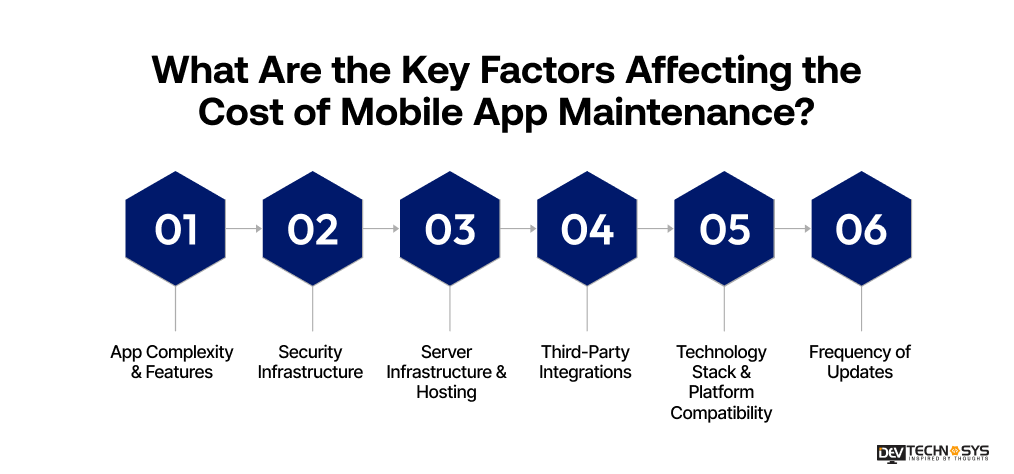
1. App Complexity & Features
The more features your app has, the more there is to monitor, update, and fix. A basic app with a login screen and a feed is straightforward to maintain. But add real-time chat, booking engines, dashboards, or AI-driven recommendations, and every update becomes a multi-layered task. More complexity means more developer hours, more testing cycles, and higher annual costs.
| Complexity Level | Key Features | Annual Maintenance Cost (USD) |
| Basic | Auth, static content, simple UI | $300 – $600 |
| Mid-level | APIs, user profiles, notifications | $600 – $1,200 |
| Complex | Real-time features, AI, dashboards | $1,200 – $2,000 |
2. Security Infrastructure
Security isn’t a one-time setup; it’s an ongoing responsibility. Every time a new vulnerability is discovered in a library your app uses, it needs patching. UAE businesses handling payments or personal data are also subject to compliance requirements that mandate regular security audits. Skipping this is not an option; it’s both a legal and reputational risk.
| Security Level | Key Requirements | Annual Maintenance Cost (USD) |
| Basic | SSL, standard auth, basic patches | $300 – $600 |
| Standard | Data encryption, regular audits | $600 – $900 |
| Advanced | PCI-DSS, penetration testing, GDPR | $900 – $1,500 |

3. Server Infrastructure & Hosting
Your app lives on servers, and servers need constant management. This includes uptime monitoring, scaling during traffic spikes, database backups, and cloud cost optimization. As your user base grows in the UAE, so does your server load. Choosing the right hosting setup early directly impacts how much you spend here year on year.
| Hosting Type | Setup | Annual Maintenance Cost (USD) |
| Shared hosting | Low traffic, basic apps | $240 – $480 |
| Cloud (AWS/GCP) | Scalable, mid-to-high traffic | $480 – $900 |
| Dedicated / enterprise | High traffic, data residency needs | $900 – $1,500 |
4. Third-Party Integrations
Most UAE apps connect to external services, payment gateways like Telr or PayTabs, Google Maps, CRMs, or analytics platforms. Every time one of these providers updates their API, your app needs to be updated too. The more integrations you have, the more touchpoints that can break and the more ongoing work required to keep everything running smoothly.
| Integration Volume | Examples | Annual Maintenance Cost (USD) |
| Low (1–2) | Payment gateway, analytics | $240 – $480 |
| Medium (3–5) | CRM, maps, notifications, auth | $480 – $960 |
| High (6+) | ERP, multiple gateways, logistics APIs | $960 – $1,500 |
5. Technology Stack & Platform Compatibility
What your app is built on determines what the cost to maintain a mobile app is. Native apps built separately for iOS and Android cost more to maintain than hybrid app development services, which share a single codebase. Older tech stacks also require more effort as frameworks release new versions and deprecate old ones.
| Stack Type | Platform | Annual Maintenance Cost (USD) |
| Native iOS | Swift / Objective-C | $600 – $1,200 |
| Native Android | Kotlin / Java | $600 – $1,200 |
| Cross-platform | React Native, Flutter | $480 – $960 |
| Legacy stack | Older frameworks | $960 – $1,500 |
6. Frequency of Updates
How often you push updates directly drives your maintenance spend. Apps that release updates quarterly cost less than those shipping monthly improvements. However, in a competitive UAE market, too infrequent updates can hurt your app store ranking and user retention. Finding the right cadence is a balance between cost and competitiveness.
| Update Frequency | What’s Included | Annual Maintenance Cost (USD) |
| Minimal (quarterly) | Bug fixes, OS patches only | $240 – $480 |
| Regular (monthly) | Feature tweaks, UI improvements | $480 – $960 |
| Active (bi-weekly) | New features, A/B testing, optimization | $960 – $1,500 |
Industry Insight
According to ITRansition Mobile App Statistics Report, the global mobile app market is expected to surpass $1.2 trillion by 2035, highlighting the growing importance of continuous app maintenance to remain competitive.
What Are the Types of Mobile App Maintenance in the UAE?
Not all maintenance is the same. When you sign up for a maintenance plan with a development partner, you’re typically paying for a mix of different service types, and knowing what each one covers helps you understand exactly what you’re getting for your money. Mobile app maintenance costs change with the type of maintenance. There are four core types of mobile app maintenance that UAE businesses should be aware of:
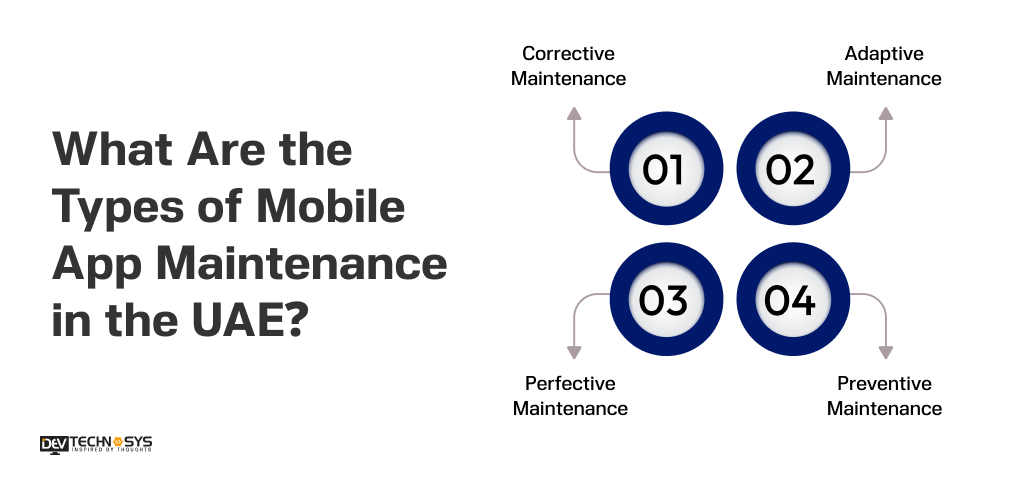
1. Corrective Maintenance
This is the most immediate type of fixing bugs, crashes, and errors that affect your users. Whether it’s a payment flow breaking after an OS update or a login screen freezing on certain devices, corrective maintenance addresses problems that are already impacting your app’s performance. It also covers issues that users report directly through reviews or support tickets, which in the UAE market can escalate quickly if left unaddressed. For businesses where user experience directly affects retention, fast corrective response time is non-negotiable.
2. Adaptive Maintenance
The digital environment around your app is always changing. Adaptive maintenance ensures your app keeps up, whether that’s compatibility with a new iOS or Android release, adjustments to meet UAE data residency regulations, or updates to support new device screen sizes. This is where many businesses get caught off guard if they haven’t budgeted for it upfront.
To handle adaptive maintenance effectively, many UAE businesses hire mobile app developers in the Dubai. Who understands both the technical landscape and local compliance requirements, making updates faster and more cost-efficient.
3. Perfective Maintenance
This is about improvement, not just survival. Perfective maintenance covers adding new features, refining the UI, improving load speeds, and optimizing the overall user experience based on real user feedback and analytics data. It also includes A/B testing new flows, improving onboarding, and acting on app store reviews. In a market like the UAE, where users have high expectations, proactive maintenance is what keeps your app competitive and your ratings strong on the App Store and Google Play.

4. Preventive Maintenance
Think of this as your app’s routine health check. Preventive maintenance involves code refactoring, database optimization, security audits, and performance testing, all done proactively before problems arise. It also includes reviewing third-party dependencies and retiring outdated libraries that could become security risks down the line. It costs less in the short term than fixing a major breakdown and significantly extends your app’s lifespan.
What Are the Core Components of Mobile App Maintenance?
Understanding where your maintenance budget actually goes is just as important as knowing how much you’ll spend. Mobile app maintenance isn’t a single activity; it’s a combination of ongoing technical, operational, and user-focused efforts that keep your app stable, secure, and competitive in the UAE market. Here are the core components for mobile app maintenance cost:
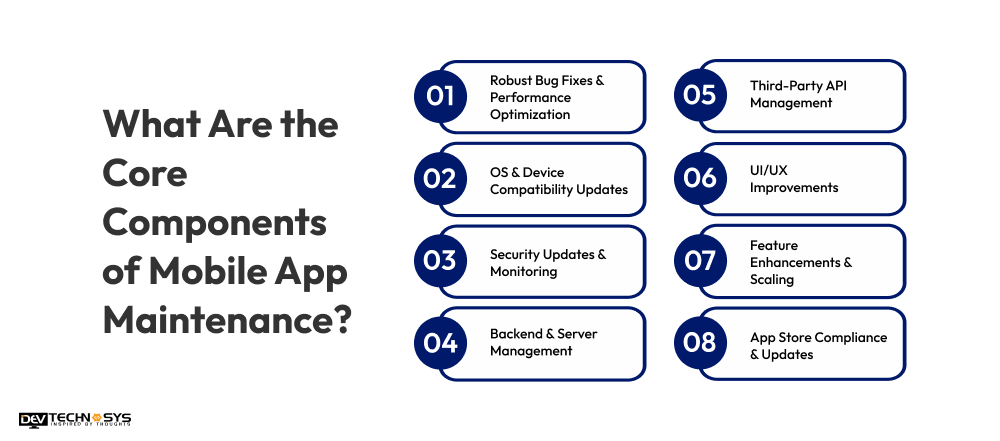
1. Bug Fixes & Performance Optimization
No app is completely bug-free at launch. Over time, users encounter issues like crashes, slow loading times, or broken features. Regular debugging and performance tuning ensure your app runs smoothly across devices and network conditions. In a fast-paced market like the UAE, even small performance lags can lead to user drop-offs.
2. OS & Device Compatibility Updates
Both iOS and Android release frequent updates, introducing new features, UI changes, and security requirements. Your app must stay compatible with the latest OS versions, screen sizes, and hardware configurations. Failing to do so can result in app store rejection or poor user experience on newer devices. Hiring an iOS app development company will help you tackle this component very easily.
3. Security Updates & Monitoring
Security is a continuous process. This component includes patching vulnerabilities, updating encryption protocols, monitoring suspicious activities, and ensuring compliance with regional regulations. For apps handling payments or sensitive data, this becomes a critical and non-negotiable investment.
4. Backend & Server Management
Your app’s backend infrastructure requires constant attention. This includes server uptime monitoring, database optimization, API management, and handling traffic spikes. As your user base grows, backend efficiency directly impacts app speed and reliability.
5. Third-Party API Management
Most modern apps rely on external services like payment gateways, maps, analytics, and CRMs. These providers frequently update their APIs, and your app must adapt accordingly. Regular monitoring and updates ensure these integrations continue to function without disruptions.
6. UI/UX Improvements
User expectations evolve quickly. Regular UI/UX updates help improve navigation, enhance usability, and align your app with current design trends. Even small tweaks like improving onboarding or simplifying checkout can significantly boost user retention.
7. Feature Enhancements & Scaling
As your business grows, your app needs to evolve. This includes adding new features, improving existing ones, and scaling infrastructure to handle increased demand. These enhancements are often driven by user feedback, analytics, and market trends.
8. App Store Compliance & Updates
Both Apple App Store and Google Play have strict and evolving guidelines. Maintenance includes updating your app to meet these policies, fixing compliance issues, and ensuring smooth approval for new releases. Ignoring this can lead to app removal or reduced visibility.
How Can You Reduce Mobile App Maintenance Costs?
Maintenance is unavoidable, but overspending on it isn’t. With the right decisions made early, UAE business owners can significantly reduce their mobile app support and maintenance cost without compromising on quality or user experience. Here are the most effective ways to keep your cost to maintain a mobile app in check:
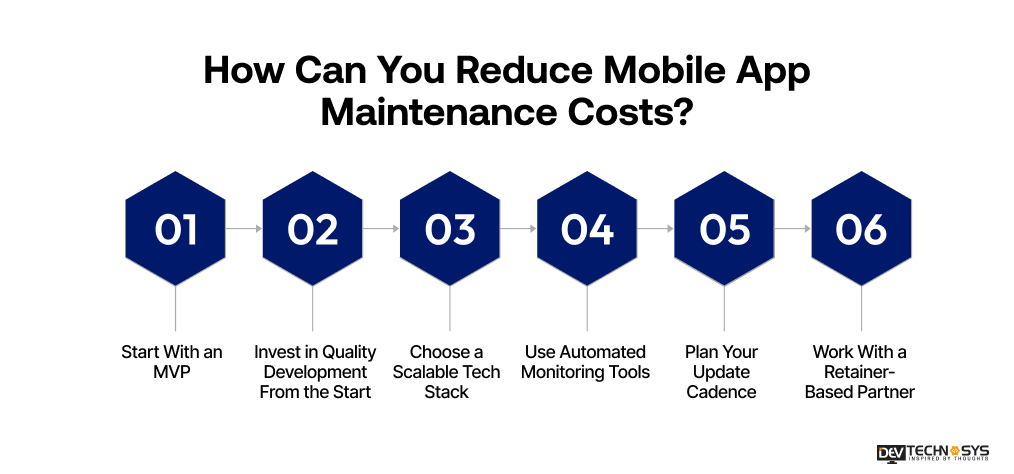
1. Start With an MVP
One of the smartest ways to reduce long-term maintenance costs is to start small. MVP development means you launch with only your core features, less code, fewer integrations, and a smaller surface area for bugs and issues. As your user base grows and your revenue justifies it, you scale up deliberately rather than maintaining a bloated app from day one.
2. Invest in Quality Development From the Start
Cutting corners during development always costs more in maintenance. Clean, well-documented code is significantly cheaper to update, debug, and hand over to a new developer if needed. Think of quality development as pre-paying for cheaper maintenance; every hour saved in future bug fixes starts with a decision made during the build.
3. Choose a Scalable Tech Stack
The technology your app is built on has a direct impact on future maintenance costs. Modern, well-supported frameworks like React Native or Flutter are easier and cheaper to maintain than legacy stacks that require specialist developers. Before you build, make sure your tech choices are future-proof. Switching stacks later is far more expensive than getting it right up front. Hire dedicated developer with domain expertise to get the best results.
4. Use Automated Monitoring Tools
In 2026, there’s no excuse for finding out about app crashes from your users. Tools like Firebase, Sentry, and Datadog automatically detect performance issues, crashes, and anomalies in real time, allowing your team to fix problems before they impact a large portion of your user base. This reduces reactive maintenance hours and keeps your retainer costs predictable.
5. Plan Your Update Cadence
Ad hoc updates are expensive. Batching your bug fixes, feature improvements, and OS compatibility updates into a regular monthly or quarterly release cycle is far more cost-efficient than pushing emergency patches reactively. A planned cadence also makes it easier to scope and budget your maintenance retainer accurately.
6. Work With a Retainer-Based Partner
Paying for maintenance on an hourly or ad hoc basis is almost always more expensive than agreeing on a fixed monthly retainer with your development partner. A retainer gives you predictable costs, priority response times, and a team that stays familiar with your codebase, all of which reduce time spent and money billed.
Industry Insight
According to the Mordor Intelligence Market Report, platform fragmentation (multiple devices, OS versions, and form factors) significantly increases maintenance complexity and costs, with enterprises spending around 18% of initial development budgets on maintenance.
How Can You Choose the Right Maintenance Partner in the UAE?
Choosing who maintains your app is just as important as choosing who built it. The wrong partner means slow response times, unexpected costs, and a team that doesn’t truly understand your business. The right one becomes a natural extension of your team, proactive, transparent, and aligned with your growth. Here’s what UAE business owners should look for:
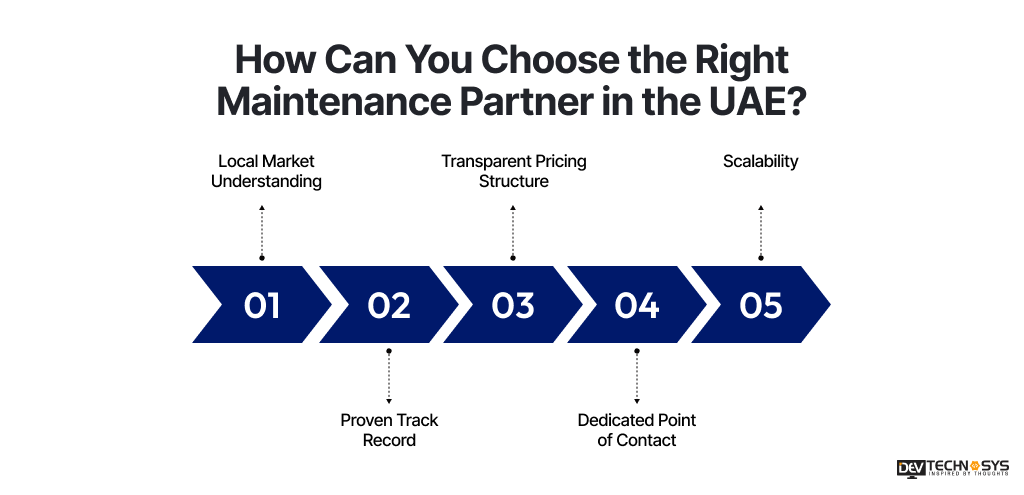
1. Local Market Understanding
Your maintenance partner should understand the UAE’s unique digital landscape, from Arabic language support and right-to-left UI considerations to local payment gateway integrations and data residency regulations. A partner experienced with the region will anticipate these requirements without you having to spell them out every time.
2. Proven Track Record
Look beyond the portfolio. Ask specifically about apps they’ve maintained, not just built. How long have they supported them? How do they handle emergency fixes? Do they have clear response time SLAs? A reliable partner should have confident, specific answers to all of these.
3. Transparent Pricing Structure
Vague pricing is a red flag. Your partner should clearly explain what’s included in their retainer, what falls outside the scope, and how additional work is billed. Hidden costs are one of the most common frustrations UAE business owners face with maintenance contracts. Clarity upfront saves disputes later.
4. Dedicated Point of Contact
Avoid partners who route every request through a generic support ticket system. You want a dedicated developer who knows your app inside out, someone who reduces back-and-forth, speeds up fixes, and ensures nothing falls through the cracks.
5. Scalability
Your maintenance needs today won’t be the same in two years. Choose a partner who can scale support up or down as your app grows, whether that means adding developers during a major release or trimming the retainer during quieter periods.
When evaluating your options, working with a mobile app development firm in Dubai ensures local expertise, regional compliance knowledge, and a team available in your time zone when it matters most.

Conclusion
Mobile app maintenance is not an optional expense; it’s a long-term investment that determines whether your app survives or scales in a competitive market like the UAE. From handling bugs and security updates to adapting to new technologies and improving user experience, every aspect of maintenance plays a direct role in your app’s performance and business growth. Mobile app maintenance cost directly affects the success of the app in the long-term.
The key is to approach maintenance strategically, plan your budget early, choose the right technology stack, and work with a reliable mobile app development company that understands your business goals. When done right, maintenance doesn’t just preserve your app; it continuously enhances its value, ensuring sustained user engagement and long-term profitability.
FAQs
Q1. How Much Does It Cost to Maintain a Mobile App Annually?
Mobile app maintenance typically costs around 15% – 20% of the original development cost per year. This includes bug fixes, updates, security patches, and performance improvements. The exact cost depends on factors like app complexity, infrastructure, and how frequently updates are released.
Q2. Why is Mobile App Maintenance Important After Launch?
Maintenance ensures your app remains functional, secure, and compatible with new OS updates and devices. Without it, apps can crash, become vulnerable to cyber threats, or lose users due to poor performance, ultimately affecting your business reputation and revenue.
Q3. How Often Should a Mobile App Be Updated?
Most apps should be updated monthly or quarterly, depending on business needs and competition. Regular updates help fix bugs, improve performance, and maintain compatibility with OS changes. Frequent updates also improve app store rankings and user engagement.
Q4. Do Third-party Integrations Increase Mobile App Maintenance Costs?
Yes, third-party integrations like payment gateways, maps, or CRMs increase maintenance efforts. These services frequently update their APIs, requiring your app to adapt accordingly. More integrations mean more potential points of failure, leading to higher ongoing maintenance work and costs.
Q5. Should I Hire a Mobile App Development Company for Maintenance?
Yes, partnering with a professional mobile app development company ensures expert handling of updates, security, and performance optimization. It provides access to experienced developers, faster issue resolution, and predictable costs, allowing you to focus on business growth instead of technical challenges.