






Key Takeaways:
-
- Careful planning is necessary to avoid data silos and operational disruptions when integrating SCM software with ERP, WMS, TMS, IoT, GPS, and legacy systems.
- Prior to migration, UAE companies can prevent erroneous inventory, forecasting, reporting, and decision-making by cleaning, standardizing, validating, and mapping operational data.
- Supply chain software adoption can be made more effective by reducing employee resistance through role-based training, pilot deployments, stakeholder involvement, and ongoing feedback.
- Encryption, RBAC, MFA, API security, audit trails, backups, monitoring, and suitable UAE data-protection procedures should all be incorporated into SCM solutions.
- SCM software can be more useful for UAE businesses with Arabic and English interfaces, RTL support, localized documentation, notifications, and reporting.
Using supply chain software allows integration of procurement, inventory, warehousing, transportation, and delivery processes in one digital ecosystem, but the implementation is often not easy.
Businesses in the UAE face problems with legacy system integration, unreliable data, resistance from employees, complex workflows, cybersecurity factors, and translation when implementing the system.
All of these supply chain software implementation challenges contribute to growing costs, postponing the go-live date, and lowering ROI if not resolved at an early stage.
It is also important to think about ERP and WMS systems, TMS, IoT, GPS, and third-party integrations while keeping scalability and transparency in mind.
Knowing all of these issues before the implementation allows organizations to work out a pertinent plan, identify the most important workflows, and decrease the risks linked to implementation.
Answer a few quick questions and our experts will share a tailored project estimate.
What Are the Most Common Supply Chain Software Implementation Challenges in the UAE?
Legacy integrations, data migration, employee adoption, cybersecurity, localization, and logistics complexity are some of the issues that supply chain software implementation in the UAE may encounter.
Businesses may develop practical implementation strategies, reduce operational disruptions, increase system adoption, and improve supply chain performance, supply chain visibility, and automation by being aware of these supply chain management challenges in the UAE early on.
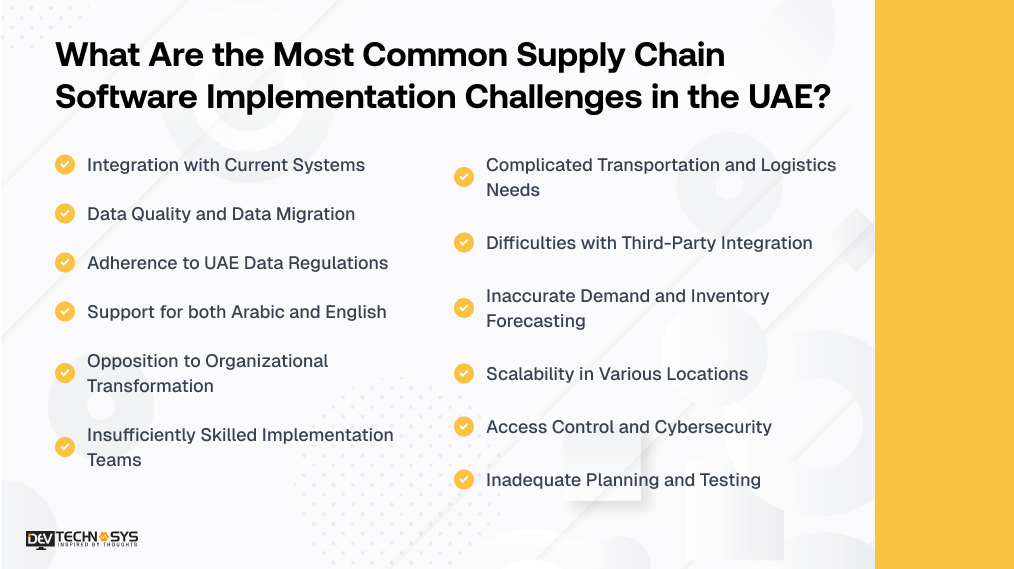
1. Integration with Current Systems
ERP, warehouse management, transportation, accounting, and procurement systems from various suppliers are frequently used by UAE companies. API, data-format, and synchronization problems may arise when these systems are connected to new supply chain applications.
Well-defined integration architecture, consistent data interchange, middleware when needed, and extensive testing to guarantee accurate information flow across all operational functions are all important for a successful implementation.
2. Data Quality and Data Migration
Duplicate, out-of-date, or incomplete records may be revealed when transferring supplier, inventory, customer, shipping, purchase-order, and warehouse data to a new platform. Forecasting, reporting, and automated decision-making can all be impacted by low-quality data.
To guarantee that the benefits of supply chain management software begins with accurate and consistent data, businesses should set up data ownership, cleansing rules, validation processes, and migration testing prior to deployment.
3. Adherence to UAE Data Regulations
Supply chain platforms handle transaction data, personnel records, customer information, and commercially sensitive data. When building the system, organizations must take industry-specific obligations and applicable UAE data-protection regulations into account.
The implementation architecture should include security controls, including encryption, role-based access, multi-factor authentication, audit logging, data minimization, secure APIs, and suitable backup mechanisms.
4. Support for both Arabic and English
Employees, suppliers, drivers, and clients may prefer Arabic or English in the bilingual settings of many UAE businesses. Inadequate localization of software can lead to usability issues and raise the need for training.
Instead of considering translation as a post-launch improvement, businesses should assess bilingual interfaces, Arabic text rendering, reporting requirements, notifications, search functionality, and document production throughout implementation.
5. Opposition to Organizational Transformation
Workers may be reluctant to embrace a new supply chain platform if they are used to spreadsheets, outdated software, or manual procedures. Digital transformation for UAE businesses can be slowed down, and system use decreased by resistance.
To promote adoption across procurement, warehouse, logistics, and management teams, organizations should establish internal champions, involve employees early, explain operational benefits, offer role-specific training, and introduce the new workflows gradually.
6. Insufficiently Skilled Implementation Teams
Supply chain software implementation challenges call for knowledge of technology, logistics, procurement, inventory, warehouse operations, integrations, and cybersecurity. Teams with adequate software and supply chain process expertise may be hard to come by for UAE companies.
Businesses can convert operational requirements into workable system configurations by assigning internal subject-matter experts and collaborating with seasoned implementation specialists.
7. Complicated Transportation and Logistics Needs
Ports, airports, free zones, warehouses, last-mile deliveries, cross-border shipments, and numerous transportation providers are all part of the UAE’s logistics landscape. These operations might not be sufficiently supported by standard software configurations.
In accordance with the particular logistics needs of the company, implementation teams must map actual operational processes and set up routing, shipment tracking, fleet coordination, carrier management, delivery exceptions, and real-time visibility.
Industry Insights:
“Gartner says, leading supply chains in 2026 are prioritizing autonomous workforces, network-centric operations, and supply orchestration, increasing pressure on businesses to modernize disconnected supply-chain processes.”
8. Difficulties with Third-Party Integration
External logistics companies, suppliers, carriers, marketplaces, payment platforms, mapping services, and government-related systems are all necessary for supply chain activities. Different APIs, authentication techniques, data formats, and availability criteria may apply to each integration.
Before putting the system into production, businesses should describe integration dependencies early on and set up standardized APIs, error handling, monitoring, security controls, and fallback methods.
9. Inaccurate Demand and Inventory Forecasting
Forecasting accuracy can be lowered by inadequate historical data, inaccurate inventory records, seasonal demand, shifting consumer behavior, and disjointed sales channels. Recommendations may be unreliable if enhanced forecasting supply chain software features are implemented without addressing underlying data issues.
Before implementing AI-powered forecasting, replenishment automation, or predictive supply chain analytics, organizations need to first create precise inventory visibility and clean historical records.
10. Scalability in Various Locations
Expanding companies in the United Arab Emirates may run several warehouses, retail locations, distribution hubs, branches, or local supply networks. Complex inventory structures and higher transaction volumes may be too much for a system built for a single location.
Prior to implementation, businesses should assess scalability in relation to multi-location inventory, centralized reporting, user administration, warehouse operations, API capacity, database performance, and future growth requirements.
11. Access Control and Cybersecurity
Access control and cybersecurity are among the major SCM software implementation challenges. Supply chain platforms increase the possible attack surface by connecting a large number of users, devices, applications, suppliers, and logistical partners.
Information about suppliers, customers, finances, and inventories may be compromised by lax access controls. Role-based permissions, MFA, encryption, secure API authentication, network controls, continuous monitoring, vulnerability testing, audit trails, and incident-response protocols should be implemented by organizations during installation rather than after deployment.
12. Inadequate Planning and Testing
Procurement, inventory, warehousing, transportation, and order fulfillment may all be affected if supply chain software is introduced without thorough testing. Before going live, businesses should test for functionality, ERP integration, performance, security, user acceptability, and data migration.
Long-term adoption can be enhanced, and operational disruption can be greatly minimized with a phased rollout, backup plan, personnel training, documentation, and post-launch monitoring.

How to Overcome Supply Chain Software Implementation Challenges in the UAE?
A methodical approach addressing business needs, data quality, system integration, security, user adoption, and phased deployment is necessary to overcome supply chain software implementation challenges in the UAE.
By aligning supply chain technology with operational procedures, regulatory constraints, scalability needs, and measurable supply chain performance objectives, businesses can reduce supply chain risk management.
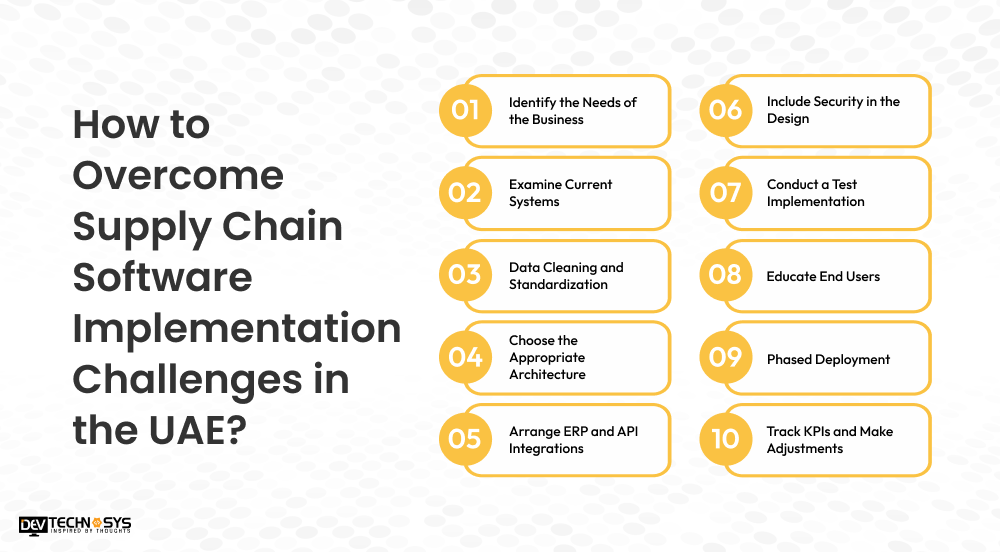
1. Identify the needs of the business
Prior to development, determine operational objectives, supply chain bottlenecks, user roles, workflows, reporting needs, and integration requirements. Record the needs for transportation, analytics, inventory, warehousing, and procurement.
Supply chain software development services teams may limit project scope, steer clear of superfluous features, and match the solution with UAE business activities with the aid of clear requirements.
2. Examine Current Systems
Prior to installation, examine existing ERP, WMS, TMS, CRM, accounting, procurement, and legacy applications. Determine redundant features, out-of-date technologies, integration dependencies, gaps in the data, and inefficient processes. During the supply chain software deployment, this audit aids in identifying which systems should be kept, updated, integrated, or replaced.
Market Insights:
“According to PwC, regional cloud adoption is accelerating, with 68% of Middle Eastern companies surveyed planning to migrate most operations to cloud environments, supporting scalable SCM modernization.”
3. Data Cleaning and Standardization
Check for duplicates, discrepancies, and out-of-date information in the current supplier, inventory, product, customer, purchase-order, and shipment records. Establish uniform data formats, ownership roles, validation guidelines, and migration protocols. After deployment, accurate reporting, forecasting, supply chain automation, and system performance are all enhanced by clean, structured data.
4. Choose the Appropriate Architecture
A business’s size, transaction volume, integration needs, security requirements, and potential growth should all be taken into consideration while selecting an architecture. When properly developed, cloud-native, modular, or hybrid architectures can offer flexibility.
Before completing the technological architecture, take into account the needs for scalability, availability, maintainability, disaster recovery, performance, and localization.
5. Arrange ERP and API Integrations
List all of the necessary integrations between supply chain software and external logistics, ERP, WMS, TMS, CRM, accounting, payment, GPS, and mapping systems. Specify data formats, error handling, synchronization frequency, authentication, API standards, and monitoring needs. Costly technical modifications during development and deployment are avoided with early integration planning.
6. Include Security in the Design
Instead of viewing security as a post-launch issue, implement it from the start. Use secure APIs, role-based access control, MFA, encryption, audit trails, backup plans, vulnerability testing, and ongoing monitoring. Align security measures with pertinent industry compliance duties and applicable UAE data protection regulations.
7. Conduct a Test Implementation
Before implementing the solution throughout the entire organization, test it in a small warehouse, department, product category, or operational workflow. Integration concerns, common supply chain challenges, inconsistent data, and process gaps can all be discovered through a pilot. Before extending the implementation, collect employee input, assess performance, fix errors, and improve workflows.
8. Educate End Users
AI in manufacturing gives procurement teams, warehouse workers, logistics coordinators, managers, administrators, and other users role-specific training. Make use of hands-on activities, documentation, demonstrations, and realistic processes.
In order to help staff members comprehend how the platform enhances day-to-day operations and promote greater adoption, training should include both system functionality and process modifications.
9. Phased Deployment
When operational complexity is great, avoid implementing every module and location at once. Capabilities including procurement, inventory, warehouse management, transportation, and analytics should be introduced in regulated phases.
Phased deployment facilitates user adoption, lowers operational risks, facilitates troubleshooting, and enables lessons learned from previous phases to enhance subsequent rollouts.
10. Track KPIs and Make Adjustments
Monitor operational and implementation KPIs including stockouts, system adoption, order fulfillment time, delivery performance, procurement efficiency, inventory correctness, and processing expenses.
To find flaws, use user input and dashboards. Businesses can enhance automation, streamline processes, and make sure the software provides quantifiable supply chain value through ongoing monitoring.

How Long Does Supply Chain Software Implementation Take in the UAE?
Depending on project scale, customization, integrations, data migration, testing, and organizational readiness, supply chain software deployment in the UAE usually takes two to five months. While complicated needs could necessitate more planning and deployment time, a targeted implementation can be finished more quickly.
Implementation Scope |
Typical Timeline |
Description |
| Basic SCM System | 2–3 months | Suitable for essential inventory, procurement, order, and reporting workflows with limited customization. |
| Mid-Level Custom SCM | 3–4 months | Includes customized workflows, multiple integrations, advanced dashboards, and role-based functionality. |
| Advanced SCM System | 4–5 months | Designed for complex operations requiring extensive customization, multiple integrations, automation, and comprehensive testing. |
Conclusion
Due to complicated logistics, old systems, data transfer, integrations, security constraints, and evolving business objectives, implementing supply chain software in the UAE can be rather tough. Implementation risks can be mitigated through a systematic strategy that incorporates security architecture, user training, phased deployment, data standards, and requirement planning.
Businesses may construct scalable supply chain solutions that comply with operational workflows and UAE needs by partnering with a competent supply chain software development company. Supply chain transparency, automation, efficiency, and decision-making are all enhanced with the correct implementation approach.
Frequently Asked Questions
1. What Are The Biggest Supply Chain Software Implementation Challenges In The UAE?
Legacy-system integration, inconsistent data, customization needs, employee opposition, cybersecurity, regulatory concerns, and intricate logistics workflows are typical obstacles. Careful preparation and gradual implementation are crucial since UAE organizations may encounter linguistic needs, various locations, third-party integrations, and supply chain disruptions during relocation.
2. How Long Does SCM Software Implementation Take in the UAE?
Depending on the size and complexity of the project, SCM software deployment in the UAE typically takes two to five months. While bespoke solutions can take three to five months, basic systems may take two to three months. The ultimate timeline can be greatly impacted by integrations, data transfer, testing, security validation, and organizational preparedness.
3. How Much Does Supply Chain Software Implementation Cost in the UAE?
Customization, integrations, modules, infrastructure, security, migration, and development needs all affect how much it costs to adopt supply chain software. While sophisticated enterprise solutions demand greater investments, a basic implementation could be less expensive. When creating budgets, businesses should include the overall expenses of development, integration, training, maintenance, and support.
4. How Can UAE Companies Integrate SCM Software With ERP Systems?
UAE businesses can use webhooks, middleware, secure APIs, or standardized data interfaces to integrate SCM software with ERP platforms. Data from procurement, inventories, orders, suppliers, finance, and logistics should all be synchronized through integration.Reliable information sharing between systems is maintained through thorough API documentation, authentication, error handling, testing, and monitoring.
5. What Security Measures Should Supply Chain Software Have?
Role-based access control, multi-factor authentication, secure APIs, audit logging, frequent vulnerability assessments, backups, disaster recovery, and ongoing monitoring should all be features of supply chain software. According to their operational and legal needs, businesses should also implement the proper data-protection and compliance procedures.