





Key takeaways:
-
- The global InsurTech market is projected to grow from $23.54 billion in 2026 to $132.71 billion by 2034.
- Building an insurance app costs between $30,000 and $150,000, depending on complexity and features.
- Claims management is the most critical feature customers evaluate when choosing an insurance platform.
- Security and compliance are not optional additions. They must be built into the platform from day one.
- Launching with a basic MVP first and scaling gradually produces better results than building everything at once.
The insurance industry is no longer defined by paperwork, branch visits, and slow claims cycles. Customers today expect instant policy access, real-time claims updates, and self-service tools that fit inside their smartphones. Insurers who fail to meet these expectations are losing ground to digital-first competitors who have already built mobile-first insurance ecosystems around convenience and speed.
For businesses, the opportunity is significant. A well-designed insurance app improves customer engagement, automates claims processing, simplifies policy management, and creates a competitive advantage that traditional service models simply cannot match. If you are looking to build an insurance app, 2026 presents the most favorable conditions yet, with mature technology, clear customer demand, and proven business models to learn from.
This article covers everything you need to know, including core features, the development process, technology stack, estimated costs, and future trends shaping the insurance app landscape.
What Is an Insurance App?
An insurance app is a digital platform that supports the complete insurance lifecycle, from quote generation and risk assessment to policy management, claims processing, and renewals. It serves both policyholders and insurers, giving customers self-service access while helping providers streamline operations and reduce administrative overhead.
Businesses planning to build an insurance app should first understand the different types of insurance applications available. Each category serves distinct customer needs and requires a different feature set.
Health Insurance Apps. Manage health coverage, claims submissions, and provider network access.
Life Insurance Apps. Handle policy management, premium payments, and beneficiary services.
Auto Insurance Apps. Support claims reporting, telematics integration, and policy tracking.
Property Insurance Apps. Cover home and property protection management and document storage.
Commercial Insurance Apps. Administer business risk policies and multi-line coverage management.
Organizations looking to develop an insurance app must align their chosen features with the specific insurance products they offer.
Insurance Industry Growth and Market Opportunities in 2026
The insurance industry is experiencing one of its most significant digital shifts in decades. Customer expectations have changed, technology costs have dropped, and insurers that delay digital investment are losing market share to faster, more agile competitors.

Key Insurance Market Statistics
- The global InsurTech market is projected to grow from $23.54 billion in 2026 to $132.71 billion by 2034, at a CAGR of 24.1%.
- North America currently dominates the market, holding a 47.9% share in 2025.
- Asia-Pacific holds the second-largest market size of $6.56 billion in 2026, growing at a CAGR of 33.90% during the forecast period.
- Many InsurTech companies are adopting a mobile-first approach, enabling customers to buy, manage, and file claims directly from their smartphones.
- Latin America generated $0.8 billion in 2025, contributing 4.20% to global InsurTech market revenue, reflecting growing digital insurance adoption across emerging markets.
Why Mobile-First Insurance Is Becoming the Industry Standard
Customers now expect instant policy access, digital claims submission, and real-time communication from their insurers. Waiting days for a claims update or visiting a branch to renew a policy is no longer acceptable. As customer expectations continue to evolve, more insurers are choosing to build an insurance app that delivers seamless digital experiences across every touchpoint.
The Rise of InsurTech Platforms
InsurTech platforms are redefining how insurance products are designed, sold, and serviced. AI-powered risk assessment, underwriting automation, digital claims modernization, embedded insurance, and personalized coverage are no longer experimental concepts. They are active components of modern insurance technology solutions. For businesses evaluating insurtech app development, these capabilities represent both a competitive benchmark and a clear product roadmap.
Why Businesses Should Build an Insurance App in 2026
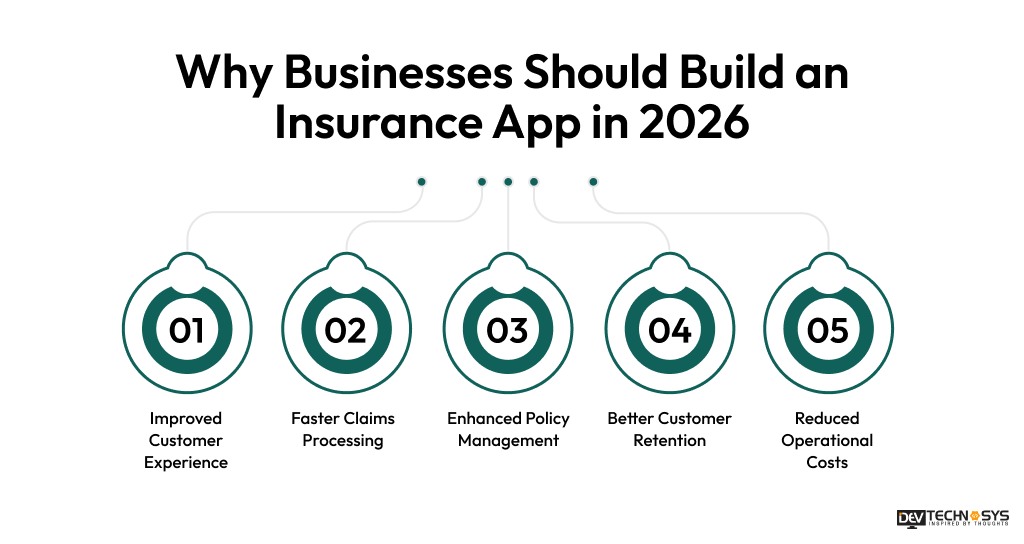
The decision to build an insurance app is no longer driven by innovation alone. It is driven by measurable business outcomes across customer experience, operational efficiency, and revenue retention.
1. Improved Customer Experience
Policyholders today expect 24/7 access to their coverage, real-time claims tracking, instant support, and complete self-service capabilities. Businesses looking to replicate that standard can study how regional leaders have done it, including how to build an insurance app like Tawuniya, one of the most recognized digital insurance platforms in the Middle East.
2. Faster Claims Processing
Digital claim submission, document uploads, and automated workflows significantly reduce settlement times. Faster claims handling directly improves customer satisfaction and lowers the administrative burden on operations teams.
3. Enhanced Policy Management
Apps give policyholders instant access to policy updates, premium payment schedules, renewal notices, and document storage, reducing inbound support volume and improving policy administration efficiency.
4. Better Customer Retention
Personalized offers, automated renewal reminders, and consistent engagement through mobile touchpoints keep customers connected between policy cycles, reducing churn.
5. Reduced Operational Costs
Process automation reduces paperwork, lowers support costs, and improves overall operational efficiency across the insurance value chain.
To fully understand these benefits, businesses must first understand the insurance lifecycle that powers policy management, claims processing, and customer retention. Investing in insurance app development begins with understanding the lifecycle end-to-end.
How Insurance Apps Work: Understanding the Insurance Lifecycle
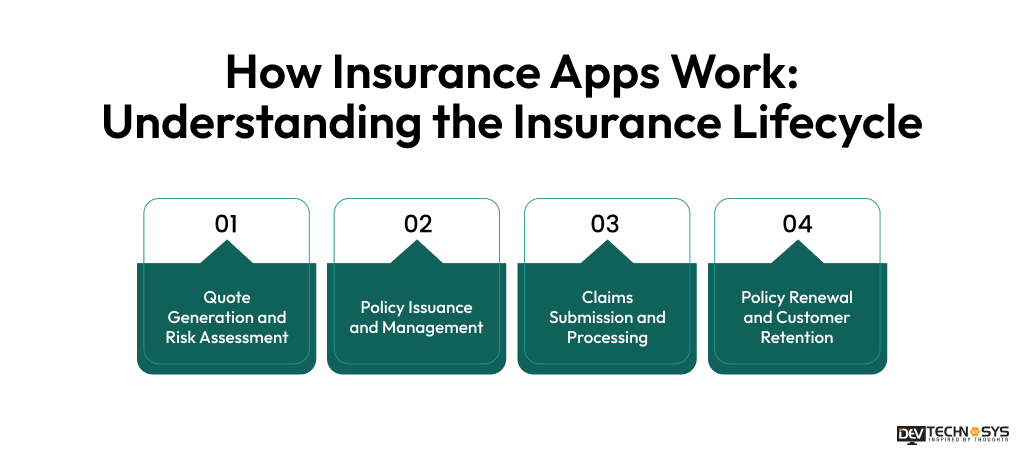
When businesses decide to build an insurance app, understanding the insurance lifecycle is the most important starting point. Every feature, workflow, and user interaction connects back to one of four core stages.
1. Quote Generation and Risk Assessment
The lifecycle begins when a user submits personal or asset information through the app. The system evaluates risk factors, applies underwriting logic, and generates personalized coverage options with accurate premium estimates. This stage sets the foundation for every policy that follows.
2. Policy Issuance and Management
Once a customer selects a plan, the app activates the policy, delivers digital documentation, and manages ongoing responsibilities, including premium payments and coverage updates. Policyholders can review, amend, or upgrade their coverage without contacting an agent, reducing friction across the entire policy administration process.
3. Claims Submission and Processing
A policyholder reports an incident, uploads supporting documents, and monitors status updates without making a single phone call. Behind the scenes, the app routes each submission through verification, assessment, and settlement workflows automatically. Businesses building claims-focused platforms can reference how to build an insurance app like Najm as a practical benchmark for mobile-first claims execution.
4. Policy Renewal and Customer Retention
As policies approach expiry, the app delivers automated renewal reminders, presents updated coverage options, and maintains consistent engagement with policyholders. This stage is critical for long-term customer retention and lifetime value.
How to Build an Insurance App in 2026?
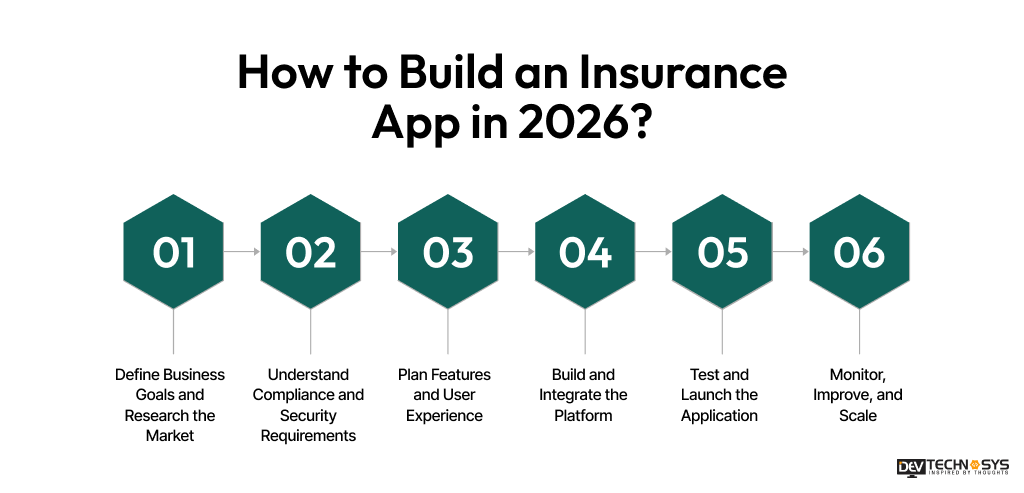
Building a successful insurance app requires a clear process that connects business strategy with technical execution. Here is a practical overview of how that journey unfolds.
1. Define Business Goals and Research the Market
Before development begins, businesses must identify their target audience, choose their insurance niche, and study what competitors are already offering. When you develop an insurance app without this groundwork, the product risks solving the wrong problem for the wrong market.
2. Understand Compliance and Security Requirements
Insurance platforms operate under strict regulatory frameworks covering data privacy, KYC verification, and financial compliance. Understanding these requirements early prevents costly rework later. Security planning at this stage also shapes how the entire platform is architected, not just how data is stored.
3. Plan Features and User Experience
The most effective way to create an insurance app is to design around customer journeys rather than feature lists. Map how users move through quote generation, policy management, claims submission, and renewals. Every feature decision should serve a specific moment in that journey.
4. Build and Integrate the Platform
This is where strategy becomes product. Insurance application development at this stage covers mobile app construction, backend systems for policy administration and claims processing, and third-party integrations including payment gateways, identity verification, and telematics services. Businesses choosing between native and cross-platform approaches for Android app development should evaluate performance requirements and long-term maintenance costs before committing.
5. Test and Launch the Application
Before releasing to customers, the platform must be tested across devices, load conditions, and security scenarios. Performance gaps identified during testing are far less costly to fix than those discovered after launch. A phased rollout also helps teams develop an insurance app that improves quickly based on real user feedback.
6. Monitor, Improve, and Scale
Launch is not the finish line. The businesses that create an insurance app successfully treat the product as a continuously evolving platform. Usage data, customer feedback, and operational metrics should drive regular updates, new feature releases, and infrastructure scaling as the user base grows.
Must-Have Features of an Insurance App
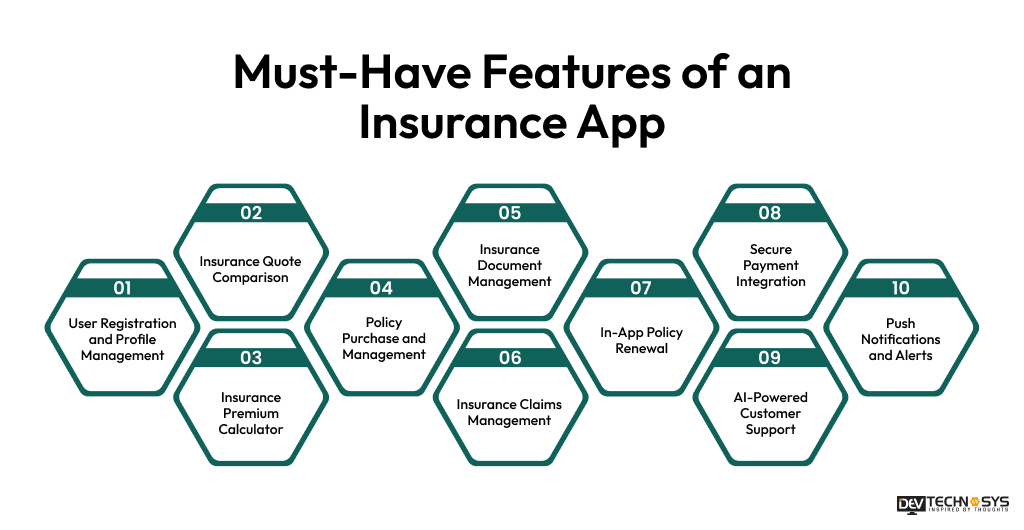
Choosing the right features is not about building the longest list. It is about identifying the capabilities that make an insurance app functional for customers and operationally valuable for the business. Each feature below solves a real problem in the insurance experience.
1. User Registration and Profile Management
Customers need a secure, centralised account where they can verify their identity, manage personal information, and access all policy details from a single dashboard. A well-designed profile system reduces support queries and gives policyholders full control over their relationship with the insurer.
2. Insurance Quote Comparison
Before committing to a policy, customers want to evaluate their options. An insurance quote comparison tool lets users review multiple plans, compare coverage limits, and assess pricing side by side. This transparency builds trust and reduces drop-off during the purchase journey.
3. Insurance Premium Calculator
A built-in insurance premium calculator allows users to estimate costs in real time based on their coverage preferences and risk profile. Giving customers this visibility before purchase reduces hesitation and improves conversion rates for insurers.
4. Policy Purchase and Management
Once a customer selects a plan, the app should handle everything from purchase to ongoing policy administration. Viewing coverage details, updating personal information, and tracking policy status should all be available without contacting an agent. Robust insurance policy management software capabilities at the app level directly reduce the workload on customer service teams.
5. Insurance Document Management
Policyholders generate significant documentation across the insurance lifecycle. A dedicated insurance document management feature allows customers to upload, store, and retrieve certificates, claim forms, and policy schedules instantly. Eliminating physical paperwork improves both the customer experience and internal processing efficiency.
6. Insurance Claims Management
This is where the quality of an insurance app is most clearly measured. An insurance claims management app should allow policyholders to report incidents, upload photographic or documentary evidence, and monitor claim progress in real time. Automated routing through verification and assessment workflows reduces settlement times and lowers the cost of claims administration.

7. In-App Policy Renewal
Allowing customers to renew coverage directly through the app removes one of the most common friction points in the insurance relationship. In-app policy renewal with automated reminders ensures that policies do not lapse due to oversight, protecting both the customer and the insurer’s revenue continuity.
8. Secure Payment Integration
Premium payments should support multiple methods, including cards, bank transfers, and digital wallets. Every transaction must be processed through encrypted, compliant payment gateways that protect sensitive financial data.
9. AI-Powered Customer Support
Intelligent chatbots handle routine policy queries, guide customers through claim submissions, and escalate complex issues to human agents. This reduces support costs while maintaining response quality around the clock.
10. Push Notifications and Alerts
Timely notifications for renewal deadlines, payment reminders, and claim status updates keep customers informed without requiring them to open the app. Consistent communication at the right moment is one of the simplest ways to improve retention.
Technologies Powering Modern Insurance Apps
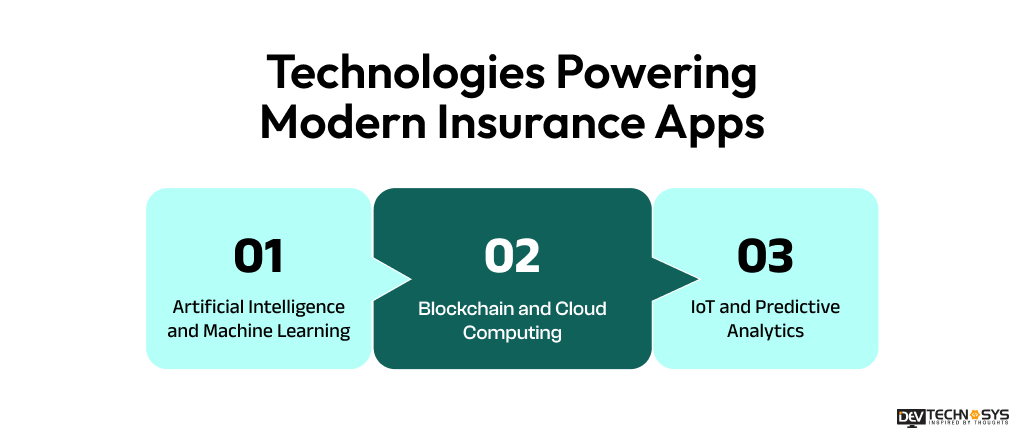
The most competitive insurance apps in 2026 are not just well-designed. They are powered by technologies that automate complex processes, reduce operational risk, and deliver smarter customer experiences across every stage of the insurance lifecycle.
1. Artificial Intelligence and Machine Learning
AI is reshaping how insurers handle claims automation, fraud detection, risk assessment, and personalized policy recommendations. Machine learning models analyse customer behavior and claims history to make faster, more accurate underwriting decisions. Businesses investing in insurtech app development are increasingly treating AI not as an added feature but as a core operational capability. These insurance technology solutions are now standard expectations in competitive markets.
2. Blockchain and Cloud Computing
Blockchain brings transparency and tamper-proof record-keeping to policy issuance, claims verification, and premium transactions. Cloud infrastructure allows insurance platforms to scale reliably, manage data securely, and deliver consistent performance across regions. For insurers building cross-platform applications, working with an experienced iOS app development company ensures the platform performs as reliably on Apple devices as it does elsewhere.
3. IoT and Predictive Analytics
Connected devices and telematics are enabling usage-based insurance models that price coverage based on real behavior rather than broad risk categories. IoT data from vehicles, homes, and wearables feeds predictive analytics engines that help insurers assess risk more accurately and intervene before claims occur. This insurance app development solution benefits both insurers through reduced claims exposure and customers through fairer, more personalized pricing.
Security, Compliance, and Fraud Prevention in InsurTech Apps
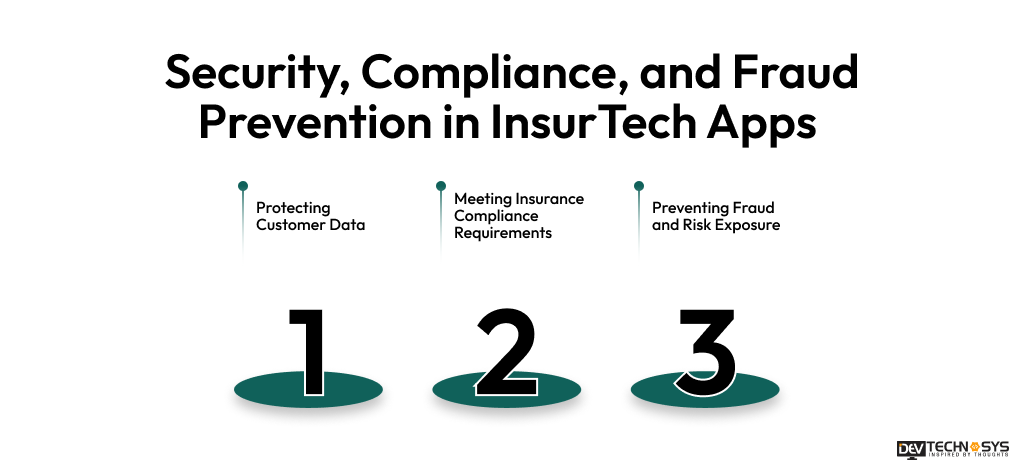
Insurance apps manage some of the most sensitive data a customer can share. Personal identity information, financial records, policy documents, and claims history all pass through these platforms daily. Security and compliance are not optional additions. They are foundational requirements.
1. Protecting Customer Data
Every insurance app must store customer data through encrypted systems, enforce secure authentication at login, and apply strict access controls that limit who can view or modify sensitive records. When customers trust an insurer with their personal and financial information, that trust depends entirely on how well the platform protects it.
2. Meeting Insurance Compliance Requirements
Insurance platforms operate within regulatory frameworks that govern data privacy, digital record management, and consumer protection. Businesses must ensure their app meets applicable standards before launch and maintains compliance as regulations evolve. Treating compliance as an ongoing operational responsibility rather than a one-time checklist separates credible platforms from vulnerable ones. Choosing the right insurance app development solution means building compliance into the product architecture from day one.
3. Preventing Fraud and Risk Exposure
Claims fraud represents one of the most significant financial risks in the insurance industry. Effective fraud prevention requires suspicious activity detection, rigorous claim verification workflows, identity validation at key touchpoints, and continuous monitoring across transactions. Insurers that build these capabilities into their platforms reduce financial exposure while protecting legitimate customers from the knock-on effects of fraudulent activity.
Common Insurance App Development Challenges and Solutions
Every insurance app project comes with obstacles. Acknowledging them early and planning around them is what separates successful launches from stalled ones.
1. Managing Complex Insurance Workflows
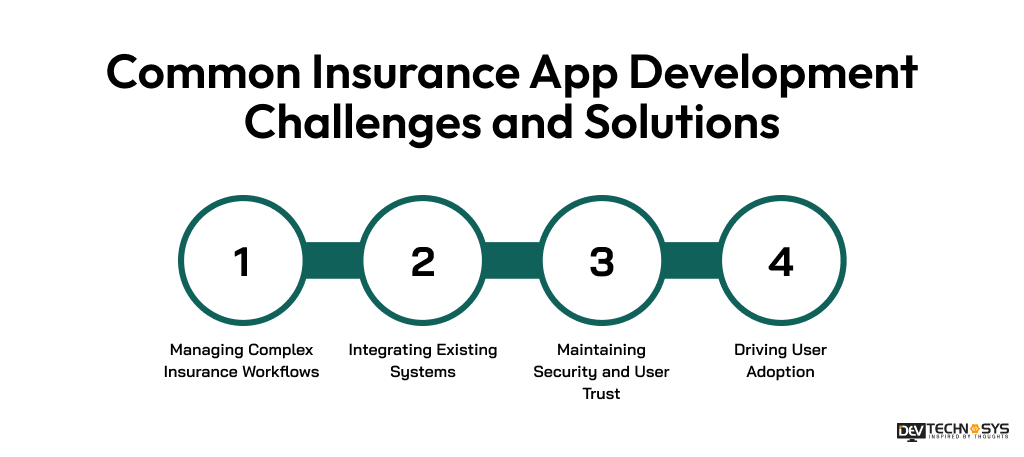
Insurance operations involve interconnected processes across quotes, underwriting, claims, and renewals. The challenge when you make an insurance app is creating a customer experience that feels simple while supporting the considerable complexity running behind it. Careful workflow mapping during the planning phase prevents this complexity from becoming a usability problem.
2. Integrating Existing Systems
Many established insurers still depend on legacy platforms that were not designed to communicate with modern mobile applications. Businesses navigating this challenge often benefit from hybrid app development services that bridge legacy environments with contemporary mobile architectures more efficiently than full replacement.
3. Maintaining Security and User Trust
Insurance platforms handle sensitive personal and financial data continuously. Maintaining robust security measures, meeting evolving compliance requirements, and ensuring every transaction is processed safely are ongoing responsibilities, not one-time implementations. Customer confidence depends on how consistently these standards are upheld.
4. Driving User Adoption
A well-built insurance app can still underperform if customers find it difficult to navigate or do not see an immediate reason to use it. Intuitive design, clear onboarding, and regular improvements based on real user feedback are what drive adoption and keep engagement levels high over time.
What is the Insurance App Development Cost in 2026?
Understanding the investment required is essential before committing to an insurance app project. Costs vary significantly depending on scope and complexity, but the ranges below provide a realistic starting point for budget planning.
1. Cost Based on App Complexity
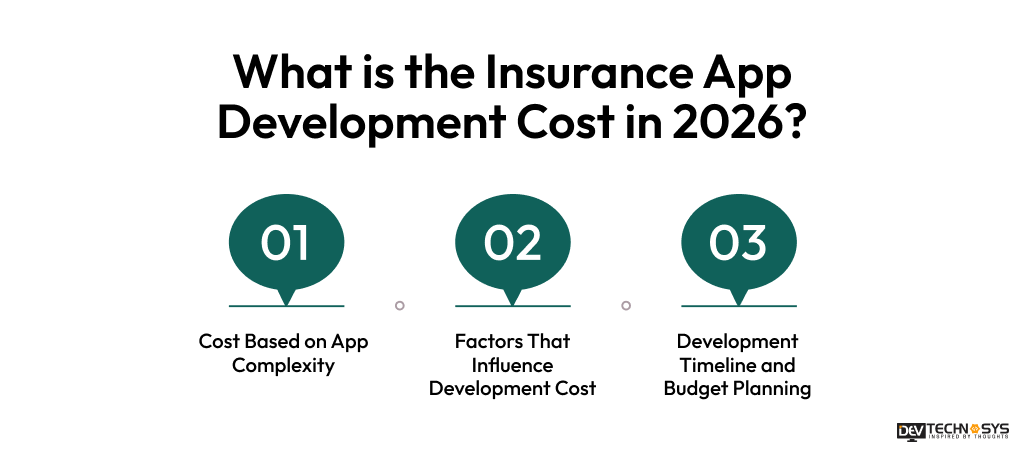
The cost to build an insurance mobile app depends largely on the scope and sophistication of the product you are delivering. Insurance app development cost scales directly with the capabilities you build into the platform.
App Type |
Estimated Cost |
Key Features |
| Basic MVP | $30,000 – $60,000 | User registration, policy viewing, premium payments, push notifications |
| Mid-Level App | $60,000 – $100,000 | Claims management, document storage, quote comparison, third-party integrations, in-app renewals |
| Advanced Insurance Platform | $100,000 – $150,000+ | AI-powered underwriting, fraud detection, telematics, predictive analytics, and enterprise compliance infrastructure |
2. Factors That Influence Development Cost
Several variables determine where your project lands within these ranges. Understanding each one helps businesses plan budgets more accurately and avoid unexpected costs. Reviewing a [mobile app development cost](internal link) breakdown gives businesses a clearer picture of where investment is typically allocated.
Feature Complexity: The more advanced the functionality, including claims automation, policy management, and quote generation, the higher the development effort and overall insurance app development cost.
Third-Party Integrations: Payment gateways, identity verification tools, CRM platforms, and analytics systems each require additional development and testing time, which increases the overall project budget.
Security and Compliance Requirements: Insurance apps handle sensitive customer data. Compliance infrastructure, secure authentication systems, and fraud prevention capabilities add meaningful development and ongoing maintenance costs.
AI and Advanced Technologies: Features powered by artificial intelligence, predictive analytics, or underwriting automation require specialized expertise, increasing both development time and total investment.

3. Development Timeline and Budget Planning
Most projects range from four months for a basic MVP to twelve or more months for a full platform.
Development Stage |
Estimated Timeline |
| Basic MVP | 2 to 3 months |
| Mid-Level App | 4 – 6 months |
| Advanced Platform | 6+ months |
Insurance mobile app development rarely succeeds when teams attempt to build everything at once. A phased approach reduces initial investment, allows real user feedback to shape the roadmap, and makes infrastructure scaling more manageable. Treating insurance app development cost as a structured long-term investment consistently produces stronger products than treating it as a fixed one-time budget.
Tech Stack for Insurance App Development in 2026
Choosing the right technology stack is one of the most consequential decisions in any insurance app project. The technologies you select determine how well the platform scales, how securely it handles data, and how efficiently your team can maintain and improve it over time.
Component |
Technologies |
| Frontend | React Native, Flutter |
| iOS Development | Swift |
| Android Development | Kotlin |
| Backend | Node.js, .NET, Django |
| Database | PostgreSQL, MySQL, MongoDB |
| Cloud Infrastructure | AWS, Azure, Google Cloud |
| Payment Integration | Stripe, PayPal |
| Authentication | OAuth, MFA |
| Analytics | Firebase Analytics |
| Notifications | Firebase Cloud Messaging |
Modern insurance application development increasingly favors cloud-native architectures that can handle growing transaction volumes without compromising performance or data integrity. For a practical example of how these technology decisions come together in a real-world deployment, reviewing how to build an insurance mobile app like ILOE demonstrates how the right stack powers a reliable and scalable insurance platform.
Future Trends Shaping Insurance Apps Beyond 2026
The insurance industry is moving faster than most sectors. Businesses that invest in insurance apps today need to understand where the technology is heading so their platforms remain competitive well beyond launch.
1. AI-Powered Claims and Underwriting
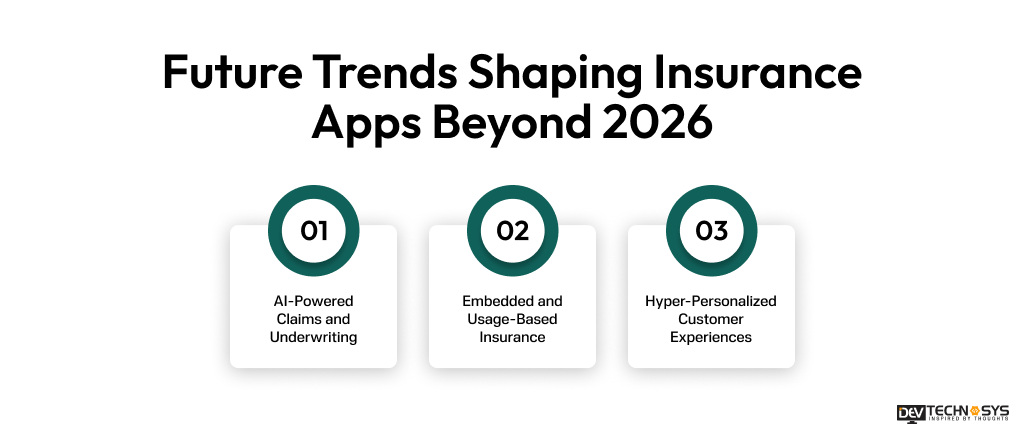
Artificial intelligence is already accelerating claims assessments and underwriting decisions, but the next phase goes further. Automated fraud detection, real-time risk scoring, and AI-generated policy recommendations will become standard expectations rather than premium features. Insurers that build these capabilities now will require significantly less rework later.
2. Embedded and Usage-Based Insurance
Insurance is increasingly appearing at the point of need rather than through traditional sales channels. Pay-as-you-drive models, real-time risk monitoring through connected devices, and insurance embedded directly into travel, property, and financial platforms are reshaping how customers engage with coverage. Personalized pricing based on actual behavior is quickly replacing flat-rate models across multiple insurance categories.
3. Hyper-Personalized Customer Experiences
Predictive analytics and behavioral data are enabling insurers to engage customers proactively rather than reactively. When businesses create an insurance app with personalization at its core, they move from transactional relationships to ongoing customer partnerships. Tailored policy recommendations, proactive renewal outreach, and data-driven communication make customers feel understood rather than processed.
The future belongs to insurance platforms that combine automation, personalization, and genuinely customer-centric experiences. Businesses that want to make an insurance app prepared for what comes next benefit from working with a forward-thinking mobile app development company that understands both insurance operations and emerging technology.

Why Partner with an Insurance App Development Company?
Insurance apps are fundamentally different from standard mobile applications. They must support claims workflows, policy administration, underwriting logic, and regulatory compliance simultaneously. Working with an experienced insurance app development company means these requirements are understood from day one, eliminating weeks of research and reducing costly scope changes mid-project.
Access to insurance app development services that cover mobile development, backend architecture, and third-party integrations removes the coordination burden from internal teams. Custom insurance app development with a specialist partner consistently reaches the market faster because the learning curve has already been eliminated.
A successful launch is the beginning of the product lifecycle, not the end. Reliable insurance software development partnerships provide structured post-launch support covering security updates, feature enhancements, and infrastructure scaling. Understanding the full scope of ongoing investment, including mobile app maintenance costs, helps businesses plan long-term product budgets realistically.
Conclusion
The insurance industry continues to shift as customers demand faster, more personalized digital experiences across every stage of their policy journey. Businesses that choose to build an insurance app today are better positioned to improve service delivery and strengthen long-term customer relationships.
Success depends on careful planning, compliance from the outset, and the decision to develop an insurance app with scalability at its core. The platforms built with that long-term mindset consistently outperform those built purely for immediate functionality.
Choosing the right development partner accelerates that journey. Working with experienced teams, including the option to hire mobile app developers in Dubai, gives businesses the expertise needed to deliver a future-ready insurance platform.
FAQS
Q1. How Long Does It Take to Build an Insurance App?
Timelines vary based on complexity. A basic MVP typically takes two to three months to build an insurance app and launch it to market. Mid-level platforms with claims management and third-party integrations require four to six months. Advanced enterprise platforms with AI capabilities and full compliance infrastructure can take six months or more.
Q2. What Factors Affect Insurance App Development Costs?
The primary cost drivers are feature complexity, third-party integrations, security and compliance requirements, and AI capabilities. More sophisticated functionality such as claims automation, underwriting logic, and fraud detection, requires greater development effort and specialist expertise, which increases overall project investment.
Q3. What Should Businesses Consider Before They Develop an Insurance App?
Before starting, businesses should define their target audience, identify their insurance niche, understand applicable regulatory requirements, and establish clear business goals. When businesses develop an insurance app without this foundation, they risk building a product that does not align with market demand or compliance obligations.
Q4. Should I Work With an Insurance App Development Company?
For most businesses, yes. An insurance app development company brings industry knowledge, proven development processes, and technical expertise that significantly reduces project risk. Teams experienced in insurance workflows deliver faster and more reliably than those approaching the domain for the first time.
Q5. What Services Are Typically Included in Insurance App Development Services?
A full-service engagement typically covers product planning, UI/UX design, frontend and backend development, third-party integrations, security implementation, testing, deployment, and post-launch support. Businesses looking to make an insurance app should carefully evaluate the complete range of insurance app development services a partner offers before committing to a contract.