





Key Takeaways:
-
- Building an app like Botim requires secure VoIP architecture, scalable cloud infrastructure, and real-time communication technologies.
- Core features include voice and video calling, instant messaging, encryption, contact sync, and multi-device support.
- The cost to develop an app like Botim typically ranges from $10,000 to $30,000, depending on complexity, platforms, and security requirements.
- Startups can compete by focusing on regional compliance, better call quality, privacy, and niche communication needs.
A few taps on your smartphone, select a contact, start a call, talk freely, share files, and end securely. For users, it feels effortless to communicate seamlessly. But behind the scenes, a communication app like Botim runs on powerful real-time technologies, encryption layers, and scalable backend systems.
With global demand for internet-based calling rising, entrepreneurs and enterprises are increasingly exploring opportunities to develop an app like Botim. However, creating a VoIP and messaging platform isn’t about cloning an interface. It’s about delivering reliable communication, compliance, and trust.
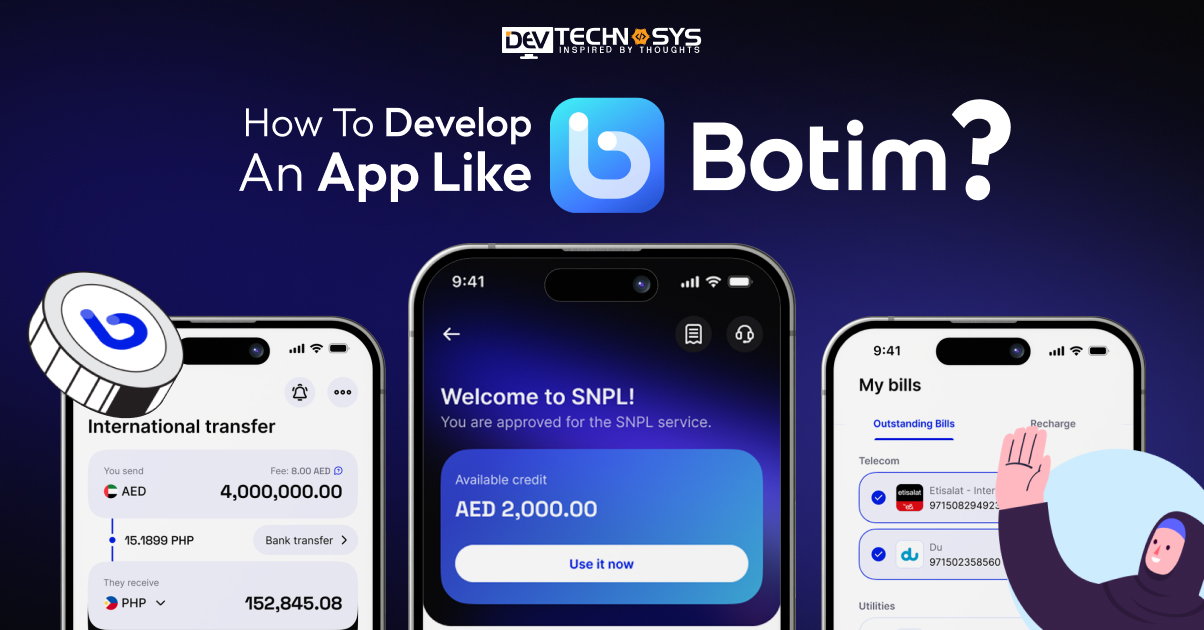
This guide explains everything you need to know to make an app like Botim, from understanding what Botim is to features, development steps, costs, and monetization strategies.
What is the Botim App?
Botim is a VoIP-based communication app that enables users to make voice calls, video calls, and send instant messages using an internet connection. It is especially popular in regions where traditional VoIP services are restricted, offering compliant and regulated communication solutions.
Launched in 2017, Botim has gained strong adoption across the Middle East, Africa, and parts of Asia. The Botim app development supports one-to-one and group calls, file sharing, emojis, and end-to-end encryption.
Key Features Offered by Botim:
- High-quality voice and video calls
- Instant messaging and media sharing
- Group chats and group calls
- End-to-end encryption
- Cross-platform availability
- Contact synchronization
Botim is positioned among the reliable internet calling and chatting apps in UAE for personal and professional use.
Industry Insight: According to ElectroiQ, the global VoIP market is projected to grow from around $161.79 billion in 2025. It is expected to reach $415.20 billion by 2034, reflecting strong technology adoption.
How Does a Botim-Like App Work?
Behind every call, multiple systems coordinate in real time: authentication servers, signaling servers, media servers, and encryption layers. Understanding the working mechanism is crucial if you want to create an app like Botim. Below is a simplified step-by-step user journey.
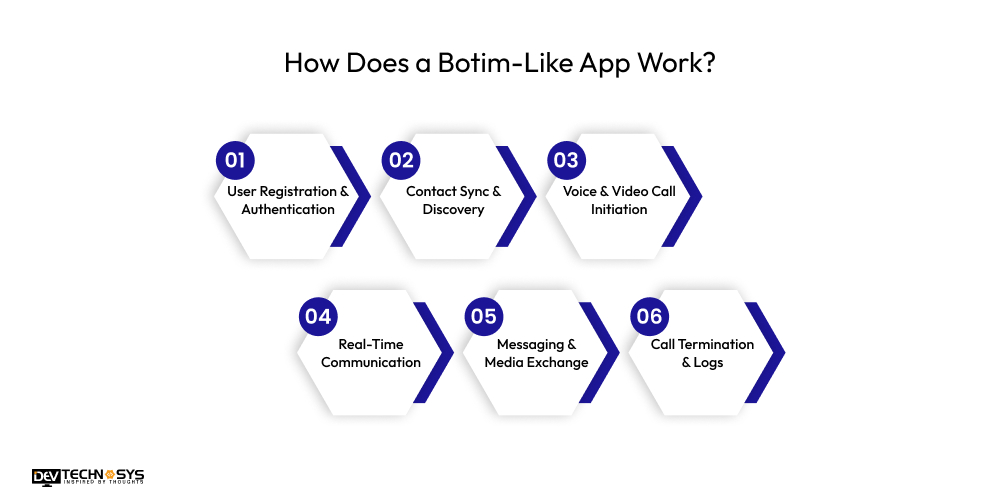
Step 1: User Registration & Authentication
Users sign up in the Botim calling app using their mobile number or email address. OTP verification ensures identity validation. Once verified, users can set up their profile and sync contacts. The backend links the user ID with a device token and encryption keys for future secure communication.
Step 2: Contact Sync & Discovery
The Botim free video call app accesses the user’s contact list (with permission) to identify other registered users. This enables instant connectivity without manual searching. Session tokens validate every request, ensuring only authorized users can initiate calls or send messages.
Step 3: Voice & Video Call Initiation
When a user initiates a call, the Botim web app establishes a secure VoIP connection using real-time communication protocols. The system selects the optimal server to reduce latency. The server returns only matched users who are already registered, maintaining privacy and compliance.

Step 4: Real-Time Communication
During the call, data packets are transmitted securely using encryption. Adaptive algorithms adjust quality based on network speed to avoid call drops. The signaling server checks recipient availability, call permissions, and initiates a connection handshake.
Step 5: Messaging & Media Exchange
Users can send text messages, images, videos, and files instantly with the Botim video call app. Messages are stored temporarily on secure servers or delivered peer-to-peer, depending on the architecture. STUN/TURN servers determine whether the call can be peer-to-peer or needs to pass through relay servers.
Step 6: Call Termination & Logs
After call completion, the app updates call history, data usage, and timestamps for transparency and reporting. Packets are transmitted over UDP for speed and reconstructed in real time on the receiver’s device.
Market Outlook: VoIP & Messaging App Industry
The demand for secure internet communication apps is growing rapidly due to remote work, global connectivity, and digital transformation.
Market Stats for VoIP & Messaging Apps
The market analysis by Mordor Intelligence states that:
- The market size of Mobile VOIP was valued at USD 55.49 billion in 2025.
- It is expected to grow and reach USD 59.92 billion in 2026.
- The overall forecast is predicted to reach USD 87.93 billion by 2031.
- This growth can be estimated at98% CAGR during the forecast period 2026–2031.
From Idea to Launch: How to Develop an App Like Botim?
A Botim mobile app development is not just about enabling calls and messages. It requires a well-planned development lifecycle that balances performance, security, compliance, and scalability. Below is a structured roadmap to create a Social Network App from Scratch. It explains how a Botim-like app evolves from an idea into a fully functional communication platform.
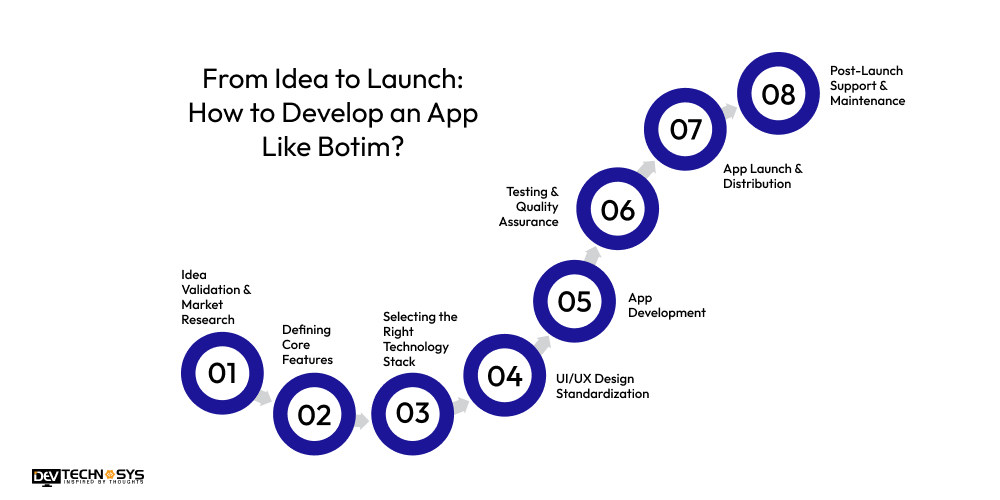
1. Idea Validation & Market Research
Before development, analyze regional regulations, user needs, competitors, and monetization potential. This step ensures your idea is legally viable and commercially sustainable. This phase helps identify restricted regions, VoIP compliance requirements, and telecom policies affecting app availability. It also reveals user pain points, feature gaps, and pricing expectations essential for long-term product positioning.
2. Defining Core Features
Start with essential features such as calling, messaging, encryption, and contact sync. Advanced features can be added later to reduce initial development cost. Prioritizing features ensures faster MVP launch while validating performance, adoption, and communication reliability. Feature planning also prevents overengineering and helps allocate budget efficiently across development stages.
3. Selecting the Right Technology Stack
Choose VoIP protocols, cloud services, databases, and security frameworks carefully for iOS and Android app development services. The tech stack determines call quality, scalability, and long-term stability. Reliable protocol selection ensures low latency, minimal packet loss, and stable voice and video transmission. A scalable backend stack supports user growth without affecting performance during peak usage hours.
4. UI/UX Design Standardization
Design simple, intuitive interfaces with minimal steps for calling and messaging. A clean UI improves user retention and trust. Clear navigation reduces user friction and makes core actions accessible even for non-technical users. Consistent design elements also build familiarity, improving engagement and long-term app usability.
5. App Development
This phase includes:
- Frontend development for Android, iOS, and web
- Backend development for call routing, messaging, and authentication
- Integration of VoIP, push notifications, and analytics
Frontend and backend of a Hybrid app development must remain tightly synchronized to avoid delays or communication mismatches. Real-time services require optimized coding practices to maintain speed, reliability, and secure data flow.
6. Testing & Quality Assurance
Thorough testing ensures:
- Stable calls under varying network conditions
- No security vulnerabilities
- Compatibility across devices and OS versions
Load testing verifies app stability during high traffic and simultaneous call scenarios. Security testing ensures encryption, authentication, and data handling meet global compliance standards.
7. App Launch & Distribution
Publish the app on app stores, comply with platform policies, and optimize listings. Marketing strategies help attract early adopters. App store optimization improves visibility while ensuring compliance with communication and privacy guidelines. Early marketing campaigns help onboard users quickly and test real-world app performance.
8. Post-Launch Support & Maintenance
Ongoing updates, bug fixes, performance monitoring, and feature enhancements ensure the success of social networking app development. Continuous monitoring helps detect call failures, latency issues, and server overloads in real time. Regular updates keep the app secure, competitive, and aligned with evolving user expectations.
Industry Insight: Around 65% of enterprises now use VoIP systems as their primary communication channel, driven by remote work needs: Global Growth Insights
Which Core Features are Required to Build an App Like Botim?
A communication app like Botim succeeds only when it combines performance, security, and simplicity seamlessly. Each feature plays a critical role in ensuring uninterrupted calling, real-time messaging, and user trust. Below are the essential features that together can develop an app like Sharechat or Botim alternatives.
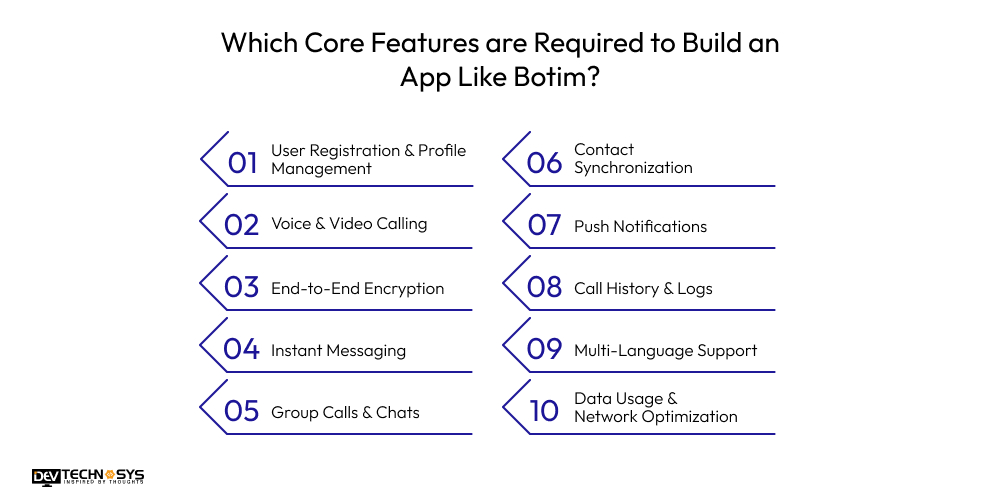
1. User Registration & Profile Management
Secure onboarding verifies user identity through OTP authentication while preventing unauthorized access and duplicate account creation. Profile management enables users to update personal information, profile images, privacy preferences, and communication settings.
2. Voice & Video Calling
Voice and video calling uses VoIP technology to transmit real-time audio and visuals over internet connections. Adaptive bitrate dynamically adjusts call quality based on bandwidth availability and network stability conditions.
3. End-to-End Encryption
End-to-end encryption protects communication data by encrypting messages and calls before leaving user devices. Encryption keys remain exclusively on user devices, preventing servers from accessing communication content.
4. Instant Messaging
When you develop an app like WhatsApp, instant messaging enables real-time text communications. These communications can be done with emojis, stickers, images, videos, and file sharing. Messages are delivered using optimized data transmission protocols to ensure speed and reliability.
5. Group Calls & Chats
Group calls and chats allow multiple participants to communicate simultaneously through voice, video, or messaging. This feature supports social interaction, remote collaboration, and business communication use cases.
6. Contact Synchronization
Contact synchronization securely scans device contacts to identify registered users within the application ecosystem. Hashed contact matching ensures user privacy while enabling instant communication discovery.
7. Push Notifications
Push notifications instantly inform users about incoming calls, new messages, missed interactions, and system updates. Notifications operate reliably in background mode across different operating systems and devices.
8. Call History & Logs
Call history records essential metadata such as call duration, timestamps, and participant information. Users can review previous interactions for reference, reporting, or usage tracking purposes. This feature maintains transparency without storing sensitive communication content.
9. Multi-Language Support
Multi-language support allows users to navigate the application in their preferred regional language. This feature enhances accessibility and usability for diverse global audiences. Language flexibility supports international expansion and improves user adoption across regions.
10. Data Usage & Network Optimization
Network optimization monitors real-time connectivity to minimize data usage during calls and messaging. Adaptive routing ensures stable communication when switching between Wi-Fi and mobile data networks.
Why Entrepreneurs Want to Develop an App Like Botim?
Entrepreneurs are increasingly attracted to communication platforms that deliver reliable, secure, and regulation-compliant internet calling solutions. Botim clone developemnt address the growing global demand for affordable communication while operating successfully within region-specific regulatory frameworks.
These platforms combine scalability, recurring revenue, and advanced technology, making them highly appealing long-term digital business opportunities.
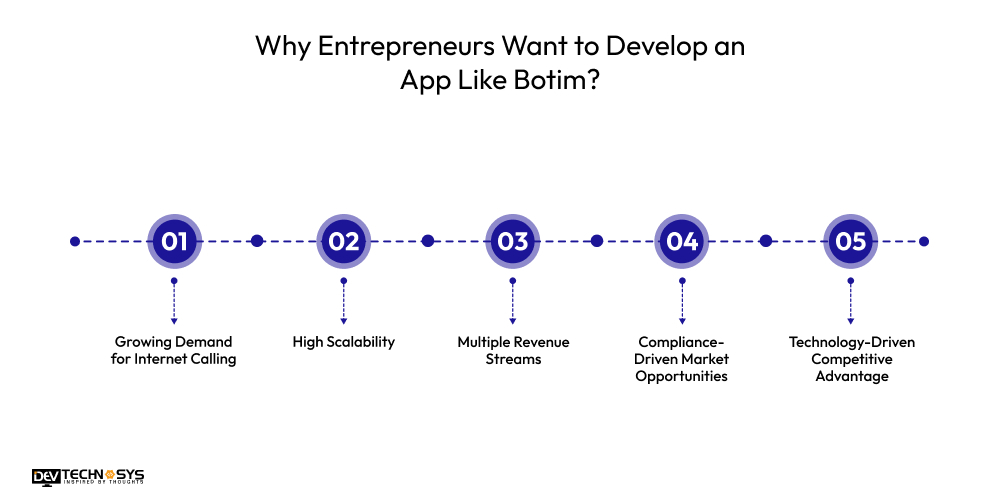
1. Growing Demand for Internet Calling
Users increasingly develop a mobile app for internet-based calling that significantly reduces costs compared to traditional cellular services. Remote work, global connectivity, and international communication needs continue driving consistent growth in VoIP app adoption. Affordable pricing and reliable call quality make internet calling apps essential for modern communication habits.
2. High Scalability
VoIP-based applications can scale rapidly across regions without requiring heavy investments in physical infrastructure. Cloud-based architecture allows seamless expansion while maintaining consistent performance during user growth. This scalability enables startups to enter multiple markets efficiently with lower operational and expansion risks.
3. Multiple Revenue Streams
A Botim app website generates income through subscriptions, premium calling features, advertisements, and enterprise communication solutions. Diversified monetization strategies reduce dependency on a single revenue source, improving financial stability. Recurring revenue models support predictable cash flow and long-term business sustainability.
4. Compliance-Driven Market Opportunities
Region-specific compliance enables communication Botim clone apps to operate legally in markets with strict VoIP regulations. Localized partnerships and regulatory alignment create entry barriers that limit global competitors. This compliance-focused strategy unlocks underserved markets with high demand for secure communication services.
5. Technology-Driven Competitive Advantage
Advanced communication tech creates strong entry barriers for competitors. Advanced VoIP technologies improve call quality, encryption, and real-time communication reliability. Proprietary optimization techniques create technical barriers that discourage new competitors from entering. The continuous innovation strengthens platform differentiation and long-term competitive positioning.

What is the Cost to Develop an App Like Botim?
The cost to develop an app like Botim typically ranges between $10,000 and $30,000, depending on the app’s complexity, feature set, and technical requirements.
- A basic MVP with essential features such as voice calling, messaging, user authentication, and limited encryption falls on the lower end of the budget.
- Mid-level applications with group calls, enhanced UI/UX, and stronger security require higher investment.
- Fully advanced Botim-like apps include end-to-end encryption, scalable cloud infrastructure, compliance with regional VoIP regulations, and performance optimization.
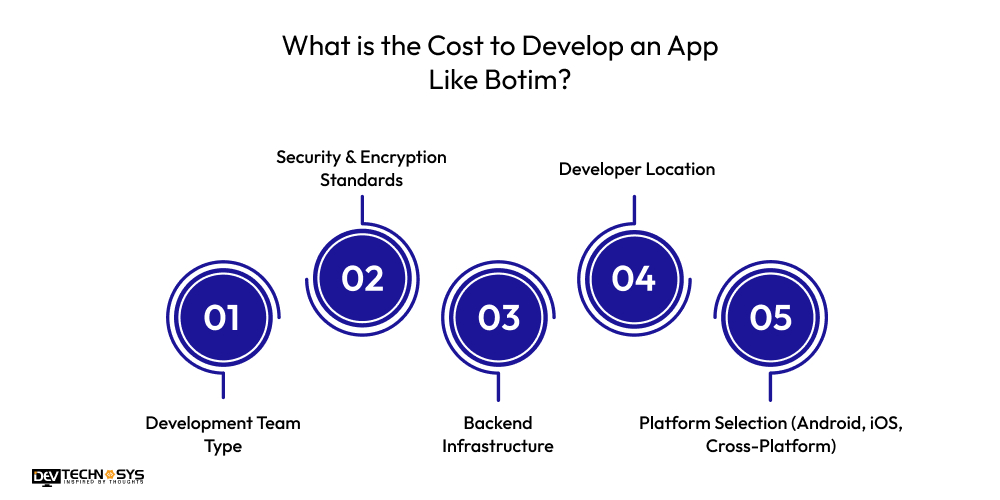
Additional cost factors include platform selection, backend architecture, development team location, third-party integrations, testing, and post-launch maintenance. All of these significantly influence the final cost to build an app like Botim.
Cost by Complexity Level
Complexity Level |
Development Effort |
Time Required |
Cost Range |
| Low | Basic VoIP & messaging | 2–3 months | $10,000–$18,000 |
| Moderate | Encryption, group calls | 4–6 months | $16,000–$23,000 |
| High | Enterprise-grade VoIP | 6+ months | $23,000–$35,000 |
Key Cost-Influencing Factors:
The total cost of developing a Botim-like app depends on multiple technical, operational, and strategic decisions. Each factor directly impacts development effort, scalability, compliance requirements, and long-term maintenance expenses. Understanding these cost drivers helps businesses plan budgets realistically and avoid unexpected development overruns.
1. Development Team Type
Choosing freelancers, in-house developers, or agencies significantly affects development speed, coordination, and overall Botim app development cost. Freelancers offer lower upfront pricing but may lack long-term support and complex VoIP expertise. Development agencies provide end-to-end services, ensuring quality, scalability, and regulatory compliance at higher rates.
Team Type |
Description |
Estimated Cost |
| Freelancers | Suitable for MVP development with limited features and minimal long-term support requirements | $3,000 – $6,000 |
| In-House Team | Offers better control, collaboration, and moderate scalability for growing communication platforms | $7,000 – $11,000 |
| Development Agency | Provides end-to-end development, VoIP expertise, compliance handling, and post-launch support | $12,000 – $15,000 |
2. Security & Encryption Standards
Implementing strong encryption protocols increases development complexity but ensures user privacy and data protection. Compliance with regional security regulations requires additional audits, certifications, and continuous monitoring systems. Higher security standards improve user trust but add to development time and overall project expenses.
Security Level |
Description |
Estimated Cost |
| Basic Encryption | Covers secure login, basic data encryption, and standard authentication mechanisms | $1,500 – $2,500 |
| Standard Encryption | Includes encrypted voice calls, secure messaging, and protected data transmission | $2,500 – $4,000 |
| Advanced Encryption | Implements end-to-end encryption, regulatory compliance, and advanced security audits | $4,000 – $6,000 |
3. Backend Infrastructure
Backend infrastructure supports call routing, real-time messaging, authentication, and performance monitoring services. Scalable cloud servers and load balancing increase reliability but raise initial setup and maintenance costs. Advanced backend architecture ensures smooth communication during high traffic and simultaneous call loads.
Infrastructure Type |
Description |
Estimated Cost |
| Basic Backend | Supports limited users with simple call routing and minimal server resources | $2,000 – $5,000 |
| Scalable Cloud Backend | Enables load balancing, real-time messaging, and flexible user growth handling | $6,000 – $10,000 |
| High-Availability Backend | Designed for large-scale usage with multi-region servers and high traffic reliability | $11,000 – $15,000 |
4. Developer Location
To hire dedicated developers, their location influences hourly rates, communication efficiency, and project management overhead. Regions with lower labor costs offer budget advantages but may require stronger coordination and supervision. Hiring developers from premium markets increases costs but provides advanced expertise and faster delivery.
Developer Region |
Description |
Estimated Cost |
| Offshore Regions | Cost-effective development with basic expertise, suitable for budget-focused projects | $1,000 – $2,500 |
| Mid-Cost Regions | Balanced pricing with reliable communication, quality output, and project management | $2,500 – $4,500 |
| High-Cost Regions | Premium expertise, faster delivery, and strong compliance and security experience | $4,500 – $6,000 |
5. Platform Selection (Android, iOS, Cross-Platform)
Developing for a single platform reduces cost but limits initial user reach and adoption potential. Cross-platform development balances cost and reach by sharing code across multiple operating systems. Building native apps for both platforms delivers optimal performance but significantly increases development expenses.
Platform Type |
Description |
Estimated Cost |
| Single Platform | Development for either Android or iOS, ideal for validating market demand | $8,000 – $12,000 |
| Cross-Platform | Shared codebase for faster launch and reduced costs across multiple platforms | $12,000 – $20,000 |
| Native Android & iOS | Separate native apps delivering optimal performance, stability, and user experience | $20,000 – $30,000 |
Which Monetization Models are Perfect for Botim-Like Apps?
Successful Botim-like apps rely on diversified monetization strategies to ensure sustainable revenue growth. Combining user-friendly pricing with enterprise offerings helps maximize profitability across multiple customer segments. Flexible revenue models allow apps to scale efficiently while adapting to regional market preferences.
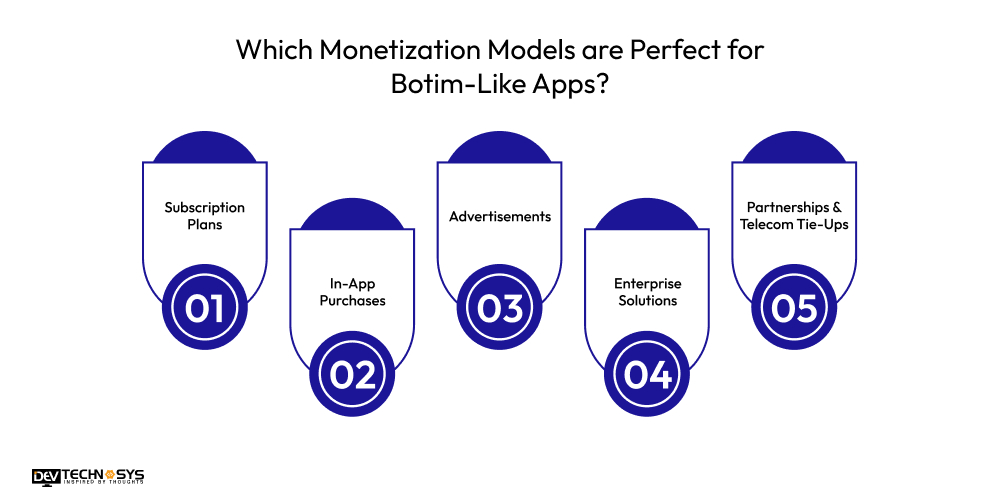
1. Subscription Plans
Subscription plans provide users with unlimited calling, enhanced quality, and exclusive premium communication features. Monthly and annual plans create predictable recurring revenue streams and improve long-term customer retention. Tiered subscriptions allow users to upgrade gradually based on usage needs and feature preferences.
2. In-App Purchases
In an app like Azar, in-app purchases generate additional revenue through paid stickers, themes, and advanced messaging tools. Users enjoy customization options while developers monetize optional features without disrupting core functionality. This model works effectively alongside subscriptions to increase average revenue per user.
3. Advertisements
Advertisements allow free users to access basic services while generating revenue for the platform. Non-intrusive ad formats preserve user experience and prevent frustration during communication activities. Targeted advertising improves engagement and maximizes advertiser value without overwhelming users.
4. Enterprise Solutions
Enterprise solutions offer secure, compliant communication tools designed specifically for organizational collaboration needs. Businesses pay premium fees for advanced security, administration controls, and guaranteed service reliability. This model delivers higher contract values and long-term revenue stability.
5. Partnerships & Telecom Tie-Ups
The telecom partnerships enable revenue sharing while expanding network reach and service availability. The collaborations with ISPs improve call quality, reduce latency, and enhance regional performance. Such partnerships strengthen market credibility and accelerate user acquisition in regulated regions.
How Network Conditions Shape the Success of Botim-Like Apps?
Network conditions directly influence call quality, user experience, and retention in real-time communication platforms. Unlike traditional apps, Botim-like solutions are engineered to adapt dynamically to unstable bandwidth, latency fluctuations, and network transitions. Optimizing performance for real-world connectivity challenges is essential for ensuring reliability, trust, and widespread adoption.
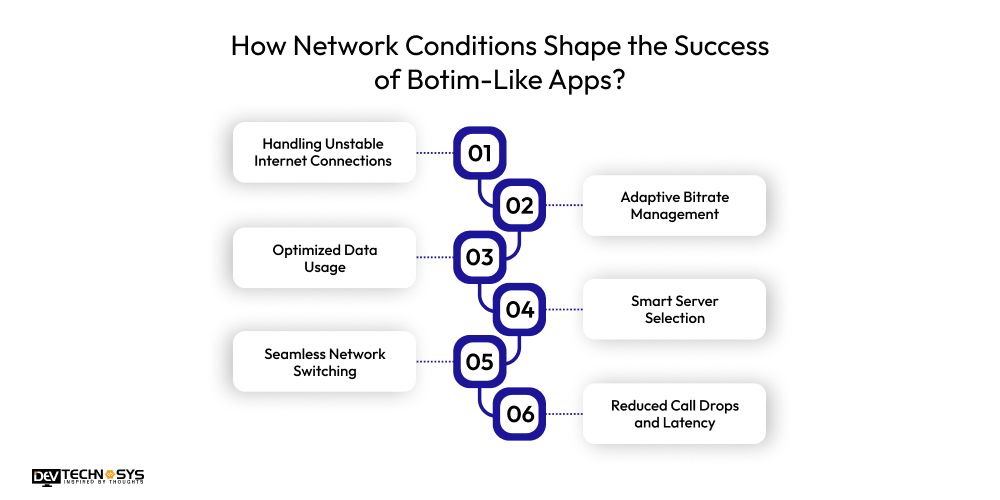
1. Handling Unstable Internet Connections
Botim-like apps are built to perform consistently despite fluctuating bandwidth and unstable internet environments. They continuously monitor network strength to dynamically adapt communication performance in real time. This capability ensures uninterrupted calling experiences even during sudden drops in connectivity.
2. Adaptive Bitrate Management
Adaptive bitrate technology automatically adjusts audio and video quality based on available network bandwidth. Lower bandwidth triggers reduced data usage without completely interrupting the call session. This mechanism prevents call drops while maintaining acceptable communication clarity for users.
3. Optimized Data Usage
Advanced audio and video codecs compress data efficiently without sacrificing essential call quality. The optimized data transmission allows smooth communication on slower networks and limited data plans. This is especially critical in regions with inconsistent internet infrastructure and affordability constraints.
4. Smart Server Selection
The system connects users to the nearest or least congested servers to reduce latency. Intelligent routing improves call stability by avoiding overloaded servers during peak usage periods. This results in faster call connections and more reliable real-time communication experiences.
5. Seamless Network Switching
Botim alternatives support seamless switching between Wi-Fi and mobile data during active calls. This prevents call disconnections when users move between different network environments. Such continuity significantly improves user experience during travel or when changing connectivity conditions.
6. Reduced Call Drops and Latency
Network-aware architecture minimizes packet loss and communication delays during voice and video calls. Lower latency ensures natural conversations without noticeable lags or audio disruptions. The consistent call performance builds trust and encourages users to rely on the app regularly.
Industry Insights: According to ElectroiQ, Asia‑Pacific alone accounts for 1.3 billion VoIP users, showing high regional demand for internet calling apps.

Conclusion
To develop an app like Botim, businesses must combine real-time communication technology, security, compliance, and scalability. From VoIP architecture to monetization, every decision impacts performance and user trust.
Startups and enterprises aiming to enter the communication app market should partner with an experienced mobile app development company. The right development partner ensures regulatory compliance, smooth performance, and long-term scalability in a competitive VoIP ecosystem.
With proven expertise, such partners help reduce development risks, accelerate time-to-market, optimize costs, and deliver secure, high-quality communication experiences. Their technical guidance supports future upgrades, evolving regulations, and seamless expansion across platforms, regions, and growing user bases without compromising reliability or performance.
People Commonly Ask
Q1. How Much Does It Cost To Develop An App Like Botim?
The development cost typically ranges between $10,000 and $35,000, depending on features, platforms, security, and backend complexity. Basic MVP versions fall within lower budgets, while advanced functionality significantly increases overall investment costs. Ongoing expenses include cloud hosting, maintenance, updates, compliance audits, and scalability optimizations for long-term growth.
Q2. How Can I Use The Botim App In UAE?
Botim is accessible in UAE after downloading it from Google Play or the Apple App Store. Users must have a valid internet connection, either mobile data or Wi-Fi, to make calls. Creating an account with a mobile number or email allows full access to all features. The app interface is user-friendly, letting users start calls, send messages, and share media instantly.
Q3. How Does The Botim App Work In UAE?
Botim uses VoIP technology to route calls and messages securely over the internet in UAE. The app selects the fastest servers to reduce latency and ensure high-quality video and voice. Contacts can be synced automatically, enabling instant communication with other Botim users in the region. All calls and messages are transmitted through encrypted channels, protecting privacy and reducing unauthorized access risks.
Q4. How Many Countries Use the Botim App?
Botim is popular in over 60 countries worldwide, including regions with restricted VoIP access. It is widely adopted in the Middle East, Asia, Europe, and parts of Africa. Millions of users rely on Botim daily for calls, messaging, and group communication globally. Regional adaptation and compliance with local regulations allow Botim to function effectively across diverse countries.
Q5. Is the Botim App End-To-End Encrypted?
Yes, Botim implements end-to-end encryption to protect calls, messages, and shared media securely. It ensures that only the sender and recipient can access the content of the communication. Encryption safeguards user privacy and ensures compliance with global data protection and security standards. Regular updates enhance encryption protocols, keeping the app resistant to hacking and other security threats.