





Key takeaways:
-
- To build an app like S’hail, a robust GPS-based ride-hailing system, secure payment integration, and scalable cloud infrastructure are required.
- Core features include ride booking, real-time driver tracking, in-app payments, rating systems, and multi-platform support.
- The cost to develop an app like S’hail typically ranges from $8,000 to $30,000, depending on complexity, platforms, and backend requirements.
- Startups can compete by focusing on faster pickups, localized services, dynamic pricing, and customer loyalty features.
With just a few taps, users book a ride, track their driver in real time, pay seamlessly, and rate their experience. Behind the scenes, apps like S’hail operate on geolocation algorithms, payment gateways, and real-time backend servers.
As global demand for urban mobility increases, entrepreneurs are increasingly exploring opportunities to build an app like S’hail. However, developing a ride-hailing platform is more than cloning a UI; it’s about reliability, trust, and user convenience.
This guide covers everything you need to know to create an app like S’hail, from understanding the app, core features, development steps, costs, and monetization strategies.
What is the S’hail App?
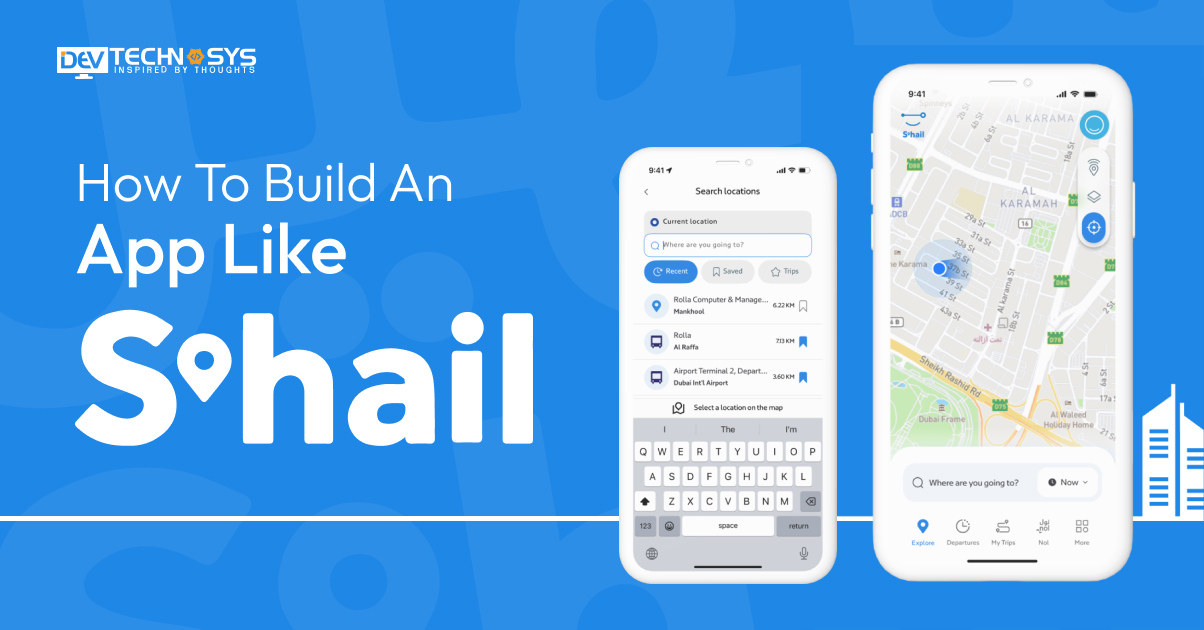
S’hail is a GPS-based ride-hailing platform that enables users to book taxis, private cars, or shared rides via their smartphones. The app is widely used in urban areas to provide quick, reliable, and secure transportation.
Launched in recent years, S’hail supports real-time driver tracking, instant booking, fare calculation, multiple payment methods, and customer ratings. The platform ensures safety, transparency, and convenience for riders and drivers alike.
Key Features Offered by S’hail:
- Real-time ride booking and driver tracking
- Multiple vehicle options (taxi, private, premium)
- Secure in-app payments and fare estimation
- Ratings and reviews for drivers and riders
- Multi-platform availability (iOS, Android, Web)
- Notifications and alerts for ride status
Industry Insight: According to Statista, the global ride-hailing market is projected to reach $212 billion by 2030, reflecting consistent growth in urban mobility adoption.
How Does a S’hail-Like App Work?
A S’hail-like ride-hailing app combines real-time GPS tracking, secure payment gateways, and smart dispatch algorithms efficiently for seamless urban mobility. Understanding this end-to-end workflow is essential for developing a successful and reliable app.
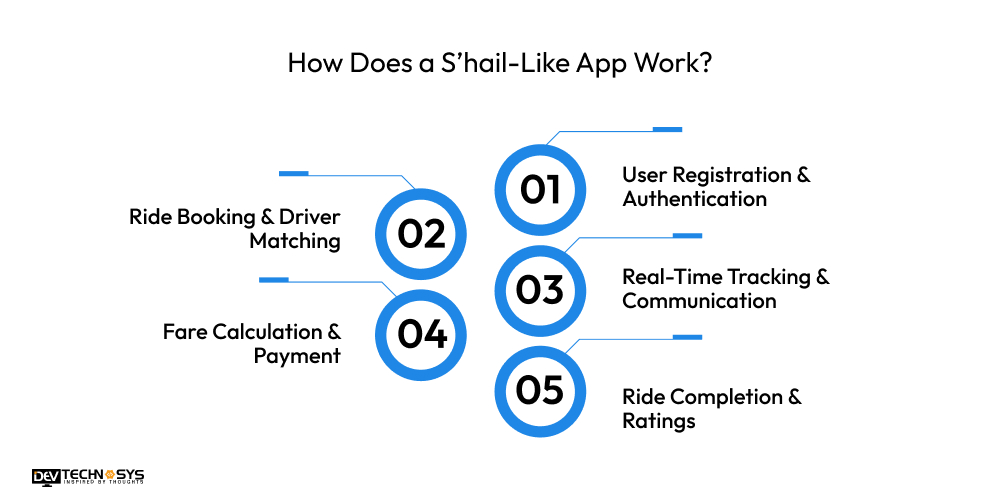
Step 1: User Registration & Authentication
Users create accounts using their mobile number, email, or social media platforms. OTP verification ensures identity validation, securing all future transactions. Profiles store preferences, saved locations, and payment methods, enabling fast, personalized ride bookings
Step 2: Ride Booking & Driver Matching
Users enter pickup and drop-off locations to request a ride. The system automatically finds nearby drivers in real time. Intelligent algorithms assign the nearest driver to reduce waiting time and optimize route efficiency during peak hours.
Step 3: Real-Time Tracking & Communication
Both drivers and riders can monitor each other’s location in real time during the ride. In-app messaging and call features allow seamless communication for coordination and safety. The backend continuously updates GPS, ride status, and estimated arrival times accurately.
Step 4: Fare Calculation & Payment
S’hail-like apps automatically calculate fares considering distance, vehicle type, traffic, and surge pricing. Users can securely pay through digital wallets, credit/debit cards, or cash options. The system generates electronic receipts, ensuring transparent and accurate financial transactions every time.
Step 5: Ride Completion & Ratings
Once the ride ends, users and drivers rate each other to maintain quality and accountability. Ride logs, receipts, and transaction records are stored securely. Feedback helps improve future ride experience, reliability, and overall platform trustworthiness.

Market Outlook: Ride-Hailing App Industry
The demand for reliable urban mobility solutions is increasing. It is due to population growth, traffic congestion, and convenience-focused users. Here are market analysis on ride-hailing app industry by Business Research Insight:
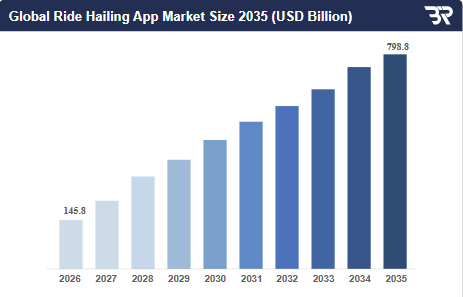
- In 2025, the global ride-hailing app market reached approximately USD 145.8 billion in total value.
- Market size is projected to grow to nearly USD 798.8 billion by 2035, showing massive expansion.
- The industry is expected to grow at a strong 18.5% CAGR throughout the forecast period.
- Rapid growth is fueled by rising urban populations, smartphone usage, and on-demand mobility adoption worldwide.
- These numbers indicate significant long-term investment potential for scalable ride-hailing and smart mobility platforms.
From Idea to Launch: How to Build an App Like S’hail?
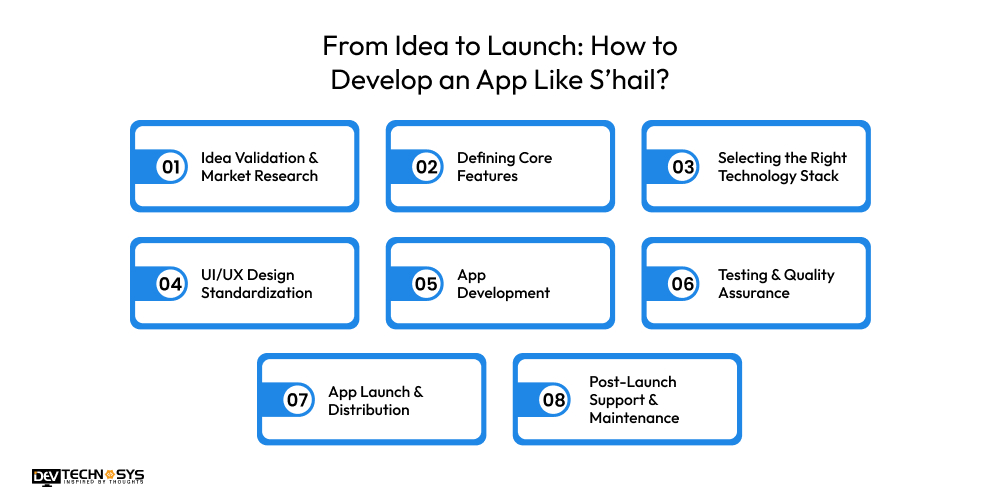
Developing a ride-hailing app is more than enabling rides. It requires a structured lifecycle balancing performance, security, and scalability. Have a look at the detailed steps to make the top transportation softwares in Middle East.
1. Idea Validation & Market Research
Analyze local transportation regulations, user demand, competitors, and revenue potential for S’hail app development. Identify underserved regions and gaps in current services. This ensures the app is legally compliant and commercially viable.
Conduct surveys and interviews with target users to understand pain points, preferences, and ride-hailing habits effectively. Research emerging technologies, local payment methods, and market trends to plan long-term app differentiation strategies.
2. Defining Core Features
Start with essential features like booking, tracking, payment, and ratings. Advanced features like loyalty programs or ride-sharing can be added later to optimize initial costs. Prioritize features that enhance rider convenience, driver efficiency, and operational transparency to ensure strong early adoption rates.
Plan incremental feature updates post-launch to maintain user engagement and continuously improve the app’s value proposition over time.
3. Selecting the Right Technology Stack
Choose backend frameworks, cloud services, GPS APIs, mapping systems, and payment gateways. Technology selection in travel booking app development impacts app speed, real-time tracking accuracy, and scalability.
Evaluate frameworks and protocols for handling high user concurrency, real-time location updates, and secure financial transactions efficiently. Select scalable databases, push notification services, and analytics tools to ensure smooth expansion across cities and regions.
4. UI/UX Design Standardization
Design a simple, intuitive interface with minimal taps for booking rides. Clean UI and clear navigation improve user retention and trust. Consistency across devices enhances usability. Incorporate visually clear icons, readable fonts, and color schemes that enhance usability for diverse age groups. Ensure consistent experience across mobile devices, tablets, and web platforms to strengthen brand identity and reduce learning curves.
5. App Development
To develop transportation software for final testing, you need to work on its:
- Frontend: Android, iOS, and web interfaces for riders and drivers to provide smooth, real-time interaction and ride booking.
- Backend: Ride matching algorithms, GPS tracking, fare calculations, payment handling, and secure data management systems.
- Integration: Maps, push notifications, analytics, chat support, and real-time communication for seamless rider-driver coordination.
Implement modular code design and API architecture to enable easier updates, feature additions, and system maintenance in the future
6. Testing & Quality Assurance
Ensure:
- Accurate GPS and ride-matching under varying network conditions
- Secure payments and data protection
- Compatibility across devices and operating systems
Conduct load testing to verify app performance during peak hours and simultaneous ride requests across multiple regions. Perform security audits, penetration testing, and compliance checks to protect user data and strengthen trustworthiness.
7. App Launch & Distribution
Publish on App Store and Google Play, optimize app listings, and implement marketing campaigns to attract early users. Implement App Store Optimization (ASO) strategies with targeted keywords, visuals, and reviews to maximize downloads. Monitor early user behavior, feedback, and crash reports to quickly fix bugs and improve app performance post-launch.
8. Post-Launch Support & Maintenance
To build a transportation app like Moovit, monitor ride performance, app crashes, and server load. Regular updates improve security, functionality, and scalability. Release regular updates with bug fixes, performance optimization, security patches, and improved user experience. Continuously analyze user feedback and industry trends to plan new features and maintain competitive market positioning.
Industry Insight: Over 70% of urban commuters now prefer app-based ride services over traditional taxis: Global Growth Insights
Which Core Features Are Required to Build an App Like S’hail?
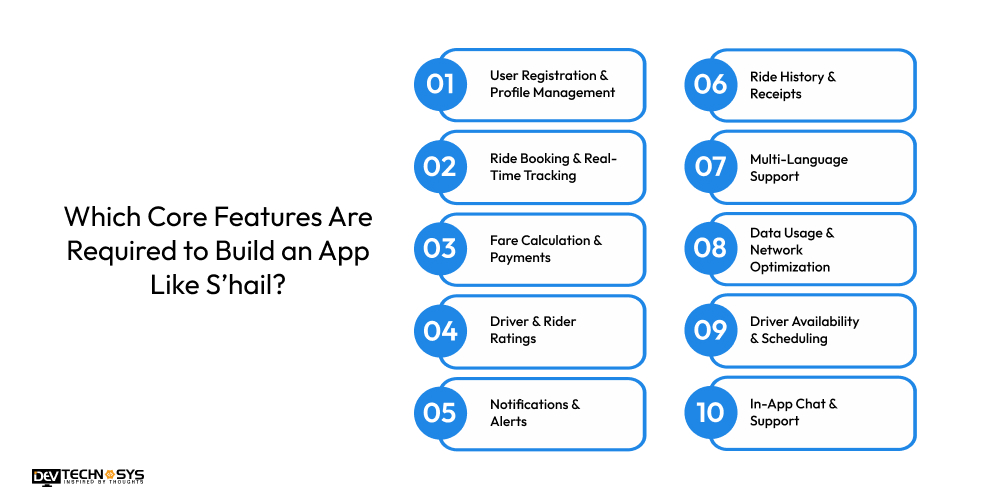
Building a successful apps simillar to S’hail requires a combination of user-friendly design, robust GPS tracking, secure payments, and real-time communication. Each feature ensures a smooth ride booking, driver-rider coordination, and enhanced customer satisfaction. It also maintains reliability, trust, and long-term scalability for urban mobility on-demand app development solutions.
1. User Registration & Profile Management
The secure onboarding verifies user identity through OTP, email, or social login for reliable account creation. Profile setup allows users to save personal information, favorite locations, and payment preferences securely. This ensures smooth, trusted app usage while reducing friction during repeated bookings or interactions within the app.
2. Ride Booking & Real-Time Tracking
Users can instantly book rides and see nearby drivers available in real time for efficient service. Live GPS tracking updates both drivers and riders continuously, providing accurate locations and estimated arrival times. Dynamic routing optimizes driver assignments, reduces waiting time, and improves overall ride efficiency during peak hours.
3. Fare Calculation & Payments
The transportation software development services also include features like automated fare calculation. For calculation, distance, traffic, vehicle type, and surge pricing are considered to ensure accurate pricing. Multiple payment methods, including digital wallets, cards, and cash, provide convenience and flexibility to users.
4. Driver & Rider Ratings
Users rate drivers, and drivers rate riders, promoting accountability and consistent service quality within the app. Ratings influence future ride matches and encourage courteous behavior while helping identify underperforming drivers efficiently. Feedback data is securely stored and analyzed to continuously improve platform reliability and customer satisfaction levels.
5. Notifications & Alerts
Instant push notifications inform users about driver arrivals, ride status, and upcoming promotions or discounts. Drivers receive alerts about new ride requests, cancellations, and navigation updates for efficient trip management. Notification scheduling and personalization increase user engagement and retention while keeping riders informed in real time.
6. Ride History & Receipts
The app records all ride logs, including distances, fares, timestamps, and payment details for complete transparency. Users and drivers can access past trip information for reference, dispute resolution, or tax and accounting purposes. Historical data analytics supports improving routing efficiency, demand forecasting, and targeted marketing campaigns within the app.
7. Multi-Language Support
The Hybrid app development services support multiple regional and global languages to enhance accessibility for diverse user groups. The localized content helps attract users from different regions, increasing adoption and user engagement significantly. Language selection is integrated seamlessly into the app for easy switching between preferred options anytime.
8. Data Usage & Network Optimization
Optimized GPS updates reduce unnecessary data transmission while maintaining real-time ride tracking accuracy. Ride status, notifications, and payment processing are streamlined for minimal latency even on low-bandwidth connections. Efficient data management improves app performance and enhances user experience, especially in areas with limited connectivity.
9. Driver Availability & Scheduling
Drivers can set availability times, preferred locations, and vehicle options to manage work schedules effectively. The system matches riders based on driver availability and proximity to reduce idle time and improve efficiency. Scheduling features help fleets plan daily operations while ensuring consistent service quality across all regions.
10. In-App Chat & Support
Riders and drivers can communicate via secure in-app messaging or voice for coordination and issue resolution. Integrated support options allow users to report issues, request help, or provide feedback without leaving the app. 24/7 chat support improves reliability, builds trust, and enhances overall customer satisfaction and retention rates.
Why Do Entrepreneurs Want to Create an App Like S’hail?
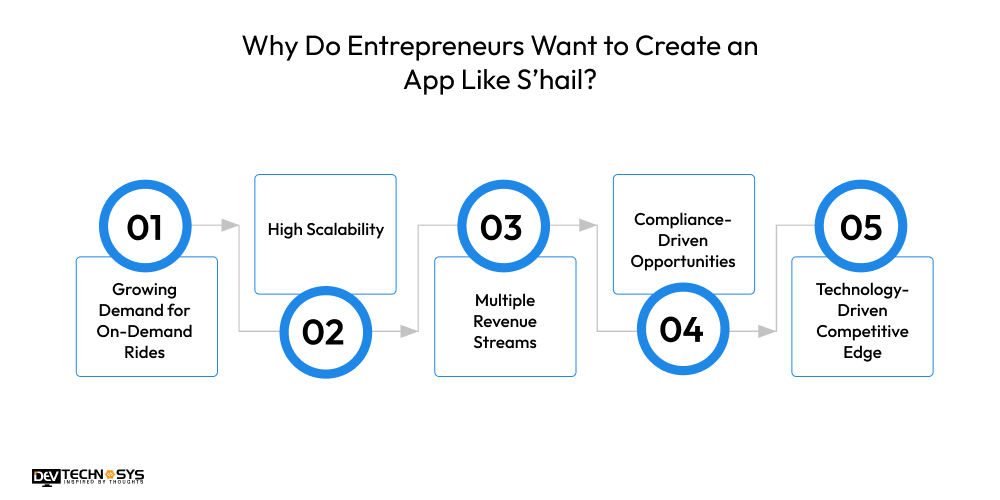
The ride-hailing mobile app development services in UAE present a unique opportunity for entrepreneurs. They can easily tap into urban mobility, recurring revenue, and scalable technology solutions.
With growing demand for convenient transportation, regional expansion potential, and innovative features. These platforms offer sustainable business growth while maintaining competitive advantages and high long-term profitability.
1. Growing Demand for On-Demand Rides
Rapid urbanization and traffic congestion increase the need for convenient, affordable, and reliable transportation solutions consistently. Users prefer app-based services due to real-time availability, ease of booking, and cost-effective ride options. High smartphone adoption and increasing digital literacy accelerate user growth and regular ride-hailing app usage worldwide.
2. High Scalability
Cloud-based infrastructure allows apps to expand smoothly across multiple cities and regions without heavy physical investments. Scalable architecture supports large volumes of users, real-time ride matching, and seamless integration of additional features. Flexible systems make it easy to manage growth, add new services, and adapt to peak usage hours efficiently.
3. Multiple Revenue Streams
Revenue is diversified through ride commissions, subscription plans, in-app advertisements, and strategic business partnerships with iOS. Additional income sources can include premium services, surge pricing, and integrated corporate ride programs for consistent profits. Multiple monetization channels reduce dependency on a single source, increasing financial stability and long-term business sustainability.
4. Compliance-Driven Opportunities
Adhering to local transportation laws and regulations ensures the S’hail alternative can operate legally in underserved or restricted markets. Compliance builds credibility with authorities, drivers, and users, reducing risks associated with legal disputes or penalties. Local partnerships and licensing opportunities open doors to regions with limited competition and high customer demand.
5. Technology-Driven Competitive Edge
Advanced GPS, intelligent routing algorithms, and secure payment integration create technical barriers for new entrants in the market. Innovative features like dynamic pricing, predictive ride matching, and real-time tracking strengthen platform differentiation and customer loyalty. Continuous technology upgrades ensure sustainable advantage, improve operational efficiency, and enhance long-term profitability and scalability.

How Much Does It Cost to Develop an App Like S’hail?
The cost to build an app like S’hail typically ranges between $18,000 and $30,000, depending on several factors. Basic versions with essential features such as user registration, ride booking, GPS tracking, fare calculation, and payments fall on the lower end of the budget.
Mid-level apps with advanced functionality, including real-time driver tracking, in-app chat, dynamic pricing, and multi-language support, require higher investment. Enterprise-grade apps with scalable backend infrastructure, cloud-based servers, advanced analytics, end-to-end security, and regulatory compliance can reach the upper cost range.
There are some additional factors influencing the cost to develop transportation software. It includes platform selection, development team location, third-party integrations, UI/UX design complexity, and post-launch maintenance, updates, and ongoing technical support.
| Complexity Level | Development Effort | Time Required | Cost Range |
| Low | Basic ride booking & tracking | 2–3 months | $8,000–$14,000 |
| Moderate | Payment integration, ratings, notifications | 4–6 months | $14,000–$22,000 |
| High | Scalable multi-city app with dynamic pricing | 6+ months | $22,000–$30,000 |
Key Cost-Influencing Factors:
Developing a S’hail-like ride-hailing app involves multiple technical, operational, and strategic decisions. Each factor impacts development effort, scalability, user experience, and long-term maintenance. Understanding these cost drivers helps businesses plan budgets accurately and avoid unforeseen expenses.
1. Backend Infrastructure
Backend architecture determines how smoothly the app handles ride requests, tracking, and payments simultaneously. A scalable backend enables load balancing, real-time ride matching, and flexible growth management for expanding cities.
High-availability infrastructure ensures uninterrupted service, even during peak traffic or multi-region operations. These elements can increase the cost to develop an app like S’hail.
| Infrastructure Type | Description | Estimated Cost |
| Basic Backend | Supports limited users, simple routing, and minimal server resources | $3,000 – $5,000 |
| Scalable Cloud Backend | Enables real-time updates, dynamic ride matching, and growth flexibility | $6,000 – $10,000 |
| High-Availability Backend | Multi-region servers with redundancy for high traffic reliability | $11,000 – $15,000 |
2. Platform Selection (Android, iOS, Cross-Platform)
Choosing the right platform affects initial reach, performance, and the S’hail app development cost significantly. A single-platform development reduces cost but limits audience, while cross-platform apps share code across iOS and Android. To develop RTA Dubai app for both platforms ensures optimal performance, UX, and stability, but increases the project budget substantially.
| Platform Type | Description | Estimated Cost |
| Single Platform | Develop for Android or iOS, ideal for MVP validation | $9,000 – $13,000 |
| Cross-Platform | Shared codebase for faster launch across multiple systems | $14,000 – $22,000 |
| Native Android & iOS | Separate apps with optimized performance and stability | $22,000 – $30,000 |
3. Third-Party API Integrations
Third-party APIs add functionality like maps, payment gateways, notifications, and analytics without building everything from scratch. Integrating reliable APIs ensures accurate GPS tracking, seamless payments, real-time updates, and smoother ride booking experiences.
The cost to build an app like S’hail vary depending on the API type, licensing fees, and development effort required for secure and stable integration.
| API Type | Description | Estimated Cost |
| Basic API Integration | Maps, notifications, and basic analytics | $1,500 – $3,000 |
| Advanced API Integration | Payment gateways, ride-matching, loyalty programs | $3,500 – $6,000 |
| Enterprise API Integration | Multiple APIs with custom configurations for scaling and automation | $6,500 – $10,000 |
4. Security Enhancements
Protecting user data, payment information, and ride details in real time is a prime focus of a transportation software development company. The security layers include encrypted data storage, two-factor authentication, secure server connections, and anti-fraud measures. High-level security also ensures compliance with local regulations and builds user trust, increasing budget to create an app like S’hail.
| Security Enhancement | Description | Estimated Cost |
| Standard Protection | SSL encryption, secure login, and basic data safety measures | $2,500 – $4,000 |
| Advanced Protection | End-to-end encryption, secure payments, and anti-fraud checks | $4,500 – $7,000 |
| Enterprise-Grade Security | Regulatory compliance audits, continuous monitoring, and penetration testing | $7,500 – $12,000 |
5. Maintenance & Support
Ongoing maintenance ensures app stability, performance, and user satisfaction after launch. The maintenance includes server monitoring, bug fixes, database optimization, and backend performance updates. Regular support services help respond to issues, keep the app compatible with new OS versions, while raising the price to make an app like S’hail.
| Maintenance Type | Description | Estimated Cost (Annual) |
| Basic Maintenance | Minor bug fixes, server uptime monitoring, and technical support | $3,000 – $5,000 |
| Standard Maintenance | Updates, performance tuning, and user support | $5,500 – $8,000 |
| Premium Maintenance | Full-scale monitoring, advanced support, security audits, and SLA-based uptime | $8,500 – $12,000 |
What are the Popular S’hail Alternatives Available in the Market?
Several ride-hailing and smart mobility apps offer services similar to S’hail, focusing on convenience, real-time tracking, and integrated transport solutions. These platforms vary by region, features, and scale, but all aim to simplify urban commuting through technology-driven mobility services and user-friendly digital experiences.
| App Name | Launch Year | Platform Availability | Ratings | Downloads |
| Uber | 2009 | Android, iOS | 4.5/5 | 500M+ |
| Careem | 2012 | Android, iOS | 4.6/5 | 100M+ |
| Bolt | 2013 | Android, iOS | 4.4/5 | 100M+ |
| Lyft | 2012 | Android, iOS | 4.5/5 | 100M+ |
| Ola | 2010 | Android, iOS | 4.3/5 | 100M+ |
| Grab | 2012 | Android, iOS | 4.6/5 | 100M+ |
| Free Now | 2009 | Android, iOS | 4.4/5 | 50M+ |
| Yango | 2018 | Android, iOS | 4.5/5 | 50M+ |
Which Are The Top Monetization Models for S’hail-Like Apps?
A S’hail clone app can generate revenue through multiple strategies, combining user-focused pricing, partnerships, and dynamic features. Effective monetization ensures sustainable growth, supports operational costs, and maximizes profitability while offering convenience, flexibility, and value to riders, drivers, and business partners across different urban markets.
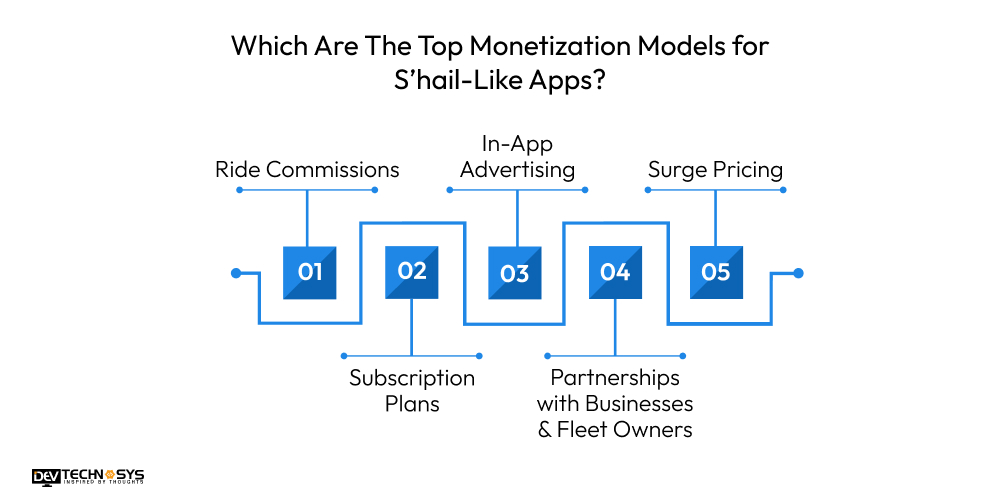
1. Ride Commissions
The platform charges drivers a fixed percentage or variable fee for each completed ride. Commissions create a steady revenue stream while incentivizing drivers to accept more bookings consistently. Transparent fee structures build trust between the platform and its drivers while maintaining long-term sustainability.
2. Subscription Plans
Offer monthly or yearly premium memberships for frequent riders or corporate clients with exclusive benefits. Subscribers may access discounted fares, priority booking, loyalty rewards, and ad-free app experiences. Tiered plans improve customer retention while providing predictable recurring revenue for long-term business stability.
3. In-App Advertising
Generate income by displaying targeted promotions, banners, or partner campaigns within the S’hail clone app interface. Advertisements provide additional revenue without charging users directly, maintaining accessibility for free users. Data-driven ad placements increase engagement and maximize revenue potential for both advertisers and the platform.
4. Partnerships with Businesses & Fleet Owners
Collaborate with taxi companies, corporate clients, or private fleet operators for ride allocation and revenue sharing. Partnerships expand service reach, increase ride volume, and create mutually beneficial business relationships. These collaborations ensure reliable operations, improved fleet utilization, and stable, diversified income streams.
5. Surge Pricing
Dynamic fare increases apply during high-demand periods, peak hours, or special events to optimize revenue. Surge pricing encourages more drivers to be available, reducing waiting times and balancing supply and demand efficiently. This model maximizes profits while maintaining ride availability and operational efficiency during periods of high usage
How Mobility Apps Transform the Way Cities Move?
Mobility apps are reshaping how cities function by connecting people, transport, and data into one experience. They simplify daily travel, reduce congestion, and support smarter urban planning, helping cities move more efficiently while offering residents faster, cleaner, and more informed mobility choices.
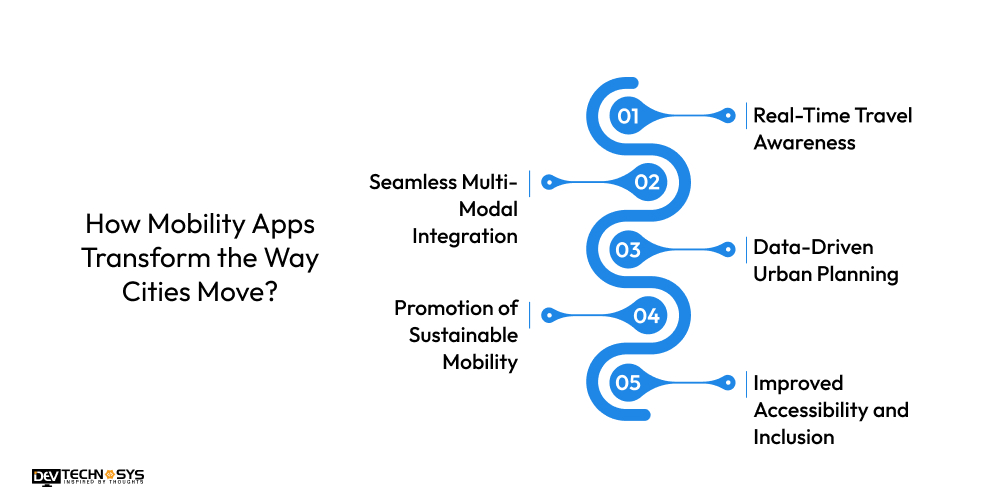
1. Real-Time Travel Awareness
Real-time information helps commuters make better decisions and reduces uncertainty during daily urban travel patterns. Live updates on routes, delays, and availability encourage smoother journeys across multiple transport modes citywide. This transparency builds trust, saves time, and minimizes stress for millions of everyday commuters globally.
2. Seamless Multi-Modal Integration
Mobility apps integrate buses, metros, taxis, cycling, and walking into one unified experience for users. This integration eliminates fragmented planning and allows people to switch modes effortlessly during daily trips. As a result, cities benefit from improved connectivity and more balanced transport usage across neighborhoods.
3. Data-Driven Urban Planning
Data collected through mobility apps helps city authorities understand travel patterns and demand better overall. These insights support smarter infrastructure investments and more responsive public transport planning decisions citywide today. Over time, data-driven decisions lead to reduced congestion and improved service reliability for residents everywhere.
4. Promotion of Sustainable Mobility
Mobility apps encourage sustainable choices by highlighting public transport, cycling, and shared mobility options daily. They help reduce private car dependency, lowering emissions and improving urban air quality for cities worldwide. This shift supports healthier communities and aligns cities with long-term environmental goals and policies globally.
5. Improved Accessibility and Inclusion
By simplifying travel, mobility apps improve accessibility for elderly, disabled, and underserved populations citywide. Inclusive design ensures everyone can navigate the city with confidence and independence, regardless of everyday mobility needs. Ultimately, this creates fairer cities where movement is a right, not a privilege, for all.
Industry Insight: In Asia-Pacific alone, over 1.5 billion rides are booked via app-based platforms annually, showing strong regional growth: Industry Research.

Conclusion
To build an app like S’hail, combining GPS-based real-time technology, secure payments, scalability, and a user-friendly interface is necessary. From backend infrastructure to monetization, every decision affects performance, reliability, and user trust.
Startups and enterprises should partner with an experienced Travel booking app development company. It ensures regulatory compliance, smooth performance, and long-term scalability. The right partner helps reduce development risks, optimize costs, and deliver a secure, high-quality ride-hailing experience while supporting future upgrades, expansion, and a growing user base.
People Commonly Ask
Q1. How Much Does It Cost to Build an App Like S’hail?
Costs range from $8,000 to $30,000, depending on features, backend complexity, and platform choices. Basic versions are more affordable, while advanced integrations and analytics significantly increase development investment costs.
Q2. How Can I Use the S’hail App?
Users begin by downloading the app and completing a simple registration using their mobile number. Once registered, the app allows users to explore transport options and plan trips instantly and easily. The interface is designed for convenience, enabling quick bookings and smooth navigation for daily travel.
Q3. How Does An App Like S’hail Work?
S’hail alternatives uses GPS technology to identify nearby drivers and match them with user ride requests. Smart algorithms calculate optimal routes, estimated arrival times, and availability in real time for users daily. Payments are handled securely within the app, ensuring smooth transactions and a reliable user experience.
Q4. How Many Countries Use S’hail?
S’hail operates across multiple urban regions rather than being limited to a single country globally. The platform adapts its services based on local transportation systems and regulatory requirements in regions worldwide. This flexibility allows S’hail to function effectively in diverse cities with varying mobility needs and demands.
Q5. Is S’hail Safe and Secure?
S’hail prioritizes user safety by implementing driver verification processes and secure onboarding measures for reliable users. All payments are protected through encrypted gateways, reducing the risks of fraud and unauthorized access significantly. These security features help build trust and confidence among users using the platform daily worldwide.