





In 2025, artificial intelligence (AI) is playing a transformative role in shaping the future of Islamic apps.
From personalized Quran recitation to smart prayer time alerts, AI is making Islamic digital experiences more intuitive, interactive, and meaningful.
With features like voice-assisted dua guides, AI chatbots answering faith-related questions, and real-time Qibla direction based on location, users now enjoy a more personalized spiritual journey.
Key Takeaways:
-
- The integration of AI strengthens faith connections by simplifying daily religious practices through innovative, accessible features.
- AI-driven learning tools recommend Islamic courses, lectures, and articles based on user interest and behavior.
- Real-world examples of AI in Islamic apps help businesses to understand their functionalities and performance.
- Challenges occur when integrating AI in Islamic apps and exploring robust solutions.
These intelligent tools help Muslims stay connected to their faith in a fast-paced digital world. AI also enhances learning by recommending tailored Islamic content based on user behavior and interests.
Whether you’re a frequent traveler or just seeking spiritual growth, the role of AI in Islamic apps offers smarter, faster, and more accessible support than ever before.
This fusion of technology and tradition is redefining how Muslims practice and learn their faith.
Market Analysis of AI in Islamic Apps
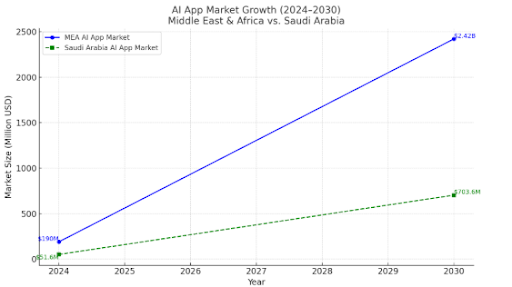
- The market for AI apps in the Middle East and Africa is anticipated to expand across all industries from around USD 190 million in 2024 to $2.42 billion by 2030, with a compound annual growth rate (CAGR) of over 47% between 2025 and 2030.
- Just in Saudi Arabia, the market for AI apps is expected to grow at a rate of 48.7% per year, going from USD $51.6 million in 2024 to $703.6 million by 2030.
- The use of AI in Islamic banking and lifestyle apps is part of the fast-growing use of AI in apps across MENA and South Asia, where the CAGR is close to 50%.
- AI is evaluating transactions for riba, gharar, and haram investments to verify Shariah compliance and develop individualized halal investment portfolios.
What is the Role of AI in Islamic Apps?
AI enhances Islamic apps like Al Quran by offering personalized Quran recitations, prayer time alerts, Qibla direction, and language translations. It enables smart chatbots for religious queries, automates Zakat calculations, and supports learning through voice recognition and adaptive teaching, making Islamic practices more accessible, accurate, and user-friendly for Muslims worldwide.
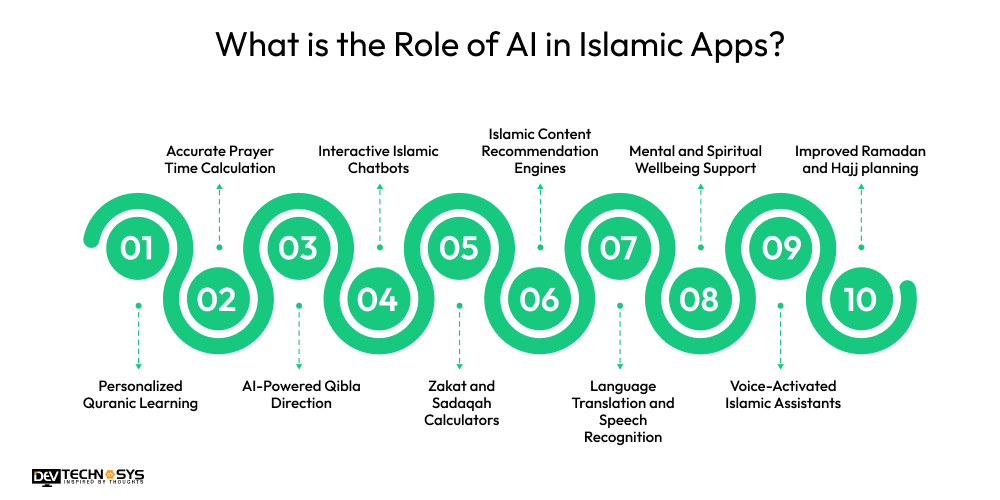
1. Personalized Quranic Learning
AI personalizes Quran learning by monitoring user reading habits, detecting Tajweed errors, and providing individualized feedback. It adapts the recitation rate, voice, and translation based on your choices. The personalized Islamic learning app suggests passages to study based on mood, interest, or learning history, resulting in a personalized spiritual journey.
2. Accurate Prayer Time Calculation
AI uses GPS data, real-time astronomical calculations, and user-specific location inputs to generate very accurate prayer timings. AI, unlike static timetables, responds to seasonal and geographic variances. It also learns user patterns to provide prayer reminders at appropriate times.
By utilizing advanced data processing, AI ensures that Muslims worldwide receive accurate and timely alerts, enabling them to perform their daily prayers with regularity.
3. AI-Powered Qibla Direction
AI improves Qibla direction performance by using compass sensors, GPS, and augmented reality to identify the most precise direction to the Kaaba. It uses advanced calibration to correct for magnetic interference and misalignment in interior conditions.
This ensures exact alignment independent of location. AI also allows for visual overlays on phone screens, making it easier for users to align themselves appropriately during prayer.
4. Interactive Islamic Chatbots
AI-powered chatbots provide 24-hour response for Islamic queries, utilizing trained datasets from legitimate religious sources. These virtual assistants respond to queries regarding daily practices, Hadiths, Quranic interpretation, and Fiqh rulings in an interactive format. Because they understand natural language, they can offer accurate, user-friendly responses instantaneously.
5. Zakat and Sadaqah Calculators
The role of AI in islamic apps simplifies Islamic financial duties by providing clever Zakat and Sadaqah calculators. It collects real-time financial data, evaluates assets, liabilities, and Nisab thresholds, and generates precise computations for each user.
These tools help to guarantee that Islamic donation guidelines are followed. Smart Zakat Calculator with AI identifies recognized charitable organizations based on their giving history and impact.
6. Islamic Content Recommendation Engines
AI enables Islamic apps to propose personalized content such as lectures, articles, Quranic verses, Duas, or reminders based on user choices, behavior, and viewing history. Similar to how streaming services personalize movies, AI in Islamic app development solutions curates spiritual content to keep users engaged and spiritually enriched.
This strategy promotes consistent learning and connection with faith, particularly for users looking for daily inspiration.
7. Language Translation and Speech Recognition
The role of AI in Islamic apps enables the real-time translation of Islamic literature into many languages while maintaining contextual and theological authenticity. It also employs voice recognition to help users recite Duas or Quran passages while offering comments on pronunciation.
This is very useful for non-Arab speakers and new Muslims. AI breaks down language barriers, making Islamic information more accessible and inclusive.
8. Mental and Spiritual Wellbeing Support
AI-Powered Islamic apps in Middle East provide emotional and spiritual wellness by monitoring users’ mood and behavior. AI can offer Duas, Quran passages, or relaxing lectures based on the user’s emotional state.
These apps assist users in managing stress, anxiety, and sadness by combining psychological models with spiritual material. This blend of mental health and spirituality, guided by Islamic principles, enhances emotional resilience.
9. Voice-Activated Islamic Assistants
AI allows voice-activated Islamic aides to reply to orders such as “Play Surah Yasin” or “What is the Hadith for today?” This hands-free interface enables obtaining Islamic knowledge more easily when driving, cooking, or multitasking.
The AI-enabled Hadith search app uses natural language processing to understand regional accents and religious phrases. They provide accessibility for the elderly, the visually challenged, and busy people, allowing them to remain linked to Islamic rituals throughout their daily lives.
10. Improved Ramadan and Hajj planning
The role of AI in Islamic apps improves the Ramadan and Hajj experiences by providing individualized timetables, Iftar/Sehri reminders, Duas, and Fiqh assistance. It can also track fasting objectives and provide nutritious food options.
Artificial intelligence helps with navigation, real-time updates, and crowd monitoring during the Hajj. AI facilitates the spiritual journey by evaluating user behavior and preferences.
Real-World Examples: AI in Islamic Apps
Islamic apps are leveraging AI to enhance user experiences, offering features such as AI-powered Quran recitation feedback, personalized prayer time reminders, and smart Qibla direction tools. Apps like Muslim Pro and Quranly utilize machine learning to tailor content, enhance engagement, and facilitate spiritual growth.
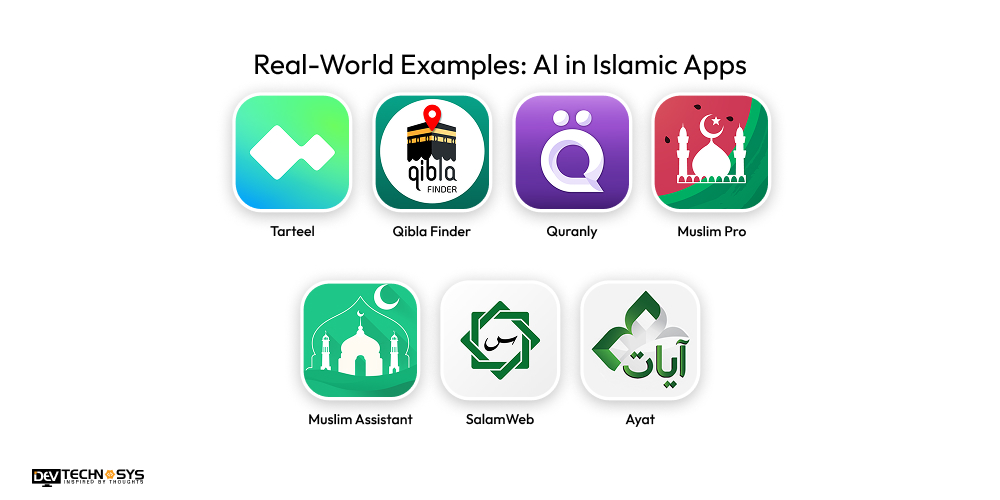
App Name |
AI Use |
| Tarteel | Uses AI-powered voice recognition to correct Quran recitation in real-time. |
| Qibla Finder | Employs AI and AR to accurately detect Qibla direction using camera and location data. |
| Quranly | AI tracks reading habits and recommends personalized Quranic content and goals. |
| Muslim Pro | Uses AI to improve prayer time accuracy based on user behavior and location patterns. |
| Muslim Assistant | AI suggests daily duas, reminders, and prayer times through behavioral learning. |
| SalamWeb | AI filters web content to ensure it aligns with Islamic ethical guidelines. |
| Ayat | Implements AI for precise audio playback control and Tajweed rule recognition. |
1. Tarteel
Tarteel employs advanced artificial intelligence to listen to your Quran recitation in real time, finding errors in pronunciation, Tajweed rules, and missed verses. It delivers instant remedial feedback, allowing users to improve accuracy independently.
This clever feature makes Quran learning more interactive and individualized, making it easier for both beginners and experienced learners to enhance their recitation.
2. Qibla Finder
Qibla Finder combines AI and augmented reality to deliver correct Qibla directions. The app compensates for magnetic interference and device tilt, leading users visually indoors and outside. This technology assures that Muslims can face the Kaaba precisely during prayer from anywhere in the world, outperforming ordinary compass apps in terms of orientation reliability.
3. Quranly
Quranly uses AI to tailor Quran memorizing and study regimens depending on individual progress and learning pace. The software changes course difficulty, advises daily schedules, and tracks progress, resulting in an adaptive learning experience.
This sophisticated technology stimulates users, enhances retention, and provides individualized coaching to help them reach their spiritual goals.
4. Muslim Pro
Muslim Pro uses artificial intelligence algorithms to understand your location and daily routines before providing you personalized prayer time reminders that are tailored to your routine. The app like Muslim Pro, automatically adjusts alarms for travel or schedule changes, so you never miss a prayer. The Azan reminder app with AI combines location-based precision with behavioral insights to encourage persistent spiritual practice.
5. Muslim Assistant
Muslim Assistant uses AI voice recognition to provide hands-free access to Islamic information. Users can use simple voice commands to seek prayer timings, Quran texts, and Dua recommendations.
This accessibility feature allows for multitasking and helps visually impaired individuals stay connected to Islamic practices at any time and from any location without the need for manual navigation.
6. SalamWeb
SalamWeb provides AI chatbots that are trained on authentic Islamic knowledge and can answer faith-related issues promptly. These chatbots offer advice on daily rituals, religious rules, and spiritual issues, citing Quranic texts and Hadiths.
The AI ensures that responses are correct and trustworthy by combining scholar-reviewed content, making religious instruction available and credible around the clock.
7. Ayat
Ayat employs AI to assess user behavior and emotions by tracking reading and prayer routines. Based on these findings, it recommends tailored spiritual content, such as uplifting Hadiths or relaxing Quran recitation. This mood-sensitive strategy increases user involvement by delivering timely inspiration and assistance based on individual spiritual needs.
5 Benefits of AI in Islamic Apps in Middle East
In Islamic apps all over the Middle East, AI improves personalized learning, makes sure that prayer times are correct, makes it easier to read the Quran, gives easy access to spiritual guidance, and gives true Qibla direction.
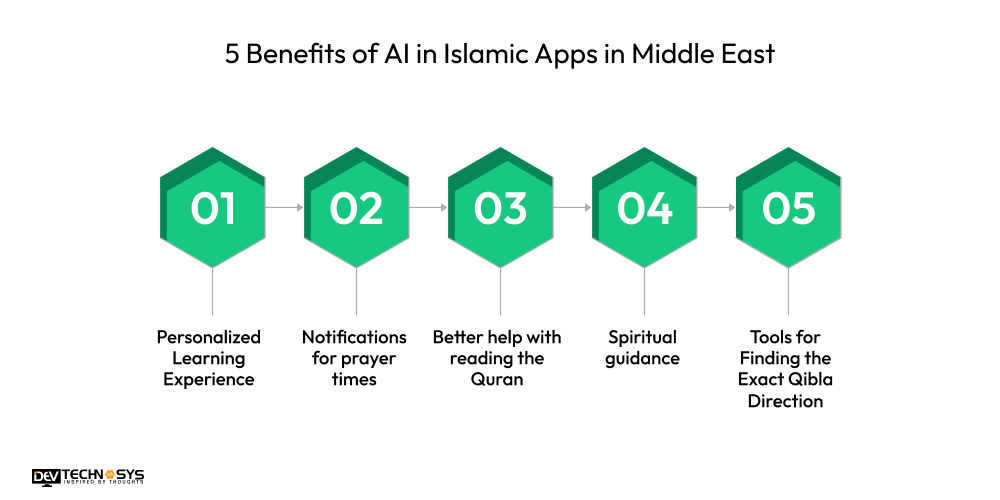
1. Personalized Learning Experience
AI in Quran Learning Apps for each user, changing based on their speed and level of understanding. This customization helps people of all skill levels get more out of religious literature by giving them personalized lessons, tracking their progress, and giving them feedback that is tailored to their requirements. This makes spiritual growth faster and more motivating.
2. Notifications for prayer times
AI looks into where you are, how the light changes, and how you use your phone to provide you with accurate prayer time alerts. This is quite useful to develop an islamic app in the Middle East, since prayer times change with the seasons. AI makes sure that users never miss their prayers by sending them timely and personalized reminders. This helps them keep up with their daily worship even when they are busy.
3. Better help with reading the Quran
An AI-powered Islamic Android app development solution in Dubai provides you with real-time feedback on how well you read the Quran, finding flaws in pronunciation and Tajweed. This technology helps people improve their recitation quality without the need for a real tutor. It makes it easier for everyone, even remote learners, to engage with the Quran in a more accurate, confident, and meaningful way.
4. Spiritual guidance
AI chatbots and virtual assistants can answer Islamic queries right away and help with religious rules, rituals, and ethics. This accessibility is very important in the Middle East since it lets people get reliable information whenever they need it. AI makes sure that the advice is always the same, correct, and culturally appropriate, which helps people make religious judgments every day.
5. Tools for Finding the Exact Qibla Direction
AI-powered Qibla apps employ sensor data and augmented reality to deliver very accurate directions. They take into account magnetic interference and the direction of the gadget to make sure that users face the Kaaba appropriately while they pray. This makes it easier for Muslims in the Middle East and elsewhere, especially when they have to worship in places they don’t know or inside.
5 Challenges with AI in Islamic Apps and Their Fixes
AI in Islamic app development services faces challenges like ensuring religious accuracy, handling sensitive data, overcoming language diversity, maintaining user trust, and addressing limited digital literacy. Tackling these issues through expert collaboration, robust privacy measures, multilingual support, transparent AI design, and user education ensures ethical, reliable, and accessible Islamic technology solutions.
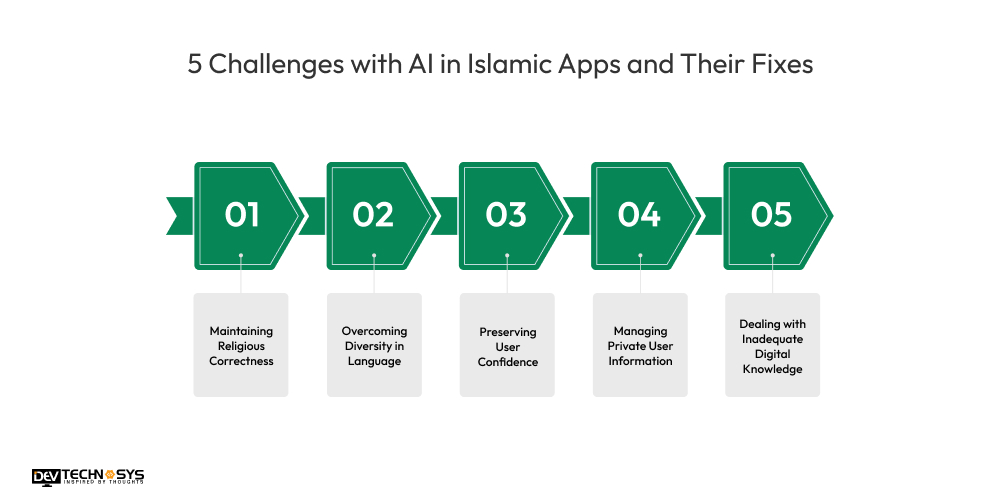
1. Maintaining Religious Correctness
AI runs the potential of giving consumers inaccurate or deceptive Islamic teachings, which could mislead or confuse them. Islamic apps must work closely with knowledgeable academics for ongoing content evaluation and validation in order to avoid this.
Users’ confidence in the app’s spiritual dependability and validity is preserved by including reputable religious authorities, who guarantee that AI-generated guidance closely adheres to accurate readings of the Quran and Hadith.
2. Overcoming Diversity in Language
Muslim users use a variety of Arabic dialects and other languages, which makes it difficult for AI to comprehend and react appropriately. AI in Arabic language Quran apps: enhancing comprehension can be achieved by offering multilingual user interfaces and training AI models on large, regionally relevant linguistic datasets. By involving native speakers, one may guarantee culturally appropriate communication and improve user experience.
3. Preserving User Confidence
Because they worry about mistakes or a lack of authenticity, many users are dubious of AI’s involvement in religious affairs. Transparency in the way AI makes suggestions, including concise descriptions of its procedures, is essential to fostering trust.
Giving users the ability to speak with human Islamic scholars within the app builds a reliable hybrid model that boosts user confidence in spiritual guidance by fusing the ease of AI with human monitoring.
4. Managing Private User Information
There are serious privacy issues with gathering personal information like location and usage patterns. Hire app developers who employ clear user permission procedures, robust encryption, and open privacy policies to handle this.
Regular security audits and compliance with local or regional data protection legislation, such as the GDPR, protect sensitive data. This increases user trust in the app’s dedication to safeguarding religion and personal privacy.
5. Dealing with Inadequate Digital Knowledge
Many users, particularly those from older generations, have trouble navigating complicated apps. Islamic apps should include voice-activated navigation, step-by-step tutorials, and straightforward, user-friendly designs to improve accessibility. Programs for digital literacy and community outreach can further enable people to embrace technology with assurance.
10 Use Cases of AI in Islamic Apps
AI transforms Islamic apps by enhancing Quran recitation, personalizing prayer reminders, offering smart Qibla direction, providing instant religious guidance, enabling voice commands, supporting adaptive learning, delivering mood-based content, ensuring accurate event timings, moderating community discussions, and safeguarding user privacy for a richer faith experience.
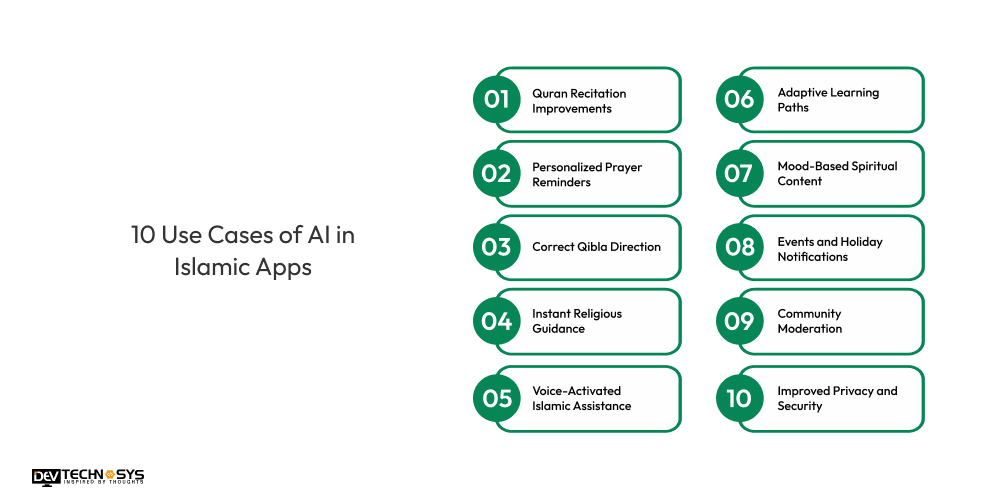
1. Quran Recitation Improvements
AI technology listens to users reciting the Quran and detects flaws in pronunciation and Tajweed. It provides real-time feedback and corrective suggestions to assist users improve their reciting without a tutor. This interactive approach to Quran learning makes it more accessible and effective, particularly for remote learners, and allows for constant practice and spiritual growth through tailored audio coaching.
2. Personalized Prayer Reminders
AI in Prayer time calculation messages to individual users based on their location, daily behaviors, and schedules. The system adjusts alerts dynamically based on travel or seasonal time changes, ensuring that prayers are never missed.
This intelligent customisation assists Muslims in keeping consistent worship practices despite busy schedules or irregular activities, hence increasing devotion and punctuality.
3. Correct Qibla Direction
AI-powered apps like Quran Majeed use sensor data and augmented reality to deliver extremely accurate Qibla directions. They automatically compensate for magnetic interference, device tilt, and ambient conditions. This allows users to confidently face the Kaaba while praying, whether indoors or outdoors, and provides greater precision and ease than traditional compass equipment.
4. Instant Religious Guidance
AI chatbots trained in real Islamic knowledge respond instantly to users’ questions on faith, rituals, and daily living. Scholars continually examine these chatbots to ensure they are accurate and culturally relevant. They offer 24-hour support, allowing customers to seek trustworthy religious advice at any time and encouraging informed spiritual decision-making.
5. Voice-Activated Islamic Assistance
AI-powered speech recognition enables users to use Islamic app features hands-free. Users can utilize voice commands to seek prayer timings, Quran verses, or Dua recommendations without having to navigate manually.
This functionality improves accessibility for visually impaired individuals while also increasing convenience for multitaskers, ensuring a continual connection with their faith.
6. Adaptive Learning Paths
Quran Translation with AI memorization and Islamic studies, altering class difficulty and pace accordingly. It suggests creating tailored study regimens to maximize learning efficiency and motivation. This personalized strategy assists users in overcoming hurdles and better retaining knowledge, thereby facilitating long-term spiritual development and effective mastery of Islamic principles.
7. Mood-Based Spiritual Content
AI uses user behavior and emotional indicators, such as reading patterns or prayer constancy, to offer individualized spiritual content. According to the Islamic app development company in UAE, it provides Quranic passages, Hadiths, or Duas that correspond to the user’s present emotional condition, providing comfort, inspiration, or motivation.
8. Events and Holiday Notifications
AI forecasts major Islamic festivals and holidays based on lunar calendar dates and regional observances. Smart Islamic apps for Ramadan, Eid, and other important holidays, allowing them to prepare spiritually and socially. This timely awareness encourages community involvement and personal dedication, ensuring that users remain connected to their faith calendar.
9. Community Moderation
Artificial intelligence checks content in Islamic app forums and chat groups for inappropriate, dangerous, or disrespectful statements. It automatically filters out hate speech, misinformation, and spam, ensuring a secure, courteous, and positive atmosphere that reflects Islamic values. Moderation promotes positive community connections and protects people from hazardous online behavior.
10. Improved Privacy and Security
AI-powered security solutions safeguard users’ sensitive religious and personal information by detecting suspicious activity and mitigating cyber threats. Transparent privacy policies and encryption techniques foster confidence while assuring compliance with data protection regulations. These safeguards ensure that users’ faith-related information remains private, establishing a safe and dependable environment for digital worship and learning.
What Kinds of AI Technologies Are Used to Build Islamic Apps?
Artificial intelligence (AI) is used in Islamic Android and iOS app development to improve user experience and spiritual engagement. Examples of these technologies include chatbots for instant religious guidance, computer vision for Qibla direction, machine learning for personalized learning, and prayer reminders.
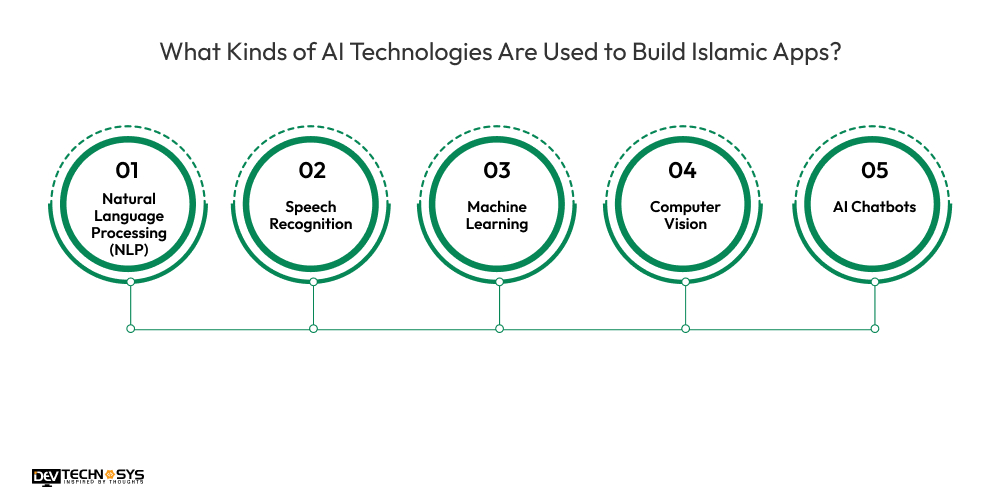
1. Natural Language Processing (NLP)
NLP enables Islamic applications to comprehend and interpret Quranic text and user inquiries in a variety of languages. It drives functions such as text search, translation, and chatbot interactions, which enable users to pose inquiries about Islam and receive precise, context-aware responses that are customized to their cultural and linguistic background.
2. Speech Recognition
Speech recognition technology enables applications to listen to Quran recitations and detect Tajweed and pronunciation errors. The AI offers real-time feedback by converting audio into text and analyzing it, thereby facilitating the independent development of recitation skills and enhancing the accessibility and interactivity of Quran learning.
3. Machine learning
In order to provide personalized content, such as prayer time reminders, study plans, and spiritual suggestions, machine learning algorithms analyze user behavior, preferences, and progress. This adaptive approach enhances user engagement by customizing experiences to the learning speeds, habits, and requirements of each individual, thereby guaranteeing the effective and meaningful development of spirituality.
4. Computer Vision
Augmented reality Qibla finders are powered by computer vision technology. It assists users in visually locating the appropriate prayer direction by utilizing camera input to discern the device’s orientation and surroundings. This improves accuracy beyond that of conventional compasses and allows for intuitive, real-time guidance in a variety of diverse environments.
5. AI Chatbots
AI chatbots provide immediate, conversational assistance by responding to inquiries regarding Islamic teachings, rituals, and daily practices. These bots are routinely reviewed by scholars and are trained on authentic religious texts.
The muslim daily routine app with AI offers reliable, accessible guidance 24/7, assisting users in deepening their understanding of Islam by providing trustworthy and timely information.
Future Trends of AI in Islamic Apps
Future AI in Islamic apps will focus on deeper personalization, enhanced voice interaction, immersive AR experiences, advanced emotional analysis, and seamless integration with smart devices for enriched, accessible spiritual guidance worldwide.
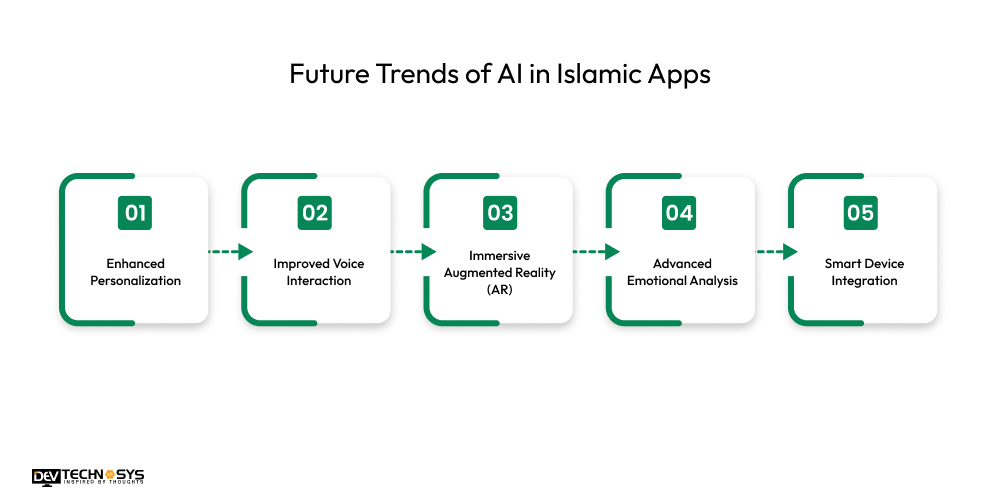
1. Enhanced Personalization
AI will provide highly personalized spiritual content and learning routes by assessing user behavior, preferences, and emotional states, resulting in individualized experiences that better support each person’s unique faith journey and progress.
2. Improved Voice Interaction
AI will become more natural and responsive, enabling hands-free access to prayers, Quran recitations, and religious instruction. This will make spiritual practice easier and more accessible for visually impaired or multitasking users.
3. Immersive Augmented Reality (AR)
AR integration will allow for interactive experiences such as virtual mosque tours, realistic Qibla direction, and immersive Islamic learning. According to the mobile app development company in UAE, this can increase user engagement by combining digital information with real-world settings.
4. Advanced Emotional Analysis
AI will recognize users’ moods and emotional needs based on behavioral signals and give consoling Quran verses, Dua, or Hadith at the most appropriate times, developing better emotional and spiritual support.
5. Smart Device Integration
Islamic apps will integrate seamlessly with smart home gadgets and wearables to deliver prayer reminders, Quran recitations, and daily spiritual insights at any time, fostering a consistent, supportive religious environment throughout daily life.

Final Words!
In 2025, the role of AI in Islamic apps continues to expand, revolutionizing how users engage with their faith through personalized learning, precise prayer management, and accessible religious guidance. By integrating advanced technologies like natural language processing and augmented reality, these apps offer enriched spiritual experiences tailored to individual needs.
Artificial intelligence development company expertise is vital in creating these intelligent, user-centric solutions, ensuring accuracy, privacy, and cultural sensitivity. As AI evolves, Islamic apps will increasingly support meaningful worship and community connection worldwide.
Frequently Asked Questions
Q1. What Is The Current Impact Of AI on Islamic Apps In 2025?
The role of AI in Islamic apps provides individualized education, precise prayer management, real-time Quran recitation feedback, and immediate religious counsel, thereby rendering religious practices more accessible and engaging globally.
Q2. How Can Businesses Benefit From Investing In AI Islamic Apps?
Businesses investing in AI Islamic apps tap into a growing market, boost user engagement with personalized features, foster community trust, and innovate faith-based technology, driving revenue and expanding global reach.
Q3. What Opportunities Exist For Startups In The AI Islamic App Market?
Startups in the AI Islamic app market can innovate personalized learning, voice interaction, augmented reality, emotional AI, and community features, meeting diverse user needs while capturing growing demand for accessible, faith-centered digital solutions.
Q4. How Does AI Improve Quran Recitation In Islamic Apps?
AI improves Quran recitation by analyzing pronunciation and Tajweed errors in real time, providing instant corrective feedback, enabling users to practice accurately and confidently without needing a physical teacher.
Q5. How Reliable Is AI in Providing Religious Rulings?
AI can provide reliable religious rulings when trained on authentic Islamic sources and reviewed by qualified scholars. Ongoing human oversight ensures accuracy, preventing misinterpretation and maintaining trust in faith-based guidance.