





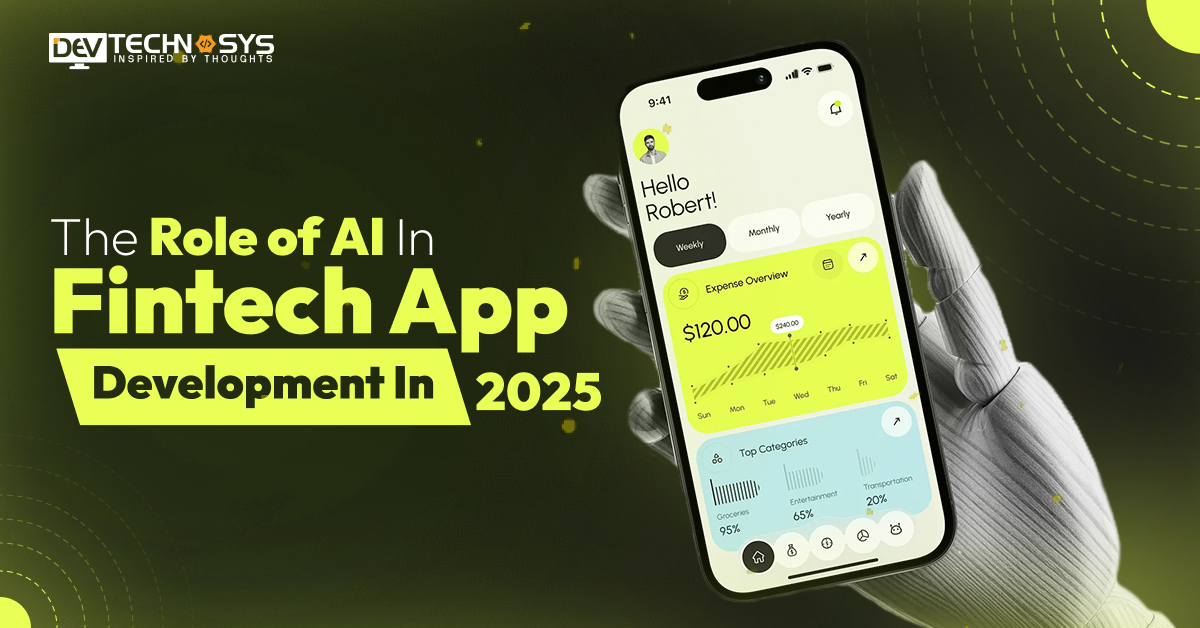
“Know AI as your companion for growth and success in the Fintech industry.”
The finance and banking services, especially in the Middle East countries like the UAE are rapidly transforming due to AI. The role of AI in fintech app development is to automate features and improve user experiences at least possible rates. Businesses must understand the importance of AI and its components before using this technology.
Key Takeaways:
-
- AI powers credit scoring, robo‑advisors, fraud detection, automated loan approvals, predictive analytics, algorithmic trading, personalized dashboards, RegTech solutions, chatbots, and insurance claim automation in fintech apps.
- The global fintech market is projected to surpass $1.1 trillion by 2032 at a CAGR of 16%, with AI‑driven services accounting for a major share of innovation and growth.
- Hyper‑personalization, voice‑first interfaces, ethical AI models, and AI‑blockchain integration are shaping user experiences and operational efficiency in fintech platforms.
- Rising digital adoption, evolving user expectations, and heightened security needs make AI integration essential for fintech businesses to remain competitive and scalable in 2025 and beyond.
There are multiple things to understand for a business investor in the fintech industry. AI is the major technology behind automated payments and user query redressal. It uses Machine Learning and other components to improve fintech services.
So, to learn more, you must go through this blog and find out whether you should implement AI in your apps or not.
Expanding Global Fintech Market
The worldwide fintech sector is growing quickly because of digital transformation, financial inclusion, and new technologies like AI and blockchain. Strong growth is happening in all regions and services because of ongoing innovation and more people using them.
- In 2024, the global revenue was $340.10 Billion, with expected growth to $394.88 Billion in 2025 and reaching $1.126 Trillion by 2032, at a 16.2% CAGR rate.
- The UAE market was $22.02 Billion in 2024, expanding to $72.17 Billion by 2034, with 15.6% CAGR rate.
- MarketDataForecast predicts a rise from $109.74 Billion in 2024 to $258 Billion by 2033, at 25.18% CAGR rate in China.
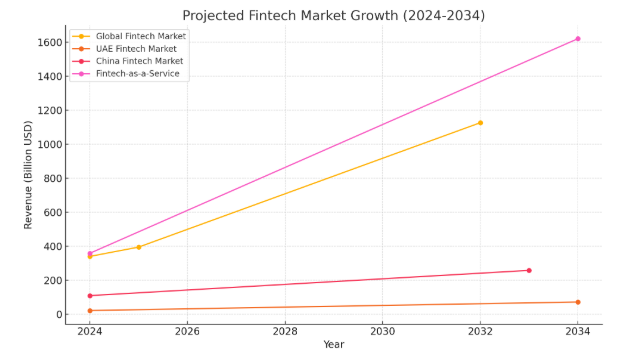
- Fintech-as-a-Service segment is valued at around $358.5 Billion in 2024, projected to reach $1.62 Trillion by 2034, with 16.3% CAGR rate.
- Fintech revenues grew 21% between 2024 and 25, significantly outpacing traditional financial services at 6%, with 69% of public fintech firms now profitable.
Evolution & Role of AI in Fintech App Development
AI in fintech apps in Saudi Arabia has changed the industry by adding smart automation, predictive analytics, and highly tailored user experiences. AI makes solutions faster, more precise, and more focused on the consumer, from finding fraud to making investing strategies better.
Its integration helps firms meet rules, cut expenses, and make things safer. An Artificial Intelligence development company may transform your system from simple automation to powerful cognitive systems that will impact the future of digital banking.
- Enhances fraud detection and risk management with real-time analysis.
- Powers personalized financial recommendations for users.
- Automates loan approvals, credit scoring, and customer onboarding.
- Improves decision-making through predictive analytics and insights.
- Streamlines regulatory compliance with AI-powered RegTech solutions.
Major Benefits of Integration AI in Fintech
The benefits of knowing the role of AI in fintech app development are many which includes focus on customer needs. It helps people and businesses make better choices, lowers risks, and gets the best prices:
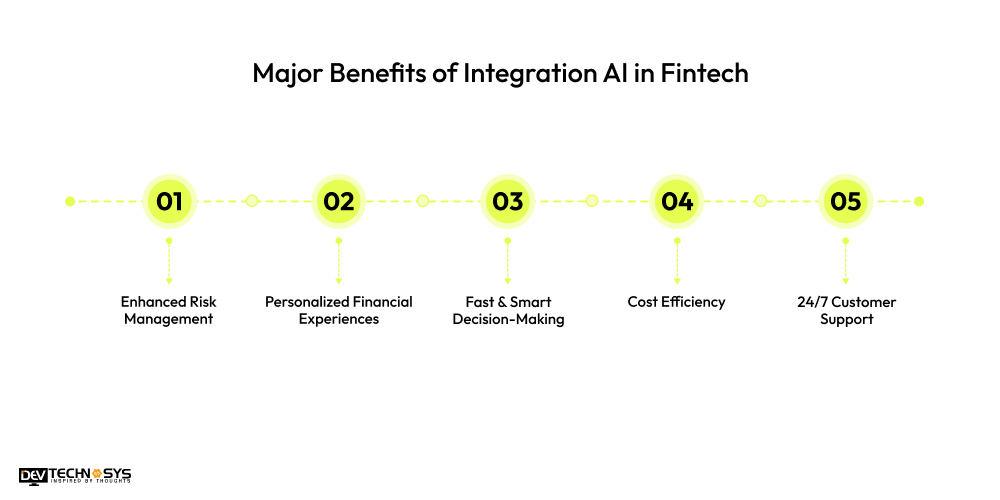
1. Enhanced Risk Management
AI systems look at huge amounts of data in real time to find trends and possible risks. This helps fintech companies find fraud, guess how the market will change, and better understand credit risks. So, institutions can reduce their financial losses and better follow the rules set by regulators.
2. Personalized Financial Experiences
AI lets banking apps give personalized suggestions based on how each user acts, such investment possibilities or spending tips. To improve user engagement, hire a mobile app development firm in UAE that uses AI. This customization builds client loyalty and helps people make smart financial decisions.
3. Fast & Smart Decision-Making
Fintech organizations can use AI-driven analytics to process data and give insights in seconds. This speeds up judgments on loans, trades, and how to manage a portfolio. Businesses can move quickly and accurately in marketplaces to target fintech app development in UAE.

4. Cost Efficiency
AI-powered automation cuts down the amount of labor required that directly reduces the cost to develop a fintech app. You can make things like onboarding new customers, keeping an eye on transactions, and processing data easier.
5. 24/7 Customer Support
AI chatbots and virtual assistants make sure that customer care is available 24/7 and that questions are answered right away. They take care of common problems like account questions, transaction changes, and frequently asked questions without needing a person to do it.
Various Fintech Use Cases Powered by AI
AI is changing fintech apps to make things that are more accurate and faster. These use cases improve business operations and provide better financial services for both enterprises and consumers:
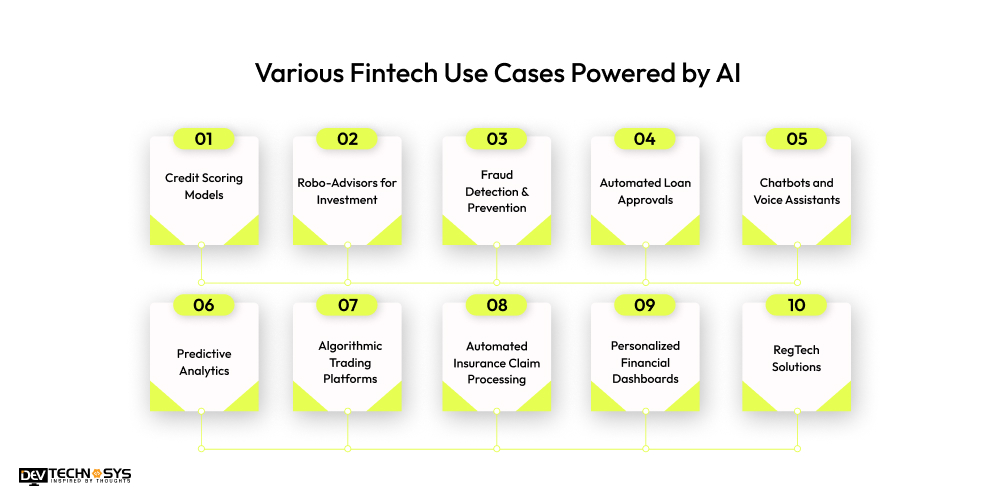
1. Credit Scoring Models
AI-driven credit scoring looks at things like transaction history, online behavior, and spending habits to figure out how much credit you may get. It makes credit checks more accurate and fair than older systems. Top fintech app developers in Dubai use AI to record short credit so users can get loans.
2. Robo-Advisors for Investment
AI-based robo-advisors manage your portfolio automatically by analyzing the market in real time and assessing risk. An AI development company provides best ways to invest based on the user’s goals. This makes it easier and cheaper for more people to handle their money.
3. Fraud Detection & Prevention
AI systems keep an eye on transactions as they happen to find strange or suspicious behavior. Machine learning models learn from patterns of fraud that have happened in the past to stop new assaults before they happen. This lowers the amount of money lost and makes things safer for users and businesses.
4. Automated Loan Approvals
AI speeds up the lending procedure by instantly checking creditworthiness and validating paperwork. It cuts down on mistakes made by hand and speeds up the time it takes to get approval by a lot. The AI financial app development in Riyadh allows customers to get their money through the borrowing process.
5. Chatbots and Voice Assistants
AI chatbots in fintech apps in Bahrain or UAE answer client questions, give account information, and help with transactions around the clock. Voice assistants make things like checking your balance or transferring money even easier by letting you give them natural language commands.
6. Predictive Analytics
AI predictive models can tell you what will happen in the market, how customers will act, and what hazards might come up. This helps banks and other financial institutions come up with plans and make the best investment choices by knowing the role of AI in fintech app development.
7. Algorithmic Trading Platforms
AI systems look at huge amounts of data to make trades at the best moments with as little human help as possible. These algorithms respond to changes in the market in milliseconds, which helps them make the most money and the least risk. It makes trading more efficient and accurate.
8. Automated Insurance Claim Processing
AI checks and settles insurance claims by looking at documentation and finding false claims. It makes the whole claims process go faster, which makes customers trust you more and have a better experience. Insurance companies use finance software development services to save money faster.
9. Personalized Financial Dashboards
AI creates user-friendly dashboards that show real-time information on spending, investments, and savings. People can use these dashboards to create objectives and make smart choices about their money. Personalization makes things more relevant and helps people learn about money.
10. RegTech Solutions
RegTech that uses AI automates the process of monitoring compliance and reporting to regulators for banks and other financial organizations. Various mobile fintech solutions in Muscat makes sure that regulations are followed, and lowers the consequences for not following the rules.
Components of AI Used for Fintech App Development
AI-powered banking apps use a number of technological components to provide accurate services. The role of AI in fintech app development is to make decisions easier and improve money handling:
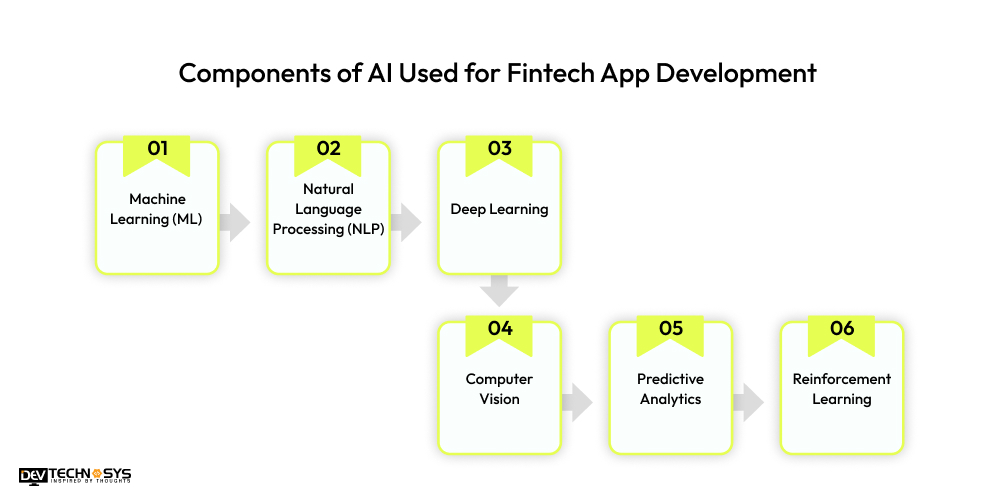
1. Machine Learning (ML)
ML algorithms look for patterns and trends in both past and present financial data. They make it possible to accurately score credit, find fraud, and optimize portfolios. Learning all the time makes forecasts better for AI-powered fintech apps in Egypt.
2. Natural Language Processing (NLP)
Natural language processing (NLP) lets financial apps understand and respond to questions from users. It helps chatbots, voice assistants, and sentiment analysis work better to keep customers interested. A mobile application development company helps to deal with money and data easily.
3. Deep Learning
Neural networks are used in deep learning to analyze huge, complicated information like photos, audio, or market signals. It makes it easier to find fraud, do automated trading, and give personalized suggestions. It can provide very accurate forecasts because it uses several layers.
4. Computer Vision
Computer vision lets finance apps read and check visual information like ID cards, paperwork, and check deposits. It makes KYC processes easier and safer by using facial recognition. To cut down excessive user interaction and speed up verifications, target custom financial app development in Qatar.
5. Predictive Analytics
Predictive analytics looks at past data to make predictions about future financial trends, customer behavior, and risk factors. It helps with investment strategies, lending evaluations, and avoiding fraud by giving data-driven insights. Businesses must use fintech app development services to make decisions.
6. Reinforcement Learning
Reinforcement learning teaches systems how to make better decisions by trying things out and seeing what works. In fintech, it makes trading methods, portfolio management, and dynamic pricing models better. It learns over time how to get the most rewards and the least risks.
Future AI Trends in the Fintech Industry
The role of AI in fintech app development is to make services smarter, safer, and more focused for users. New trends are likely to change how people and corporations handle their money:
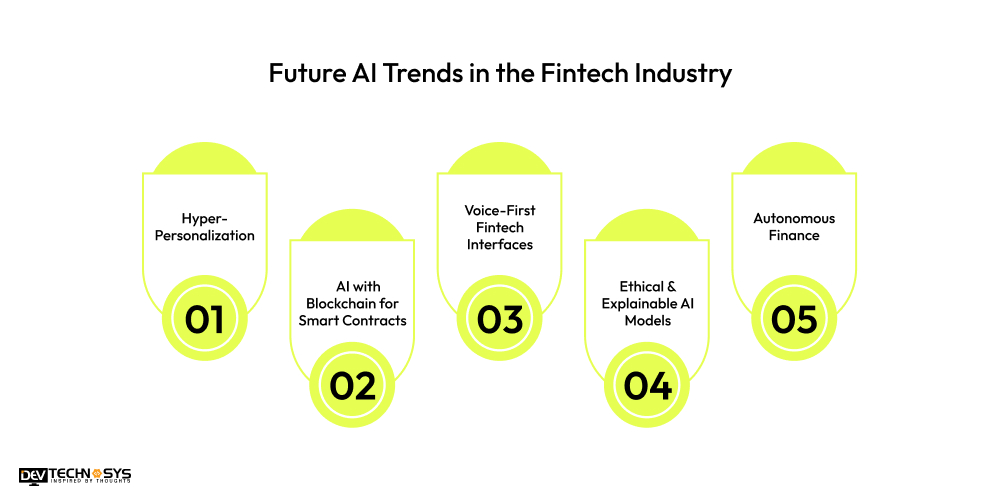
1. Hyper-Personalization
AI will make it possible for financial services to be very personalized to each person’s needs and stage of life. Every encounter uses services, from investing advice to notifications about a custom fintech app in Egypt. This method makes customers more loyal and helps them learn more about money.
2. AI with Blockchain for Smart Contracts
Combining AI with blockchain will make smart contracts work better and faster, making transactions easier. AI can check conditions, guess hazards, and make sure that rules are being followed in real time. You can develop a fintech app to make financial agreements more open and less likely to be fraudulent.

3. Voice-First Fintech Interfaces
Voice-enabled AI will let people do banking and trading chores by talking to it. It makes it easier for people who are on the go or who don’t know much about technology to use. To make these kinds of interfaces, you must hire a fintech app design company in Saudi Arabia.
4. Ethical & Explainable AI Models
AI systems in the future will put more emphasis on fairness, openness, and responsibility when making financial decisions. Explainable AI makes sure that users know how algorithms get their judgments. This fosters trust and helps to reduce the cost to maintain an app for all institutions.
5. Autonomous Finance
AI will move toward self-managing financial ecosystems where algorithms take care of budgeting, paying bills, and investing. Users can let AI make all of their financial decisions with very little monitoring. This trend offers easy money management and the best results.
How to Implement AI in Fintech Apps
To make sure that AI works correctly and follows the rules, fintech apps need to take an organized approach. Every step makes sure that the financial solutions are safe and secure for consumers:
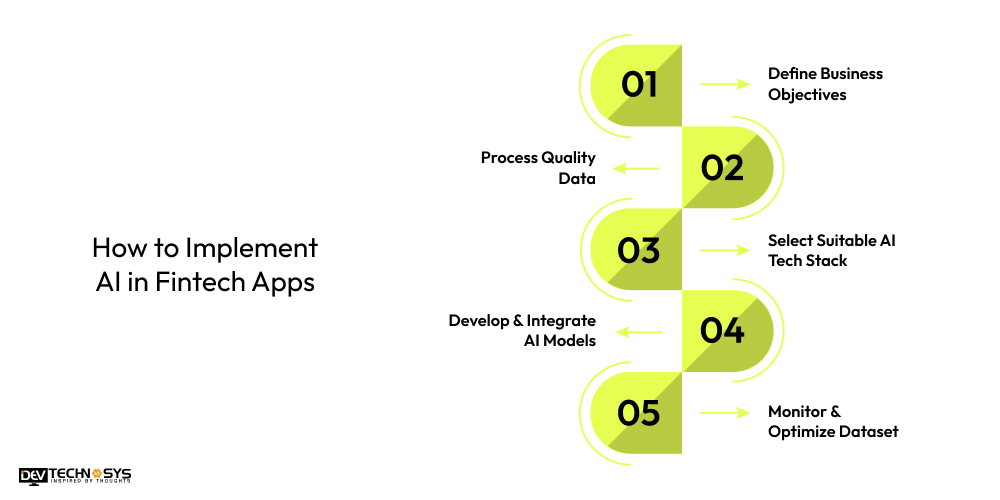
1. Define Business Objectives
Start by figuring out what AI needs to do, such as find fraud, make investments that are right for you, or automate loans. Clearly state the key performance indicators (KPIs) that will show how well you’re doing.
Make sure that the ways you employ AI fit with your business demands and the rules that apply to your industry. This makes sure that the development roadmap is targeted and that the return on investment is as high as possible.
2. Process Quality Data
Get and sanitize financial data from a variety of sources, such as transactions, user profiles, and market feeds. Make that the dataset is correct, fair, and follows the rules of data privacy.
You must contact a fintech app development company for normalization that is a preprocessing technique to make AI models. Good AI insights depend on having good data.
3. Select Suitable AI Tech Stack
To design AI systems that can grow, pick the correct mix of frameworks, tools, and cloud platforms. Think about using technologies like TensorFlow, PyTorch, or AWS AI services, depending on the size of the project.
Make sure it works with the security protocols and infrastructure already in place in the fintech industry. A strong tech stack must be used to create AI payment solutions in Dubai.
4. Develop & Integrate AI Models
Use historical and real-time data that is relevant to financial operations to design and train AI models. Use APIs or microservices to add them to the app so that they work together smoothly.
Check models for speed, accuracy, and how well they follow industry standards. After deployment, use android app development services for continuous feedback that improve the models.
5. Monitor & Optimize Dataset
Keep an eye on how well AI is doing and compare the results to the goals you set. Change your datasets to reflect new market conditions, client behavior, and financial trends.
Use continuous learning to make your predictions more accurate and less biased. Ongoing optimization makes sure that performance stays high and can change.
Case Study of e& money: A Successful AI-Driven Fintech App
e&money is among the smart financial apps in UAE that are made to deliver AI-powered services. Its success story shows how telecom-backed platforms can make financial experiences smooth and accessible for everyone.
- e& money was launched in March 2023 as the fintech arm of e& life (part of the Emirates Telecommunications Group).
- Its mission is to deliver a secure, unified financial super‑app serving both banked and unbanked individuals in the UAE.
- At launch, the app saw rapid adoption as within months it issued over 250,000 digital cards and expanded its subscriber base to 750,000 users.
- As of early 2025, e& money counts over 1.5 million subscribers, has issued over 1 million cards, and supports international transfers to 200+ countries with global partners like Mastercard.
- Looking ahead, the platform plans to roll out micro‑lending, digital gold investment tools, and deeper regional expansion that will position it as a fintech leader in the Middle East.
Key Challenges With AI and Fintech Sector
AI has the potential to change the fintech industry, but it also comes with big problems. By dealing with these problems, we can make sure that AI solutions are safe, moral, and cost-effective:
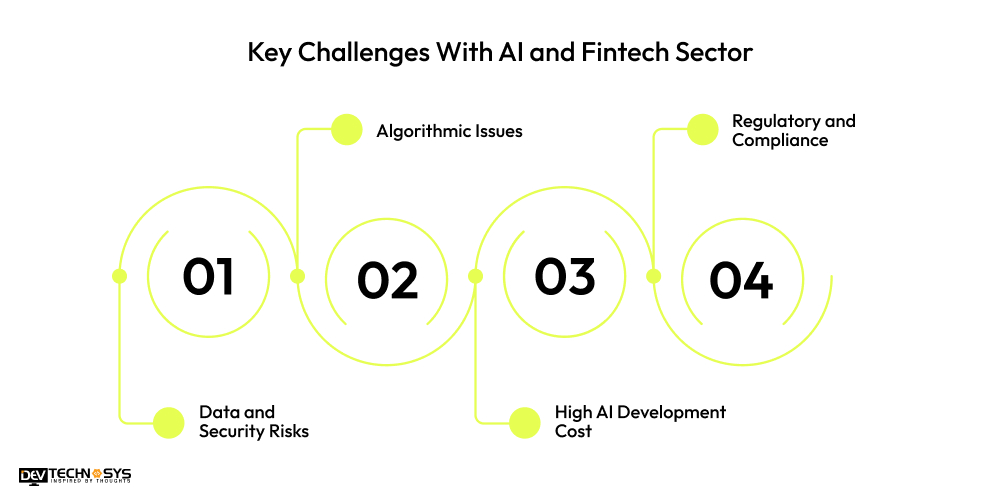
1. Data and Security Risks
AI systems need sensitive financial information, which makes them easy targets for hackers and breaches. Data leaks or misuse can cost a lot of money and hurt your reputation.
Solution: To protect private information, hire fintech mobile app developers in Riyadh to use end-to-end encryption and follow data privacy rules like GDPR.
2. Algorithmic Issues
AI models can make wrong or biased predictions if the training data is bad or the model is poorly designed. This could lead to discriminatory lending or wrong fraud detection.
Solution: To keep AI fair and reliable, you should regularly audit AI models, make sure you have a variety of datasets, and use explainable AI frameworks.
3. High AI Development Cost
Building and keeping AI solutions up and running takes a lot of money for technology, infrastructure, and qualified workers. This can be a problem for smaller fintech companies or startups.
Solution: To reduce the cost to develop an app, use cloud-based AI services, pre-trained models, and phased adoption.
4. Regulatory and Compliance
AI in fintech must follow changing rules and standards for compliance and finance. If you don’t follow the rules, you could face fines and legal problems.
Solution: To make sure you follow all the rules, hire AI banking app developers in Kuwait to use RegTech tools and keep an eye on legal revisions all the time.

In a Nutshell!!
To make AI-powered smart and intelligent fintech applications, you must approach Dev Technosys, an iOS app development company in UAE. As an entrepreneur, you can easily target fintech app development in Middle East by getting:
- A complete dedicated environment for making AI-based apps.
- Strong internal support of developers.
- Rules that follow the role of AI in fintech app development.
- And, strict observation of business models.
With this, you can change the business scenario and make a huge profit in less time. Additionally, user engagement will also increase that directly results in revenue generation.
FAQs
1. How is AI Transforming Fintech App Development in 2025?
- AI analyzes user behavior and financial data.
- Perform tasks like customer onboarding and KYC verification.
- AI models process massive financial data for faster business decisions.
2. What Types of Fintech Apps Benefit the Most From AI Integration?
- Credit Scoring Apps: Use AI for faster loan approvals.
- Investment Management Apps: Employ robo-advisors and algorithmic trading tools.
- Digital Banking Apps: Leverage real-time monitoring.
3. Which AI Technologies are Most Commonly Used in Fintech Apps?
- Machine Learning: Powers predictive analytics for credit scoring.
- Natural Language Processing: Enables chatbots and virtual assistants.
- Deep Learning: Used for complex tasks like biometric authentication.
4. How AI Provides Security to FinTech Applications?
- AI models identify irregular patterns.
- Recognizes unique user patterns.
- The technology continuously learns from threats.
5. What are the Challenges in Adopting AI for Fintech App Development?
- Data Privacy: Managing sensitive financial data is complex.
- Bias in AI Algorithms: Poor data quality can lead to unfair decisions.
- High Technical Cost: Developing and maintaining AI systems requires high investment.