





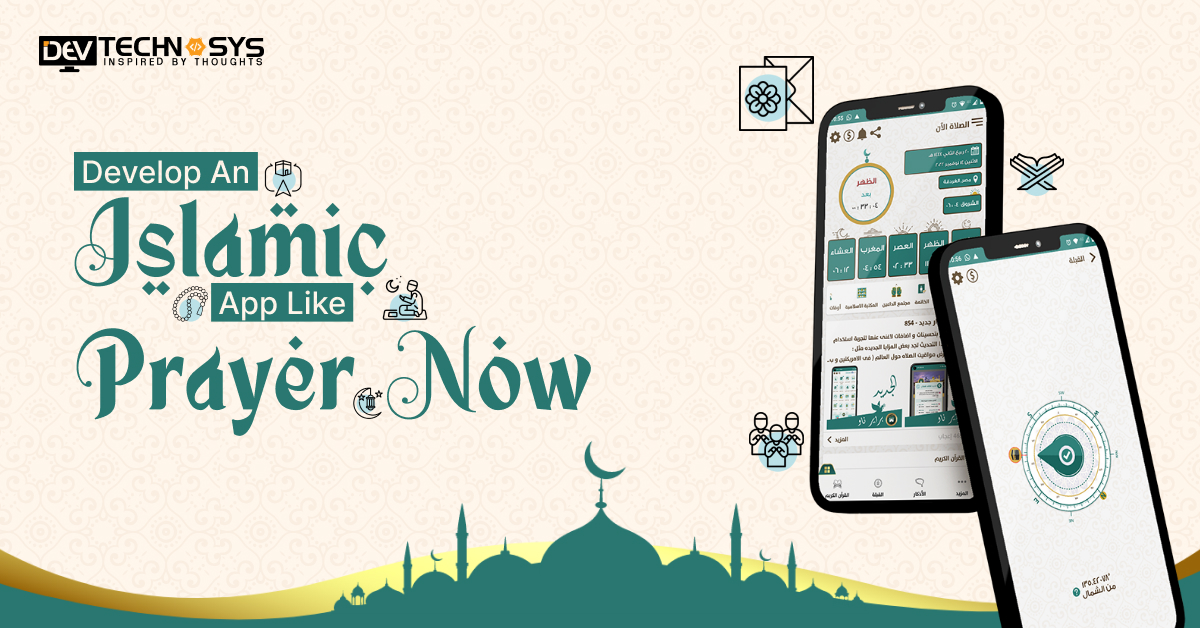
In today’s digital age, creating an Islamic app like Prayer Now is a meaningful way to connect Muslims worldwide with their faith.
From prayer times and Qibla direction to Quran readings and Islamic reminders, such an app brings essential daily tools into one easy-to-use platform.
Whether you’re a developer, entrepreneur, or someone passionate about tech and Islam, building an app that serves the Ummah can be both rewarding and impactful.
But where do you start?
Key Takeaways:
-
- Prayer Now has amassed over 15 million downloads globally, boasting a stellar 9-star rating from more than 1.1 million user reviews.
- Leading apps succeed by focusing on user-centric features: accurate, real-time prayer schedules based on location, seamless UI/UX, and accessible tools like daily duas and Quran readings.
- The cost to develop an Islamic app like Prayer Now ranges from $8,000 to $25,000 or more, depending on the unique requirements of the business.
This blog will walk you through the key steps, understanding user needs, choosing the right features, designing a clean interface, and ensuring accuracy in Islamic content.
With the right approach, you can develop an Islamic app like Prayer Now that supports millions in their daily worship.
Let’s explore how to turn your vision into a powerful digital companion for Muslims around the world.
Market Statistics of Global Islamic Applications
- By 2025, Islamic mobile apps, including Quran, prayer time, Qibla, and Azkar tools, are projected to cross US$1 billion in cumulative annual revenue, fueled by the growth of digital spirituality and mobile-first behavior in Muslim communities.
- Between 2025 and 2030, this niche is expected to expand steadily at an 8%–9% annual growth rate, driven by demand for integrated, ad-free, and privacy-conscious Islamic utilities.
- The average revenue per user (ARPU) for top Islamic lifestyle apps is anticipated to hover around US $4.80–$5.20 per year in 2025, including freemium subscriptions, in-app purchases, and donations.
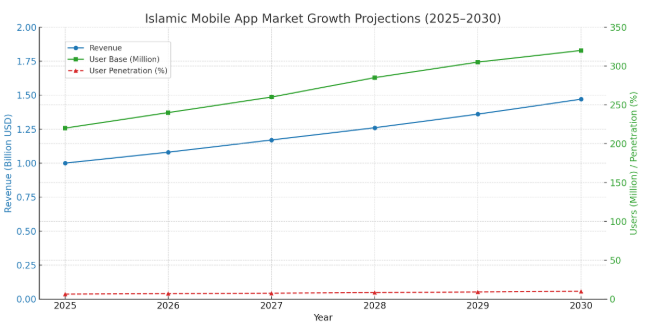
- The active global user base for Islamic utility and Azan apps is expected to reach over 320 million users by 2030, with major traffic spikes observed during Ramadan, Eid al-Fitr, and Hajj season.
- User penetration is estimated to hit 3% of total global smartphone users in 2025, increasing to nearly 10% by 2030, with the highest uptake in digital-savvy Muslim-majority countries.
What is Prayer Now?
Prayer Now is a complete Islamic mobile app meant to help Muslims with their everyday religious routines. It uses GPS or offline data to deliver correct prayer timings and Athan alerts, as well as support for different calculating techniques, including the Hanafi approach for Asr prayers.
Apps like Al Quran and Prayer Now include a Qur’an reader with audio recitations, Qibla directions, daily Azkar, mosque location, Ramadan tools, Islamic wallpapers, greeting cards, and an Islamic library.
Prayer Now: A Success Story
- Prayer Now launched in 2015 to provide accurate prayer times and Islamic resources accessible worldwide on smartphones.
- The app quickly gained popularity due to its reliable Athan notifications and user-friendly interface, attracting millions of users globally.
- By 2018, Prayer Now had surpassed 10 million downloads, becoming one of the most trusted Islamic apps available.
- The development team raised funds through community support and donations to continuously improve features and expand content offerings.
- Strategic partnerships with mosques and Islamic organizations helped Prayer Now reach broader audiences and enhance credibility.
- The app’s offline mode and multi-method prayer time calculations made it ideal for diverse Muslim communities worldwide.
Various Types of Islamic Applications
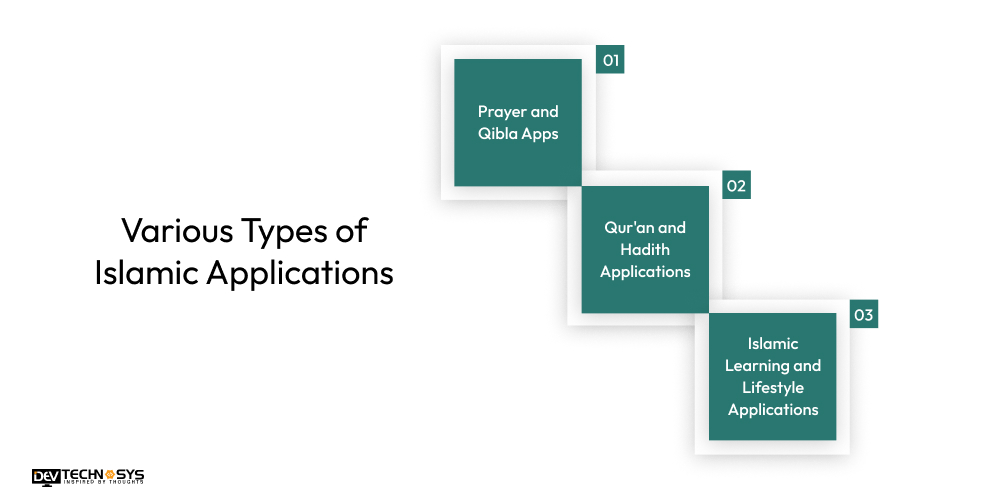
Islamic apps range from prayer time reminders, Quran readers, and Qibla finders to learning tools, charity platforms, Ramadan trackers, Hadith collections, and community social networks, enhancing daily Muslim life.
1. Prayer and Qibla Apps
These applications use GPS to deliver exact prayer timings, Athan notifications, and Qibla direction. They assist Muslims in praying on time and facing the right direction, frequently with configurable calculating algorithms and offline access to ensure dependability even when there is no internet connection.
2. Qur’an and Hadith Applications
These Islamic on-demand app development solutions promote spiritual growth by providing the whole Qur’an, translations, tafsir, and audio recitations. Hadith apps include compilations from genuine sources together with search options, allowing users to study and understand Islamic teachings at any time and from any location. They frequently include bookmarking and note-taking features.
3. Islamic Learning and Lifestyle Applications
These applications provide education through courses, quizzes, and Islamic material such as daily duas and Azkar. They frequently incorporate Ramadan calendars, charity giving platforms, and community forums, resulting in a comprehensive ecosystem that enables Muslims to interact, study, and practice their faith in everyday life..
10 Popular Islamic Apps Like Prayer Now
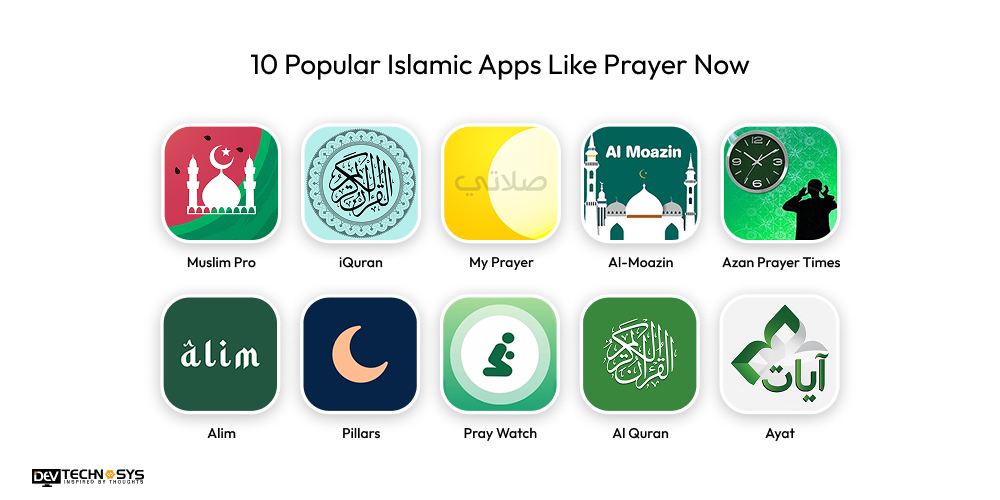
Popular Islamic apps like Prayer Now include Muslim Pro, iQuran, My Prayer, and Al-Moazin, offering prayer times, Qur’an recitations, Qibla direction, and Islamic learning tools worldwide.
App Name |
Downloads |
Ratings |
Launched |
Platforms |
| Muslim Pro | 100M+ | 4.7/5 | 2010 | iOS, Android |
| iQuran | 10M+ | 4.6/5 | 2010 | iOS, Android |
| My Prayer | 50M+ | 4.5/5 | 2013 | iOS, Android |
| Al-Moazin | 50M+ | 4.5/5 | 2013 | iOS, Android |
| Azan Prayer Times | 50M+ | 4.5/5 | 2013 | iOS, Android |
| Alim | 10M+ | 4.6/5 | 2010 | iOS, Android |
| Pillars | 1M+ | 4.8/5 | 2023 | iOS, watchOS, iPadOS, macOS |
| Pray Watch | 1M+ | 4.7/5 | 2023 | iOS, watchOS |
| Al Quran | 10M+ | 4.6/5 | 2010 | iOS, Android |
| Ayat | 10M+ | 4.7/5 | 2010 | iOS, Android |
Why Entrepreneurs Want to Invest in an Islamic App Development?
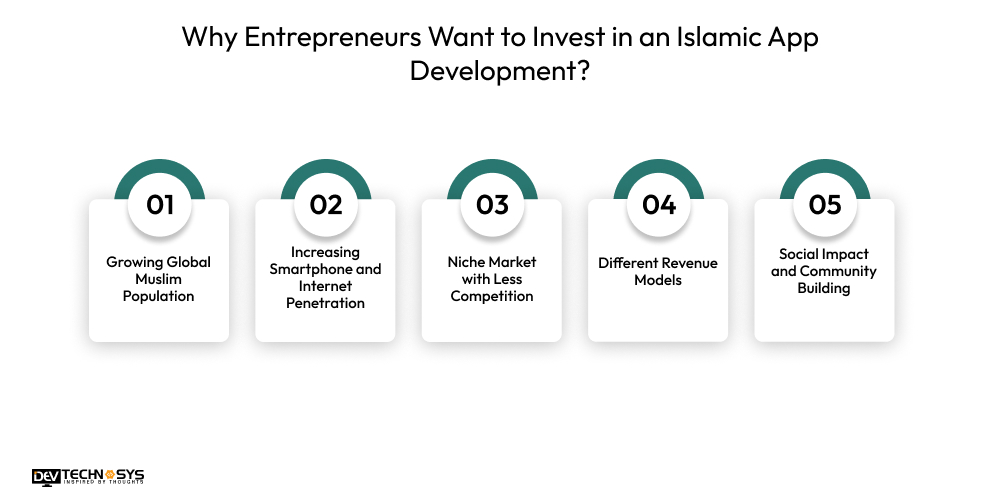
Islamic charity platform development presents a unique blend of economic opportunity, market growth, and social impact, making it an attractive investment area for forward-thinking entrepreneurs worldwide.
1. Growing Global Muslim Population
With approximately 1.9 billion Muslims worldwide, the Muslim community is one of the fastest-growing groups. This growing audience generates a significant market demand for digital Islamic solutions such as prayer time applications, Quran readers, and instructional websites. Entrepreneurs perceive a good opportunity to service this vast and active population.
2. Increasing Smartphone and Internet Penetration
Smartphone penetration and internet availability have increased dramatically in Muslim-majority nations and expatriate groups. As more people utilize mobile technology, there is a growing desire for applications that allow them to practice their faith effortlessly, at any time and from any location.
Arabic parenting guide app development caters to a tech-savvy demographic seeking accessible religious material.
3. Niche Market with Less Competition
Compared to conventional app marketplaces, the Islamic app business is still relatively small but fast increasing. Entrepreneurs see the opportunity to build strong brands and loyal user communities by providing high-quality, culturally appropriate Islamic apps. This unique positioning enables distinct goods and specialized services.
4. Different Revenue Models
Islamic applications include a variety of income options, including freemium models, in-app purchases (such as premium content or ad-free experiences), contributions, collaborations with Islamic organizations, and targeted advertising. This diversity enables businesses to generate long-term profitability while offering meaningful religious services.
5. Social Impact and Community Building
Beyond profit, many entrepreneurs are driven by the opportunity to positively benefit the Muslim community. Islamic applications encourage spiritual development, education, and interaction among users globally. Investing in these applications enables entrepreneurs to balance corporate objectives with important social contributions, therefore improving their brand reputation and customer loyalty.
The Role of AI in Islamic Applications
- AI personalizes prayer time notifications based on user location, habits, and preferred calculation methods for higher accuracy.
- AI enables intelligent Qur’an search and recommendation features, improving access to relevant verses and interpretations.
- AI powers voice recognition for reciting Qur’an or duas, enhancing pronunciation feedback and learning.
- AI assists in real-time Q&A about Islamic topics using verified databases and scholarly sources.
- AI enhances Islamic chatbots for education, offering instant guidance on rituals, ethics, and daily spiritual practices.
7 Basic Steps to Develop an Islamic App Like Prayer Now
Developing an Islamic app like Prayer Now involves market research, authentic religious content, user-friendly design, accurate prayer tools, and cross-platform development. It offers spiritual value, global reach, and a strong opportunity to serve the growing Muslim digital audience.
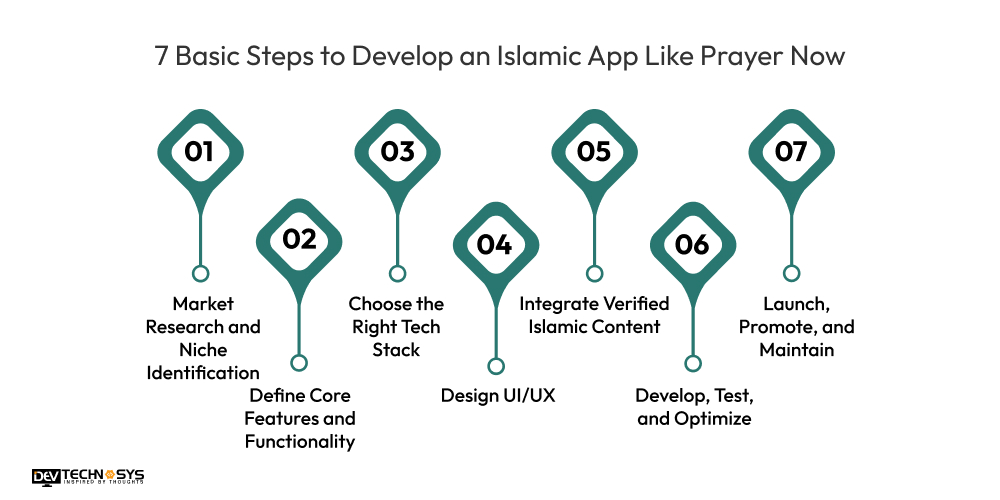
1. Market Research and Niche Identification
Moving to the first stage to build an App Like Prayer Now, begin with a thorough market analysis to determine user wants, competitors, and feature gaps. Hire dedicated developers in UAE to concentrate on specialized niches, such as prayer times, the Qur’an, or Islamic education.
Understanding cultural sensitivities and religious requirements ensures that your software connects with its intended audience and offers really helpful, Sharia-compliant features.
2. Define Core Features and Functionality
In the second stage, to develop an app like Prayer Now, include key features like exact prayer timings, Qibla direction, Athan alerts, Qur’an access, Azkar, and an Islamic calendar. Include GPS-enabled computations and offline access. Prioritize simplicity, usability, and multilingual support to appeal to varied user groups across geographies and sectors, hence increasing your app’s value and worldwide accessibility.
3. Choose the Right Tech Stack
Choose the proper iOS and Android development technologies, such as Flutter or React Native, for cross-platform compatibility. Hire mobile app developer in Dubai to use APIs to calculate prayer times, map integrations for Qibla and mosque location, and cloud storage for audio and Quran data. Scalability and security must be considered from the beginning.
4. Design UI/UX
In the fourth stage, to develop an Islamic app like Prayer Now, create a simple, beautiful, and user-friendly UI/UX that respects Islamic aesthetics. Ensure that all functions are easily accessible and do not cause confusion. Maintain a spiritual ambiance by using peaceful hues, legible typefaces, and culturally acceptable imagery. This improves the overall user experience and encourages daily participation.
5. Integrate Verified Islamic Content
Collaborate with academics or Islamic groups to provide accurate Qur’an translations, Hadith, Azkar, and prayer timings. Hire experienced developers from an educational app development company to maintain credibility and religious correctness by ensuring all information follows established Islamic views. This increases confidence and lowers the chance of religious misrepresentation.
6. Develop, Test, and Optimize
Create the application utilizing agile development. Ensure that bugs, prayer time accuracy, and GPS features are thoroughly tested across all devices. Gather input by doing beta testing with genuine users from various areas. Continuously improve performance, UI, and content depending on user experience and religious accuracy.
7. Launch, Promote, and Maintain
In the last stage to create an App Like Prayer Now, after releasing in app stores, promote via Islamic influencers, communities, and SEO/ASO methods. To monetize responsibly, use freemium models or accept donations.
Hire hybrid app development company to collect user feedback, issue frequent updates with new features such as Ramadan tools and Khatma sharing, and maintain the app consistently to guarantee long-term success and relevance.
What Benefits Do Islamic Applications Provide Users?
Islamic applications offer users convenient access to prayer times, Qur’an, Hadith, and religious tools, supporting spiritual growth, daily worship, community engagement, and personalized Islamic practice anytime, anywhere on mobile devices.
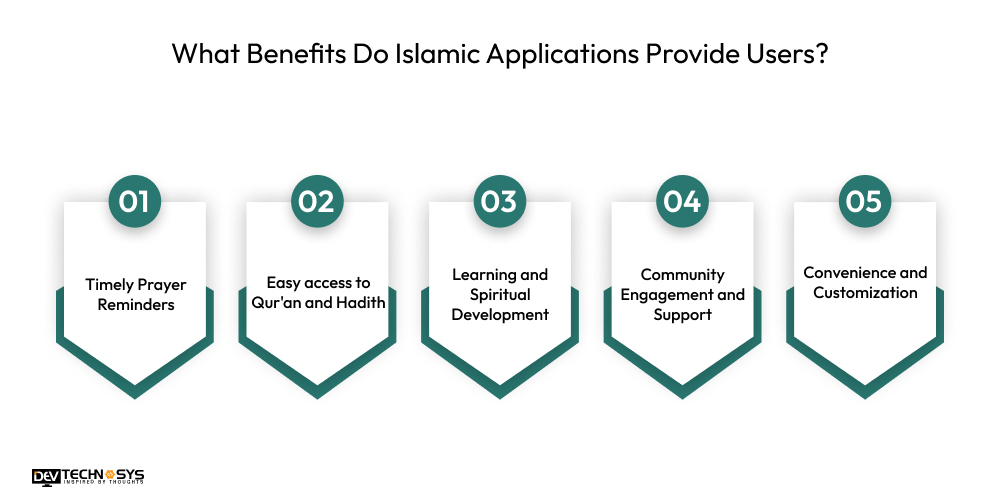
1. Timely Prayer Reminders
Islamic apps provide precise prayer times and Athan alerts based on location, allowing users to complete daily salah on time. This promotes regular spiritual discipline and a greater connection to Allah throughout the day.
2. Easy access to Qur’an and Hadith
Users can read or listen to the Qur’an and Hadith at any time and from any location. With translations and tafsir incorporated, it makes learning, reflection, and memorizing easier, especially for individuals who do not have tangible Islamic resources.
3. Learning and Spiritual Development
Islamic apps offer daily duas, Azkar, teachings, and quizzes, allowing users to learn and practice Islam in an interactive environment. These elements promote continual learning and self-improvement in a modern, mobile-friendly manner.

4. Community Engagement and Support
Some apps offer forums, shared khatma features, and local mosque locators, which let users connect with other Muslims. This fosters a sense of connection and encourages collective worship and religious participation, particularly during Ramadan and Hajj.
5. Convenience and Customization
Users can tailor their Islamic routines by using tools such as Qibla direction, Islamic calendars, halal finders, and fasting clocks. These resources make it easier to follow Islam continuously in today’s fast-paced, globalized environment.
10 Must-Have Features of Islamic Apps Like Prayer Now
Islamic apps like Prayer Now play a vital role in helping Muslims maintain their daily religious obligations and spiritual connection. To truly serve their purpose and appeal to a wide audience, such apps must include the following 10 essential features:
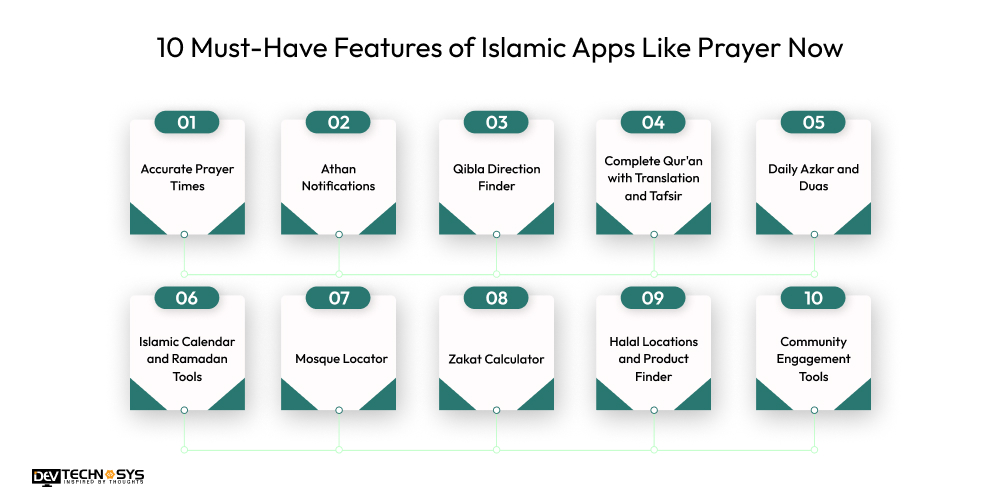
1. Accurate Prayer Times
GPS-based prayer time calculations, including various calculation methods (e.g., Muslim World League, Umm al-Qura), with customizable alerts for each salah.
2. Athan Notifications
High-quality Athan audio reminders for each prayer, with various muezzin settings and silent mode controls for meetings and at night.
3. Qibla Direction Finder
A accurate compass tool for locating the Qibla from any location, with map integration and AR (augmented reality) compatibility for increased precision.
4. Complete Qur’an with Translation and Tafsir
Access the complete Qur’an in Arabic, including numerous translations, tafsir (interpretation), bookmarking, and audio recitations by various qaris.
5. Daily Azkar and Duas
Morning, evening, and situational duas (e.g., travel, sleep, anxiety), with counter features to tally repetitions and promote consistency.
6. Islamic Calendar and Ramadan Tools
The Hijri calendar includes fasting regimens, Ramadan countdowns, iftar/suhoor times, and special prayers or reminders for each day of the holy month.
7. Mosque Locator
Apps like Muslim Pro enable users to locate nearby mosques using GPS, providing information on prayer schedules, distance, directions, and reviews.
8. Zakat Calculator
Integrated calculator to assist users in precisely calculating and fulfilling their zakat duties based on current nisab thresholds.
9. Halal Locations and Product Finder
This feature allows you to find halal restaurants and markets, as well as scan products for certification.
10. Community Engagement Tools
Group khatma sharing, Islamic events, digital greeting cards, and forums for connecting with others and discussing spiritual aspirations.
What is the Cost to Develop an Islamic App Like Prayer Now?
The cost to develop an Islamic app like Prayer Now typically ranges from $8,000 to $25,000, depending on features, design complexity, and platform (iOS, Android, or both). A basic version with prayer times, Athan, and Qibla direction may cost around $10,000–$15,000.
A feature-rich version with Qur’an audio, Azkar, mosque locator, Islamic calendar, and community tools can cost $15,000–$25,000. Ongoing costs like maintenance, content updates, server hosting, and marketing also add to the budget. Choosing the right development team and tech stack greatly influences final costs.
Feature/Service |
Estimated Cost (USD) |
| UI/UX Design | $2,000 – $5,000 |
| Prayer Time & Qibla Functionality | $3,000 – $6,000 |
| Athan Notifications | $1,000 – $2,500 |
| Qur’an with Audio & Translations | $4,000 – $7,000 |
| Azkar & Daily Duas | $1,500 – $3,000 |
| Islamic Calendar & Ramadan Tools | $2,000 – $4,000 |
| Mosque Locator with Maps | $2,000 – $3,500 |
| Admin Panel & Backend | $3,000 – $6,000 |
| iOS & Android Development | $5,000 – $10,000+ |
| Testing & QA | $1,000 – $2,500 |
Total Estimated Cost: $8,000 – $25,000+
5 Major Factors That Affect the Islamic App Development Cost
The Islamic app development cost is influenced by a number of important elements, including the platform selection, backend infrastructure, developer location, app complexity, and design quality. Strategic planning is crucial for a successful and economical app launch because every component affects the total budget, schedule, and scalability.
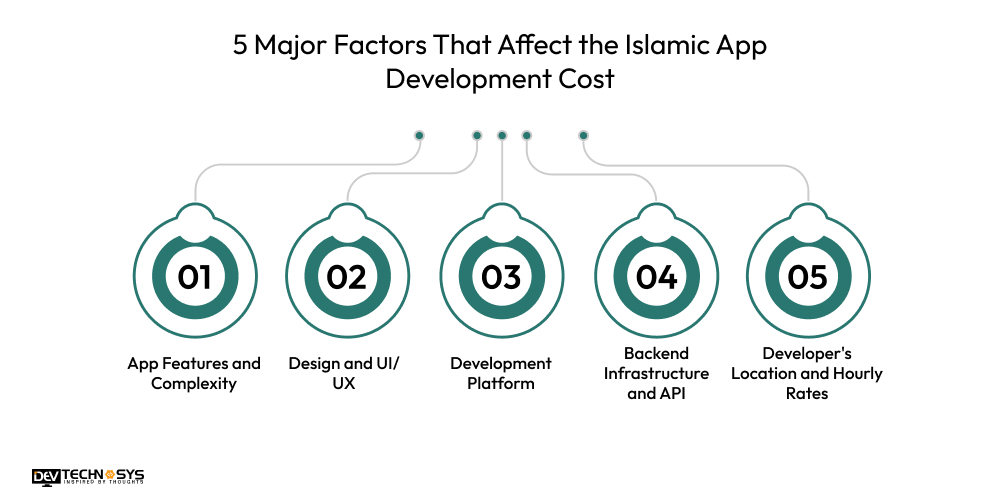
1. App Features and Complexity
The more features you include, such as prayer timings, Quran recitation, Qibla finder, and community tools, the greater the Islamic app development cost. Complex functionalities, such as GPS integration or real-time notifications, necessitate additional coding and testing, hence raising the cost of Android and iOS app development services.
Feature Type |
Impact on Cost |
Explanation |
| Basic (Prayer times, Qibla) | Low to Medium | Simple features with minimal backend requirements. |
| Medium (Qur’an audio, Azkar) | Medium to High | Requires audio, text, and multiple data sources. |
| Advanced (Community tools, Real-time updates) | High to Very High | Complex coding, real-time data, and interactions. |
2. Design and UI/UX
Islamic apps require a UI/UX design that is clear, intuitive, and culturally appropriate. Customized graphics, multilingual interfaces, and responsive layouts across devices increase design costs. Investing in a good user experience frequently necessitates hiring professional designers, which can dramatically increase the overall cost to develop an app like Prayer Now.
Design Aspect |
Impact on Cost |
Explanation |
| Simple UI | Low | Basic layouts and standard elements. |
| Customized UI/UX | Medium | Tailored graphics, fonts, and user flows. |
| Multilingual & Responsive | High | Supports multiple languages and devices smoothly. |
3. Development Platform
Developing for a single platform is less expensive than building for both iOS and Android. Cross-platform development frameworks, such as Flutter, can cut expenses; nevertheless, choosing native development for each platform roughly doubles the cost due to separate coding and optimization.
Platform |
Impact on Cost |
Explanation |
| Single Platform (iOS or Android) | Medium | Development focused on one operating system. |
| Cross-Platform (Flutter, React Native) | Medium to High | Single codebase for both but with some limitations. |
| Native Dual Platform | High | Separate development for iOS and Android. |
4. Backend Infrastructure and API
Features such as Quran audio, real-time prayer time calculation, and mosque locators rely on a strong backend and third-party APIs. These services frequently necessitate integration time and may include licensing or subscription fees, which significantly impact long-term development and maintenance expenditures.
Backend Component |
Impact on Cost |
Explanation |
| Simple Backend | Low | Minimal server-side logic and data storage. |
| Integration of APIs | Medium | Prayer times, Qibla, mosque locators require APIs. |
| Scalable Cloud Backend | High | Handles large user base and real-time features. |
5. Developer’s Location and Hourly Rates
Prayer Now app development in Middle East expenses vary widely among regions. Hiring developers in North America or Western Europe from a mobile app development company costs more than working with teams in South Asia or Eastern Europe. Hourly rates, team size, and experience all have a direct impact on your cost to develop an Islamic app like Prayer Now.
Region |
Hourly Rate (Approx.) |
Impact on Cost |
| North America / Western Europe | $30 – $50+ | Highest development costs, premium quality. |
| Eastern Europe | $27 – $40 | Moderate costs, skilled developers. |
| South Asia / Southeast Asia | $15 – $25 | Lowest costs, growing tech talent pool. |
5 Monetization Techniques of Islamic Apps Like Prayer Now
Islamic apps like Prayer Now not only serve spiritual needs but can also generate revenue through various ethical monetization strategies. Here are five effective techniques:
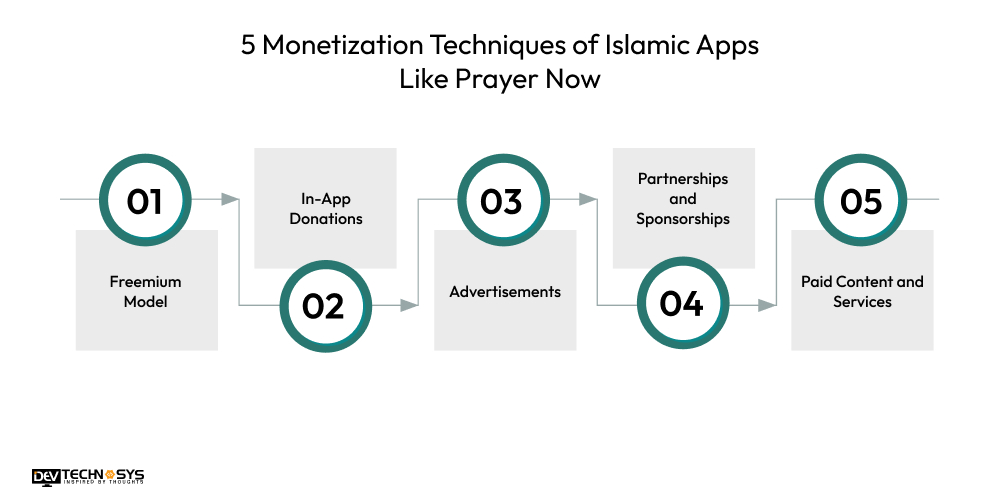
1. Freemium Model
Many Islamic apps include a free basic version that includes important functions such as prayer timings and Qibla orientation. Users can upgrade to the premium edition for advanced features including ad-free browsing, offline access, unique Qur’an recitations, and more instructional content. This model balances accessibility and revenue creation.
2. In-App Donations
Because charitable giving is an important element of Islam, applications frequently include secure donation mechanisms that allow users to contribute zakat or sadaqah directly from the app. This provides a meaningful opportunity for users to contribute while also supporting the app’s continuing development and maintenance, aligning monetization with Islamic principles.
3. Advertisements
Islamic apps may include non-intrusive, relevant advertisements from halal companies and services, such as halal food vendors, Islamic bookstores, or travel agencies. According to the mobile app development firm in UAE, carefully controlled advertising ensures that the user experience is not disrupted while earning consistent revenue.
4. Partnerships and Sponsorships
Collaboration with Islamic organizations, mosques, or companies might result in sponsorship opportunities or co-branded features. Ramadan campaign sponsorships, for example, or partner-funded exclusive content, can provide both legitimacy and financial support to consumers and developers.
5. Paid Content and Services
Offering premium courses, thorough tafsir, private lectures, and personalized coaching via the app generates additional revenue streams. These paid services attract consumers wanting greater knowledge or personalized spiritual counsel, adding value to free offerings.

How Dev Technosys Will Help You to Develop an Islamic App Like Prayer Now?
Developing feature-rich, intuitive Islamic applications like Prayer Now is the specialty of Dev Technosys, a top Islamic app development company. They provide precise prayer time calculations, smooth Qibla direction, genuine Qur’anic integration, and captivating community features thanks to their proficiency with cutting-edge technologies.
Cross-platform compatibility, a strong backend infrastructure, and culturally sensitive design are all guaranteed by their committed staff. Dev Technosys offers end-to-end solutions, from conception to launch and upkeep, assisting you in creating a dependable, scalable Islamic application that successfully and economically satisfies the spiritual needs of customers everywhere.
Frequently Asked Questions
1. How Much Does It Cost To Build an Islamic App Like Prayer Now?
The cost to build an Islamic app like Prayer Now lies between $8,000 and $25,000, depending on features, design complexity, platform choice, and developer expertise.
2. How Long Does it Take to Create an Islamic App Like Prayer Now?
To create an Islamic app like Prayer Now usually takes 3 to 6 months, depending on complexity, features, design, and development team efficiency.
3. Is GPS Required For Qibla Direction And Mosque Locator Features?
Yes, GPS is essential for Qibla direction and mosque locator features, as it accurately determines the user’s location, enabling precise compass orientation and nearby mosque searches for effective and reliable guidance.
4. How Do I Maintain And Update The App Post-Launch?
Maintain your app post-launch by regularly releasing updates, monitoring user feedback, fixing bugs promptly, updating Islamic content with scholarly input, and ensuring compatibility with new devices and OS versions for smooth performance.
5. What Is The Best Technology Stack to Make an Islamic App Like Prayer Now?
Several tech stacks are best suited to make an Islamic app like Prayer Now; here is the list:
- Python
- Java
- C++
- PHP
- Flutter
- Swift