



 Tarun Nagar
 Key Takeaways:
-
- To build an app like Realtor.com, a robust property listing system, MLS integration, secure data management, and scalable cloud infrastructure are required.
- Core features include advanced property search filters, real-time listing updates, virtual tours, mortgage calculators, agent contact options, and multi-platform support.
- The cost to develop an app like Realtor.com typically ranges from $8,000 to $30,000, depending on complexity, integrations, and backend infrastructure.
- Startups can compete by focusing on hyper-local listings, AI-driven recommendations, faster search results, and personalized property alerts.
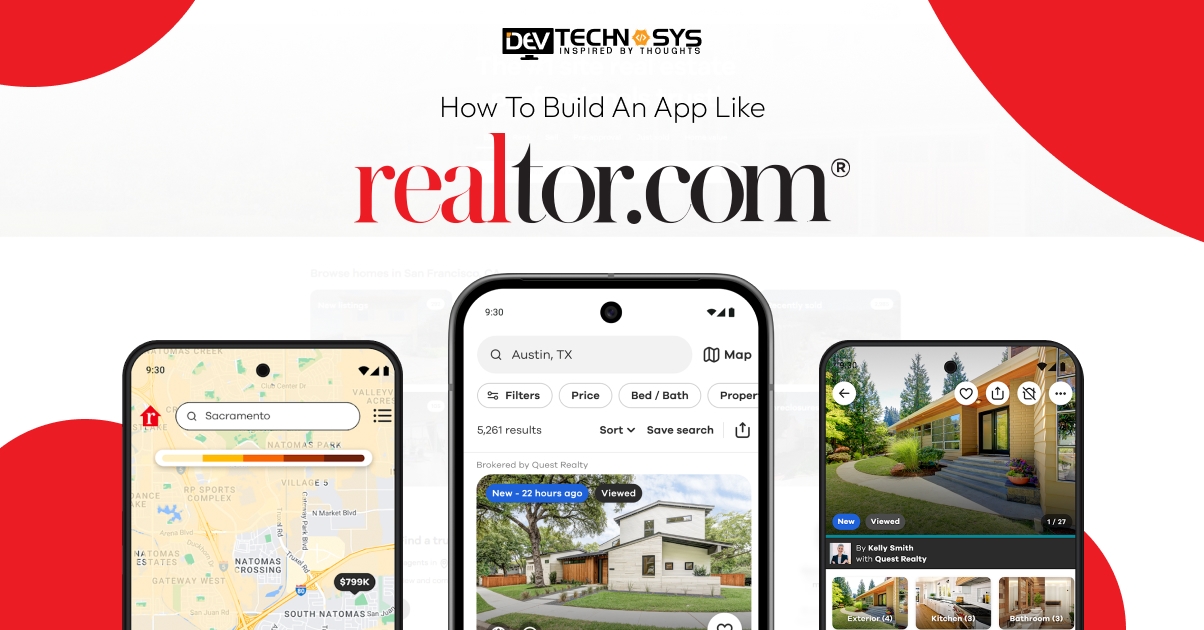
With just a few taps, users browse property listings, filter homes by preferences, view images and virtual tours, connect with agents, and calculate mortgage payments. Behind the scenes, a similar app like Realtor.com operates on MLS integrations, property databases, mapping APIs, analytics engines, and secure backend servers.
As global demand for digital property discovery increases, entrepreneurs are actively exploring opportunities to build an app like Realtor.com. However, developing a real estate marketplace platform requires more than cloning a UI; it demands data accuracy, performance reliability, compliance, and user trust.
This guide covers everything you need to know to create an app like Realtor.com, from understanding the platform, core features, development steps, costs, and monetization strategies.
What is the Realtor.com App?
The real estate app development solution, like Realtor.com, is a digital marketplace. It allows users to buy, sell, rent, and explore properties via mobile and web platforms. The app aggregates property listings from MLS databases and provides detailed home information, pricing insights, and neighborhood data.
Launched in 1996 and later evolving into a mobile-first platform, Realtor.com supports real-time listing updates, interactive maps, property valuation tools, mortgage calculators, and agent connectivity. The platform ensures transparency, accurate property data, and convenient home search experiences.
Key Features Offered by Realtor.com:
- Real-time property search and filtering
- Interactive map-based browsing
- Mortgage calculator and affordability tools
- Agent contact and scheduling options
- Saved searches and property alerts
- Multi-platform availability (iOS, Android, Web)
- Virtual tours and high-resolution property media
Industry Insight: According to Statista, the global online real estate market continues to expand as property buyers increasingly prefer digital-first home searches.
How Does a Realtor. Com App Work?
A Realtor. com-like real estate app combines MLS data integration, advanced filtering systems, property analytics, and secure communication tools to provide seamless home-buying experiences. Understanding this workflow is essential when you develop a property listing app like Bayut.
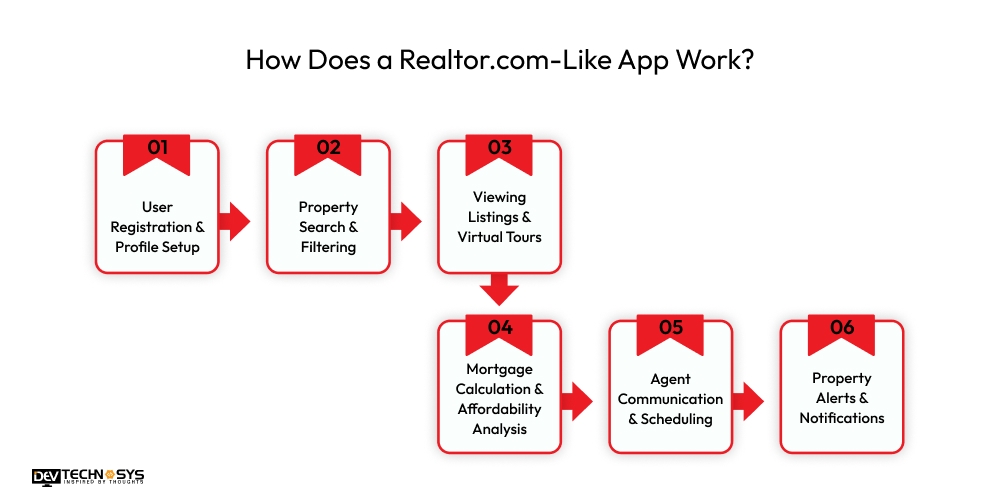
Step 1: User Registration & Profile Setup
Users create accounts using email, mobile number, or social login. Profiles allow them to save searches, bookmark listings, set budget preferences, and receive personalized property alerts. Authentication ensures secure user access and data privacy.
Step 2: Property Search & Filtering
Users enter location preferences, budget range, property type, bedrooms, amenities, and other filters. The system retrieves matching properties from integrated MLS databases in real time. Smart algorithms personalize results based on browsing behavior and saved searches.
Step 3: Viewing Listings & Virtual Tours
Each listing displays high-resolution images, pricing history, property details, neighborhood insights, and agent contact information. Users can explore 3D tours or video walkthroughs for immersive property viewing experiences.
Step 4: Mortgage Calculation & Affordability Analysis
The app provides integrated mortgage calculators to estimate monthly payments based on down payment, loan term, and interest rates. Affordability tools help buyers understand financial commitments before contacting agents.
Step 5: Agent Communication & Scheduling
Users can contact listing agents directly via call, chat, or appointment scheduling tools. Secure in-app messaging ensures smooth communication between buyers and agents.
Step 6: Property Alerts & Notifications
Users receive instant notifications when new properties match their criteria, when prices change, or when listings are updated. This improves engagement and increases platform retention rates.
Market Outlook: Real Estate App Industry
The demand for real estate mobile app development solutions, like Realtor.com alternatives, continues to grow. It is due to the digital transformation in property buying and renting requirements. Have a look at the market predictions analyzed by Research Market Future.
- The real estate software market was valued at USD 7.879 billion in 2024.
- Market size is expected to grow to USD 8.675 billion in 2025.
- By 2035, the industry is projected to reach USD 22.71 billion globally.
- The market is forecasted to grow at a 1% CAGR from 2025 to 2035.
- Artificial Intelligence is transforming property management and enhancing user experiences across North America.
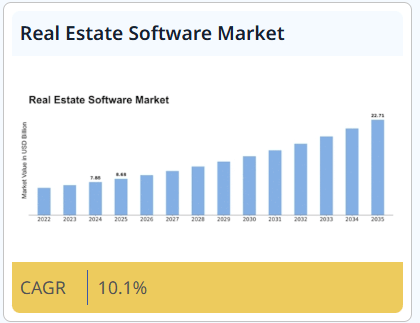
These numbers highlight strong investment potential for scalable property listing and marketplace platforms.
From Idea to Launch: How to Develop an App Like Realtor.com?
Developing a Realtor.com clone app requires strategic planning, regulatory understanding, scalable architecture, and strong performance optimization. Below is an extended explanation of each development step, with deeper insights into the process a mobile app development company follows.
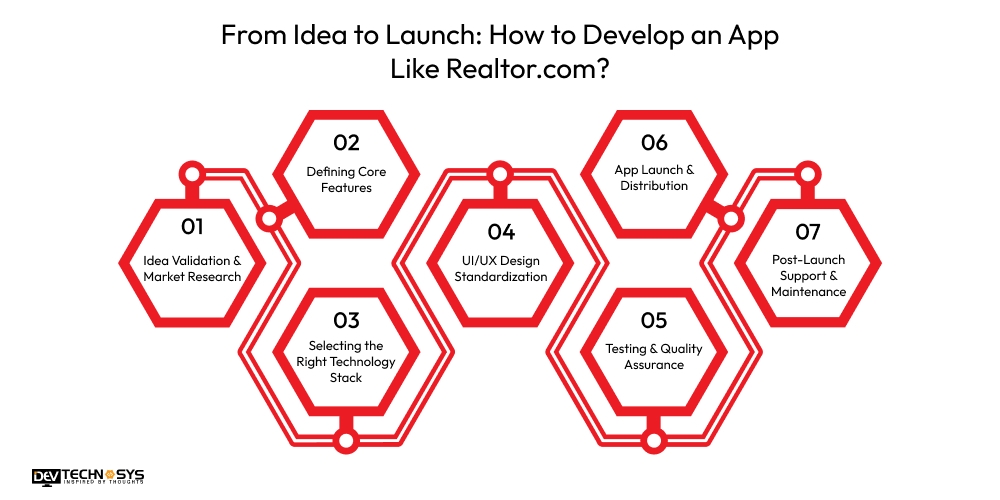
1. Idea Validation & Market Research
Before starting Realtor.com app development, conduct deep research on local real estate laws, MLS data accessibility rules, licensing requirements, and compliance obligations. Study competitors like Zillow and Redfin to understand feature gaps, pricing models, user behavior patterns, and regional property demand variations. Engage potential buyers, sellers, and agents through surveys and interviews to validate pain points, trust factors, and preferred property search experiences.
2. Defining Core Features
Start by identifying essential features such as property listing management, advanced filtering, interactive maps, agent communication, and alert systems. Ensure your MVP focuses on smooth browsing, fast search results, and clear property information presentation for strong early adoption. Advanced features like AI-powered recommendations and predictive pricing insights can be added post-launch based on user engagement analytics.
3. Selecting the Right Technology Stack
Choose backend technologies capable of handling large property datasets, real-time listing updates, and simultaneous user search requests efficiently. Cloud platforms such as AWS or Google Cloud support scalability, ensuring performance remains stable during high traffic periods. Mapping APIs enable interactive location-based browsing and neighborhood insights. While secure databases protect sensitive user and property information.
4. UI/UX Design Standardization
Design a clean, map-focused interface prioritizing ease of navigation, clear filters, intuitive search bars, and responsive property cards. Use high-quality images and structured layouts for property previews,
ensuring users quickly access relevant information without confusion. Maintain consistent design patterns across Android, iOS, and web platforms to create a unified and seamless brand experience everywhere.
5. App Development
- Frontend Development: Build responsive interfaces for buyers, sellers, and real estate agents, ensuring smooth performance across devices and screen sizes.
- Backend Development: Develop secure property databases, MLS synchronization engines, search indexing systems, and recommendation algorithms for personalization.
- Integration Layer: Integrate mortgage calculators, CRM tools, messaging systems, push notifications, and analytics dashboards for operational insights.
Use modular architecture for flexible updates and feature expansions, allowing entry into rental, luxury, or commercial segments later.
6. Testing & Quality Assurance
Verify MLS synchronization to ensure listings update accurately, without delays, duplication errors, or outdated property information. Test secure login systems and encrypted data handling processes to maintain user privacy and protect financial details. Conduct performance testing under heavy traffic simulations, ensuring fast search results during peak user activity.
7. App Launch & Distribution
Publish the app on Google Play and Apple App Store, ensuring metadata optimization with relevant real estate keywords. Implement App Store Optimization strategies to improve discoverability and encourage positive reviews from early adopters. Launch targeted digital marketing campaigns across social platforms, focusing on local buyers, investors, and real estate agencies.
8. Post-Launch Support & Maintenance
Monitor listing accuracy, server uptime, and user session analytics regularly to maintain seamless performance and prevent downtime issues. Release updates to enhance security patches and UI improvements, ensuring compatibility with evolving operating systems. Analyze feature usage patterns and conversion funnels deeply to introduce improvements that drive higher user retention.
Which Core Features Are Required to Build an App Like Realtor.com?
For real estate app development, a hybrid app development company requires a powerful combination of advanced features. It includes property search capabilities, real-time data synchronization, secure communication tools, and intelligent analytics features. They collectively ensure seamless property discovery, enhanced user engagement, and long-term platform scalability.
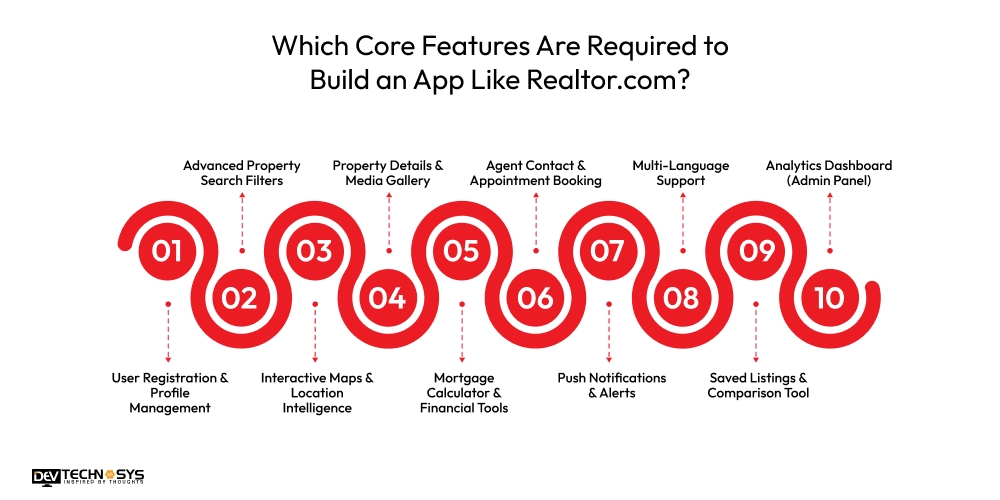
1. User Registration & Profile Management
Secure onboarding verifies user identity through email or mobile authentication, allowing safe account creation and personalized experience settings. Users can save searches, bookmark listings, and receive tailored alerts, enhancing engagement and repeated platform visits over time.
2. Advanced Property Search Filters
Enable filtering by budget, property size, amenities, location radius, construction status, and neighborhood preferences easily. Smart filtering improves property discovery efficiency, helping users quickly narrow options aligned with their goals.
3. Interactive Maps & Location Intelligence
Provide map-based browsing with dynamic property pins, allowing visual exploration of neighborhoods and pricing clusters. Display nearby schools, hospitals, public transport, and markets to support informed real estate decisions confidently.
4. Property Details & Media Gallery
Each listing should include detailed descriptions and floor plans, pricing trends, tax information, and historical sales records. High-resolution images and 3D virtual tours enhance engagement, reducing uncertainty and increasing buyer confidence remotely.
5. Mortgage Calculator & Financial Tools
Integrated calculators estimate monthly payments and interest rates, based on down payment and loan duration inputs. Affordability insights empower users to plan finances effectively, before contacting agents or scheduling visits.

6. Agent Contact & Appointment Booking
Allow direct messaging, phone call integration, and calendar scheduling to streamline communication between buyers and agents. Quick responses improve conversion rates significantly and reduce friction in the inquiry process.
7. Push Notifications & Alerts
Notify users instantly about price drops and new listings, matching their saved search preferences automatically. Real-time alerts increase urgency and engagement, encouraging faster property decision-making.
8. Multi-Language Support
Support multiple regional languages for broader audience accessibility, ensuring inclusivity across diverse demographic segments. Localized content increases user comfort and trust, driving higher engagement across international markets.
9. Saved Listings & Comparison Tool
Allow users to compare multiple properties side by side, based on price, area, amenities, and location insights. Comparison features accelerate decision-making processes and reduce research time significantly.
10. Analytics Dashboard (Admin Panel)
Many real estate mobile app development solutions provide administrators with data insights. These include information on listing performance, user engagement metrics, and lead conversion analytics. Advanced dashboards help optimize marketing strategies and improve operational efficiency.
Why Do Entrepreneurs Want to Create an App Like Realtor.com?
Entrepreneurs want to make an app like Realtor.com because of the growing demand for digital property search. It also includes scalable technology infrastructure, multiple revenue streams, and data-driven decision-making. It presents a highly profitable and sustainable opportunity in the rapidly expanding real estate market.
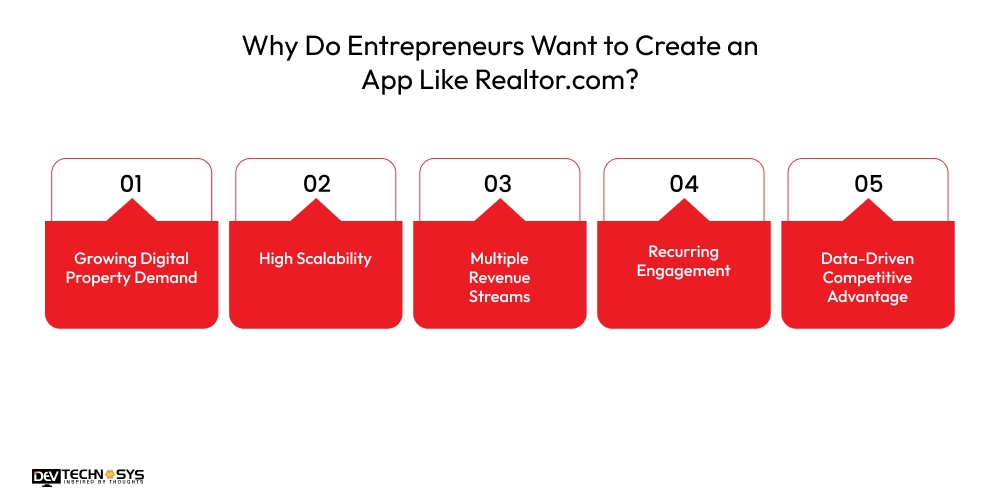
1. Growing Digital Property Demand
More than 90% of buyers begin home searches online, making digital platforms essential for real estate businesses. Convenience, transparency, and instant access drive adoption, accelerating digital transformation within property markets. Mobile-first platforms further increase accessibility for remote buyers and international property investors.
2. High Scalability
Cloud infrastructure supports expansion into new cities without heavy investment in physical operations are preferred for real estate app development services. Scalable systems handle increasing property listings and simultaneous user traffic efficiently. Multi-region deployment enables seamless growth without disrupting core platform performance stability.
3. Multiple Revenue Streams
Revenue can be generated through subscriptions and featured listings, along with advertising partnerships and qualified lead sales. Diversified income models reduce business risks, ensuring sustainable financial growth. Premium analytics services also attract institutional investors and large real estate agencies.
4. Recurring Engagement
Saved searches and automated alerts bring users back regularly, boosting retention and lifetime customer value. Frequent engagement increases lead conversion probability and strengthens brand loyalty significantly. Personalized notifications improve user stickiness and drive consistent app re-engagement.
5. Data-Driven Competitive Advantage
User behavior analytics refine recommendations and search accuracy, enhancing personalization across the platform. Data insights also support targeted marketing campaigns, improving ROI and operational decisions. Predictive analytics enables smarter property pricing and market demand forecasting.
How Much Does It Cost to Build an App Like Realtor.com?
The cost to develop a real estate app in UAE typically ranges between $8,000 and $30,000. It depends on feature complexity, platform choice, and development scale.
- Basic versions include essential features like property listing, search filters, user registration, and contact forms, which fall on the lower end of the budget.
- Mid-level apps add advanced functionalities like map-based search, saved favorites, push notifications, mortgage calculators, and user reviews, requiring higher investment.
- Enterprise-grade apps with scalable cloud infrastructure, multi-agent support, CRM integration, AI-based property recommendations, and advanced analytics reach the upper cost range.
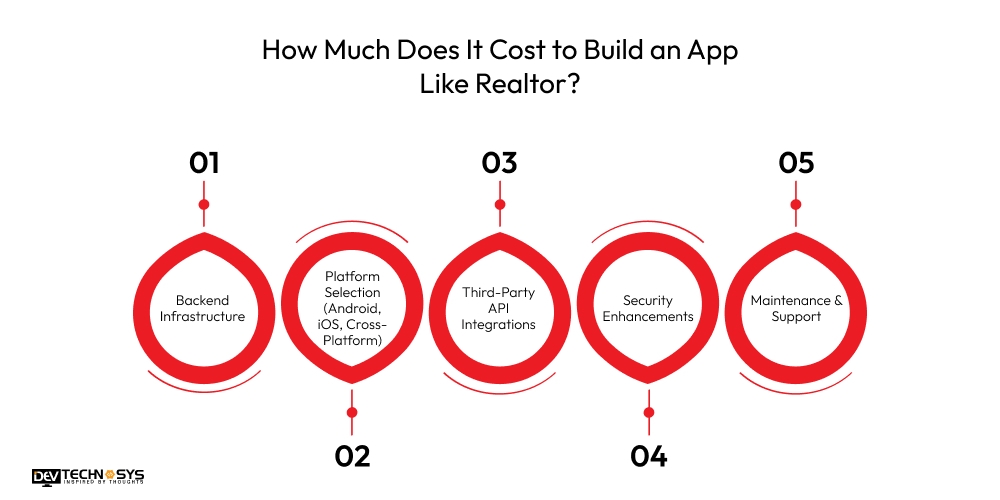
Additional factors influencing the cost to maintain an app include platform selection, design complexity, third-party integrations, backend infrastructure, and post-launch maintenance.
Complexity Level | Development Effort | Time Required | Cost Range |
| Low | Basic property listing & search | 2–3 months | $8,000–$14,000 |
| Moderate | Map search, favorites, notifications | 4–6 months | $14,000–$23,000 |
| High | Multi-agent support, AI recommendations, analytics | 6+ months | $23,000–$30,000 |
Key Cost-Influencing Factors:
Developing a Realtor-like app involves several strategic and technical choices. Understanding these Realtor.com app development cost factors helps businesses plan budgets accurately.
1. Backend Infrastructure
A robust backend ensures smooth property search, listing management, user interaction, and real-time updates. Scalable and high-availability backends are essential for supporting multiple agents and users simultaneously. A robust backend ensures smooth property search, listing management, user interactions, and seamless real-time updates for all users.
Infrastructure Type | Description | Estimated Cost |
| Basic Backend | Supports limited users, simple property listings | $3,000–$7,000 |
| Scalable Cloud Backend | Real-time updates, agent dashboards, multiple cities | $7,000–$11,000 |
| High-Availability Backend | Multi-region servers with redundancy, high traffic reliability | $11,000–$15,000 |
2. Platform Selection (Android, iOS, Cross-Platform)
Choosing the right platform impacts reach, UX, and app cost. Cross-platform development reduces time but may compromise performance, while native apps provide optimal performance but cost more. Choosing the right platform eitheriOS or Android app development, affects app reach, user experience, performance, and overall development cost significantly.
Platform Type | Description | Estimated Cost |
| Single Platform | Android or iOS only, ideal for MVP | $8,000–$16,000 |
| Cross-Platform | Shared codebase for both platforms | $16,000–$22,000 |
| Native Android & iOS | Separate apps optimized for performance | $22,000–$30,000 |

3. Third-Party API Integrations
Integrating APIs accelerates development and adds features like maps, MLS property databases, chat, analytics, or payment gateways. The mobile app development cost depends on API licensing, complexity, and security requirements. Integrating reliable APIs adds essential features like maps, MLS databases, chat, analytics, and payment gateways efficiently.
API Type | Description | Estimated Cost |
| Basic API Integration | Maps, property search filters, analytics | $800–$1,500 |
| Advanced API Integration | MLS APIs, mortgage calculators, and in-app chat | $1,500–$2,000 |
| Enterprise API Integration | CRM integration, multi-API automation | $2,000–$3,500 |
4. Security Enhancements
Protecting user data, property details, and payments is critical. Security layers include encrypted data storage, secure login, two-factor authentication, and compliance with local data regulations. It’s like implementing strong security that protects user data, property information, and payments while complying with relevant local regulations.
Security Enhancement | Description | Estimated Cost |
| Standard Protection | SSL encryption, secure login, basic data safety | $1,000–$2,000 |
| Advanced Protection | End-to-end encryption, secure payments, and anti-fraud checks | $2,000–$4,000 |
| Enterprise-Grade Security | Compliance audits, continuous monitoring, penetration testing | $4,000–$6,000 |
5. Maintenance & Support
Regular maintenance ensures app stability, updates, and compatibility with new OS versions. Ongoing maintenance ensures app stability, performance optimization, bug fixes, and compatibility with future operating system updates. This can be a reason for the higher real estate app development cost.
Maintenance Type | Description | Estimated Cost (Annual) |
| Basic Maintenance | Minor bug fixes, server monitoring, and technical support | $500–$1,000 |
| Standard Maintenance | Updates, performance tuning, and user support | $1,000–$2,500 |
| Premium Maintenance | Full-scale monitoring, advanced support, security audits | $2,500–$4,000 |
What are the Popular Realtor.com Alternatives Available in the Market?
Several mobile app development companies offer full-stack development services similar to Realtor.com. It provides advanced listing search tools, pricing insights, neighborhood data, and agent connectivity. This helps buyers and sellers navigate real estate transactions through reliable, technology-driven platforms worldwide. Have a look at the list of the best real estate apps in UAE.
App Name | Year Launch | Ratings | Downloads | Platform Available |
| Zillow | 2006 | 4.7/5 | 100M+ | Android, iOS |
| Redfin | 2004 | 4.6/5 | 10M+ | Android, iOS |
| Trulia | 2005 | 4.6/5 | 50M+ | Android, iOS |
| Homes.com | 1999 | 4.5/5 | 5M+ | Android, iOS |
| Rightmove | 2000 | 4.5/5 | 10M+ | Android, iOS |
| Zoopla | 2008 | 4.4/5 | 5M+ | Android, iOS |
| Magicbricks | 2006 | 4.3/5 | 10M+ | Android, iOS |
| 99acres | 2005 | 4.4/5 | 10M+ | Android, iOS |
| Domain | 1999 | 4.5/5 | 5M+ | Android, iOS |
| PropertyGuru | 2007 | 4.6/5 | 10M+ | Android, iOS |
Now, we will discuss some of the top real estate apps in Middle East and their functioning. These are some of the common app ideas for real estate businesses in UAE.
1. Zillow
Zillow offers property listings, Zestimate valuations, and interactive tools for buyers and sellers nationwide. It integrates mortgage services and rental listings, creating a comprehensive property marketplace ecosystem. The platform also provides robust market trend reports and neighborhood analytics for informed real estate decision-making.
2. Redfin
Redfin combines brokerage services with digital search tools, offering lower commission models for property sellers. It emphasizes data accuracy and agent collaboration, enhancing transparency and affordability. Its mobile app delivers real-time listing updates, virtual home tours, and instant agent communication options efficiently.
3. Trulia
Trulia focuses on neighborhood insights and lifestyle data, helping buyers evaluate safety, amenities, and commute factors. Its community-based insights strengthen decision confidence and improve local market understanding. The platform also features crime maps, school ratings, and local business reviews for comprehensive community evaluation.
4. Homes.com
Homes.com provides property listings and home value tools, supporting both buyers and sellers across regions. The platform emphasizes listing visibility for agents, driving consistent lead generation. Users can access interactive property comparisons, mortgage calculators, and saved search alerts for enhanced browsing convenience.
5. Rightmove
Rightmove dominates the UK property market digitally, aggregating listings from agents nationwide. Its strong brand recognition and data reach make it a leading property discovery portal. It also offers detailed neighborhood guides, pricing trends, and agent contact options to simplify property transactions.
Which Are the Top Monetization Models for an App Like Realtor.com?
A Realtor-like app can generate revenue through diversified monetization strategies that combine listing visibility, agent services, advertising, and financial partnerships. A well-balanced revenue model ensures long-term profitability while delivering value to property buyers, sellers, agents, and real estate agencies across competitive markets.
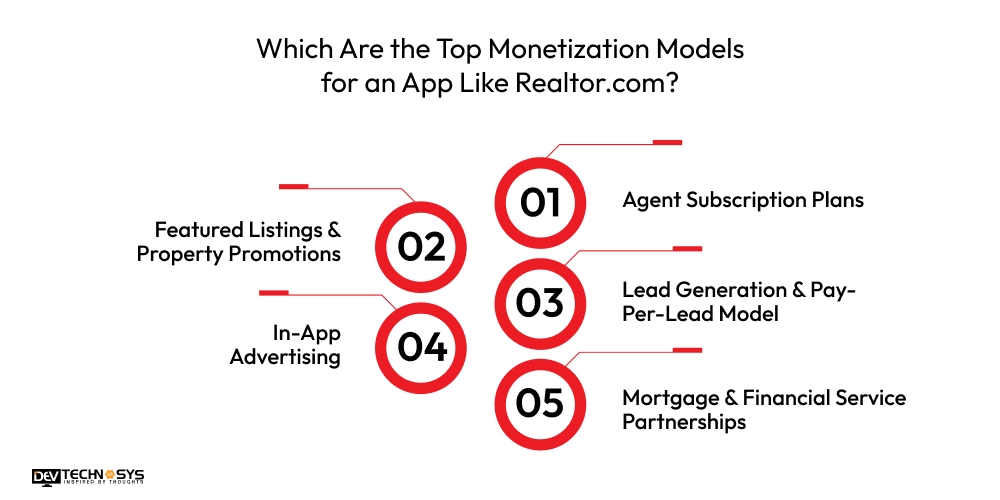
1. Agent Subscription Plans
Real estate agents pay monthly or annual subscription fees to list properties and access premium features. Subscription tiers may include advanced analytics, featured listings, CRM tools, and lead management dashboards. Recurring plans create predictable revenue while improving agent retention and platform loyalty.
2. Featured Listings & Property Promotions
Property owners or agents can pay to highlight listings at the top of search results. Sponsored listings increase visibility, generate more inquiries, and accelerate property sales. This pay-per-listing or promotional boost model offers flexible revenue opportunities without mandatory long-term commitments.
3. Lead Generation & Pay-Per-Lead Model
Agents are charged for verified buyer or renter inquiries generated through the platform. High-quality, location-targeted leads increase conversion potential and justify premium pricing. This performance-based model aligns platform success with agent results, ensuring measurable return on investment.
4. In-App Advertising
Display targeted banner ads, sponsored content, or local business promotions within the app interface. Mortgage lenders, home inspectors, movers, and interior designers can advertise their services. Data-driven ad placements improve engagement while generating additional non-transactional revenue streams.
5. Mortgage & Financial Service Partnerships
Partner with banks and financial institutions to offer mortgage calculators, pre-approval services, and home loan referrals. The platform earns referral commissions for each approved loan application. These partnerships diversify income while enhancing user convenience during property transactions.
How Can AI-Powered Hyperlocal Property Intelligence Transform Your Real Estate App in 2026?
AI-powered hyperlocal intelligence is redefining how property platforms attract, engage, and convert buyers. Instead of just displaying listings, your app can deliver data-driven insights tailored to specific neighborhoods and user behavior. This intelligence can be really beneficial when you build a real estate app like Dubai REST.
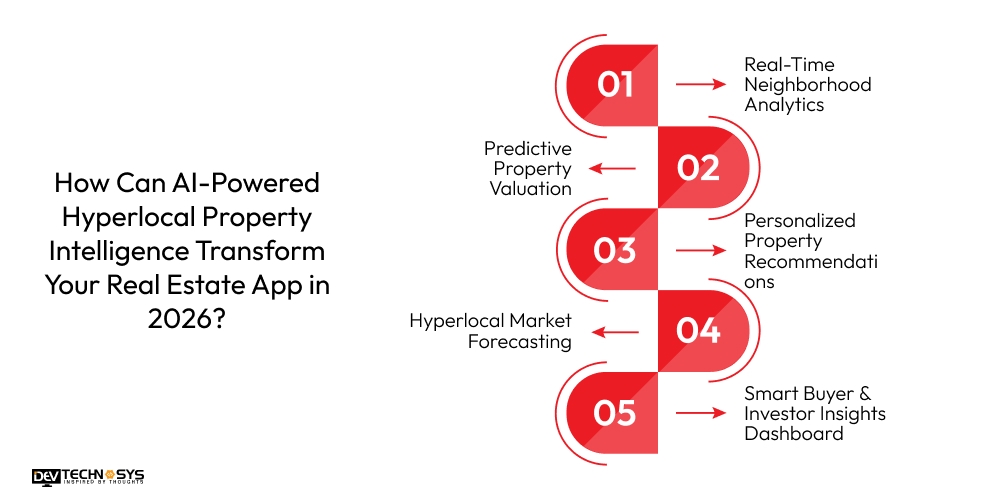
1. Real-Time Neighborhood Analytics
Provide live data on pricing trends, rental yields, demand fluctuations, crime rates, school ratings, and local amenities. This helps buyers evaluate neighborhoods instantly without relying on external research platforms or outdated reports.
2. Predictive Property Valuation
Use AI algorithms to estimate future property appreciation, investment potential, and resale value accurately. Predictive insights reduce investment risks and support smarter long-term property purchasing decisions confidently.
3. Personalized Property Recommendations
Analyze user search history, budget preferences, and browsing patterns to deliver highly relevant property suggestions. Personalized recommendations increase engagement rates, session duration, and qualified lead generation significantly.
4. Hyperlocal Market Forecasting
Offer AI-driven forecasts about infrastructure projects, urban expansion, and upcoming commercial developments. Forward-looking market intelligence positions your platform as a trusted real estate decision-making assistant.
5. Smart Buyer & Investor Insights Dashboard
Create dashboards showing ROI projections, affordability metrics, loan comparisons, and investment breakdowns. Interactive insights empower users to compare properties strategically before making financial commitments.
Conclusion
To build an app like Realtor.com, combining real-time listing integration, scalable cloud infrastructure, advanced search filters, and secure data management is essential. From backend architecture to monetization, every decision impacts performance, reliability, and user trust.
Startups and enterprises should partner with an experienced real estate app development company to ensure compliance, smooth performance, and long-term scalability. The right technology partner reduces risks, optimizes development costs, and delivers a secure, high-performance property marketplace ready for expansion.

Mostly Asked!
Q1. How Much Does It Cost To Build An App Like Realtor.com?
The cost typically ranges between $8,000 and $30,000, depending on features, platform selection, integrations, and scalability requirements. A basic MVP with property listings and search filters costs less, while AI features, CRM integrations, and multi-city scalability increase overall development expenses.
Q2. What Essential Features Are Required In A Realtor-Like App?
Core features include property listings, advanced search filters, map-based browsing, user registration, agent profiles, favorites, push notifications, and inquiry forms. Advanced versions may include AI-based recommendations, mortgage calculators, CRM dashboards, and virtual property tours to enhance engagement and lead conversion.
Q3. How Long Does It Take To Develop A Real Estate App Like Realtor?
Development time typically ranges from 3 to 12+ months. A simple MVP may take around 3–4 months, as it requires simple integrations, features, security, backend, and other components. A fully featured, scalable platform with AI integration, multi-agent support, and third-party APIs can take 8 months or longer.
Q4. Which Technology Stack Is Best For Building A Realtor-Like App?
Popular choices include React Native or Flutter for cross-platform apps, Swift for iOS, and Kotlin for Android. Backend technologies like Node.js or Python with cloud services such as AWS or Google Cloud ensure scalability, performance, and secure data management.
Q5. How Does A Realtor-Like App Generate Revenue?
Revenue comes from agent subscriptions, featured listings, pay-per-lead models, in-app advertising, and mortgage or financial service partnerships. Combining multiple monetization strategies ensures consistent income, higher profitability, and sustainable business growth in competitive real estate markets.