





In today’s digital era, online shopping has shifted from traditional e-commerce websites toward smarter, personalized mobile experiences. An AI shopping app blends advanced technology like machine learning, natural language processing, and recommendation engines to build an AI shopping app that meets evolving user expectations.
AI shopping apps have transformed the way consumers discover, evaluate, and purchase products. These apps not only streamline purchasing but also anticipate user preferences, offer tailored suggestions, and automate customer service, making them ideal for businesses planning to create an AI shopping app.
As more people prefer online shopping, consumer expectations rise for seamless, intuitive retail experiences. In this scenario, businesses are seeking a competitive advantage with an interest to develop an AI shopping app that supports scalability and personalization.
That’s why entrepreneurs and developers are increasingly investing in these platforms with the help of a reliable and experienced development company. This helps them unlock higher engagement, sales, and long-term customer loyalty in a dynamic retail landscape.
The Analyze Market Predictions Of AI-Shopping Apps
The shopping app market is rapidly evolving with AI-driven personalization and automation shaping future consumer behavior. Understanding market predictions helps businesses identify growth opportunities, investment potential, and long-term scalability in AI-powered shopping platforms offered by modern shopping app development services.
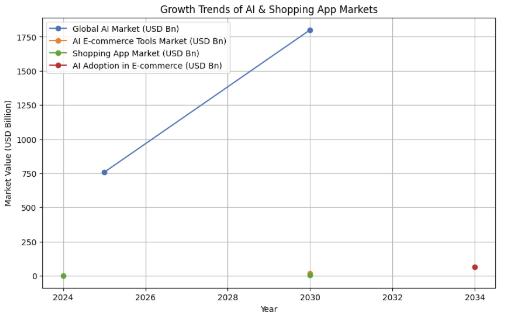
- The worldwide artificial intelligence market is expected to reach $1.8 trillion by 2030, rising significantly from approximately $757.6 billion in 2025, highlighting the importance across industries.
- The market for AI-enabled e-commerce and shopping tools is projected to grow to nearly $17 billion by 2030, fueled by personalization, automation, and predictive analytics supporting AI shopping app development.
- The global shopping app market is forecasted to double from $1.2 billion in 2024 to $2.4 billion by 2030, reflecting increased mobile commerce usage and demand for AI-powered shopping app solutions.
- Artificial intelligence adoption in e-commerce is expected to reach $64 billion by 2034, highlighting long-term investment and innovation trends related to the role of artificial intelligence in mobile app development.
- By 2030, nearly 80% of customer interactions in retail are predicted to be managed or assisted by AI-driven systems.
What Is An AI Shopping App?
An AI shopping app is a mobile or tablet application that uses artificial intelligence technologies to enhance the shopping journey . Rather than just listing products, AI shopping apps understand user behavior, preferences, and intent through data analysis.
These apps leverage personalized recommendation engines, visual and voice search, intelligent chatbots, and predictive analytics to deliver smarter shopping using shopping app development using AI. If you build an artificial intelligence app, it offers contextual and adaptive interactions that boost conversion rates, customer satisfaction, and long-term loyalty.
Their evolution is fueled by advances in artificial intelligence in shopping app development and the growing demand to build an AI shopping app.
Why Are Entrepreneurs Investing In Building An AI Shopping App?
Entrepreneurs are increasingly adopting AI shopping apps to meet rising consumer expectations for smarter, faster, and personalized shopping experiences, especially when planning to make an AI shopping app for competitive markets.
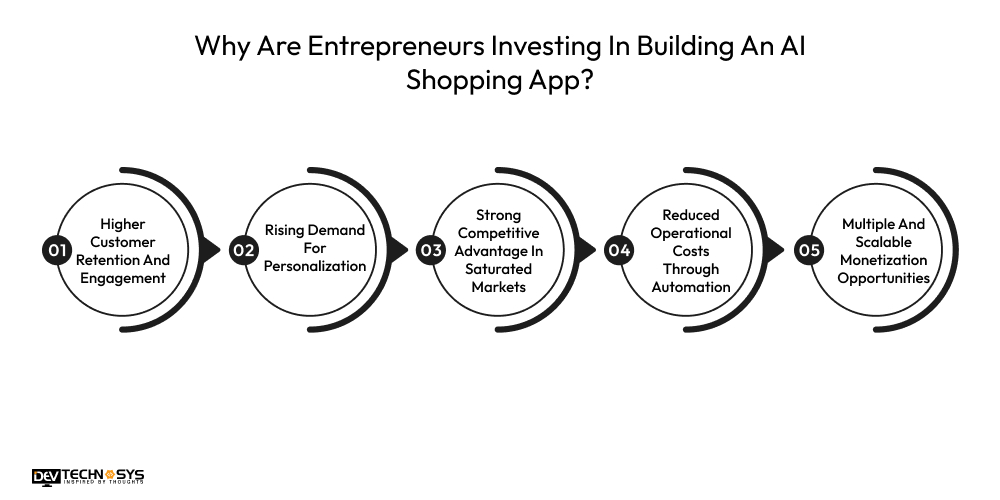
1. Higher Customer Retention And Engagement
AI enables dynamic content, personalized offers, and behavior-based notifications. These tailored interactions keep users engaged, encourage repeat purchases, and build long-term loyalty by consistently delivering relevant shopping experiences. Dynamic content and personalized notifications increase loyalty, helping businesses develop shopping app like OUNASS with sustained engagement.
2. Rising Demand For Personalization
Modern consumers expect shopping experiences tailored to their preferences, behavior, and purchase history. AI-powered personalization boosts relevance, improves satisfaction, and supports smart shopping app development. This personalized approach also increases conversion rates by delivering the right products at the right time, encouraging repeat purchases and long-term customer loyalty.
3. Strong Competitive Advantage In Saturated Markets
With countless shopping apps available, AI-driven features like smart recommendations and predictive search help brands stand out. Entrepreneurs use AI to deliver faster discovery and more intuitive experiences that outperform traditional e-commerce apps. AI-driven features help brands stand out and replicate successful models.
4. Reduced Operational Costs Through Automation
AI chatbots and automated workflows handle customer queries, order tracking, returns, and payments efficiently. This reduces dependency on large support teams, lowers operational expenses, and ensures faster, round-the-clock customer service, making an AI chatbot for shopping apps a cost-effective operational solution.
5. Multiple And Scalable Monetization Opportunities
AI shopping apps unlock diverse revenue streams, including premium subscriptions, sponsored product placements, targeted advertisements, and strategic brand partnerships, allowing entrepreneurs to scale profits while maintaining a seamless user experience. Revenue models scale efficiently, especially when brands aim to use AI-driven monetization.
What Are The Steps To Build An AI Shopping App?
Building an AI shopping app requires a structured development approach combining strategy, technology, design, and continuous improvement. To make an AI shopping app, a structured development approach combining strategy, technology, design, and continuous improvement, often guided by a reliable mobile app development company, is required.
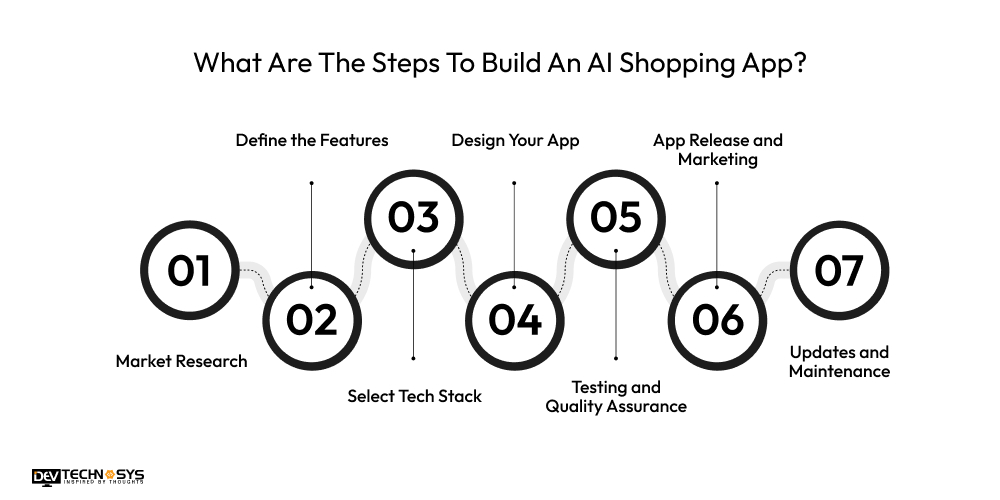
1. Market Research
To build an AI shopping app, market research helps identify target users, shopping behavior, competitors, and market gaps. This step validates your app idea, defines user needs, analyzes pricing strategies, and ensures your AI shopping app solves real problems with clear business value. Market research identifies users, competitors, and opportunities, especially for brands planning to develop Egyptian Shopping App like Kenzz in regional markets.
2. Define the Features
In this stage, you decide on the core and advanced features such as AI recommendations, smart search, chatbots, and payment options. Prioritizing must-have and optional features helps control costs and ensures a focused, scalable app roadmap. Clear feature documentation at this stage helps align developers, designers, and stakeholders, reducing rework and development delays later.
3. Select Tech Stack
Choosing the right technology stack ensures performance, scalability, and security. This includes selecting programming languages, AI frameworks, cloud platforms, databases, and third-party APIs that support machine learning, real-time data processing, and seamless user experiences. Choosing scalable technologies enables AI-powered voice shopping app integration without future rework and leads to seamless mobile app development solutions.
4. Design Your App
UI/UX design focuses on creating intuitive navigation, appealing visuals, and smooth user flows. This step includes wireframes, prototypes, and user testing to ensure the app is easy to use, visually engaging, and optimized for conversions. Strong design consistency across screens builds brand trust and reduces user friction during browsing and checkout. Integrating strong UI/UX supports conversion-focused app development and user retention.
5. Testing and Quality Assurance
Thorough testing ensures the app functions smoothly across devices and platforms. This includes functional testing, AI model validation, security checks, performance testing, and usability testing to eliminate bugs and ensure reliable user experiences. Early and continuous testing minimizes post-launch issues and ensures iOS or Android app development. Rigorous testing ensures stability across devices for AI shopping app development for Android.
6. App Release and Marketing
After final approval, the app is launched on app stores with proper optimization. Marketing efforts such as app store optimization, digital campaigns, influencer outreach, and promotions help drive downloads and attract early users. A phased launch strategy helps gather early feedback and refine features before scaling to a wider audience. A phased rollout improves feedback collection for AI shopping app development for iOS.
7. Updates and Maintenance
Post-launch maintenance includes fixing bugs, updating AI models, improving features, and adding new functionalities. Continuous updates based on user feedback ensure better performance, security compliance, and long-term engagement and growth. Regular updates keep the app competitive, relevant, and aligned with evolving user expectations. Ongoing updates address the cost to maintain an app while ensuring long-term growth.
What Are The Basic Features In An AI Shopping App?
AI shopping apps rely on intelligent features to deliver personalized, automated, and seamless shopping experiences for users. AI shopping apps rely on intelligent features to deliver seamless experiences supported by AI-driven shopping app development strategies.
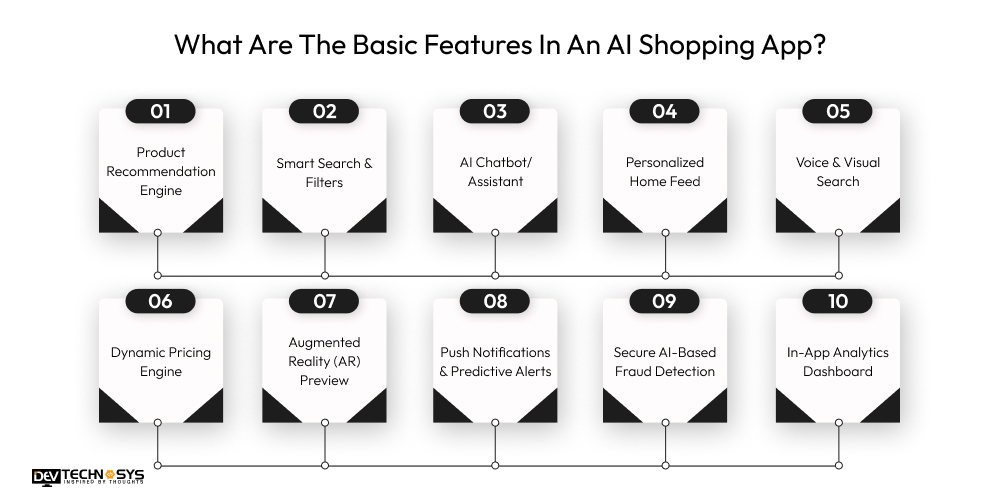
1. Product Recommendation Engine
Uses AI algorithms to analyze browsing history, past purchases, and preferences to suggest relevant products, increasing engagement, average order value, and overall conversion rates. It continuously learns from user interactions to refine suggestions over time, adapting to changing preferences and seasonal shopping trends automatically.
2. Smart Search & Filters
To develop a shopping app like Joom, natural language and predictive search must allow users to find products quickly through keywords, voice input, or intent-based queries, improving discoverability and user satisfaction. The system reduces zero-result searches by understanding user intent and correcting spelling errors or vague queries in real time.
3. AI Chatbot/Assistant
Provides 24/7 customer support by answering queries, tracking orders, resolving issues, and guiding users toward suitable products, ensuring faster response times and reduced support costs. Chatbots can upsell and cross-sell products during conversations by understanding customer intent and purchase readiness intelligently.
4. Personalized Home Feed
Displays customized product listings, deals, and content based on user behavior, location, and preferences, creating a unique shopping experience that boosts retention and repeat purchases. The feed dynamically updates in real time, ensuring users always see fresh, relevant content without manual refresh or browsing effort.
5. Voice & Visual Search
Allows users to search products using voice commands or images, enabling hands-free browsing and instant discovery, especially useful for fashion, furniture, and lifestyle shopping. This feature improves accessibility, making shopping easier for users with disabilities or those preferring hands-free interactions.
6. Dynamic Pricing Engine
To develop a shopping app like Danube Home, leveraging AI is necessary to adjust prices, discounts, and offers in real time based on demand, user behavior, competitor pricing, and inventory levels to maximize revenue. It helps clear excess inventory efficiently by automatically offering targeted discounts to price-sensitive customers.
7. Augmented Reality (AR) Preview
Let users virtually try products or place items in real-world environments using their device camera, reducing purchase hesitation and product return rates. AR previews increase buyer confidence by bridging the gap between online browsing and in-store product experience.
8. Push Notifications & Predictive Alerts
Sends intelligent alerts for price drops, restocks, abandoned carts, and personalized deals, increasing engagement while avoiding irrelevant or excessive notifications. AI optimizes notification timing to reach users when they are most likely to engage and convert.
9. Secure AI-Based Fraud Detection
An artificial intelligence development in a shopping app monitors transactions and user behavior patterns to detect suspicious activities, prevent fraud, and ensure secure payments without interrupting legitimate purchases. The system evolves with new fraud patterns, continuously strengthening security without requiring manual rule updates.
10. In-App Analytics Dashboard
Provides real-time insights into user behavior, sales performance, and campaign effectiveness, helping businesses optimize strategies, improve user experience, and drive data-driven decisions. Businesses can make faster decisions using actionable insights generated from real-time dashboards and automated performance reports.
What Are The Best AI Shopping Apps Available in The Market?
Several AI-powered shopping apps have set benchmarks by delivering intelligent personalization and seamless user experiences. Several AI-powered shopping apps have set benchmarks by delivering intelligent personalization and seamless user experiences through shopping app development solution strategies.
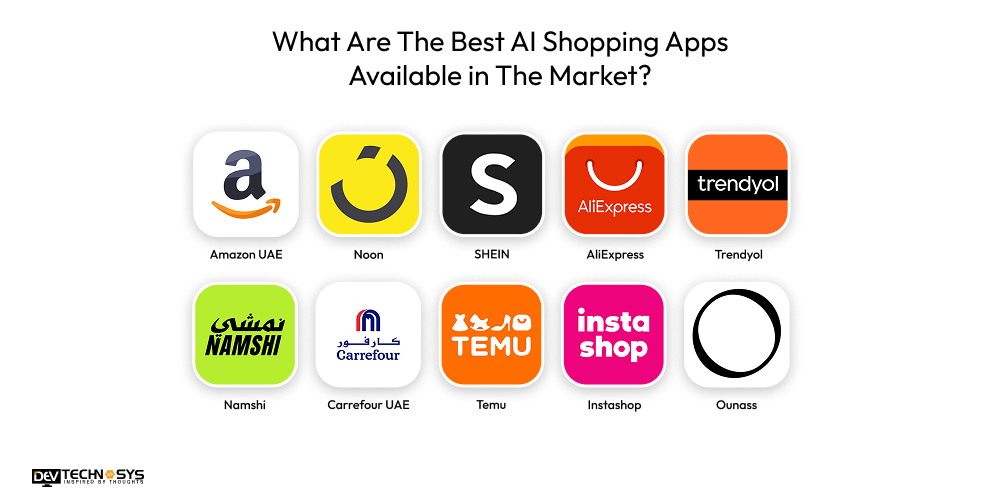
| App Name | Launch Year | Rating | Downloads | Platform Availability |
| Amazon UAE | 2005 | 4.5/5 | 100M+ | Android + iOS |
| Noon | 2017 | 4.3/5 | 50M+ | Android + iOS |
| SHEIN | 2008 | 4.5/5 | 500M+ | Android + iOS |
| AliExpress | 2010 | 4.4/5 | 300M+ | Android + iOS |
| Trendyol | 2010 | 4.6/5 | 50M+ | Android + iOS |
| Namshi | 2012 | 4.4/5 | 10M+ | Android + iOS |
| Carrefour UAE | 2014 | 4.3/5 | 10M+ | Android + iOS |
| Temu | 2022 | 4.3/5 | 100M+ | Android + iOS |
| Instashop | 2015 | 4.5/5 | 5M+ | Android + iOS |
| Ounass | 2016 | 4.2/5 | 5M+ | Android + iOS |
What Is The Cost To Build An AI Shopping App?
The cost to develop an online shopping app will commonly be estimated from $8,000 to $30,000. Generally, the AI shopping app development cost depends on the app’s complexity. A basic app with MVP, standard AI features might range lower because of less complexity
Whereas more advanced apps with sophisticated recommendation engines, AR, voice search, and custom AI models can cost more due to high complexity. The AI shopping app development cost can also vary by region and team expertise, backend, security, platform choice, third-party integrations, and so on.
In addition to upfront development, ongoing costs such as cloud services, AI training data, model retraining, updates, and maintenance must be factored in, often reaching 20–30% of the initial build cost annually.
| App Type | Key Features Included | Estimated Cost |
| Basic AI Shopping App | Core shopping features, basic AI recommendations, simple UI, standard search, limited personalization | $8,000 – $12,000 |
| Standard AI Shopping App | Enhanced recommendations, AI chat support, smart search, user profiles, basic analytics | $12,000 – $20,000 |
| Advanced AI Shopping App | Full personalization engine, voice/visual search, predictive analytics, scalable backend, stronger customization | $20,000 – $30,000 |
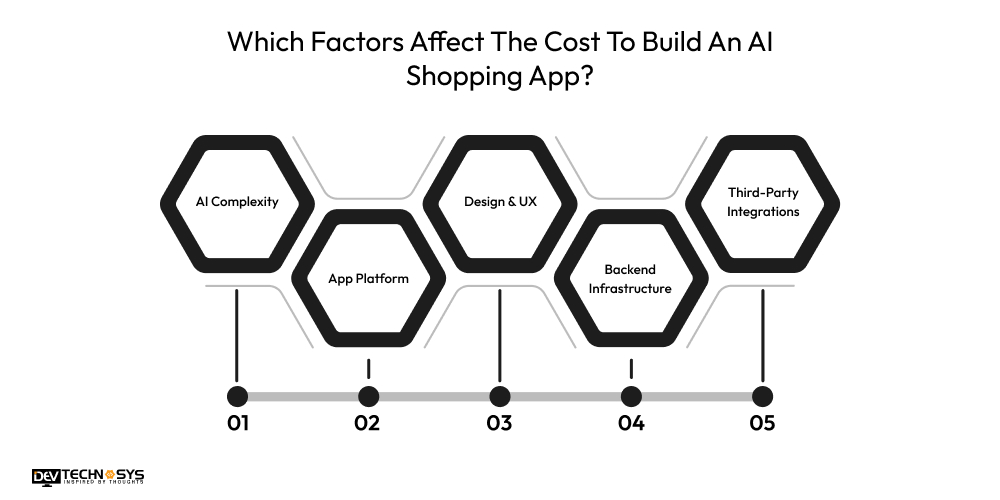
Which Factors Affect The Cost To Build An AI Shopping App?
Multiple technical and business factors influence overall cost, especially when choosing Cross-platform AI shopping app development or native builds. Evaluating these factors early helps control expenses and ensures smarter investment decisions during development.
1. AI Complexity
Advanced machine learning models require skilled AI engineers, extensive training data, longer development cycles, and higher computing power, which significantly increases development, testing, and ongoing maintenance costs.
| AI Level | Description | Estimated Cost |
| Basic AI | Includes rule-based recommendations and basic personalization using limited user data with minimal machine learning model training. | $8,000 – $12,000 |
| Mid-Level AI | Uses machine learning models for behavior tracking, smarter product recommendations, and improved search accuracy. | $12,000 – $20,000 |
| Advanced AI | Implements deep learning models, real-time personalization, predictive analytics, and continuous model optimization. | $20,000 – $30,000 |
2. App Platform
Developing separate native apps for iOS and Android or ensuring cross-platform compatibility increases development time, testing efforts, and maintenance requirements, directly impacting the overall project budget.
| Platform Type | Description | Estimated Cost |
| Single Platform | Development for either Android or iOS with core shopping and AI features. | $8,000 – $12,000 |
| Cross-Platform | Shared codebase for Android and iOS, reducing time while maintaining consistent performance. | $12,000 – $20,000 |
| Native Multi-Platform | Separate native apps for Android and iOS, offering higher performance and platform-specific optimization. | $20,000 – $30,000 |
3. Design & UX
Highly customized user interfaces, personalized layouts, and intuitive user journeys demand professional UI/UX designers, usability testing, and multiple iterations, making design a major contributor to the cost to develop an AI Shopping App.
| Design Level | Description | Estimated Cost |
| Basic UI | Simple layouts, standard components, and limited customization focused on functionality. | $2,000 – $4,000 |
| Enhanced UX | Improved user flows, better navigation, and a user-friendly design optimized for engagement. | $4,000 – $7,000 |
| Premium UX | Custom visuals, animations, micro-interactions, and usability testing for a polished experience. | $7,000 – $10,000 |
4. Backend Infrastructure
Scalable backend systems, cloud hosting, databases, and real-time data processing engines are essential for AI apps, resulting in higher setup costs and continuous expenses for storage, computing, and scalability.
| Backend Type | Description | Estimated Cost |
| Basic Backend | Simple server setup, database management, and essential APIs for app operations. | $3,000 – $6,000 |
| Scalable Backend | Cloud-based infrastructure with scalability, real-time data handling, and better security. | $6,000 – $10,000 |
| Enterprise Backend | High-availability servers, load balancing, advanced security, and large-scale data processing. | $10,000 – $15,000 |
5. Third-Party Integrations
Integrating payment gateways, analytics tools, AI APIs, and logistics services involves licensing fees, compliance requirements, and technical customization, adding to both initial development and the recurring cost to develop an AI Shopping App.
| Integration Level | Description | Estimated Cost |
| Basic Integrations | Includes analytics tools, simple APIs, and basic external services. | $500 – $1,500 |
| Standard Integrations | Payment gateways, shipping services, CRM tools, and marketing automation. | $1,500 – $2,500 |
| Advanced Integrations | AI APIs, voice or visual search SDKs, AR tools, and advanced analytics platforms. | $2,500 – $3,500 |

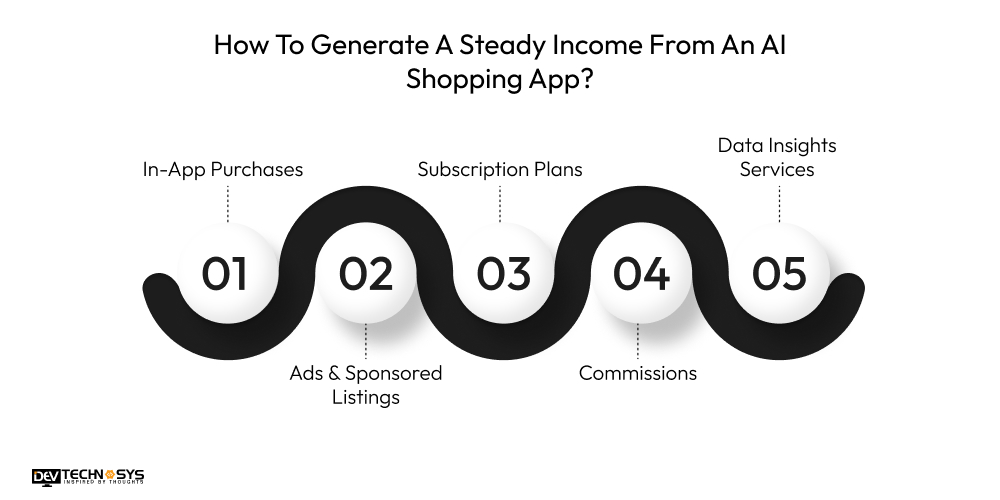
How To Generate A Steady Income From An AI Shopping App?
AI shopping apps unlock recurring revenue models supported by AI-based shopping app solution architectures. Implementing the right revenue strategies ensures consistent income while maintaining a valuable and engaging user experience.
1. In-App Purchases
Offer premium AI-powered features such as advanced recommendations, exclusive deals, early access to products, or personalized shopping assistants that encourage users to pay for enhanced experiences.
2. Ads & Sponsored Listings
Generate revenue by allowing brands to promote products through sponsored placements in search results, personalized feeds, or recommendations, ensuring ads remain relevant and non-intrusive through AI targeting.
3. Subscription Plans
Provide monthly or annual subscription tiers with benefits like free delivery, special discounts, priority support, and exclusive content, creating predictable and recurring revenue streams. Monetization strategies scale efficiently when built using full-stack development services and optimized APIs.
4. Commissions
Earn commissions by partnering with retailers and redirecting users to third-party stores, generating income for every successful purchase completed through affiliate links integrated within the app.
5. Data Insights Services
Monetize anonymized user behavior data by offering retailers valuable insights into shopping trends, customer preferences, and demand forecasting, while maintaining strict data privacy and compliance standards.
Conclusion
An AI shopping app represents the next frontier of digital retail, melding cutting-edge AI technologies with consumer-centric design to deliver speed, personalization, and convenience. An AI shopping app represents the next frontier of digital retail, combining innovation, personalization, and automation through an AI-powered shopping app architecture.
These apps stand out by enriching every step of the shopping journey, from discovery and decision-making to checkout and support. Market forecasts indicate significant growth in both AI and shopping app usage, making this space ripe for innovation and investment.
Entrepreneurs who invest strategically are supported by a hybrid app development company and experienced teams. Ultimately, building an AI shopping app is not just about technology. The success lies in selecting the right development of a shopping app, hiring skilled teams, and planning long-term scalability.
FAQs
Q1. What Is The Difference Between An AI Shopping App And A Regular Shopping App?
An AI shopping app leverages machine learning and automation to personalize product recommendations, search results, pricing, and support interactions, while regular shopping apps provide static catalogs, manual search, and limited personalization features.
Q2. How Long Does It Take To Build An AI Shopping App?
The development timeline usually ranges from four to eight months for a basic AI-powered app. Advanced features like custom AI models, AR previews, and predictive analytics can extend development to twelve months or more.
Q3. Which Technology Stack Is Best For AI Shopping Apps?
AI shopping apps commonly use Python for machine learning, React Native or Flutter for cross-platform frontend development, and cloud services like AWS or Google Cloud for scalable backend infrastructure and data processing.
Q4. Do AI Shopping Apps Need User Data?
Yes, AI shopping apps rely on anonymized user data such as browsing behavior and purchase history to deliver personalization, but they must follow strict data privacy laws and implement secure data handling practices.
Q5. Can Small Businesses Afford AI Shopping Apps?
Yes, small businesses can start with MVP versions using ready-made AI APIs, cloud services, and modular features. It allows them to launch cost-effectively and gradually scale as their user base grows. To create an AI shopping app, an MVP is widely preferred at the beginning.