





Key takeaways:
- Overall Cost Range: eWallet app development cost in 2026 typically ranges between $30,000 and $150,000. The overall development cost depends on app complexity, security requirements, features, integrations, and other factors.
Cost Breakdown by Complexity:
- Basic/MVP eWallet: $30,000 – $70,000 (wallet creation, user registration, KYC, money transfer, transaction history)
- Mid-Level eWallet: $70,000 – $100,000 (bill payments, multiple payment methods, API integrations, enhanced security)
- Advanced eWallet: $100,000 – $150,000+ (AI fraud detection, multi-currency support, advanced analytics, loyalty programs, and real-time transactions
- By charging real estate agents, property owners, and service partners for visibility, leads, and premium tools, custom real estate platforms can generate recurring revenue.
- Key Cost Factors: Features, UI/UX design, security architecture, compliance requirements, third-party payment integrations, backend infrastructure, platform selection, and development team location.
- Development Timeline: A fully functional eWallet app typically takes 4 to 7+ months to develop, depending on its complexity, integrations, testing, and compliance requirements.
- Regional Cost Rates: Hiring development teams in regions like India can be 40–60% more cost-effective than hiring teams in the US or Western Europe, while maintaining access to skilled fintech developers.
- Additional Costs: Businesses should also budget for maintenance, cloud hosting, payment gateway fees, security audits, compliance updates, third-party API charges, and ongoing feature enhancements after launch.
Creating an eWallet mobile application is not just about adding the payment function anymore. It means developing a reliable, secure financial environment through a scalable digital wallet architecture and eWallet platform. It processes payments, manages sensitive data, and complies with all regulations.
This makes eWallet app development a top choice for startups and fintech businesses to invest in. However, the only question is: what will be the cost to build an eWallet app in 2026-2027? The eWallet app development cost usually ranges from $30,000 to $150,000.
The final development budget depends on several factors such as wallet type, features, eWallet technology stack, API integration, security, and others. In addition to this amount, companies must consider the eWallet app maintenance cost, compliance, payment processing system, and other expenses.
This guide will help you analyze the eWallet app development cost breakdown. It also includes features, development phases, technology stack, security requirements, benefits, ROI, and cost-optimization strategies for your future success.
Answer a few quick questions and our experts will share a tailored project estimate.
How Much Does It Cost to Develop an eWallet App in 2026-2027?
The average cost to build an eWallet app in 2026-2027 ranges between $30,000 and $150,000. The final development cost is determined by wallet type, transaction complexity, backend architecture, and compliance scope. A basic eWallet MVP development cost with P2P transfers and wallet top-up can start around $30,000. A feature-rich wallet with AI fraud detection, multi-currency support, and crypto integration can exceed $150,000.
Complexity |
Cost Range |
Estimated Timeline |
Suitable For |
| Basic | $25,000–$60,000 | 3–4 months | Startups & MVPs |
| Mid-Level | $60,000–$1,10,000 | 4–6 months | Growing fintech businesses |
| Advanced | $1,10,000–$150,000+ | 7+ months | Banks & enterprise platforms |
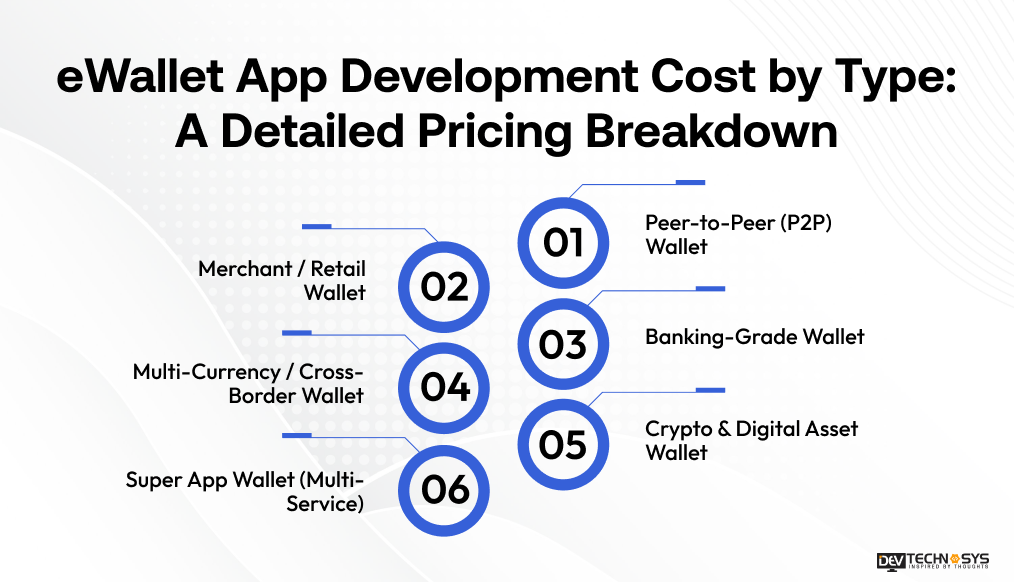
eWallet App Development Cost by Type: A Detailed Pricing Breakdown
Not every eWallet app needs the same architecture. A simple P2P wallet is straightforward, while a multi-currency or crypto wallet requires more robust digital wallet architecture and stricter compliance. That difference directly affects digital wallet app development cost. Here, we have mentioned some of the most popular mobile wallet app development cost and type estimations.
1. Peer-to-Peer (P2P) Wallet
A peer-to-peer (P2P) wallet enables users to send and receive money instantly through a simple digital interface. Its main focus is fast onboarding and seamless money transfers between individuals. Typical features include user profiles, bank account linking, instant transfers, transaction history, payment notifications, and contact-based payments.
2. Merchant / Retail Wallet
A merchant or retail wallet allows users to make payments at physical stores and online merchants from one platform. These wallets often combine payment functionality with customer engagement tools such as loyalty programs and merchant offers. Common features include QR scan-to-pay, cashback, digital coupons, merchant offers, payment history, and order tracking.
3. Banking-Grade Wallet
A banking-grade wallet is designed for banks, NBFCs, and financial institutions that want to provide secure digital wallet services across different customer segments. It supports more complex financial operations and administrative controls than a basic wallet. Banks and financial institutions can work with an eWallet app development company in UAE to create a secure wallet. It supports KYC, card management, multiple accounts, and administrative controls.
4. Multi-Currency / Cross-Border Wallet
A multi-currency or cross-border wallet enables users to hold, exchange, send, and receive money in multiple currencies. It is particularly useful for international payments, remittances, travelers, and global businesses. Its core capabilities typically include real-time foreign exchange rates, international transfers, currency conversion, compliance checks, multi-language support, and cross-border payments.
5. Crypto & Digital Asset Wallet
A crypto and digital asset wallet allows users to store, manage, exchange, and transfer cryptocurrencies alongside traditional currencies. Its key differentiator is blockchain connectivity combined with strong wallet security. Common features include multi-chain support, crypto swaps, staking, asset tracking, secure key management, cold storage integration, and blockchain transaction monitoring.
6. Super App Wallet (Multi-Service)
A super app wallet brings multiple financial and everyday services together within a single digital ecosystem. Instead of focusing only on payments, it can connect users with services such as bill payments, insurance, investments, and more. Typical features include bill pay, insurance services, investment options, loyalty programs, rewards, payment services, and personalized financial offers.

eWallet App Type |
Cost Range |
Complexity |
| Peer-to-Peer Wallet | $25,000–$70,000 | Basic |
| Merchant / Retail Wallet | $35,000–$95,000 | Basic–Medium |
| Multi-Currency Wallet | $60,000–$1,20,000 | Medium–Advanced |
| Banking-Grade Wallet | $70,000–$1,25,000 | Advanced |
| Crypto Wallet | $80,000–$1,45,000 | Advanced |
| Super App Wallet | $90,000–$1,60,000 | Advanced |
eWallet App Development Cost by Development Phase
Development cost is not spent all at once. Each phase of building an eWallet app carries its own share of the total budget. Understanding this payment wallet app development cost breakdown helps you plan payments and timelines realistically.
An eWallet project moves through discovery, design, development, testing, and deployment before launch. Each phase demands different skill sets and effort, which is why costs vary sharply from one stage to the next. This also explains variations in eWallet app testing cost and eWallet app deployment cost.
Development Phase |
What Happens |
Estimated Cost |
% of Total Budget |
| Discovery & Requirement Planning | Market research, compliance mapping, digital wallet architecture planning, and scope finalization | $2,500–$6,000 | 5–8% |
| UI/UX Design | Wireframes, prototypes, user flows for onboarding, payments, and dashboards | $4,000–$10,000 | 8–12% |
| Frontend Development | Mobile and web interface build for iOS, Android, and web portals | $6,000–$18,000 | 15–20% |
| Backend Development | Core wallet logic, Transaction Processing Engine, database, and server architecture | $8,000–$25,000 | 20–25% |
| Payment Gateway & Banking Integrations | Connecting card networks, bank APIs, payment processors, and Payment API Integration | $5,000–$16,000 | 10–15% |
| Security & Compliance Implementation | Encryption, KYC/AML checks, PCI DSS setup, and regulatory alignment | $6,000–$20,000 | 12–15% |
| AI & Fraud Detection Setup | Fraud scoring models, risk scoring, and AI-based personalization | $5,000–$14,000 | 8–10% |
| QA & Testing | Functional testing, security testing, load testing, and bug fixes | $4,000–$12,000 | 8–10% |
| Deployment & Launch | App store submission, server deployment, and go-live checks | $2,000–$6,000 | 4–6% |
| Post-Launch Support & Maintenance | Bug fixes, updates, monitoring, and compliance renewals (monthly/ongoing) | $1,500–$5,000/month | Ongoing |
Expert Advice
Testing and security implementation carry more weight in eWallet apps than in most other app categories. Even a minor gap in fraud detection or compliance can lead to regulatory penalties or user trust loss.
Mohit Nag (CTO at Dev Technosys)
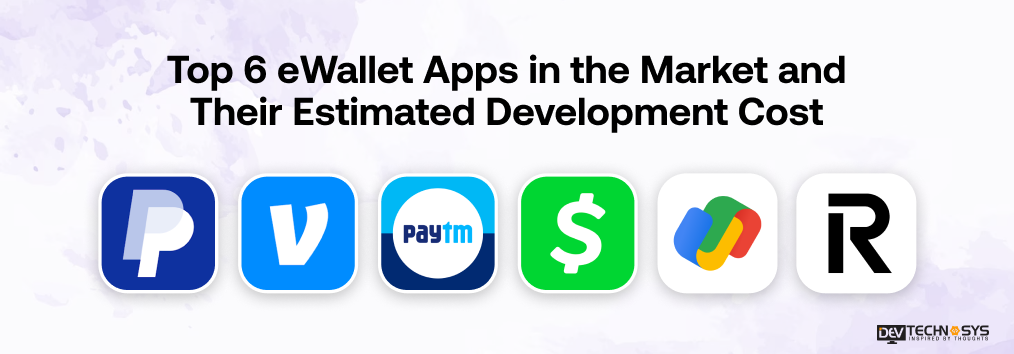
Top 6 eWallet Apps in the Market and Their Estimated Development Cost
Existing eWallet platforms provide useful benchmarks for understanding how feature depth influences development cost. These estimates are indicative, not the actual proprietary budgets of these companies. Businesses looking to build an app like Touch ‘n Go eWallet can use these established platforms as references for understanding features, integrations, scalability, and development complexity. Have a look at the top eWallet apps leading worldwide and their cost estimates.
eWallet App |
What It Offers |
Estimated Development Cost |
| PayPal | Global P2P payments, merchant checkout & buyer protection | $1,10,000–$160,000+ |
| Venmo | Social P2P payments, split bills & instant transfers | $90,000–$1,40,000 |
| Paytm | Wallet payments, bill pay, banking & investments | $1,00,000–$150,000 |
| Cash App | P2P transfers, stock trading & Bitcoin wallet | $90,000–$1,45,000 |
| Google Pay | UPI payments, rewards, bill pay & bank linking | $80,000–$1,30,000 |
| Revolut | Multi-currency accounts, cards & crypto trading | $1,00,000–$160,000 |
For businesses estimating the cost to build a multi-currency wallet specifically, FX handling and remittance compliance drive up the budget.
eWallet App Development Cost by Features: From Core to Advanced
Features are the biggest driver of eWallet app budgets. Core features build the payment foundation, while advanced features add automation, intelligence, and deeper integrations. We have mentioned the core and advanced features that a scalable and high-performing eWallet app must have.
Core eWallet App Features
Core Feature |
Estimated Cost |
| User Registration & KYC | $2,500–$4,000 |
| Wallet Creation & Top-Up | $2,000–$3,500 |
| Peer-to-Peer Transfers | $2,500–$4,000 |
| QR Code Payments | $2,000–$3,500 |
| Bank & Card Linking | $2,500–$4,000 |
| Transaction History | $1,500–$2,500 |
| Bill Payments & Recharges | $2,000–$3,500 |
| In-App Chat & Support | $2,000–$3,000 |
| Payment Gateway Integration | $3,000–$5,000 |
| Push Notifications | $1,500–$2,500 |
Advanced eWallet App Features
Advanced Feature |
Estimated Cost |
| Biometric Authentication | $5,000–$8,000 |
| Multi-Currency & FX Support | $8,000–$12,000 |
| Crypto Wallet Integration | $9,000–$14,000 |
| Loyalty & Rewards Engine | $6,000–$9,000 |
| Split Bills & Group Payments | $5,000–$8,000 |
| Merchant & Admin Dashboard | $7,000–$10,000 |
| Subscription & Recurring Payments | $6,000–$9,000 |
| Voice-Enabled Payments | $7,000–$10,000 |
| Investment & Savings Pockets | $8,000–$12,000 |
| Insurance & Micro-Lending Add-Ons | $8,000–$13,000 |
Businesses can develop eWallet apps with high-security features by combining biometric authentication, tokenization, encryption, fraud detection, and multi-factor authentication.
How Much Does It Cost to Add AI Features to an eWallet App?
AI is no longer optional in modern eWallet platforms. It strengthens fraud detection, personalizes spending insights, and automates support. Here are some essential AI-powered features that should be included in an eWallet platform.
AI-Powered Feature |
What It Does |
Estimated Cost |
| AI Fraud Detection | Flags suspicious transactions in real time using behavior patterns | $9,000–$14,000 |
| AI Credit Risk Scoring | Assesses user creditworthiness for lending or BNPL features | $8,000–$13,000 |
| AI Spend Analytics & Insights | Categorizes transactions and shows personalized spending trends | $7,000–$11,000 |
| AI Chatbot for Support | Handles balance checks, disputes, and FAQs automatically | $6,000–$10,000 |
| AI-Based Budgeting Assistant | Suggests savings goals and alerts on overspending | $7,000–$11,000 |
| Face & Voice Biometric AI | Verifies identity through facial or voice recognition | $8,000–$12,000 |
| AI-Powered KYC Verification | Automates document checks and identity validation | $8,000–$13,000 |
| Predictive Cash Flow Alerts | Predicts low balance or upcoming due payments | $6,000–$10,000 |
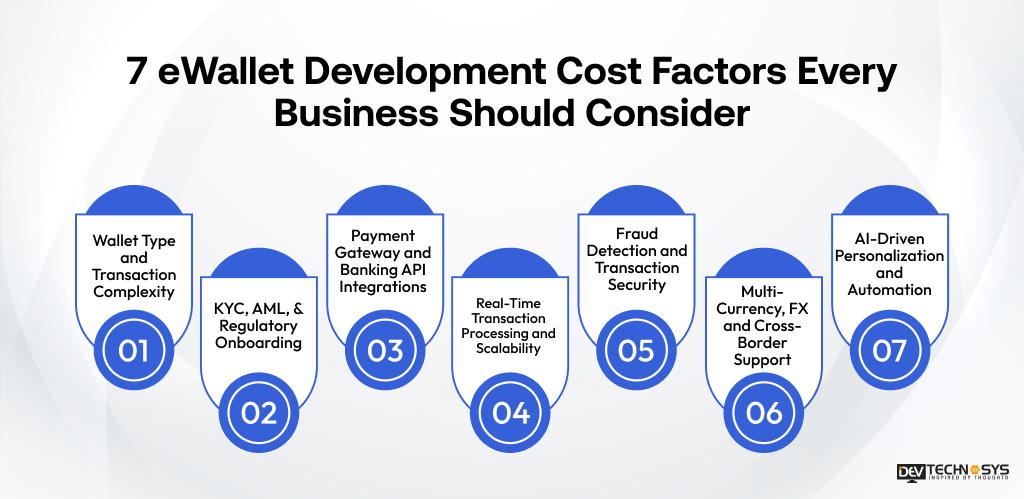
7 eWallet Development Cost Factors Every Business Should Consider
Two eWallet apps with similar interfaces can carry very different budgets. The difference usually comes down to transaction handling, compliance depth, and banking integrations. We have explained some major factors that are responsible for eWallet app development cost fluctuations. Businesses can also hire dedicated developers when they need greater control over development.
1. Wallet Type and Transaction Complexity
A P2P wallet is far simpler than a multi-currency or crypto wallet. More transaction types, such as bill pay, remittance, or merchant settlement, mean more logic, more edge cases, and more testing. As transaction workflows become more complex, development hours and testing requirements increase.
2. KYC, AML, & Regulatory Onboarding
Every eWallet needs identity verification and anti-money-laundering checks before a user can transact. Building compliant onboarding flows, especially for UAE Central Bank and VARA requirements, adds meaningful development time. Ongoing regulatory changes can also require additional updates and compliance work.
3. Payment Gateway and Banking API Integrations
Wallets depend on card networks, bank APIs, and payment processors to move money. Each payment gateway integration, banking API integration, and open banking integration needs its own testing, error handling, and settlement logic, which directly increases cost.
4. Real-Time Transaction Processing and Scalability
Balance updates, instant transfers, and live notifications require low-latency backend architecture. As transaction volume grows, the system must scale without failing during peak load, which raises infrastructure cost. High availability and disaster recovery further add to the technical investment.
5. Fraud Detection and Transaction Security
Wallets are a direct target for fraud, so a fraud detection engine, real-time fraud scoring, tokenization, and encrypted transaction pipelines are non-negotiable. This is a heavier security lift than most other app categories. Regular security testing and threat monitoring also increase ongoing development and maintenance costs.
6. Multi-Currency, FX and Cross-Border Support
Supporting multiple currencies means live exchange rate handling, cross-border compliance, and settlement across regions. This is one of the costliest additions for wallets targeting international users. Additional localization, tax rules, and regional payment methods can further increase development complexity.
7. AI-Driven Personalization and Automation
Spend analytics, budgeting assistants, and AI-based risk scoring add intelligence on top of core payments. These features require data pipelines and model tuning, which adds to both cost and development complexity. AI also requires ongoing model monitoring, optimization, and infrastructure resources.
Cost Factor |
Estimated Cost Impact |
What Drives the Cost Higher? |
| Wallet Type and Transaction Complexity | $6,000–$15,000 | More transaction types, wallet workflows, and use cases |
| KYC, AML and Regulatory Onboarding | $5,000–$14,000 | Identity verification, AML checks, region-specific compliance |
| Payment Gateway and Banking API Integrations | $6,000–$16,000 | Multiple gateways, bank APIs, settlement logic |
| Real-Time Transaction Processing and Scalability | $10,000–$24,000 | Low-latency architecture, high transaction volume, uptime needs |
| Fraud Detection and Transaction Security | $8,000–$18,000 | Real-time fraud scoring, tokenization, encrypted pipelines |
| Multi-Currency, FX and Cross-Border Support | $8,000–$20,000 | Live exchange rates, cross-border compliance, settlement |
| AI-Driven Personalization and Automation | $7,000–$16,000 | Spend analytics, budgeting AI, personalized risk scoring |
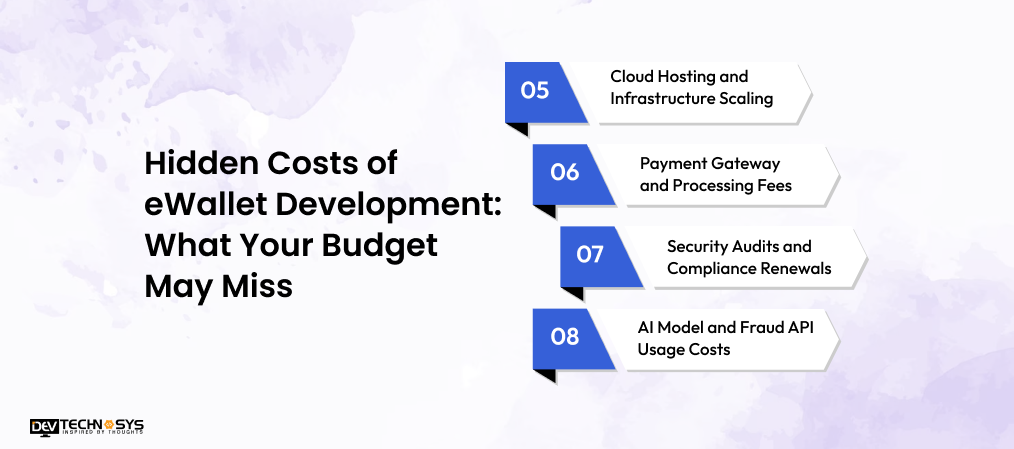
Hidden Costs of eWallet Development: What Your Budget May Miss
The development quote is rarely the full project budget. eWallet apps carry recurring costs that surface during and after development. These costs might affect your budget and make your development difficult. Understanding these costs earlier will help you make informed decisions and avoid future cost mismanagement.
1. Cloud Hosting and Infrastructure Scaling
eWallet apps require reliable cloud infrastructure to process transactions, store account data, and maintain availability. As users and transaction volumes increase, businesses may need additional computing power, storage, backups, and monitoring, increasing recurring infrastructure costs. A scalable cloud-native architecture can help support this growth.
2. Payment Gateway and Processing Fees
Payment gateways typically charge businesses per transaction, through fixed fees, percentage-based charges, or both. As transaction volumes grow, these processing costs can become significant. Businesses should account for gateway charges, settlement fees, currency conversion, and other expenses.
3. Security Audits and Compliance Renewals
Financial applications require ongoing security assessments to identify vulnerabilities and protect sensitive user information. Businesses may need recurring penetration testing, security audits, compliance assessments, certifications, and regulatory reviews. These costs should be included when estimating the long-term eWallet app support cost.
4. AI Model and Fraud API Usage Costs
AI-powered wallets may use machine learning models and third-party APIs for fraud detection, risk scoring, transaction monitoring, and behavioral analysis. Many providers charge based on usage, meaning costs can increase as transaction volumes, users, and real-time risk checks grow.
eWallet App Tech Stack: Cost, Tools, Frameworks, APIs & Infrastructure
The technology stack determines how securely, efficiently, and reliably an eWallet app handles transactions, user data, integrations, and real-time processing. A well-planned eWallet architecture may use REST API or GraphQL API communication, a microservices architecture, secure API gateways, scalable databases, and cloud-native infrastructure depending on project requirements.
Technology Layer |
Recommended Technologies |
Main Purpose |
Estimated Cost |
| Mobile App | Flutter, React Native, Swift, Kotlin | iOS & Android apps | $7,500–$13,000 |
| Web Frontend | React.js, Next.js | User & merchant portals | $6,000–$10,500 |
| Backend | Node.js, Python, Java | APIs and transaction logic | $9,500–$15,000 |
| Database | PostgreSQL, MongoDB, Redis | Transaction & user data | $5,500–$9,500 |
| Cloud | AWS, Azure, Google Cloud | Hosting and scalability | $5,000–$8,500 |
| Payments | Stripe, PayPal, Regional Gateways | Wallet transactions | $6,000–$10,000 |
| Real-Time | WebSockets, Kafka, Firebase | Live balance & notifications | $5,500–$9,000 |
| Authentication | OAuth 2.0, Auth0, Biometric SDKs | Secure account access | $5,000–$8,500 |
| Banking Integration | Plaid, Open Banking APIs | Bank & card connectivity | $8,500–$15,000 |
| AI & Fraud Detection | TensorFlow, AWS Fraud Detector | Risk scoring & fraud alerts | $8,000–$13,000 |
| DevOps | Docker, Kubernetes, Jenkins | Deployment and infrastructure | $6,000–$10,000 |
| Security | Encryption, RBAC, Tokenization | Data protection | $7,500–$13,500 |
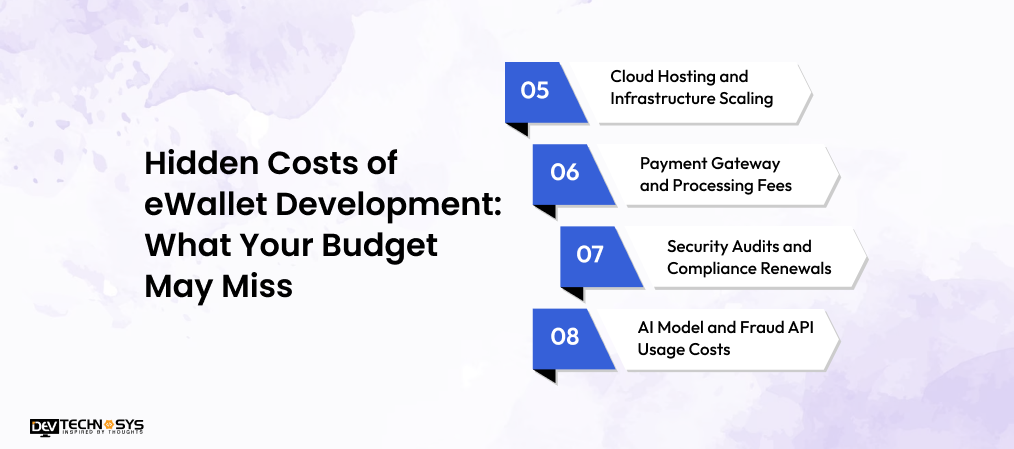
How Security and Compliance Requirements Affect eWallet App Development Cost?
Security and compliance are a core part of eWallet software development cost structure. This is because the platform processes account balances, card data, and transaction history. Compliance should be planned from day one, especially for a PCI DSS-compliant eWallet app development cost estimate targeting UAE and GCC markets.
1. PCI DSS Compliance
Protects card data through secure storage, card tokenization, and encrypted communication channels. This is required across all regions, not just the UAE, wherever card payments are processed.
Estimated cost: $8,000–$20,000
2. UAE Central Bank & Regional Regulatory Compliance
Wallets operating in the UAE must align with UAE Central Bank payment regulations and VARA guidelines for crypto-linked wallets. This includes licensing checks, transaction reporting, and consumer protection rules. Other regions require similar approvals, such as GDPR in the EU or RBI norms in India.
Estimated cost: $6,000–$15,000
3. Data Encryption
Protects wallet data in transit and at rest using AES-256 Encryption and SSL/TLS protocols. This keeps sensitive information unreadable even if intercepted, a baseline requirement across every market.
Estimated cost: $5,000–$12,000
4. Multi-Factor and Biometric Authentication
Adds extra layers of verification through Multi-Factor Authentication and biometric authentication for users and admins, reducing unauthorized access risk. This is especially critical for wallets in the UAE and GCC, where biometric ID checks are increasingly expected by regulators and users.
Estimated cost: $5,000–$10,000
5. Fraud Monitoring, Audit Logs and Access Control
Combines Role-Based Access Control, continuous transaction monitoring, and Audit Logging with secure authentication. This helps detect suspicious activity early and supports compliance reporting required by financial regulators in most jurisdictions.
Estimated cost: $7,000–$15,000
Custom eWallet vs White-Label Solution: Cost, Features & Flexibility Comparison
Custom and white-label eWallet solutions differ in cost, flexibility, ownership, and scalability. A custom eWallet app development cost generally requires a higher initial investment. White-label wallet software offers a faster and less expensive route to market. Here, we have explained the comparison between custom and white-label digital payment app development costs.
Cost Factor |
Custom eWallet App |
White-Label Solution |
| Initial Development | $30,000–$150,000+ | $5,000–$30,000+ |
| Customization | Full | Limited |
| Branding | Full control | Platform-dependent |
| Integrations | Flexible | Limited by provider |
| Source Code | Usually owned | Usually unavailable |
| Scalability | High | Provider-dependent |
| Launch Time | 4–9 months | Few weeks–3 months |
| Long-Term Control | High | Lower |
Businesses that want to build an eWallet App in minimum budget can prioritize an MVP and select only the features required for the initial launch.
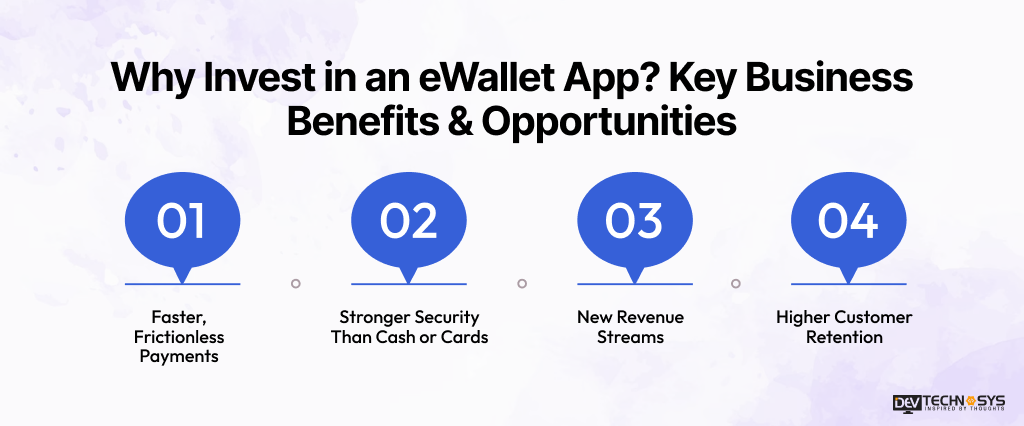
Why Invest in an eWallet App? Key Business Benefits & Opportunities
An eWallet app pays off through faster transactions, stronger customer retention, and new revenue streams that traditional payment methods cannot offer.
1. Faster, Frictionless Payments
Wallet transactions complete in seconds compared to card swipes or bank transfers. This speed reduces checkout abandonment, keeps users engaged during high-traffic periods, and creates a smoother payment experience overall, which directly improves conversion rates for merchants and platforms alike.
2. Stronger Security Than Cash or Cards
End-to-End Encryption, tokenization, biometric verification, and secure authentication protect every transaction from fraud and theft. Unlike physical cash or cards, wallet balances cannot be stolen on the spot. This built-in security layer builds user confidence and reduces chargeback risk for businesses handling digital payment infrastructure.
3. New Revenue Streams
Transaction fees, merchant commissions, premium subscriptions, and embedded lending products turn a payment tool into a revenue engine. Businesses are not limited to one monetization model. This flexibility lets wallet owners diversify income and scale profitability well beyond the initial launch phase.

4. Higher Customer Retention
Loyalty points, cashback offers, and stored balances give users a reason to return to the same wallet repeatedly. Once funds sit inside the app, switching to a competitor becomes less convenient. This stickiness increases lifetime value and reduces customer churn significantly over time.
eWallet App ROI: How to Estimate Your Potential Return Before Development
An eWallet app is a business investment, not just a product build. Before development starts, weigh the cost against realistic revenue potential. This shows whether the app has a genuine path to profitability.
Key ROI Variables
- Monthly transaction volume
- Average transaction fee or commission
- Platform commission from merchants
- Subscription revenue
- Active paying users
- User acquisition cost
- Monthly operating expenses
- Infrastructure and API costs
Simple ROI Formula
ROI (%) = [(Revenue − Total Investment) ÷ Total Investment] × 100
Payback Period
Payback Period = Initial Development Investment ÷ Monthly Profit
Track these numbers from month one. They tell you exactly when the app starts paying for itself.
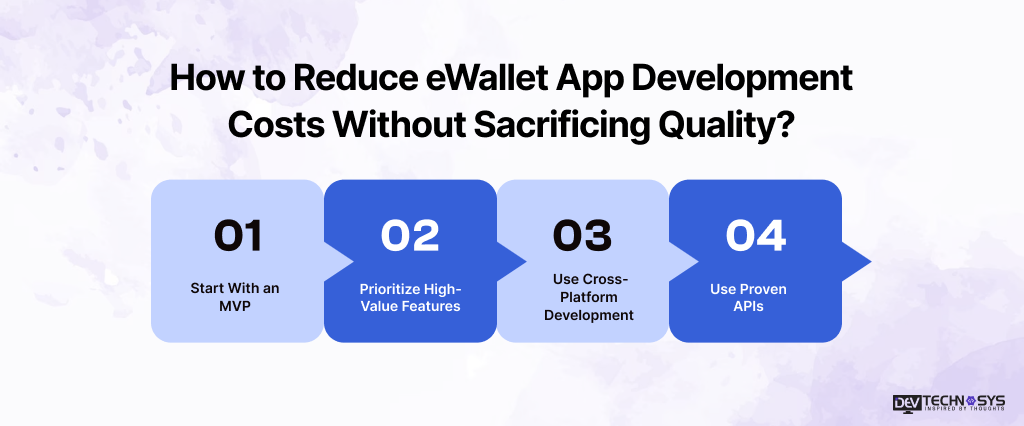
How to Reduce eWallet App Development Costs Without Sacrificing Quality?
Reducing eWallet development costs does not mean compromising security, compliance, or payment functionality. The smarter approach is to control the scope, prioritize business-critical features, and use proven technologies and integrations. This helps businesses launch faster, validate demand, and invest gradually in advanced capabilities.
1. Start With an MVP
Begin with core features like onboarding, wallet top-up, P2P transfers, and payments. This validates the idea early and focuses resources on what users need most. Once the MVP gains traction, advanced features can be introduced based on real user feedback and business priorities.
2. Prioritize High-Value Features
Focus on features that directly improve transaction speed and user trust. Avoid experimental features in early stages unless they clearly drive revenue. A focused feature set reduces development hours while allowing more budget for security, testing, and overall product quality.
3. Use Cross-Platform Development
Adopt frameworks like Flutter or React Native to build a single codebase for iOS and Android. This significantly reduces duplicated effort and lowers long-term maintenance costs. It can also simplify future updates by allowing teams to manage major changes across platforms more efficiently.
4. Use Proven APIs
Integrate trusted third-party APIs for payments, authentication, and banking connectivity. This reduces development time and ensures compliance-ready functionality without building complex systems from scratch. Selecting reliable APIs also reduces integration risks and allows developers to focus on the wallet’s unique business functionality.
Final Words
The eWallet can be transformed from just a payments app into something much more. This only happens if development takes security, convenience, scalability, and business value into account. Whether building a P2P wallet or an AI-powered financial platform, the right development strategy determines how it attracts investment and yields later.
A proper MVP, technology stack, compliance model, and feature prioritization can help manage costs without hindering growth. Are you also planning to build an eWallet app? You must contact one of the best eWallet app development companies. It helps turn your concept into a secure, scalable, and market-ready digital wallet tailored to your business goals.
FAQs
Q1. How Much Does It Cost To Build An eWallet App In 2026-2027 In The UAE?
Generally, the eWallet app development cost ranges from $30,000 to $1,50,000. The overall development cost depends on the platform’s complexity and several factors. These factors include platform choice, backend infrastructure, security and compliance, UI/UX, and post-launch support. An MVP-based app costs less than a fully advanced app.
Q2. How Long Does It Take to Develop an eWallet App?
Usually, it takes 3 to 7+ months to build an eWallet app. The final timeline relies on platform complexity, number of features, integrations, and security requirements. An MVP takes 3 to 5 months. On the other hand, a fully advanced app with AI and crypto support can take 7+ months to build.
Q3. How Can I Monetize an eWallet App?
Transaction fees, commissions, subscription plans, and premium services are among the common monetization models. By implementing these strategies, an eWallet platform generates recurring revenue. The right money-making model also depends on your target users and the services you offer. A well-planned monetization strategy keeps the core wallet experience affordable and competitive for users.
Q4. What Security Measures Does an eWallet App Need?
An eWallet app handles monetary transactions, so it must secure users’ personal and financial details along with their money. Security measures include End-to-End Encryption, Multi-Factor Authentication, Role-Based Access Control, a secure API Gateway, audit logs, tokenization, and regular security testing. Since the app handles financial data, these measures must be built in from the start.
Q5. Can an eWallet App Support Multiple Currencies and Crypto?
Yes, eWallet apps can support multi-currency transactions and crypto assets. For this, they integrate FX APIs and blockchain integrations. This is common among cross-border remittance wallets and platforms. They strategically target global users who need support for both fiat and digital assets. This expands payment flexibility while creating new global revenue opportunities.