





Key takeaways:
-
- Strategic Alignment Matters: Build AI in-house when it drives core competitive advantage or involves sensitive data. Partner when speed, scalability, or niche expertise is the priority.
- Skilled AI professionals are scarce and expensive. Partners provide immediate access to experienced teams, while in-house development requires long-term capability building.
- AI partners accelerate deployment using pre-built frameworks and cloud ecosystems. Internal teams may take longer due to recruitment and experimentation cycles.
- Cost & ROI Considerations: In-house AI requires a high upfront investment in hiring, infrastructure, and training. AI partners offer predictable pricing and faster time-to-value.
Artificial Intelligence has become a present-day business necessity. From automating operations to improving customer experience, AI is transforming how enterprises compete and grow. Tech companies are using tools powered by organizations such as OpenAI, Google Cloud, and Microsoft Azure to build smarter systems and enable data-driven decision-making.
But here’s the big question every enterprise faces: Should you build AI in-house or partner with an AI development company in Middle East?
Building an internal AI team gives you full control and long-term capability. Partnering with an experienced AI technology consulting firm in UAE gives you speed, expertise, and faster results. Both options have advantages. Both come with risks. The right choice depends on your budget, timeline, internal skills, data sensitivity, and long-term business vision.
In this AI partner vs. in-house development decision guide, we’ll break down both models in simple terms. You’ll understand the costs, benefits, risks, and key factors that matter most, so you can confidently choose the AI strategy that aligns with your enterprise goals.
What Is In-House AI Development?
In-house AI development refers to building, training, and maintaining artificial intelligence solutions using the internal team of your chatbot development company. It includes hiring data scientists, machine learning engineers, AI researchers, DevOps specialists, and project managers.
The organization owns the entire AI lifecycle, from data collection and model training to deployment and optimization. Companies often use platforms like TensorFlow and PyTorch, as well as cloud services such as Amazon Web Services, to build AI systems internally.
Key Characteristics:
- Full control over development and data
- Deep alignment with internal business processes
- Higher upfront investment
- Long-term internal capability building
Between AI partner vs in-house AI development, the AI development model is more suitable for enterprises with strong technical infrastructure and long-term AI ambitions.
What Is an AI Development Partner?
An AI development partner is a third-party company specializing in designing, developing, and deploying AI solutions for businesses. Instead of building everything internally, enterprises collaborate with experienced AI vendors who provide technical expertise, tools, and implementation support.
These In-house AI development teams in Middle East may leverage solutions from providers such as OpenAI, Google Cloud, or Microsoft Azure to accelerate development.
Key Characteristics:
- Faster time-to-market
- Access to specialized AI talent
- Reduced hiring burden
- Predictable project-based pricing
This model is ideal for enterprises that want edge-cutting artificial intelligence development services and quick deployment without building a full AI team from scratch.
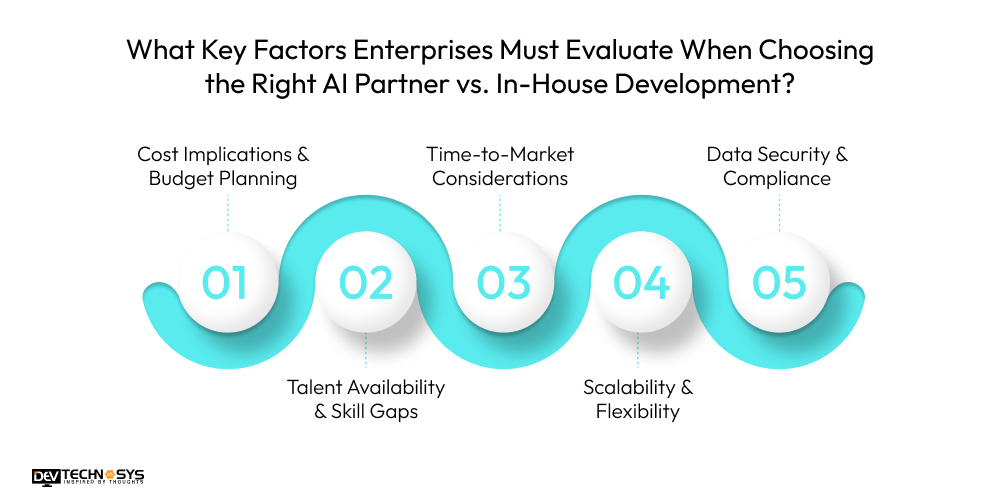
What Key Factors Enterprises Must Evaluate When Choosing the Right AI Partner vs. In-House Development?
Making the right decision between an AI partner vs. in-house development requires careful evaluation across multiple business dimensions. Below are the most critical factors enterprises should assess, along with side-by-side comparison tables for clarity.
1. Cost Implications & Budget Planning
AI projects involve more than just development expenses. Before choosing between AI partner vs. in-house development, enterprises must account for salaries, infrastructure, software licenses, cloud usage, compliance requirements, and ongoing maintenance.
In-house teams in Saudi Arebia require high upfront investment, while AI partners typically offer milestone-based, fixed-cost, or subscription pricing models. Smart budget forecasting should include both short-term build costs and long-term scaling expenses. The table below draws comparisons between outsourced AI development vs internal team based on cost implications.
| Cost Component | In-House AI Development | AI Development Partner |
| Initial Setup Cost | High (hiring + infrastructure) | Moderate (project-based) |
| Salary & Benefits | Ongoing fixed expense | Not applicable |
| Infrastructure (Cloud, GPUs) | Fully enterprise-funded | Often bundled in a contract |
| Licensing & Tools | Separate procurement cost | Included or shared |
| Budget Predictability | Variable | More predictable |
| Long-Term Financial Impact | Potentially lower over time | May increase with scaling |
2. Talent Availability & Skill Gaps
In an in-house model, companies must not only hire talent but also continuously invest in upskilling. AI technologies evolve rapidly, with new frameworks, tools, and models emerging frequently. Teams often work with platforms like TensorFlow and PyTorch, which require ongoing learning and experimentation to stay competitive.
Partnering with a firm that uses artificial Intelligence in mobile app development eliminates long recruitment cycles. Enterprises gain immediate access to experienced specialists who have already worked on diverse AI projects. AI implementation partners are typically trained in the latest technologies and best practices, allowing faster execution without internal skill gaps.
Many enterprises adopt a hybrid approach, building a small internal AI leadership team while leveraging external specialists for advanced development and scaling.
Industry Insights: According to Statista, two-thirds (about 66%) of business leaders globally said they would not hire someone who lacks AI skills, and more than 70% said they prefer hiring candidates with AI skills, even if they are less experienced.
| Talent Factor | In-House AI Development | AI Development Partner |
| Recruitment Time | Long hiring cycles | Immediate access |
| Skill Diversity | Limited to internal hires | Multi-domain expertise |
| Upskilling Requirement | Continuous internal training | Managed by a partner |
| Retention Risk | High turnover risk | Vendor handles staffing |
| Knowledge Retention | Strong internal knowledge | Limited internal learning |

3. Time-to-Market Considerations
In today’s competitive landscape, speed can determine market leadership. Enterprises that deploy AI solutions faster gain early advantages in customer experience, operational efficiency, and data-driven decision-making. Building an internal team may delay deployment due to recruitment, onboarding, experimentation, and infrastructure setup.
An AI partner who provides an artificial intelligence development solution uses proven frameworks, reusable components, and pre-built accelerators (such as Amazon Web Services or Microsoft Azure) to shorten development cycles.
| Timeline Factor | In-House AI Development | AI Development Partner |
| Team Setup Time | 3 to 6+ months | Immediate project start |
| Infrastructure Setup | Built from scratch | Pre-configured environments |
| MVP Development | Slower experimentation | Accelerated with frameworks |
| Deployment Speed | Moderate | Fast-track deployment |
| Competitive Response | Gradual | Rapid market entry |
4. Scalability & Flexibility
Before deciding on an AI partner vs in-house development, take note of the scalability factor. With an in-house model, scaling requires additional hiring, more cloud resources, upgraded hardware (such as GPUs), and expanded DevOps support. This can increase capital expenditure and slow down expansion. Workforce limitations may also create bottlenecks when multiple AI initiatives run simultaneously.
AI development partners, however, are structured for elastic scaling. They can quickly add specialists, expand computing capacity, or allocate cross-functional teams as project scope increases.
This flexibility allows enterprises to scale AI programs efficiently without long procurement cycles or hiring delays. However, if flexibility and rapid scaling are critical, especially during uncertain growth phases. Partnering with an AI firm provides operational agility and lower expansion risk. Here’s the comparison of AI collaboration models based on scalability.
| Scalability Factor | In-House AI Development | AI Development Partner |
| Workforce Expansion | Requires new hiring | On-demand expert allocation |
| Infrastructure Scaling | Enterprise-managed | Vendor-managed |
| Speed of Scaling | Slower | Rapid |
| Cost During Expansion | High capital investment | Operational expense model |
| Multi-Project Handling | Resource constraints possible | Flexible team deployment |
| Adaptability to New Use Cases | Moderate | High |
5. Data Security & Compliance
Data security is one of the most critical factors when implementing AI solutions. Enterprises must comply with strict data privacy regulations, such as the General Data Protection Regulation (GDPR), as well as industry-specific standards in healthcare, finance, and government sectors. Non-compliance can result in heavy penalties, reputational damage, and operational risks.
Building an internal AI team provides greater direct control over sensitive enterprise data. However, established AI partners build an artificial intelligence app by following enterprise-grade compliance frameworks and security best practices.
Industry Insights: According to Market.biz, around 40% of organizations have experienced an AI-related privacy breach, while 48% have reported employees uploading non-public company data.
| Security Factor | In-House AI Development | AI Development Partner |
| Data Ownership | Full internal control | Shared or contract-defined control |
| Regulatory Compliance | Internally managed | Vendor-supported compliance |
| Security Investment | Enterprise-funded | Often included in the service agreement |
| Risk Accountability | Fully internal | Shared responsibility model |
| Audit & Monitoring | Internal governance team | SLA-based monitoring & reporting |
| Scalability of Security | Depends on internal capacity | Enterprise-grade frameworks available |
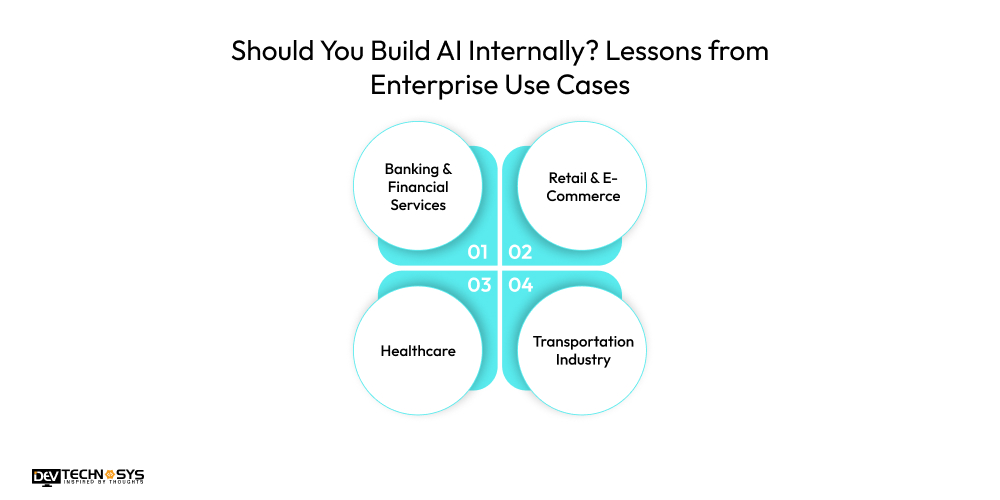
Should You Build AI Internally? Lessons from Enterprise Use Cases
Understanding how enterprises apply AI helps clarify the decision between AI partners and in-house development. The decision between an AI vendor vs internal AI team differs according to different industry choices. industries adopt different models depending on data sensitivity, competitive advantage, and speed requirements.
1. Banking & Financial Services
The role of artificial intelligence in financial Industry is quite significant. Major institutions such as JPMorgan Chase and HSBC typically develop core AI fraud detection and risk-scoring systems in-house. It helps them maintain strict control over sensitive financial data and regulatory compliance. However, they often collaborate with AI vendors to develop customer-facing chatbots and advanced analytics tools, accelerating innovation and reducing deployment time.
2. Retail & E-Commerce
Global retailers like Amazon and Walmart use AI extensively for product recommendations, dynamic pricing, and demand forecasting. While some large retailers build internal AI labs, many partner with AI solution providers in Dubai to quickly deploy recommendation engines and conversational commerce platforms, especially when expanding into new digital markets.
3. Healthcare
The use of AI in healthcare industry has completely changed the way of receiving and providing medical assistance. Healthcare organizations often develop AI systems involving sensitive patient data internally to comply with strict healthcare regulations. At the same time, they collaborate with AI technology firms to enable predictive analytics, radiology image analysis, and workflow automation, improving operational efficiency without overextending internal teams.
4. Transportation Industry
AI in transportation industry helps with route optimization, fleet management, and predictive maintenance. Companies like UPS often build core logistics AI systems in-house to maintain control over operational data and gain a competitive advantage.
However, many transportation firms partner with AI vendors to accelerate deployment and reduce upfront investment through fleet analytics, maintenance platforms, and customer service automation.
What Are the Risks of Building AI In-House vs. Hiring a Partner?
AI consulting firm vs in-house developers: which is a riskier choice? Every AI initiative carries risk, whether built internally or delivered through an external partner. The key is not avoiding risk, but identifying, managing, and mitigating it proactively.
In-house AI development gives enterprises full ownership of intellectual property, architecture decisions, and data governance. It strengthens long-term strategic capability and builds institutional knowledge. However, it demands sustained capital investment, continuous hiring, infrastructure scaling, and ongoing model maintenance.
Hiring an offshore AI development company, on the other hand, reduces execution complexity and accelerates delivery timelines. Yet, they introduce vendor dependency and require strong governance to ensure alignment, security, and long-term sustainability.
A hybrid model that combines internal ownership with external expertise often delivers the optimal balance between control, agility, and risk management. Here’s the table with AI outsourcing vs in-house team comparison and the recommended approach.
| Risk Area | In-House AI | AI Partner | Recommended Approach |
| Strategic Alignment | High control | Shared control | Strong governance model |
| Talent Stability | Recruitment challenges | External dependency | Hybrid capability building |
| Financial Exposure | High upfront cost | Contractual commitments | Phased budgeting |
| Data Security | Full internal control | Requires strict oversight | Compliance audits |
| Operational Resilience | Infrastructure dependent | SLA dependent | Clear monitoring framework |
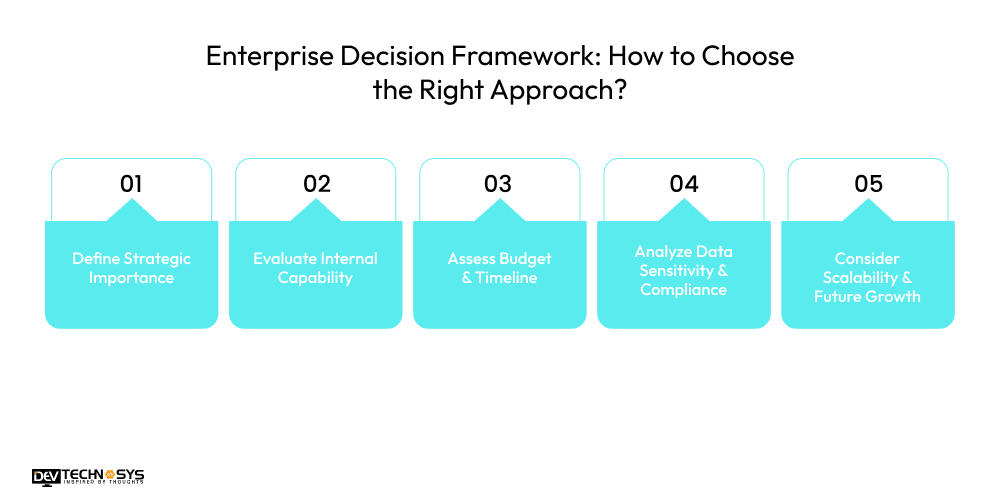
Enterprise Decision Framework: How to Choose the Right Approach?
Selecting an AI partner vs. in-house development requires a structured, objective evaluation. Enterprises should assess strategic priorities, internal readiness, financial flexibility, and long-term scalability before committing. Below is a simplified decision framework to guide executive decision-making:
Step 1: Define Strategic Importance
- Is AI central to long-term competitive differentiation?
- Will AI become a core intellectual property asset?
- Or is it primarily a support or operational efficiency function?
Guidance:
- If AI is a core competitive advantage, consider in-house or hybrid.
- If it supports operations, a partner model may be sufficient.
Step 2: Evaluate Internal Capability
- Have you experienced AI leadership?
- Is there existing data science or MLOps maturity?
- Can you sustain continuous model improvement and innovation?
Guidance:
- Strong internal capability favors in-house development.
- Capability gaps suggest partnering or hybrid execution.

Step 3: Assess Budget & Timeline
- Is rapid deployment critical to market positioning?
- Can you absorb the high upfront costs of hiring and infrastructure?
- Is predictable operational spending preferred over capital investment?
Guidance:
- Tight timelines favor AI partners.
- Long-term investment outlook supports in-house models.
Step 4: Analyze Data Sensitivity & Compliance
- Are you operating in a highly regulated industry?
- Does your data require strict internal governance?
- Are there cross-border data restrictions?
Guidance:
- High data sensitivity leans toward in-house or controlled hybrid approaches.
Step 5: Consider Scalability & Future Growth
- Will AI expand enterprise-wide over time?
- Do you expect fluctuating resource demands?
- Is flexible scaling important?
Guidance:
- Rapid, uncertain growth favors partner-led scalability.
- Stable, long-term expansion supports internal capability building.
Cost Comparison: AI Partner vs. In-House Team
Choosing between an AI partner and an in-house AI team directly impacts enterprise budget, scalability, and speed. In-house development involves high upfront hiring and infrastructure costs but builds long-term internal capability.
The cost to hire AI developers is more than an in-house team, and it is also more time-consuming. In contrast, AI partners bring ready-made expertise without internal recruitment overhead. AI partners reduce initial investment and accelerate deployment with predictable pricing models.
| Cost Factor | In-House Team | AI Partner |
| Initial Investment | High | Moderate |
| Hiring Costs | Significant | None |
| Infrastructure | Enterprise-funded | Often Included |
| Time-to-Value | Slower | Faster |
| Long-Term ROI | High (Strategic) | Moderate |

Conclusion
Choosing between AI partner vs. in-house development is not simply a technical decision; it is a long-term strategic commitment that affects cost structure, talent strategy, scalability, and competitive positioning. Both AI partner and in-house development offer unique benefits and services. Ultimately, the right choice depends on your enterprise’s strategic priorities, regulatory environment, internal capability, and growth ambitions.
Still confused? Talk to experts at Dev Technosys, a leading artificial intelligence development company in UAE, to find out which model is the right choice for your business.
FAQs
Q1. AI Partner vs. In-House Development: Which Option is Cheaper?
In-house AI requires significant upfront investment in hiring, infrastructure, and training. AI partners typically offer predictable pricing and faster deployment. While internal teams may deliver long-term value, partners often reduce short-term financial risk and accelerate ROI.
Q2. When Should An Enterprise Choose In-House AI Development?
Enterprises should build AI internally when it is central to competitive advantage, involves highly sensitive data, or requires full intellectual property ownership. Strong leadership, long-term funding, and internal technical maturity are essential for sustainable success.
Q3. When Is Partnering With An AI Company The Better Option?
Partnering is ideal when speed-to-market is critical, internal expertise is limited, or scalability demands fluctuate. AI firms provide immediate access to specialists, proven frameworks, and faster deployment without lengthy recruitment and onboarding cycles.
Q4. What Is A Hybrid AI Model?
A hybrid model combines internal governance and data control with external execution expertise. Enterprises retain strategic oversight while leveraging partners for AI consulting services, development, scaling, or niche capabilities, balancing control, flexibility, and innovation efficiency.
Q5. How Can Enterprises Avoid Vendor Lock-In?
Enterprises can reduce vendor dependency by adopting modular architectures, clearly defined SLAs, exit clauses, and structured knowledge-transfer plans. Maintaining internal oversight ensures long-term flexibility and protects strategic AI assets.
Q6. Why Is Long-Term AI Maintenance Important?
AI systems require continuous monitoring, retraining, optimization, and governance. Without lifecycle management, model accuracy and performance degrade over time. Enterprises must allocate resources for sustained AI operations regardless of development model.