





Key Takeaways:
-
- AI-powered ERP automates business processes, improves productivity, and supports faster, data-driven decision-making.
- A successful AI ERP implementation depends on quality data, clear planning, and the right technology strategy.
- The cost of AI ERP implementation typically ranges from $30,000 to $150,000, depending on project scope and customization.
- Businesses that adopt AI-enabled ERP systems gain better operational efficiency, scalability, and long-term competitive advantages.
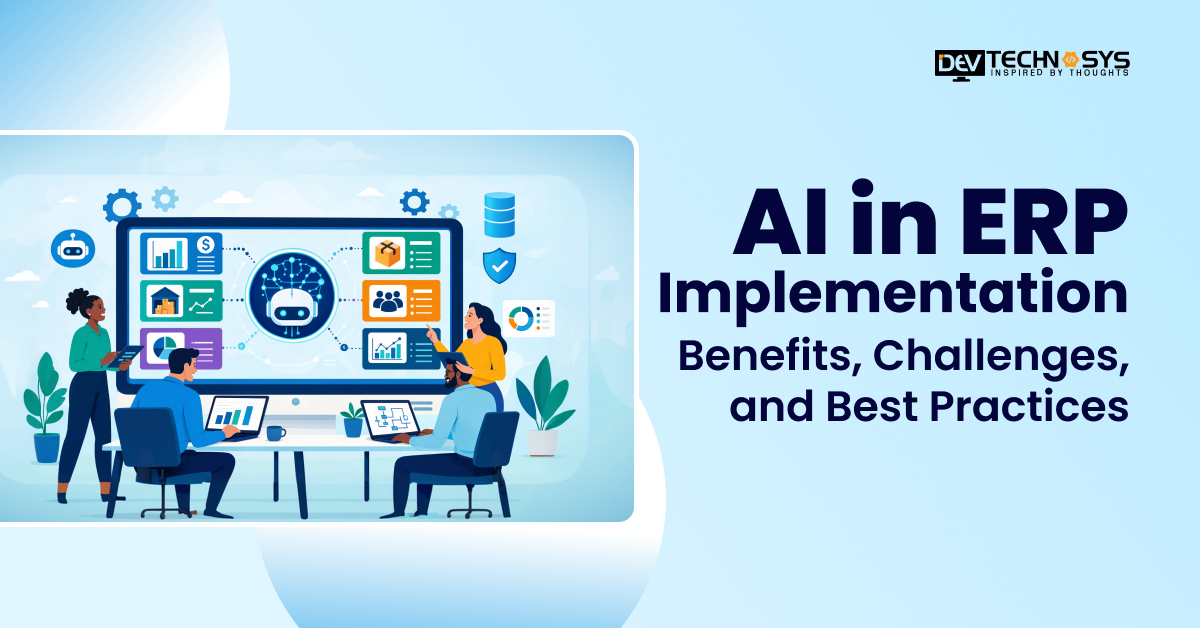
Artificial intelligence is transforming how businesses manage operations, and AI in ERP implementation is at the center of this shift. Modern organizations are moving beyond traditional enterprise resource planning systems by integrating AI-powered capabilities that automate workflows, improve forecasting, and deliver real-time business insights. From predictive analytics and machine learning to generative AI assistants, intelligent ERP systems help enterprises make faster decisions while reducing manual effort and operational costs.
A successful AI ERP implementation requires careful planning, high-quality data, seamless integration, and a well-defined strategy to maximize return on investment. In this guide, you’ll learn the key benefits of artificial intelligence in ERP, common implementation challenges, proven best practices, cost considerations, and future trends to help your business build a smarter, more efficient, and scalable ERP ecosystem.
What is AI in ERP Implementation?
AI in ERP implementation refers to the integration of artificial intelligence technologies into the enterprise resource planning ecosystem to automate processes, improve decision-making, and enhance overall business performance.
Unlike traditional ERP platforms that primarily store and process data, AI-powered ERP solutions leverage technologies such as machine learning in ERP, natural language processing (NLP), predictive analytics, and generative AI in ERP to analyze large datasets, identify patterns, and provide actionable recommendations in real time.
An AI ERP implementation goes beyond deploying software; it involves embedding intelligent capabilities into finance, human resources, supply chain, procurement, inventory, and customer relationship management workflows. This enables organizations to automate repetitive tasks, forecast demand, detect anomalies, optimize resource allocation, and improve operational efficiency with minimal manual intervention.
As businesses continue their ERP modernization initiatives, intelligent ERP systems are becoming a strategic investment for organizations seeking greater agility, scalability, and data-driven decision-making. Whether deployed on-premises or in the cloud, AI-enabled ERP software supports continuous learning, adapts to changing business conditions, and delivers measurable improvements across enterprise operations.
Businesses planning to adopt these capabilities often partner with an ERP software development company to design customized solutions that align AI technologies with their operational goals, existing infrastructure, and long-term digital transformation strategy.
AI in ERP Implementation Market Overview
The adoption of AI in ERP implementation is accelerating as enterprises modernize their business operations with intelligent automation, predictive analytics, and real-time decision-making. Organizations across manufacturing, retail, healthcare, and financial services are integrating AI-powered ERP solutions to streamline workflows, improve forecasting, and increase operational efficiency.
As businesses continue their ERP modernization initiatives, artificial intelligence is becoming a key driver of innovation and long-term digital transformation. According to the Business Research Company, the latest market statistics highlight the growing demand for AI ERP implementation across global industries.
Market Metric |
Latest Market Insight |
| Global Market Size | In 2025, the global AI in Enterprise Resource Planning (ERP) market was valued at USD 4.68 billion. |
| Market Growth | In 2026, the market is projected to reach USD 5.54 billion, growing at a CAGR of 18.4%. |
| Future Forecast | By 2030, the global AI in ERP market is expected to reach USD 10.95 billion, expanding at a CAGR of 18.6% during the forecast period. |
| Regional Leadership | In 2025, North America held the largest market share, while Asia-Pacific is expected to be the fastest-growing regional market through 2030. |
These trends show that AI ERP implementation is no longer an emerging concept. It is becoming a core strategy for enterprises seeking greater efficiency, automation, and data-driven decision-making across business operations.
Industry Insight
According to McKinsey, early adopters of AI-integrated ERP systems are already reporting EBIT improvements of 5% or more.
Top Benefits of AI in ERP Implementation for Modern Enterprises
Implementing AI into an ERP system helps organizations move beyond basic automation and achieve smarter, data-driven operations. Unlike traditional ERP platforms, AI in ERP implementation enables businesses to analyze large volumes of data, automate repetitive workflows, and generate actionable insights in real time.
By combining technologies such as machine learning in ERP, predictive analytics, natural language processing (NLP), and generative AI in ERP, organizations can improve productivity, reduce operational costs, and make faster business decisions.
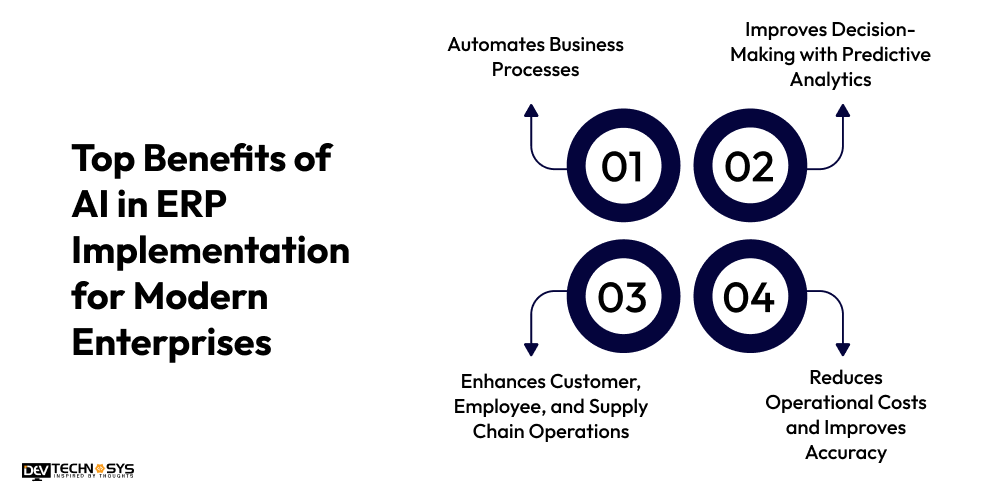
1. Automates Business Processes
One of the biggest advantages of AI-powered ERP is its ability to automate routine business activities such as invoice processing, procurement approvals, inventory updates, payroll management, and financial reporting. Intelligent automation minimizes manual intervention, reduces processing time, and allows employees to focus on strategic initiatives. Businesses looking to maximize these capabilities often rely on ERP software development services to integrate AI features that align with their operational requirements.
2. Improves Decision-Making with Predictive Analytics
Artificial intelligence continuously analyzes historical and real-time business data to identify trends, forecast demand, and detect operational risks. With predictive analytics and AI copilots, managers can make informed decisions based on accurate insights instead of assumptions. This enhances planning across finance, supply chain, sales, and human resources while improving overall business agility.
3. Enhances Customer, Employee, and Supply Chain Operations
Modern AI-enabled ERP software improves experiences across multiple business functions. AI-powered chatbots and virtual assistants provide faster employee support, while intelligent demand forecasting helps optimize inventory levels and reduce supply chain disruptions. These capabilities enable organizations to respond quickly to changing customer expectations and market conditions.
4. Reduces Operational Costs and Improves Accuracy
An AI-driven ERP implementation minimizes human errors by automating data validation, anomaly detection, and workflow execution. AI algorithms also support fraud detection, resource optimization, and financial forecasting, leading to lower operational expenses and better compliance. As organizations continue their ERP modernization journey, these intelligent capabilities deliver measurable improvements in efficiency, scalability, and long-term return on investment.
Answer a few quick questions and our experts will share a tailored project estimate.
How Does AI Improve the ERP Implementation Process?
Successfully implementing an ERP system requires careful planning, data preparation, system configuration, testing, and continuous optimization. By incorporating ERP implementation in AI, businesses can streamline each stage of the ERP implementation process, reduce project risks, and accelerate deployment timelines.
Technologies such as machine learning, natural language processing (NLP), predictive analytics, and intelligent automation help organizations improve data quality, automate repetitive tasks, and deliver better project outcomes.
ERP Implementation Stage |
Traditional ERP Approach |
AI-Driven ERP Approach |
Business Benefit |
| Planning & Process Analysis | Manual workflow assessments | AI analyzes workflows and recommends improvements | Faster project planning and better resource allocation |
| Data Migration & Configuration | Manual data mapping and validation | AI automates data cleansing, mapping, and anomaly detection | Improved data accuracy and reduced migration errors |
| Testing & Deployment | Time-consuming manual testing | AI performs automated testing and identifies configuration issues | Faster deployment with fewer implementation risks |
| Post-Implementation Optimization | Periodic manual reviews | AI continuously monitors performance and recommends optimizations | Ongoing efficiency improvements and better business outcomes |
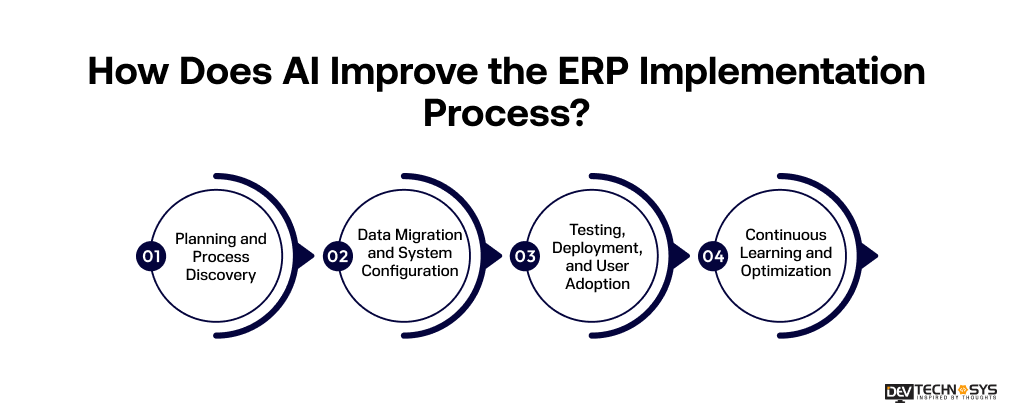
1. Planning and Process Discovery
The success of any AI ERP implementation begins with understanding existing business workflows. AI-powered process mining tools evaluate operational data, identify inefficiencies, and recommend workflow improvements before implementation starts. This creates a stronger foundation for a successful ERP deployment.
2. Data Migration and System Configuration
Migrating data from legacy systems is often one of the most challenging phases of an ERP project. AI simplifies this process by automating data cleansing, detecting duplicate records, validating master data, and improving data governance. Businesses implementing these capabilities through an ERP software development solution can significantly reduce migration errors and improve system reliability.

3. Testing, Deployment, and User Adoption
AI accelerates software testing by identifying configuration issues, validating business rules, and monitoring application performance before deployment. Intelligent virtual assistants and AI copilots also support employee onboarding by answering user questions, recommending workflows, and improving adoption across departments.
4. Continuous Learning and Optimization
Unlike traditional ERP systems, intelligent ERP systems continue to learn after deployment. AI continuously analyzes operational data, recommends process improvements, predicts equipment failures, forecasts demand, and identifies emerging business risks. This ongoing optimization helps organizations maximize the long-term value of their ERP investment while supporting continuous digital transformation.
Quote
According to Jensen Huang, “People talk about AI reducing jobs, complete nonsense.”
AI ERP Implementation Cost Breakdown in Q3 – 2026
The cost of AI in ERP implementation depends on several factors, including business size, customization requirements, AI capabilities, third-party integrations, deployment model, and implementation complexity.
Features such as machine learning in ERP, predictive analytics, AI copilots, and intelligent document processing (IDP) require additional planning, data preparation, and integration. A well-defined implementation roadmap helps businesses control costs while maximizing long-term value.
Business Size |
Estimated Development Cost |
Timeline |
Best For |
| Small Business | $30,000–$50,000 | 3–5 Months | Standard ERP modules with basic AI automation |
| Medium Business | $50,000–$100,000 | 5–8 Months | Custom workflows, predictive analytics, and third-party integrations |
| Large Enterprise | $100,000–$150,000+ | 8–12 Months | Enterprise-wide automation, advanced AI capabilities, and scalable cloud deployment |
The final development cost is influenced by several technical and business requirements:
- AI functionality: Advanced features such as generative AI, AI agents, predictive analytics, and NLP increase implementation effort.
- Customization: Tailoring workflows, dashboards, and business logic to specific operational requirements requires additional development.
- Data migration: Cleansing, validating, and migrating legacy data ensures higher system accuracy and reliable reporting.
- Third-party integrations: Connecting the ERP with CRM, HRM, payment gateways, BI tools, and REST APIs adds development time.
- Cloud infrastructure and security: Hosting, scalability, RBAC, data encryption, and compliance standards such as GDPR or ISO 27001 also contribute to the overall budget.
Businesses planning to build a custom ERP solution can reduce ERP implementation costs by prioritizing high-value AI features, adopting a phased deployment strategy, and selecting a scalable architecture that supports future growth without requiring major system redesigns.
Common Challenges in AI ERP Implementation in Businesses
While ERP implementation in AI offers significant business advantages, organizations may face several technical and operational challenges during deployment. Issues such as poor data quality, legacy system compatibility, employee resistance, and security concerns can impact project success if they are not addressed early.
Following a structured ERP implementation process and partnering with experienced technology experts can help businesses overcome these challenges and achieve long-term value.
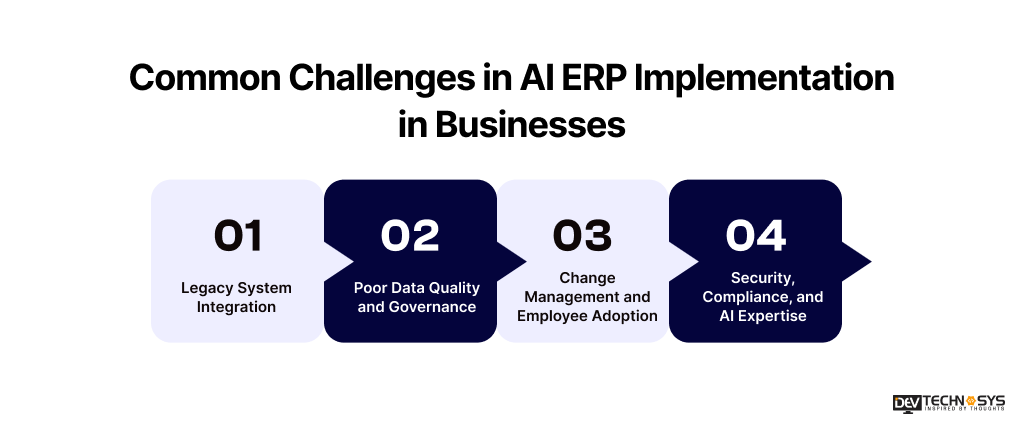
1. Legacy System Integration
Many organizations still rely on outdated software that lacks compatibility with modern AI-powered ERP platforms. Integrating legacy applications with cloud-based ERP systems, APIs, and AI services often requires custom middleware and careful planning. A well-designed custom software development solution helps ensure seamless integration while minimizing operational disruptions.
2. Poor Data Quality and Governance
Artificial intelligence relies on accurate, consistent, and well-structured data to generate meaningful insights. Duplicate records, incomplete datasets, and inconsistent formatting can reduce the accuracy of predictive analytics and machine learning models. Establishing strong data governance, master data management (MDM), and data cleansing processes is essential before implementation begins.
3. Change Management and Employee Adoption
Introducing AI-enabled ERP software changes how employees interact with business processes. Without proper training and communication, users may hesitate to adopt new workflows and automation tools. Organizations should provide role-based training, AI-assisted onboarding, and continuous support to improve user confidence and accelerate adoption across departments.
4. Security, Compliance, and AI Expertise
Enterprise ERP systems process sensitive financial, operational, and customer information. Businesses must implement robust security measures such as role-based access control (RBAC), identity and access management (IAM), encryption, and continuous monitoring to protect critical data. Compliance with standards such as GDPR and ISO 27001 is equally important. In addition, organizations should invest in skilled AI and ERP professionals who can configure, optimize, and maintain intelligent ERP systems for long-term success.
ERP Implementation Best Practices for AI Success
A successful AI in ERP implementation requires more than selecting the right software. Businesses need a clear strategy, reliable data, scalable technology, and continuous optimization to maximize the value of their investment. Following these ERP implementation best practices helps organizations reduce project risks, improve adoption, and achieve measurable business outcomes.
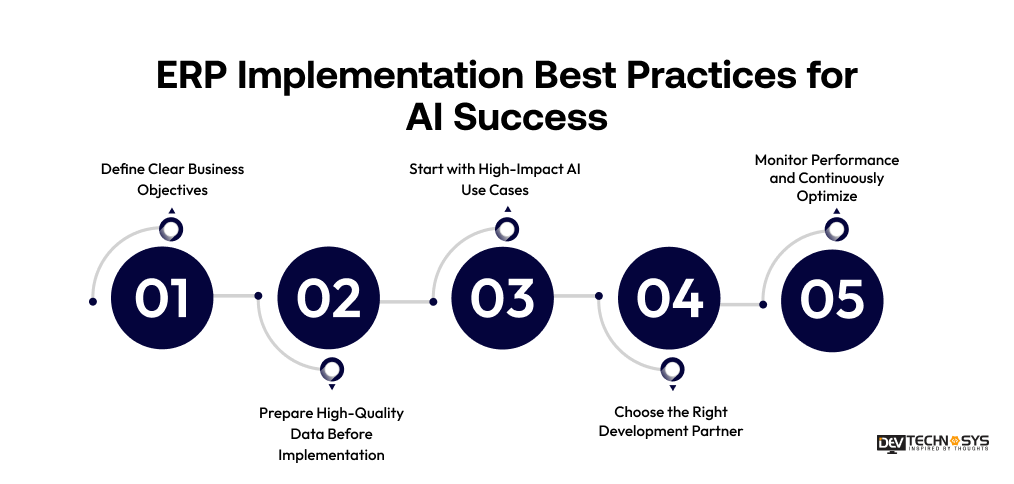
1. Define Clear Business Objectives
Start by identifying the business challenges your ERP system should solve. Whether the goal is to automate financial operations, optimize inventory management, improve customer service, or strengthen supply chain visibility, clearly defined objectives help prioritize AI capabilities and measure project success through relevant KPIs.
2. Prepare High-Quality Data Before Implementation
The effectiveness of artificial intelligence in ERP depends on the quality of enterprise data. Clean, standardized, and well-governed data improves machine learning models, predictive analytics, and reporting accuracy. Data cleansing, master data management (MDM), and ETL processes should be completed before deployment to minimize implementation issues.
3. Start with High-Impact AI Use Cases
Instead of introducing AI across every department at once, begin with processes that deliver the highest return on investment. Invoice automation, demand forecasting, procurement optimization, and intelligent reporting often provide measurable improvements within a shorter timeframe while building confidence in the new system.
4. Choose the Right Development Partner
Selecting the right implementation partner is just as important as choosing the ERP platform. Experienced teams can design scalable architectures, integrate third-party systems, and align AI capabilities with business objectives. Many organizations choose to hire dedicated developers with expertise in ERP, cloud technologies, APIs, and AI integration to ensure a smoother implementation journey.
5. Monitor Performance and Continuously Optimize
An ERP system should continue evolving after deployment. Track KPIs such as workflow efficiency, reporting accuracy, user adoption, and operational costs to evaluate performance. Regular updates, AI model refinement, and continuous process optimization help businesses maximize the long-term value of their AI ERP implementation while supporting future growth.
Industry Insight
According to Gartner, finance teams using cloud ERP with embedded AI assistants are expected to achieve a 30% faster financial close by 2028.
How Different Industries Are Using AI in ERP Implementation?
The impact of AI in ERP implementation extends across industries, helping organizations automate operations, improve decision-making, and optimize resource utilization. By combining AI-powered ERP capabilities with predictive analytics, machine learning, and intelligent automation, businesses can address industry-specific challenges while improving efficiency and scalability.
Industry |
AI ERP Use Case |
Business Benefit |
| Manufacturing | Predictive maintenance, production scheduling, quality control | Reduced downtime and improved production efficiency |
| Retail | Demand forecasting, inventory optimization, personalized promotions | Better inventory accuracy and higher customer satisfaction |
| Healthcare | Patient resource planning, billing automation, compliance monitoring | Faster administrative processes and improved regulatory compliance |
| Finance | Financial forecasting, fraud detection, automated reporting | Improved accuracy and better financial decision-making |
| Logistics | Fleet optimization, warehouse automation, route planning | Lower transportation costs and faster deliveries |
| Construction | Project planning, procurement management, equipment tracking | Better resource utilization and reduced project delays |
Organizations adopting AI-enabled ERP software can tailor these capabilities to their operational requirements.
Businesses evaluating modern ERP platforms should also compare the top ERP software available in the market before selecting a solution. Choosing the right platform ensures compatibility with future AI capabilities, supports business growth, and simplifies long-term ERP modernization initiatives.
The Future of ERP Implementation through AI
The future of AI in ERP implementation will be shaped by intelligent automation, autonomous decision-making, and continuously evolving enterprise systems. As AI technologies mature, organizations will move beyond process automation and adopt ERP platforms that can analyze data, recommend actions, and execute routine tasks with minimal human intervention. These innovations will help businesses become more agile, resilient, and data-driven.
One of the biggest trends is the growing adoption of generative AI in ERP, where AI copilots assist employees with report generation, workflow recommendations, document creation, and natural language queries. At the same time, AI agents will automate multi-step business processes across finance, procurement, inventory, and customer service.
Another key trend is the rise of predictive and self-optimizing ERP platforms. Using machine learning, real-time analytics, and digital twins, intelligent ERP systems will continuously identify inefficiencies, forecast business risks, and recommend process improvements before problems occur.
Investing in scalable architecture today will help organizations adapt to future innovations while maximizing the long-term value of their ERP platform.
Why Businesses Should Invest in AI ERP Implementation in 2026?
As enterprises continue to embrace digital transformation, investing in AI in ERP implementation has become a strategic decision rather than a technology upgrade. Modern organizations need ERP systems that can adapt to changing market conditions, automate complex workflows, and provide real-time insights for faster decision-making. An AI-powered ERP platform delivers these capabilities while improving operational efficiency, reducing manual effort, and supporting long-term business growth.
Beyond automation, AI ERP implementation enables organizations to optimize resource planning, improve financial forecasting, strengthen supply chain resilience, and enhance customer experiences. Intelligent technologies such as machine learning, predictive analytics, and AI copilots also help businesses identify new opportunities, mitigate risks, and respond proactively to market changes.
Organizations that invest in scalable, AI-enabled ERP software today are better positioned to innovate, remain competitive, and support future expansion. By aligning AI capabilities with clear business objectives and following a structured implementation strategy, companies can maximize return on investment while building a smarter, more resilient enterprise for years to come.

Conclusion
AI in ERP implementation is redefining how businesses manage operations, make decisions, and drive long-term growth. By integrating intelligent technologies such as machine learning, predictive analytics, and generative AI, organizations can automate workflows, improve data accuracy, and enhance overall business performance. While successful implementation requires careful planning, quality data, and effective change management, the long-term benefits often outweigh the initial investment.
Businesses that adopt a structured implementation approach and prioritize scalable AI capabilities will be better equipped to improve operational efficiency, reduce costs, and adapt to changing market demands. Businesses planning their digital transformation should also evaluate a custom web development company that can integrate AI technologies, cloud infrastructure, APIs, and enterprise applications into a unified ecosystem.
Frequently Asked Questions
Q1. What is the Difference Between Traditional ERP and AI-powered ERP?
Traditional ERP systems primarily record, organize, and manage business data using predefined rules. In contrast, AI-powered ERP uses machine learning, predictive analytics, and generative AI to automate workflows, forecast trends, detect anomalies, and provide intelligent recommendations that support faster business decisions.
Q2. What is the Biggest Challenge in AI in ERP Implementation?
The main challenge is to make sure the data is high quality and governed appropriately. For AI models to produce credible insights, they need accurate and consistent input. Organizations also need to consider legacy system interoperability, employee adoption, and security for successful AI in ERP installation.
Q3. Can AI Be Integrated Into an Existing ERP System?
Yes, most modern ERP platforms allow AI integration through APIs, cloud services, and embedded AI capabilities. Companies can incorporate predictive analytics, intelligent document processing, AI copilots, and workflow automation without replacing their entire ERP system.
Q4. Which Industries Benefit the Most From AI-powered ERP?
The industries that gain the most from AI-powered ERP are manufacturing, retail, healthcare, finance, logistic,s and construction. These firms leverage AI to estimate demand, predict maintenance, plan finances, optimize inventory, monitor compliance, and allocate resources intelligently.
Q5. Is AI Replacing ERP Systems?
No, AI is enhancing ERP systems, not replacing them. Modern ERP systems incorporate AI to automate repetitive processes, enhance decision-making, and streamline user interactions. Human oversight is still important for governance, compliance, financial approvals, and strategic company choices.