





Key Takeaways:
-
- Mobile app adoption is rapidly increasing across the Middle East, fueled by digitalization, smartphone penetration, and the rising demand for convenient, technology-driven services.
- Development costs vary significantly by complexity, platform, and country, with advanced apps requiring AI, AR, custom backend systems, and high-quality UX/UI design.
- Emerging trends such as AI, AR/VR, IoT, low-code development, and mobile-first strategies are reshaping app functionality and user engagement in the region.
- The future of mobile apps in the Middle East relies on fintech growth, blockchain adoption, cross-platform development, and government-driven digital transformation initiatives supporting smart cities.
The Middle East is witnessing a digital revolution, and mobile apps are at the heart of this transformation. Businesses across sectors, from retail and finance to healthcare and logistics, are leveraging mobile technology to enhance customer experiences, optimize operations, and create new revenue opportunities.
This blog dives into five real business case studies that reveal how organizations in the region are redefining mobile app development. Each story highlights innovative solutions, practical challenges, and measurable outcomes. It offers a roadmap for mobile app development in Middle East seeking to thrive in a mobile-first world.
From AI-powered features to seamless cross-platform experiences, these cases showcase how mobile apps are driving efficiency, engagement, and growth. Discover how visionary businesses in the Middle East are turning apps into powerful tools for competitive advantage and long-term success.
Mobile App Development Landscape in the Middle East
Mobile technology is spearheading the rapid adoption of digital transformation in the Middle East. Mobile apps are the main means of communication, business, and service delivery in nations like the United Arab Emirates, Saudi Arabia, and Qatar, where smartphone adoption is remarkably high. Businesses have a plethora of options to interact digitally as consumers depend more and more on apps for banking, retail, healthcare, entertainment, and even government services.
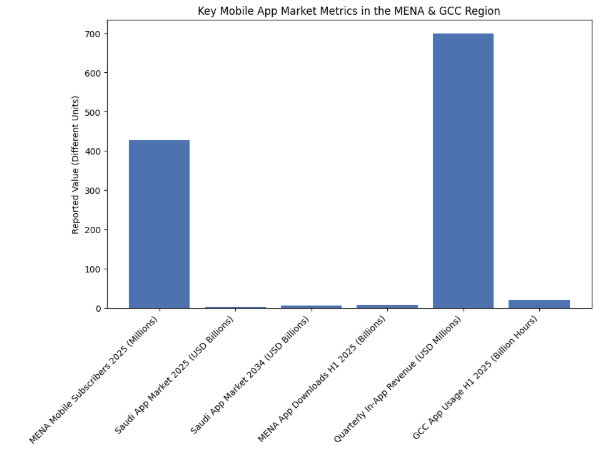
- Approximately 427 million individuals in the MENA region were subscribers to Middle East mobile app development services by the end of 2025, with nearly half of them routinely utilizing mobile internet.
- Smartphone penetration rates in the Gulf Cooperation Council (GCC) countries, which include Saudi Arabia, the UAE, Qatar, Kuwait, Bahrain, and Oman, surpass 90%, with some countries approaching 100% adoption.
- Smartphone usage in the Middle East and Africa is anticipated to reach over 90% by 2030.
- Mobile app development in Saudi Arabia industry was valued at approximately $2.2 billion in 2025 and is anticipated to reach $5.8 billion by 2034.
- In the initial half of 2025, the MENA region documented 7.9 billion app downloads, reflecting an 11% year-over-year rise.
- In-app purchases made a lot of money in the area, with some reports saying they climbed by 20% every year and made over $700 million in just one quarter.
- In the first half of 2025, users in the GCC used mobile apps for more than 20 billion hours.
Dev Technosys: Transforming Mobile Experiences Across the Middle East
Businesses want more than just apps in today’s fast-paced digital environment; they also require intelligent, scalable, and user-centric solutions that boost customer engagement and spur growth. With over 1000 creative solutions that have helped brands redefine digital success, Dev Technosys has become a reputable hybrid app development company in Middle East.
From streamlining user experiences to boosting revenue and operational efficiency, our mission is simple: turn bold ideas into apps that matter. Let’s explore the success stories of six transformative projects we’ve delivered for leading brands in the region.
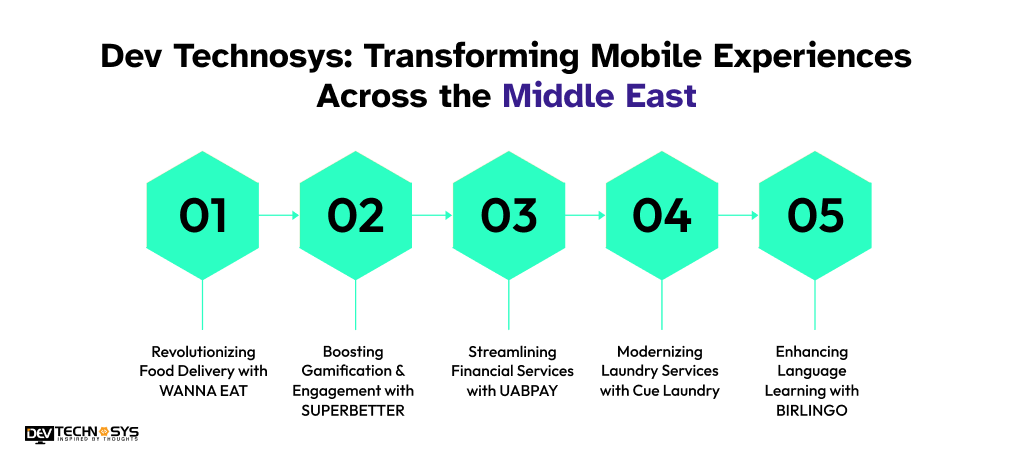
1. Revolutionizing Food Delivery with WANNA EAT
WANNA EAT is a food delivery platform connecting hungry customers with local restaurants, aiming to provide faster, more reliable service in the UAE.
Challenges and Concerns
- Dependence on Third-Party Platforms: Most orders came through external aggregators, limiting brand visibility.
- User Retention: Low app engagement and repeat orders were affecting revenue growth.
- Regional Expansion: The brand wanted to scale quickly across multiple cities in the UAE.
Our Approach
Dev Technosys developed a robust, intuitive mobile app with a focus on seamless ordering, real-time tracking, and personalized recommendations. Hire on-demand app developers to implement advanced analytics to monitor user behavior and optimize engagement strategies.
Results
- Increased direct app orders by 48%, reducing reliance on third-party platforms.
- Achieved an average app rating of 4.6 on iOS and Android.
- Repeat orders grew by 55%, enhancing customer loyalty.
2. Boosting Gamification & Engagement with SUPERBETTER
SUPERBETTER is a wellness and habit-building app designed to help users achieve personal goals through gamified challenges.
Challenges and Concerns:
- User Motivation: Keeping users engaged in long-term challenges.
- Cross-Platform Consistency: Ensuring seamless experiences on both iOS and Android.
- Data-Driven Insights: Capturing behavioral data for continuous improvement.
Read more: Top 10 Mobile App Development Frameworks
Our Approach:
Our team created a gamified UX with interactive quests, rewards, and community features. Integration with social platforms allowed users to share progress, while dashboards helped track performance and engagement.
Results:
- Increased active user retention by 60% within 6 months.
- Daily engagement metrics rose by 70%, making SUPERBETTER a habit-forming platform.
- Enhanced analytics enabled tailored challenges, boosting overall user satisfaction.
3. Streamlining Financial Services with UABPAY
UABPAY is a fintech solution aimed at simplifying payments and digital banking for businesses and individuals across the Middle East.
Challenges and Concerns:
- Secure Transactions: Ensuring compliance with regional financial regulations.
- User-Friendly Interfaces: Making complex financial services accessible to non-technical users.
- Scalable Architecture: Preparing the app to handle rapid growth and multi-regional expansion.
Our Approach:
We built a secure, feature-rich mobile application with multi-currency support, instant payments, and AI-driven expense management. Real-time dashboards provided both users and admins with actionable insights.
Results:
- User adoption grew by 3x within the first year.
- Over 80% of transactions shifted to the app from traditional channels.
- Positive app store rating of 4.7, reflecting user trust and satisfaction.
4. Modernizing Laundry Services with Cue Laundry
Cue Laundry provides on-demand laundry and dry-cleaning services across urban areas, aiming to make home care hassle-free.
Challenges and Concerns:
- Logistics Optimization: Managing pick-up and delivery efficiently.
- Real-Time Tracking: Providing accurate order status updates.
- User Retention: Reducing app churn in a competitive market.
Our Approach:
We developed an intelligent mobile platform integrating route optimization, automated notifications, and secure payment gateways. Personalized reminders and loyalty programs encouraged repeat orders.
Results:
- Order fulfillment time reduced by 35%, improving operational efficiency.
- Monthly active users increased by 50%, strengthening market presence.
- Customer satisfaction scores reached 4.8 on app stores.
Read More: A Beginner’s Guide to Using MANGA Plus
5. Enhancing Language Learning with BIRLINGO
BIRLINGO is an innovative app that empowers users to learn languages through interactive lessons, games, and live tutoring sessions.
Challenges and Concerns:
- Engagement: Keeping learners motivated over long-term courses.
- Scalability: Supporting multiple languages and regional content variations.
- Analytics: Monitoring progress to deliver personalized learning experiences.
Our Approach:
We designed an engaging, gamified learning environment, integrating quizzes, live tutor sessions, and AI-based adaptive learning modules. Personalized dashboards tracked progress and suggested next steps.
Results
- User engagement improved by 65%, with learners completing courses faster.
- Over 200,000 downloads within the first 6 months of launch.
- Partnerships with educational institutions strengthened BIRLINGO’s brand credibility.
What is the Mobile App Development Cost in Middle East?
The mobile app development cost in UAE varies greatly based on the platform, area, and complexity of the app. For startups or small enterprises, a basic app with straightforward features usually costs between $8,000 and $15,000. Apps with user authentication, APIs, or payment integration that are of medium complexity typically cost between $15,000 and $20,000.
Advanced or enterprise-level applications can cost more than $20,000 to $25,000 and include capabilities like AR/AI, real-time analytics, and reliable backend infrastructure. Due to the higher cost of mobile app developers in Middle East, costs are often higher in nations like Saudi Arabia and the United Arab Emirates. While smaller markets could provide lower development costs.
| App Type | Features | Estimated Cost (USD) |
| Basic App | Simple UI, basic functionality, no backend | $8,000 – $15,000 |
| Medium Complexity App | User login, API integration, payments, database | $15,000 – $20,000 |
| Advanced/Enterprise App | AR/AI features, real-time analytics, complex backend | $20,000 – $25,000+ |
The Future of Mobile App Development in Middle East
Transforming mobile app development in Middle East examines the impact of technology on business and daily life in the region. This section emphasizes the trends, problems, and opportunities influencing the future of custom mobile app development services in Middle East, focusing on AI and AR integration, finance innovation, and smart city solutions.
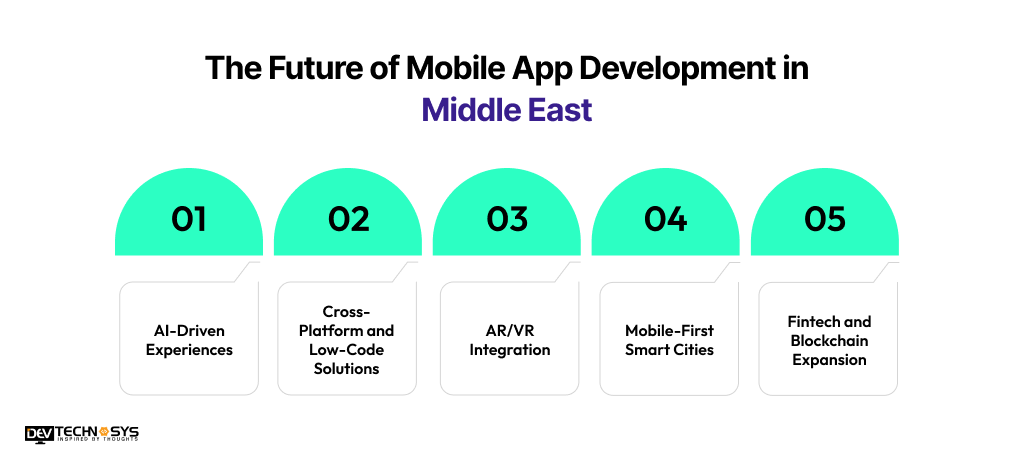
1. AI-Driven Experiences
Chatbots, tailored content, and predictive analytics will all be made possible by artificial intelligence. Businesses in the Middle East will utilize AI more and more to boost customer service, increase user engagement, and maximize operational efficiency. This will make apps smarter, more responsive, and customized to each user’s tastes in industries like retail and banking.
2. Cross-Platform and Low-Code Solutions
Low-code/no-code platforms and cross-platform development tools will become more common, cutting down on development time and expense. Businesses and startups in the area can maintain scalability, reach numerous devices, and build apps more quickly. These mobile app development solutions enable companies with modest technological resources to innovate and successfully compete in online markets.
3. AR/VR Integration
User experiences in retail, real estate, education, and travel will be completely transformed by augmented and virtual reality. Enterprise mobile app development in Middle East will include AR and VR capabilities to provide immersive training programs, virtual tours, and interactive product demos. These Middle East mobile app solutions will assist the region’s expanding digital-first initiatives, increase sales, and improve engagement.
4. Mobile-First Smart Cities
Android app development solutions will be crucial to urban administration as cities like Dubai and Riyadh adopt smart infrastructure. Applications for utilities, transportation, healthcare, and citizen services will be integrated, utilizing IoT and real-time data to enhance urban living’s sustainability, efficiency, and convenience.
5. Fintech and Blockchain Expansion
Blockchain in custom mobile app development in Middle East offers safe transactions, identity verification, and payments, which will be fueled by the financial growth in the Middle East. In order to support regional economic diversification objectives and offer safer, quicker, and more transparent financial services, governments and the business sector will invest in digital wallets, cryptocurrency solutions, and decentralized platforms.

Conclusion
Mobile experiences are changing dramatically in the Middle East in today’s cutthroat digital environment. It is evident from our work with WANNA EAT, SUPERBETTER, UABPAY, Cue Laundry, and BIRLINGO that scalable solutions, user-centric design, and strategic innovation lead to quantifiable growth and customer happiness. As a reputable custom mobile app development company, Dev Technosys keeps enabling companies to overcome obstacles, grow their online presence, and provide consumers with outstanding value. These case studies demonstrate how customized mobile solutions can redefine success in the region’s sectors.
Frequently Asked Questions
Q1. Which Industries are Covered in The Case Studies?
The featured case studies span multiple industries including food delivery (WANNA EAT), wellness and gamification (SUPERBETTER), fintech (UABPAY), laundry services (Cue Laundry), and language learning (BIRLINGO), illustrating Dev Technosys’ expertise in creating tailored mobile solutions for diverse market needs in the Middle East.
Q2. Why is Mobile App Development Important In The Middle East?
With rapid smartphone adoption and growing digital markets, mobile apps are crucial for customer engagement, brand presence, and revenue growth. Businesses rely on mobile app development in UAE to deliver seamless user experiences and stay competitive in increasingly tech-driven industries.
Q3. What Challenges Do Businesses Face in Mobile App Adoption?
Common challenges include dependence on third-party platforms, low user engagement, multi-region scalability, complex product management, and performance optimization. Dev Technosys addresses these by creating tailored mobile solutions that enhance app performance, user experience, and operational efficiency.
Q4. Are These Apps Scalable for Multiple Regions?
Yes. All apps are designed with scalability in mind, supporting multi-region launches, multi-language interfaces, and flexible product or content management. This ensures businesses can expand seamlessly across Middle Eastern markets and beyond without compromising performance or user experience.
Q5. How Much Does it Cost to Build a Mobile App in Middle East?
The cost of mobile app development in Middle East depends on factors like app complexity, platform (iOS, Android, or both), design, features, and integrations. Simple apps may start around $8,000, while complex enterprise solutions can exceed $25,000. Partnering with a custom mobile app development company ensures transparent pricing and quality delivery.
Q6. What is the Average Duration for Mobile App Development Projects in Middle East?
Mobile app development in Middle East typically ranges from 3 to 6 months, depending on app complexity, platform requirements, design, and backend integrations. Enterprise or multi-region apps may take longer. Collaborating with an app development company ensures realistic timelines, quality assurance, and on-time delivery of scalable solutions.