





Key takeaways:
-
- Public blockchains are open and decentralized, while private blockchains are permissioned and controlled by an organization or consortium.
- Accessibility: Anyone can participate in public blockchains; private blockchains restrict access to authorized users.
- Consensus Mechanisms: Public blockchains use PoW or PoS; private blockchains rely on lightweight, centralized methods like PBFT.
- Speed & Scalability: Public blockchains are slower due to large networks; private blockchains are faster and more scalable.
Blockchain technology is transforming the digital world by offering a secure, decentralized, and transparent way to record and share data. Unlike traditional databases, where a central authority controls information, blockchain distributes data across a network of nodes, making it tamper-proof and reliable.
This technology powers cryptocurrencies, smart contracts, supply chain solutions, and more, creating trust without intermediaries. However, not all blockchains are the same. They are generally categorized into public and private blockchains. But what is the difference between public vs. private blockchain? Well, both public and private blockchain serves different purposes.
Public blockchains are open and fully decentralized, while private blockchains are controlled and restricted to authorized users. This blog discusses both Private and Public blockchain and the core differences between them. Understanding the differences between public and private blockchains helps businesses and developers in UAE choose the right blockchain solution. So, let’s get started!
Brief Overview of Blockchain Technology
Blockchain is a revolutionary digital ledger that stores information in a chain of blocks, secured by cryptography. Each block holds transaction details, a timestamp, and a unique identifier called a hash. Once a block is added to the chain, the data becomes permanent and cannot be altered, ensuring transparency and trust. Unlike traditional databases, blockchain is decentralized, meaning no single entity controls the network.
This makes it highly secure, tamper-resistant, and ideal for applications such as cryptocurrencies, supply chain management, and digital contracts. By combining immutability, decentralization, and transparency, blockchain provides a reliable foundation for modern digital transactions.
Why Blockchain Matters? Understanding Public vs. Private Blockchains
Blockchain is reshaping how data is stored, shared, and secured in digital systems. Choosing between public blockchain vs private blockchain affects transparency, speed, and control. Understanding their differences helps businesses and individuals pick the right solution for their needs. Now, let’s understand public vs. private Blockchain.
What is a Public Blockchain?
A public blockchain is a fully decentralized ledger that anyone in the world can access and participate in. Among the public vs private distributed ledger, a public one operates without a central authority, meaning no single organization or individual controls the network. All transactions are verified and recorded by network participants, ensuring transparency and immutability.
Developers who offer blockchain development services in Riyadh use public blockchain for applications where openness, trust, and community participation are critical, such as cryptocurrencies, decentralized finance (DeFi), and public decentralized applications (DApps).
Key Characteristics
- Open Access: Anyone can join and participate.
- Decentralization: No single entity controls the network.
- Transparency: All transactions are visible to participants.
- Security: Secured through consensus mechanisms like Proof of Work (PoW) or Proof of Stake (PoS).
Examples
- Bitcoin: A digital currency operating on a decentralized network.
- Ethereum: A platform for smart contracts and decentralized applications (DApps).
- Litecoin: A faster, low-cost cryptocurrency network.
What is a Private Blockchain?
A private blockchain is a permissioned ledger where access is restricted to a specific group of participants, typically managed by a single organization or consortium. Unlike public blockchains, private blockchains do not allow open participation, giving administrators full control over who can read, write, or validate transactions.
A private blockchain development solution is commonly used in enterprise settings, such as supply chain management, banking, healthcare, and internal business processes, where security, compliance, and controlled access are more important than full decentralization.
Key Characteristics
- Restricted Access: Only invited users can join.
- Centralized Control: Network governed by an organization or consortium.
- Faster Transactions: Limited nodes improve speed and efficiency.
- Privacy: Data is visible only to authorized participants.
Examples
- Hyperledger Fabric: Enterprise-grade blockchain for supply chains and finance.
- R3 Corda: Focused on banking and financial institutions.
- Quorum: Blockchain for private, secure transactions in enterprises.
Key Differences Between Public and Private Blockchains
While both public and private blockchains are built on distributed ledger technology, they differ significantly in access, control, speed, security, and cost. Understanding these differences helps determine the best blockchain type for specific use cases.
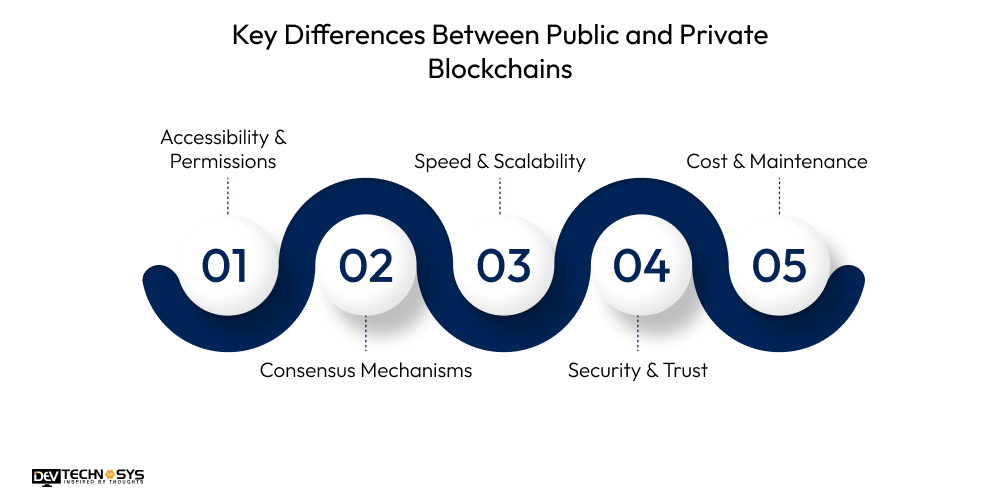
1. Accessibility & Permissions
- Public Blockchain: Anyone can join, read, or validate transactions without permission. Fully open and decentralized, it allows global participation, encouraging transparency and community-driven trust across the network.
- Private Blockchain: Only authorized participants can access and validate transactions. Controlled by an organization or consortium, it ensures privacy, restricted access, and controlled participation for enterprise or specialized applications.
| Feature | Public Blockchain | Private Blockchain |
| Accessibility | Open to anyone globally | Restricted to authorized users |
| Participation | Anyone can read, write, and validate | Only approved participants can access |
| Control | No central authority | Controlled by an organization/consortium |
2. Consensus Mechanisms
- Public Blockchain: Uses decentralized mechanisms like Proof of Work (PoW) or Proof of Stake (PoS). Multiple nodes validate transactions independently, ensuring transparency and preventing a single point of failure.
- Private Blockchain: Uses efficient, centralized consensus like Practical Byzantine Fault Tolerance (PBFT) or voting-based methods. Requires fewer nodes, allowing faster validation while maintaining trust within a controlled environment.
| Feature | Public Blockchain | Private Blockchain |
| Consensus Type | Decentralized: PoW, PoS | Centralized: PBFT, voting-based |
| Node Involvement | Many nodes validate transactions | Few trusted nodes validate transactions |
| Security | Secured by network-wide consensus | Secured by trusted participants |
3. Speed & Scalability
- Public Blockchain: experts who provide software development solutions state that transaction processing is slower in public blockchain due to large networks and resource-intensive consensus mechanisms. When it comes to public vs private blockchain scalability, public blockchain scalability is limited by the number of participants and network load, which affect efficiency in high-volume applications.
- Private Blockchain: between Public vs. Private Blockchain, a private public blockchain network is faster and more scalable because fewer nodes participate. Reduced consensus complexity enables high-speed transactions, making it ideal for enterprise use and real-time processing scenarios. Here’s the table showcasing the public vs, private blockchain network types comparison
| Feature | Public Blockchain | Private Blockchain |
| Transaction Speed | Slower due to large network | Faster due to fewer nodes |
| Scalability | Limited by network size | Highly scalable |
| Use Case | Suitable for open, decentralized systems | Ideal for enterprise applications |
4. Security & Trust
- Public Blockchain: According to a top enterprise blockchain development company in Middle East, public blockcains are highly secure due to decentralization, cryptography, and immutability. Public blockchain transparency and trust are distributed across nodes, reducing manipulation risk, though it is theoretically vulnerable to 51% attacks if one entity controls most of the power.
- Private Blockchain: Security depends on the network administrator or consortium. Less prone to public attacks, but centralized control requires participants to trust the governing organization for integrity and proper operation.
| Feature | Public Blockchain | Private Blockchain |
| Security Level | Very high; decentralized | Moderate; centralized trust required |
| Risk | Vulnerable to 51% attacks | Depends on the organization’s integrity |
| Trust Model | Distributed trust across all nodes | Trust is concentrated in the governing entity |
5. Cost & Maintenance
- Public Blockchain: the OTC crypto exchange development cost for this will be high due to energy-intensive consensus mechanisms, large network maintenance, and ongoing infrastructure expenses required to keep the decentralized system operational.
- Private Blockchain: Lower costs because of smaller networks and efficient validation methods. Between Maintenance is simpler, resource usage is lower, and operations are more predictable and manageable.
| Feature | Public Blockchain | Private Blockchain |
| Operational Cost | High, energy-intensive | Lower, more efficient |
| Maintenance | Complex, decentralized | Easier, centralized control |
| Resource Usage | High computational requirements | Less resource-intensive |
Provide Use Cases of Public Blockchains
Public blockchains are open networks accessible to anyone, making them ideal for applications that require transparency, decentralization, and trust. The role of blockchain technology in online lottery industry, cryptocurrencies, DeFi platforms, NFTs, and global collaborative projects is known to everyone.
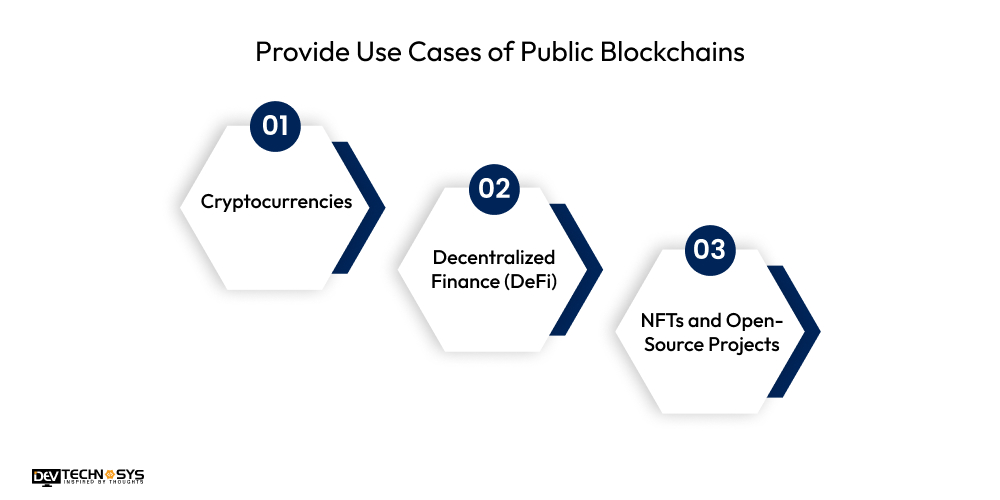
1. Cryptocurrencies
Public blockchains are the foundation of digital currencies like Bitcoin and Ethereum. Cryptocurrency-based blockchain enables peer-to-peer financial transactions without relying on banks or intermediaries. Every transaction is recorded transparently on the blockchain, ensuring security, immutability, and decentralization, thereby building trust among users while enabling global access to financial systems.
2. Decentralized Finance (DeFi)
When it comes to Decentralized vs centralized blockchain, the decentralized finance (DeFi) platforms leverage public blockchains to offer financial services such as lending, borrowing, trading, and staking without the need for traditional financial institutions. Smart contracts automate processes securely, providing users with trustless, borderless, and transparent financial interactions, enabling anyone worldwide to access the decentralized blockchain ecosystem.
3. NFTs and Open-Source Projects
Public blockchains support the creation, sale, and verification of non-fungible tokens (NFTs), digital art, and collectibles, providing proof of ownership and authenticity. They also enable collaborative open-source projects, where dedicated blockchain developers in Middle East can contribute to decentralized applications (DApps) with transparency and accountability.
Provide Use Cases of Private Blockchains
Private blockchains are permissioned networks with restricted access, perfect for enterprises needing security, control, and efficiency. They are widely used in banking, supply chain management, healthcare, and internal business operations.
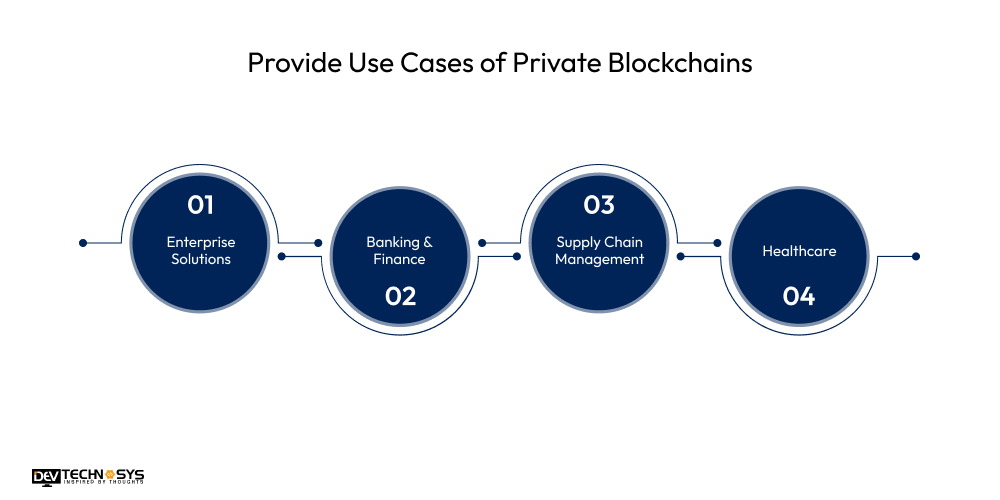
1. Enterprise Solutions
Private blockchains are widely used by enterprises to manage internal processes securely. They provide controlled access, efficient data sharing, and reliable transaction tracking, helping organizations streamline operations, reduce fraud, and maintain compliance while protecting sensitive corporate information within a trusted network.
2. Banking & Finance
Blockchain in Financial Industry is used to improve payment settlements, cross-border transactions, and record-keeping. By leveraging permissioned networks, they ensure faster processing, enhanced security, and regulatory compliance while maintaining centralized control over sensitive financial data.
3. Supply Chain Management
Private blockchains enable companies to track products across the supply chain with high accuracy and transparency. Organizations can verify authenticity, monitor shipments, prevent fraud, and ensure quality control, all while restricting sensitive information to trusted participants within the network.
4. Healthcare
Private blockchain in healthcare Industry helps by offering medical professionals a way to store and share patient data securely. They ensure privacy, compliance with regulations like HIPAA, and controlled access for authorized personnel. This allows accurate medical record management, data integrity, and improved patient care without compromising confidentiality.
What are the Advantages and Disadvantages of Public vs Private Blockchain?
Understanding the pros and cons of public vs. private blockchain is essential. Each type offers unique benefits and limitations in terms of security, speed, cost, privacy, and decentralization, guiding the right choice for specific use cases.
Advantages of Public Blockchain:
- Fully decentralized and transparent, ensuring trust and accountability across participants.
- Highly secure due to distributed consensus and cryptography, making it resistant to tampering and fraud.
- Open access allows global participation and innovation, supporting cryptocurrencies, DeFi, and DApps.
Disadvantages of Public Blockchain:
- Slower transaction speeds due to large networks and resource-intensive consensus mechanisms.
- The cost to hire blockchain developers, as well as operational and maintenance costs, will be high, especially with energy-heavy mining processes.
- Less privacy since all transactions are visible to the public.
Advantages of Private Blockchain :
- Faster and more efficient due to limited nodes and lightweight consensus mechanisms.
- Controlled access ensures privacy, confidentiality, and regulatory compliance for sensitive data.
- Lower operational costs and easier maintenance compared to public blockchains.
Disadvantages of Private Blockchain:
- Centralized control reduces decentralization and may create a single point of failure.
- Trust depends on the governing organization; participants must rely on administrators for data integrity.
- Limited participation may reduce transparency and restrict innovation opportunities.
How to Choose Between Public and Private Blockchains?
Choosing between public vs. private blockchain depends on your project’s goals, transparency requirements, speed, and control needs. Understanding the differences between public and private blockchains helps businesses and developers make informed decisions.
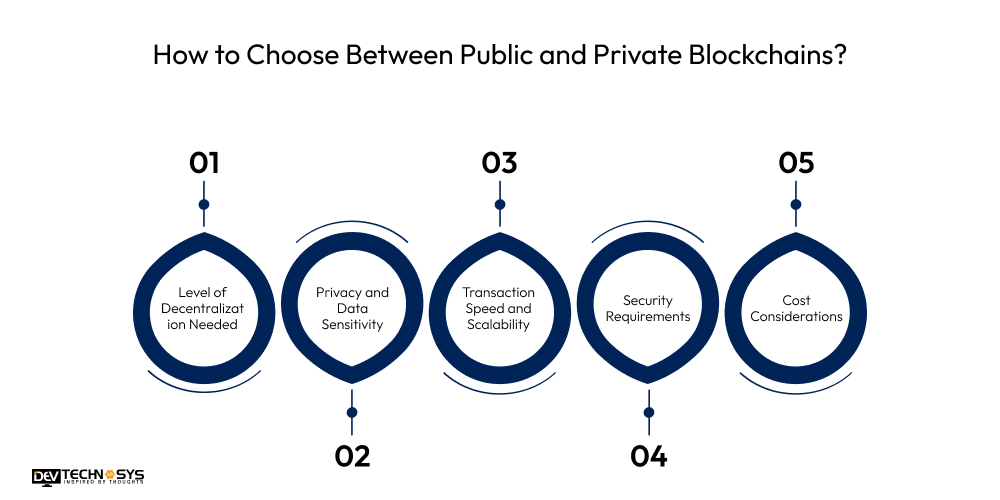
1. Level of Decentralization Needed
Hybrid crypto exchange development providersin Dubai choose a public blockchain for projects that require full decentralization, trustless operations, and open participation. Private blockchains work best for enterprises needing controlled access, governance, and centralized oversight for efficient management.
2. Privacy and Data Sensitivity
Public blockchains offer full transparency, making them unsuitable for sensitive or confidential data. Private blockchains provide permissioned access, allowing only authorized participants to view or validate transactions, ensuring privacy and regulatory compliance.
3. Transaction Speed and Scalability
Public blockchains are slower due to large networks and resource-intensive consensus mechanisms. Private blockchains handle transactions faster and scale more efficiently, as fewer nodes participate, reducing network congestion and improving performance.
4. Security Requirements
Invest in blockchain app development (Public blockchain development) because public blockchains are highly secure thanks to decentralization and cryptography, but may face theoretical risks such as 51% attacks. Private blockchains rely on trusted administrators for security, requiring strict governance to prevent internal misuse or breaches.
5. Cost Considerations
Public blockchains often involve higher operational costs due to energy-intensive validation, infrastructure, and maintenance. Private blockchains are more cost-effective, requiring less computational power and simpler management, making them suitable for enterprise budgets.

Conclusion
Choosing the right blockchain depends on your project’s goals, priorities, and industry requirements. Public blockchains are ideal for projects that need decentralization, transparency, and global participation. Private blockchains are best suited for enterprises that require privacy, faster transactions, controlled access, and compliance.
Understanding the differences between public vs. private blockchain helps businesses choose the right blockchain development company in Saudi Arabia, make informed decisions, and leverage blockchain technology effectively for their unique use cases.
FAQs
Q1. What Is The Main Difference Between Public And Private Blockchains?
Public blockchains are fully decentralized, open to anyone for reading, writing, and validating transactions. Private blockchains are permissioned networks controlled by an organization or consortium that restrict access for privacy, performance, and compliance purposes.
Q2. Which Blockchain Is Faster, Public Or Private?
Private blockchains are faster due to fewer participating nodes and lightweight consensus mechanisms. Public blockchains involve large networks and resource-intensive validations, which slow transaction speed and reduce scalability for high-volume operations.
Q3. Are Public Blockchains More Secure Than Private Blockchains?
Public blockchains provide high security through decentralization, cryptography, and network-wide consensus. Private blockchains rely on trusted administrators, so security depends on governance, internal policies, and proper access and permission management.
Q4. Can Enterprises Use Public Blockchains?
Enterprises can use public blockchains, but sensitive data may be exposed. Private blockchains are often preferred for enterprise solutions because they offer controlled access, privacy, faster transactions, and compliance with industry regulations.
Q5. What Are Common Use Cases Of Public And Private Blockchains?
Public blockchains are used for cryptocurrencies, DeFi, NFTs, and decentralized applications. Private blockchains are used in banking, supply chain management, healthcare, and internal enterprise operations requiring privacy, efficiency, and control.