





“Get the latest transportation software providing the best services in the Middle East.”
Consider you own a business that offers delivery services regularly. Top transportation softwares in Middle East assists entrepreneurs to improvise business processes and enhance user experiences. The introduction of digital platforms expanded the market and filled all the gaps between a business investor and other industrial services.
In 2025, the need for making transportation software is rapidly increasing due to the multiple financial benefits in rich Middle East countries. There are numerous software available in the Middle East market that deliver smart services.
So, in this blog, we will focus on the major software that has the most number of consumers all across the Middle East.
Growing Transportation Market in the Middle East
With growing e-commerce and smart mobility projects, the Middle East’s transportation sector is growing quickly. You require transportation software development services for growth in freight, logistics, and passenger mobility:
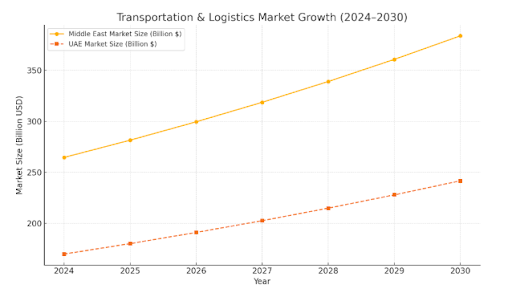
- Market Size (2024): The Middle East transportation and logistics market was valued at $264.5 Billion in 2024.
- Projected Market Size (2030): Expected to reach approximately $384.2 Billion by 2030, indicating strong expansion.
- Growth Rate: The sector is growing at a 6.4% CAGR rate between 2025 and 2030.
- UAE Share: The UAE logistics and transportation market alone was worth $169.7 Billion in 2024, with a projected $241.6 Billion value by 2030.
- E-commerce Impact: E-commerce-driven last-mile delivery and digital freight platforms are contributing to 15–20% annual growth in urban logistics demand.
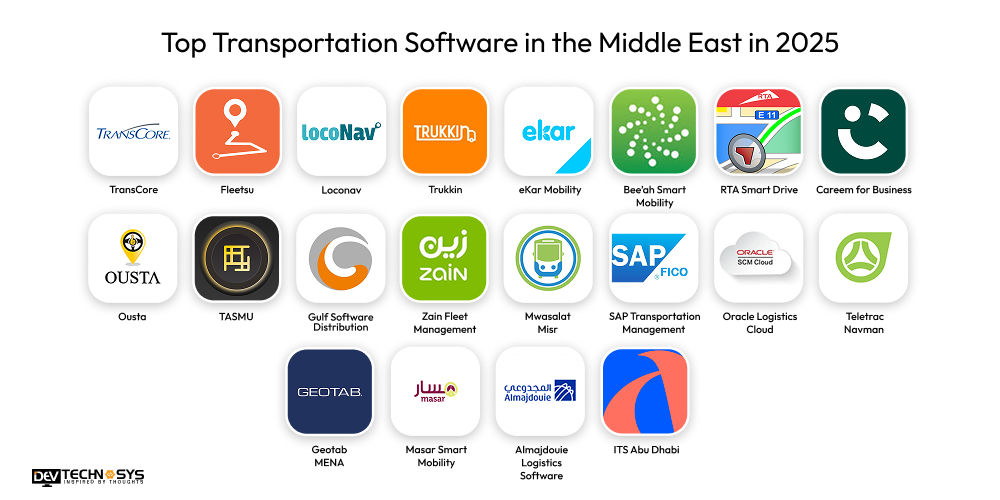
Top 20 Transportation Software in the Middle East
Smart mobility, fleet management, and last-mile optimization are provided by the top transportation softwares in Middle East. These are the best 20 software improving visibility and cutting expenses:
1. TransCore
TransCore provides cutting-edge RFID-based traffic control and tolling systems that are utilized at border crossings and on Gulf highways. It makes it possible for smooth vehicle identification, intelligent toll collection, and real-time tracking.
- RFID-based tolling and vehicle identification for automated toll collection and access control.
- Real-time traffic management solutions integrated with ITS for highways and border control.
2. Fleetsu
Fleetsu is a cloud-based fleet management platform that provides location monitoring and real-time vehicle diagnostics. It assists businesses in effectively managing maintenance schedules, driving behavior, and fuel use. Utilized for operational visibility in the Middle Eastern rental and logistics industries.
- Live GPS tracking with driver behavior monitoring for fleet safety and efficiency.
- Cloud-based platform with customizable dashboards and real-time diagnostics.
3. Loconav
Loconav offers comprehensive fleet management and car tracking services that are tailored for Middle Eastern roads. It provides multilingual support for GPS tracking, cost tracking, and compliance reports. This free transportation management software is popular among logistics firms and SMEs.
- All-in-one fleet management system combining GPS tracking, maintenance, and analytics.
- Multi-language mobile app support tailored for diverse user bases across the Middle East.
4. Trukkin
Based in the United Arab Emirates, Trukkin is an online freight marketplace that facilitates easy communication between shippers and carriers. With load matching, tracking, and clear pricing, it simplifies cross-border logistics.
- Digital freight matching connecting shippers and transporters across GCC borders.
- Real-time load tracking and document management for seamless cargo movement.
5. eKar Mobility
The first car-sharing service in the Middle East, eKar, provides on-demand vehicle rentals through a smartphone application. Users can use it to find, unlock, and rent cars on a daily or hourly basis. Fleet optimization, driver analytics, and usage data tracking are all supported by its backend software.
- App-based car rental and car-sharing system for short-term and flexible vehicle use.
- Fleet utilization insights and driver analytics for operators.
6. Bee’ah Smart Mobility
With an emphasis on sustainability, Bee’ah’s mobility platform incorporates intelligent transportation systems. It oversees fleets of green public transportation. This is the best transportation management software in the Middle East that develops environmentally sustainable solutions.
- Autonomous vehicle integration for sustainable urban transport.
- AI-powered smart routing and electric fleet management tools.

7. RTA Smart Drive
This GPS app, created by the Roads & Transport Authority of Dubai, provides intelligent routing and offline navigation. It helps drivers with speed limit notifications, route planning, and real-time traffic information. Connected to traffic control and smart city infrastructure in Dubai.
- Offline GPS navigation with real-time traffic and speed limit alerts in Dubai.
- Voice-guided route suggestions integrated with smart city infrastructure.
8. Careem for Business
Careem’s workplace mobility solution for corporate ride management and employee transportation. It offers multi-user account control, travel analytics, and centralized billing. Businesses may approach a custom software development company to handle employee mobility.
- Centralized dashboard for corporate rides and automated employee travel management.
- Expense tracking and bulk billing with trip analytics and custom controls.
9. Ousta
In Egypt, Ousta was a ride-hailing business that provided a localized, app-based taxi substitute. Users were able to share trips, reserve rides in advance, and follow drivers in real time. Its platform played a crucial role in Egypt’s ride-hailing development, even though activities have decreased.
- App-based taxi and ride-hailing platform with route visibility and fare estimation.
- Shared ride features and driver performance ratings for better commuting.
10. TASMU
TASMU is a smart city initiative in Qatar that uses digital infrastructure to facilitate intelligent transportation. For route optimization, traffic flow analysis, and intelligent mobility solutions, it makes use of AI, IoT, and 5G.
- AI-driven traffic flow optimization across city-level mobility infrastructure.
- IoT and 5G integration to support smart mobility initiatives in Qatar.
11. Gulf Software Distribution
It provides localized implementation of global logistics and transportation software, like IBM’s. They offer B2B transport technology solutions, such as ERP, route planning, and asset tracking. Important technological enabler for logistics firms in Oman, the United Arab Emirates, and Bahrain.
- Custom transportation IT deployments for fleet, warehouse, and ERP systems.
- Support for IBM and Oracle solutions tailored to logistics and transport needs.
12. Zain Fleet Management
It provides GPS-based fleet tracking and vehicle telematics throughout the MENA area and is a part of the Zain Group. Offers corporate fleets performance statistics, geofencing, and real-time information. This is the best logistics management software in Saudi Arabia, Jordan, and Kuwait.
- Telematics with geofencing and driver alerts for real-time fleet control.
- Fuel monitoring and reporting to cut operational costs.
13. Mwasalat Misr
An Egyptian public transportation platform that provides smart bus services and fleet optimization. For scheduling, real-time tracking, and commuter data insights, it makes use of AI and GPS. Aimed toward enhancing Cairo’s passenger experience and the dependability of urban transportation.
- Smart bus management system with live tracking and commuter apps.
- AI-based route scheduling and capacity optimization for urban buses.
14. SAP Transportation Management
SAP TM, a worldwide leader with regional deployment, streamlines logistics, freight, and fleet operations. It offers route optimization, freight cost simulation, and real-time carrier collaboration. It is used to automate supply networks by large companies around the Middle East.
- End-to-end freight and fleet operations management with integrated logistics.
- Carrier collaboration and freight cost simulation across multiple regions.
15. Oracle Logistics Cloud
This SaaS technology combines freight billing, transportation planning, and execution into a single suite. It facilitates worldwide compliance, carrier integration, and real-time visibility. This is the best logistics software in the Middle East deployed to expedite delivery times and streamline cross-border logistics.
- Transportation planning and execution from order to delivery.
- Advanced analytics and supply chain visibility with cloud scalability.
16. Teletrac Navman
Teletrac Navman offers compliance management, driver behavior monitoring, and GPS fleet tracking. Its AI-powered analytics lower operating expenses while enhancing security. This is used by logistics companies and fleet operators in Saudi Arabia and the United Arab Emirates.
- Driver performance scoring and safety alerts using GPS and onboard sensors.
- Fleet compliance and maintenance scheduling with detailed reporting tools.
17. Geotab MENA
For fleets of commercial vehicles, Geotab provides sophisticated telematics and data analytics. The MENA branch offers solutions that are specifically tailored for driver coaching, fuel efficiency, and regulatory compliance. Reliable in the Gulf’s transportation, construction, and oil and gas sectors.
- Data-rich telematics with fuel, engine, and route analytics.
- Custom rules engine and real-time dashboarding for fleet optimization.
18. Masar Smart Mobility
A platform founded in the United Arab Emirates that provides shared transit and electric mobility services. It incorporates intelligent routing, EV charging, and environmentally friendly fleet management systems. Corresponds with the development of smart cities and regional green mobility goals.
- EV charging station integration with fleet route planning.
- App-based vehicle access and real-time availability tracking for shared mobility.
19. Almajdouie Logistics Software
Almajdouie Logistics uses proprietary software for their freight and transportation operations in Saudi Arabia. Include warehouse integration, real-time monitoring, and fleet scheduling. Created to facilitate intricate supply networks in the manufacturing, gas, and oil industries.
- Customized logistics suite for freight scheduling and warehouse synchronization.
- Real-time tracking and documentation system supporting regional compliance.

20. ITS Abu Dhabi
The Department of Municipalities and Transportation in Abu Dhabi has launched an Intelligent Transportation Systems (ITS) initiative. This is the best TMS software in UAE that makes use of AI, IoT, and predictive analytics to improve safety, navigation, and intelligent traffic signals.
- Smart traffic signal control with AI-based adaptive timing.
- Predictive mobility analytics to reduce congestion and improve public safety.
Adoption of Transportation Software in Various Middle East Regions
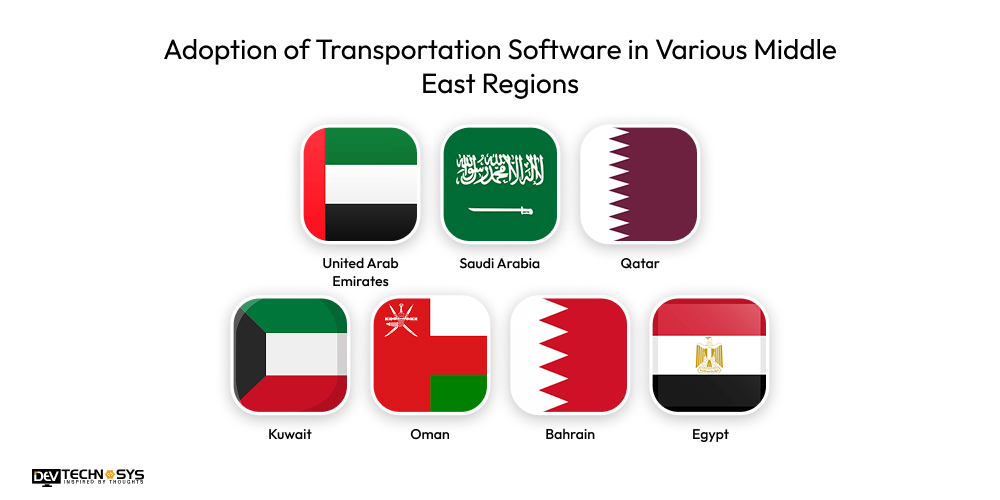
To improve sustainability and logistical efficiency, top transportation softwares in Middle East are delivering various services. Each region is embracing technology at a different rate:
-
United Arab Emirates
With national initiatives like Smart Dubai and Abu Dhabi’s ITS, the UAE is a regional pioneer in the adoption of smart transportation. AI-powered transportation solutions are being actively used by government organizations for last-mile deliveries, ride-hailing, and traffic control. Various best transportation management systems like TransCore, SAP TM, and eKar are leading the sector.
Impact:Enabled smart traffic control and real-time navigation through platforms like RTA Smart Drive.
-
Saudi Arabia
The digital transformation of transportation, including intelligent freight networks and public mobility, is being accelerated under Saudi Arabia’s Vision 2030. Smart parking systems, route optimization tools, and fleet management software are being adopted by businesses and government agencies. Businesses like Zain Fleet are essential to the modernization of supply chain and logistics operations.
Impact: Improved cross-border freight efficiency with digital logistics platforms and fleet telematics.
-
Qatar
Through programs like TASMU, Qatar is concentrating on integrating smart cities, making transportation software a key component of urban planning. The government is spending money on cloud, IoT, and AI technologies for fleet digitization, traffic monitoring, and public transportation. The World Cup legacies and continuous infrastructure development are supported by Qatar’s software adoption.
Impact: Powered smart city mobility with AI-driven transport solutions via TASMU initiative.
-
Kuwait
With a greater emphasis on fleet tracking, logistics automation, and safety compliance, Kuwait is progressively implementing transportation software. Telecom companies like Zain and private logistics companies are investing in GPS-based fleet management systems. To develop transportation software for smart transportation, you need specific resources.
Impact: Enhanced fleet safety and compliance with GPS-based tracking from providers like Zain Fleet.
-
Oman
To enhance logistics for ports, freight, and government fleet systems, Oman is integrating transportation software. Real-time tracking, automatic tolling, and vehicle health diagnostics are among the main areas of focus. In cooperation with logistical hubs like Duqm and Sohar, software adoption is increasing.
Impact: Streamlined port logistics and government fleet operations using integrated tracking systems.
-
Bahrain
Bahrain is mostly using logistics integrators and regional software distributors to use transportation software. Through programs connected to smart transportation networks throughout the GCC, the nation promotes digital mobility. ERP-connected transport modules, delivery optimization, and telematics are important adoption areas.
Impact: Supported urban delivery and distribution efficiency through ERP-integrated transport solutions.
-
Egypt
Egypt’s urban sprawl and dense population make sophisticated transportation software essential for both governmental and commercial sectors. AI and GPS technologies are being used by startups and public transportation providers like Mwasalat Misr to optimize routes and lessen traffic. As part of national digital transformation initiatives, software is being used for ride-hailing and logistics.
Impact: Modernized public bus systems and reduced congestion via smart scheduling and route optimization.
Top Transportation Sector Use Cases
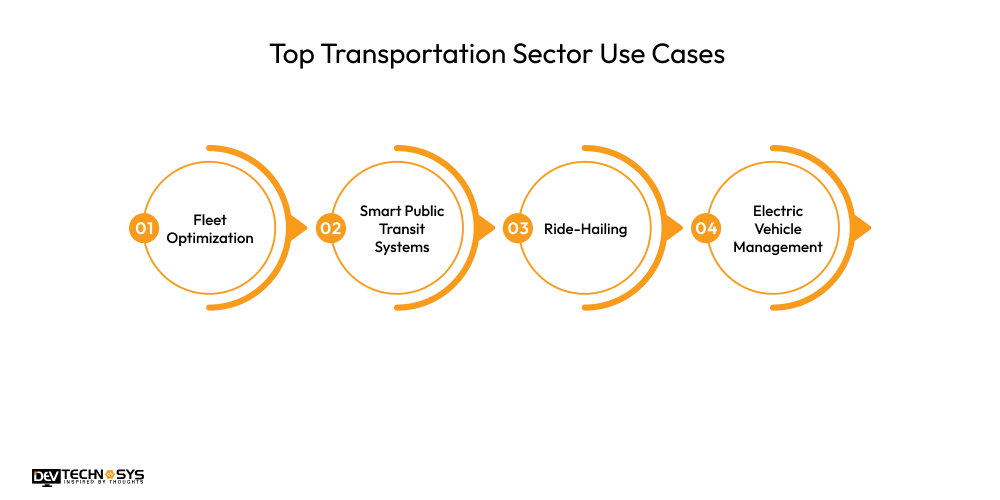
The movement of people and commodities is being revolutionized by transportation software. Important use cases include ride-hailing services, public transportation, fleet operations, and electric car ecosystems:
-
Fleet Optimization
Businesses may optimize fleet utilization and efficiency in real time with the use of fleet optimization software. It makes it possible to schedule maintenance, track fuel use, plan routes, and keep an eye on driver conduct.
-
Smart Public Transit Systems
Through real-time tracking and predictive scheduling, smart transport systems leverage IoT and software to optimize urban mobility. Through digital ticketing and real-time updates, they improve the traveler experience. Businesses must reduce the cost to develop transportation software with monetization.
-
Ride-Hailing
Transportation software is used by ride-hailing services for driver-passenger matching, automatic dispatching, fare calculation, and route optimization. With features like digital payments, safety tracking, and analytics dashboards, it supports both B2C and B2B models.
-
Electric Vehicle Management
For electric fleets, EV management software keeps an eye on energy usage, charging schedules, battery health, and route optimization. For smooth energy distribution and cost control, it interfaces with charging networks and smart grids.
Success Story of the Aramex Platform
- Founded & Launch Date: Established in 1982 in Amman, Jordan by Fadi Ghandour and Bill Kingson, later relocating its headquarters to Dubai by 1985.
- IPO & Milestones: Became the first Arab‑based company listed on the NASDAQ in 1997, then re‑listed on the Dubai Financial Market in February 2005.
- Past & Current Revenue: Generated under US $1 million in 1984; by 2021, revenue reached approximately US $1.65 billion, rising modestly in 2023 to about US $1.7 billion.
- Key Strategic Goals: To facilitate global trade via end‑to‑end logistics, expand through alliances (e.g. GDA/WFA), and drive sustainability with a net‑zero emissions roadmap by 2050.
- Industry Verticals Served: Offers services across express courier, freight forwarding, e‑commerce logistics (Shop & Ship, MyUS), supply chain solutions, and information management, serving sectors like healthcare, SMEs, oil & gas, retail and e‑commerce.
- Geographic & Operational Footprint: Operates in over 600 cities across 70 countries, with more than 16,000‑17,000 employees globally and a widespread alliance network including the Global Distribution Alliance .
- Recent Ownership & Financial Position: In March 2025, Abu Dhabi’s sovereign wealth fund ADQ acquired a 58% stake in Aramex. End‑2024 net profit was AED 142 million, with strong cash reserves (~AED 513 million) and healthy leverage metrics.
Latest Trends in the Transportation Industry
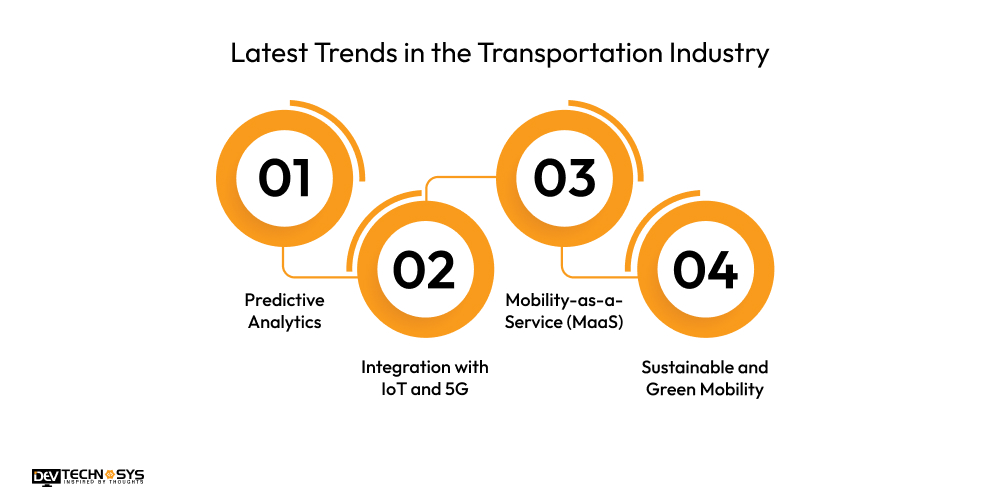
Rapid innovation in the transportation sector is being driven by sustainability objectives and digital transformation. New trends are changing fleet management, logistics, and mobility:
-
Predictive Analytics
Predictive analytics forecasts demand, traffic patterns, and vehicle maintenance requirements using AI in transportation software development with historical data. It assists public transportation networks and logistics companies in minimizing delays, streamlining routes, and averting malfunctions.
-
Integration with IoT and 5G
Vehicles, infrastructure, and control systems can share data in real time thanks to IoT sensors and 5G connectivity. Autonomous driving, remote diagnostics, intelligent traffic management, and increased safety are all supported by this connection.
-
Mobility-as-a-Service (MaaS)
MaaS platforms combine many forms of transportation, such as ride-hailing, buses, and bike rentals, into a single online service. These top trends in transportation allow users to arrange, reserve, and pay for multimodal travel, promoting smooth urban transportation.
-
Sustainable and Green Mobility
The goal of green mobility is to lower emissions by using eco-friendly transit systems, shared mobility, and electric cars. Clean fuel alternatives, carbon-neutral logistics, and EV infrastructure are being funded by both the public and commercial sectors.

Points to Consider While Choosing Transportation Software
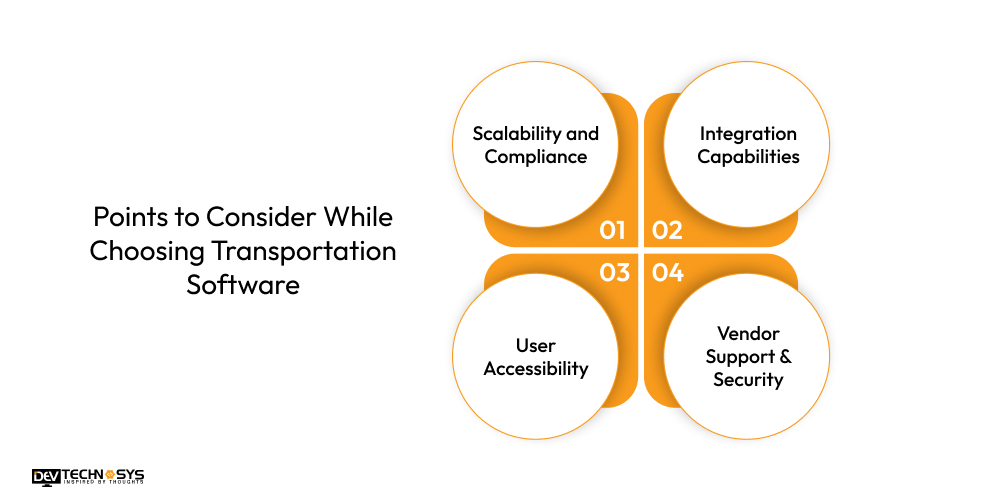
For long-term ROI and operational effectiveness, choosing the top transportation softwares in Middle East is essential. For effectiveness, important elements like scalability, integration and support are needed:
-
Scalability and Compliance
Your company’s expansion across geographies, fleet sizes, and legal frameworks should be supported by the software. Over time, scalability guarantees that it can manage growing numbers of users, data volumes, and operational complexity.
-
Integration Capabilities
Software for transportation must easily interface with current systems, such as warehousing tools, ERP, CRM, and GPS. Automated processes and improved data flow are made possible by robust APIs and modular architecture. This increases the software development cost, but ensures quality support.
-
User Accessibility
The platform should provide a user-friendly interface that is available on mobile devices and the web for a range of user roles. Adoption rates rise, onboarding time decreases, and real-time decision-making is enhanced by ease of use. Diverse regional teams benefit from role-based dashboards and multilingual support.
-
Vendor Support & Security
Timely updates, bug fixes, training, and technical support are guaranteed by dependable vendor support. It is crucial to have strong security features like data encryption, access control, and compliance monitoring. Select suppliers who have a solid track record in the sector, regional presence, and established credibility.
Let’s Summarize!!
We have studied the top transportation softwares in Middle East with their basic features in detail. Now, if you are looking to start a logistics business, then it is beneficial to approach a transportation software development company in UAE. Dev Technosys provides all kinds of services starting from consulting to maintenance.
We have experienced developers helping businesses to choose the right development model and pricing model. An entrepreneur in the Middle East countries may easily generate revenue by delivering logistics services with transportation software. So, you should also start investing in the development of a similar platform at affordable rates.
FAQs
1. Why is Transportation Software Important in the Middle East?
- Supports national smart mobility goals.
- Enhances fleet efficiency and cost savings.
- Enables real-time monitoring with regional transport regulations.
2. Which Industries Benefit from Transportation Software?
- Logistics – For delivery tracking.
- Public Transportation – For passenger analytics.
- Ride-Hailing – To manage bookings.
3. What Features are Necessary for Transportation Software in 2025?
- Real-time GPS tracking.
- AI-powered route optimization.
- Cloud-based dashboards.
4. Which are the Top Transportation Software in the Middle East?
Yes, the Middle East offers a number of regionally customized transportation software systems. Regionally specific solutions like Bee’ah Smart Mobility (UAE), TransCore (UAE, KSA), TASMU (Qatar), and Trukkin (GCC) provide support for smart city projects.
5. How the Transportation Industry is Growing in 2025 in the Middle East?
- Driven by government infrastructure and investments.
- Growth in electric and autonomous fleets.
- Rise of Mobility-as-a-Service (MaaS).