



 Tarun Nagar
 A mobile app that meets all the needs and preferences of users is a must-have today. Users also expect exceptional work, fast access and a beautiful interface. If you want to incorporate all these points, it is important that we choose the right tech stack for mobile app development. You will save money, have more prospects and be able to improve your next project.
It is important to know the right tech stack for mobile application development. In this post, we’ll discuss the same. We will also examine the technology stack to support native, hybrid, and cross-platform app creation.
So, let’s start.
What is a Tech Stack?
Technology stacks are also known as solution stacks. They combine aspects such as multiple languages, frameworks and technology services. Together they create a network that includes a website, mobile app, and web app. A stack is a layer of technology that is layered on top of another.
It has two parts: the frontend and the backend. First, you need to know what the technology stack is before you can move on to the mobile app developer technologies.
It is simply a collection of various instruments, frameworks and libraries.Server and client components make up the two major parts of the technology architecture. Other elements include the user experience, development platform and stability, safety, reliability, trustworthiness, among others.
Your app’s responsiveness and efficiency will depend on the tech stack you choose. A wrong tech stack selection can result in wasted time, money, and even project failure. It is also difficult to gain sufficient knowledge about the mobile app design process. Therefore, it is essential to hire dedicated developers who are skilled and competent.
Why Choose The Best & Right Tech Stack for Mobile App Development?
The technology stack that you use will determine the mobile app you create. You should therefore check the various characteristics of your app. For example, whether it is stable or has the ability to scale to different OS versions.
While you can choose any technology stack for mobile application, it is important to know that the best technology stack will improve the app’s performance as well as support its growth potential.
The wrong technology stack will cause you to suffer in terms of time and development costs. Other than that, there are other fundamental problems with your mobile app. Before you begin to develop your mobile app, take the time to choose the best.

Negative outcomes of wrong stack selection
Your business may face these issues if you select a tech stack that isn’t right for your project:
Realizing that you made the wrong choices, switching to a different stack can cause delays in project delivery. It will take longer to build the product.
- If you choose a tech stack that isn’t scalable, it will likely be difficult to scale horizontally or vertically.
- You might have difficulty finding developers with sufficient experience.
- Security issues may arise from unreliable technology.
How do you choose the best tech stack for mobile app development?
Selecting the best tech platform for developing mobile applications requires careful consideration of a number of variables. This will enable you to power your product with success. These are the key factors that influence the choice of technology stack for mobile app for development.
1. App Considerations
There are many factors that can vary between apps.
- The device where the app would work
- It would be in a network condition.
- Your goal for the user experience
- The estimated time to go to market
- It would be run on a platform, among other things.
These app elements, when combined, help to decide which framework, library, languages and software would be used to develop the mobile.
2. The Goal of Mobile App
The goal of your mobile app will also influence the choice of tech stack. If you’re looking to create progressive web app in React with high latency, a fast response, and low latency, there would be a huge difference in the technology stack choices.
Mobile apps that are dependent on heavy load processing require a more robust tech stack than those that rely on simple interactions.

3. Development Team Skill-Set
While many languages and frameworks can produce the same results, there are some that have differentiating features that distinguish them from one another. It is recommended to consider the developer’s skill set when selecting between two tech platforms that are comparable.
Introduce a tech stack to your on demand app development services team that they are unfamiliar with. This will not only increase the development effort and cost but also make it more difficult for them to use the technology.
On the other hand, it will speed up the process and save quality by introducing a mobile application development platform that your team is familiar with.
4. Technology’s Parent Company
It is also critical to evaluate the mobile tech stack parent business. Some companies provide superior documentation and customer service. Google, Microsoft and Adobe, for example, are well-known for offering more community support options than Facebook with React Native App Development.
5. The Choice to Operate on Multiple Platforms
Comparing an app that works across Android, iOS, and the Web to one that only runs on one platform’s technology base reveals significant differences.
To make your mobile app portable to other platforms (e.g., iOS and Android), you must provide a high level of scalability. Cross-Platform App Development or Hybrid App Development will require a different tool set than that used to develop Native apps.
6. The Tech Stack Security Level
Each mobile app development technology is prepared to address any security issues that the app may encounter after it has been launched on the market. Problems arise when you choose a tech stack that isn’t well documented or requires the writing of a lot of code.
Then there is the matter of developers’ skills. Hackers will be able to access your mobile app regardless of the technology used. Your app developers must be skilled, along with their tech stack.
7. Compatibility with Existing Technologies
It’s crucial to select a tech platform that is compatible with the tools being used to build your mobile application. This is especially important if you plan to introduce a new tech stack into the mobile app development process.
You should not only check the compatibility between the current project and the mobile tech stack, but also make sure that the stack is compatible with any tools you may be adding to the app in the future.
After reading this, you will have all of the information you need to start your first mobile app development endeavor. No matter what technology you choose, ensure that your app is compatible with the existing app structure. This will allow your app to be innovatively scalable and flexible.
Factors to Consider When Choosing a Tech Stack
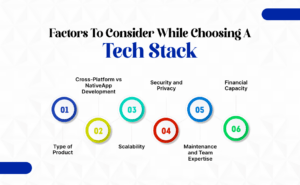
Choosing the appropriate tech platform for the creation of mobile apps can be challenging. Even the most experienced developers and geeks can find it difficult to make the right choice with so many options.
If you’re considering starting an app-based business, you should be even more cautious when weighing your choices. By selecting the incorrect technology platform, you run the risk of destroying your ideal app. Here are some key factors to help you make a decision about your tech stack.
1. Type of Product
When deciding on a technology platform, it is critical to keep the product category in mind.
- Complexity
- It should be based on your business goals
- It’s designed to support the load it is supposed to support
- Potential growth is just one example.
The more complex the project (for example, if you want to build a social media app or a business solution), the more sophisticated the tools needed to realize your goals.
2. Cross-Platform vs Native App Development
Businesses frequently decide to create applications that are native to particular platforms, operating systems, and gadgets. As the market for smartphone apps develops, new methods—such as how to build shared code across multiple platforms—are becoming more prevalent.
This is especially true for Android and iOS. This will be covered in more detail below. We will also discuss the tech stack options, including whether native or cross-platform app development is an option.
3. Scalability
Before you approve the stack, it is important to evaluate the potential growth and the technical requirements. A tech stack is essential for an application’s ability to scale.
It must be able to handle increasing user load and users, as well as allow for the expansion of functionality. You should choose carefully the tech stack if you are creating an IoT app. Scalability is crucial when building such apps.
4. Security and Privacy
Security is a problem that must be addressed at all times. It is also critical to recognise that cyber-attacks are becoming more prevalent by the year.
A reliable text stack, which manages privacy and security risks, is essential if you plan to create a video chat app or messaging app. Node.js is one of the most trusted frameworks that offers security guidelines.
5. Maintenance and Team Expertise
It is important to assess whether your team can maintain the application after it has been deployed. If you don’t plan to work with an outsourcing company that offers maintenance services after implementation, it is important to consider the expertise and experience of your team when selecting a tech stack for mobile application development.
It is preferable to know for sure that your team can utilize the tech stack effectively and without extra instruction. You ought to think about working with a consulting hybrid app development services provider that has the necessary skills to assist you in developing the tech infrastructure.
6. Financial Capacity
Although the majority of tools are already in existence or free to use, product owners still need to be mindful of a number of things that could have an effect on their budget.
These include the rate for developers, which varies depending upon the product’s specialization and licensing fees. Teams can build products quicker with ready-made tools. Some tools may not be able to implement custom features. Also, affordability comes with its own risks.
Major Tech Stack for Mobile App Development
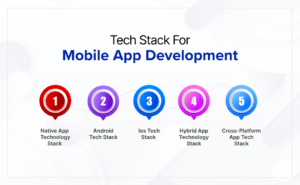
We now know how to select the right tech stack for mobile app development. Let us move on to the section that examines the technology stack that powers the creation of innovative, scalable and powerful mobile and web apps. This mobile tech stack is what you will find in any web app design company.
1. Native App Technology Stack
Native applications are renowned for being dependable and highly effective. It is the perfect solution to the quality standards that businesses are looking for in their mobile journey.
Without the need for an external API, native apps let companies incorporate the device’s built-in features into their mobile applications.
When we speak of Native apps, we tend to refer to both iOS and Android App development. Both platforms have different capabilities and require different technology stacks.
Let’s take a look at the most popular tech stacks for mobile app developers that can be used in both Android and Custom ios app Development.
2. Android Tech Stack
- Programming languages: Java and Kotlin
Despite the fact that Kotlin is the approved computer language for Android app development, many android app development firms continue to use Java. Because of its prevalence, Java is a popular tech platform for mobile app creation businesses.
Kotlin is not far behind in this popularity race. Kotlin is becoming a more stable choice for mobile app developers who use the Android studio to create their apps. It is a great solution for all Java problems because it is simple, lightweight, and much more concise than Java.
- Toolkit: Android Developer Tools & Android Studio
Developers can rapidly release code, conduct tooling, modify code, debug code, and create flexible systems using Android Studio.
This best tech stack for mobile apps allows you to concentrate entirely on creating high-quality, unique apps.
The Android Developer Tools will offer comprehensive assistance with all parts of Android app creation. Additionally, it enables the use of simulators, graphical UI builders, and a variety of on-device testing software tools by developers.
- Android SDK
To create programs that use the most recent features, developers must download and install the appropriate version SDK for each phone.
This tech stack is ideal for Android app developers. It has allowed them to grow the app count to millions, and made Android application solution the preferred choice for businesses looking to reach the masses.
3. iOS Tech Stack
- Programming Languages: Swift & Objective-C
Swift and Objective-C are the most popular languages for iOS app development.
Objective-C, the superset C language, provides a dynamic environment and object-oriented capabilities.
Swift is our preferred language over Objective-C. This is because Swift has more functionality and codes that are less likely to be misinterpreted. The dynamic libraries are also uploaded directly to the memory, reducing app size and improving performance.
- Toolkit: Xcode &IntelliJ AppCode
Toolkits provide the complete feature environment for creating both desktop and mobile apps. These are the most popular tools for iPhone app developers and iPad users: IntelliJ AppCode, Apple Xcode.
- iOS SDK
An API acts as a link between the platforms they run on and the application. The iPhone SDK offers tools for the exclusive iOS operating system as well as Apple’s mobile interaction.
This technology stack has allowed the Apple app industry to be able to position itself as the market where businesses seek to generate revenue from their mobile apps.
For Native applications, this was. One kind of app, though, needs a unique collection of full-stack mobile app creation. The ones we’re alluding to are hybrid applications.
They aren’t used as much anymore but a few entrepreneurs still use them due to their low cost and quick time to market.
4. Hybrid App Technology Stack
The majority of hybrid apps are created using standard web technologies like HTML5, HTML5, and JavaScript. These apps usually have two sections: the Native shell and the Backend. These apps are compatible with all platforms. They provide API access and allow you to store your device data.
These frameworks are the most popular for developing hybrid apps: Sencha Touch 2, Sencha Touch 2 and Ionic.
After having discussed both Native Apps as well as Hybrid Apps it is now time to shift our focus to the tech stack for mobile app development and cross-platform development .
5. Cross-Platform App Tech Stack
Utilizing the same code to build applications that function across various platforms, including Android, iOS, and the web, is known as cross-platform app creation. Businesses frequently choose cross-platform app development because it enables them to access a larger population. You can also take advantage of the reduced development costs and faster time to market.

Conclusion
The most common tech stack for mobile app development has now been addressed. This will help you choose the best approach for your business idea. The sort and function of your smartphone app will determine the technology stack you choose.
Analyze the industry specifications and establish your objective before you begin the development process. The reputable mobile application development company can help you develop a fully-featured native, hybrid or cross-platform mobile app.
FAQ
1. How Much Does It Cost to Maintain an App in 2022?
The cost to maintain an app depends on various factors that can increase or decrease the final cost. For example, such as the complexity of the app, the size of the development team, the hosting infrastructure, and the ongoing updates and improvements. On average, the cost to maintain an app will be around $15-$20 per hour.
2. How do I choose a tech stack for my mobile app?
Choosing a tech stack for mobile app development is very crucial. However, you can choose the tech stack by following the below steps:
- App Considerations.
- The Goal of Mobile App.
- Technology’s Parent Company.
- The Choice to Operate on Multiple Platforms.
- Security Level of the Tech Stack.
- Compatibility with the Existing Technologies.
- Native App Technology Stack.
- Android Tech Stack.