




 Tarun Nagar
 The cryptocurrency world seems to have changed from a niche hobby for tech enthusiasts to a global, financial ecosystem that has massive implications for everything from investment strategy to government actions. Heading into 2025, cryptocurrency exchange apps are situated at the center of this shift away from traditional finance systems.
They offer users instant access to hundreds of available digital assets, from Bitcoin and Ethereum to stablecoins and tokenized assets.But the industry is not stagnant – it’s evolving rapidly, as today’s users demand and require not only faster, but safer and smarter trading solutions.
Businesses will require compliance-ready platforms to stay afloat in a world of increasing regulation. And developers operate in tandem as they push the envelope on trends such as AI, interoperability, and decentralized exchanges.
This expert guide will explore current and future trends of cryptocurrency exchange apps in 2025.
You can expect to learn about decentralized exchanges vs centralized exchanges, AI-supported trading predictions, gamification, tokenization of real-world assets, and more pre-requisite knowledge that will give you the edge as we navigate the crypto revolution.
Understanding the Cryptocurrency Exchange Landscape
Before discussing future trends of cryptocurrency exchange apps, it is important first to understand the existing exchange ecosystem. Given that crypto exchanges are sorted into two identifiable categories.
- Centralized Exchanges (CEXs) – Centralized exchanges (CEXs) such as Binance, Coinbase, or Kraken, where trades happen on networks that are managed by a centralized authority. CEXs also boast of high liquidity, advanced trading features, and an easy user experience, but rely on the user trusting that the platform will protect their funds.
- Decentralized Exchanges (DEXs) – Platforms like Uniswap or PancakeSwap allow peer-to-peer trading, meaning users can trade directly with one another without any intermediaries. Typically, these platforms offer more privacy and control over assets but frequently have lower liquidity and may not be very user-friendly for beginners.
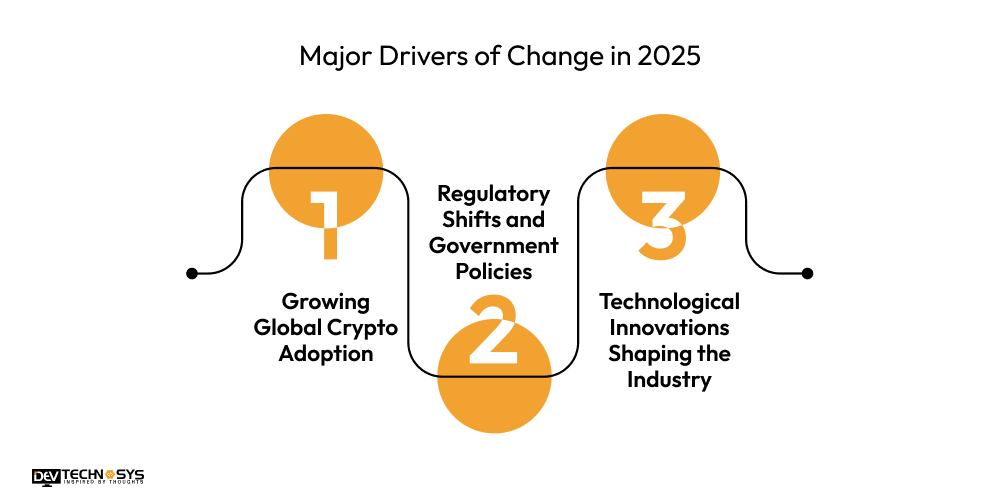
Major Drivers of Change in 2025
The evolution of crypto exchange apps isn’t random; it’s being driven by three powerful forces:
-
Growing Global Crypto Adoption
In 2025, we will get a more comprehensive picture than just early crypto adopters. Besides retail investors, governments, and Fortune 500 companies are already on board.
Such a massive adoption creates the need for exchanges that are capable of dealing with extremely high trading volumes, numerous fiat currencies, and different types of users.
-
Regulatory Shifts and Government Policies
The global crypto regulations are becoming stricter but evolving slowly in contrast to the highly dynamic crypto sector. The new rules on KYC/AML compliance, taxation, and consumer protection significantly change the way exchanges operate.
The future trends of cryptocurrency exchange apps must be able to integrate these security features without making the user experience complicated.
-
Technological Innovations Shaping the Industry
One of the perks of 2025 is all these tech innovations that include the integration of Layer-2 scaling solutions and AI-based fraud detection, among other things. As a result, trading in crypto becomes faster, cheaper, and safer than before.
Another trend of 2025 is the growth of cross-chain solutions that allow seamless trading across different blockchains, thus, a game-changer for liquidity.
Top 10 Future Trends of Cryptocurrency Exchange Apps
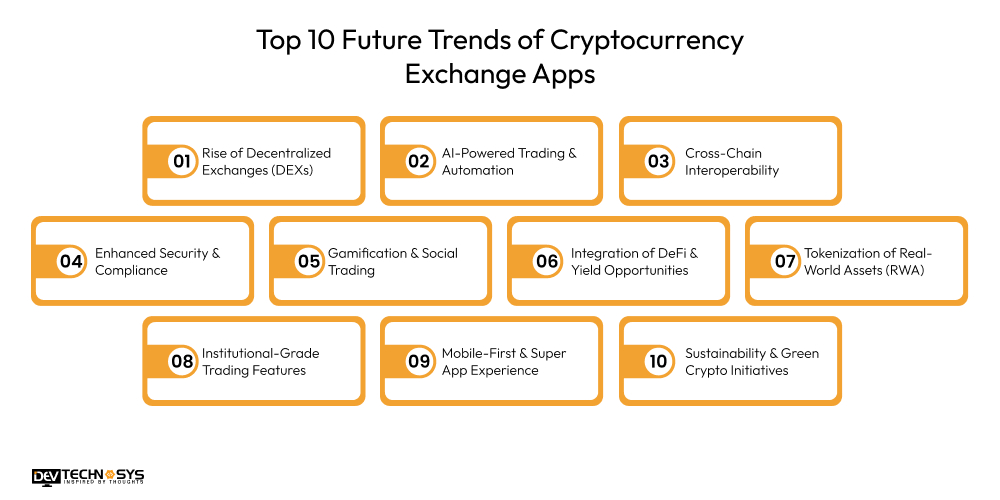
1. Rise of Decentralized Exchanges (DEXs)
In 2025, decentralized exchanges (DEXs) will no longer be for the six or seven-digit number users but will already be mainstream. The collapse of several centralized exchanges (CEXs) in the last few years has changed the mindset of the traders, and they are now looking for platforms that offer them self-custody of their funds and do away with the risks of a third party.
DEXs operate on smart contracts, which enable peer-to-peer trading and hence allow transparency and trust.
Automated Market Makers (AMMs) and the reformed liquidity mechanisms have also made them more user-friendly, and advanced issues like slippage have become less of a problem. Being permissionless, anyone with a wallet can engage in trading, and so, crypto markets have become accessible to global participants without geographical restrictions.
The trend of DEXs can even be that of competing head-to-head with that of centralized exchanges in terms of their volume of daily trades.
2. AI-Powered Trading & Automation
AI in cryptocurrency exchange apps is changing the game and streamlining their operations and tasks. AI-powered tools will forecast the prices of assets by studying the past market data, on-chain metrics, and the sentiments of the crypto community in 2025.
Moreover, the use of automated bots will allow traders to carry out their transactions at any time of the day or night without the intervention of their emotions, and hence their results will be better.
From the perspective of exchanges, the use of AI technology leads to the strengthening of fraud detection and risk management, thereby protecting users’ funds and increasing their confidence. Furthermore, machine learning models also offer customization of the users’ needs, thus helping them with selecting trading pairs and coming up with the strategies that are in line with their preferences.
As the competition among markets increases, AI in cryptocurrency trading apps will become one of the distinguishing features for those platforms that want to catch the attention of both retail and institutional traders who are looking for more intelligent and quicker trading solutions.
3. Cross-Chain Interoperability
The Blockchain trends in crypto exchanges are coming to an end. One of the most significant trends for 2025 is cross-chain interoperability, which allows users to trade assets across various blockchains effortlessly through a single interface.
No matter whether you are transferring tokens from Ethereum to Solana or Bitcoin,cross-chain bridges and atomic swaps are making transactions quicker and cheaper.
In this way, liquidity is raised to a whole new level, trading options are broadened, and the user experience is greatly simplified as there is no longer a need to have multiple wallets.
Exchanges that are focused on cross-chain functionality will be the ones that traders will select the most since they will provide access to the whole crypto ecosystem without any kind of barrier or technical difficulty.
4. Enhanced Security & Compliance
Security is still the number one concern of crypto exchanges, and in 2025, platforms are introducing avant-garde solutions. Multi-signature wallets, hardware security modules, and real-time AI monitoring are the defense lines against hacks.
Technologies that preserve privacy, such as Zero-Knowledge Proofs, help users to prove their identity without sharing any sensitive data, thus ensuring privacy and compliance at the same time.
On the other hand, regulatory compliance is being carried out automatically through efficient KYC/AML integrations, which allow exchanges to always be updated with government requirements. Platforms with stringent security and preparedness for compliance will win the race because users will trust exchanges that give priority to the safety of their funds and personal information.
5. Gamification & Social Trading
Top cryptocurrency exchange apps in the Middle East are morphing from mere trading tools to welcoming platforms with gaming features. Users are motivated to active trading by leaderboards, achievement badges, and reward systems.
With social trading features, newbies can easily copy the strategies of expert traders, which in turn makes the crypto market more accessible.
Through gamified learning, users are taught about the blockchain and trading while receiving token rewards for completing their lessons. Not only does this method attract new users, but it also retains the existing ones by making the experience enjoyable and interactive.
In 2025, gamification will be one of the main factors for the growth of exchanges that will be targeting the younger, tech-savvy traders who are looking for more engaging and fun experiences.
6. Integration of DeFi & Yield Opportunities
By fusing DeFi functionality, crypto exchange apps are turning into all-in-one financial hubs. In 2025, users will have the ability to stake their tokens, engage in liquidity pools, and generate yields right from their exchange apps.
Doing so removes the need for multiple platforms and wallets, ensuring a smooth ride. Furthermore, some exchanges are in the process of introducing credit and debit options so that users will be allowed to borrow against their possessions.
In such a way, they can attract the funds from which they can generate passive income. Better yet, the fusion of centralized and decentralized finance will not only open up new avenues of earnings but also help exchanges offer such instruments to users for the easy management of their portfolios.
This coalescence would have an even greater impact in terms of the speed at which the DeFi space would see the adoption of mainstream users.
7. Tokenization of Real-World Assets (RWA)
One of the most game-changing future trends of cryptocurrency exchange apps is the tokenization of real-world assets. Exchanges in the crypto space are now listing tokenized versions of real estate, stocks, bonds, and commodities.
Through this method, fractional ownership is achieved, thus smaller investors get the chance to invest in high-value assets such as commercial properties or gold with only a small amount of capital.
At the same time, it also helps to provide more liquidity in markets that are traditionally less liquid. RWA serves as a connector between traditional finance and crypto; thus, it attracts not only institutional investors but also regulators’ attention.
The platforms that provide the safest and most compliant tokenized asset trading will be the ones that stand out as the financial innovators of the next wave.
8. Institutional-Grade Trading Features
As institutional adoption keeps gaining momentum, crypto exchanges are progressively launching new services strictly designed for professional investors. If businesses develop a cryptocurrency exchange app like Bybit, they will have access to deep liquidity pools and also the integration of APIs, which enables users to trade algorithms.
To make it easier for the users, there are some compliance tools such as automated tax reporting and audit-friendly records, which are funds and corporations’ favorite as they make them feel at ease.
Besides that, custodial solutions with insurance coverage are like an additional layer of trust. In 2025, platforms that meet the institutional requirements will be the ones witnessing the highest volumes and gaining the most credibility, thus playing a major role in making crypto a part of the global financial markets.
9. Mobile-First & Super App Experience
Most crypto users mainly deal with their smartphones, and exchanges are responding by developing mobile-first experiences. In 2025, “super apps” are becoming the crypto exchange apps, which amalgamate trading, staking, NFT marketplaces, and news feeds into one single interface.
Real-time market updates are delivered via push notifications, while the user-friendly design guarantees a smooth onboarding experience for newbies.
Mobile-first exchanges will be the winners in emerging markets, where smartphones are the main internet devices. Hire developers for next-gen crypto apps, managing all crypto-related activities with a single app, will be the main factor in increasing user retention and engagement.
10. Sustainability & Green Crypto Initiatives
The rising fear of the environmental impact of the blockchain has made sustainability a major concern. In 2025, future trends of cryptocurrency exchange apps are going green by joining hands with green projects, providing support to proof-of-stake networks, and balancing their carbon footprints.
Some platforms may incentivize users to trade carbon-free cryptocurrencies or to participate in energy-efficient blockchain protocol implementation. This move of aligning with ESG (Environmental, Social, Governance) investment trends will be the source of attraction for green traders and institutional funds.
Sustainability efforts will not only improve the image of crypto among the public, but they will also secure the long-term survival of the crypto world, which is becoming more regulated as regulators and consumers are giving priority to environmental responsibility.
Opportunities for Businesses & Investors
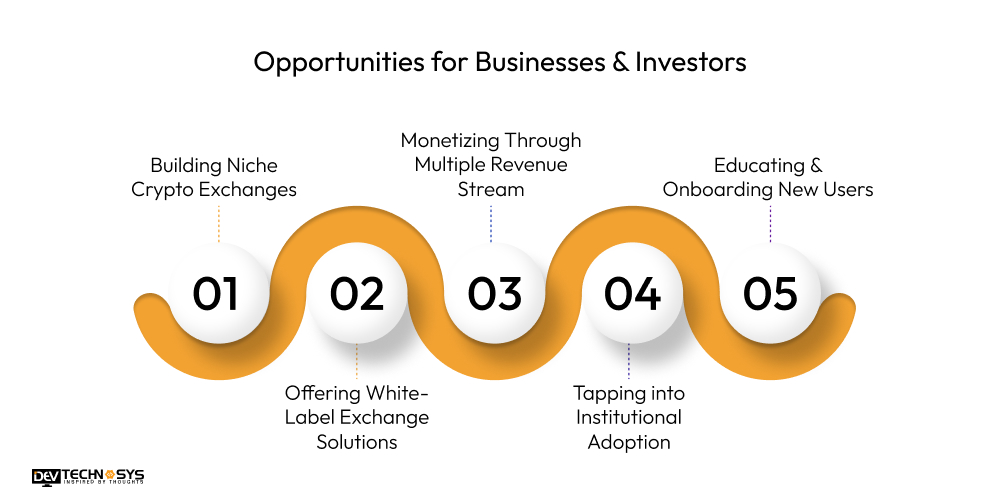
The future trends of cryptocurrency exchange apps will be an amazing opportunity for entrepreneurs, startups, and investors to flourish. These are the five biggest opportunities as the adoption of cryptocurrencies grows:
-
Building Niche Crypto Exchanges
Instead of going head-to-head with the likes of Coinbase or Binance, companies could concentrate on niche exchanges that focus on certain regions, industries, or types of tokens (for instance, NFT-centric exchanges, DeFi-only platforms). With such a move, they can set themselves apart from the crowd and even have a community of users who are loyal to them.
-
Offering White-Label Exchange Solutions
Many businesses do not have sufficient resources to create a crypto exchange platform from the ground up. White-label cryptocurrency exchange app development services provide a turnkey infrastructure that can be personalized, thereby lowering development expenditures and the time for the product to enter the market for entrepreneurs.
-
Monetizing Through Multiple Revenue Streams
Mobile crypto exchange trends can get money by trading fees, withdrawal charges, staking services, listing fees for new tokens, and even premium subscriptions for advanced analytics. Investors can invest in platforms with various income models to make money in the long term.
-
Tapping into Institutional Adoption
As regulations firm up, banks, hedge funds, and large companies are getting involved in crypto trading. The businesses can provide institutional-grade exchange apps with high liquidity, next-gen crypto trading features, and secure APIs for high-volume trades.
-
Educating & Onboarding New Users
Mass adoption will be possible only when there are such platforms that make crypto completely understandable for beginners. Companies that provide educational content, gamified learning, and risk-free demo trading will attract first-time traders and turn them into loyal customers.
Challenges Ahead for Exchange Platforms
In fact, cryptocurrency exchange app development solutions will continue to develop swiftly, but they incessantly face numerous difficulties in attaining their growth and broad usage. Here are five major issues that they have to solve:
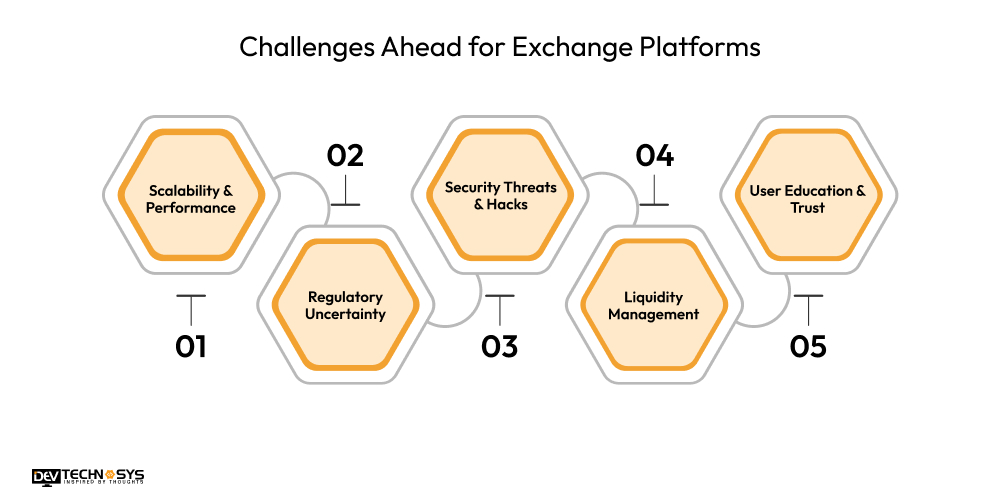
1. Scalability & Performance
It is absolutely necessary to be able to handle millions of trades per second when global adoption is on the rise. Platforms need to invest in Layer-2 scaling solutions and high-performance infrastructure to be able to avoid downtime and delays.
2. Regulatory Uncertainty
Governments all over the world are implementing stricter KYC/AML laws, tax reporting, and licensing requirements. It is very difficult to deal with all these different regulations and, at the same time, keep user privacy, but it is a challenge that has to be met.
3. Security Threats & Hacks
When businesses develop a cryptocurrency exchange app, there is still one of the biggest wishes of hackers. However, they need to utilize high-level security means like multi-signature wallets, threat detection in real time, and zero-knowledge proofs to give users their money back.
4. Liquidity Management
Low liquidity may cause slippage, which makes the trade costly for the users. To guarantee adequate trading, exchanges have to attract market makers, provide incentives, and facilitate cross-chain liquidity.
5. User Education & Trust
In the beginning, cryptocurrency can seem scary to a novice. Platforms must offer appealing UX, give out educational materials, and have a clear fee structure in order to gain user trust and encourage widespread adoption.

Expert Insights & Predictions for 2025 and Beyond
The peer-to-peer crypto trading apps are going to change greatly, and experts have made some predictions that the following things will govern the industry:
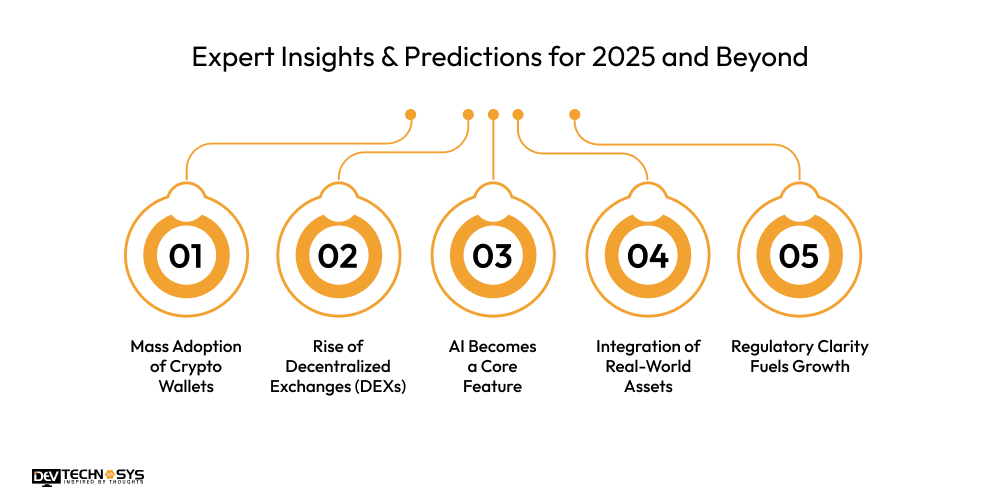
1. Mass Adoption of Crypto Wallets
Knowing that more than one billion people will have crypto wallets by 2027, experts foresee that exchange apps will be as popular as banking apps are today.
2. Rise of Decentralized Exchanges (DEXs)
According to one view, as a result of fears over security, privacy, and custodial risks, the daily trading volume of DEXs will overtake that of centralized exchanges.
3. AI Becomes a Core Feature
Smart Artificial Intelligence will be the driving force behind everything, like automated trading bots, just at the time, the risk will be assessed automatically, and so on. In short, AI will offer traders and institutions the smarter, longer, and more efficient use of data through AI.
4. Integration of Real-World Assets
One of the main reasons for the tokenization of real estate, stocks, and commodities is to make it possible for users to buy a fraction of real-world assets directly from exchange apps that are trading.
5. Regulatory Clarity Fuels Growth
The clearer crypto regulations introduced by governments will lead institutional investors to enter the market in large numbers. Consequently, higher liquidity and legitimacy will be the result of this.

Conclusion – Preparing for the Future of Cryptocurrency Trading
The future of cryptocurrency exchange apps will be positive only for those who are ready to change. They should dedicate their energy to decentralization, security, and compliance while providing the customers with an interesting experience. They should monitor the rise of AI, interoperability, and tokenization among trading platforms to make a prudent decision on their investments.
The year 2025 is not only about cryptocurrency trading; it is about creating a fully interconnected, all-inclusive, and transparent financial ecosystem. Every business, investor, or trader who follows these trends will be able to survive and thrive in the new wave of digital finance.
Dev Technosys is the one blockchain development company that can successfully complete this mission; we are a perfect match for the creation of highly secure, highly scalable, and future-ready cryptocurrency exchange apps. We work with corporate enterprises on secure crypto wallet integration, AI, interoperability, and compliance, enabling them to be among the leaders in crypto trends by 2025.
FAQ’s
1. What Are The Biggest Trends Shaping Cryptocurrency Exchange Apps In 2025?
The main features of top trends are decentralization, AI-based trading, compatibility between different blockchain platforms, tokenization of real-world assets, improved security, and the gamification of users, all of which make it possible to trade at a better speed and a higher level of safety and accessibility for anyone.
2. How Will Ai Impact Cryptocurrency Exchange Platforms In 2025?
AI-powered predictive trading algorithms will enable fraud detection, personalized recommendations, etc., which will facilitate the decision-making of traders. Besides that, the security, user experience, and general efficiency on exchange platforms will also be improved.
3. Why Is Cross-Chain Interoperability Important For Future Exchanges?
Cross-chain interoperability is the smooth trading of assets on different blockchains, thus increasing the liquidity, simplifying the user experience, and making crypto exchanges more open to users. Such users do not need to have multiple wallets or do manual transfers to use them.
4. Are Decentralized Exchanges Safer Than Centralized Ones?
Indeed, decentralized exchanges provide users with complete control over their funds, thus minimizing the risk of hacks and custodial failures. However, they still have to be careful about smart contract vulnerabilities and take user responsibility.
5. How Can Businesses Benefit From These Future Trends?
Businesses can build niche exchanges, attract global users, integrate DeFi features, and monetize through fees, staking, and premium services while staying competitive in the evolving cryptocurrency ecosystem of 2025.