





Key takeaways:
-
- AI improves property search through personalized recommendations, while supporting automated valuation and predictive pricing.
- Real estate businesses use AI for chatbots, lead scoring, and fraud detection. It also powers virtual tours and property management automation.
- Key benefits of AI-powered real estate apps include greater efficiency, a better customer experience, and smarter decision-making.
- Some of the main challenges of AI-based online property businesses include cost, data quality, privacy, and technical complexity.
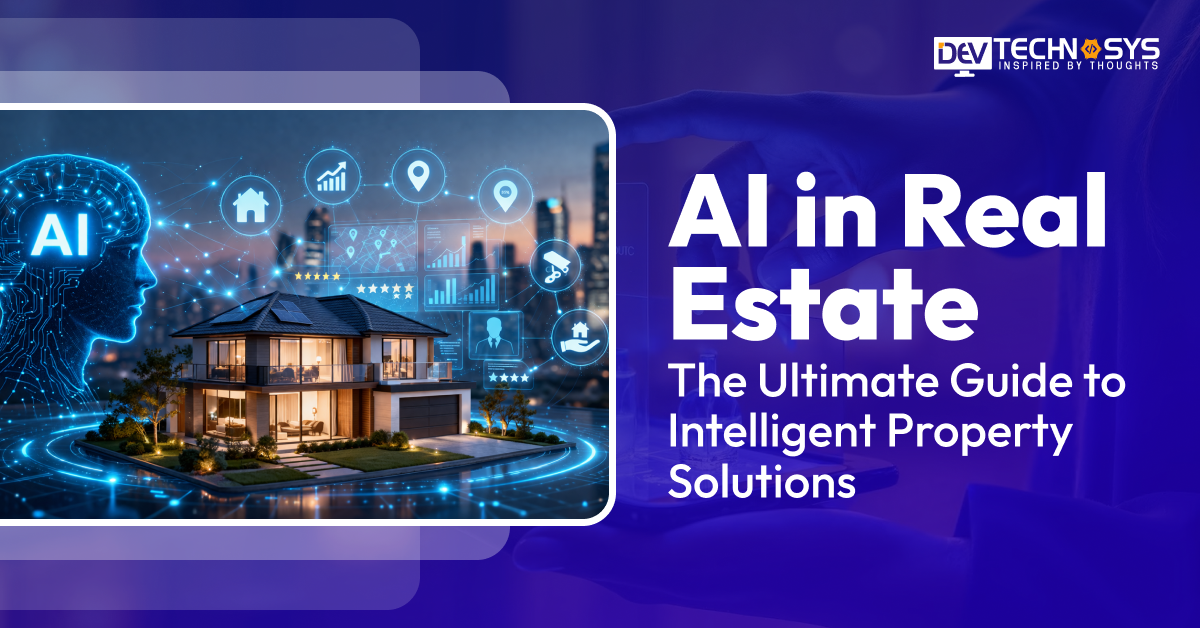
AI in real estate is the use of intelligent technologies such as machine learning, predictive analytics, NLP, computer vision, and automation. It improves property search, valuation, lead management, customer support, and property operations. In 2026, it will help businesses deliver smarter, faster, and more personalized real estate experiences.
Real estate is no longer driven only by listings, brokers, and manual paperwork. Today, buyers expect AI-based property recommendations, sellers want accurate pricing, investors need better forecasting, and agencies aim to automate time-consuming processes. This shift is why AI -powered real estate platforms have become one of the most important proptech trends for modern businesses.
From virtual tours and AI chatbots to smart lead scoring and predictive pricing, these are the real estate AI solutions. They are transforming how real estate companies attract customers, manage operations, and improve profitability. You will learn the role of AI in real estate, its business benefits, major challenges, and future trends in 2026.
What Is AI in Real Estate?
Artificial Intelligence in real estate means using intelligent technologies to improve how properties are searched, priced, marketed, managed, and sold. It helps real estate businesses analyze large amounts of data, automate repetitive tasks, and personalize user experiences.
AI-powered real estate applications enable faster decision-making across buying, selling, and renting. An AI-powered real estate management platform streamlines overall workflows. In simple words, AI allows real estate companies to work smarter instead of harder.
Rather than depending only on manual research, sales calls, and guesswork, businesses can use AI to recommend relevant listings. AI can also be used to estimate property values, predict demand, detect fraud, and improve overall platform performance.
Key functions of AI in real estate
- Property recommendations
- Automated valuation
- Lead scoring
- Chatbots and virtual assistants
- Fraud detection
- Predictive market analysis
- Virtual tours
- Property management automation
Market Prediction on Artificial Intelligence (AI) in Real Estate
The growth of Artificial Intelligence in real estate reflects how strongly the property sector is moving toward intelligent automation. Businesses are adopting AI not only to improve operations but also to stay competitive in the market. Have a look at the market analysis examined by Maximize Market Research.
- The AI in the real estate market was valued at USD 402.19 billion globally in 2025.
- Total AI in Real Estate revenue is expected to grow at a 30% CAGR until 2032.
- By 2032, the market size is projected to reach approximately USD 3286.78 billion worldwide.
- Chatbots accounted for98% market share in AI real estate solutions in 2025.
- Chatbots are expected to maintain market dominance throughout the forecast period due to high adoption.

What Is The Role Of AI In Real Estate In 2026?
The biggest reason AI is gaining traction in real estate is its practical value. It solves real business problems, improves customer journeys, and helps companies scale efficiently. In 2026, AI is not limited to experimentation anymore. It is actively being used across property search, valuations, operations, marketing, and support.
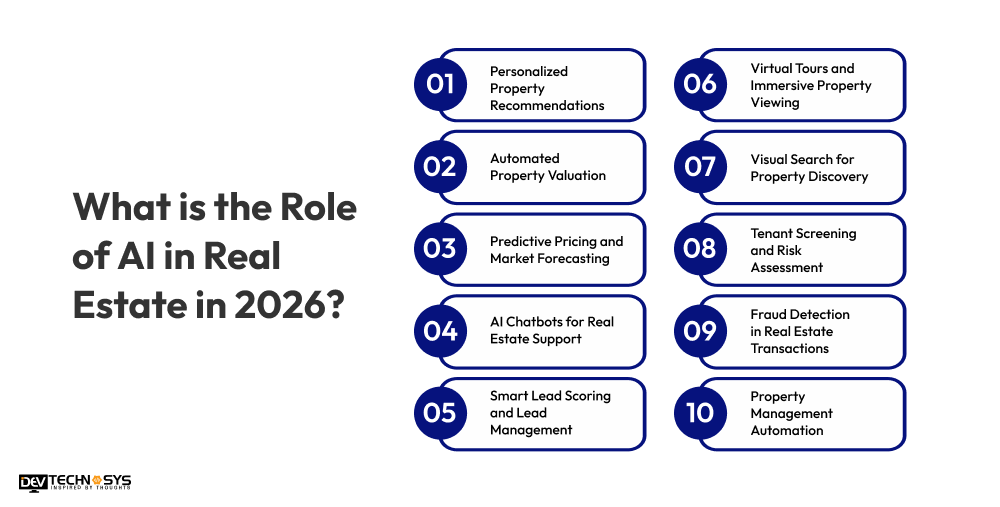
1. Personalized Property Recommendations
AI -powered property search platforms can analyze search history, preferred locations, lifestyle choices, budget, and engagement behavior. It recommends properties that align closely with user intent. This creates a more relevant browsing experience, reduces search fatigue, and improves the chances of users finding suitable listings on real estate platforms.
2. Automated Property Valuation
AI for property valuation assesses property prices using historical sales records, neighborhood data, amenities, market activity, and demand shifts. These tools help buyers, sellers, and agents estimate fair market value more accurately, reducing pricing errors and allowing faster, more informed decision-making during property transactions.
3. Predictive Pricing And Market Forecasting
AI uses historical trends, economic indicators, buyer behavior, and local development signals to forecast price changes and demand patterns. This helps investors, agencies, and developers make strategic decisions, reduce risk, and identify high-potential opportunities before they become obvious in the broader property market.
4. AI Chatbots For Real Estate Support
AI chatbots can answer listing questions, schedule site visits, qualify leads, explain financing basics, and respond instantly at any time of day. This improves customer service, reduces delays, and ensures potential buyers or renters receive quick assistance without waiting for a human representative to respond.
5. Smart Lead Scoring And Lead Management
AI can identify which leads are most likely to convert by analyzing user actions such as listing views, repeat visits, inquiries, time on page, and saved properties. This allows sales teams to prioritize qualified prospects, improve follow-up efficiency, and increase conversion rates with better lead allocation.
6. Virtual Tours And Immersive Property Viewing
Artificial Intelligence in real estate, combined with AR and VR, helps users take virtual property tours from any location. These immersive experiences let buyers explore layouts, room flow, design quality, and spatial features before arranging a physical visit, saving time for both customers and agents while improving decision confidence.

7. Visual Search For Property Discovery
Visual search enables users to upload property images and discover similar homes based on interior design, architecture, colors, or layout preferences. This makes search more intuitive for users who think visually and improves property discovery beyond traditional keyword-based filters and category browsing.
8. Tenant Screening And Risk Assessment
AI helps landlords and property managers assess tenant applications by analyzing financial behavior, document consistency, and other relevant screening signals. This supports better tenant selection, reduces default risks, and strengthens decision-making while helping teams process applications more efficiently and consistently.
9. Fraud Detection In Real Estate Transactions
AI can detect unusual activity such as fake listings, duplicate properties, forged documents, suspicious payments, and abnormal user behavior. This improves platform trust, reduces financial risk, and helps real estate businesses maintain secure digital environments where buyers, renters, and sellers feel more confident.
Read more: How Much Does It Cost To Build A Real Estate App?
10. Property Management Automation
AI in property management automates rent reminders, maintenance requests, service coordination, tenant communication, occupancy forecasting, and issue prioritization. This reduces operational workload, improves response times, and helps landlords and real estate firms manage larger property portfolios with greater consistency and efficiency.
How Beneficial Is AI For Real Estate Businesses?
AI brings measurable advantages to real estate businesses by improving customer satisfaction, increasing productivity, and enabling more data-driven decisions. Whether the goal is to close more deals, reduce manual effort, or manage properties more efficiently, AI supports better business outcomes across nearly every operational layer.
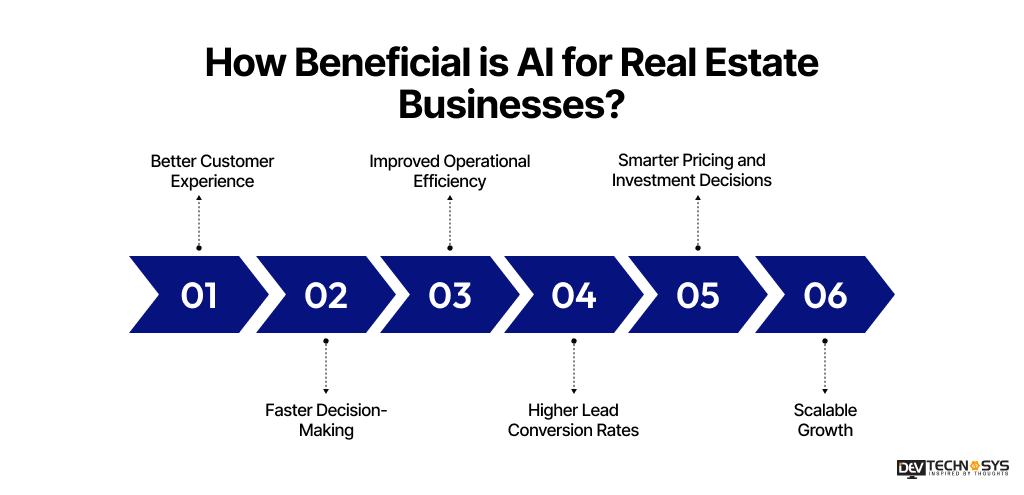
1. Better Customer Experience
AI improves the customer journey through personalized recommendations, instant responses, faster search experiences, and interactive tools such as virtual tours. These features help buyers, renters, and investors engage more comfortably with real estate platforms, resulting in stronger satisfaction, trust, and long-term brand preference.
2. Faster Decision-Making
By analyzing market data, customer behavior, pricing trends, and performance metrics in real time, AI helps businesses make decisions more quickly and accurately. This is especially valuable in real estate, where timing, pricing, and responsiveness often determine whether opportunities are won or lost.
3. Improved Operational Efficiency
AI automates repetitive tasks such as lead sorting, follow-up reminders, scheduling, tenant communication, and document handling. This reduces administrative workload, saves time, and allows real estate teams to focus on strategic tasks like client relationships, negotiation, and revenue-generating activities rather than manual coordination.
4. Higher Lead Conversion Rates
AI helps businesses identify high-intent users, personalize their experience, and trigger timely engagement through chatbots, email automation, and smart recommendations. These capabilities improve lead quality and sales follow-through, which can significantly increase conversion performance across agency websites and real estate apps.

5. Smarter Pricing And Investment Decisions
AI in real estate investment decisions helps businesses estimate property values, evaluate local trends, and identify profitable opportunities. It uses larger and more dynamic datasets than manual analysis. It supports better decisions for brokers, developers, investors, and property management companies.
6. Scalable Growth
As businesses expand their listings, teams, and customer base, AI helps maintain performance without requiring the same growth in manual effort. It enables real estate companies to handle more leads, transactions, and service interactions while keeping operations more organized, responsive, and cost-efficient.
AI in Real Estate: Platforms With AI vs Without AI
The difference between AI-powered and traditional real estate platforms is significant. AI -enabled platforms offer smarter recommendations, better automation, and stronger personalization. In contrast, non-AI platforms usually depend on manual operations and generic user journeys. It can limit efficiency, engagement, and long-term business growth.
Basis of Comparison |
With AI |
Without AI |
| Property Search | Personalized recommendations based on behavior and intent | Generic listings shown with standard filters |
| Property Valuation | AI -based estimates using multiple live and historical factors | Manual or static pricing methods |
| Customer Support | 24/7 chatbot support and faster query resolution | Business-hour support with slower replies |
| Lead Management | Automated lead scoring, qualification, and follow-up | Manual lead sorting and inconsistent response times |
| Virtual Experience | Smart virtual tours and immersive previews | Static images and limited property visualization |
| Fraud Detection | Detects anomalies, fake listings, and suspicious patterns | Basic or manual verification only |
| Marketing | Personalized retargeting and audience segmentation | Broad campaigns with lower precision |
| Property Management | Automates reminders, maintenance, and tenant communication | Manual coordination and tracking |
| Data Insights | Deeper analytics for pricing, demand, and conversion trends | Limited reporting and fewer actionable insights |
| Scalability | Easier to manage growth across listings and customer volume | Growth increases the workload more heavily |
Which Real Estate Companies Are Broadly Using AI In 2026?
Several major real estate and proptech companies already use AI to improve property discovery, pricing accuracy, customer support, and operational efficiency. These examples show that AI is not just a concept for future adoption. It is already helping leading platforms create more intelligent and competitive property experiences. Have a look at the app ideas for real estate business integrating AI in 2026.
1. Zillow
Zillow is widely known for using data-driven technology to support home value estimates, property recommendations, and smarter search experiences. Its AI capabilities help users explore relevant listings, understand market value, and make better-informed decisions while interacting with large volumes of property data more efficiently.
2. Redfin
Redfin uses AI and analytics to improve listing suggestions, search relevance, and pricing insights. These intelligent tools help customers discover suitable homes faster while giving the company better visibility into user behavior, local trends, and factors that influence buying interest across different markets.
3. Realtor.com
Realtor.com applies AI to optimize search, personalize user experiences, and improve listing relevance. Analyzing browsing patterns and market information helps home seekers navigate complex property inventories more effectively, making the process more efficient for buyers, renters, and sellers using its platform.
4. Compass
Compass leverages AI-powered tools to support its agents with pricing intelligence, customer insights, and workflow optimization. The platform uses technology to make brokerage operations more efficient and to help professionals act on better information when advising clients, managing relationships, and pursuing opportunities.
5. Opendoor
Opendoor uses automation and AI-based models to streamline home valuation and simplify parts of the buying and selling process. Its approach reflects how AI can reduce friction in property transactions by improving speed, consistency, and confidence for homeowners navigating time-sensitive real estate decisions.
What Are The Core Technologies Behind AI In Real Estate Solutions?
Artificial Intelligence in real estate depends on several technologies working together rather than one single tool. These technologies allow platforms to analyze data, understand user intent, automate processes, and create more intelligent digital experiences for buyers, sellers, agents, property managers, and investors across the property lifecycle.
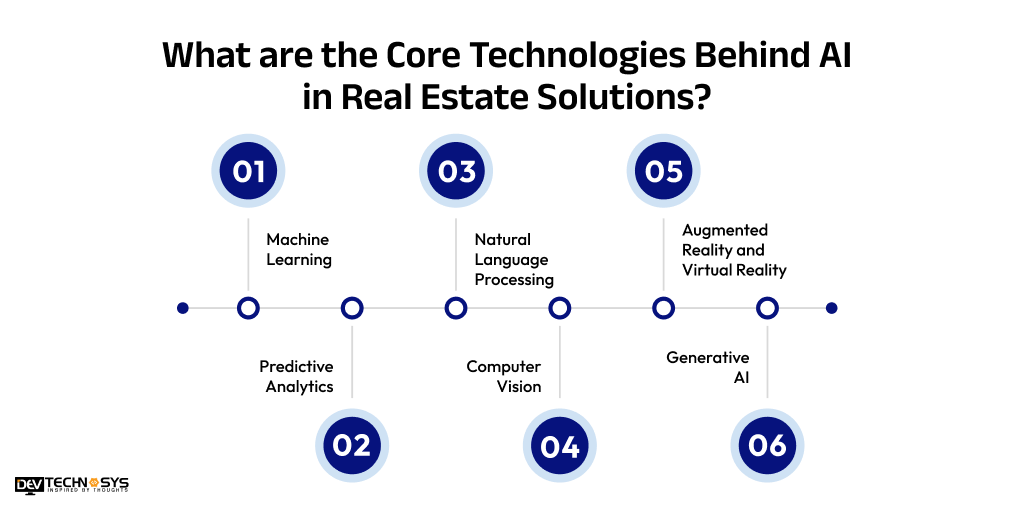
1. Machine Learning
Machine learning helps real estate systems improve continuously by learning from search behavior, transaction patterns, market activity, and customer interactions. It powers recommendation engines, lead scoring, valuation tools, and forecasting models, making real estate platforms more accurate, adaptive, and useful over time.
2. Predictive Analytics
Predictive analytics uses historical and live data to identify likely future outcomes such as price appreciation, rental demand, market slowdown, or lead conversion probability. This helps real estate businesses act proactively, reduce uncertainty, and allocate resources more intelligently in competitive and changing markets.
3. Natural Language Processing
Natural language processing allows real estate platforms to understand conversational search queries, chatbot messages, voice commands, and text-based customer interactions. This improves usability by enabling more human-like communication between users and systems, making search and support faster, simpler, and more intuitive.
4. Computer Vision
Computer vision enables systems to understand property photos, listing images, scanned records, and visual design patterns. It supports visual search, image classification, feature recognition, and document analysis, helping real estate businesses improve listing quality, data organization, and customer discovery experiences through visual intelligence.
5. Augmented Reality And Virtual Reality
AR and VR technologies support immersive property exploration by allowing users to view spaces remotely, understand layouts, and visualize interiors more realistically. These tools make digital property evaluation more effective, especially for long-distance buyers, investors, and users comparing multiple properties before scheduling visits.
6. Generative AI
Generative AI can create listing descriptions, marketing content, email responses, design concepts, and property-related communication assets. This helps businesses save time, maintain content consistency, and scale communication more efficiently while also supporting creative workflows across marketing, sales, and customer engagement teams.
Common Challenges Faced While Implementing AI In Real Estate
Although AI offers strong benefits, implementation is not always simple. Real estate businesses often face challenges related to cost, data quality, integration complexity, and compliance. Understanding these barriers early helps companies plan more effectively and avoid mistakes that can weaken long-term AI performance.
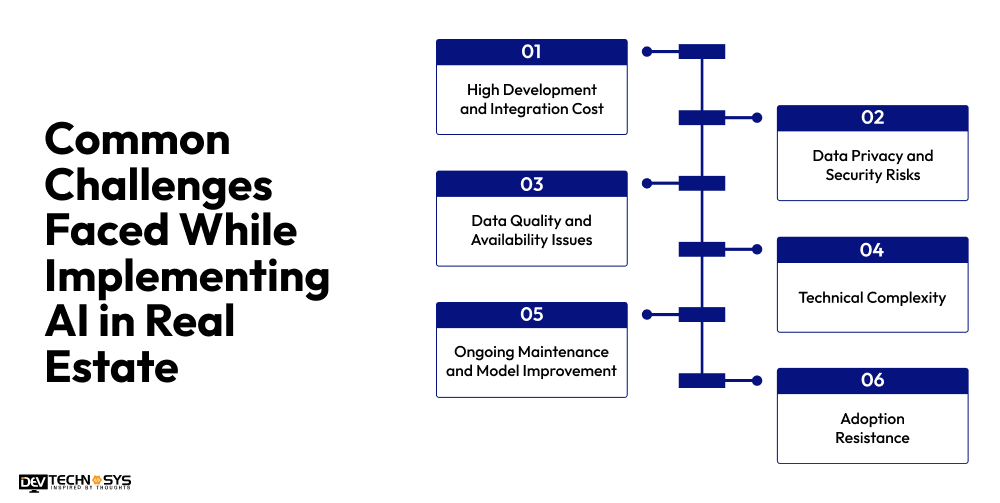
1. High Development And Integration Cost
Building AI-powered real estate platforms often requires investment in skilled developers, cloud infrastructure, APIs, data systems, testing, and long-term support. For startups or traditional agencies, these costs can be high, especially when advanced capabilities like predictive pricing, computer vision, or immersive tours are included.
2. Data Privacy And Security Risks
Real estate platforms handle personal details, legal records, financial information, and property documentation. AI systems that rely on this data must be designed with strong protection measures. Weak security practices can damage user trust, trigger compliance problems, and expose businesses to financial and reputational harm.
3. Data Quality and Availability Issues
AI performs best when trained on clean, complete, and relevant data. In real estate, inconsistent listings, outdated pricing, missing property details, and fragmented datasets can reduce model accuracy. Poor data quality can lead to weak recommendations, flawed valuations, and unreliable decision-support outputs.
4. Technical Complexity
AI implementation involves model training, system integration, workflow design, and performance monitoring. Businesses without internal expertise often struggle to deploy these systems effectively. That is why many companies partner with experienced AI real estate app development teams to ensure smoother implementation and better long-term results.
5. Ongoing Maintenance and Model Improvement
AI is not a one-time deployment. Models need retraining, workflows need optimization, and systems must be updated as user behavior and market conditions change. Real estate businesses must plan for continuous maintenance so their AI tools remain accurate, relevant, and scalable over time.
6. Adoption Resistance
Some real estate teams may hesitate to adopt AI due to unfamiliarity, workflow disruption, or concerns about replacing human judgment. Successful implementation often depends on proper training, change management, and positioning AI as a support tool that strengthens human expertise rather than replacing it.
What Will Be The Future Of AI In The Real Estate Industry?
The future of AI-powered real estate platforms will likely become even more personalized, predictive, and integrated into everyday workflows. As data quality improves and adoption expands, AI will increasingly influence how properties are marketed, valued, and managed. These real estate app development trends will be integrated across residential, commercial, and investment segments.
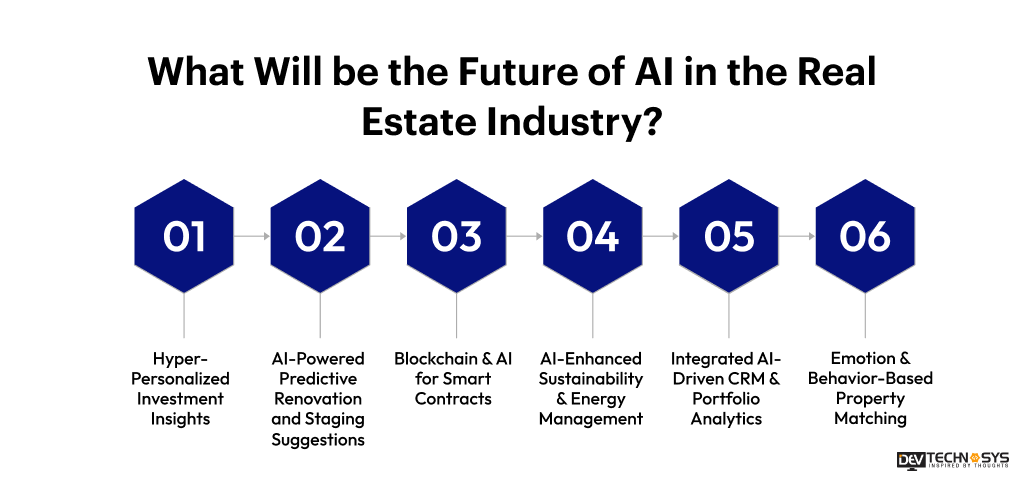
1. Hyper-Personalized Investment Insights
AI will analyze investor profiles, local market dynamics, and risk tolerance to provide highly tailored property investment strategies. This enables smarter portfolio decisions, helping investors optimize returns while minimizing exposure to volatile market conditions.
2. AI-Powered Predictive Renovation And Staging Suggestions
AI will recommend property improvements or staging changes that maximize resale or rental value. By analyzing buyer trends, neighborhood preferences, and property condition, agents can suggest targeted renovations for higher returns.
3. Blockchain & AI for Smart Contracts
AI integrated with blockchain will automate lease agreements, transactions, and title transfers securely. Smart contracts reduce fraud, speed up closing times, and create trustless property transactions with minimal human intervention.
4. AI -Enhanced SustAI nability & Energy Management
AI will forecast energy usage, recommend eco-friendly property upgrades, and optimize energy efficiency for commercial and residential properties. This trend addresses sustainability goals, attracts eco-conscious tenants, and reduces operational costs.
5. Integrated AI -Driven Crm & Portfolio Analytics
Future AI will unify customer relationship management, property portfolio performance, and predictive insights into a single dashboard. Businesses can anticipate client needs and manage multiple properties efficiently. AI in real estate CRM and portfolio analytics makes more informed decisions.
6. Emotion & Behavior-Based Property Matching
Advanced AI will analyze user emotions, search patterns, and social sentiment to recommend properties aligned with personal preferences and lifestyle, bridging the gap between human intuition and machine intelligence.
AI in Real Estate: ROI and Cost-Benefit Analysis
AI adoption in real estate is no longer just a tech trend; it’s a business decision with measurable returns. Companies using AI can significantly reduce operational costs, improve lead conversion rates, and make faster, data-driven decisions. By analyzing property data, automating repetitive tasks, and personalizing customer experiences, AI helps agencies, investors, and brokers maximize efficiency and profitability.
Key Benefits and ROI Metrics:
- Operational Efficiency: AI automates tasks like lead sorting, tenant screening, and document processing, reducing manual workload by up to 40%.
- Improved Conversions: Personalized property recommendations and AI chatbots increase lead engagement, boosting conversion rates by 20–30% on average.
- Cost Reduction: Predictive analytics and demand forecasting minimize overstocking and unnecessary expenses, saving businesses 10–25% in operational costs.
- Faster Decision-Making: Automated valuation models and predictive pricing allow quicker investment or sales decisions, reducing delays and missed opportunities.

Conclusion
AI in real estate is transforming how businesses attract leads, recommend properties, estimate prices, manage operations, and support customers. It is helping agencies, brokers, developers, landlords, and proptech startups create faster, smarter, and more scalable digital property experiences that match modern user expectations.
For businesses, the real value of AI lies in better efficiency, stronger personalization, improved decision-making, and long-term competitive advantage. Whether you want to build an AI real estate app or modernize a property platform, intelligent property solutions can play a major role in future growth. Businesses can reach out to the top real estate app development company to incorporate AI in real estate platforms.
Frequently Asked Questions
Q1. What Is AI In Real Estate?
AI in real estate is the use of artificial intelligence technologies to improve property search, valuation, lead generation, customer support, fraud detection, and property management. It helps businesses automate tasks, personalize user experiences, analyze market data, and make smarter decisions across real estate operations and transactions.
Q2. How Is AI Used In Real Estate?
AI is used in real estate for personalized property recommendations, automated property valuation, predictive pricing, virtual tours, chatbot support, lead scoring, tenant screening, fraud detection, and property management automation. These use cases help businesses improve service quality, efficiency, customer engagement, and overall decision-making.
Q3. What Are The Benefits Of AI In Real Estate?
The main benefits of AI in real estate include better customer experience, faster decision-making, more accurate property valuation, improved lead conversion, reduced manual workload, stronger market insights, and scalable business growth. AI helps real estate companies become more efficient, data-driven, and competitive in a digital market.
Q4. Can AI Predict Property Prices?
AI can help predict property prices by analyzing historical transactions, neighborhood patterns, market demand, local developments, and buyer behavior. While no model can guarantee perfect forecasts, AI can improve pricing accuracy and help agents, investors, and sellers make more informed property decisions.
Q5. Can AI Replace Real Estate Agents?
AI is unlikely to fully replace real estate agents because property decisions involve trust, negotiation, local expertise, and human relationships. However, it supports agents by automating routine work, improving AI -driven real estate insights, and speeding up service delivery. It allows professionals to focus more on high-value client interactions.