





Key takeaways:
-
- Agentic AI enables autonomous healthcare systems to analyze data, make decisions, and execute clinical workflows with minimal human intervention.
- Healthcare providers use agentic AI for patient monitoring, diagnosis assistance, treatment planning, and hospital resource optimization.
- Agentic AI is expected to play a crucial role in future healthcare systems by improving efficiency, personalization, and medical innovation.
The rapid advancement of artificial intelligence is positioning digital technologies as integral to the modern medicine system. If you have noticed, we have entered the Agentic AI era of autonomous functionality and advanced reasoning.
Agentic AI in healthcare has the potential to ease the burden of clinicians and medical staff by providing real-time support. A study by MarketsandMarkets estimates that the healthcare AI market will reach over $187 billion by 2030.
With automation and predictive intelligence, autonomous AI agents in healthcare are changing the landscape of care delivery.
This blog evaluates the effect of Agentic AI in healthcare and how it fits within healthcare technology. We’ll also explore agentic AI use cases in hospitals and future trends.
What is Agentic AI in Healthcare?
Agentic AI in healthcare refers to advanced artificial intelligence systems capable of autonomously performing tasks, making decisions, and executing complex workflows with minimal human intervention. Unlike traditional AI systems that simply analyze data or generate predictions, agentic AI systems act as intelligent agents, capable of planning, reasoning, and adapting to dynamic healthcare environments.
These AI agents are designed to observe patient data, interpret clinical information, evaluate possible actions, and implement decisions in real time. Self-learning healthcare AI models operate through multi-step reasoning and can coordinate with other digital systems such as Electronic Health Records (EHRs), diagnostic tools, and hospital management platforms.
The defining characteristics of agentic AI include:
- Autonomy
- Goal-Oriented Behavior
- Multi-Step Reasoning
- Adaptive Learning
- Integration with Healthcare Ecosystems
What are the Key Benefits of Agentic AI in Healthcare?
AI agent development services in Sharjah have several benefits for hospitals, doctors, and patients. It greatly enhances the quality and efficiency of healthcare services by automating complex tasks and enabling smart decision-making.
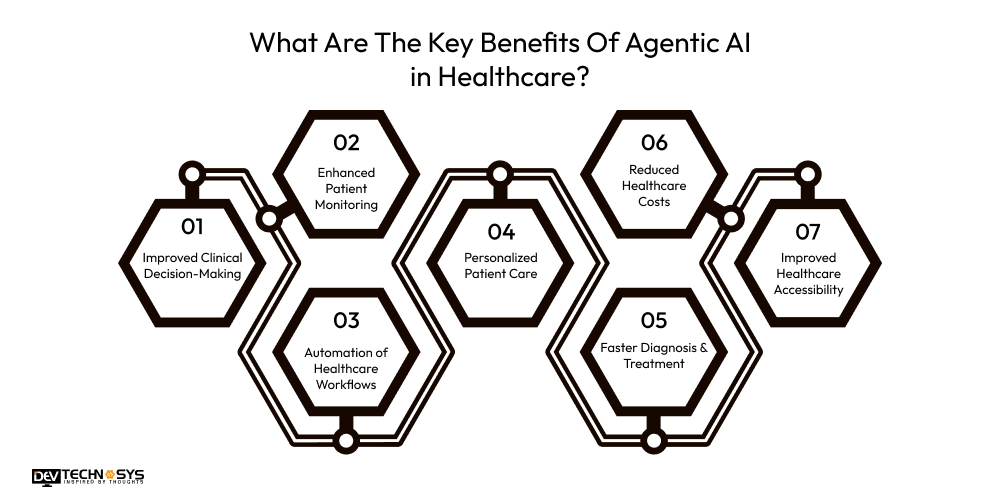
1. Improved Clinical Decision-Making
Self-learning healthcare AI models analyze large volumes of medical data, including patient history, diagnostic reports, and clinical research, to support evidence-based decisions. By providing data-driven insights and treatment recommendations, it helps healthcare professionals make more accurate diagnoses and select the most effective treatment options.
This helps doctors:
- Identify the most effective treatment plans
- Detect potential risks earlier
- Reduce diagnostic errors
2. Enhanced Patient Monitoring
Predictive analytics in healthcare AI enables continuous monitoring of patient health using wearable devices, remote sensors, and connected medical equipment. It tracks vital signs and detects abnormal patterns in real time, allowing healthcare providers to respond quickly and prevent potential health complications or medical emergencies.
Agentic AI can monitor:
- Heart rate fluctuations
- Blood pressure changes
- Oxygen levels
3. Automation of Healthcare Workflows
AI-powered healthcare automation streamlines repetitive administrative and operational tasks, including appointment scheduling, patient record management, billing, and documentation. By streamlining these workflows, healthcare staff can reduce manual workload, minimize errors, and focus more on delivering quality patient care.
Agentic AI can automate:
- Managing patient scheduling
- Processing medical records
- Coordinating laboratory tests
4. Personalized Patient Care
Agentic AI analyzes individual patient data, including medical history, genetic information, and lifestyle factors, to create personalized treatment plans. This approach allows healthcare providers to tailor therapies according to patient needs, improving treatment effectiveness and supporting better long-term health outcomes.
This includes:
- Customized medication plans
- Tailored therapy recommendations
- Personalized diet and lifestyle guidance
5. Faster Diagnosis & Treatment
AI-powered patient monitoring systems process medical images, lab reports, and patient data quickly to detect diseases at earlier stages. Faster analysis enables healthcare professionals to diagnose conditions sooner and initiate treatment promptly, which is crucial for managing serious illnesses and improving patient recovery rates.
- Faster disease detection
- Reduced waiting times
- Earlier treatment initiation
6. Reduced Healthcare Costs
By automating processes, improving operational efficiency, and minimizing unnecessary procedures, agentic AI helps reduce overall healthcare expenses. Hospitals can optimize resource utilization, prevent hospital readmissions, and lower administrative costs while still delivering high-quality healthcare services to patients.
Cost-saving benefits include:
- Reduced hospital readmissions
- Automated administrative processes
- Optimized resource allocation
7. Improved Healthcare Accessibility
AI agents for clinical decision support, telemedicine platforms, virtual consultations, and remote patient monitoring, making healthcare services more accessible. Patients in rural or underserved areas can receive medical guidance, symptom assessments, and follow-up care without frequent hospital visits.
AI agents can:
- Provide virtual health consultations
- Assist with symptom analysis
- Monitor patients remotely
Industry Insight: According to Simbo.ai, administrative paperwork, often cited as a major source of clinician burnout, was reduced by 60%, allowing more time for patient care.
Top Use Cases of Agentic AI in Healthcare
Agentic AI in Abu Dhabi is transforming the healthcare industry by enabling intelligent systems that can autonomously analyze data, make decisions, and execute complex workflows. An AI agent development company offers AI-driven solutions to enhance efficiency, accuracy, and patient outcomes across various healthcare applications.
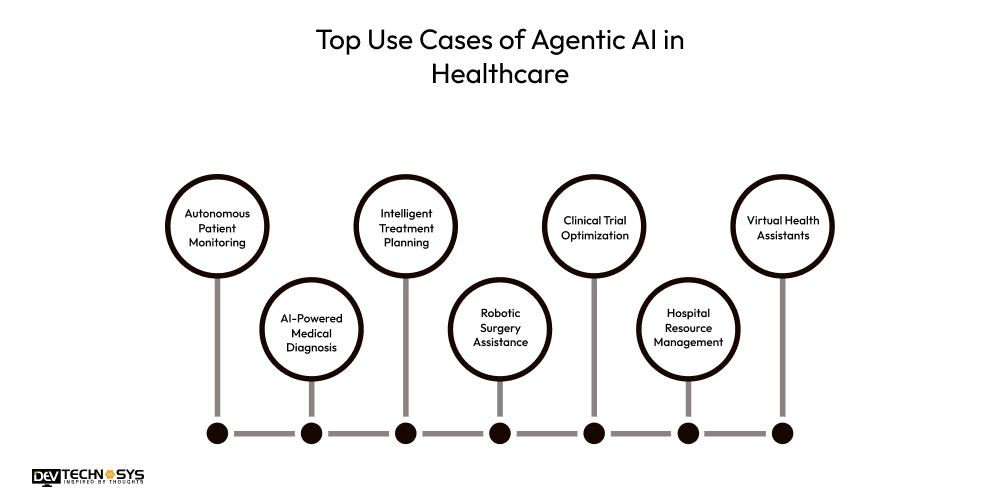
1. Autonomous Patient Monitoring
With agentic AI, autonomous patient monitoring keeps an eye on a patient’s health continuously via wearable devices, remote sensors, and connected medical equipment. These devices look at real-time information, including heart rate, blood pressure, and oxygen levels. This lets health care workers find problems early and act swiftly when they see a health danger.
These systems automatically:
- Track vital signs
- Identify abnormal health patterns
- Notify doctors about potential issues
- Suggest medical interventions
2. AI-Powered Medical Diagnosis
Intelligent healthcare systems assist doctors by analyzing medical images, laboratory reports, and patient records to accurately detect diseases. These systems can identify patterns that may be difficult for humans to detect. By supporting faster and more accurate diagnosis, AI-powered tools help healthcare professionals provide timely treatment and improve patient outcomes.
It assists doctors in diagnosing conditions such as:
- Cancer
- Cardiovascular diseases
- Neurological disorders
- Respiratory illnesses
3. Intelligent Treatment Planning
AI agents for patient care management enable healthcare providers to create personalized treatment plans based on patient history, genetic data, lifestyle factors, and medical conditions. These systems analyze various treatment options and recommend the most effective strategies. They can also adjust treatment plans over time based on patient progress and responses.
Agentic AI can develop personalized treatment strategies by evaluating:
- Patient history
- Genetic information
- Drug interactions
- Clinical guidelines
4. Robotic Surgery Assistance
Autonomous AI agents in healthcare enhance robotic surgery systems by providing real-time insights and precision support during medical procedures. These systems analyze patient data and guide surgeons with accurate movements and risk monitoring. Robotic surgery AI systems help improve surgical accuracy, reduce complications, and support minimally invasive procedures, leading to faster patient recovery.
AI-driven surgical systems can:
- Analyze real-time patient data
- Guide surgical instruments with precision
- Monitor surgical risks
- Suggest optimal surgical approaches
5. Clinical Trial Optimization
Clinical trial optimization AI helps streamline clinical trials by identifying suitable participants, monitoring patient responses, and analyzing large volumes of research data. These systems can predict trial outcomes and optimize study designs. This innovation accelerates drug development, reduces research costs, and improves the success rate of clinical trials.
Agentic AI can streamline clinical trial processes by:
- Identifying suitable patient candidates
- Monitoring trial progress
- Analyzing trial data
- Predicting trial outcomes
6. Hospital Resource Management
Hospital automation with AI improves hospital operations by optimizing resource allocation, including bed availability, staff scheduling, and equipment utilization. These systems analyze operational data to predict patient demand and manage hospital workflows efficiently. This helps reduce overcrowding, improve service delivery, and enhance the overall healthcare management process.
These systems can manage:
- Bed allocation
- Staff scheduling
- Medical equipment usage
- Emergency response coordination
7. Virtual Health Assistants
AI healthcare virtual assistants provide patients with 24/7 healthcare support. These assistants answer medical questions, send medication reminders, schedule appointments, and monitor symptoms. By offering instant assistance and personalized health guidance, virtual assistants improve patient engagement and support better self-care management.
These assistants can:
- Answer health-related questions
- Provide medication reminders
- Assist with appointment scheduling
- Monitor chronic conditions
Industry Insight:Health Management Data shows that Early ROI is visible across patient experience, support services, and core back‑office workflows, not just in a single isolated use case.
What Are The Emerging Innovations Driven By Agentic AI?
AI agent development solution is accelerating innovation in healthcare by enabling smart systems to plan, act, and improve complex medical processes on their own. These powerful healthcare AI agents are changing how hospitals work, how medical research is conducted, and how patients are cared for.
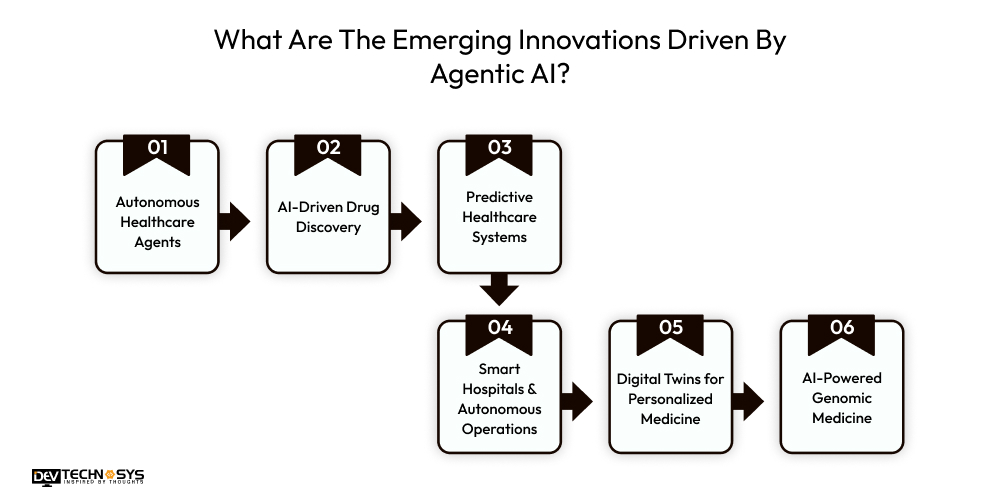
1. Autonomous Healthcare Agents
Autonomous healthcare agents are intelligent AI systems capable of independently managing complex healthcare workflows. They can schedule appointments, coordinate patient care, monitor treatment progress, and communicate with medical systems. These agents help reduce administrative workload, ensure timely medical interventions, and improve coordination between healthcare providers and patients.
2. AI-Driven Drug Discovery
AI agents in medical systems are transforming pharmaceutical research by analyzing biological data, chemical compounds, and clinical studies to identify potential drug candidates. These systems simulate molecular interactions and predict treatment outcomes. AI-driven drug discovery accelerates the drug development process, reduces research costs, and enables faster discovery of effective medications.
3. Predictive Healthcare Systems
Predictive healthcare systems use agentic AI to analyze patient history, genetic data, lifestyle patterns, and environmental factors. These systems identify early signs of diseases and predict potential health risks before symptoms appear. This allows a mobile app development company in Dubai to build AI agents for preventive care strategies and improve long-term patient outcomes.
4. Smart Hospitals & Autonomous Operations
Smart healthcare AI solutions are enabling smart hospitals where intelligent systems automatically manage operational tasks. Smart hospital technologies optimize bed allocation, manage staff schedules, monitor patient flow, and track medical equipment. By automating hospital management processes, smart hospitals improve efficiency, reduce delays, and enhance the overall patient care experience.

5. Digital Twins for Personalized Medicine
Digital twin technology creates virtual replicas of patients using their health data, medical history, and genetic information. Agentic AI uses these models to simulate treatment responses before applying therapies to real patients. This helps doctors test treatment strategies safely and choose the most effective personalized care options.
6. AI-Powered Genomic Medicine
Next-generation healthcare AI is advancing robotic surgery by enabling surgical systems to analyze real-time patient data and assist surgeons during procedures. These intelligent systems improve surgical precision, monitor risks, and recommend optimal surgical actions. This innovation supports minimally invasive surgeries and helps improve recovery times and surgical outcomes.
What Are The Challenges & Risks Of Agentic AI In Healthcare?
Agentic AI and chatbot development services in Dubai have the potential to transform the healthcare business, but their adoption also comes with a number of challenges and risks. Healthcare companies need to address these issues carefully to ensure that autonomous AI systems are used safely, ethically, and effectively.
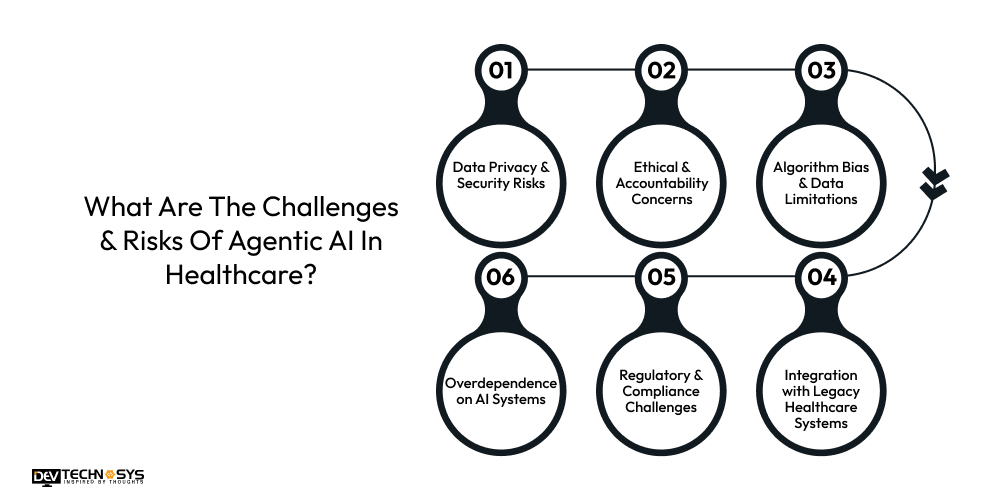
1. Data Privacy & Security Risks
AI assistants for doctors and clinicians rely heavily on large volumes of sensitive patient data, including medical records, imaging results, and personal health information. Protecting this data from cyberattacks, breaches, and unauthorized access is critical. Healthcare organizations must implement strong encryption, strict access controls, and regulatory compliance to maintain patient trust and safeguard data.
2. Ethical & Accountability Concerns
Because agentic AI can make autonomous decisions, determining accountability for medical errors becomes complex. If an AI system recommends an incorrect treatment or diagnosis, responsibility may be unclear between developers, healthcare providers, and institutions. Establishing ethical guidelines, transparent decision-making frameworks, and clear accountability models is essential for safe AI adoption.
3. Algorithm Bias & Data Limitations
AI models learn from historical healthcare data, which may contain biases or incomplete information. If datasets lack diversity, agentic AI systems may produce inaccurate predictions for certain populations. This can lead to unequal healthcare outcomes. Ensuring high-quality, diverse training data is necessary to improve fairness and reliability.
4. Integration with Legacy Healthcare Systems
Many hospitals still rely on outdated IT infrastructure and fragmented healthcare systems. Integrating agentic AI with electronic health records, diagnostic platforms, and hospital management systems can be technically challenging. Without proper system interoperability and infrastructure upgrades, healthcare organizations may struggle to fully leverage the benefits of agentic AI technologies.
5. Regulatory & Compliance Challenges
Healthcare technologies must meet strict regulatory requirements and safety standards before deployment. Agentic AI systems must undergo extensive validation, testing, and certification to ensure reliability. Navigating complex healthcare regulations across different regions can slow innovation and create barriers for organizations adopting advanced AI-driven healthcare solutions.
6. Overdependence on AI Systems
As healthcare organizations adopt advanced AI technologies, there is a risk of excessive reliance on automated decision-making. Overdependence on agentic AI could reduce human oversight in critical medical situations. Maintaining a balanced approach where AI supports rather than replaces healthcare professionals is essential for safe and responsible use.
Which Core Technologies Power Healthcare Agentic AI?
Agentic AI for fraud detection systems relies on a combination of advanced technologies that enable autonomous decision-making, intelligent reasoning, and real-time data processing. These technologies allow AI agents to analyze medical data, learn from outcomes, and execute complex healthcare workflows.
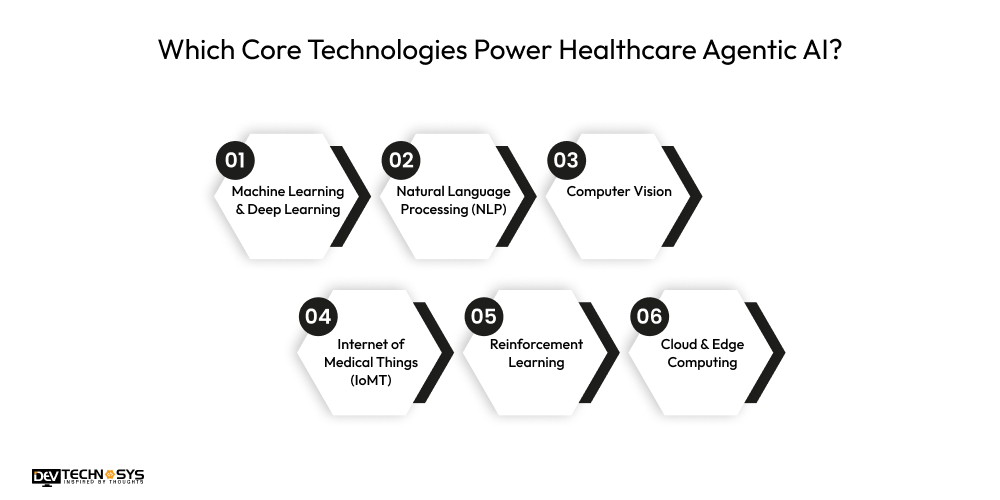
1. Machine Learning & Deep Learning
Agentic AI systems can analyze large healthcare datasets and identify patterns using machine learning and deep learning methods. These algorithms keep improving at making decisions by learning from patient records, treatment outcomes, and clinical data. In healthcare, they help predict diseases, diagnose them, and make personalized treatment recommendations.
2. Natural Language Processing (NLP)
Natural language processing in healthcare enables AI systems to understand, interpret, and analyze human language in medical contexts. It helps extract insights from physician notes, clinical documentation, patient feedback, and medical research papers. By converting unstructured text into actionable data, NLP helps agentic AI improve clinical decision-making and healthcare documentation.
3. Computer Vision
Computer vision medical diagnosis allows agentic AI to analyze medical images such as X-rays, CT scans, MRIs, and pathology slides. These AI models detect abnormalities, identify disease patterns, and assist doctors in diagnosing conditions more accurately. Computer vision technology significantly enhances diagnostic precision and supports faster medical imaging analysis.
4. Internet of Medical Things (IoMT)
Internet of Medical Things (IoMT) AI connects healthcare devices such as wearable sensors, smart monitors, and remote diagnostic tools. Agentic AI uses real-time data from these connected devices to track patient health conditions, monitor vital signs, and detect potential medical issues early, enabling proactive and continuous healthcare management.
5. Reinforcement Learning
Reinforcement learning healthcare AI improves its decision-making through trial and error. By evaluating outcomes and learning from feedback, agentic AI systems refine their strategies over time. In healthcare, this technology helps optimize treatment planning, clinical workflows, and resource allocation for better patient care.
6. Cloud & Edge Computing
Cloud and edge computing give you the tools you need to store and process big healthcare datasets. Cloud platforms let you train AI models and share data on a large scale. Edge computing lets you analyze data in real time right on medical devices. Together, they make sure that agentic AI systems can process data quickly and work reliably.
Agentic AI vs Generative AI vs Traditional AI in Healthcare
Chatbot development trends in UAE have changed a lot over the years. It has moved from rule-based systems to more advanced, independent technology. Today, healthcare systems use three main types of AI: Agentic AI, Generative AI, and Traditional AI. Each type has its own job, such as analyzing medical data, creating content, or running complex healthcare workflows on its own.
Aspect |
Agentic AI |
Generative AI |
Traditional AI |
| Definition | Autonomous AI systems that can plan, reason, and execute tasks to achieve specific goals | AI systems are designed to generate new content, such as text, reports, and images | AI systems that analyze structured data and perform predefined tasks |
| Level of Autonomy | High autonomy with the ability to make decisions and perform multi-step actions | Moderate autonomy focused mainly on generating outputs | Low autonomy, operates based on predefined rules and models |
| Primary Function | Executes complex workflows and performs goal-oriented actions | Creates medical documentation, summaries, and conversational responses | Analyzes data patterns and provides predictions or classifications |
| Decision-Making Capability | Can recommend and initiate actions based on analysis and goals | Provides generated suggestions that require human validation | Supports decision-making through predictive insights |
| Healthcare Applications | Patient monitoring, treatment coordination, hospital resource management | Clinical documentation, medical report generation, patient communication | Disease prediction, diagnostic support, risk analysis |
| Learning Approach | Uses adaptive learning, reinforcement learning, and feedback loops | Learns patterns from large datasets to generate human-like outputs | Trained on structured datasets for pattern recognition and predictions |
| Workflow Integration | Integrates with multiple healthcare systems to automate processes | Assists with documentation and information generation | Supports specific analytical tasks in healthcare systems |
| Example Use Case | AI agent coordinating patient care across hospital systems | AI generating clinical notes or patient summaries | AI predicting the risk of diseases based on patient data |
Final Thoughts!
Agentic AI represents an inflection point in healthcare operations. It supports the workflow technology, bringing adaptability, continuity, and clarity. Intelligent healthcare systems are more than efficient tools; they have become strategic capabilities. Healthcare organizations in UAE are seeking artificial intelligence development services to succeed with agentic AI.
By embracing autonomous medical AI systems, pharmaceutical and healthcare organizations are enhancing patient care and optimizing operational costs. But the shift toward this revolution requires a radical rethink of work to ensure care delivery remains efficient, impactful, and sustainable. Agentic AI is not the destination. It is the next step towards a healthcare system in which coordination no longer depends solely on human endurance.
Frequently Asked Questions
Q 1. Can Agentic AI Replace Doctors and Healthcare Professionals?
Agentic AI is designed to assist healthcare professionals rather than replace them. It provides intelligent insights, automates repetitive tasks, and supports clinical decision-making. However, human expertise remains essential for patient care, ethical judgment, and complex medical decisions.
Q 2. How will Agentic AI Shape the Future of Healthcare?
Agentic AI is projected to change healthcare by enabling predictive care, personalized treatment, automated hospital operations, and accelerated medical research. In the future, these new ideas could help medical facilities run more smoothly, make healthcare easier to access, and enhance patient outcomes.
Q 3. Is Agentic AI Safe for Handling Sensitive Healthcare Data?
Agentic AI systems are designed to follow strict data security and privacy standards. Healthcare organizations implement encryption, secure data storage, and regulatory compliance measures to protect patient information and ensure safe handling of sensitive healthcare data.
Q 4. What is Agentic AI in Healthcare, and How Does it Work?
Agentic AI in healthcare is an AI system that can operate autonomously to analyze patient data, make decisions, and execute healthcare workflows with minimal human intervention. These systems use cutting-edge technology to support diagnosis, treatment planning, patient monitoring, and hospital operations.
Q 5. What are the Biggest Challenges in Adopting Agentic AI in Healthcare?
Major challenges include data privacy concerns, integration with existing healthcare systems, regulatory compliance, high implementation costs, and potential algorithm bias. Healthcare organizations must address these issues carefully to ensure responsible, secure, and effective deployment of agentic AI technologies.