




 Tarun Nagar
 Key takeaways:
-
- The ongoing digital transformation has ignited the craze and popularity of web development in the UAE.
- App’s complexity, features, backend infrastructure, third-party integrations, security, and other factors are responsible for influencing web development cost in UAE.
- One can even reduce the final development cost by opting for MVP development, cross-platform development, outsourcing developers from cheaper regions, and more.
The digital transformation is rapidly evolving multiple industries and businesses in the world, and the UAE is no exception. Large enterprises and startups in UAE are heavily investing to make their online presence in this digitally competitive world.
Web development plays a vital role in customer acquisition, branding, and revenue growth, whether for an ecommerce store, corporate website, etc. The UAE is emerging as a technological hub in the Middle East, and it is supported by the government initiatives.
As demand grows, businesses often ask a crucial question: What is the web development cost in UAE? The web development cost in UAE depends on multiple aspects, from website complexity to post-launch maintenance.
This blog offers detailed insights into the cost to build a website in UAE, including market statistics, cost breakdowns, influencing factors, cost-saving strategies, and revenue benefits.
What Are the Market Stats of Web Development in UAE?
The UAE web development market is rapidly expanding due to digital transformation, business innovation, and increasing online consumer engagement. Let’s explore the market size and future outlook of web development in the UAE:
- The UAE digital economy contributed approximately $140 billion to GDP in 2023, with web-based businesses accounting for nearly 35% of digital revenue.
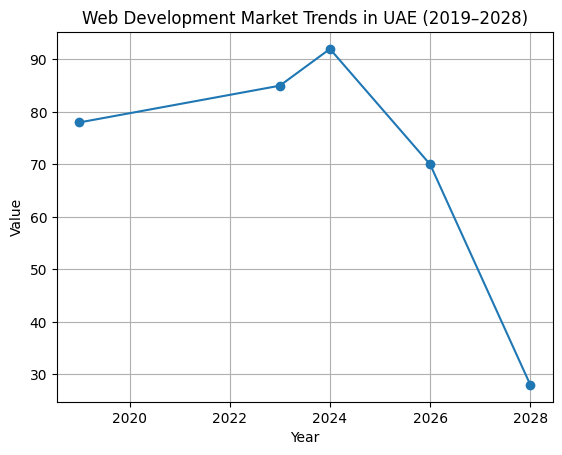
- In 2024, over 92% of UAE businesses reported having an official website, compared to 78% in 2019, showing strong digital adoption.
- The UAE web development and IT services market is projected to reach $28 billion by 2028, growing at a CAGR of 3%.
- Dubai alone accounts for nearly 45% of web development projects in the UAE, driven by startups, real estate, tourism, and fintech sectors.
- By 2026, over 70% of customer interactions in the UAE are expected to occur through digital platforms, significantly increasing demand for high-performance websites.
What Is Web Development?
Web development refers to the process of building, designing, and maintaining websites and web applications that operate on the internet. It includes frontend development (user interface and experience), backend development (server-side logic, databases, APIs), and full-stack development that combines both.
A custom web development company in Middle East offers a wide range of solutions such as business websites, eCommerce platforms, enterprise web portals, SaaS products, content management systems (CMS), and progressive web apps (PWAs).
In the UAE, web development focuses heavily on performance, security, scalability, multilingual support, and compliance with regional regulations. It ensures businesses meet both local and global digital standards.
How Much Does Web Development Cost in UAE?
The custom website development cost UAE typically ranges between $8,000 and $30,000, depending on project scope, complexity, and customization requirements. A basic website with standard design and limited functionality falls within the lower web development cost in UAE. While advanced enterprise-grade platforms with custom integrations and scalability features have a higher web development cost in UAE.
A simple business website generally includes static pages, responsive design, and basic SEO setup. Mid-level websites incorporate dynamic content, CMS integration, advanced UI/UX, and third-party APIs. Advanced websites include custom dashboards, cloud hosting, AI-driven features, data analytics, multilingual support, and enterprise security.
Website Type | Description | Cost Range |
| Basic Website | Static pages, responsive design, contact forms, basic SEO setup | $8,000 – $12,000 |
| Mid-Level Website | Custom UI/UX, CMS integration, dynamic content, third-party APIs | $13,000 – $20,000 |
| Advanced Website | Enterprise features, high security, scalability, and custom integrations | $21,000 – $30,000 |
What Factors Influence Web Development Cost in UAE?
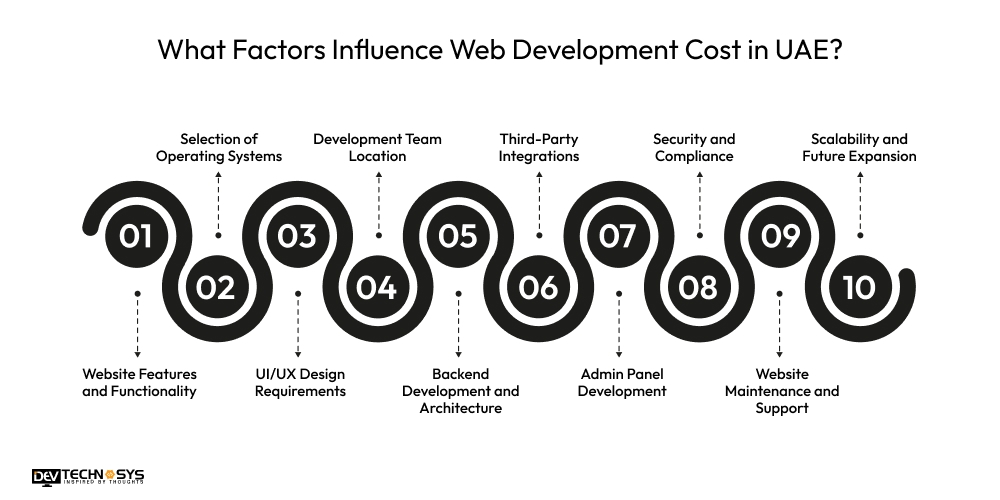
Web development cost in UAE varies based on website complexity, features, design quality, technology stack, and development approach. Let’s examine some of these factors influencing the web development cost in Middle East in detail.
1. Website Features and Functionality
The number and complexity of website features directly affect development cost. Basic features include static pages and contact forms, while advanced functionality includes user dashboards, payment gateways, real-time updates, and automation. It requires additional development time, testing, and technical expertise, increasing the overall responsive website development cost UAE significantly.
Feature Level | What’s Included | Cost Range |
| Basic Features | Static pages, contact forms, basic navigation, mobile responsiveness | $2,000 – $3,500 |
| Advanced Features | Dynamic content, user login, custom forms, basic automation | $3,500 – $5,500 |
| Premium Features | Custom dashboards, advanced workflows, data-driven functionality | $5,500 – $8,000 |
2. Selection of Operating Systems
Different website types require different development approaches and effort. The choice of operating system, Android, iOS, or both, directly impacts web development cost in Abu Dhabi and other emirates.
Developing for a single platform is cheaper and faster, while creating apps for multiple OS increases design, coding, and testing efforts. Compatibility, performance optimization, and maintenance requirements also vary with the chosen OS.
Platform Type | Description | Cost Range |
| Single Platform | Developing for only one OS (Android or iOS) is faster and more cost-effective. Ideal for startups or small businesses. | $8,000 – $14,000 |
| Cross-Platform | A single codebase works across both Android and iOS. Reduces development time compared to building separate apps. | $14,000 – $22,000 |
| Native Multi-Platform | Separate native apps for both Android and iOS. Provides optimal performance, design flexibility, and full feature access. | $22,000 – $30,000 |
3. UI/UX Design Requirements
High-quality UI/UX design improves engagement but adds to development costs. UI/UX design plays a crucial role in user engagement and conversion rates. Simple template-based designs are affordable, while custom layouts, animations, interactive elements, and user experience are not. This research demands more design hours, prototyping, and usability testing, thereby increasing the overall website development price estimate.
Design Level | Description | Cost Range |
| Basic UI/UX | Uses ready-made templates, simple layouts, and standard navigation, ensuring fast deployment and cost-effectiveness. | $2,000 – $4,000 |
| Custom UI/UX | Tailored visuals, color schemes, brand integration, and improved user journey for better engagement. | $4,000 – $7,000 |
| Advanced UI/UX | Interactive animations, micro-interactions, detailed usability testing, and responsive design for high-end user experience. | $7,000 – $10,000 |
4. Development Team Location
The developer outsourcing location decides the professional web developers cost UAE. The geographical location of the development team significantly impacts pricing. When you hire dedicated developers in regions like the UAE, North America, or Western Europe charge higher rates. While offshore teams from Asia or Eastern Europe offer cost-effective solutions without compromising quality, making location a critical budgeting factor.

Team Type | Description | Cost Range |
| Offshore Team | Skilled developers from countries with lower rates; ideal for startups looking to save costs while maintaining quality. | $8,000 – $15,000 |
| Hybrid Team | A combination of local management and offshore developers balances cost-efficiency with regional expertise. | $15,000 – $22,000 |
| Onshore UAE Team | Full local team with premium expertise; suitable for enterprise projects requiring close collaboration and compliance with UAE standards. | $22,000 – $30,000 |
5. Backend Development and Architecture
Backend complexity affects scalability, performance, and security. Backend architecture ensures website performance, data handling, and scalability. Basic backends use simple databases and APIs, while advanced architectures involve cloud hosting, microservices, load balancing, and optimized databases. It increases web development cost in Dubai and other emirates, but ensures long-term stability and growth.
Backend Level | Description | Cost Range |
| Basic Backend | Simple database, APIs, and limited server-side functionality. Fits small websites or informational platforms. | $3,000 – $6,000 |
| Scalable Backend | Cloud hosting, optimized APIs, and moderate data management. Supports a growing user base and additional features. | $6,000 – $10,000 |
| Advanced Backend | Microservices architecture, load balancing, high-performance servers, and database optimization for enterprise-level applications. | $10,000 – $15,000 |
6. Third-Party Integrations
Integrations enhance functionality but increase cost. Third-party integrations enhance website functionality by connecting external services like payment gateways, CRM systems, analytics tools, maps, and email services. While these integrations improve efficiency and user experience, they require additional development effort, licensing costs, and ongoing maintenance, increasing the overall project budget.
Integration Level | Description | Cost Range |
| Essential Integrations | Includes payment gateways, maps, or basic API connections for functional operations. | $500 – $1,200 |
| Extended Integrations | Adds CRM, analytics, email automation, and workflow tools to enhance operations and tracking. | $1,200 – $2,500 |
| Advanced Integrations | Complex connections with ERP systems, automation platforms, and third-party enterprise solutions for full-scale operations. | $2,500 – $3,500 |
7. Admin Panel Development
Admin dashboards help manage content, users, and analytics. An admin panel allows businesses to manage content, users, orders, and analytics efficiently. Basic admin dashboards are affordable, but advanced panels with real-time reporting, automation, role-based access, and performance insights require extensive backend development, increasing both complexity and overall web development cost in Sharjah and other emirates.
Panel Type | Description | Cost Range |
| Basic Admin Panel | Manage content, pages, and users; suitable for small-scale websites with simple management needs. | $3,000 – $5,000 |
| Advanced Admin Panel | Includes reporting, role-based access, and content moderation for medium-scale websites or eCommerce platforms. | $5,000 – $7,500 |
| Smart Admin Panel | Real-time analytics, automation tools, notifications, and performance dashboards for enterprise websites. | $7,500 – $10,000 |
8. Security and Compliance
Security is crucial for UAE businesses, especially in the finance and healthcare sectors. Security and regulatory compliance are essential for protecting user data and business operations. Implementing SSL certificates, secure authentication, data encryption, GDPR compliance, and region-specific regulations increases development time and cost but is critical for building trust and avoiding legal risks.
Security Level | Description | Cost Range |
| Basic Security | SSL certificates, secure login, and standard protection against common threats. | $1,000 – $2,500 |
| Enhanced Security | Data encryption, secure payment processing, and advanced authentication measures for sensitive data handling. | $2,500 – $4,500 |
| Compliance Security | GDPR, UAE regulatory compliance, and advanced monitoring for high-security enterprise websites. | $4,500 – $6,000 |
9. Website Maintenance and Support
Ongoing maintenance ensures website performance, security, and compatibility with updates. Services include bug fixes, security patches, performance optimization, and feature updates. While it increases the website maintenance cost UAE, it prevents major technical issues, improves user experience, and ensures long-term website reliability.
Maintenance Level | Description | Cost Range |
| Basic Maintenance | Bug fixes, minor updates, and general troubleshooting for small websites. | $250 – $1,000 |
| Standard Maintenance | Performance optimization, security updates, and feature updates for medium-sized sites. | $1,000 – $2,500 |
| Full Maintenance | Full support, including monitoring, backups, feature upgrades, and emergency fixes for enterprise-grade platforms. | $2,500 – $4,000 |
10. Scalability and Future Expansion
Scalable websites cost more initially but save money long-term. Scalability planning prepares the website for future growth, increased traffic, and additional features. Building a scalable architecture initially requires higher investment, but it reduces future redevelopment costs, supports regional or global expansion, and ensures smooth performance as business demands evolve.
Scalability Level | Description | Cost Range |
| Limited Scalability | Supports a small user base and minor feature expansion; suitable for startups or pilot projects. | $8,000 – $14,000 |
| Moderate Scalability | Handles increasing users, traffic, and additional features; good for growing businesses. | $14,000 – $22,000 |
| High Scalability | Enterprise-level infrastructure supporting global traffic, high-performance operations, and large-scale feature expansion. | $22,000 – $30,000 |

How to Reduce Web Development Cost in UAE?
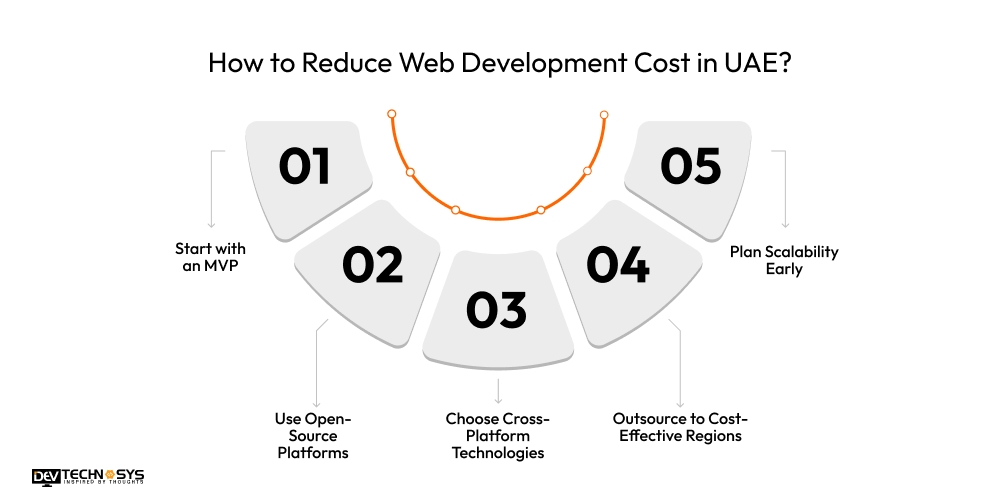
Hire dedicated web developers for strategic planning, MVP development, cross-platform solutions, and outsourcing. This can significantly lower web development expenses without compromising quality. Despite multiple cost factors, businesses can reduce expenses with smart planning.
1. Start with an MVP
Launching a Minimum Viable Product helps businesses focus on essential features only. This approach reduces initial development cost, shortens timelines, validates the idea quickly, and allows improvements based on real user feedback before investing in advanced functionalities.
2. Use Open-Source Platforms
Open-source platforms like WordPress, Magento, or Drupal significantly lower development expenses. They provide ready-made themes, plugins, and community support, minimizing custom coding requirements while maintaining flexibility, security, and scalability for future business needs.
3. Choose Cross-Platform Technologies
Cross-platform frameworks such as React, Angular, or Flutter allow developers to reuse code efficiently. This reduces development time, eliminates the need for separate builds, and lowers overall costs while ensuring consistent performance across devices and browsers.
4. Outsource to Cost-Effective Regions
Outsourcing web development to cost-effective regions provides access to skilled professionals at lower rates. This strategy reduces overall expenses, accelerates development timelines, and ensures high-quality output when working with experienced and well-managed offshore development teams.
5. Plan Scalability Early
Planning scalability during the initial development phase prevents costly redesigns later. A scalable architecture supports future traffic growth, new features, and regional expansion, ensuring long-term cost efficiency and seamless performance as business requirements evolve.
How Does a Website Generate Revenue?
Websites generate revenue through lead generation, eCommerce sales, subscriptions, advertising, affiliate marketing, and premium CMS web development services. Here we will discuss some of these monetization models in detail:
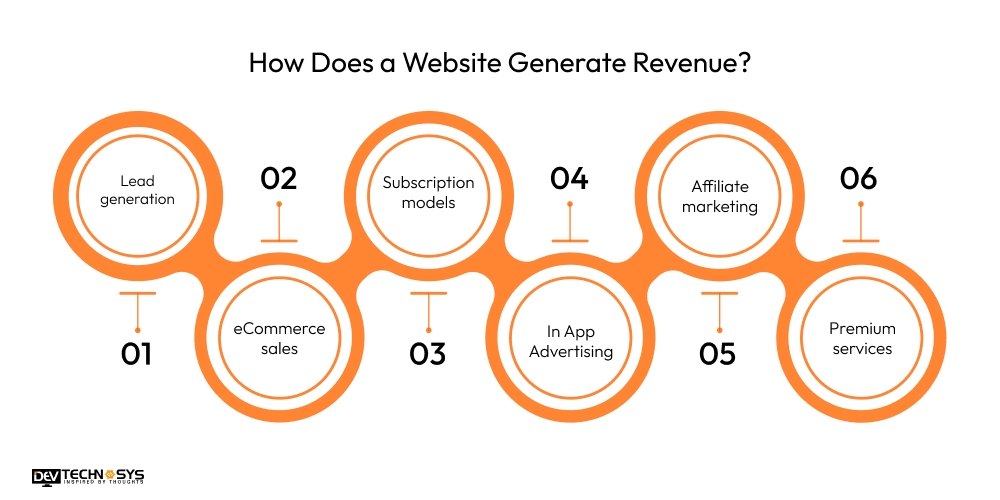
1. Lead generation
Websites generate revenue by collecting potential customer information through contact forms, inquiries, or sign-ups. These qualified leads are then converted into sales through follow-up marketing, consultations, or direct outreach, making lead generation a cost-effective and scalable income source.
2. eCommerce sales
eCommerce websites generate revenue by selling products or services directly to customers online. Secure payment gateways, product catalogs, shopping carts, and smooth checkout experiences help increase conversions, expand market reach, and drive consistent online sales.
3. Subscription models
Subscription-based websites charge users recurring monthly or yearly fees for access to exclusive content, tools, or services. This model provides predictable revenue, improves customer retention, and supports long-term business growth through continuous user engagement.
4. In App Advertising
Websites earn revenue by displaying advertisements from third-party brands or businesses. Income is generated through impressions, clicks, or conversions, making advertising a profitable option for high-traffic websites while maintaining free access for users.
5. Affiliate marketing
Affiliate marketing allows websites to earn commissions by promoting third-party products or services. Revenue is generated when users purchase through referral links, making it a low-risk model that works well for content-driven and niche websites.

6. Premium services
Websites offer premium services such as advanced features, personalized support, exclusive access, or enhanced performance for an additional fee. These value-added services increase customer satisfaction while creating an additional and sustainable revenue stream.
Final Words
Web development in UAE is a strategic investment that drives brand visibility, customer engagement, and long-term business growth. The cost of web development in UAE typically ranges from $8,000 to $30,000, depending on features, complexity, and development approach.
A web design company in Dubai helps businesses understand cost factors, choose the right development strategy, and implement cost-saving techniques. The best web development company in UAE can help you build scalable and high-performing websites.
Whether you are a startup or an enterprise, investing in professional web development services in UAE ensures digital success in an increasingly competitive market.
FAQs
Q1. How Much Does It Cost To Build A Website In The UAE?
In the UAE, typical website development ranges from $8,000 for basic sites to $30,000+ for complex web applications, based on features and design expectations. Costs can also vary depending on UI/UX design quality, platform choice, integrations, and long-term scalability requirements for future growth.
Q2. How Are Web Development Costs Calculated In The UAE?
Costs are calculated based on project scope, design complexity, backend development needs, CMS integration, third-party tools, security, and developer rates. Project timelines, post-launch support, and the need for mobile responsiveness or multilingual features also influence overall development expenses.
Q3. How Do UAE Web Development Companies Price Their Services?
Agencies use either fixed-price packages or hourly billing, with pricing influenced by experience, project size, and service inclusions like maintenance and SEO. Pricing may also include consulting, QA testing, and ongoing updates to ensure websites remain secure, optimized, and scalable.
Q4. How Does Tech Stack Selection Impact Web Development Cost In The UAE?
Advanced stacks, custom frameworks, and scalable backend systems require more development time, increasing cost, whereas standard stacks like LAMP or CMS can reduce expenses. The choice of front-end and back-end technologies also affects integration capabilities, security standards, and ease of future feature expansions.
Q5. What Are The Trending Web Development Technologies In UAE In 2026?
In 2026, trends include progressive web apps (PWAs), headless CMS, serverless architecture, AI-driven functionality, and API-first development, impacting both cost and performance. Businesses adopting these technologies benefit from faster load times, improved user experience, and greater flexibility to scale across digital platforms.