




 Tarun Nagar
 Key takeaways:
-
- The top 5 Postman Alternatives include Insomnia, Hoppscotch, Amazon API Gateway, Apidog, Swagger/SwaggerHub, and RapidAPI.
- To choose the right Postman alternative, start by defining your use case. Consider project size, automation needs, and team collaboration.
- Security is critical for business APIs. Enterprise tools similar to Postman offer authentication, rate limiting, encryption, and compliance support.
- Developers prefer offline and privacy-focused tools like Postman for better privacy, faster performance, and Git-based collaboration.
We agree that Postman is an incredibly popular tool for testing and developing APIs, but to think it’s the single best option available? In this economy? Absolutely Not! There are several amazing open-source Postman alternatives that you can rely on. Insomnia, Bruno, Hoppscotch, the list goes on.
But maybe you are dealing with API testing tools for the first time or don’t belong to the technology field, so you are unaware of these mind-blowing alternatives to Postman.
If you are a business searching for advanced and comprehensive platforms similar to Postman to transform API development from a fragmented, multi-tool process into a unified, collaborative platform, then this blog is for you.
Below, we have provided a complete list of the best open source API testing tools like Postman, that simplify every step of the API lifecycle, from design to documentation and monitoring. So, without wasting any more of your time, let’s dive straight into these popular api testing tools.
What are the Enterprise Leading Postman Substitutes?
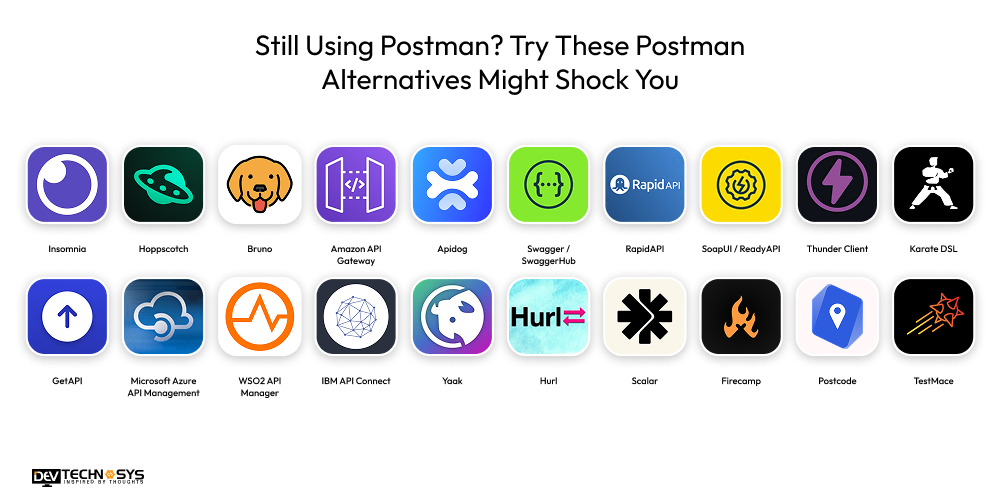
Looking for lightweight postman alternatives for startups and enterprises? Great, here are some of the top tools similar to Postman that you can explore. Each of these api testing tools for startups offers a simple setup, fast performance, and essential features for developing and testing APIs.
| Softwares/Systems | Coding Skills Required | RESTful API Support | GraphQL API Support | SOAP API Support | API Testing | API Monitoring |
| Insomnia | Low | Yes | Yes | No | Yes | No |
| Hoppscotch | Low | Yes | Yes | No | Limited | No |
| Bruno | Medium | Yes | No | No | Yes | No |
| Amazon API Gateway | High | Yes | Limited | No | No | Yes |
| Apidog | Low | Yes | Yes | No | Yes | No |
| Swagger / SwaggerHub | Medium | Yes | No | No | Limited | No |
| RapidAPI | Low | Yes | Limited | No | Limited | Limited |
| SoapUI / ReadyAPI | Medium | Yes | No | Yes | Yes | Limited |
| Thunder Client | Low | Yes | No | No | Limited | No |
| Karate DSL | High | Yes | No | No | Yes | Limited |
| GetAPI | Low | Yes | No | No | Limited | No |
| Microsoft Azure API Management | High | Yes | Limited | No | No | Yes |
| WSO2 API Manager | High | Yes | Limited | Limited | Limited | Yes |
| IBM API Connect | High | Yes | Limited | Limited | Limited | Yes |
| Yaak | Low | Yes | No | No | Limited | No |
| Hurl | High | Yes | No | No | Yes | No |
| Scalar | Medium | Yes | Limited | No | Limited | No |
| Firecamp | Medium | Yes | No | No | Yes | Limited |
| Postcode | Low | Yes | No | No | Limited | No |
| TestMace | Low | Yes | No | No | Limited | No |
1. Insomnia
Insomnia is a user-friendly tool designed for API development and testing. According to Allied Market Research, Insomnia had over 1 million users by mid 2025. Yes, you heard it right. Why is it so popular? Because it allows developers to create, send, and manage HTTP and REST requests such as GET, POST, PUT, DELETE, and more.
This is one of the best Postman alternatives for users because it enables them to easily view API responses, including status codes, headers, and response bodies, which helps in understanding how applications behave. This makes debugging faster and more efficient.
Key Factors:
- Supports REST, GraphQL, and HTTP request testing
- Environment variables for easy switching between setups
- Clean and user-friendly interface
- Detailed response inspection (headers, status, body)
- Suitable for individual developers and small teams
2. Hoppscotch
Hoppscotch is a fast, free, and open-source API development ecosystem used by API developers in Middle East for creating, testing, and documenting APIs. It ranked 30th among 173 active competitors in its sector.
It is a lightweight, web-based alternative to Postman and Insomnia, designed for speed and simplicity. Hoppscotch is an alternative to Postman that supports REST, GraphQL, and WebSocket APIs and offers features such as real-time collaboration, collections, and shared team workspaces. Available on web, desktop, and CLI, it also supports self-hosting, giving teams greater flexibility and control.
Key Factors:
- Open-source, fast, and web-based alternative to Postman
- Supports REST, GraphQL, and WebSocket APIs
- Real-time collaboration with team workspaces
- Cross-platform availability (web, desktop, CLI)
- Optional self-hosting for full control
3. Bruno
Do you know half a million developers use Bruno? Now you do! Bruno is a fast, open-source, offline-first API client built as a Git-friendly alternative to Postman. It is considered the best postman alternative because it stores API collections directly on the local file system in plain text format, allowing developers to use Git for version control and collaboration without relying on cloud services. Bruno supports both REST and GraphQL APIs and follows a developer-first approach. It is lightweight, loads quickly, consumes minimal system resources, and runs smoothly on macOS, Windows, and Linux platforms.
Key Factors:
- Offline-first API client for local storage
- Git-friendly with collections stored as plain text
- Supports REST and GraphQL APIs
- Lightweight and fast with minimal system resources
- Designed for developer-focused workflows
4. Amazon API Gateway
Amazon API Gateway is a powerful service that enables developers in UAE to create, publish, maintain, monitor, and secure REST, HTTP, and WebSocket APIs at any scale. It acts as a front door for applications to access backend services such as AWS Lambda, EC2, and other AWS resources. The platform handles traffic management, authorization, monitoring, and API versioning efficiently. Amazon API Gateway can support hundreds of thousands of concurrent API calls with high reliability and performance.
Note: According to Amazon Web Services, Amazon API Gateway has an estimated 10.15% market share in the API management market and is ranked #2.
Key Factors:
- Supports REST, HTTP, and WebSocket APIs
- Integrates with AWS backend services (Lambda, EC2, etc.)
- Handles traffic management and scaling for high loads
- Security, authorization, and monitoring are included
- Suitable for enterprise-grade, high-traffic applications
5. Apidog
Apidog is a comprehensive, spec-driven free Postman alternative designed to streamline the entire API lifecycle, from design and development to testing, documentation, and management. It treats the API specification as a single source of truth, helping developers, QA engineers, and project managers collaborate more effectively. Apidog combines the capabilities of tools like Postman, Swagger, and JMeter into one unified platform. This reduces tool dependency, prevents data inconsistencies, and improves overall team productivity.
Key Factors:
- Spec-driven platform using API as a single source of truth
- Combines API design, testing, documentation, and management
- Supports cross-functional team collaboration
- Replaces multiple tools like Postman and Swagger
- Reduces data inconsistency and improves workflow efficiency
6. Swagger / SwaggerHub
Swagger and SwaggerHub are widely used tools for API design, documentation, and collaboration. SwaggerHub provides a centralized environment where teams can design APIs while enforcing quality, consistency, and industry standards.
Postman open source alternative such as Swagger offer interactive documentation, automated code generation, and strong collaboration features. SwaggerHub can generate client SDKs and server stubs in multiple programming languages, helping teams accelerate development and reduce manual effort throughout the API lifecycle.
Key Factors:
- Centralized API design and documentation platform
- Standardizes APIs using OpenAPI specifications
- Provides interactive documentation and code generation
- Supports multiple programming languages
- Enhances team collaboration and version control

7. RapidAPI
RapidAPI is the world’s largest API marketplace and developer hub, used by over five million developers worldwide. It helps users discover, test, connect to, and manage thousands of public APIs using a single account and API key. RapidAPI simplifies API integration and reduces development time. For API providers, it offers powerful tools to publish, monitor, manage, and monetize APIs through subscriptions, all handled through a unified and easy-to-use dashboard..
Key Factors:
- Largest API marketplace connecting millions of developers
- Single API key for managing multiple APIs
- Offers built-in testing and monitoring tools
- Monetization options for API providers
- Simplifies discovery and consumption of third-party APIs
8. SoapUI / ReadyAPI
SoapUI and ReadyAPI are widely used API testing tools designed for testing both REST and SOAP services. SoapUI is mainly used for functional testing, while ReadyAPI extends its capabilities with advanced features such as test automation, performance testing, security testing, and detailed reporting.
These lightweight postman alternatives are commonly used in enterprise environments where API reliability and accuracy are critical. They help teams detect issues early and ensure stable API performance before deployment.
Key Factors:
- Supports both REST and SOAP API testing
- Functional, performance, and security testing
- Advanced automation and reporting (ReadyAPI)
- Enterprise-grade testing capabilities
- Strong CI/CD integration support
9. Thunder Client
Thunder Client is a lightweight API testing extension built directly into Visual Studio Code. It allows developers to streamline providing chatbot app development services and send API requests, inspect responses, and manage request collections without leaving the editor. With quick installation and a simple interface, Thunder Client enables fast and efficient API testing. It is especially useful for frontend and backend developers who primarily work in VS Code and want minimal disruption to their workflow.
Key Factors:
- Fully integrated with Visual Studio Code
- Lightweight and fast API testing
- Supports collections and environments
- Minimal setup and easy learning curve
- Ideal for developers working inside VS Code
10. Karate DSL
Karate DSL is an open-source testing framework designed specifically for API automation. It uses a simple and readable syntax that does not require advanced programming skills, making it accessible to both developers and testers. Karate postman like tools allow teams to combine API testing, mocking, and performance testing within a single framework.
It integrates smoothly with CI/CD pipelines, making it ideal for automated testing environments and continuous delivery workflows.
Key Factors:
- Open-source API automation framework
- Simple, readable, script-based syntax
- Combines API testing, mocking, and performance testing
- Strong CI/CD pipeline integration
- Suitable for large-scale automated testing
11. GetAPI
GetAPI is the best free Postman alternative for developers that helps them discover and explore public APIs easily. It allows users to review API documentation, test endpoints, and understand request and response formats before integration. GetAPI is useful for developers who want to speed up development by using existing APIs instead of building everything from scratch. It simplifies API discovery and makes third-party integrations faster and more efficient.
Key Factors:
- GPS & map API integration
- Real-time ride status updates
- Fare calculation API accuracy
- Surge pricing support
- Payment gateway API compatibility
12. Microsoft Azure API Management
Microsoft Azure API Management is a cloud-based service that helps organizations publish, secure, monitor, and scale APIs. It provides features like authentication, rate limiting, caching, analytics, and developer portals. Businesses use Azure API Management to control API access, improve performance, and protect backend services. It is commonly used by enterprises building large, scalable applications on the Azure cloud ecosystem.
Key Factors:
- Cloud-based API publishing, security, and monitoring
- Authentication, rate limiting, and caching features
- Built-in analytics and developer portals
- Scales easily for large enterprise applications
- Protects backend services and improves API performance
13. WSO2 API Manager
WSO2 API Manager is an open-source, enterprise-grade platform that supports the full API lifecycle. It enables organizations to create, publish, secure, monitor, and analyze APIs from a single system. WSO2 offers strong security features, traffic management, and detailed analytics. It supports both cloud and on-premise deployments, making it a flexible choice for organizations that require customization and large-scale API management.
Key Factors:
- Full API lifecycle support from creation to monitoring
- Strong security and traffic management features
- Detailed analytics for usage and performance
- Supports both cloud and on-premise deployments
- Flexible for customization and enterprise-scale environments.
14. IBM API Connect
IBM API Connect is a comprehensive API management solution designed for large and complex enterprise environments. It helps teams design, secure, publish, and manage APIs while maintaining strong governance and compliance. As the best api testing software for developers, it provides analytics, lifecycle management, and developer portals to improve API adoption. IBM API Connect is often used by organizations in regulated industries that require high security, control, and scalability.
Note: Do you know that, as of 2026, over 571 companies use IBM API Connect? It is highly concentrated in enterprise-level companies (10,000+ employees).
Key Factors:
- Comprehensive API management with strong governance
- Secure, publish, and manage APIs across teams
- Built-in analytics and lifecycle management tools
- Developer portals for API adoption and collaboration
- Ideal for regulated industries requiring high security

15. Yaak
Yaak is a modern API client focused on privacy, speed, and simplicity. It works offline and stores data locally, making it a good choice for developers who prefer not to rely on cloud syncing. According to the 2025 user survey results, Yaak has over 100,000 downloads and 9,000 active users per week as of September 2025. Yaak supports REST and GraphQL APIs and offers a clean, distraction-free interface. It is ideal for developers who want a fast, secure, and private alternative to traditional API testing tools.
Key Factors:
- Offline-first API client with local data storage
- Supports REST and GraphQL APIs
- Fast, private, and distraction-free interface
- Lightweight and easy to use
- Ideal for developers avoiding cloud dependencies
16. Hurl
Hurl is a command-line tool used for testing HTTP APIs through simple text-based scripts. Developers can send requests, validate responses, and check headers or status codes easily. Hurl is commonly used in automated testing and CI/CD pipelines because it is lightweight and easy to integrate. It is best suited for developers who prefer scripting and automation over graphical user interfaces.
Key Factors:
- Command-line API testing tool
- Send requests, validate responses, check headers/status
- Lightweight and easy to integrate into CI/CD
- Suitable for automation and scripting workflows
- No graphical interface, perfect for dev-focused testing
17. Scalar
Scalar is an API documentation tool that converts OpenAPI specifications into clean, interactive, and developer-friendly documentation. It focuses on readability and modern design, making APIs easier to understand and adopt. Scalar helps teams improve developer experience by presenting clear examples and structured content. It is often used by organizations that want professional-looking API documentation without complex configuration or heavy tooling.
Key Factors:
- Converts OpenAPI specs into interactive documentation
- Clean, readable, developer-friendly design
- Improves developer experience with clear examples
- Easy setup without heavy configuration
- Ideal for teams needing professional API docs quickly
18. Firecamp
Firecamp is an all-in-one API development and testing platform that supports REST, GraphQL, WebSockets, and real-time APIs. It allows teams to test, debug, and collaborate on APIs in shared workspaces. Among all api testing tools for automation and manual testing, Firecamp stands out because it also supports automation and monitoring, helping teams identify issues faster. It is ideal for developers and teams who want multiple API tools combined into a single, easy-to-use platform.
Key Factors:
- All-in-one platform for REST, GraphQL, WebSockets, and real-time APIs
- Supports API testing, debugging, and team collaboration
- Automation and monitoring are built in
- Shared workspaces for team productivity
- Ideal for developers wanting multiple tools in one platform
19. Postcode
Postcode is a simple API testing tool designed for sending HTTP requests and checking API responses. It focuses on ease of use and quick setup, making it suitable for beginners and small development teams. Postcode allows developers to test endpoints, validate data, and troubleshoot API issues without complex features. It is a good choice for basic API testing needs and quick debugging tasks.
Key Factors:
- Simple API testing with HTTP requests
- Quick setup, beginner-friendly interface
- Endpoint validation and troubleshooting
- Lightweight and easy to use
- Good for small teams and basic API testing
20. TestMace
TestMace is a lightweight API testing and monitoring tool built for REST APIs. It helps developers send requests, create automated tests, and monitor API performance over time. TestMace is easy to use and does not require heavy configuration. It offers enterprise api testing solutions and is suitable for developers and teams who want basic API validation, testing, and monitoring without the complexity of enterprise-level tools.
Key Factors:
- Lightweight REST API testing and monitoring tool
- Create requests and automated tests easily
- Tracks API performance over time
- Minimal setup, no heavy configuration required
- Suitable for small teams or basic API validation

Free vs Paid API Tools: Which One Delivers Better Value?
Paid API tools usually offer better value for professional, high-stakes, and scalable projects because they provide advanced features, higher reliability, stronger security, and dedicated support. Free API tools are more suitable for learning, experimentation, personal projects, and low-volume usage.
The right choice depends on your specific needs, such as project complexity, data volume, performance expectations, and long-term growth plans. Here we present a comparison table of free vs API tools, in hopes of making you better understand the differences and similarities between them.
| Aspect | Free API Tools | Paid API Tools |
| Cost | No upfront cost, ideal for tight budgets | Subscription-based or usage-based pricing |
| Features | Basic testing and limited functionality | Advanced testing, automation, monitoring, and analytics |
| Usage Limits | Strict rate limits and request caps | Higher or unlimited API call limits |
| Performance | Suitable for low-volume and non-critical use | Optimized for high performance and heavy workloads |
| Security | Basic security controls | Enterprise-grade security and compliance |
| Collaboration | Limited or no team collaboration | Full team collaboration and role management |
| Support | Community or self-help support | Dedicated customer and technical support |
| Scalability | Not ideal for growing applications | Designed for scaling and enterprise growth |
| Best For | Learning, experiments, small projects | Production apps, startups, and enterprises |
Conclusion
Postman alternatives in 2026 offer faster performance, simpler workflows, and more focused features for modern API testing needs. From lightweight tools for startups to enterprise-grade platforms with automation, security, and analytics, there’s an option for every team size and budget.
Choosing the right tool depends on your project scale, collaboration needs, and long-term growth plans. Ready to upgrade your API testing stack? Explore the right Postman alternative today and contact Dev Technosys, a leading AI agent development company in UAE, to upgrade your API testing stacks. For more information, stay tuned.
FAQs
Q1. Why are Developers Looking for Postman Alternatives in 2026?
Many teams want simpler and faster tools. Postman can feel heavy for small projects. New tools offer cleaner interfaces, better performance, offline access, and lower costs. Privacy and local data storage are also major reasons.
Q2.Which Postman Alternatives Are Best for Startups?
Startups usually choose lightweight tools like Thunder Client, Hoppscotch, Bruno, Yaak, and Insomnia. These tools are easy to use, quick to set up, and cost-effective. They help teams test APIs without complex features.
Q3. What Tools are Better Suited for Enterprises?
Enterprises prefer Azure API Management, IBM API Connect, WSO2 API Manager, and ReadyAPI. These platforms support large-scale systems, strong security, analytics, and governance. They are ideal for regulated and high-traffic environments.
Q4. Do These Tools Support Automated API Testing?
Yes. Tools such as Karate DSL, Hurl, SoapUI, and ReadyAPI support automation. They allow scripting, assertions, and integration with CI/CD pipelines. This helps API testing teams catch issues early and improve release quality.
Q5. Are Free API Testing Tools Reliable For Production Use?
Free tools work well for testing, learning, and small applications. They often have limits on features, usage, and support. For production and business-critical APIs, paid tools are more reliable. Whether you choose free tools or paid tools for API testing, it is crucial to hire experienced developers for the task.