





 Tarun Nagar
 Key takeaways:
-
- Agentic AI empowers security teams, increasing productivity, faster decision-making, and strategic focus.
- Integration with existing systems ensures seamless, scalable, and efficient enterprise security operations.
- Agentic AI autonomously detects, analyzes, and prevents fraud in real time across enterprises.
- Future developments include predictive intelligence, multi-agent collaboration, and fully autonomous fraud response.
In the modern world, companies face more threats like online scams, data breaches, and fraudulent purchases. Agentic AI can be an incredible shield against such threats. Agentic AI can be described as an advanced form of artificial intelligence that has the ability to think, make decisions, and act independently.
AI can be described as a digital watchdog. Instead of just sitting and waiting to be told what to do, Agentic AI monitors the system, identifies, and learns the normal patterns, and identifies the outliers, which may be an indicator of fraudulent activities. Among other things, this means, for businesses, this translates to quicker and more efficient fraud detection.
Agentic AI for fraud detection in UAE has the ability to detect and analyze digital patterns more accurately and rapidly than an average human. Thereby decreasing the possibility of human error and prevents fraud and losses.
Major cybersecurity companies building their services on Agentic AI will have a competitive advantage to sustain the modern digital economy.
What is Agentic AI?
Agentic AI is a type of AI that is programmed to act on its own to reach certain goals. It can see what’s going on around it, think about what’s going on, plan its next move, act, and learn from what happens. Traditional AI only predicts or responds. Agentic AI, on the other hand, makes choices over time, adjusts to new situations, uses tools or systems on its own, and works with people or other agents to effectively solve complex real-world problems while keeping safety, oversight, and alignment with organizational goals in mind.
Quick Facts: According to SymphonyAI, Agentic AI continuously learns from emerging fraud patterns, improving detection accuracy over time.

What are the Key Characteristics of Agentic AI?
The next generation of intelligent systems is represented by agentic AI, which enables autonomous, goal-driven decision-making that improves security, efficiency, and resilience against contemporary threats while coordinating across corporate systems and adapting in real time.
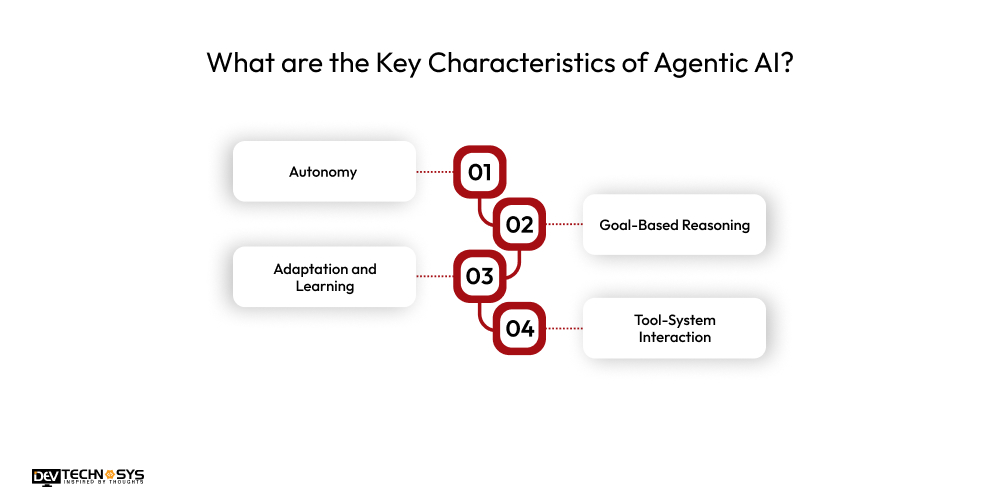
1. Autonomy
Agentic AI functions freely, making decisions and executing actions without continual human interaction. While adhering to preset goals, limitations, and governance frameworks established by organizations.
2. Goal-Based Reasoning
Rather than just reacting to inputs or executing static rules. It considers objectives, assesses various possibilities, organizes action sequences, and chooses the best pathways to accomplish outcomes.
3. Adaptation and Learning
Autonomous AI for fraud detection is constantly learning from feedback, outcomes, and environmental changes, allowing it to adjust methods. It can increase performance and effectively respond to changing conditions and dangers.
4. Tool-System Interaction
It can communicate with tools, APIs, data sources, and corporate systems, coordinating operations across platforms to quickly perform tasks. Collect insight, and provide real-world effects.
Why Fraud Detection Needs Agentic AI?
By independently evaluating complicated data, adjusting to changing threats, lowering false positives, and coordinating across systems, agentic AI revolutionizes fraud detection. It empowers businesses to safeguard assets, increase security operations, and stay ahead of complex fraudulent activities by enabling proactive, real-time protection, increasing efficiency, and scaling effortlessly.
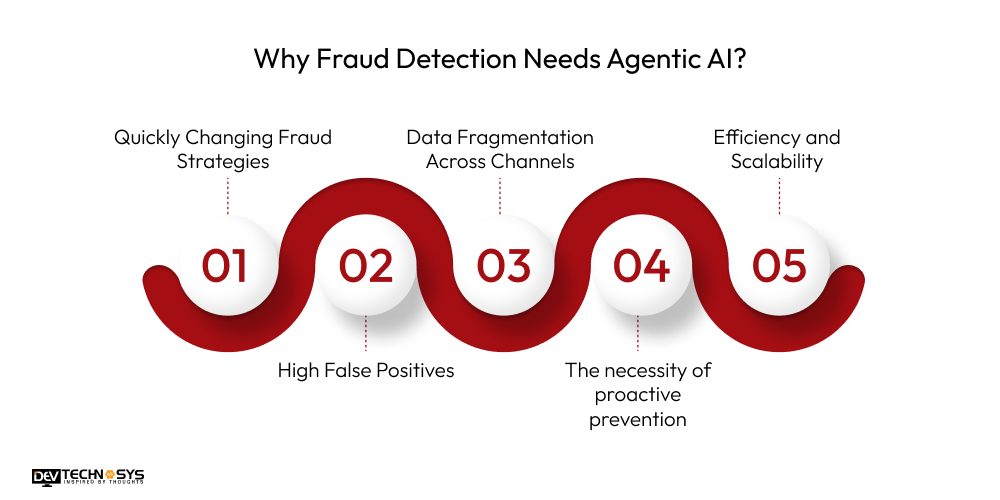
1. Quickly Changing Fraud Strategies
Fraudsters continuously adapt, generating complex, multi-channel assaults. Traditional systems struggle to keep pace. In order to keep businesses ahead of new fraud tactics, agentic AI learns and adapts in real time, spotting new trends, foreseeing dangers, and acting proactively to stop losses before they worsen.
2. High False Positives
Intelligent agents for fraud prevention sometimes flag valid transactions, irritating users and overwhelming analysts. Agentic AI analyzes complex behavioral patterns, connects signals across systems, and makes context-aware judgments, greatly lowering false positives while retaining robust protection, increasing both security and user experience.
3. Data Fragmentation Across Channels
Large amounts of dispersed data are produced by businesses from accounts, gadgets, and payments. Agentic AI collects and analyzes data from many sources in real time, uncovering hidden relationships and detecting fraudulent conduct across channels that static systems generally overlook.
4. The necessity of proactive prevention
Most fraud detection systems react after an incident occurred. Agentic AI predicts possible risks, formulates answers, and acts autonomously, changing organizations from reactive defense to proactive fraud prevention, reducing financial losses and operational interruption.
5. Efficiency and Scalability
As transaction volumes expand, manual monitoring becomes impractical. Agentic AI scales autonomously, digesting enormous information, making intelligent judgments, and continually improving performance, allowing enterprises to retain robust security without correspondingly adding human resources.
What are the Core Components of an Agentic Fraud Detection System in Middle East?
Agentic AI for fraud detection integrates autonomous decision-making, real-time data processing, and adaptive learning. Its fundamental components, perception, reasoning, action, learning, and governance, work together seamlessly. Enabling companies to identify risks proactively, respond rapidly, scale operations, and maintain security, accuracy, and compliance across complex, multi-channel settings.
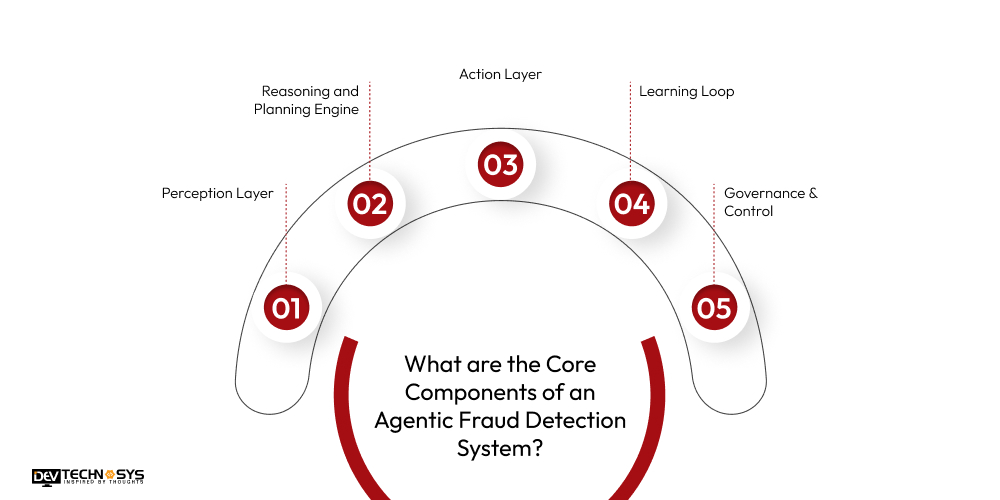
1. Perception Layer
The perception layer takes and processes data from many sources, including as transactions, user activity, device information, and third-party feeds. It converts raw inputs into structured signals, allowing the system to detect abnormalities, identify trends, and retain situational awareness. Laying the groundwork for intelligent, real-time fraud detection and reaction.
2. Reasoning and Planning Engine
This engine examines incoming data, detects unusual activity, and provides theories regarding suspected fraud. It determines the best methods, prioritizes risks, and prepares action sequences. Simulating events and calculating probability allows for proactive, goal-driven decision-making rather than reactive responses, resulting in intelligent, context-aware fraud prevention.
3. Action Layer
The action layer makes autonomous choices, such as stopping transactions, generating authentication challenges, notifying security teams, or escalating high-risk events. According to the chatbot development company, it works with corporate systems and APIs in real time to provide rapid and effective solutions. While reducing business impact and maintaining customer experience.
4. Learning Loop
The learning loop constantly adjusts the system depending on feedback, outcomes, and analyst decisions. It fine-tunes detection algorithms, adjusts methods to new fraud tendencies, and increases accuracy over time. This iterative approach guarantees that the system adapts to evolving threats, becoming smarter, quicker, and more reliable in fraud prevention.
5. Governance & Control
Governance promotes conformity, openness, and ethical behavior. Human oversight oversees agentic behavior, enforces rules, audits choices, and controls risks. Policies, explainability frameworks, and safety restrictions ensure that fraud detection systems are aligned with corporate objectives. While balancing autonomy, responsibility, and operational performance.
How Agentic AI Detects and Prevents Fraud in UAE?: Step-By-Step Process
Agentic AI for fraud detection using an organized, intelligent procedure. It gathers and monitors data, discovers abnormalities, correlates signals, analyzes risk, makes autonomous choices, incorporates feedback, and continually learns. This methodical approach improves business security, lowers false positives, and allows for real-time, proactive fraud prevention while effectively responding to changing threats.
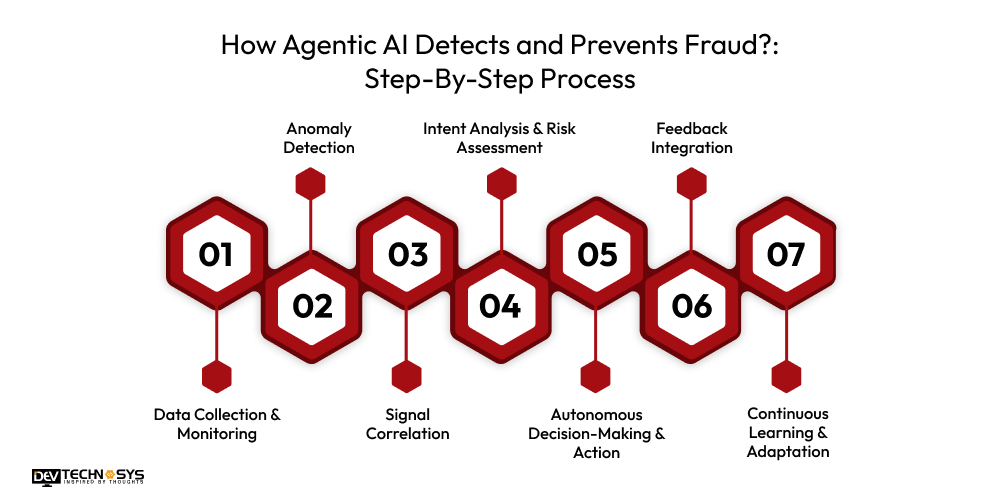
1. Data Collection & Monitoring
Agentic AI for fraud detection continually gathers and monitors data from transactions, user behavior, gadgets, and other sources. By retaining real-time visibility, it discovers possible irregularities promptly. By ensuring that no suspicious activity goes unreported, this ongoing monitoring builds a rich data foundation that facilitates autonomous decision-making in complicated organizational contexts and allows for precise fraud detection.
2. Anomaly Detection
The system examines data streams to discover unexpected patterns or departures from regular activity. It detects possible fraud in real time by contrasting current activity with baselines, historical patterns, and forecast models. Early anomaly detection helps avert financial losses, decreases reaction times, and allows the system to focus attention on high-risk behaviors before they escalate.
3. Signal Correlation
AI Agents for fraud monitoring combine and correlate signals from numerous sources, including accounts, devices, transactions, and third-party feeds. By examining these interactions together, the system discovers hidden patterns that may imply coordinated or complicated fraud operations. This multi-dimensional approach enhances detection accuracy, lowers false positives, and gives a holistic picture of possible threats across the company.

4. Intent Analysis & Risk Assessment
The system assesses suspicious activities by reasoning about user intent and probable threat severity. Using behavioral analytics, historical trends, and anomaly scores, it provides a risk assessment for each occurrence. This prioritizing guarantees that high-risk actions receive prompt attention while limiting needless interventions on lawful behavior, balancing security effectiveness and user experience.
5. Autonomous Decision-Making & Action
Once danger is identified, Agentic AI calculates and performs suitable actions autonomously. Responses might include stopping transactions, generating authentication difficulties, or notifying security teams. Hire dedicated developers to follow set policies, risk thresholds, and organizational standards, enabling swift, consistent, and predictable responses that eliminate fraud. While reducing operational disturbance and ensuring seamless customer experiences.
6. Feedback Integration
All outcomes, including analyst inputs, verified fraud instances, and stopped actions, are pushed back into the system. Future decision-making is improved, risk scoring is improved, and detection algorithms are refined through this ongoing feedback loop. By learning from successes and errors, the system becomes increasingly precise, efficient, and capable of addressing emerging threats with minimum human interaction.
7. Continuous Learning & Adaptation
Agentic AI for fraud detection continually learns from fresh data, developing fraud strategies and operational consequences. It changes its techniques, optimizes answers, and develops its decision-making framework over time. This self-improving capacity guarantees the system remains ahead of more sophisticated threats. Increases business security, lowers losses, and creates resilience against dynamic and complicated fraudulent activities.
What Benefits Does Agentic AI Bring to Enterprise Security in Dubai, UAE?
By facilitating proactive fraud protection, lowering false positives, expanding operations effectively, continually learning from new threats, and increasing analyst productivity. It guarantees better, quicker, and more robust security across complex corporate environments by independently identifying, evaluating, and reacting to dangers in real time.
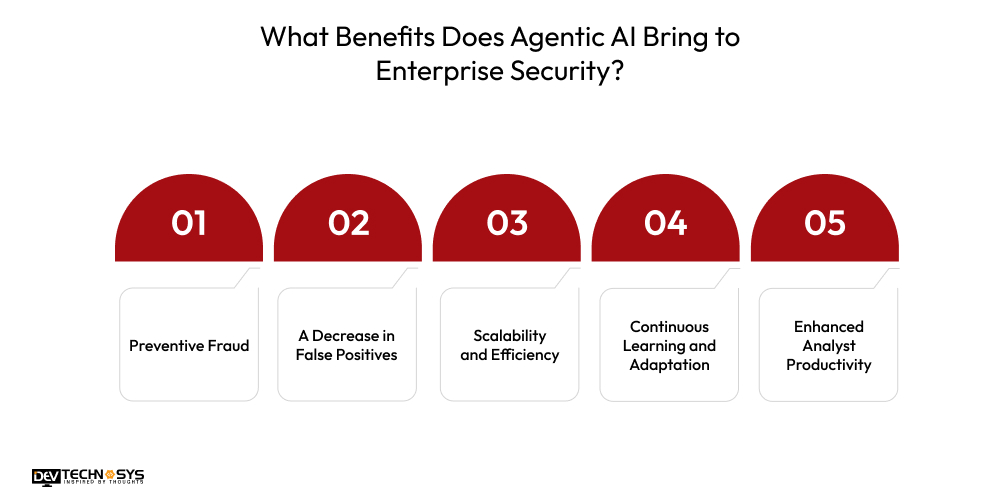
1. Preventive Fraud
Next-gen fraud detection systems recognize suspicious patterns and possible risks in real time, helping organizations to avoid fraud before it occurs. By studying activity across many channels and anticipating assaults, it lowers financial losses, boosts security defenses, and moves businesses from reactive to proactive, intelligent protection measures.
2. A Decrease in False Positives
Traditional fraud detection systems sometimes identify genuine actions, irritating consumers and overburdening analysts. Agentic AI assesses contextual data, connects signals across systems, and reasons about purpose, dramatically lowering false positives. This increases detection accuracy, improves client satisfaction, and frees up security professionals to effectively concentrate on real threats without needless interruptions.
3. Scalability and Efficiency
As transaction volumes and data complexity expand, manual monitoring becomes unfeasible. A custom fraud detection system using AI scales autonomously, evaluating enormous amounts of information, making real-time choices, and taking preventive measures without requiring equivalent human resources. This guarantees organizations retain robust security across geographies, systems, and channels while maximizing operational efficiency and lowering costs.
4. Continuous Learning and Adaptation
Agentic AI for fraud detection develops over time by learning from outcomes, analyst comments, and developing fraud trends. Its adaptive learning guarantees detection models grow alongside sophisticated threats, retaining high accuracy, robustness, and relevance. This self-improving capacity helps organizations to remain ahead of fraudsters and consistently boost their security posture.
5. Enhanced Analyst Productivity
By automating routine monitoring, risk assessment, and early decision-making, Agentic AI frees security professionals to focus on complicated investigations and strategic projects. Analysts may exploit AI-driven insights and suggestions, accelerating reaction times, lowering burden, and boosting decision quality, eventually enhancing the overall efficacy of company security operations.
What are the Best Enterprise Use Cases in Middle East?
Autonomous fraud detection systems in all fields by keeping an eye on transactions, finding oddities, stopping insider threats, and making sure they follow the rules. It gives real-time information about everything from financial services and e-commerce to telecom and insurance. It also automates reactions and makes security, efficiency, and resistance to new, complex scam activities stronger.
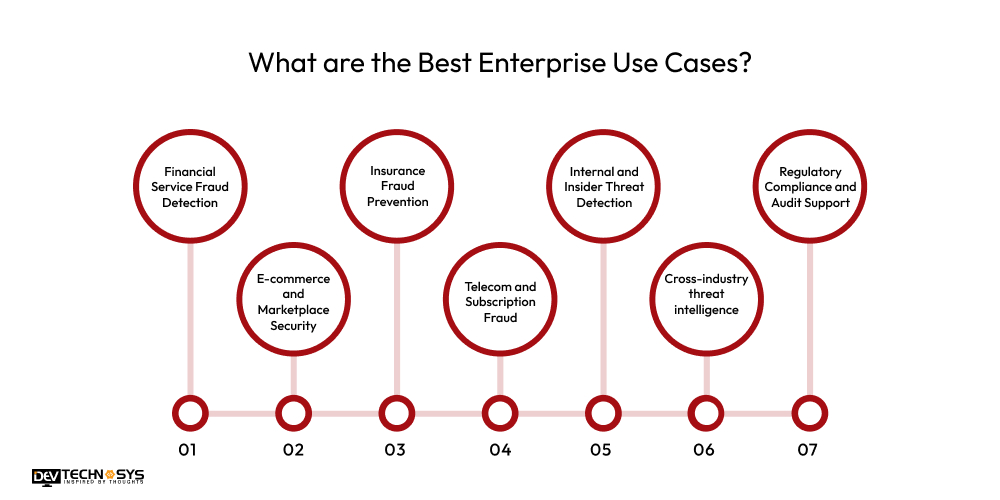
1. Financial Service Fraud Detection
Banking fraud detection software analyzes financial transactions, credit applications, and account activity for abnormalities and suspicious conduct. Payment fraud, account takeovers, and loan custom mobile app development solution fraud are all prevented by real-time pattern analysis. Safeguarding both financial institutions and clients while decreasing losses and enhancing regulatory compliance.
2. E-commerce and Marketplace Security
Payment fraud, false accounts, and refund fraud are all issues that affect online markets. Agentic AI recognizes strange purchasing trends, bot activity, and questionable users, ensuring transactions remain safe. By decreasing false positives, it preserves revenue, increases consumer confidence, and improves operational efficiency across digital commerce platforms.
3. Insurance Fraud Prevention
Agentic AI examines claims data, behavioral tendencies, and external records to identify fraudulent insurance claims. It detects discrepancies, duplication, and suspicious activity across numerous policies, allowing insurers to reduce losses, speed claims processing, and maintain regulatory compliance, all while enhancing customer service quality.
4. Telecom and Subscription Fraud
SIM switching, subscription fraud, and identity theft are all issues that telecom operators must address. Machine learning fraud detection tracks user behavior, account changes, and payment trends to detect fraudulent activities in real time. It safeguards income, lowers operational risk, and increases consumer trust and retention by preventing unwanted access and misuse.
5. Internal and Insider Threat Detection
Organizations are susceptible to internal fraud and data misuse. Agentic AI analyzes employee behavior, system access, and transaction patterns for abnormalities that may suggest insider threats. This proactive detection helps companies secure sensitive data, avoid financial losses, and ensure compliance with corporate rules and legal requirements.
6. Cross-industry threat intelligence
Artificial intelligence fraud detection collects and analyzes threat data from many sectors, identifying trends that might suggest coordinated fraud or cyberattacks. Enterprises may use this knowledge to predict future threats, develop security plans, and work with partners to eliminate risks before they affect operations.
7. Regulatory Compliance and Audit Support
Fraud detection using AI assists organizations in maintaining compliance by continually monitoring activity against regulatory criteria. It produces audit trails, chronicles decision-making, and automatically identifies questionable transactions, eliminating manual supervision, mistakes, and guaranteeing that enterprises satisfy reporting requirements while maintaining strong fraud protection and corporate security.
Quick Facts: According to Salesforce, agentic systems automate audit‑ready reports, aiding compliance and regulatory transparency.
5 Best Practices for Implementing Agentic AI in Fraud Detection
Strategic planning and best practices are required when using Agentic AI for fraud detection. Enterprises can maximise security, reduce fraud losses, increase analyst productivity, and achieve scalable, responsible, and efficient. AI-driven fraud prevention begins with high-impact use cases, integrating with existing systems, ensuring transparency, and maintaining strong governance.
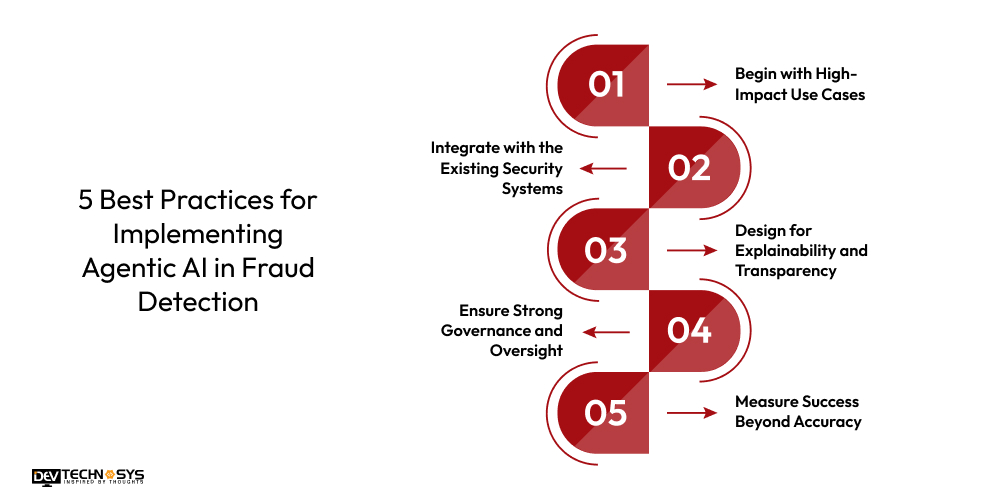
1. Begin with High-Impact Use Cases
Determine which areas of fraud represent the most danger or financial damage. When implementing Agentic AI, start with targeted, high-value processes. Focusing on essential areas initially produces demonstrable outcomes, boosts system confidence, and serves as a solid platform for efficiently growing AI capabilities across the enterprise.
2. Integrate with the Existing Security Systems
Integrate Agentic AI with existing fraud detection technologies, transaction systems, and analytics platforms. Integration enables consistent data flows, improves situational awareness, and uses existing infrastructure, allowing AI to supplement current processes while reducing interruption and maximising ROI.
Fun Facts: According to Amazon Web Services, it supports enterprise integration with scalable platforms and real‑time alerting.
3. Design for Explainability and Transparency
Check that the system gives a clear explanation for its decisions and actions. Transparent AI builds trust among security teams, promotes regulatory compliance, and enables analysts to check and comprehend replies, lowering the risk of mistakes, boosting accountability, and assuring the responsible, ethical deployment of autonomous decision-making.
4. Ensure Strong Governance and Oversight
Implement human-in-the-loop procedures, policies, and monitoring to supervise autonomous AI behaviors. Governance frameworks guarantee that AI is in accordance with business objectives, legal requirements, and ethical principles, preventing over-autonomy, controlling risk, and balancing responsibility and operational control.
5. Measure Success Beyond Accuracy
Monitor business outcomes such as fraud reduction, operational efficiency, analyst productivity, and customer experience, as well as detection accuracy. Evaluating larger KPIs ensures that the system provides actual organizational value, guides iterative enhancements, and connects AI performance with long-term strategic security objectives.

How Will Agentic AI Shape the Future of Fraud Prevention in Dubai?
AI-driven fraud intelligence is the way of the future for stopping fraud because it allows multiple agents to work together, real-time cross-industry information, fully autonomous reactions, smooth integration with security ecosystems, and the ability to predict and adapt. These new technologies give businesses the tools they need to find and stop theft before it happens
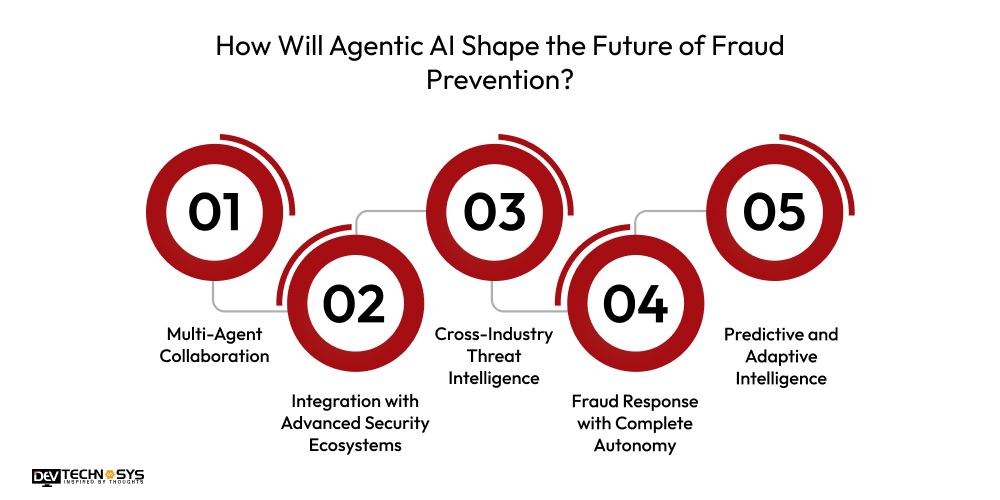
1. Multi-Agent Collaboration
In the future, AI-driven fraud detection will collaborate across multiple autonomous agents, exchanging insights and coordinating actions in real time. By facilitating speedier threat detection, holistic risk assessment, and unified responses. This collective intelligence enables enterprises to proactively prevent fraud on a larger scale. While simultaneously enhancing operational efficiency and accuracy.
2. Integration with Advanced Security Ecosystems
Agentic artificial intelligence development solutions will seamlessly integrate with cybersecurity systems, cloud platforms, and zero-trust architectures. This convergence guarantees comprehensive protection, improved situational awareness, and coordinated responses, enabling enterprises to maintain resilient defenses, expedite operations, and fully utilize AI’s potential in complex, multi-layered security environments.
3. Cross-Industry Threat Intelligence
Fraud patterns will be aggregated and analyzed across industries and geographies by agentic AI. Utilizing shared threat intelligence, organizations can proactively respond to emergent attacks, detect coordinated schemes early, and anticipate them. Thereby establishing a collaborative ecosystem that enhances security across sectors, minimizes losses, and enhances resilience.
4. Fraud Response with Complete Autonomy
In the future, Agentic AI-based fraud detection will autonomously execute end-to-end fraud responses, including detection and mitigation. Real-time decision-making, adaptive learning, and automated interventions will reduce human involvement. Assuring rapid containment of fraudulent activities, reducing operational burden, and enabling immediate protection, all without compromising accuracy or compliance.
5. Predictive and Adaptive Intelligence
Predictive fraud analytics, behavioral modeling, and machine learning will enable future agentic AI to anticipate fraud patterns rather than merely react. It will continuously alter its adaptive intelligence to evolve in response to emergent threats. Thereby facilitating the long-term protection of enterprise assets, smarter risk management, and proactive prevention in a digital landscape that is constantly changing.
Conclusion
To sum up, AI Agents in fraud detection are changing how businesses analyze fraud and defend their digital fraud protection systems. By working autonomously and intelligently, it recognizes threats and minimizes risks. Numerous companies rely on the AI Agent development company in UAE to bolster their protective measures. With advancements in technology, Agentic AI will be relied upon even more to protect data. Implementing this advanced system is a progressive step into a safe, secure, and fraud-free future for businesses.
Frequently Asked Questions
Q1. How Does Agentic AI Differ From Traditional AI in Middle East?
Traditional AI executes predefined tasks or predictions, while Agentic AI acts autonomously, plans strategies, adapts to evolving conditions, and interacts with multiple systems, enabling real-time, goal-driven decision-making that enhances fraud detection and enterprise security.
Q2. Why is Agentic AI Important For Fraud Detection?
Modern fraud is sophisticated, multi-channel, and adaptive. Agentic AI proactively identifies anomalies, correlates signals, and executes protective actions in real time, reducing losses, false positives, and response times compared to conventional detection systems.
Q3. What Types of Fraud Can Agentic AI Detect?
It can detect payment fraud, account takeovers, subscription and telecom fraud, insurance claim fraud, insider threats, and cross-system coordinated attacks by analyzing patterns, behavior, and transactional anomalies across multiple channels and systems.
Q4. What Industries Benefit Most From Agentic AI in UAE?
Financial services, e-commerce, insurance, telecom, and enterprises vulnerable to insider threats benefit most, as Agentic AI protects transactions, accounts, policies, and sensitive data while ensuring regulatory compliance and operational efficiency.
Q5. What is the Role of Human Analysts With Agentic AI?
Analysts oversee autonomous actions, validate decisions, provide feedback, and investigate complex cases. Agentic AI handles routine monitoring and initial risk assessments, enhancing analyst productivity and decision quality.