





Key Takeaways:
- Agentic AI autonomously analyzes financial data, making intelligent, goal-driven decisions in real time.
- Human oversight maintains governance, compliance, and ethical AI deployment alongside autonomous operations.
- Enables next-generation financial systems that are resilient, adaptive, and strategically forward-looking.
- Drives innovation in banking, trading, insurance, and other financial services sectors globally.
Agentic AI helps finance systems in a similar way to how a smart brain helps a person. Instead of following a set of rules like other computer programs and acting in a pre-determined way. Agentic AI in finance can analyze data, learn from it, and make smart, real-time decisions.
It is used in digital payments, banking, and stock trading to analyze and monitor huge amounts of data simultaneously to improve customer service, manage risks, offer investment advice, and detect fraud. Agentic AI can do more than just detect and alert users to a problem.
It can also devise a course of action, modify its approach, and make enhancements, just like a human.
As technology and finance become more intertwined, Agentic AI is revolutionizing the financial systems of the future. Additionally, it is improving the way we manage and invest our money.
What is Agentic AI in Finance?
Artificial intelligence in finance is an autonomous, goal-driven intelligence that analyzes data, makes decisions, and acts independently across financial systems. It enhances operations by detecting fraud, predicting risks, optimizing trading, and managing compliance in real time. By continuously learning and adapting, Agentic AI enables smarter, faster, and more efficient decision-making for next-generation financial institutions.
Quick Facts: According to IBM, Agentic AI refers to intelligent systems that act independently, plan actions, connect to real data/tools, and execute tasks.
What are the Core Capabilities of Agentic AI in Finance?
Artificial intelligence in finance organizations with autonomous decision-making, predictive analytics, real-time monitoring, continuous learning, and seamless system integration. These capabilities boost fraud detection, optimize risk management, improve operational efficiency, and allow smarter, quicker decisions. And more resilient financial operations, driving the next generation of intelligent, data-driven financial systems.
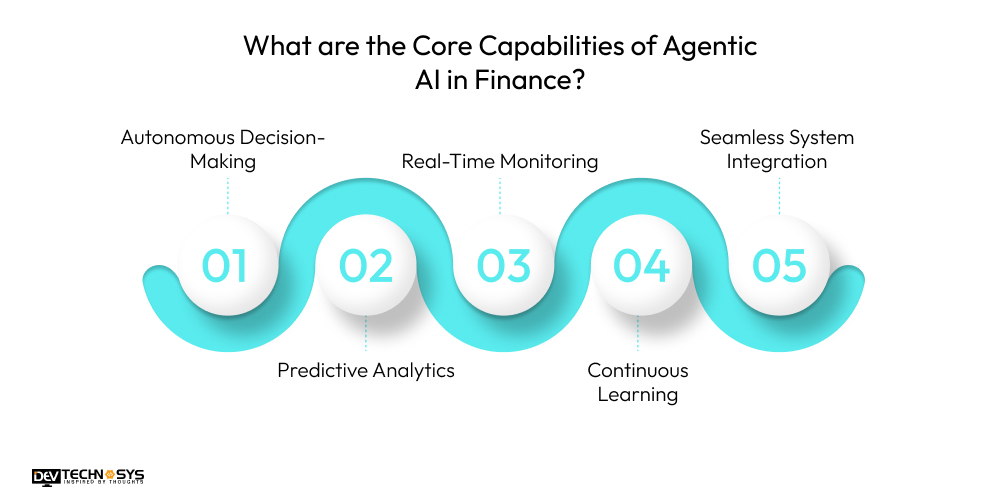
1. Autonomous Decision-Making
Agentic AI is capable of independently evaluating financial data, approving loans, detecting fraudulent transactions, and optimizing trading tactics. By responding without continual human interaction, it provides quicker, consistent, and accurate judgments, eliminating operational delays and risk. Custom website development services provider allowing financial institutions to expand processes quickly and maintain high governance and compliance requirements.
2. Predictive Analytics
Agentic AI in financial services predicts credit risk, consumer behavior, and market movements by analyzing historical data, behavioral patterns, and market trends. These predictive insights assist financial organizations in anticipating opportunities and dangers, allowing proactive risk management, strategic decision-making, and enhanced financial planning, resulting in more accurate, data-driven results across lending, trading, and investing activities.
3. Real-Time Monitoring
AI-powered finance solutions constantly monitor transactions, accounts, and market activity across many channels. By detecting anomalies, strange patterns, or suspicious activity in real time, financial institutions may respond promptly to possible fraud, compliance violations, or operational risks, assuring rapid mitigation and preserving both organizational assets and consumer confidence.
4. Continuous Learning
Agentic AI solutions for finance adjust and evolve based on outcomes, market developments, and analyst comments. This iterative learning process refines its models, increases accuracy, and improves its capacity to detect emerging threats or fraud schemes. Ensuring that the system remains relevant, robust, and successful in a rapidly changing financial market.
Read more: Agentic AI for Fraud Detection: Harnessing Agentic AI for Enterprise Security
5. Seamless System Integration
Agentic AI seamlessly interfaces with existing financial platforms, trading systems, compliance tools, and business applications. This link enables uniform data flows, simpler operations, and improved operational efficiency. Integration enables institutions to use AI capabilities without disturbing processes. Resulting in real-time decision-making, improved reporting, and scalable, intelligent financial operations.
Why Finance Needs Agentic AI?
Finance has to deal with more complicated scams, government pressure, and changing market threats. Agentic AI gives institutions the power to find fraud, control risk, make sure they’re following the rules, make the best choices, boost business efficiency, improve the customer experience, and adapt to changing financial environments. This makes it possible for next-generation financial systems to be smarter, faster, and more resilient.
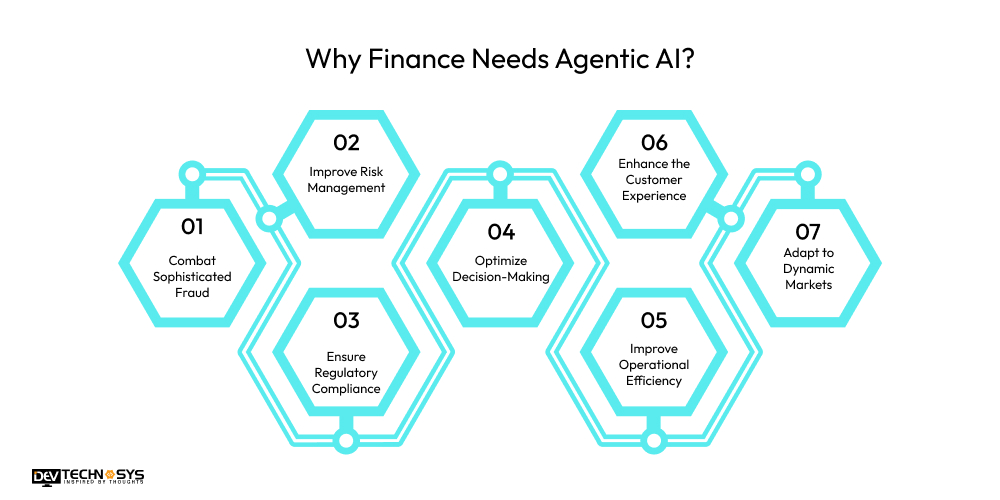
1. Combat Sophisticated Fraud
Financial fraud is becoming more complicated and multi-channel. Agentic AI continuously analyzes transactions, accounts, and behavioral patterns, identifying abnormalities and actively combating fraud. Its autonomous decision-making saves losses, allows for speedier intervention, and increases institutional security against emerging financial crime strategies.
2. Improve Risk Management
Agentic AI in financial services uses real-time data and predictive analytics to forecast and analyze credit, market, and operational risks. By continually learning from results and responding to market developments, it helps financial institutions can make educated, timely choices, reducing potential losses while preserving regulatory compliance and strategic resilience.
3. Ensure Regulatory Compliance
Finance is heavily regulated, necessitating continuous monitoring and reporting. Agentic AI automates compliance duties, monitors audit trails, and detects infractions in real time. This lowers human error, assures regulatory compliance, and promotes transparent, responsible decision-making throughout all financial activities.
4. Optimize Decision-Making
Traditional financial decision-making processes can be sluggish and prone to prejudice. Agentic AI examines vast datasets, evaluates scenarios, and recommends or performs appropriate actions autonomously. This speeds up credit approvals, investment plans, and operational decisions while increasing accuracy, efficiency, and overall financial performance.

5. Improve Operational Efficiency
Manual financial operations are time-consuming and prone to errors. Agentic AI automates transaction monitoring, reporting, and repetitive tasks, freeing up staff to work on strategic initiatives. This lowers operating costs, improves throughput, and provides uniform, high-quality execution across all financial activities.
6. Enhance the Customer Experience
Agentic AI increases client trust and pleasure by swiftly identifying fraud, customizing financial services, and allowing for speedier approvals. According to the chatbot development company, real-time replies, targeted suggestions, and proactive risk management. Result in frictionless, secure, and intelligent interactions that increase loyalty and competitive advantage.
7. Adapt to Dynamic Markets
Financial markets and dangers are continually evolving. Agentic AI constantly learns from fresh data, evolving fraud schemes, and market patterns. Its adaptive intelligence enables institutions to foresee changes, respond proactively, and retain resilience. Assuring long-term sustainability and a competitive edge in a fast-changing financial environment.
What are the Top Use Cases of Agentic AI in Finance?
Agentic AI changes finance by making it possible to find fraud, make credit choices on its own. Use predictive analytics, optimize portfolios, keep an eye on compliance, and provide personalized customer service. It makes operations more efficient, protects against threats, lowers risks, and gives financial institutions the power to make faster, better decisions. Best agentic AI use cases in finance services:
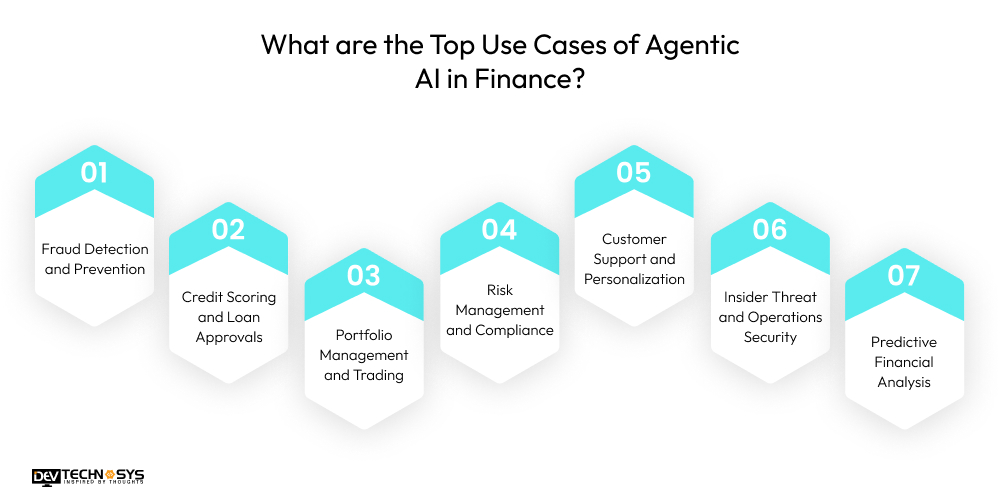
1. Fraud Detection and Prevention
Agentic AI analyzes transactions, accounts, and behavioral patterns in real time to detect abnormalities and suspect activity. It stops fraud before it occurs, saves financial losses, decreases false positives, and boosts confidence, assuring safe, compliant operations in banking, payments, and financial services.
Quick Facts: According to Forbes, financial AI agents continuously detect early fraud patterns that static systems might miss.
2. Credit Scoring and Loan Approvals
AI agents in corporate finance use consumer financial histories, transaction patterns, and risk indicators to automate credit rating and loan approvals. Its predictive analytics and automated decision-making speed up processing, improve accuracy, and reduce human bias. Ensure speedier, data-driven lending choices that meet regulatory requirements.
3. Portfolio Management and Trading
Agentic AI in financial services uses market trends, financial instruments, and client preferences to improve investment portfolios and trading tactics. It maximizes returns, reduces risks, and reacts to market volatility by making autonomous choices in real time, allowing for better, quicker, and more efficient asset management.
4. Risk Management and Compliance
Agentic AI regularly analyzes financial processes to ensure compliance, regulatory changes, and operational hazards. Predicting possible concerns and proactively identifying infractions decreases regulatory fines, ensures accountability, and assists institutions in maintaining good governance and adherence to shifting legal and operational requirements.
5. Customer Support and Personalization
Agentic AI powers intelligent virtual assistants that offer tailored financial advice, transaction help, and proactive notifications. By studying client behavior and preferences, it increases engagement, satisfaction, and allows safe, responsive, and personalized financial services at scale.
6. Insider Threat and Operations Security
Agentic AI analyzes employee behavior, system access, and sensitive transactions to identify insider threats or policy breaches. It protects vital data, prevents internal fraud, and improves corporate security and operational integrity by identifying abnormalities and taking preventative steps on its own.
7. Predictive Financial Analysis
Autonomous agents in finance anticipate market trends, consumer behavior, credit risks, and revenue potential based on historical data and predictive models. These insights enable financial custom mobile app development solutions to foresee issues, refine strategies, and make proactive, data-driven decisions that boost performance, resilience, and long-term profits.
What are the Key Benefits of Agentic AI for Financial Institutions?
Agentic AI applications in finance organizations can strengthen fraud protection, improve risk management, and automate activities. It allows data-driven choices, speeds processing, and offers tailored consumer experiences. By continually learning and adapting, Agentic AI increases security, optimizes efficiency, minimizes financial vulnerability, and delivers smarter, quicker, and more resilient financial systems.
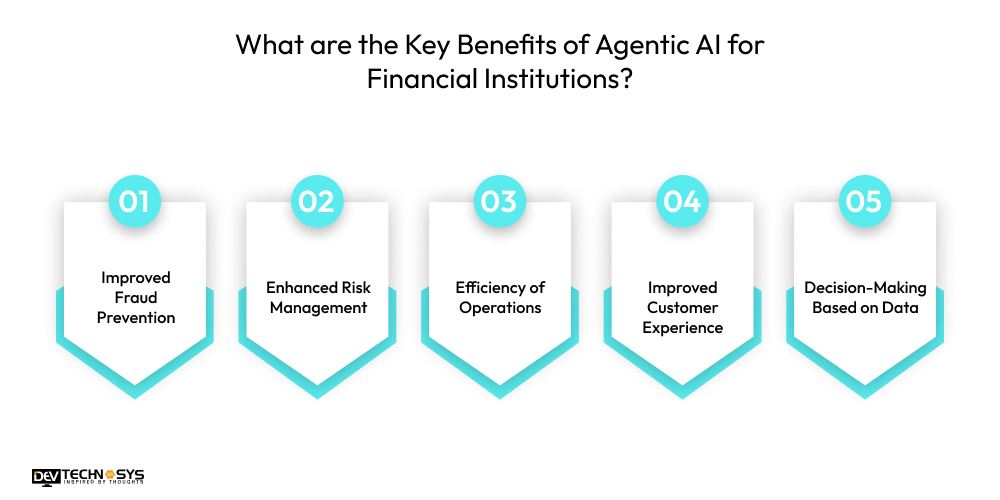
1. Improved Fraud Prevention
In order to identify anomalies and prevent fraudulent activity, agentic AI proactively monitors transactions, accounts, and behavioral patterns. The autonomous decision-making of this system enhances institutional security, minimizes false positives, and reduces losses. Thereby allowing financial institutions to effectively secure assets, maintain compliance, and create customer trust.
2. Enhanced Risk Management
Agentic AI forecasts operational, market, and credit risks by examining extensive datasets, historical trends, and market behaviors. It continuously adjusts to emergent threats, enabling institutions to make informed, proactive decisions that reduce financial exposure. Ensure regulatory compliance while optimizing strategic planning and resource allocation.
3. Efficiency of Operations
Transaction monitoring, reporting, and compliance checks are automated by agentic AI, which eliminates repetitive and time-consuming tasks. This significantly enhances overall productivity, efficiency, and resource utilization across financial operations by reducing manual burden. Accelerating processing times, minimizing errors, and freeing staff to focus on strategic initiatives.
4. Improved Customer Experience
Agentic AI enhances consumer interactions by facilitating proactive fraud notifications, personalized financial services, and faster loan approvals. In the market, the institution’s competitive advantage is enhanced by the creation of seamless, secure, and tailored experiences that are facilitated by intelligent automation and real-time insights. This enhances satisfaction, loyalty, and trust.
Quick Fact: As per the research of Neontri, continuous compliance monitoring becomes easier with agentic AI checking real-time transaction streams.
5. Decision-Making Based on Data
In order to offer actionable insights across finance functions, agentic AI employs continuous learning and predictive analytics. Institutions can enhance accuracy, mitigate risk, and implement adaptive strategies in a financial landscape that is swiftly evolving by making quicker, more intelligent, and evidence-based decisions, ranging from portfolio management to credit assessment.

What Are the Best Practices for Deploying Agentic AI Effectively?
To ensure the successful deployment of Agentic AI in finance services, it is necessary to identify high-value use cases, integrate with existing systems seamlessly, and conduct operations that are transparent and comprehensible. Maximizing operational efficiency, fraud prevention, risk management, and delivering demonstrable business value across financial institutions, strong governance, and human supervision.
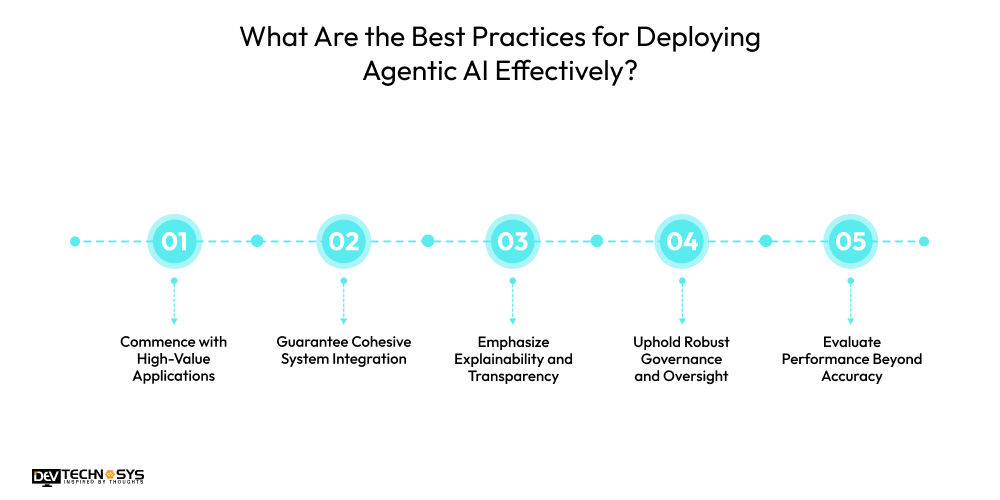
1. Commence with High-Value Applications
Identify procedures with the most significant impact, such as fraud detection or credit approvals. Initiate with focused applications to rapidly showcase value, get stakeholder endorsement, and establish a basis for the efficient and assured expansion of AI capabilities throughout the firm.
2. Guarantee Cohesive System Integration
Integrate Agentic AI with current banking, trading, compliance, and analytics platforms. Integration guarantees a seamless data flow, immediate insights, and continuous operations. Hire dedicated developers to improve processes without interrupting workflows or necessitating significant infrastructure modifications.
3. Emphasize Explainability and Transparency
Develop AI systems that offer transparent rationales for their actions. Transparent operations cultivate trust among analysts, fulfill legal obligations, and facilitate the validation of autonomous activities. So as to assure responsible, ethical, and compliant AI implementation.
4. Uphold Robust Governance and Oversight
Implement human-in-the-loop methods, policies, and monitoring systems. Governance guarantees that AI choices conform to corporate objectives, legal requirements, and ethical standards, striking a balance between autonomy and responsibility while mitigating operational and reputational risks.
5. Evaluate Performance Beyond Accuracy
Monitor overarching KPIs, including fraud mitigation, operational efficacy, analyst productivity, and customer contentment. A comprehensive evaluation of outcomes guarantees that the AI provides measurable business value and guides ongoing enhancements for scalable and efficient implementation.
What is the Future of Agentic AI in Finance?
Autonomous AI in finance is changing the future of finance by letting processes run completely on their own, providing predictive intelligence, and allowing multiple agents to work together. By combining new technologies like blockchain and open banking, it improves risk management, stops fraud, and gives customers a more personalized experience. This lets financial institutions thrive in a world that is changing quickly and is driven by data.
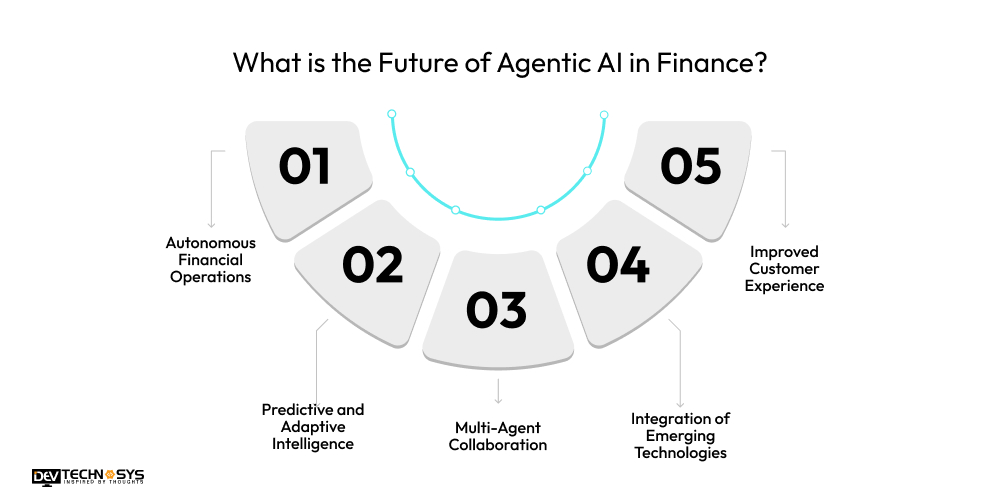
1. Autonomous Financial Operations
AI agent applications in finance will automatically manage complex financial processes ranging from trading and portfolio optimization to loan approvals, allowing for real-time, precise decision-making while decreasing human interference and operational bottlenecks, resulting in quicker, smarter, and completely autonomous financial ecosystems.
2. Predictive and Adaptive Intelligence
Intelligent AI agents in finance will use advanced analytics to predict market patterns, identify hazards, and customer behavior. Its adaptive learning capabilities will enable financial institutions to respond proactively, reducing losses and optimizing strategies in an ever-changing financial landscape.
3. Multi-Agent Collaboration
Multiple Agentic artificial intelligence development solutions will collaborate across departments and institutions to share insights, coordinate decisions, and improve operations. This multi-agent AI systems in finance will increase efficiency, risk reduction, and decision accuracy throughout the financial ecosystem.
4. Integration of Emerging Technologies
AI agent systems for finance in Dubai will work with blockchain, digital assets, open banking, and cloud platforms to create unified, intelligent financial systems. This connection provides safe, transparent, and smooth operations for both traditional and decentralized financial services.
5. Improved Customer Experience
Financial AI agents will provide quicker, safer, and more specialized client interactions by employing predictive insights, personalized services, and proactive fraud protection. Giving financial institutions a competitive edge and increasing satisfaction and loyalty.

What Challenges Must Be Addressed When Implementing Agentic AI in Finance?
Implementing Agentic AI in banking offers problems such as data privacy, regulatory compliance, model bias, change management, and system integration. Addressing these factors assures secure, ethical, and efficient adoption, enabling institutions to employ AI successfully, preserve trust, improve operations, and create robust, future-ready financial systems in a continuously shifting context.
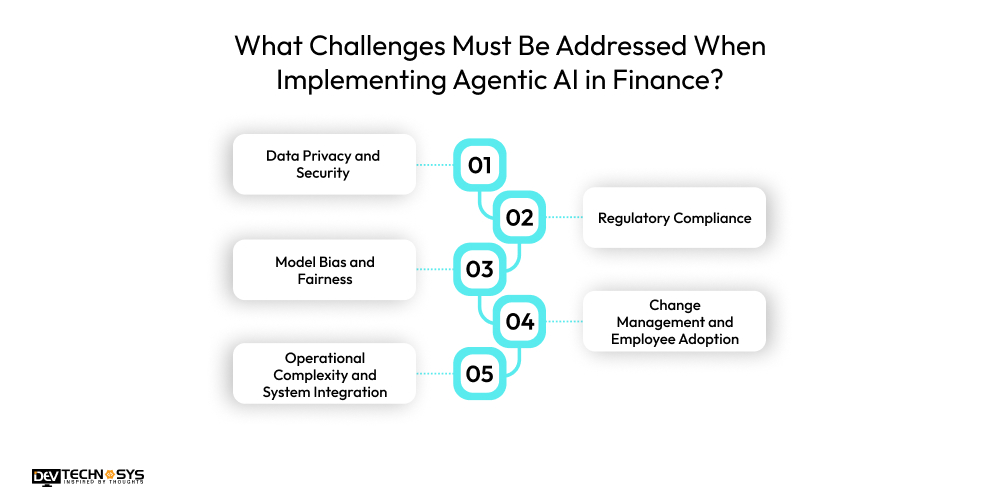
1. Data Privacy and Security
Financial institutions manage sensitive consumer and transactional data. Implementing Agentic AI involves tight data security measures, secure storage, encryption, and access controls to avoid breaches, unauthorized access, and abuse. Assuring compliance with privacy legislation while retaining consumer confidence and defending institutional reputation.
2. Regulatory Compliance
Finance is extensively regulated, requiring stringent adherence to regulations and reporting standards. Autonomous financial AI systems must be explainable, auditable, and transparent. Ensuring their autonomous actions conform to growing rules, reducing legal risks, and promoting accountability. While avoiding penalties or operational interruptions.
3. Model Bias and Fairness
AI algorithms might inherit biases from prior data, leading to unjust or discriminatory outputs. Maintaining ethical decision-making, regulatory compliance, and consumer, stakeholder, and regulatory trust all depend on ensuring fairness, variety in training data, and ongoing monitoring.
4. Change Management and Employee Adoption
Introducing agent-based AI in financial services modifies workflows, roles, and responsibilities. Organizations must manage change successfully through training, clear communication, and human-in-the-loop integration to guarantee employee acceptance, reduce opposition, and harness AI to complement human expertise rather than replace it.
5. Operational Complexity and System Integration
Integrating smart agents in finance with legacy systems, diverse data sources, and current financial platforms can be complicated. Proper planning, testing, and phased implementation are necessary to ensure smooth interoperability, reduce operational interruptions, and enhance AI effectiveness across the company.
Conclusion
In the end, Agentic AI in finance in the Middle East is changing finance by allowing people to make their own decisions. Using predictive analytics, monitoring in real time, and making consumer experiences better. Financial firms that use these smart technologies may stop fraud, make their operations more efficient, and quickly adjust to changing market conditions. Working with an AI agent development company in UAE makes sure that everything goes well, is compliant, and can grow. Banks, fintechs, and insurers can stay ahead of new problems, encourage new ideas, and construct stronger.
Frequently Asked Questions
Q1. Why is Agentic AI Important For Modern Financial Systems?
Financial markets are complex, fast-moving, and data-heavy. Agentic AI enables institutions to respond instantly, optimize decisions continuously, reduce human error, and scale intelligent operations beyond what manual or rule-based systems can handle.
Q2. Can Agentic AI Reduce Financial Risk?
Yes. Agentic AI proactively identifies anomalies, predicts potential losses, stress-tests scenarios, and takes corrective actions automatically. This enables earlier intervention, better hedging strategies, and stronger resilience against market volatility and systemic shocks.
Q3. How Does Agentic AI Handle Real-Time Financial Data?
Agentic AI in finance in UAE processes streaming data from markets, transactions, and external signals simultaneously. It prioritizes information, updates internal models instantly, and takes immediate action, making it ideal for time-sensitive financial decisions.
Q4. What Technologies Enable Agentic AI Systems?
Agentic AI combines large language models, reinforcement learning, planning algorithms, memory systems, and tool-use capabilities. Together, these technologies allow agents to reason, learn from feedback, and execute complex financial workflows autonomously.
Q5. How Does Agentic AI Support Financial Forecasting?
Agentic AI continuously updates forecasts using real-time data, macroeconomic indicators, and behavioral signals. It tests multiple scenarios autonomously, improving prediction accuracy and enabling faster responses to economic and market changes.