





In this digital era, staying connected is not a problem, thanks to social media platforms. There are numerous social media apps flooding the market, offering the convenience of communication through videos, photos, texts, and voice messages.
Popular examples being Facebook, Twitter, Snapchat, and Instagram, TikTok, etc.
Businesses, sensing the opportunity, are keen to explore the potential of developing their social media user apps.
However, one of the maximum common questions that arises throughout the initial app development levels is: How much will it cost?
In today’s blog, we will talk about the most cost to build a social media app in 2025. From factors affecting the cost to factors that reduce the development costs. Let’s get educated!
Social Media App Market Insights
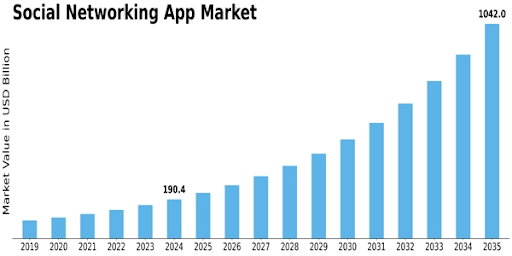
- The social networking app market size was valued at USD 178.27 billion in 2023 and is projected to grow from USD 190.4 billion in 2024 to USD 380.39 billion by 2032, exhibiting a CAGR of 7.99% during the forecast period (2024-2032).
- North America remains the largest market for social networking apps, holding approximately 45% of the global market share.
- The Middle East and Africa region is emerging as a significant player in the social networking app market, accounting for about 5% of the global market share.
- Among these segments, Messaging is expected to hold the largest market share of over 50% in 2023, followed by Social Sharing and Live Streaming.
What is a Social Media App?
Social media apps are online systems where people join and percentage content material. They permit customers to create profiles, connect to buddies and their families, post, share text, pictures, and motion pictures, and engage with others via likes, remarks, and messages.
These social media app developments foster online communities and may be used for staying in contact, sharing reviews, and eating information and facts. Famous examples consist of Facebook, Instagram, Twitter, and TikTok.

How Much Does it Cost to Develop a Social Media App?
The cost to develop a mobile app can vary depending on complexity, capabilities, platform (iOS, Android, net), design, and development company location. A simple social media app with basic capabilities like user profiles, photo sharing, and messaging costs anywhere from $8000 to $25,000.
However, more complicated apps with advanced functionalities such as geolocation, actual-time notifications, video streaming, and AI integration can increase the cost to develop a video-sharing social app upwards of $25,000 or more.
App Type |
Estimated Cost |
Development Timeline |
| Basic Social Media App | $8,000 – $12,000 | 8–12 weeks |
| Mid-Level Social Media App | $12,000 – $18,000 | 12–18 weeks |
| Advanced Social Media App | $18,000 – $25,000 | 18–26 weeks |
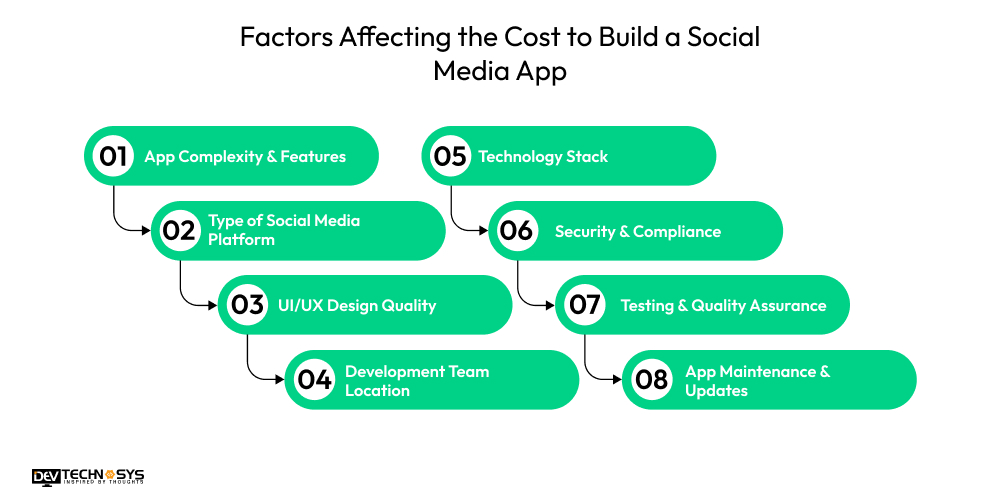
Factors Affecting the Cost to Build a Social Media App
If you want to develop a social media app like Yubo, Snapchat or Instagram, then you need to consider all the factors that affect the cost to build a social media app. In this section below, we have covered vital factors that affect the cost to build a social media app:
1. App Complexity & Features
The overall cost to develop a social media app depends heavily on app complexity. Basic social apps with simple posting and messaging cost less, while advanced features like live streaming, AI-powered feeds, AR filters, and social commerce are more expensive.
A complex app with advanced features significantly increases development time, technical effort, and final budget requirements.
Complexity |
Short Features |
Cost |
| Basic | Profiles, feed, likes, simple chat | $8,000–$12,000 |
| Medium | Media sharing, groups, real-time chat | $12,000–$18,000 |
| Advanced | AI feed, AR filters, live streaming | $18,000–$25,000 |
2. Type of Social Media Platform
According to a top Mobile app development services, different platform categories require different development efforts. Community apps, messaging platforms, professional networks, and video-sharing apps each demand unique features and backend structures.
As the functionality changes by app type, development time, required expertise, and total cost to build a social media app also change accordingly.
Platform Type |
Short Features |
Cost |
| Community App | Groups, posts, interactions | $8,000–$14,000 |
| Messaging App | Chats, calls, file sharing | $10,000–$18,000 |
| Professional Network | Profiles, jobs, connections | $15,000–$22,000 |
| Video-Sharing App | Reels, editing, recommendations | $18,000–$25,000 |
Read also: How Much Does it Cost to Build an App Like Lapse
3. UI/UX Design Quality
Intuitive, custom animations, modern interfaces, and micro-interactions increase design time and cost to build a social media app. High-first-rate user interface (UI) and user experience (UX) design are crucial for a hit social media app.
Design is another factor affecting the cost of building a social media app, varying from $3,000 to $5,000.
Design Level |
Short Features |
Cost |
| Basic | Simple layouts | $2,000–$3,000 |
| Standard | Clean UI, smooth flow | $3,000–$5,000 |
| High-End | Animations, micro-interactions | $5,000–$7,000 |
4. Development Team Location
The cost to create a social media app like whatsapp varies significantly based on where the team is located. Teams in the US, UK, or Western Europe typically charge much higher hourly rates, while equally skilled developers in India or Eastern Europe offer more affordable pricing, greatly influencing the overall project budget.
This makes choosing the right region essential for maximizing value and controlling expenses.
Region |
Short Summary |
Cost Impact |
| US/UK | High hourly rates | $18,000–$25,000 |
| Eastern Europe | Mid-level rates | $12,000–$20,000 |
| India/South Asia | Most cost-efficient | $8,000–$16,000 |
5. Technology Stack
Choosing native apps (Swift/Kotlin) vs. cross-platform frameworks (Flutter/React Native) impacts the cost to make a social media app. It consists of frontend and backend development, database setup, and API integration.
The cost to build a social media app can range from $6,000 to $12,000, depending on complexity.
Stack Type |
Short Features |
Cost |
| Basic | Flutter + Firebase | $8,000–$14,000 |
| Standard | Node.js + AWS | $12,000–$20,000 |
| Advanced | AI models, microservices | $18,000–$25,000 |
6. Security & Compliance
Implementing strong security measures, such as data encryption, two-factor authentication, biometric login, and compliance with privacy laws like GDPR, adds to social media app development costs.
Ensuring user safety, preventing fraud, and maintaining regulatory compliance requires specialized expertise and advanced tools, thereby increasing the total investment required for the app.
Security Level |
Short Features |
Cost |
| Basic | SSL, encryption | $1,000–$2,500 |
| Standard | 2FA, secure APIs | $2,500–$4,000 |
| Advanced | Biometrics, fraud detection | $4,000–$6,000 |
7. Testing & Quality Assurance
Ensuring the app bugs are fixed and performed correctly throughout unique gadgets and platforms is vital. Testing factors influence the cost to make a social media app, which may vary from $3,000 to $5,000. More devices, OS versions, and feature sets require extensive manual and automated testing.
Testing Level |
Short Features |
Cost |
| Basic | Functional testing | $1,000–$2,000 |
| Standard | Manual + automation | $2,000–$4,000 |
| Advanced | Load + device testing | $4,000–$6,000 |
8. App Maintenance & Updates
After launch, ongoing preservation, updates, and guides incur additional charges; the cost to maintain an app ranges from $1000 to $2,000 in steps within 12 months.
Overall, it’s essential to cautiously plan and cost to create a social media app range for each stage of development to ensure a successful launch and the sustained achievement of a social media app.
Maintenance Level |
Short Features |
Yearly Cost |
| Basic | Fixes, minor updates | $1,000–$3,000 |
| Standard | Enhancements, optimization | $3,000–$6,000 |
| Advanced | Scaling, security updates | $6,000–$10,000 |
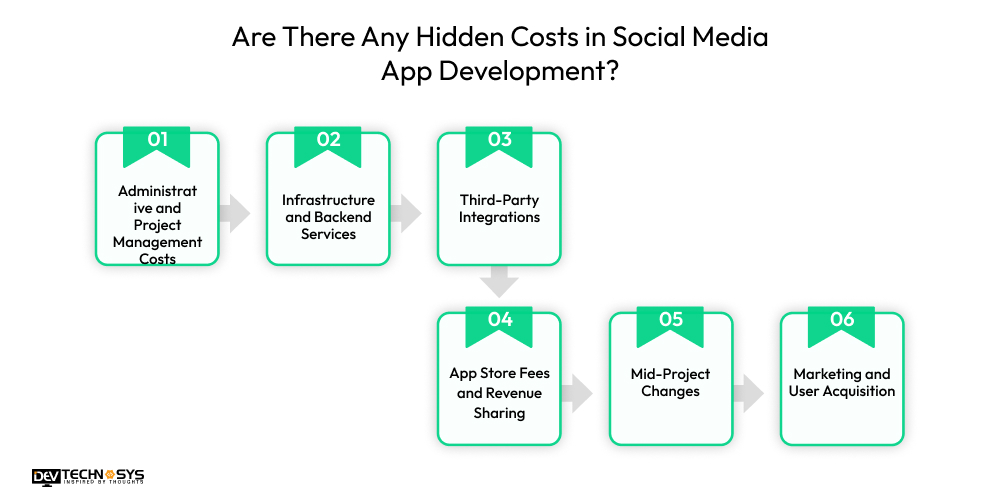
Are There Any Hidden Costs in Social Media App Development?
Besides the factors that affect the cost to develop a mobile app for social networking, there are some other hidden factors that affect the social media applications:
-
Administrative and Project Management Costs:
Documentation, communication tools, project management software, coordination time, and team collaboration tools create ongoing expenses throughout development and can significantly increase the overall project budget.
These tasks ensure smooth workflow and communication between teams. Proper management prevents delays that could add even more development costs.
-
Infrastructure and Backend Services:
Data storage, servers, testing environments, security measures, and third-party services (APIs, SDKs) require continuous payment, often as monthly subscriptions that grow with user traffic.
Scaling infrastructure for performance and security adds more cost. Cloud providers charge extra for high storage, bandwidth, and advanced security features.
-
Third-Party Integrations:
Payment gateways, geolocation, push notifications, analytics, and messaging services may involve setup fees and recurring usage charges. The more third-party tools used, the higher the monthly bill becomes. Premium APIs or SDKs with advanced features increase costs further.
-
App Store Fees and Revenue Sharing:
Google Play charges a one-time $25 fee; Apple charges $99 annually. Both stores charge a 15-30% commission on in-app purchases or subscriptions, which affects app revenue.
These fees impact profits, especially for apps relying heavily on IAP or subscriptions. Developers must plan pricing models accordingly.
-
Mid-Project Changes:
Changes in UI/UX design, feature additions, or scope alterations during development can lead to increased costs beyond initial estimates. Frequent changes disrupt workflows and require rework. This can also delay release schedules and increase resource allocation.
-
Marketing and User Acquisition:
Budgeting for app store optimization (ASO), SEO, paid ads, influencer partnerships, and social media campaigns is essential but often underestimated.
Marketing costs for top social media apps often exceed development expenses in competitive markets. Continuous user engagement campaigns are essential to maintain consistent growth.
Factors Reducing the Cost to Develop a Social Media App
Now that we have seen the factors that affect the social media app development cost and also reviewed the hidden factors, let’s take a step forward and look into the factors that help reduce the cost. Here are some of the factors to reduce the total app development budget.
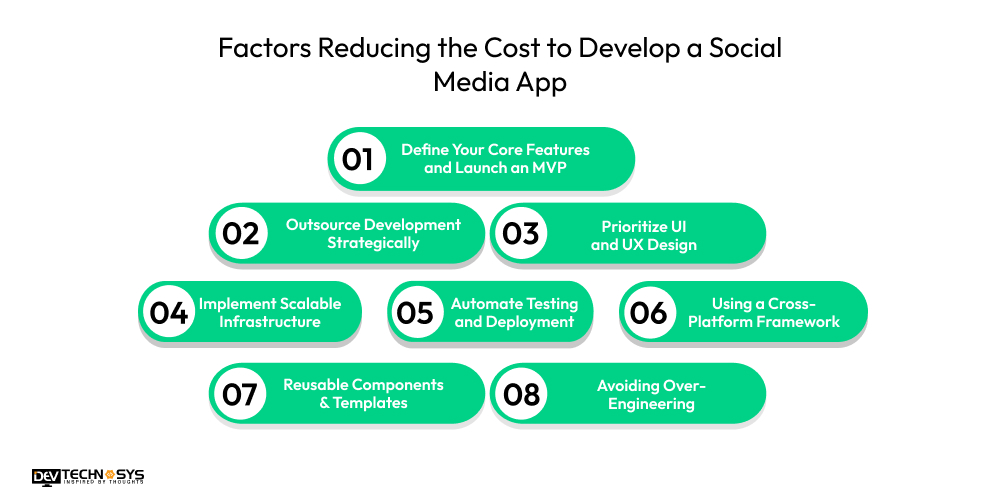
1. Define Your Core Features and Launch an MVP (Minimum Viable Product):
Start by building a Minimum Viable Product (MVP) first to validate your idea before jumping into extensive development. When developing a social media app, pay close attention to essential features instead of going overboard with advanced and complex ones.
Launch an early prototype to see the response it gets in the market. This fail-fast method prevents resources from going to waste on a faulty app.
Strategy |
How It Reduces Cost |
Estimated Savings |
| MVP development | Focus only on essential features like login, profiles, and feed | $2,000–$3,000 |
| Feature prioritization | Eliminates expensive non-essential modules | $1,000–$2,500 |
| Faster time-to-market | Reduces development hours significantly | $1,000–$2,000 |
2. Outsource Development Strategically:
It is widely known that a few aspects of the social media app development process to regions with a lower hourly development rate. However, be cautious and choose the best service provider to ensure the quality of work.
Outsourcing is a cost-effective method of handling operations like design, testing, or other specific development modules.
Strategy |
How It Reduces Cost |
Estimated Savings |
| Offshore developers | Lower hourly rates (India/Eastern Europe) | $2,000–$4,000 |
| Dedicated team model | Fixed monthly cost avoids overhead | $1,500–$2,000 |
| Experienced teams | Reduce rework and delays | $500–$1,000 |
3. Prioritize User Interface (UI) and User Experience (UX) Design:
A clean, intuitive UI/UX plays an important role in bringing user engagement. However, overly complex designs can increase the budget of development significantly. Pay attention to crucial screens, simple navigation, and core user interactions to streamline the design workflow.
This ensures a visually appealing interface without unnecessary customization, helping you reduce costs while still delivering a smooth user experience.
Strategy |
How It Reduces Cost |
Estimated Savings |
| Wireframes first | Prevents redesign expenses later | $500–$1,500 |
| Template-based UI | Cuts custom design time | $1,000–$2,500 |
| Simple layouts | Faster development and testing | $800–$1,500 |
4. Implement Scalable Infrastructure:
By using scalable backend solutions like AWS, Google Cloud, or Firebase, you can save up on upfront infrastructure costs while supporting future growth. Start with minimal server resources and scale with the increase of user traffic. This pay-as-you-go approach reduces waste, improves performance, and keeps early-stage development affordable.
Strategy |
How It Reduces Cost |
Estimated Savings |
| Cloud services | Pay-as-you-go pricing lowers initial cost | $1,000–$3,000 |
| Serverless architecture | No server maintenance | $800–$2,000 |
| Auto-scaling | Avoids unnecessary deployment cost | $500–$1,000 |
5. Automate Testing and Deployment:
Automating testing and deployment speeds up development by reducing manual work and minimizing errors. Tools like CI/CD pipelines ensure faster releases with consistent code quality. This approach lowers long-term development costs and allows teams to ship updates more efficiently.
Additionally, automated processes help quickly detect and fix issues, improving overall app reliability.
Strategy |
How It Reduces Cost |
Estimated Savings |
| Automated testing tools | Reduce manual QA hours | $1,000–$2,500 |
| CI/CD pipelines | Faster builds & error reduction | $700–$1,500 |
| Bug detection early | Lowers rework expenses | $500–$1,000 |
6. Using a Cross-Platform Framework
Using cross-platform technologies like Flutter or React Native significantly reduces the social media app development time and cost by enabling a single codebase for both iOS and Android. This cost eliminates the need for two separate teams, speeds up delivery, and simplifies long-term app maintenance.
Strategy |
How It Reduces Cost |
Estimated Savings |
| Flutter/React Native | One codebase for iOS & Android | $3,000–$8,000 |
| Faster development cycles | Shortens timeline | $1,000–$2,000 |
| Reduced maintenance | Updates applied simultaneously | $800–$1,500 |
7. Reusable Components & Templates
Using pre-built UI kits, design templates, and reusable components minimizes design and coding efforts. These ready-made modules ensure consistency, reduce development hours, and significantly cut overall costs without compromising performance or user experience.
Additionally, leveraging reusable components allows faster updates and easier maintenance for future app enhancements.
Strategy |
How It Reduces Cost |
Estimated Savings |
| UI kits & design libraries | Cuts design + development time | $1,000–$3,000 |
| Pre-built modules | Speed up login, chat, notifications | $800–$2,000 |
| Code reusability | Less custom coding required | $600–$1,000 |
8. Avoiding Over-Engineering
Keeping the feature set simple and avoiding unnecessary complexities helps control development budgets. Focusing only on core functionality reduces build time, prevents scope creep, and ensures resources are utilized efficiently without inflating the project’s overall cost.
Strategy |
How It Reduces Cost |
Estimated Savings |
| Build only required features | Prevents expensive complexity | $2,000–$4,000 |
| Simple architecture | Faster testing & optimization | $1,000–$2,000 |
| Lean development | Reduces unnecessary tools | $800–$1,500 |
What Monitization Strategies Are Needed For Social Media Apps?
Monetizing a social media app can be a challenging yet worthwhile endeavor. With the right strategies, you could turn your app right into a practical challenge. Here are eight powerful methods to monetize your social media app development:
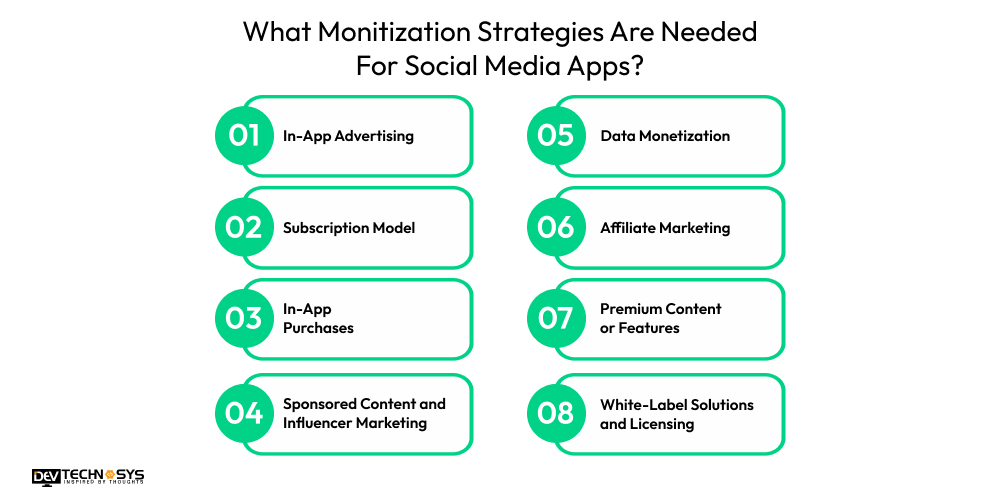
1. In-App Advertising:
One of the most common monetization techniques for social media apps is in-app advertising. You can display commercials within the app interface as banners, interstitials, or backed content. Advertisers pay you primarily based on impressions (CPM) or clicks (CPC).
Remember to maximize sales by enforcing centred marketing based on consumer hobbies, demographics, and behaviour. Additionally, it permits advertisers to bid for ad space through a real-time bidding (RTB) gadget, which could increase ad inventory costs.
Connect with an iOS app development company if you want to know some incredible ways to monetize the social media app.
2. Subscription Model:
Offer top-rate subscription plans to users who want to get the right of entry to distinctive features, content material, or more desirable capabilities. For example, you may restrict primary functionality without spending a dime on customers and offer additional advantages, including advert-free browsing, advanced analytics, or customization alternatives for subscribers.
Ensure the subscription plans are priced competitively and offer enough value to justify the cost. Consider offering an unfastened trial length to lure customers to improve to a paid subscription.
3. In-App Purchases:
Integrate in-app purchases (IAPs) to allow customers to buy virtual items, premium content, or extra functions in the app. This model works well for social gaming apps, where users should buy digital forex, electricity-ups, or cosmetic objects to enhance their gameplay.
Implement a seamless and stable payment machine, and frequently update your virtual item inventory to keep customers engaged and incentivize purchases.
Connect with social networking app development company if you want to know more about monetization techniques. only an leading Social networking app development service providers will offer you accurate knowledge on monetization with the help of its business analyst.
4. Sponsored Content and Influencer Marketing:
Collaborate with manufacturers and organizations to create sponsored content or partner with influencers to promote their services or products inside your app. Identify influencers whose target audience aligns with your app’s target demographic and negotiate sponsored posts, product placements, or branded events.
Ensure that the backed content material feels authentic and adds fee to the user enjoy to avoid alienating your target audience. Track the performance of sponsored campaigns using analytics gear and offer exact reviews to advertisers to illustrate the effectiveness of their investment.
5. Data Monetization:
Collect anonymized user information and insights about their behaviour, alternatives, and interactions in the app, and monetize this information by selling it to third-party advertisers, marketplace researchers, or analytics businesses.
Ensure compliance with facts and security regulations inclusive of GDPR and CCPA and reap explicit consent from customers before accumulating and sharing their records. Offer customers transparency and control over their facts privacy settings, such as choosing to choose out of records sharing if they prefer.
Hire a social media app developer to get a cost-effective ROI of your cost.
6. Affiliate Marketing:
Partner with affiliate networks or individual brands to sell their products or services within your app and earn commissions for driving income or leads. Integrate affiliate links or promotional codes into relevant content material or consumer-generated posts and music conversions by using an associate tracking software program.
Choose affiliate partners that resonate with your app’s target market and add a fee to their level. Disclose any associate relationships transparently to hold beliefs together with your customers.
7. Premium Content or Features:
Offer top-rate content material, functions, or offerings that users can liberate via one-time purchases or micro transactions. For example, you could promote access to top-class filters, stickers, or enhancing tools in a photo-sharing app or offer virtual presents and badges that users can send to their friends in a messaging app.
Regularly update your top-rate services catalogue to keep customers engaged and inclined to spend cash inside the app. Hybrid app development services will help you learn some incredible ways to monetize your social media app with this also.
8. White-Label Solutions and Licensing:
License your social media app development generation, features, or platform to other agencies or corporations that want to create customized social networking answers. Offer white-label answers that permit customers to rebrand and customize the app to shape their emblem identification and target market.
Provide ongoing technical guides, updates, and maintenance offerings as part of the licensing settlement, and negotiate sales-sharing or subscription-primarily based pricing fashions with your clients.

How Dev Technosys Can Help You Build a Social Media App?
Dev Technosys is a leading custom Android app development company that can assist in constructing your social media app by providing comprehensive social media app development services tailor-made to your specific requirements.
With their know-how in frontend and backend development, UI/UX design, and first-class guarantee, they ensure a continuing personal experience. Their crew collaborates closely with customers to apprehend their vision and deliver a fantastic, scalable app that meets their wishes and exceeds expectations.
Frequently Asked Questions
1. How Much Does It Cost To Build a Social Media App?
The cost of building a social media app varies based on features and complexity. Essential apps may additionally begin at $8,000, at the same time as extra advanced ones can exceed $30,000.
2. How Long Does It Take To Build a Social Media App?
Development time relies upon complexity. Simple apps take 4-6 months, while complex ones require 12-18 months.
3. What Are The Benefits of Building a Social Media App?
Benefits include reaching a much broader audience, fostering community engagement, promoting emblem visibility, and generating sales through numerous monetization strategies.
4. Why Should You Choose Us To Build a Social Media App?
We provide:
- Complete development
- Tailor-made answers.
- Knowledge of UI/UX design.
- A dedication to delivering high-quality, scalable apps that meet your wishes.
5. How Can You Monetize Social Media App?
You can monetize through in-app marketing, subscriptions, in-app purchases, subsidized content material, records monetization, affiliate marketing, top-rate functions, and white-label answers.
6. What is the Most Cost-Efficient Development Strategy?
Launching an MVP, utilizing reusable components, selecting cross-platform frameworks, and outsourcing to an experienced offshore team help minimize overall expenses.
7. Are There Any Additional Hidden Costs?
Yes, cloud hosting, backend infrastructure, app store fees, third-party services, marketing, user acquisition, maintenance, and updates all add to post-launch expenses.